ACID BASE DISORDERS
ABG ANALYSIS
ABHILASHA
CHAUDHARY
3/6/2017 10:22 AM
ACIDS
• Acids can be defined as a proton (H+) donor
• Acids are hydrogen containing substances
which dissociate in solution to release H+
2
BASES
• Bases can be defined as:
–A proton (H+) acceptor
–Molecules capable of accepting a hydrogen
ion.
3
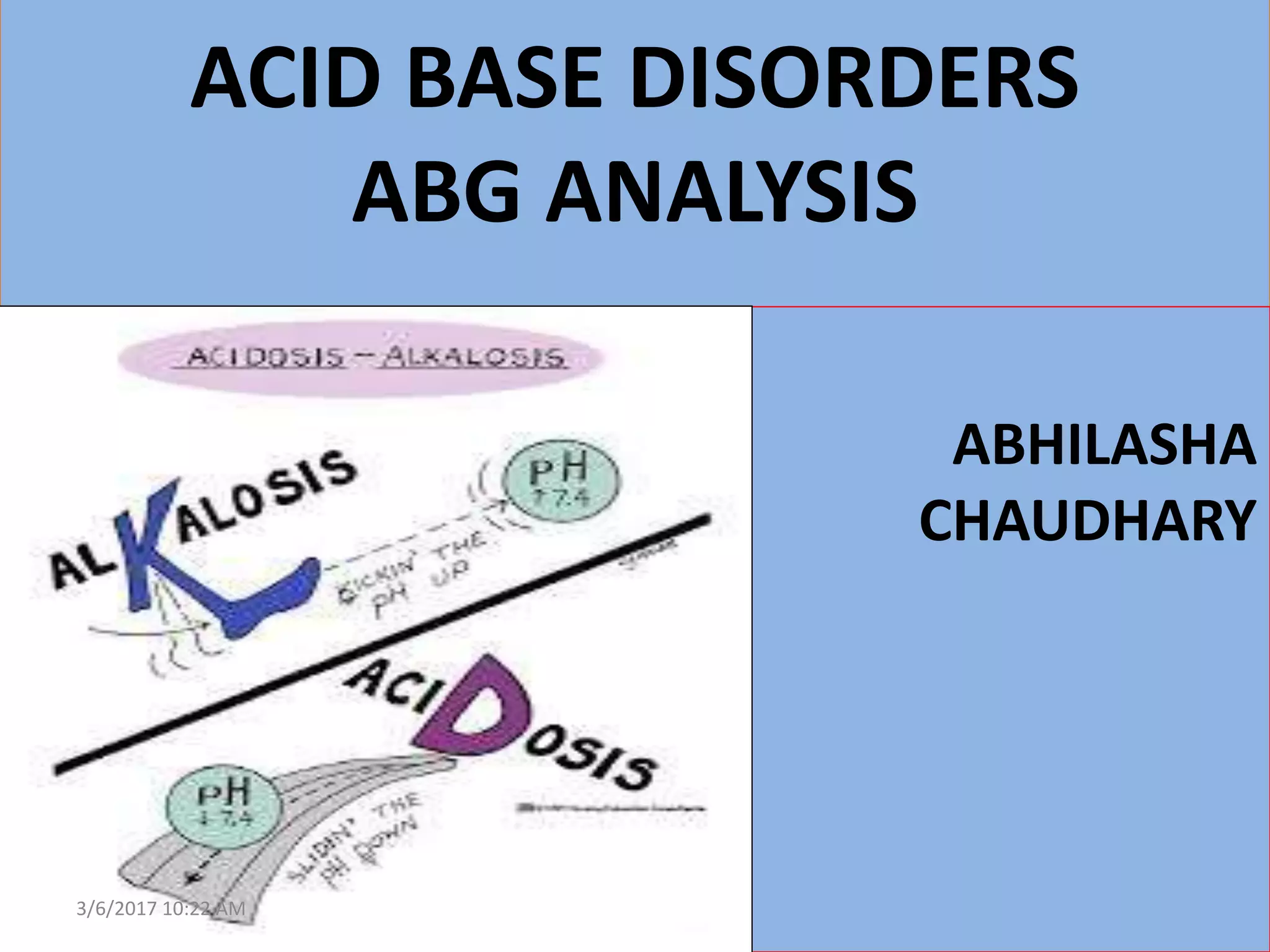
ACIDOSIS AND ALKALOSIS
• The normal blood pH range is 7.35 to 7.45. In
order for normal metabolism to take place, the
body must maintain this narrow range at all
times.
• When the pH is below 7.35, the blood is said to
be acidic.
• When the pH is above 7.45, the blood is said to
be alkalotic.
4
pH SCALE
5
• Plasma pH is an indicator of hydrogen ion (H)
concentration.Homeostatic mechanisms keep
pH within a normalrange (7.35 to 7.45) . These
mechanisms consist of buffer systems, the
kidneys, and the lungs.
• pH of a buffer system may be determined from
the Henderson- Hasselbach equation :
pH=pK+log10([HCO3
-]/[H2CO3])
7
ACID-BASE REGULATION
• Maintenance of an acceptable pH range in the
extracellular fluids is accomplished by three
mechanisms:
1) Chemical Buffers
Phosphate Buffer
Protein Buffer
Bicarbonate Buffer System
• React very rapidly
(less than a second)
8
2) Respiratory Regulation
Hyperventillation
Hypoventilation
• Reacts rapidly (seconds to minutes)
3) Renal Regulation
Reabsorption or excretion of filtered (HCO3
-).
Formation of titratable acid.
Excretion of NH4+ in the urine.
• Reacts slowly (minutes to hours)
HOW ACID BASE DISORDER OCCUR
Normally, there are 20 parts of bicarbonate (HCO3–)
to one part of carbonicacid (H2CO3). If this ratio is
altered, the pH will change. It is the ratio of HCO3 –
to H2CO3 that is important in maintaining Ph.If
either bicarbonate or carbonic acid is increased or
decreased so that the 20:1 ratio is no longer
maintained, acid–base imbalance occur.
ACIDOSIS / ALKALOSIS
• Acidosis
–A condition in which the blood has too much
acid (or too little base), resulting in a
decrease in blood pH.
• Alkalosis
–A condition in which the blood has too much
base (or too little acid), resulting in an
increase in blood pH
12
ACIDOSIS / ALKALOSIS
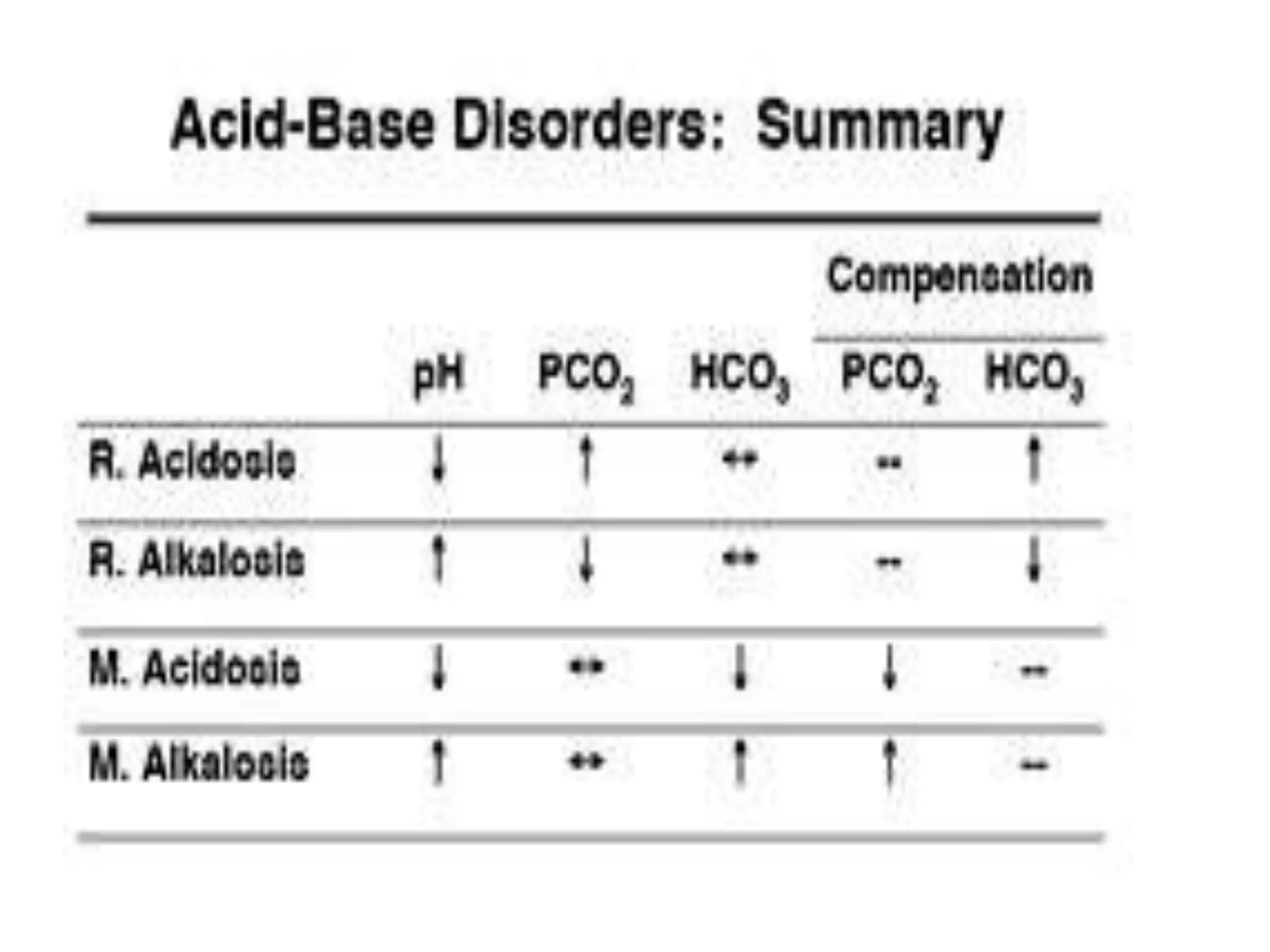
• Deviations from normal Acid-Base status are
divided into four general categories;
–Respiratory Acidosis
–Respiratory Alkalosis
–Metabolic Acidosis
–Metabolic Alkalosis
13
RESPIRATORY ACIDOSIS
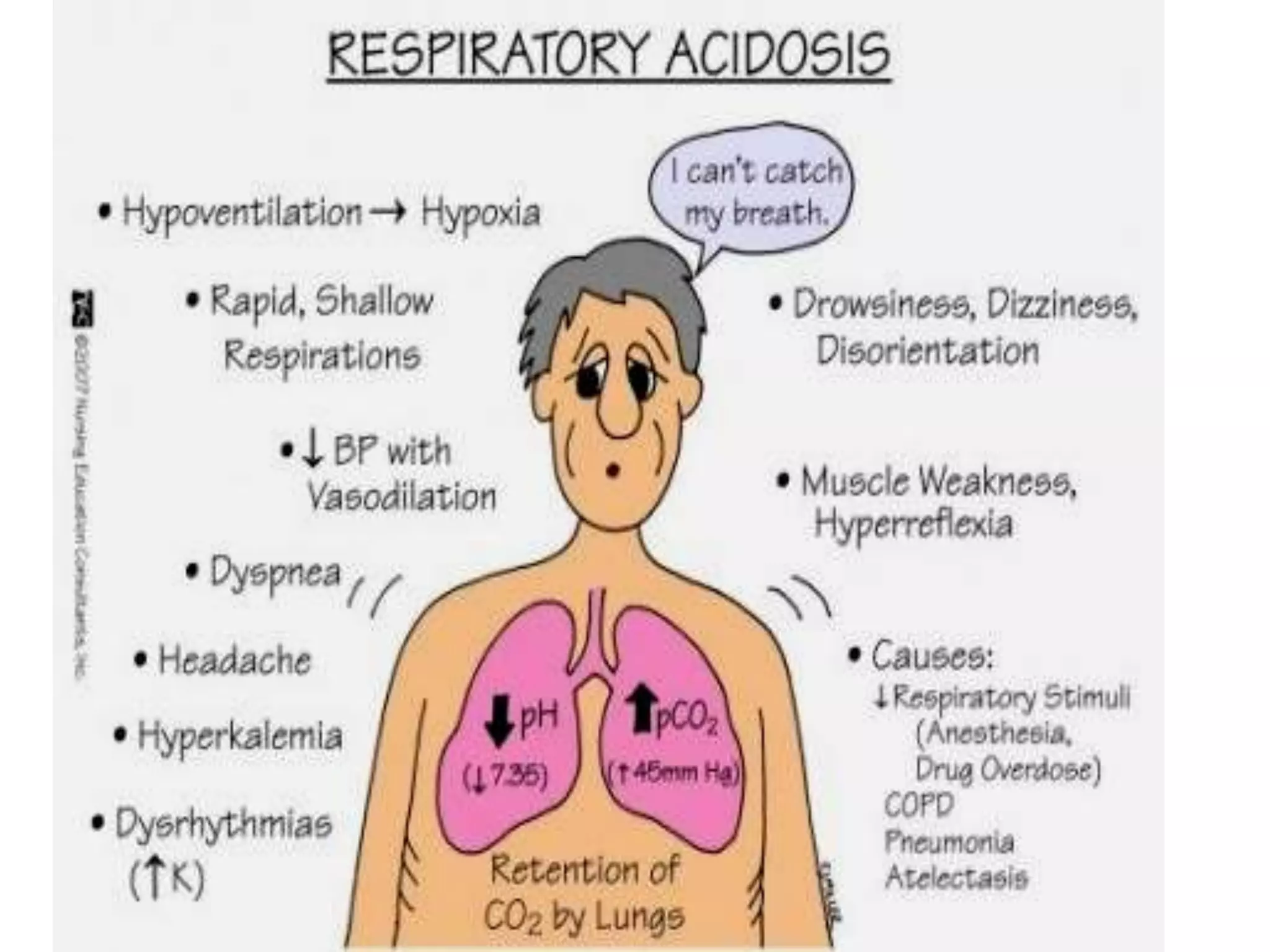
• It is a clinical condition in which the ph is less
than 7.35 and the PaCO2 is greater than 45
mm of Hg.
CAUSES
Respiratory acidosis is always due to
inadequate excretion of CO2 with inadequate
ventilation.
• Lung disease like(Acute pulmonary
edema,Atelactasis,Pneumothorax,COPD etc)
• Impaired respiratory muscles(muscular
dystrophy,myasthenia gravis,GBS)
• Obstruction of airway passage
• Decreased respiration(shallow breathing)
• Overly sedated narcotics,drug overdoses
COMPENSATIONOF RESPIRATORY
ACIDOSIS
• CO2 + H2O H2CO3 H+ + HCO3
-
• For compensation CO2 H+ and HCO3
-
SO
High levels of CO2 in the blood stimulate the
parts of the brain that regulate breathing,
which in turn stimulate faster and deeper
breathing
- kidneys reabsorbs HCO3
- ions .
- kidneys eliminate H+ ion in acidic urine by
buffering action of ammonia and
phosphate buffer.
TREATMENT
• Treatment is directed as improving
ventillation.
• Mechanical ventilation;if pCO2 is high (>50
mm Hg).
• Pharmacological agents :
bronchodilators,antibiotics, thrombolytics.
• Pulmonary hygiene measure such as
;placement in semifowler’s position,adequate
hydration, supplement oxygen.
RESPIRATORY ALKALOSIS
• Respiratory alkalosis is a clinical condition in
which the arterial pH is greater than 7.45 and
the PaCO2 is less than 35 mm Hg.
CAUSES
• Respiratory alkalosis is always caused by
hyperventilation, which causes excessive
“blowing off” of CO2 .
• Extreme anxiety
• Hypoxemia
• Early phase of salicylate intoxication.
• Inappropriate ventillator settings
• CNS trauma
COMPENSATIONOF RESPIRATORY
ALKALOSIS
• CO2 + H2O H2CO3 H+ + HCO3
-
• For compensation CO2 H+ and HCO3
-
SO
• The respiratory rate decreases causing CO2 to
be retained.
• Kidneys conserve H+ ions and eliminate
HCO3
- in alkaline urine
TREATMENT OF ALKALOSIS
• Treat underlying cause
• If the causes is anxiety, the patient is instructed
to breath more slowly to allow co2 to
accumulate or to breath in closed system (such
as a paper bag).
• A sedative may be required to relieve
hyperventilation in very anxious patients.
• Adjustment of ventilator settings.
26
METABOLIC ACIDOSIS
• Metabolic acidosis is a common clinical
disturbance characterized by a low pH
(increased H concentration) and a low plasma
bicarbonate concentration.
• Any acid-base imbalance not attributable to
CO2 is classified as metabolic.
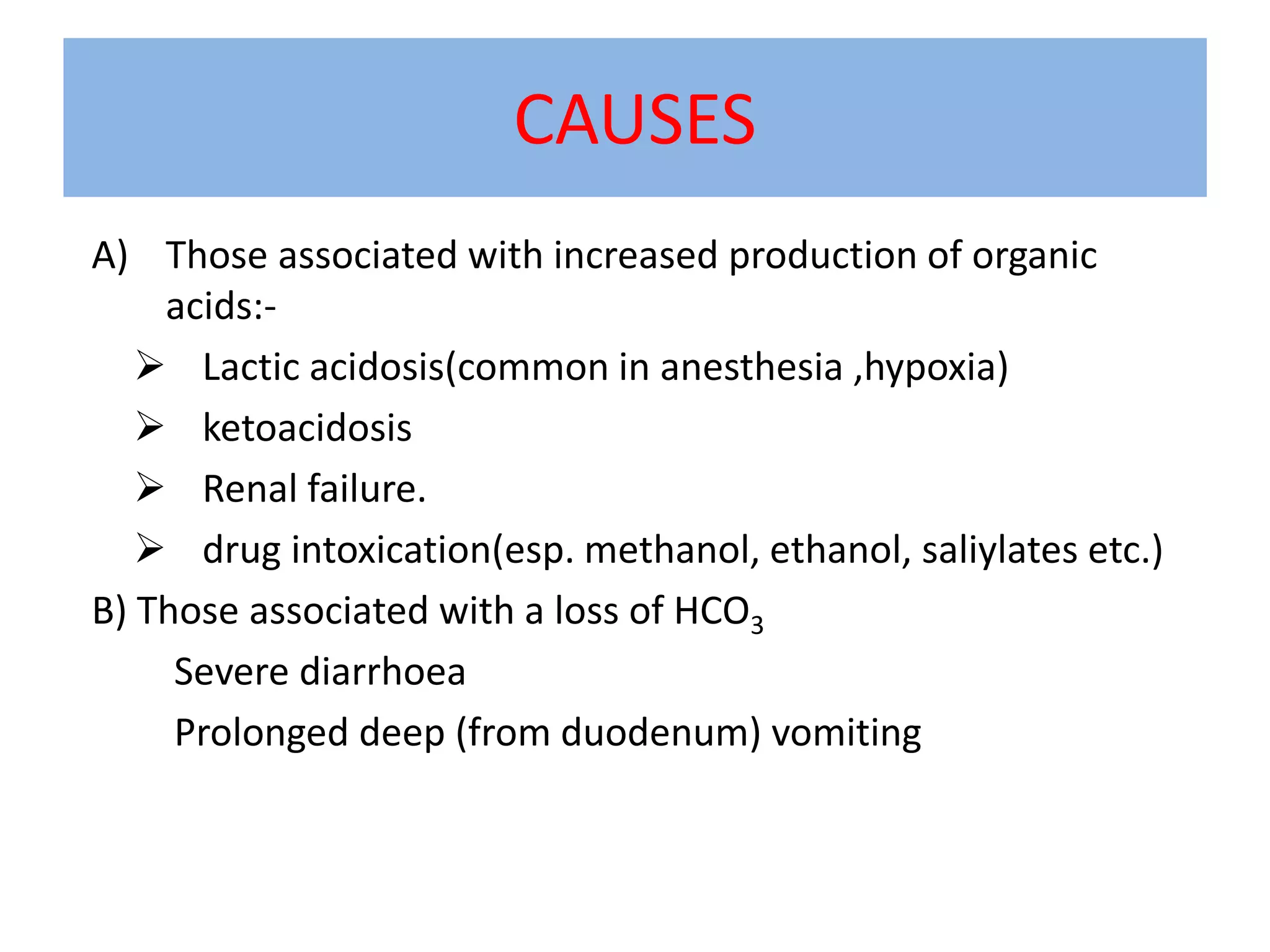
CAUSES
A) Those associated with increased production of organic
acids:-
 Lactic acidosis(common in anesthesia ,hypoxia)
 ketoacidosis
 Renal failure.
 drug intoxication(esp. methanol, ethanol, saliylates etc.)
B) Those associated with a loss of HCO3
Severe diarrhoea
Prolonged deep (from duodenum) vomiting
Compensation in metabolic acidosis
• CO2 + H2O H2CO3 H+ + HCO3
-
SO
• For compensation H+ and HCO3
- and CO2
• hyperactive breathing to “ blow off ” CO2
• kidneys conserve HCO3
- and eliminate H+ ions
in acidic urine
TREATMENT OF METABOLIC ACIDOSIS
1. Treating the underlying cause: For example,
control diabetes with insulin or treat poisoning by
removing the toxic substance from the blood.
Occasionally dialysis is needed to treat severe
overdoses and poisonings.
31
Treatment cont----
2. When acidosis is severe, bicarbonate may be
given intravenously
–Bicarbonate provides only temporary relief .
32
METABOLIC ALKALOSIS
• Metabolic alkalosis is a clinical disturbance
characterized by a high pH (decreased H
concentration) and a high plasma bicarbonate
concentration.
CAUSES
• Vomiting
• Ryle’s tube aspiration.
• Diuretics(furosemide,thiazides)
• Renal failure
• Hypovolemia
• Diarrhea
• Hypokalemia
Compensation in metabolic alkalosis
• CO2 + H2O H2CO3 H+ + HCO3
-
SO
• For compensation H+ and HCO3
- and CO2
• Breathing suppressed to hold CO2
• kidneys conserve H+ ions and eliminate HCO3
-
in alkaline urine
37
TREATMENT
• Treat underlying disorder
• Treatment involves provision of adequate
intravenous fluid, especially isotonic sodium
chloride .
• Simultaneous potassium chloride may be
needed in critical ill patients.
• Severe alkalosis (pH < 7.55) may require
treatment with acidifying agents like NH4Cl,
HCl or acetazolamide.
ABG ANALYSIS
INTRODUCTION
• An arterial blood gas (ABG) is a blood test that is
performed using blood from an artery.
• It involves puncturing an artery with a thin needle
and syringe and drawing a small volume of blood.
41
• The most common puncture site is the radial artery
at the wrist, but sometimes the femoral artery in the
groin or other sites are used. Before performing
procedure allen’s test should be done.
42
• Contraindications to using radial artery include
absent ulnar circulation or impaired circulation and
an AV fistula.
• Complications include thrombosis , embolization,
haematoma, ischaemia and infection.
43
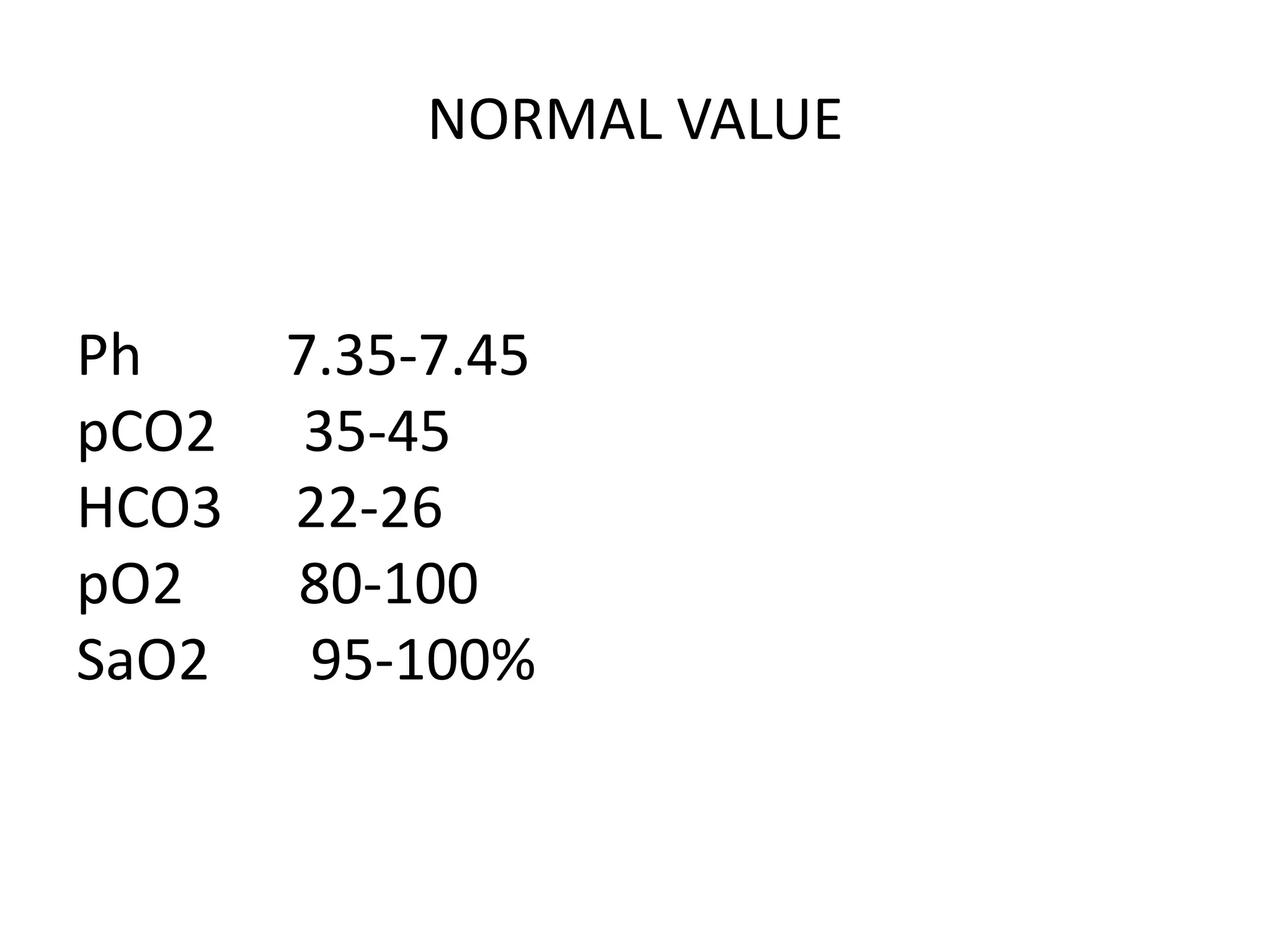
NORMAL VALUE
Ph 7.35-7.45
pCO2 35-45
HCO3 22-26
pO2 80-100
SaO2 95-100%
ABG ANALYSIS
1. A 42 year old IDDM developed nausea and vomiting
for 2 days. He was unable to keep any food down so
he stopped taking his insulin. Lab work shows the
following:
 pH 7.21, pCO2 26, HCO3 10
 Na 133, Cl 88, K 5
Q. What is the acid-base disturbance?
METABOLIC ACIDOSIS
Problem 2
• 1 month old male presents with projectile emesis x
2 days.
– pH 7.49, pCO2 40, HCO3 30
– Na 140, Cl 92, K 2.9
• Q. What is the acid-base disturbance?
METABOLIC ALKALOSIS
acid base disorder and ABG analysis

acid base disorder and ABG analysis

  • 1.
    ACID BASE DISORDERS ABGANALYSIS ABHILASHA CHAUDHARY 3/6/2017 10:22 AM
  • 2.
    ACIDS • Acids canbe defined as a proton (H+) donor • Acids are hydrogen containing substances which dissociate in solution to release H+ 2
  • 3.
    BASES • Bases canbe defined as: –A proton (H+) acceptor –Molecules capable of accepting a hydrogen ion. 3
  • 4.
    ACIDOSIS AND ALKALOSIS •The normal blood pH range is 7.35 to 7.45. In order for normal metabolism to take place, the body must maintain this narrow range at all times. • When the pH is below 7.35, the blood is said to be acidic. • When the pH is above 7.45, the blood is said to be alkalotic. 4
  • 5.
  • 6.
    • Plasma pHis an indicator of hydrogen ion (H) concentration.Homeostatic mechanisms keep pH within a normalrange (7.35 to 7.45) . These mechanisms consist of buffer systems, the kidneys, and the lungs.
  • 7.
    • pH ofa buffer system may be determined from the Henderson- Hasselbach equation : pH=pK+log10([HCO3 -]/[H2CO3]) 7
  • 8.
    ACID-BASE REGULATION • Maintenanceof an acceptable pH range in the extracellular fluids is accomplished by three mechanisms: 1) Chemical Buffers Phosphate Buffer Protein Buffer Bicarbonate Buffer System • React very rapidly (less than a second) 8
  • 9.
    2) Respiratory Regulation Hyperventillation Hypoventilation •Reacts rapidly (seconds to minutes) 3) Renal Regulation Reabsorption or excretion of filtered (HCO3 -). Formation of titratable acid. Excretion of NH4+ in the urine. • Reacts slowly (minutes to hours)
  • 11.
    HOW ACID BASEDISORDER OCCUR Normally, there are 20 parts of bicarbonate (HCO3–) to one part of carbonicacid (H2CO3). If this ratio is altered, the pH will change. It is the ratio of HCO3 – to H2CO3 that is important in maintaining Ph.If either bicarbonate or carbonic acid is increased or decreased so that the 20:1 ratio is no longer maintained, acid–base imbalance occur.
  • 12.
    ACIDOSIS / ALKALOSIS •Acidosis –A condition in which the blood has too much acid (or too little base), resulting in a decrease in blood pH. • Alkalosis –A condition in which the blood has too much base (or too little acid), resulting in an increase in blood pH 12
  • 13.
    ACIDOSIS / ALKALOSIS •Deviations from normal Acid-Base status are divided into four general categories; –Respiratory Acidosis –Respiratory Alkalosis –Metabolic Acidosis –Metabolic Alkalosis 13
  • 15.
    RESPIRATORY ACIDOSIS • Itis a clinical condition in which the ph is less than 7.35 and the PaCO2 is greater than 45 mm of Hg.
  • 16.
    CAUSES Respiratory acidosis isalways due to inadequate excretion of CO2 with inadequate ventilation. • Lung disease like(Acute pulmonary edema,Atelactasis,Pneumothorax,COPD etc) • Impaired respiratory muscles(muscular dystrophy,myasthenia gravis,GBS)
  • 17.
    • Obstruction ofairway passage • Decreased respiration(shallow breathing) • Overly sedated narcotics,drug overdoses
  • 18.
    COMPENSATIONOF RESPIRATORY ACIDOSIS • CO2+ H2O H2CO3 H+ + HCO3 - • For compensation CO2 H+ and HCO3 - SO High levels of CO2 in the blood stimulate the parts of the brain that regulate breathing, which in turn stimulate faster and deeper breathing
  • 19.
    - kidneys reabsorbsHCO3 - ions . - kidneys eliminate H+ ion in acidic urine by buffering action of ammonia and phosphate buffer.
  • 21.
    TREATMENT • Treatment isdirected as improving ventillation. • Mechanical ventilation;if pCO2 is high (>50 mm Hg). • Pharmacological agents : bronchodilators,antibiotics, thrombolytics. • Pulmonary hygiene measure such as ;placement in semifowler’s position,adequate hydration, supplement oxygen.
  • 22.
    RESPIRATORY ALKALOSIS • Respiratoryalkalosis is a clinical condition in which the arterial pH is greater than 7.45 and the PaCO2 is less than 35 mm Hg.
  • 23.
    CAUSES • Respiratory alkalosisis always caused by hyperventilation, which causes excessive “blowing off” of CO2 . • Extreme anxiety • Hypoxemia • Early phase of salicylate intoxication. • Inappropriate ventillator settings • CNS trauma
  • 24.
    COMPENSATIONOF RESPIRATORY ALKALOSIS • CO2+ H2O H2CO3 H+ + HCO3 - • For compensation CO2 H+ and HCO3 - SO • The respiratory rate decreases causing CO2 to be retained. • Kidneys conserve H+ ions and eliminate HCO3 - in alkaline urine
  • 26.
    TREATMENT OF ALKALOSIS •Treat underlying cause • If the causes is anxiety, the patient is instructed to breath more slowly to allow co2 to accumulate or to breath in closed system (such as a paper bag). • A sedative may be required to relieve hyperventilation in very anxious patients. • Adjustment of ventilator settings. 26
  • 27.
    METABOLIC ACIDOSIS • Metabolicacidosis is a common clinical disturbance characterized by a low pH (increased H concentration) and a low plasma bicarbonate concentration. • Any acid-base imbalance not attributable to CO2 is classified as metabolic.
  • 28.
    CAUSES A) Those associatedwith increased production of organic acids:-  Lactic acidosis(common in anesthesia ,hypoxia)  ketoacidosis  Renal failure.  drug intoxication(esp. methanol, ethanol, saliylates etc.) B) Those associated with a loss of HCO3 Severe diarrhoea Prolonged deep (from duodenum) vomiting
  • 29.
    Compensation in metabolicacidosis • CO2 + H2O H2CO3 H+ + HCO3 - SO • For compensation H+ and HCO3 - and CO2 • hyperactive breathing to “ blow off ” CO2 • kidneys conserve HCO3 - and eliminate H+ ions in acidic urine
  • 31.
    TREATMENT OF METABOLICACIDOSIS 1. Treating the underlying cause: For example, control diabetes with insulin or treat poisoning by removing the toxic substance from the blood. Occasionally dialysis is needed to treat severe overdoses and poisonings. 31
  • 32.
    Treatment cont---- 2. Whenacidosis is severe, bicarbonate may be given intravenously –Bicarbonate provides only temporary relief . 32
  • 33.
    METABOLIC ALKALOSIS • Metabolicalkalosis is a clinical disturbance characterized by a high pH (decreased H concentration) and a high plasma bicarbonate concentration.
  • 34.
    CAUSES • Vomiting • Ryle’stube aspiration. • Diuretics(furosemide,thiazides) • Renal failure • Hypovolemia • Diarrhea • Hypokalemia
  • 35.
    Compensation in metabolicalkalosis • CO2 + H2O H2CO3 H+ + HCO3 - SO • For compensation H+ and HCO3 - and CO2 • Breathing suppressed to hold CO2 • kidneys conserve H+ ions and eliminate HCO3 - in alkaline urine
  • 37.
    37 TREATMENT • Treat underlyingdisorder • Treatment involves provision of adequate intravenous fluid, especially isotonic sodium chloride . • Simultaneous potassium chloride may be needed in critical ill patients. • Severe alkalosis (pH < 7.55) may require treatment with acidifying agents like NH4Cl, HCl or acetazolamide.
  • 40.
  • 41.
    INTRODUCTION • An arterialblood gas (ABG) is a blood test that is performed using blood from an artery. • It involves puncturing an artery with a thin needle and syringe and drawing a small volume of blood. 41
  • 42.
    • The mostcommon puncture site is the radial artery at the wrist, but sometimes the femoral artery in the groin or other sites are used. Before performing procedure allen’s test should be done. 42
  • 43.
    • Contraindications tousing radial artery include absent ulnar circulation or impaired circulation and an AV fistula. • Complications include thrombosis , embolization, haematoma, ischaemia and infection. 43
  • 44.
    NORMAL VALUE Ph 7.35-7.45 pCO235-45 HCO3 22-26 pO2 80-100 SaO2 95-100%
  • 45.
  • 47.
    1. A 42year old IDDM developed nausea and vomiting for 2 days. He was unable to keep any food down so he stopped taking his insulin. Lab work shows the following:  pH 7.21, pCO2 26, HCO3 10  Na 133, Cl 88, K 5 Q. What is the acid-base disturbance? METABOLIC ACIDOSIS
  • 48.
    Problem 2 • 1month old male presents with projectile emesis x 2 days. – pH 7.49, pCO2 40, HCO3 30 – Na 140, Cl 92, K 2.9 • Q. What is the acid-base disturbance? METABOLIC ALKALOSIS