Metabolic processes producing and
consuming H+.
Buffer systems in the body.
Acid-base balance in the body and its
control.


2011                          (E.T.)
                                        1
The production and regulation of hydrogen ions
 in the body                  Acids are continuously produced
                      Liquids, food              in the body and threaten the
                                                 normal pH of the body fluids


ICT                    Metabolic processes


         CO2                                         H+
                           OH-


ECT        CO2 + H2O ⇔ H2CO3 ⇔ HCO3- + H+ ⇔ bufferY


          Lung                            Kidneys


         CO2                           HCO3-        NH4+, H2PO4-, SO42-
                                                                                2
        ~ 20 mol /d                   1 mmol/d        40-80 mmol/d
Sources of acids in metabolism :
1/ volatile carbonic acid:
   ● the source is CO2 - from decarboxylations
   ● CO2 with water gives weak volatile carbonic acid
   ● the exchange of CO2 ( 15 – 25 mol . d-1 ) between the blood
       and the external environment secure the lungs

2/ nonvolatile acids:
   ● sulfuric acid - from sulfur-containing amino acids (Cys + Met)
   ● phosphoric acid - from phosphorus-containing compounds
   ● carboxylic acids (e.g. lactate, acetoacetate, 3-hydroxybutyrate),
                      unless they are completely oxidized to CO2
                      and water
   ● nonvolatile acids cannot be removed through the lungs,
      they are excreted by the kidney into the urine
      ( 40 – 80 mmol . d-1 )                                     3
The limit value of pH (blood)
Although there is a large
production of acidic
metabolites in the body,            pH = 7,40
concentrations of H+
ions in biological fluids
                               [H+] ≅ 40 nmol . l-1
are maintained in the                                             The human body is
very                                                              more tolerant of
narrow range:                                                     acidaemia (acidosis)
                                                                  than of alkalaemia
                                                                  (alkalosis).


          pH = 6,80                                          pH = 7,70
    [H ] ≅ 160 nmol . l
         +                            -1                [H+] ≅ 20 nmol . l-1
                                                                                 4
       Steep decrease or increase of pH may be life-threatening
Buffer systems in organism

                                    IVF                      ISF         ICF
Buffering system
                        blood    plazma     erytrocytes

HCO3−/H2CO3 + CO2       50 %      33 %         17 %         HCO3−       HCO3−

Protein−/HProtein       45 %      18 %         27 %            –       proteins

HPO42−/H2PO4−                      1%        3 % (org.)      anorg.      org.
                        5%
                                 (anorg.)   1 % (anorg.)   phosphates phosphates

Concentration of
                        48 ± 3   42 ± 3
buffer systems (mmol/                          ~ 56
                        (BBb)    (BBp)
l)


                                                                                   5
Buffer systems in blood
Hydrogen carbonate buffer - the most important buffer in blood

           CO2 + H2O              H2CO3            H+ + HCO3–

                                            −                                         −
                               [HCO3 ]                       [HCO3 ]
  pH = pK (H 2CO3 )   + log                    = 6,1 + log
                            [CO 2 + H 2 CO 3 ]             [ H 2CO3 ] ef
Effective concentration of carbonic acid        [CO2 + H2CO3] = 0,23 x pCO2

                                                 0,23 is the coefficient of solubility of
                                                 CO2 for pCO2 in kPa

  Physiological values:
  pCO2         5,3 kPa ± 0,5 kPa.               HCO3-          24 ± 2 mmol/l

  In these equations, the concentrations [HCO3-] and [CO2+H2CO3] are expressed in         6
  mmol/l, not in the basal SI unit mol/l !
Hydrogen carbonate buffer

                Metabolic component


                            −
                  [HCO 3 ]
 pH = 6,1 + log
                [ H 2CO3 ] ef

              Respiratory component


                                      7
The ratio HCO3- / H2CO3 in blood at pH 7,4

                                  −
                       HCO3                  20
       pH = 6,1 + log            = 6,1 + log    = 7,4
                      pCO2 .0,22             1


                              −
                     HCO3       24 20
                              =   =
                    pCO2 .0,22 1,2 1


pCO2     5,3 kPa ± 0,5 kPa.           HCO3-   24 ± 2 mmol/l   8
The other buffer systems in organism
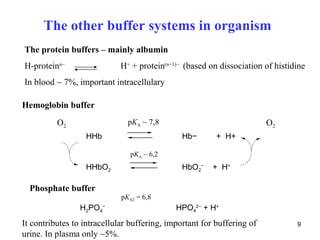
The protein buffers – mainly albumin
H-proteinn−                  H+ + protein(n+1)− (based on dissociation of histidine
In blood ∼ 7%, important intracellulary

Hemoglobin buffer
          O2                   pKA ~ 7,8                                O2
                  HHb                          Hb−       + H+

                                pKA ~ 6,2
                  HHbO2                        HbO2−    + H+

  Phosphate buffer
                             pKA2 = 6,8
                 H2PO4−                      HPO42− + H+
It contributes to intracellular buffering, important for buffering of           9
urine. In plasma only ∼5%.
Transport of O2 and CO2 between the tissues and lungs
– cooperation of hydrogencarbonate and hemoglobine
              Blood in lungs                                Blood in tissues

                                  Erc                          Erc
   O2   O2          O2                                               O2                O2    O2
              HHb                                             HHb
                           HbO2−         HCO3   −
                                                    HCO3−                      HbO2−
                          H+                                               H+

                                 HCO3−                        HCO3−
                                          Cl−       Cl-
                         H2CO3                                            H2CO3
               CA                                                              CA
                                 H2O                           H2O
                         CO2                                              CO2          CO2   CO2
  CO2   CO2


                                                            Chloride shift in venous blood
                                                                                                   10
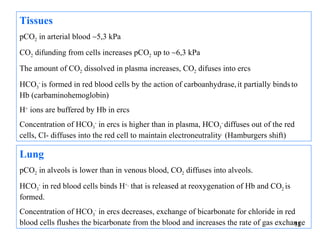
Tissues
pCO2 in arterial blood ∼5,3 kPa
CO2 difunding from cells increases pCO2 up to ∼6,3 kPa
The amount of CO2 dissolved in plasma increases, CO2 difuses into ercs
HCO3- is formed in red blood cells by the action of carboanhydrase, it partially binds to
Hb (carbaminohemoglobin)
H+ ions are buffered by Hb in ercs
Concentration of HCO3- in ercs is higher than in plasma, HCO3- diffuses out of the red
cells, Cl- diffuses into the red cell to maintain electroneutrality. (Hamburgers shift)

Lung
pCO2 in alveols is lower than in venous blood, CO2 diffuses into alveols.
HCO3- in red blood cells binds H+, that is released at reoxygenation of Hb and CO2 is
formed.
Concentration of HCO3- in ercs decreases, exchange of bicarbonate for chloride in red
blood cells flushes the bicarbonate from the blood and increases the rate of gas exchange
                                                                                      11
Forms of CO2 transport in blood


 Form of CO2            Occurence in
                        plasma (%)
 HCO3−                      ~ 85
 Carbamino proteins         ~ 10
 Physically dissolved       ~5


                                       12
The respiratory system regulates acid base
balance by controlling the rate of CO2 removal

Peripheral chemoreceptors in arterial walls and central
chemoreceptors in brain


Increase of [H+] in arterias at metabolic disturbances, or ↑of pCO2
in CNS activates medullary respiratory center that stimulates
increased ventilation promoting elimination of CO2


Conversely, the peripheral chemoreceptors reflexely suppres
respiratory activity in response to a fall in arterial H+ concentration
resulting from non-respiratory causes.


                                                                          13
Kidneys function in maintaning acid-base balance

         Tubular cell                                           Tubular lumen
                                                                                    HCO3−    HPO42−
          Activation at
                                                         Na+                                         A−
          alkalemia
                                       H+                              H+           HCO3−
        Gln
           +   acidosis                                        NH4+
                      NH4   +
        Glu
                                                       Na+                  H2CO3
           + acidosis
       2-OG                                      ATP
                                            H+
               H2O              CO2                                   CO2           H2O              A−

       carboanhydrase
                    H2CO3
 Cl-
                                                         Na+                                HPO42−
              HCO3−
                                H+                                    H+
           Na+                        Competition
                                      with K+                                               H2PO4−

                                                                                                          14
                                                                                          ~30 mmol/day
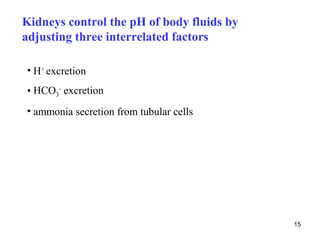
Kidneys control the pH of body fluids by
adjusting three interrelated factors

• H+ excretion
• HCO3- excretion
• ammonia secretion from tubular cells


                                           15
Tub.cell        lumen
 H secretion in proximal tubulus
   +
                                                                 ATP
                                                             H+
                                                                 H+
   H+-ATPase
                                                                  Na+
   Antiport with Na+


H+ secretion in distal tubulus and collecting duct
 Type A intercalated cells:
 Active secretion of H+ into urine – H+ -ATPase, H+-K+ -ATPase
 HCO3- resorption

 Type B intercalated cells:
 HCO3- secretion
 H+                                                                           16
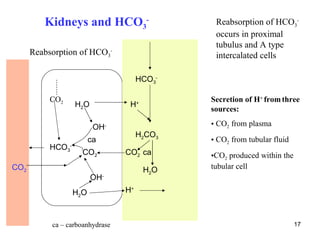
Kidneys and HCO3-                           Reabsorption of HCO3-
                                                     occurs in proximal
                                                     tubulus and A type
      Reabsorption of HCO3-                          intercalated cells

                                          HCO3-

           CO2                                      Secretion of H+ from three
                      H2O             H   +
                                                    sources:

                             OH-                    • CO2 from plasma
                                          H2CO3
                            ca                      • CO2 from tubular fluid
           HCO   3
                  -
                        CO2          CO2 ca         •CO2 produced within the
CO2                                           H2O   tubular cell
                            OH   -


                      H2O            H+


           ca – carboanhydrase                                                 17
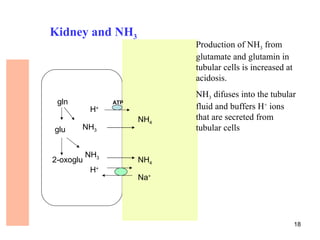
Kidney and NH3
                                Production of NH3 from
                                glutamate and glutamin in
                                tubular cells is increased at
                                acidosis.
                                NH3 difuses into the tubular
 gln                ATP
            H   +               fluid and buffers H+ ions
                          NH4   that are secreted from
glu    NH3                      tubular cells


           NH3
2-oxoglu                  NH4
            H+
                          Na+


                                                                18
Urinary buffers

H+ transporters in tubular cells and collecting duct can secrete H+
against the concentration gradient until the tubular fluid becomes 800
times more acidic than plasma. At this point, further secretion stops,
because the gradient becomes too great for the secretory process to
continue. The corresponding pH value is 4,5.
                                                           Tub.cell        lumen
H+ ions are buffered by:
                                                                              HPO4-
                                                                      ATP
         HPO4 (filtered from blood)
              -
                                                                  H+
                                                                               H2PO4-
         NH3 secreted from tubular cells                              H+
                                                                       Na+

                                                                NH3            NH4


If more buffer base is available in the urine, more H+ can be secreted                19
Summary of renal responses to acidosis and alkalosis


abnormality H+        H+        HCO3-      HCO3-          pH of    Change of pH
            secretion excretion resorption excretion      urine    in plasma

Acidosis     ↑          ↑          ↑          -           acidic   Alkalinization
                                                                   to normal
Alkalosis    ↓          ↓          ↓          ↑           alkaline Acidification
                                                                   to normal


Kidneys requires hours to days to compensate for changes in body fluid pH
(compared to the immediate responses of the body buffers and the few minute
delay before the respiratory systém responds)
However, kidneys are the most potent acid-base regulatory system
                                                                              20
Contribution of liver to maintenance of acid base
   balance


                                         2-OG               Kidneys           URINE
      Liver
                                  acidemia    +      Gln     Gln       NH4+   NH4+
                                                                   +

               NH3                           2NH4+    H+
                                                              acidemie
     AK                                              urea


              CO2 + H2O   H2CO3       H+ + HCO3−                              urea


    Two ways of NH3 elimination in the liver
                urea synthesis (connected with release of 2H+ - acidifying process)
                glutamin synthesis (without release of H+)
Higher synthesis of glutamin is stimulated at acidosis, synthesis of urea is
                                                                                      21
potentiated at alkalosis.
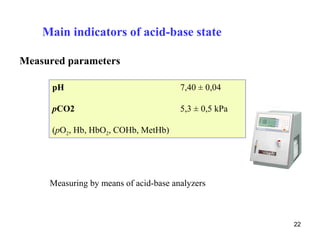
Main indicators of acid-base state

Measured parameters

      pH                               7,40 ± 0,04

      pCO2                             5,3 ± 0,5 kPa

      (pO2, Hb, HbO2, COHb, MetHb)


     Measuring by means of acid-base analyzers


                                                       22
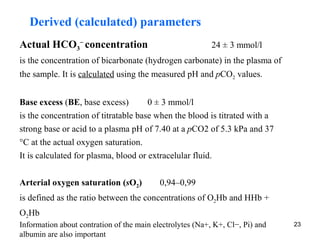
Derived (calculated) parameters
Actual HCO3− concentration                                 24 ± 3 mmol/l
is the concentration of bicarbonate (hydrogen carbonate) in the plasma of
the sample. It is calculated using the measured pH and pCO2 values.


Base excess (BE, base excess)         0 ± 3 mmol/l
is the concentration of titratable base when the blood is titrated with a
strong base or acid to a plasma pH of 7.40 at a pCO2 of 5.3 kPa and 37
°C at the actual oxygen saturation.
It is calculated for plasma, blood or extracelular fluid.


Arterial oxygen saturation (sO2)           0,94–0,99
is defined as the ratio between the concentrations of O2Hb and HHb +
O2Hb
Information about contration of the main electrolytes (Na+, K+, Cl−, Pi) and   23
albumin are also important
Dependent and independent variables of acid base
balance
  • Dependent variables: pH, BE a HCO3-
  These variable are not subject to independent alteration. Their
  concentrations are governed by concentrations of other ions and
  molecules.


  • Independent variables: pCO2, SID, weak
  nonvolatile acids Atot
  the concentration of each of the dependent variables is uniquely and
  independently determined by these three independent variables

  (primary changes in concentrations of some cations (mainly
  Na+) and anions (Cl−, albumin, phosfphate and unmeasured
  ions) triggers consequently the changes of acid-base                   24
  parameters).
The complementary calculations are derived from
  principle of plasma electroneutrality


[Na+] + [K+] + [Ca2+] + [Mg2+] = ([Cl-] + [HCO3-] + [albx-] + [Piy-] + [UA-])


    UA- - unmeasured anions (see later)


                                                                                25
Some complementary calculations

  Anion gap                                                       150


  AG = [Na+] + [K+] − ([Cl−] + [HCO3−])                                     Na+
                                                                                   Cl-
                                                                                   Cl-

  16 ± 2 mmol/l                                                   100

                                                                                   HCO3-
  Higher value of AG indicates the presence of extra
                                                                             K+
  unmeasured anions e.g. lactate, acetoacetate, 3-                  50
                                                                                   Albx-
  hydroxybutyrate.
                                                                            Ca2+                AG
                                                                                   Piy-
  The value is often corrected on serum albumin                             Mg2+
                                                                                   UA-
  concentration:
  *AGkorig=AG + 0.25 x ([Alb]norm- [Alb]zjišt

* Information about empirical formulas are given only for ilustration, students need
not to know them                                                                           26
Some complementary calculations
Albumin charge Albx-
It is calcultaed from albumin concentration (g/l) and pH
                     11,2 mmol/l at pH =7,4 a [alb]= 40 g/l


Phosphate charge Piy-
It is calculated from pH and concentration of phosphates


                      1,8 mmol/l at pH =7,4 a [Pi]=1 mmol/l

Corrected chloride ion concentration
correcting the chloride concentration for changes in Na+

[Cl]kor = [Cl]zjišt.x [Nanorm.] / [Nazjišt]

                                                              27
Some complementary calculations
Unmeasured anions
[UA] = ([Na+] + [K+] + [Ca2+] + [Mg2+]) – ([Cl−] + [HCO3−] +[Albx-] +[Piy-] )
                                                 6-10 mmol/l


UA expresses the concentration of other          150
anions that are not included in the
equation of electroneutrality (e.g.lactate,                 Na+
                                                                    Cl-
                                                                    Cl-
keton bodie, glycolate at poisonning with
ethylene glycol, formiate at poisonning          100
with methanol, salicylates etc.)
Increased value of UA is compensated by                            HCO3-
                                                            K  +
decrease of concetration of other anions
or mainly HCO3-                                     50
                                                                   Albx-
                                                            Ca2+
                                                                    Piy-
                                                            Mg2+           28
                                                                    UA-
Some complementary calculations
SID (strong ion difference)

SIDeff = [Na+] + [K+] + [Ca2+] + [Mg2+] – ([Cl-] + [UA-])

38–40 mmol/l

                                                     150
Accurate measurement of SID is
complicated by difficulties with                                      Cl-
                                                                      Cl-
                                                            Na   +
determination of UA (unmeasured
                                                     100
anions), empirical relation is therefore
used
                                                                     HCO3-
SIDeff = [HCO3−] + 0,28∙[albumin] + 1,8∙[Pi]                K+
[Pi] and [HCO3-] are in mmol/l and albumin in                                     SID
                                                      50
g/l                                                                  Albx-
                                                            Ca2+
                                                                      Piy-
                                                            Mg2+
                                                                      UA-    29
Classification of acid-base disorders

„acidosis“ (pH < 7,36)               metabolic disorder


                                          [HCO3-]
      pH = pK H CO + log
                     2   3

                                       [CO2 + H2CO3 ]

„alkalosis“ (pH > 7,44)              respiratory disorder

                                                            30
  Disturbances are often combined.
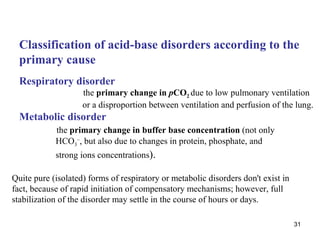
Classification of acid-base disorders according to the
  primary cause
  Respiratory disorder
                    the primary change in pCO2 due to low pulmonary ventilation
                    or a disproportion between ventilation and perfusion of the lung.
  Metabolic disorder
            the primary change in buffer base concentration (not only
            HCO3–, but also due to changes in protein, phosphate, and
            strong ions concentrations).

Quite pure (isolated) forms of respiratory or metabolic disorders don't exist in
fact, because of rapid initiation of compensatory mechanisms; however, full
stabilization of the disorder may settle in the course of hours or days.

                                                                                   31
−
                           HCO3                  20
           pH = 6,1 + log            = 6,1 + log    = 7,4
                          pCO2 .0,22             1
                     Change of   Change of the ratio   Change of   Typ acute
                     parameter   HCO3-/pCO2            pH          disturbance
pCO2                     ↑                                         Resp.acidosis
                                          ↓                 ↓
HCO3   -
                         -
concentration
pCO2                     ↓                                             Resp.
                                          ↑                 ↑        alkalosis
Change of HCO3   -
                         -
concentration
pCO2                     -                                           Metab.
                                          ↓                 ↓        acidosis
HCO3-                    ↓
concentration
pCO2                     -                                            Metab.
                                          ↑                 ↑        alkalosis
HCO3-                    ↑
concentration                                                               32
The classification of A-B disorders according
to time manifestation

         acute (uncompensated)
        stabilized (compensated)


    - simple metabolic disorders or simple respiratory disorders
    practically do not exist, because the compensation processes
    begin nearly immediately, however the stabilization can also
    take some days (in dependence on the type of disorder)


                                                                   33
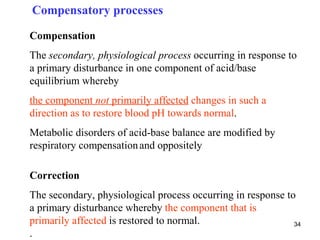
Compensatory processes

Compensation
The secondary, physiological process occurring in response to
a primary disturbance in one component of acid/base
equilibrium whereby
the component not primarily affected changes in such a
direction as to restore blood pH towards normal.
Metabolic disorders of acid-base balance are modified by
respiratory compensation and oppositely

Correction
The secondary, physiological process occurring in response to
a primary disturbance whereby the component that is
primarily affected is restored to normal.                    34
.
Time course of regulatory responses

Buffer systems                            Organ

             ECT       ICT         bone                   lung        liver    kidney


Full         immed     min/hours   h/days Development of hours/days           days
efectivity   iately                       compenzation


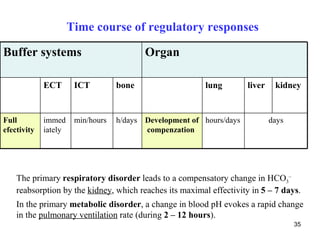
    The primary respiratory disorder leads to a compensatory change in HCO3–
    reabsorption by the kidney, which reaches its maximal effectivity in 5 – 7 days.
    In the primary metabolic disorder, a change in blood pH evokes a rapid change
    in the pulmonary ventilation rate (during 2 – 12 hours).
                                                                                     35
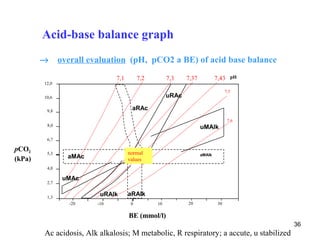
Acid-base balance graph
        →      overall evaluation (pH, pCO2 a BE) of acid base balance
                               7,1        7,2        7,3    7,37           7,43    pH
        12,0
                                                                                 7,5
        10,6                                         uRAc

         9,8                          aRAc
                                                                                  7,6
         8,0                                                       uMAlk
         6,7

pCO2                                 normal
         5,3                                                       aMAlk
(kPa)            aMAc                values
         4,0

                uMAc
         2,7


         1,3
                          uRAlk      aRAlk
                 -20     -10          0         10          20              30

                                     BE (mmol/l)
                                                                                         36
        Ac acidosis, Alk alkalosis; M metabolic, R respiratory; a accute, u stabilized
Example of acid-base balance disturbance

Metabolic acidosis (MAc)
Causes of MAc
• Increased production of H+ - lactacidosis
                           - ketoacidosis (starvation, non-compensated DM)
                           - acidosis from retention of non volatile acids in renal failure

2. Exogenous gain of H+       - metabolites at intoxication with methanol, ethylen glycol,
                                        - overdosing with acetylsalicylic acid
                              - NH4Cl infusion at the treatment of MAlk

3. Loss of HCO3-              - diarhea, burns, renal disturbances

4. Relative dilution of plasma – excessive infusion of isotonic solutions


                                                                                         37
Correction and compensation of MAc
↑H+
        1. Effect of buffers :        H+ + HCO3- → H2CO3 → H2O + CO2

                                         −
            HCO3- ↓               HCO3       20
                                           <                pH <7.4
                                 pCO2 .0,22 1

      2. respiratory compensation – increase of pulmonary ventilation

                                         −
                                  HCO3       20
               pCO2 ↓                      ≈
                                 pCO2 .0,22 1

       pH approches to 7,4, but concentrations of HCO3- and pCO2 are non physiological

      3. Renal correction (development during 2–3 days) - acidic urine is excreted.
      Excretion of H+ is accompanied by excretion of the given anion (A−) (lactate,
      acetacetate, 3-hydroxybutyrate). HCO3− consumed during buffering reaction is
                                                                                         38
      regenerated in renal tubuli.
Grafical description of changes during
         compensation and correction of MAc

                                    7,1       7,2        7,3    7,37           7,43    pH
        12,0
                                                                                     7,5
        10,6                                             uRAc

         9,8                               aRAc
                                                                                      7,6
         8,0                                                           uMAlk
         6,7

pCO2                                    normal
(kPa)
         5,3
                aMAc   1                                               aMAlk
                                      3 values
         4,0

               uMAc    2
         2,7


         1,3
                            uRAlk         aRAlk
                -20        -10            0         10          20              30

                                          BE (mmol/l)
                                                                                            39
Changes of electrolyte parameters during acid-base
                disturbances (example)
Acidosis
The cause: loss of HCO3-
(e.g.diarrhea)
                                     Na   +    Cl
                                               Cl-
                                                  -


   Loss of HCO3- is replaced
   by Cl- → hyperchloremic
   acidosis                                   HCO3-
                                      K+              SID ↓
                               50
                                              Albx-
                                     Ca2+
                                               Piy-
                                     Mg2+
                                               UA-

                                                              40
                                UA not changed AG not changed
Acidosis
cause – production of lactate, keton bodies, formiate,
salicylate etc.
   Due to buffering reaction          150
   concentration of [HCO3-],
   event. Albx- a Piy- is decreased         Na   +    Cl
                                                      Cl-
                                                         -


   Concentration of
   unmeasured anions (UA)
   increases                                         HCO3-

   Concentration of chlorides
                                            K+                 SID ↓
                                       50
   is not changed –
                                                     Albx-
   normochloremic acidosis                  Ca2+
                                                      Piy-
                                            Mg2+
                                                      UA-

                                                        UA ↑
                                                               AG ↑    41
Dilution acidosis – consequence of plasma dilution


      By the dilution the        150
      concentration of
      buffer bases falls                          Cl
                                                  Cl-
                                                     -
                                        Na   +


                                                 HCO3-
                                         K+              SID ↓
                                 50
                                                 Albx-
                                        Ca2+
                                                  Piy-
                                        Mg2+
                                                  UA-

                                                         AG ↓    42
                                                  UA ↓
The classification of acid-base disorders :
Disorder                                acidosis alkalosis
I. respiratory                           pCO2      pCO2
II. metabolic (nonrespiratory)
    1. abnormal SID                      SID
       a/ water (excess/deficit)         [Na+]
      b/ imbalance of strong anions      SID       SID
         chlorides (excess/deficit)      [Cl-]     [Cl-]
         unidentified anions (excess)    SID
                                                    SID
                                         [UA-]
                                                    [Na+]
   2. weak nonvolatile acids
      a/ serum albumin                   [Alb-]    [Alb-]
      b/ inorganic phosphate             [Pi-]     [Pi-]
                                                      43
The
procedure of
evaluation of
AB-balance
parameters :


                44
Evaluation of acid –base parameters (1)
1/ pH, pCO2, BE – type of disturbance, measure of compensation

  pH= 7,367, pCO2 = 5,25 kPa, BE = - 2,5 mmol.l-1


                                                          45
Evaluation of acid –base parameters (2)
2/ recalculation of laboratory results
• calculation of [Albx-] and [Piy-]
•   calculation of unmeasured anions [UA-]
•   correction of Cl- to actual content of water


                                                   46
Evaluation of acid –base parameters (2)
      the deviations of patient values from the reference values are
      filed to the columns „acidosis“ / „alkalosis“
      (according to their signs: „+“ for increase, „−“ for decrease)

                 mmol . l-1     patient acidosis alkalosis
[Na+]               140                     −           +
[Cl-]correc         100                     +           −
[UA-]correc           8                     +           −
[Pi-]                 2                     +           −
[Alb-]               12                     +           −
                                                                   47
Evaluation of acid –base parameters (1)
  3/ quantitative evaluation
   pH= 7,367, pCO2 = 5,25 kPa, BE = - 2,5 mmol.l-1

               mmol . l-1 patient acidosis alkalosis
 [Na+]           140           129   − 11      +
 [Cl-]correc     100           111   + 11      −
 [UA-]correc       8            9    +   1     −
 [Pi-]             2           1,7   +         − 0,3
 [Alb-]           12           1,9   +         − 10,1

= combined metabolic disorder with normal ABE parameters
                                                           48
 „hypoalbuminemic MAlk+ hyponatremic MAc“

11 acid base regulation

  • 1.
    Metabolic processes producingand consuming H+. Buffer systems in the body. Acid-base balance in the body and its control. 2011 (E.T.) 1
  • 2.
    The production andregulation of hydrogen ions in the body Acids are continuously produced Liquids, food in the body and threaten the normal pH of the body fluids ICT Metabolic processes CO2 H+ OH- ECT CO2 + H2O ⇔ H2CO3 ⇔ HCO3- + H+ ⇔ bufferY Lung Kidneys CO2 HCO3- NH4+, H2PO4-, SO42- 2 ~ 20 mol /d 1 mmol/d 40-80 mmol/d
  • 3.
    Sources of acidsin metabolism : 1/ volatile carbonic acid: ● the source is CO2 - from decarboxylations ● CO2 with water gives weak volatile carbonic acid ● the exchange of CO2 ( 15 – 25 mol . d-1 ) between the blood and the external environment secure the lungs 2/ nonvolatile acids: ● sulfuric acid - from sulfur-containing amino acids (Cys + Met) ● phosphoric acid - from phosphorus-containing compounds ● carboxylic acids (e.g. lactate, acetoacetate, 3-hydroxybutyrate), unless they are completely oxidized to CO2 and water ● nonvolatile acids cannot be removed through the lungs, they are excreted by the kidney into the urine ( 40 – 80 mmol . d-1 ) 3
  • 4.
    The limit valueof pH (blood) Although there is a large production of acidic metabolites in the body, pH = 7,40 concentrations of H+ ions in biological fluids [H+] ≅ 40 nmol . l-1 are maintained in the The human body is very more tolerant of narrow range: acidaemia (acidosis) than of alkalaemia (alkalosis). pH = 6,80 pH = 7,70 [H ] ≅ 160 nmol . l + -1 [H+] ≅ 20 nmol . l-1 4 Steep decrease or increase of pH may be life-threatening
  • 5.
    Buffer systems inorganism IVF ISF ICF Buffering system blood plazma erytrocytes HCO3−/H2CO3 + CO2 50 % 33 % 17 % HCO3− HCO3− Protein−/HProtein 45 % 18 % 27 % – proteins HPO42−/H2PO4− 1% 3 % (org.) anorg. org. 5% (anorg.) 1 % (anorg.) phosphates phosphates Concentration of 48 ± 3 42 ± 3 buffer systems (mmol/ ~ 56 (BBb) (BBp) l) 5
  • 6.
    Buffer systems inblood Hydrogen carbonate buffer - the most important buffer in blood CO2 + H2O H2CO3 H+ + HCO3– − − [HCO3 ] [HCO3 ] pH = pK (H 2CO3 ) + log = 6,1 + log [CO 2 + H 2 CO 3 ] [ H 2CO3 ] ef Effective concentration of carbonic acid [CO2 + H2CO3] = 0,23 x pCO2 0,23 is the coefficient of solubility of CO2 for pCO2 in kPa Physiological values: pCO2 5,3 kPa ± 0,5 kPa. HCO3- 24 ± 2 mmol/l In these equations, the concentrations [HCO3-] and [CO2+H2CO3] are expressed in 6 mmol/l, not in the basal SI unit mol/l !
  • 7.
    Hydrogen carbonate buffer Metabolic component − [HCO 3 ] pH = 6,1 + log [ H 2CO3 ] ef Respiratory component 7
  • 8.
    The ratio HCO3-/ H2CO3 in blood at pH 7,4 − HCO3 20 pH = 6,1 + log = 6,1 + log = 7,4 pCO2 .0,22 1 − HCO3 24 20 = = pCO2 .0,22 1,2 1 pCO2 5,3 kPa ± 0,5 kPa. HCO3- 24 ± 2 mmol/l 8
  • 9.
    The other buffersystems in organism The protein buffers – mainly albumin H-proteinn− H+ + protein(n+1)− (based on dissociation of histidine In blood ∼ 7%, important intracellulary Hemoglobin buffer O2 pKA ~ 7,8 O2 HHb Hb− + H+ pKA ~ 6,2 HHbO2 HbO2− + H+ Phosphate buffer pKA2 = 6,8 H2PO4− HPO42− + H+ It contributes to intracellular buffering, important for buffering of 9 urine. In plasma only ∼5%.
  • 10.
    Transport of O2and CO2 between the tissues and lungs – cooperation of hydrogencarbonate and hemoglobine Blood in lungs Blood in tissues Erc Erc O2 O2 O2 O2 O2 O2 HHb HHb HbO2− HCO3 − HCO3− HbO2− H+ H+ HCO3− HCO3− Cl− Cl- H2CO3 H2CO3 CA CA H2O H2O CO2 CO2 CO2 CO2 CO2 CO2 Chloride shift in venous blood 10
  • 11.
    Tissues pCO2 in arterialblood ∼5,3 kPa CO2 difunding from cells increases pCO2 up to ∼6,3 kPa The amount of CO2 dissolved in plasma increases, CO2 difuses into ercs HCO3- is formed in red blood cells by the action of carboanhydrase, it partially binds to Hb (carbaminohemoglobin) H+ ions are buffered by Hb in ercs Concentration of HCO3- in ercs is higher than in plasma, HCO3- diffuses out of the red cells, Cl- diffuses into the red cell to maintain electroneutrality. (Hamburgers shift) Lung pCO2 in alveols is lower than in venous blood, CO2 diffuses into alveols. HCO3- in red blood cells binds H+, that is released at reoxygenation of Hb and CO2 is formed. Concentration of HCO3- in ercs decreases, exchange of bicarbonate for chloride in red blood cells flushes the bicarbonate from the blood and increases the rate of gas exchange 11
  • 12.
    Forms of CO2transport in blood Form of CO2 Occurence in plasma (%) HCO3− ~ 85 Carbamino proteins ~ 10 Physically dissolved ~5 12
  • 13.
    The respiratory systemregulates acid base balance by controlling the rate of CO2 removal Peripheral chemoreceptors in arterial walls and central chemoreceptors in brain Increase of [H+] in arterias at metabolic disturbances, or ↑of pCO2 in CNS activates medullary respiratory center that stimulates increased ventilation promoting elimination of CO2 Conversely, the peripheral chemoreceptors reflexely suppres respiratory activity in response to a fall in arterial H+ concentration resulting from non-respiratory causes. 13
  • 14.
    Kidneys function inmaintaning acid-base balance Tubular cell Tubular lumen HCO3− HPO42− Activation at Na+ A− alkalemia H+ H+ HCO3− Gln + acidosis NH4+ NH4 + Glu Na+ H2CO3 + acidosis 2-OG ATP H+ H2O CO2 CO2 H2O A− carboanhydrase H2CO3 Cl- Na+ HPO42− HCO3− H+ H+ Na+ Competition with K+ H2PO4− 14 ~30 mmol/day
  • 15.
    Kidneys control thepH of body fluids by adjusting three interrelated factors • H+ excretion • HCO3- excretion • ammonia secretion from tubular cells 15
  • 16.
    Tub.cell lumen H secretion in proximal tubulus + ATP H+ H+ H+-ATPase Na+ Antiport with Na+ H+ secretion in distal tubulus and collecting duct Type A intercalated cells: Active secretion of H+ into urine – H+ -ATPase, H+-K+ -ATPase HCO3- resorption Type B intercalated cells: HCO3- secretion H+ 16
  • 17.
    Kidneys and HCO3- Reabsorption of HCO3- occurs in proximal tubulus and A type Reabsorption of HCO3- intercalated cells HCO3- CO2 Secretion of H+ from three H2O H + sources: OH- • CO2 from plasma H2CO3 ca • CO2 from tubular fluid HCO 3 - CO2 CO2 ca •CO2 produced within the CO2 H2O tubular cell OH - H2O H+ ca – carboanhydrase 17
  • 18.
    Kidney and NH3 Production of NH3 from glutamate and glutamin in tubular cells is increased at acidosis. NH3 difuses into the tubular gln ATP H + fluid and buffers H+ ions NH4 that are secreted from glu NH3 tubular cells NH3 2-oxoglu NH4 H+ Na+ 18
  • 19.
    Urinary buffers H+ transportersin tubular cells and collecting duct can secrete H+ against the concentration gradient until the tubular fluid becomes 800 times more acidic than plasma. At this point, further secretion stops, because the gradient becomes too great for the secretory process to continue. The corresponding pH value is 4,5. Tub.cell lumen H+ ions are buffered by: HPO4- ATP HPO4 (filtered from blood) - H+ H2PO4- NH3 secreted from tubular cells H+ Na+ NH3 NH4 If more buffer base is available in the urine, more H+ can be secreted 19
  • 20.
    Summary of renalresponses to acidosis and alkalosis abnormality H+ H+ HCO3- HCO3- pH of Change of pH secretion excretion resorption excretion urine in plasma Acidosis ↑ ↑ ↑ - acidic Alkalinization to normal Alkalosis ↓ ↓ ↓ ↑ alkaline Acidification to normal Kidneys requires hours to days to compensate for changes in body fluid pH (compared to the immediate responses of the body buffers and the few minute delay before the respiratory systém responds) However, kidneys are the most potent acid-base regulatory system 20
  • 21.
    Contribution of liverto maintenance of acid base balance 2-OG Kidneys URINE Liver acidemia + Gln Gln NH4+ NH4+ + NH3 2NH4+ H+ acidemie AK urea CO2 + H2O H2CO3 H+ + HCO3− urea Two ways of NH3 elimination in the liver urea synthesis (connected with release of 2H+ - acidifying process) glutamin synthesis (without release of H+) Higher synthesis of glutamin is stimulated at acidosis, synthesis of urea is 21 potentiated at alkalosis.
  • 22.
    Main indicators ofacid-base state Measured parameters pH 7,40 ± 0,04 pCO2 5,3 ± 0,5 kPa (pO2, Hb, HbO2, COHb, MetHb) Measuring by means of acid-base analyzers 22
  • 23.
    Derived (calculated) parameters ActualHCO3− concentration 24 ± 3 mmol/l is the concentration of bicarbonate (hydrogen carbonate) in the plasma of the sample. It is calculated using the measured pH and pCO2 values. Base excess (BE, base excess) 0 ± 3 mmol/l is the concentration of titratable base when the blood is titrated with a strong base or acid to a plasma pH of 7.40 at a pCO2 of 5.3 kPa and 37 °C at the actual oxygen saturation. It is calculated for plasma, blood or extracelular fluid. Arterial oxygen saturation (sO2) 0,94–0,99 is defined as the ratio between the concentrations of O2Hb and HHb + O2Hb Information about contration of the main electrolytes (Na+, K+, Cl−, Pi) and 23 albumin are also important
  • 24.
    Dependent and independentvariables of acid base balance • Dependent variables: pH, BE a HCO3- These variable are not subject to independent alteration. Their concentrations are governed by concentrations of other ions and molecules. • Independent variables: pCO2, SID, weak nonvolatile acids Atot the concentration of each of the dependent variables is uniquely and independently determined by these three independent variables (primary changes in concentrations of some cations (mainly Na+) and anions (Cl−, albumin, phosfphate and unmeasured ions) triggers consequently the changes of acid-base 24 parameters).
  • 25.
    The complementary calculationsare derived from principle of plasma electroneutrality [Na+] + [K+] + [Ca2+] + [Mg2+] = ([Cl-] + [HCO3-] + [albx-] + [Piy-] + [UA-]) UA- - unmeasured anions (see later) 25
  • 26.
    Some complementary calculations Anion gap 150 AG = [Na+] + [K+] − ([Cl−] + [HCO3−]) Na+ Cl- Cl- 16 ± 2 mmol/l 100 HCO3- Higher value of AG indicates the presence of extra K+ unmeasured anions e.g. lactate, acetoacetate, 3- 50 Albx- hydroxybutyrate. Ca2+ AG Piy- The value is often corrected on serum albumin Mg2+ UA- concentration: *AGkorig=AG + 0.25 x ([Alb]norm- [Alb]zjišt * Information about empirical formulas are given only for ilustration, students need not to know them 26
  • 27.
    Some complementary calculations Albumincharge Albx- It is calcultaed from albumin concentration (g/l) and pH 11,2 mmol/l at pH =7,4 a [alb]= 40 g/l Phosphate charge Piy- It is calculated from pH and concentration of phosphates 1,8 mmol/l at pH =7,4 a [Pi]=1 mmol/l Corrected chloride ion concentration correcting the chloride concentration for changes in Na+ [Cl]kor = [Cl]zjišt.x [Nanorm.] / [Nazjišt] 27
  • 28.
    Some complementary calculations Unmeasuredanions [UA] = ([Na+] + [K+] + [Ca2+] + [Mg2+]) – ([Cl−] + [HCO3−] +[Albx-] +[Piy-] ) 6-10 mmol/l UA expresses the concentration of other 150 anions that are not included in the equation of electroneutrality (e.g.lactate, Na+ Cl- Cl- keton bodie, glycolate at poisonning with ethylene glycol, formiate at poisonning 100 with methanol, salicylates etc.) Increased value of UA is compensated by HCO3- K + decrease of concetration of other anions or mainly HCO3- 50 Albx- Ca2+ Piy- Mg2+ 28 UA-
  • 29.
    Some complementary calculations SID(strong ion difference) SIDeff = [Na+] + [K+] + [Ca2+] + [Mg2+] – ([Cl-] + [UA-]) 38–40 mmol/l 150 Accurate measurement of SID is complicated by difficulties with Cl- Cl- Na + determination of UA (unmeasured 100 anions), empirical relation is therefore used HCO3- SIDeff = [HCO3−] + 0,28∙[albumin] + 1,8∙[Pi] K+ [Pi] and [HCO3-] are in mmol/l and albumin in SID 50 g/l Albx- Ca2+ Piy- Mg2+ UA- 29
  • 30.
    Classification of acid-basedisorders „acidosis“ (pH < 7,36) metabolic disorder [HCO3-] pH = pK H CO + log 2 3 [CO2 + H2CO3 ] „alkalosis“ (pH > 7,44) respiratory disorder 30 Disturbances are often combined.
  • 31.
    Classification of acid-basedisorders according to the primary cause Respiratory disorder the primary change in pCO2 due to low pulmonary ventilation or a disproportion between ventilation and perfusion of the lung. Metabolic disorder the primary change in buffer base concentration (not only HCO3–, but also due to changes in protein, phosphate, and strong ions concentrations). Quite pure (isolated) forms of respiratory or metabolic disorders don't exist in fact, because of rapid initiation of compensatory mechanisms; however, full stabilization of the disorder may settle in the course of hours or days. 31
  • 32.
    HCO3 20 pH = 6,1 + log = 6,1 + log = 7,4 pCO2 .0,22 1 Change of Change of the ratio Change of Typ acute parameter HCO3-/pCO2 pH disturbance pCO2 ↑ Resp.acidosis ↓ ↓ HCO3 - - concentration pCO2 ↓ Resp. ↑ ↑ alkalosis Change of HCO3 - - concentration pCO2 - Metab. ↓ ↓ acidosis HCO3- ↓ concentration pCO2 - Metab. ↑ ↑ alkalosis HCO3- ↑ concentration 32
  • 33.
    The classification ofA-B disorders according to time manifestation acute (uncompensated) stabilized (compensated) - simple metabolic disorders or simple respiratory disorders practically do not exist, because the compensation processes begin nearly immediately, however the stabilization can also take some days (in dependence on the type of disorder) 33
  • 34.
    Compensatory processes Compensation The secondary,physiological process occurring in response to a primary disturbance in one component of acid/base equilibrium whereby the component not primarily affected changes in such a direction as to restore blood pH towards normal. Metabolic disorders of acid-base balance are modified by respiratory compensation and oppositely Correction The secondary, physiological process occurring in response to a primary disturbance whereby the component that is primarily affected is restored to normal. 34 .
  • 35.
    Time course ofregulatory responses Buffer systems Organ ECT ICT bone lung liver kidney Full immed min/hours h/days Development of hours/days days efectivity iately compenzation The primary respiratory disorder leads to a compensatory change in HCO3– reabsorption by the kidney, which reaches its maximal effectivity in 5 – 7 days. In the primary metabolic disorder, a change in blood pH evokes a rapid change in the pulmonary ventilation rate (during 2 – 12 hours). 35
  • 36.
    Acid-base balance graph → overall evaluation (pH, pCO2 a BE) of acid base balance 7,1 7,2 7,3 7,37 7,43 pH 12,0 7,5 10,6 uRAc 9,8 aRAc 7,6 8,0 uMAlk 6,7 pCO2 normal 5,3 aMAlk (kPa) aMAc values 4,0 uMAc 2,7 1,3 uRAlk aRAlk -20 -10 0 10 20 30 BE (mmol/l) 36 Ac acidosis, Alk alkalosis; M metabolic, R respiratory; a accute, u stabilized
  • 37.
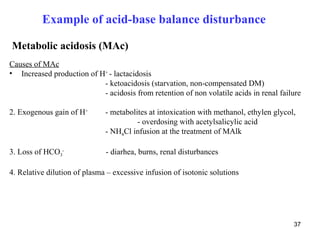
    Example of acid-basebalance disturbance Metabolic acidosis (MAc) Causes of MAc • Increased production of H+ - lactacidosis - ketoacidosis (starvation, non-compensated DM) - acidosis from retention of non volatile acids in renal failure 2. Exogenous gain of H+ - metabolites at intoxication with methanol, ethylen glycol, - overdosing with acetylsalicylic acid - NH4Cl infusion at the treatment of MAlk 3. Loss of HCO3- - diarhea, burns, renal disturbances 4. Relative dilution of plasma – excessive infusion of isotonic solutions 37
  • 38.
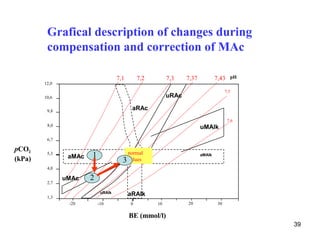
    Correction and compensationof MAc ↑H+ 1. Effect of buffers : H+ + HCO3- → H2CO3 → H2O + CO2 − HCO3- ↓ HCO3 20 < pH <7.4 pCO2 .0,22 1 2. respiratory compensation – increase of pulmonary ventilation − HCO3 20 pCO2 ↓ ≈ pCO2 .0,22 1 pH approches to 7,4, but concentrations of HCO3- and pCO2 are non physiological 3. Renal correction (development during 2–3 days) - acidic urine is excreted. Excretion of H+ is accompanied by excretion of the given anion (A−) (lactate, acetacetate, 3-hydroxybutyrate). HCO3− consumed during buffering reaction is 38 regenerated in renal tubuli.
  • 39.
    Grafical description ofchanges during compensation and correction of MAc 7,1 7,2 7,3 7,37 7,43 pH 12,0 7,5 10,6 uRAc 9,8 aRAc 7,6 8,0 uMAlk 6,7 pCO2 normal (kPa) 5,3 aMAc 1 aMAlk 3 values 4,0 uMAc 2 2,7 1,3 uRAlk aRAlk -20 -10 0 10 20 30 BE (mmol/l) 39
  • 40.
    Changes of electrolyteparameters during acid-base disturbances (example) Acidosis The cause: loss of HCO3- (e.g.diarrhea) Na + Cl Cl- - Loss of HCO3- is replaced by Cl- → hyperchloremic acidosis HCO3- K+ SID ↓ 50 Albx- Ca2+ Piy- Mg2+ UA- 40 UA not changed AG not changed
  • 41.
    Acidosis cause – productionof lactate, keton bodies, formiate, salicylate etc. Due to buffering reaction 150 concentration of [HCO3-], event. Albx- a Piy- is decreased Na + Cl Cl- - Concentration of unmeasured anions (UA) increases HCO3- Concentration of chlorides K+ SID ↓ 50 is not changed – Albx- normochloremic acidosis Ca2+ Piy- Mg2+ UA- UA ↑ AG ↑ 41
  • 42.
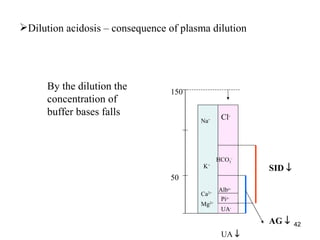
    Dilution acidosis –consequence of plasma dilution By the dilution the 150 concentration of buffer bases falls Cl Cl- - Na + HCO3- K+ SID ↓ 50 Albx- Ca2+ Piy- Mg2+ UA- AG ↓ 42 UA ↓
  • 43.
    The classification ofacid-base disorders : Disorder acidosis alkalosis I. respiratory  pCO2  pCO2 II. metabolic (nonrespiratory) 1. abnormal SID  SID a/ water (excess/deficit)  [Na+] b/ imbalance of strong anions  SID  SID chlorides (excess/deficit)  [Cl-]  [Cl-] unidentified anions (excess)  SID  SID  [UA-]  [Na+] 2. weak nonvolatile acids a/ serum albumin  [Alb-]  [Alb-] b/ inorganic phosphate  [Pi-]  [Pi-] 43
  • 44.
  • 45.
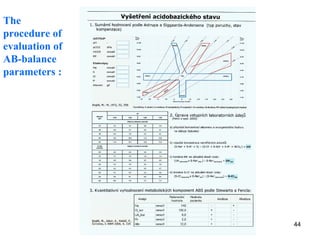
    Evaluation of acid–base parameters (1) 1/ pH, pCO2, BE – type of disturbance, measure of compensation pH= 7,367, pCO2 = 5,25 kPa, BE = - 2,5 mmol.l-1 45
  • 46.
    Evaluation of acid–base parameters (2) 2/ recalculation of laboratory results • calculation of [Albx-] and [Piy-] • calculation of unmeasured anions [UA-] • correction of Cl- to actual content of water 46
  • 47.
    Evaluation of acid–base parameters (2) the deviations of patient values from the reference values are filed to the columns „acidosis“ / „alkalosis“ (according to their signs: „+“ for increase, „−“ for decrease) mmol . l-1 patient acidosis alkalosis [Na+] 140 − + [Cl-]correc 100 + − [UA-]correc 8 + − [Pi-] 2 + − [Alb-] 12 + − 47
  • 48.
    Evaluation of acid–base parameters (1) 3/ quantitative evaluation pH= 7,367, pCO2 = 5,25 kPa, BE = - 2,5 mmol.l-1 mmol . l-1 patient acidosis alkalosis [Na+] 140 129 − 11 + [Cl-]correc 100 111 + 11 − [UA-]correc 8 9 + 1 − [Pi-] 2 1,7 + − 0,3 [Alb-] 12 1,9 + − 10,1 = combined metabolic disorder with normal ABE parameters 48 „hypoalbuminemic MAlk+ hyponatremic MAc“