Department of Biochemistry, KMC, DuwakotThursday,
February 4, 2016
Rajesh Chaudhary 1
Nucleotide and Nucleic acids
Thursday, February 4, 2016
2
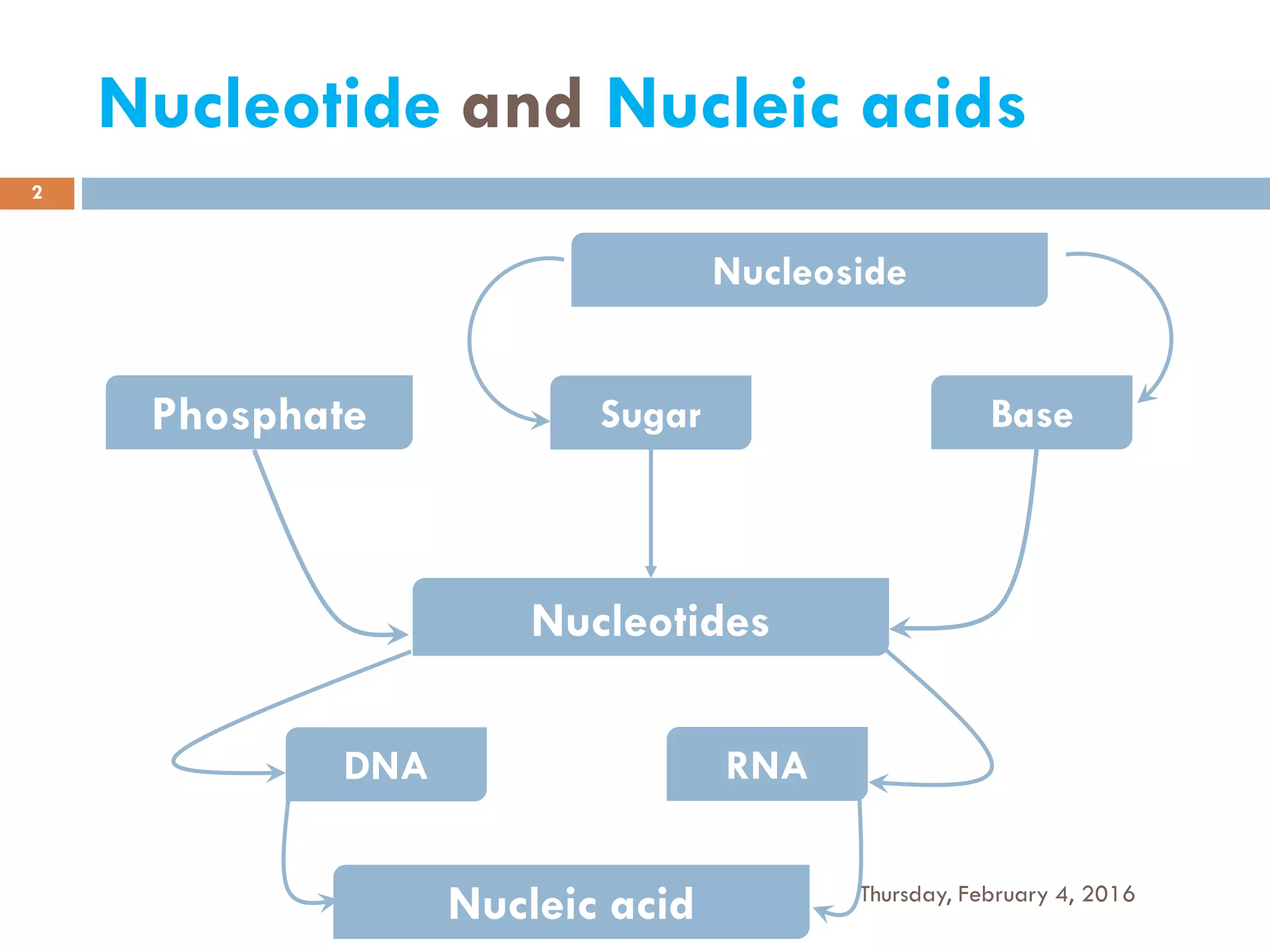
Nucleoside
Sugar BasePhosphate
DNA RNA
Nucleotides
Nucleic acid
Nucleic acids
3
 Information flow
 DNA  RNA 
PROTEIN
 DNA: storage of
genetic information
 RNA: expression of
genetic information
 PROTEIN:
Rajesh Chaudhary
Ribose and Deoxyribose |sugar within gene
Thursday, February 4, 2016
4
DNA vs RNA
Thursday, February 4, 2016
5
DNA vs RNA
Thursday, February 4, 2016
6
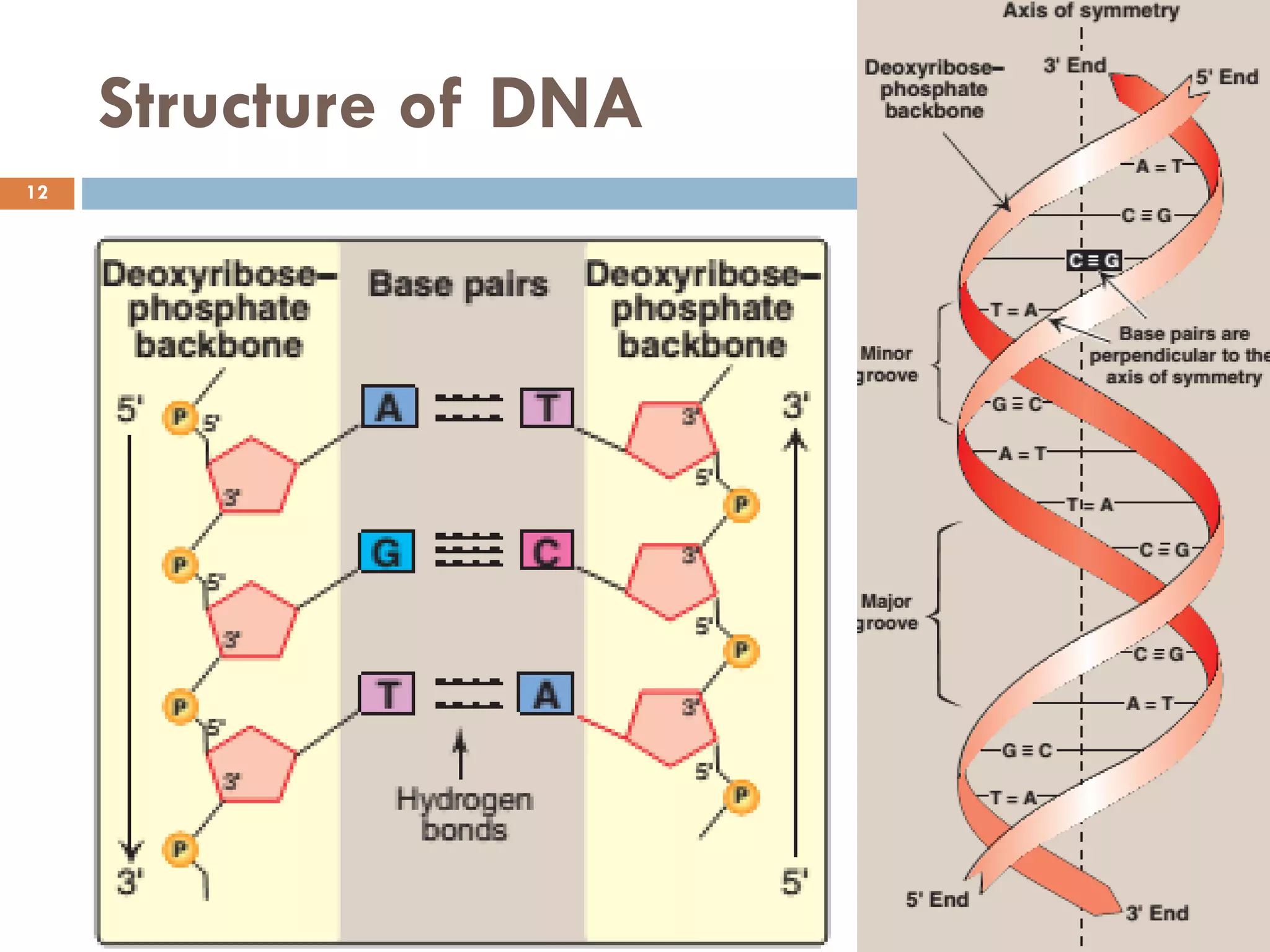
With exception of few
viruses that contain single-
stranded (ss) DNA, DNA
exists as dsDNA.
The two strands of DNA are
coiled around a common
axis forming helical
structure known as “AXIS
OF SYMMETRY”.
Rajesh Chaudhary
Nucleic acid
Thursday, February 4, 2016
7
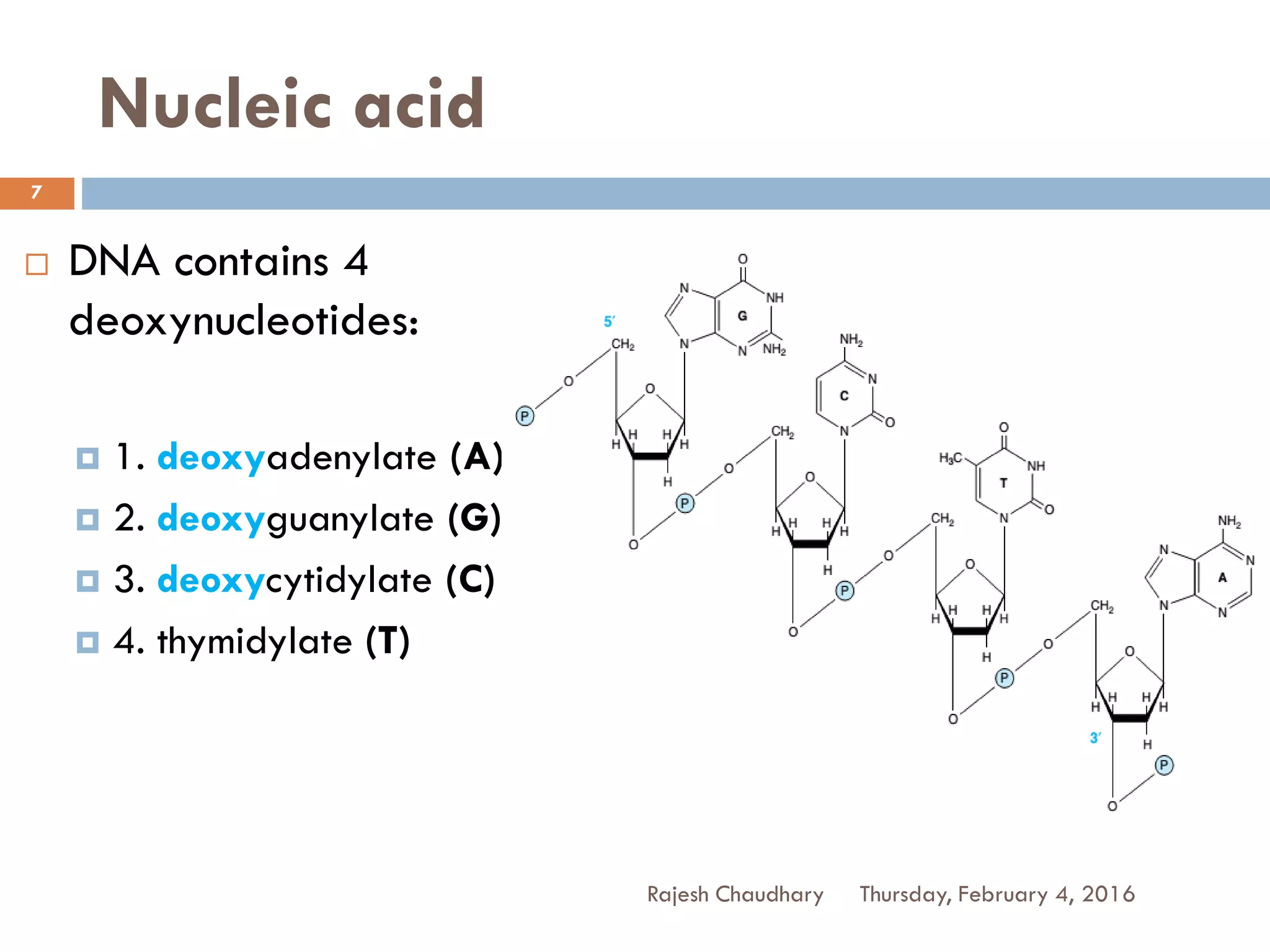
 DNA contains 4
deoxynucleotides:
 1. deoxyadenylate (A)
 2. deoxyguanylate (G)
 3. deoxycytidylate (C)
 4. thymidylate (T)
Rajesh Chaudhary
Thursday, February 4, 20168 Rajesh Chaudhary
Rajesh Chaudhary
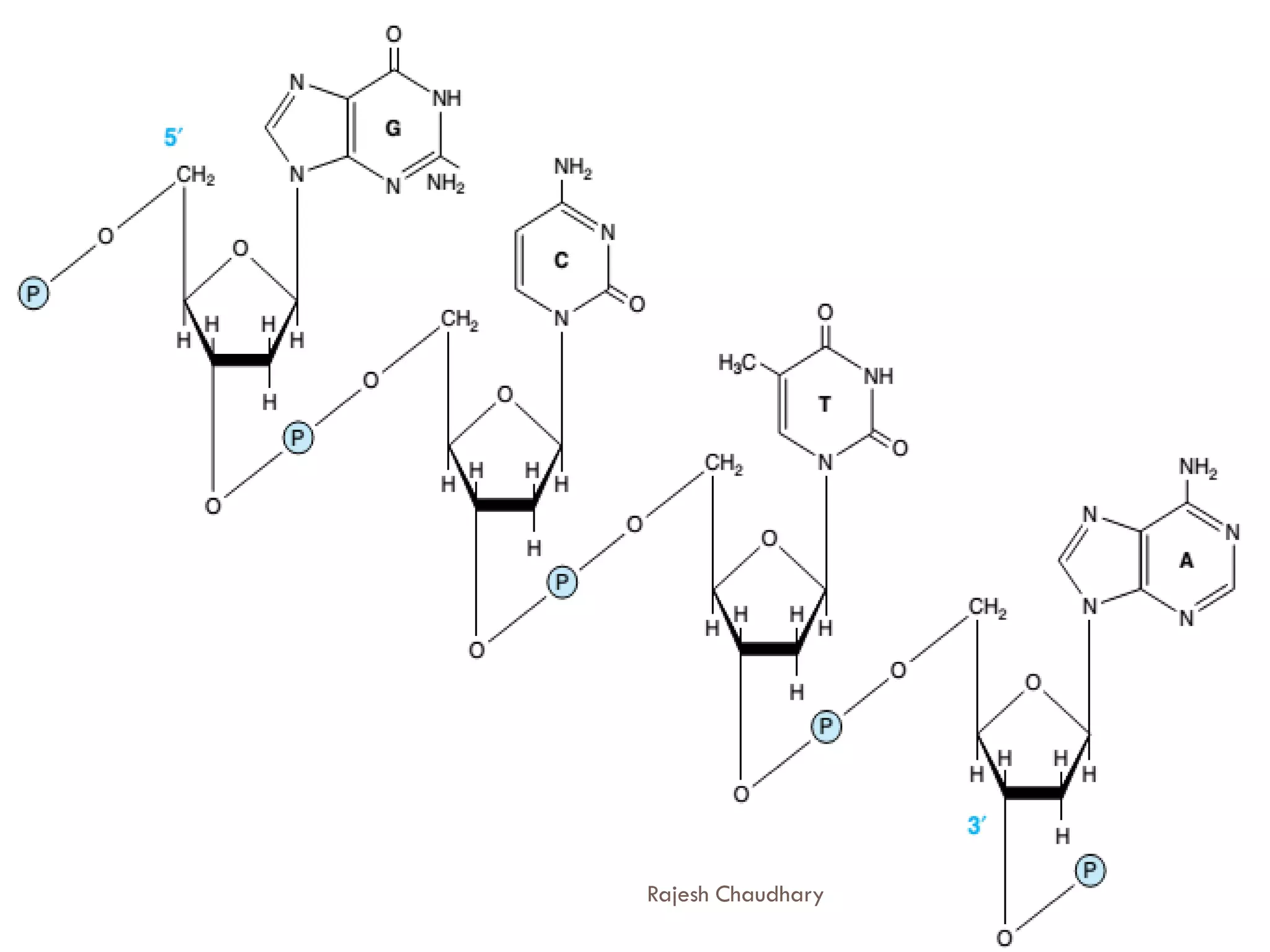
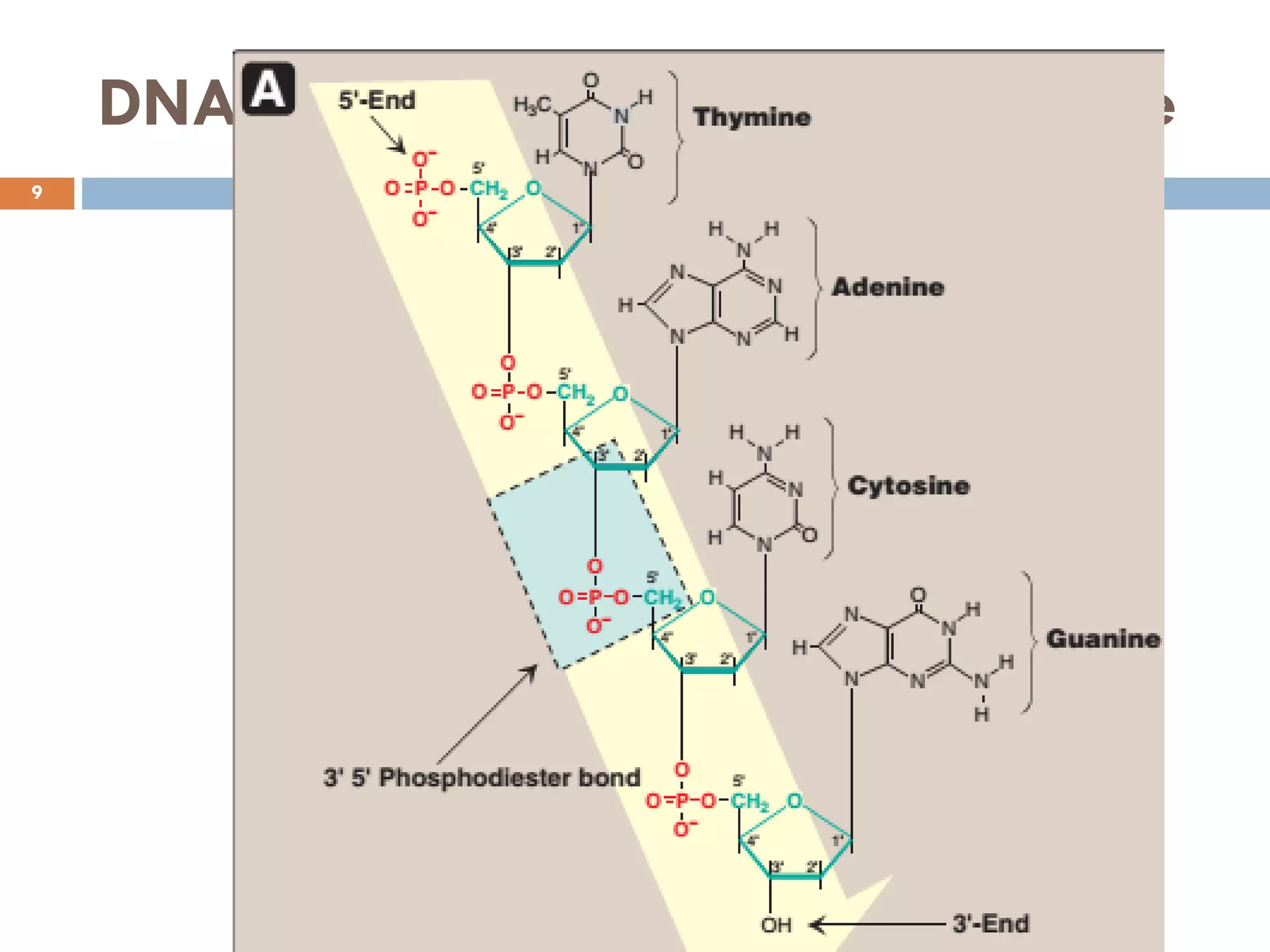
DNA chain with nucleotide sequence
Thursday, February 4, 2016
9
Thursday, February 4, 2016
10
Rajesh Chaudhary
Phosphodiester bond
Phosphodiester bonds in DNA or RNA
are cleaved hydrolytically by
chemicals or enzymes such as
nucleases: deoxyribonucleases for
DNA and ribonucleases for RNA.
Thursday, February 4, 2016
11
Major grooves Vs Minor grooves
Anticancer drug, for example, “Actinomycin D” exerts its cytotoxic effect by
intercalating into the narrow groove of DNA double helical structure.
Structure of DNA
Thursday, February 4, 2016
12
Base pairing
Rajesh Chaudhary
13
1. Hydrogen bond
2. Van der Waals force
3. Hydrophobic interaction
4. 3’,5’-phosphodiester bond
What are the stabilizing forces in
DNA?
Thursday, February 4, 2016
14
Rajesh Chaudhary
Chargaff’s rule
Thursday, February 4, 2016Rajesh Chaudhary
15
 1. The base composition of DNA generally varies from
one species to another.
 2. DNA specimens isolated from different tissues of the
same species have the same base composition.
 3. The base composition of DNA in a given species does
not change with an organism’s age, nutritional state or
changing environment.
 4. In all cellular DNAs, regardless of the species, the total
number of purines is equal to total no. of pyrimidine.
“In any sample of dsDNA, the amount of
Adenine equal the amount of Thymine, the
amount of Guanine equals the amount of
Cytosine, and the total amount of Purines
equals the total amount of Pyrimidines.”
Chargaff Rule
Thursday, February 4, 2016
16
-- Lippincott’s Illustrated Review, Biochemistry
Rajesh Chaudhary
Thursday, February 4, 2016
17
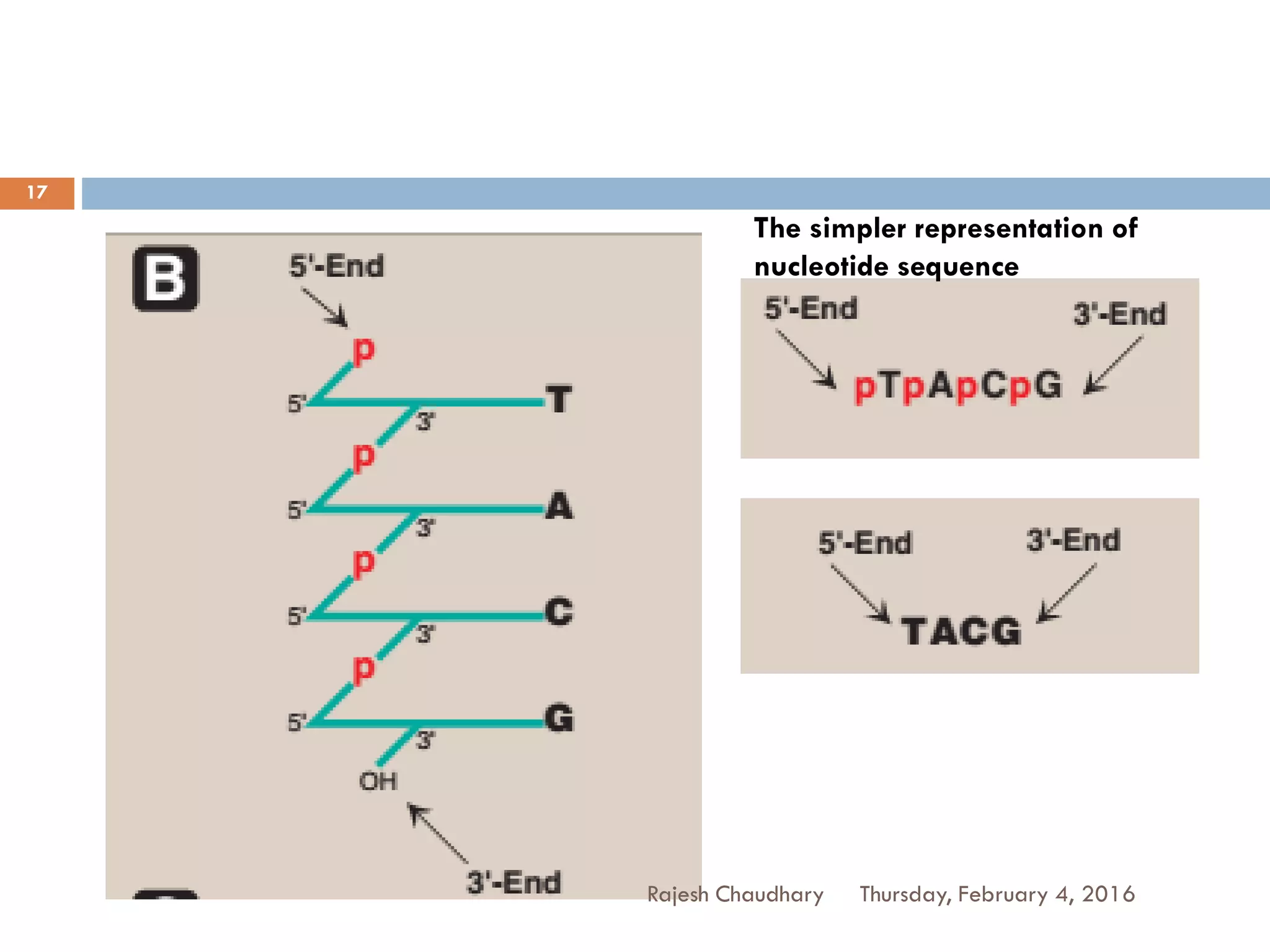
The simpler representation of
nucleotide sequence
Rajesh Chaudhary
Forms of DNA
Thursday, February 4, 2016
18
Forms: A – E and Z-form
B-form: found under low
salt, high degree of
hydration
DNA exists in relaxed & supercoiled
form
Thursday, February 4, 2016
19
 Circular DNA
 Mitochondrial & bacterial
 Torsional stress of DNA
 Negative supercoiling
 Topoisomerase (coils or relaxes)
Rajesh Chaudhary
Melting temperature (Tm)
20
Factors influencing
melting temperature:
1. The GC-content of
DNA.
2. Non-covalent cations
3. Formamide
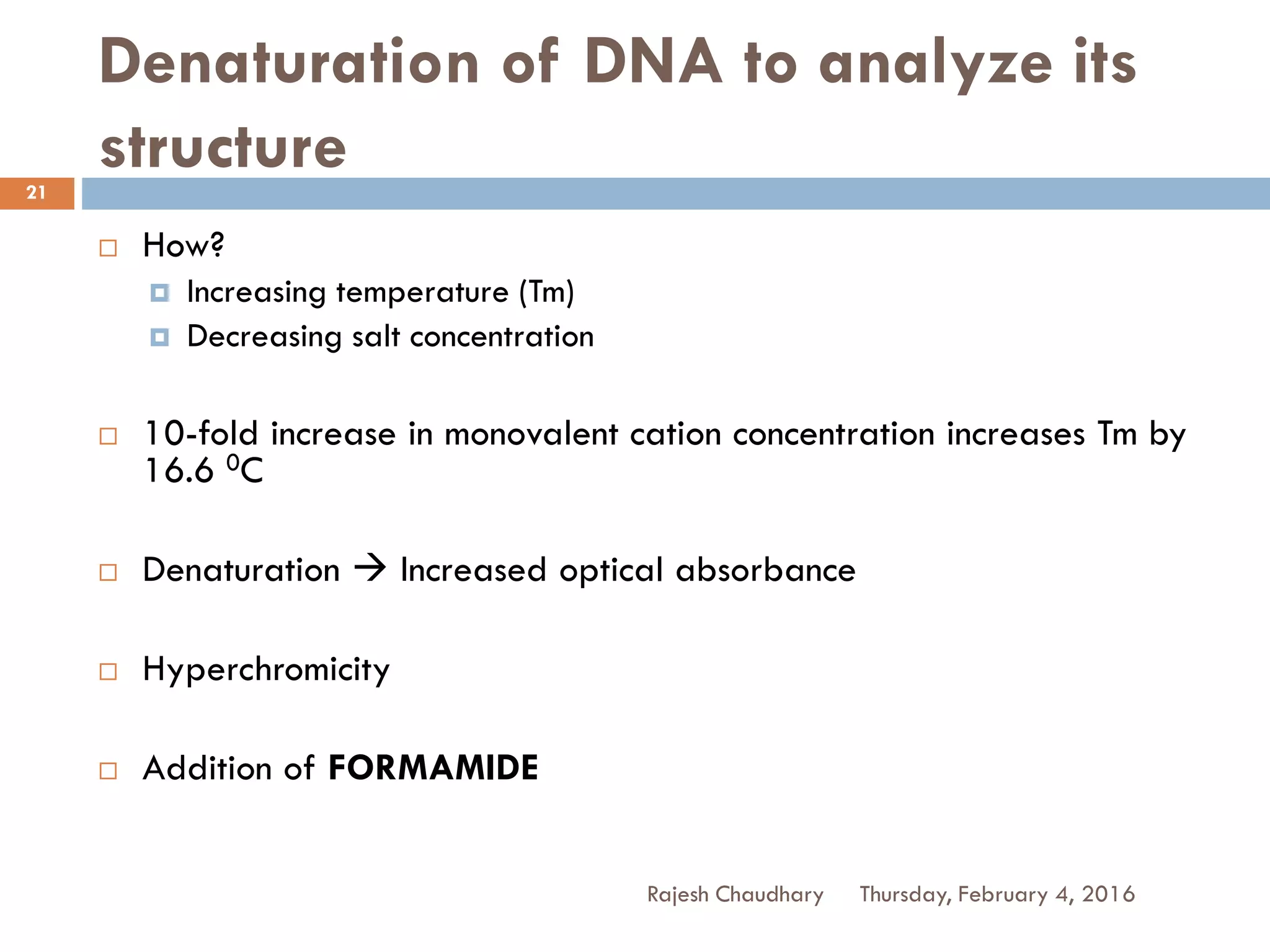
Denaturation of DNA to analyze its
structure
Thursday, February 4, 2016
21
 How?
 Increasing temperature (Tm)
 Decreasing salt concentration
 10-fold increase in monovalent cation concentration increases Tm by
16.6 0C
 Denaturation  Increased optical absorbance
 Hyperchromicity
 Addition of FORMAMIDE
Rajesh Chaudhary
Renaturation of DNA
Thursday, February 4, 2016Rajesh Chaudhary
22
Differences between DNA and RNA
Thursday, February 4, 2016
23
DNA RNA
1. Sugar moiety: deoxiribose 1. Sugar moiety: Ribose
2. Usually double stranded 2. Usually single stranded
3. Bases: Adenine, Guanine, Cytosine,
Thymine
3. Bases: Adenine, Guanine, Cytosine,
Uracil
4. DNA is comparatively more stable
then RNA
4. RNA is comparitively less stable then
DNA
5. Follows Chargaff’s rule 5. Do not follow Chargaff’s rule
6. DNA is bigger in size compared to
RNA
6. RNA is comparatively smaller in size
than DNA
Rajesh Chaudhary
Chemical nature of RNA
Thursday, February 4, 2016
24
 Sugar moiety: ribose rather than 2’-deoxyribose of
DNA
 ss rather than ds
 Doesn’t follow Chargaff's rule
 Alkaline treatment: RNA can be hydrolyzed while
DNA can’t
Rajesh Chaudhary
Thursday, February 4, 201625
RNA types
Thursday, February 4, 2016
26
 1. Messenger RNA (mRNA)  acts as a template
 2. Transfer RNA (tRNA)  carries AA for protein
synthesis
 3. Ribosomal RNA (rRNA)  structural component of
ribosomes
 4. Small nuclear RNA (snRNA)  helps in RNA
processing
Rajesh Chaudhary
RNA
Thursday, February 4, 2016
27
Rajesh Chaudhary
mRNA
Thursday, February 4, 2016
28
 Heterogeneous in abundance, size and stability
 Have unique chemical characteristics
Thursday, February 4, 201629
7-methylguanosine triphosphate
Cap prevents from 5’-exonuclease as
well as 3’-exonuclease digestion,
stability, recognition by protein
synthesis complex
Poly A tail residue (20-250 nucleotide long)
Rajesh Chaudhary
tRNA
Thursday, February 4, 2016
30
 Length = 74 – 95 nucleotides
 Adaptor for the translation of information
 20 species of RNA in each cell to carry 20 AA.
Rajesh Chaudhary
What is common in all tRNA?
31
Thursday, February 4, 2016
• (CpCpAoH) terminal
• Added post transcriptionally
• By Nucleotidyl transferase
enzyme
Define specific RNA
Rajesh Chaudhary
tRNA
rRNA
Thursday, February 4, 2016
32
 Protein synthesis (RNA + Protein) = Polysomes.
 MW = 4.6×10⁶
 Sedimentation velocity = 80S (60S vs 40S)
 Mammalian cells = 2 mitochondria rRNA and 4
Cytoplasmic
Ribosomal RNA
Thursday, February 4, 2016
33
Rajesh Chaudhary
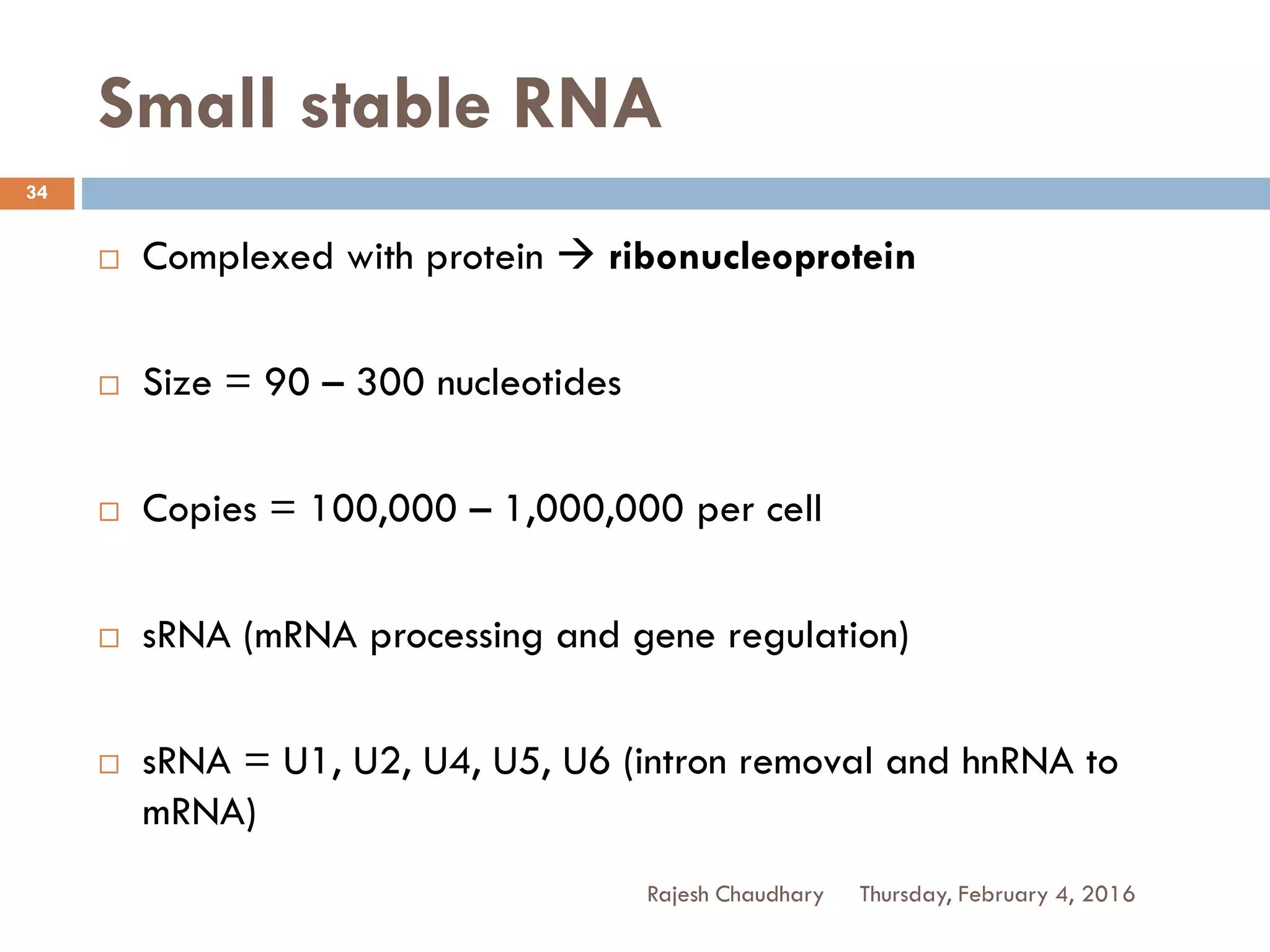
Small stable RNA
Thursday, February 4, 2016
34
 Complexed with protein  ribonucleoprotein
 Size = 90 – 300 nucleotides
 Copies = 100,000 – 1,000,000 per cell
 sRNA (mRNA processing and gene regulation)
 sRNA = U1, U2, U4, U5, U6 (intron removal and hnRNA to
mRNA)
Rajesh Chaudhary
References35
Thursday, February 4, 2016Rajesh Chaudhary

Nucleotides and nucleic acids

  • 1.
    Department of Biochemistry,KMC, DuwakotThursday, February 4, 2016 Rajesh Chaudhary 1
  • 2.
    Nucleotide and Nucleicacids Thursday, February 4, 2016 2 Nucleoside Sugar BasePhosphate DNA RNA Nucleotides Nucleic acid
  • 3.
    Nucleic acids 3  Informationflow  DNA  RNA  PROTEIN  DNA: storage of genetic information  RNA: expression of genetic information  PROTEIN: Rajesh Chaudhary
  • 4.
    Ribose and Deoxyribose|sugar within gene Thursday, February 4, 2016 4
  • 5.
    DNA vs RNA Thursday,February 4, 2016 5
  • 6.
    DNA vs RNA Thursday,February 4, 2016 6 With exception of few viruses that contain single- stranded (ss) DNA, DNA exists as dsDNA. The two strands of DNA are coiled around a common axis forming helical structure known as “AXIS OF SYMMETRY”. Rajesh Chaudhary
  • 7.
    Nucleic acid Thursday, February4, 2016 7  DNA contains 4 deoxynucleotides:  1. deoxyadenylate (A)  2. deoxyguanylate (G)  3. deoxycytidylate (C)  4. thymidylate (T) Rajesh Chaudhary
  • 8.
    Thursday, February 4,20168 Rajesh Chaudhary
  • 9.
    Rajesh Chaudhary DNA chainwith nucleotide sequence Thursday, February 4, 2016 9
  • 10.
    Thursday, February 4,2016 10 Rajesh Chaudhary Phosphodiester bond Phosphodiester bonds in DNA or RNA are cleaved hydrolytically by chemicals or enzymes such as nucleases: deoxyribonucleases for DNA and ribonucleases for RNA.
  • 11.
    Thursday, February 4,2016 11 Major grooves Vs Minor grooves Anticancer drug, for example, “Actinomycin D” exerts its cytotoxic effect by intercalating into the narrow groove of DNA double helical structure.
  • 12.
    Structure of DNA Thursday,February 4, 2016 12
  • 13.
  • 14.
    1. Hydrogen bond 2.Van der Waals force 3. Hydrophobic interaction 4. 3’,5’-phosphodiester bond What are the stabilizing forces in DNA? Thursday, February 4, 2016 14 Rajesh Chaudhary
  • 15.
    Chargaff’s rule Thursday, February4, 2016Rajesh Chaudhary 15  1. The base composition of DNA generally varies from one species to another.  2. DNA specimens isolated from different tissues of the same species have the same base composition.  3. The base composition of DNA in a given species does not change with an organism’s age, nutritional state or changing environment.  4. In all cellular DNAs, regardless of the species, the total number of purines is equal to total no. of pyrimidine.
  • 16.
    “In any sampleof dsDNA, the amount of Adenine equal the amount of Thymine, the amount of Guanine equals the amount of Cytosine, and the total amount of Purines equals the total amount of Pyrimidines.” Chargaff Rule Thursday, February 4, 2016 16 -- Lippincott’s Illustrated Review, Biochemistry Rajesh Chaudhary
  • 17.
    Thursday, February 4,2016 17 The simpler representation of nucleotide sequence Rajesh Chaudhary
  • 18.
    Forms of DNA Thursday,February 4, 2016 18 Forms: A – E and Z-form B-form: found under low salt, high degree of hydration
  • 19.
    DNA exists inrelaxed & supercoiled form Thursday, February 4, 2016 19  Circular DNA  Mitochondrial & bacterial  Torsional stress of DNA  Negative supercoiling  Topoisomerase (coils or relaxes) Rajesh Chaudhary
  • 20.
    Melting temperature (Tm) 20 Factorsinfluencing melting temperature: 1. The GC-content of DNA. 2. Non-covalent cations 3. Formamide
  • 21.
    Denaturation of DNAto analyze its structure Thursday, February 4, 2016 21  How?  Increasing temperature (Tm)  Decreasing salt concentration  10-fold increase in monovalent cation concentration increases Tm by 16.6 0C  Denaturation  Increased optical absorbance  Hyperchromicity  Addition of FORMAMIDE Rajesh Chaudhary
  • 22.
    Renaturation of DNA Thursday,February 4, 2016Rajesh Chaudhary 22
  • 23.
    Differences between DNAand RNA Thursday, February 4, 2016 23 DNA RNA 1. Sugar moiety: deoxiribose 1. Sugar moiety: Ribose 2. Usually double stranded 2. Usually single stranded 3. Bases: Adenine, Guanine, Cytosine, Thymine 3. Bases: Adenine, Guanine, Cytosine, Uracil 4. DNA is comparatively more stable then RNA 4. RNA is comparitively less stable then DNA 5. Follows Chargaff’s rule 5. Do not follow Chargaff’s rule 6. DNA is bigger in size compared to RNA 6. RNA is comparatively smaller in size than DNA Rajesh Chaudhary
  • 24.
    Chemical nature ofRNA Thursday, February 4, 2016 24  Sugar moiety: ribose rather than 2’-deoxyribose of DNA  ss rather than ds  Doesn’t follow Chargaff's rule  Alkaline treatment: RNA can be hydrolyzed while DNA can’t Rajesh Chaudhary
  • 25.
  • 26.
    RNA types Thursday, February4, 2016 26  1. Messenger RNA (mRNA)  acts as a template  2. Transfer RNA (tRNA)  carries AA for protein synthesis  3. Ribosomal RNA (rRNA)  structural component of ribosomes  4. Small nuclear RNA (snRNA)  helps in RNA processing Rajesh Chaudhary
  • 27.
    RNA Thursday, February 4,2016 27 Rajesh Chaudhary
  • 28.
    mRNA Thursday, February 4,2016 28  Heterogeneous in abundance, size and stability  Have unique chemical characteristics
  • 29.
    Thursday, February 4,201629 7-methylguanosine triphosphate Cap prevents from 5’-exonuclease as well as 3’-exonuclease digestion, stability, recognition by protein synthesis complex Poly A tail residue (20-250 nucleotide long) Rajesh Chaudhary
  • 30.
    tRNA Thursday, February 4,2016 30  Length = 74 – 95 nucleotides  Adaptor for the translation of information  20 species of RNA in each cell to carry 20 AA. Rajesh Chaudhary What is common in all tRNA?
  • 31.
    31 Thursday, February 4,2016 • (CpCpAoH) terminal • Added post transcriptionally • By Nucleotidyl transferase enzyme Define specific RNA Rajesh Chaudhary tRNA
  • 32.
    rRNA Thursday, February 4,2016 32  Protein synthesis (RNA + Protein) = Polysomes.  MW = 4.6×10⁶  Sedimentation velocity = 80S (60S vs 40S)  Mammalian cells = 2 mitochondria rRNA and 4 Cytoplasmic
  • 33.
    Ribosomal RNA Thursday, February4, 2016 33 Rajesh Chaudhary
  • 34.
    Small stable RNA Thursday,February 4, 2016 34  Complexed with protein  ribonucleoprotein  Size = 90 – 300 nucleotides  Copies = 100,000 – 1,000,000 per cell  sRNA (mRNA processing and gene regulation)  sRNA = U1, U2, U4, U5, U6 (intron removal and hnRNA to mRNA) Rajesh Chaudhary
  • 35.