Honors Spanish 2 Grammar BookBy: Brenda Jean-Bart
Table of ContentsSerEstarVerbs like GustarHacer expressionPreteritoTrigger wordsCar, gar, zarSpock verbsCucaracha verbsSnakes and snackeysDopCommandsIrregular verbsIop’sSe impersonalPast Participles as adjectivesEl future and ir + a+ infinitiveDemonstrative adjectivesDemonstrative pronounsLos mandatesImperfect tenseInformal+ irregularsFormal +irregularsDOP +IOP placementModal verbsReflexsivesSaber v. conocer
SerDescriptionOriginCharacteristicsSer timeOccupationRelationshipsPocessioneventsDate
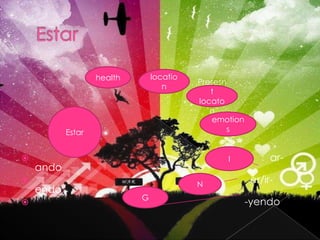
Estarar-andoer/ir- endo                                                                          -yendohealthlocationPresesntlocatonEstaremotionsING
Verbs like GustarDoler (o-ue)- to hurtFascinar- to fascinateMolestar- to botherEncantar- to loveFaltar- to lack, be in need of Importar- to be important toDisgustar- to disgust
Hacer ExpressionsHACE + TIME + QUE + CONJUGATED VERBConjuagated verb can be in any tense
PreterritoAr verbsEAsteOAmosAronEr/Ir verbsIIsteIoImosieron
Trigger wordsAyerAnocheEl anopasadoLe semanapasadaAnte ayer
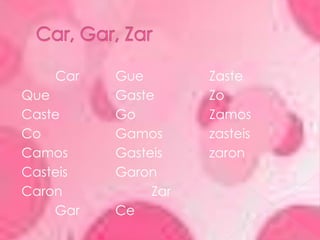
Car, Gar, ZarCarQueCaste CoCamosCasteisCaronGarGueGasteGoGamosGasteisGaronZarCeZasteZoZamoszasteiszaron
Spock verbsPreterite Conjugations of Irregular Spock VerbsVerserDarIrHacer
Cucaracha verbsAndar-anduv				-eEstar-Estuv				-istePoder-pud				-oPoner-pus				-imosQuerer-quis				-isteisSaber-sup				-ieronTener-tuv				* “j” verbs i=ieronVenir-vinConducir-condujProducir-produjTraducir-tradujDecir-dijTraer-traj
Snakes and SnakeysSnakesPederYopediTupedisteElla/el  pidioNosotrospedimosVosotrospedisteisEllos/ellaspidieronSnakeysVerbs such as leer, creer, and oir change i to y in 3rd personLeiLeisteLeyoLeimosLeisteisLeisteisleyeron
DOPs Lo-it masculineLas-it plural and feminineLos –it plural and masculine La- it feminine
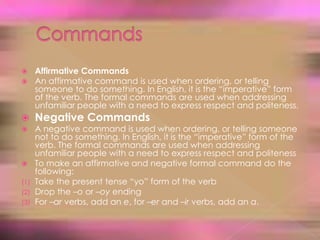
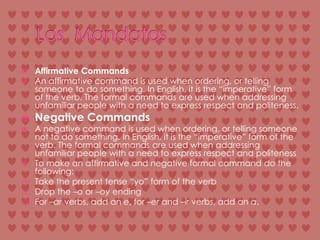
CommandsAffirmative CommandsAn affirmative command is used when ordering, or telling someone to do something. In English, it is the “imperative” form of the verb. The formal commands are used when addressing unfamiliar people with a need to express respect and politeness.Negative CommandsA negative command is used when ordering, or telling someone not to do something. In English, it is the “imperative” form of the verb. The formal commands are used when addressing unfamiliar people with a need to express respect and politenessTo make an affirmative and negative formal command do the following:Take the present tense “yo” form of the verbDrop the –o or –oyendingFor –ar verbs, add an e, for –er and –ir verbs, add an a.
Irregular verbsIrregular Affirmative Formal CommandThere are only three verbs that have irregular conjugations which are: ir, saber, ser. Ir goes to to ¡Vaya!, saber goes to !Sepa!, and ser goes to ¡Sea!Ex:To tell someone to go to the front of the room say: ¡Vaya al frente de la sala!Irregular Negative Formal CommandThere are only three verbs that have irregular conjugations which are: ir, saber, ser. Ir goes to to ¡Vaya!, saber goes to !Sepa!, and ser goes to ¡Sea!Ex:To tell someone not to be bad say: ¡No sea malo!
IOPsMe- yoTe- tuLe-el/ ella/udLes- ellos/ellas/udsNos- nosotros
Se impersonalUse se to avoid specifying a person who is doing the action of the verb.Se vendefruta en la frutería.When using se, the verb is always in the 3rd person.Aquí se hablaespañol.Se can be used in all tenses.Se hizo mucho.Se hará mucho.Se habíahecho.
TV-DISHEST-tenga-tenerV-venga-venirD-de-darI-vaya-irS-sea-serH-haga-hacerE- este-estarS- sepa-saber
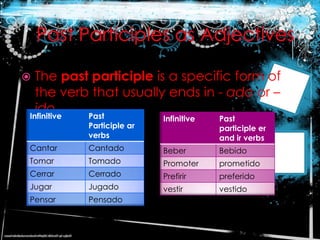
Past Participles as AdjectivesThe past participle is a specific form of the verb that usually ends in - ado or – ido
El Futuro and ir + a + infinitiveThe future tense is used to tell what "will" happen, or what "shall" happen.Add é, -ás, -á, -emos, -éis, -án to the end of initive verb.Hablar:YohablaréTuhablarásÉlhablaráNosotroshablaremosVosotroshablaréisElloshablaránir a + infinitive = to be going to do something (in the near future)Voy a llevar a mi hermana a su casa.I am going to take my sister to her house.Vas a invitar a muchasmuchachas.You are going to invite lots of girls.Cristina va a conversar con mi mamá.Christina is going to talk with my mom.Eduardo va a leer el libro.Edward is going to read the book.
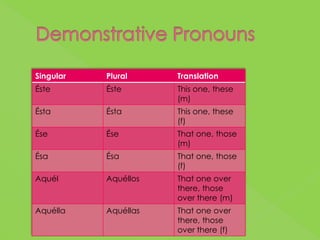
Demonstrative adjectives Demonstrative adjectives describe a nounEste thisEseThat AquelThat one over thereEstos	These
Demonstrative Pronouns
Los  MandatosAffirmative CommandsAn affirmative command is used when ordering, or telling someone to do something. In English, it is the “imperative” form of the verb. The formal commands are used when addressing unfamiliar people with a need to express respect and politeness.Negative CommandsA negative command is used when ordering, or telling someone not to do something. In English, it is the “imperative” form of the verb. The formal commands are used when addressing unfamiliar people with a need to express respect and politenessTo make an affirmative and negative formal command do the following:Take the present tense “yo” form of the verbDrop the –o or –oyendingFor –ar verbs, add an e, for –er and –ir verbs, add an a.
Imperfect tenseImperfected actions in the pastTo conjugate regular -ar verbs in the imperfect, simply drop the ending (-ar) and add one of the following:abaabasabaábamosabaisabanExample:CantarYocantabaTucantabasUd/elle/ellaCantabaNosotrosCantabamosVosotrosCantabaisUds/ellas/elloscantabanTo conjugate regular -er and -ir verbs in the imperfect, simply drop the ending (-er or -ir) and add one of the following:íaíasíaíamosíaisíanExample:EscribirEscrbiaEscribiasEscribiaEscribiamosEscribiasescribian
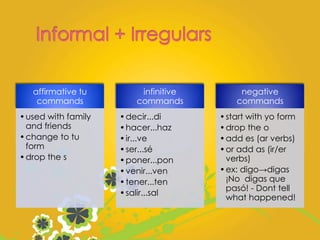
Informal + Irregulars
Formal + irregularsCommands are used when ordering, or telling someone to do something. This is often referred to as the "imperative" form of the verb.CompreUd. el anillo. (You) Buy the ring.HagaUd. la tarea. (You) Do the homework. ComprenUds. los libros. (You-all) Buy the books. Hagan Uds. el trabajo. (You-all) Do the work. Start with the yo form of the present indicative. Then drop the -o ending. Finally, add the following endings: -ar verbs:-e (for Ud.), -en (for Uds.)-er and -ir verbs:-a (for Ud.), -an (for Uds.)Iregulars:Tengan Uds. un buen viaje. (yo tengo) Have a goodtrip.Traiga Ud. el dinero. (yo traigo) Bringthemoney.Venga Ud. conmigo. (yo vengo) Come with me.
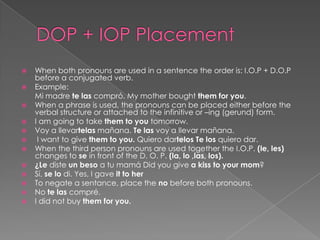
DOP + IOP PlacementWhen both pronouns are used in a sentence the order is: I.O.P + D.O.P before a conjugated verb. Example:	Mi madretelascompró. My mother bought them for you.When a phrase is used, the pronouns can be placed either before the verbal structure or attached to the infinitive or –ing (gerund) form.I am going to take them to you tomorrow. Voy a llevartelasmañana. Te lasvoy a llevarmañana. I want to give them to you.QuierodartelosTe losquierodar. When the third person pronouns are used together the I.O.P. (le, les) changes to se in front of the D. O. P. (la, lo ,las, los).¿Le disteun besoa tumamá Did you give a kiss to your mom? Sí, se lo di. Yes, I gave it to herTo negate a sentance, place the no before both pronouns.No telascompré.I did not buy them for you.
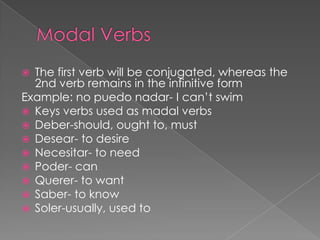
Modal VerbsThe first verb will be conjugated, whereas the 2nd verb remains in the infinitive formExample: no puedonadar- I can’t swimKeys verbs used as madal verbsDeber-should, ought to, mustDesear- to desireNecesitar- to needPoder- canQuerer- to wantSaber- to knowSoler-usually, used to
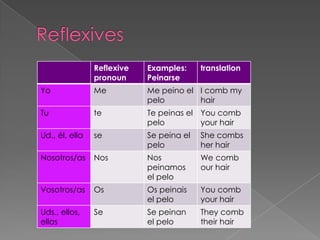
Reflexives
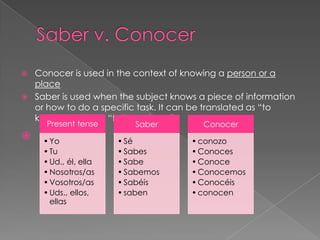
Saber v. ConocerConocer is used in the context of knowing a person or a placeSaber is used when the subject knows a piece of information or how to do a specific task. It can be translated as “to know” as well as “to know how.”

Bianca book 2

  • 1.
    Honors Spanish 2Grammar BookBy: Brenda Jean-Bart
  • 2.
    Table of ContentsSerEstarVerbslike GustarHacer expressionPreteritoTrigger wordsCar, gar, zarSpock verbsCucaracha verbsSnakes and snackeysDopCommandsIrregular verbsIop’sSe impersonalPast Participles as adjectivesEl future and ir + a+ infinitiveDemonstrative adjectivesDemonstrative pronounsLos mandatesImperfect tenseInformal+ irregularsFormal +irregularsDOP +IOP placementModal verbsReflexsivesSaber v. conocer
  • 3.
  • 4.
    Estarar-andoer/ir- endo -yendohealthlocationPresesntlocatonEstaremotionsING
  • 5.
    Verbs like GustarDoler(o-ue)- to hurtFascinar- to fascinateMolestar- to botherEncantar- to loveFaltar- to lack, be in need of Importar- to be important toDisgustar- to disgust
  • 6.
    Hacer ExpressionsHACE +TIME + QUE + CONJUGATED VERBConjuagated verb can be in any tense
  • 7.
  • 8.
  • 9.
    Car, Gar, ZarCarQueCasteCoCamosCasteisCaronGarGueGasteGoGamosGasteisGaronZarCeZasteZoZamoszasteiszaron
  • 10.
    Spock verbsPreterite Conjugationsof Irregular Spock VerbsVerserDarIrHacer
  • 11.
    Cucaracha verbsAndar-anduv -eEstar-Estuv -istePoder-pud -oPoner-pus -imosQuerer-quis -isteisSaber-sup -ieronTener-tuv * “j”verbs i=ieronVenir-vinConducir-condujProducir-produjTraducir-tradujDecir-dijTraer-traj
  • 12.
    Snakes and SnakeysSnakesPederYopediTupedisteElla/el pidioNosotrospedimosVosotrospedisteisEllos/ellaspidieronSnakeysVerbs such as leer, creer, and oir change i to y in 3rd personLeiLeisteLeyoLeimosLeisteisLeisteisleyeron
  • 13.
    DOPs Lo-it masculineLas-itplural and feminineLos –it plural and masculine La- it feminine
  • 14.
    CommandsAffirmative CommandsAn affirmativecommand is used when ordering, or telling someone to do something. In English, it is the “imperative” form of the verb. The formal commands are used when addressing unfamiliar people with a need to express respect and politeness.Negative CommandsA negative command is used when ordering, or telling someone not to do something. In English, it is the “imperative” form of the verb. The formal commands are used when addressing unfamiliar people with a need to express respect and politenessTo make an affirmative and negative formal command do the following:Take the present tense “yo” form of the verbDrop the –o or –oyendingFor –ar verbs, add an e, for –er and –ir verbs, add an a.
  • 15.
    Irregular verbsIrregular AffirmativeFormal CommandThere are only three verbs that have irregular conjugations which are: ir, saber, ser. Ir goes to to ¡Vaya!, saber goes to !Sepa!, and ser goes to ¡Sea!Ex:To tell someone to go to the front of the room say: ¡Vaya al frente de la sala!Irregular Negative Formal CommandThere are only three verbs that have irregular conjugations which are: ir, saber, ser. Ir goes to to ¡Vaya!, saber goes to !Sepa!, and ser goes to ¡Sea!Ex:To tell someone not to be bad say: ¡No sea malo!
  • 16.
    IOPsMe- yoTe- tuLe-el/ella/udLes- ellos/ellas/udsNos- nosotros
  • 17.
    Se impersonalUse seto avoid specifying a person who is doing the action of the verb.Se vendefruta en la frutería.When using se, the verb is always in the 3rd person.Aquí se hablaespañol.Se can be used in all tenses.Se hizo mucho.Se hará mucho.Se habíahecho.
  • 18.
  • 19.
    Past Participles asAdjectivesThe past participle is a specific form of the verb that usually ends in - ado or – ido
  • 20.
    El Futuro andir + a + infinitiveThe future tense is used to tell what "will" happen, or what "shall" happen.Add é, -ás, -á, -emos, -éis, -án to the end of initive verb.Hablar:YohablaréTuhablarásÉlhablaráNosotroshablaremosVosotroshablaréisElloshablaránir a + infinitive = to be going to do something (in the near future)Voy a llevar a mi hermana a su casa.I am going to take my sister to her house.Vas a invitar a muchasmuchachas.You are going to invite lots of girls.Cristina va a conversar con mi mamá.Christina is going to talk with my mom.Eduardo va a leer el libro.Edward is going to read the book.
  • 21.
    Demonstrative adjectives Demonstrativeadjectives describe a nounEste thisEseThat AquelThat one over thereEstos These
  • 22.
  • 23.
    Los MandatosAffirmativeCommandsAn affirmative command is used when ordering, or telling someone to do something. In English, it is the “imperative” form of the verb. The formal commands are used when addressing unfamiliar people with a need to express respect and politeness.Negative CommandsA negative command is used when ordering, or telling someone not to do something. In English, it is the “imperative” form of the verb. The formal commands are used when addressing unfamiliar people with a need to express respect and politenessTo make an affirmative and negative formal command do the following:Take the present tense “yo” form of the verbDrop the –o or –oyendingFor –ar verbs, add an e, for –er and –ir verbs, add an a.
  • 24.
    Imperfect tenseImperfected actionsin the pastTo conjugate regular -ar verbs in the imperfect, simply drop the ending (-ar) and add one of the following:abaabasabaábamosabaisabanExample:CantarYocantabaTucantabasUd/elle/ellaCantabaNosotrosCantabamosVosotrosCantabaisUds/ellas/elloscantabanTo conjugate regular -er and -ir verbs in the imperfect, simply drop the ending (-er or -ir) and add one of the following:íaíasíaíamosíaisíanExample:EscribirEscrbiaEscribiasEscribiaEscribiamosEscribiasescribian
  • 25.
  • 26.
    Formal + irregularsCommandsare used when ordering, or telling someone to do something. This is often referred to as the "imperative" form of the verb.CompreUd. el anillo. (You) Buy the ring.HagaUd. la tarea. (You) Do the homework. ComprenUds. los libros. (You-all) Buy the books. Hagan Uds. el trabajo. (You-all) Do the work. Start with the yo form of the present indicative. Then drop the -o ending. Finally, add the following endings: -ar verbs:-e (for Ud.), -en (for Uds.)-er and -ir verbs:-a (for Ud.), -an (for Uds.)Iregulars:Tengan Uds. un buen viaje. (yo tengo) Have a goodtrip.Traiga Ud. el dinero. (yo traigo) Bringthemoney.Venga Ud. conmigo. (yo vengo) Come with me.
  • 27.
    DOP + IOPPlacementWhen both pronouns are used in a sentence the order is: I.O.P + D.O.P before a conjugated verb. Example: Mi madretelascompró. My mother bought them for you.When a phrase is used, the pronouns can be placed either before the verbal structure or attached to the infinitive or –ing (gerund) form.I am going to take them to you tomorrow. Voy a llevartelasmañana. Te lasvoy a llevarmañana. I want to give them to you.QuierodartelosTe losquierodar. When the third person pronouns are used together the I.O.P. (le, les) changes to se in front of the D. O. P. (la, lo ,las, los).¿Le disteun besoa tumamá Did you give a kiss to your mom? Sí, se lo di. Yes, I gave it to herTo negate a sentance, place the no before both pronouns.No telascompré.I did not buy them for you.
  • 28.
    Modal VerbsThe firstverb will be conjugated, whereas the 2nd verb remains in the infinitive formExample: no puedonadar- I can’t swimKeys verbs used as madal verbsDeber-should, ought to, mustDesear- to desireNecesitar- to needPoder- canQuerer- to wantSaber- to knowSoler-usually, used to
  • 29.
  • 30.
    Saber v. ConocerConoceris used in the context of knowing a person or a placeSaber is used when the subject knows a piece of information or how to do a specific task. It can be translated as “to know” as well as “to know how.”