Spanish 3 Grammatical Concepts Nicholas Arce
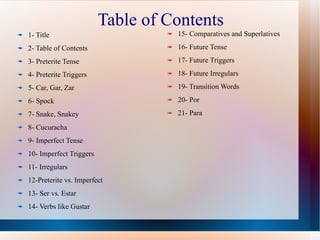
Table of Contents 1- Title 2- Table of Contents 3- Preterite Tense 4- Preterite Triggers 5- Car, Gar, Zar 6- Spock  7- Snake, Snakey 8- Cucuracha  9- Imperfect Tense 10- Imperfect Triggers 11- Irregulars 12-Preterite vs. Imperfect 13- Ser vs. Estar 14- Verbs like Gustar 15- Comparatives and Superlatives 16- Future Tense 17- Future Triggers 18- Future Irregulars 19- Transition Words 20- Por 21- Para
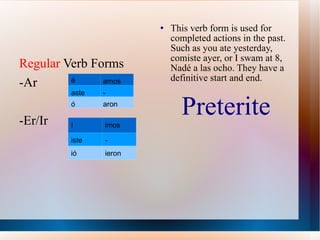
Preterite This verb form is used for completed actions in the past. Such as you ate yesterday, comiste ayer, or I swam at 8, Na d é a las ocho. They have a definitive start and end.  Regular  Verb Forms -Ar -Er/Ir é amos aste - ó aron í imos iste - i ó ieron
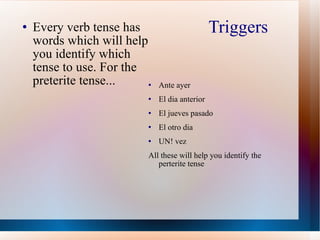
Triggers Every verb tense has words which will help you identify which tense to use. For the preterite tense... Ante ayer El dia anterior El jueves pasado  El otro dia UN! vez All these will help you identify the perterite tense
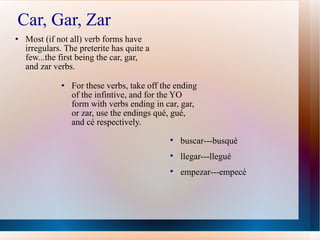
Car, Gar, Zar Most (if not all) verb forms have irregulars. The preterite has quite a few...the first being the car, gar, and zar verbs. For these verbs, take off the ending of the infintive, and for the YO form with verbs en ding in car, gar, or zar, use the endings qu é, gué, and cé respectively. buscar---busqu é llegar---llegué empezar---empecé
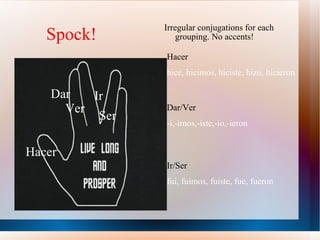
Spock! Irregular conjugations for each grouping. No accents! Hacer Dar Ir Ser Ver Dar/Ver -i,-imos,-iste,-io,-ieron Hacer hice, hicimos, hiciste, hizo, hicieron Ir/Ser fui, fuimos, fuiste, fue, fueron
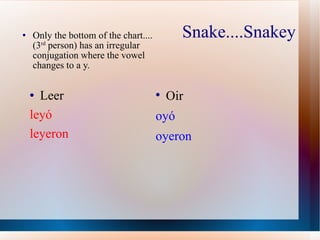
Snake....Snakey Only the bottom of the chart....(3 rd  person) has an irregular conjugation where the vowel changes to a y. Leer le y ó  leyeron Oir oy ó oyeron
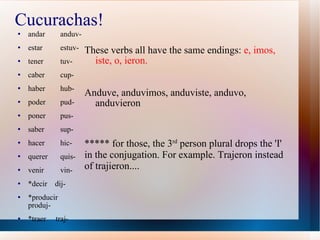
Cucurachas! These verbs all have the same endings:  e, imos, iste, o, ieron. Anduve, anduvimos, anduviste, anduvo, anduvieron andar  anduv- estar  estuv- tener  tuv- caber  cup- haber  hub- poder  pud- poner  pus- saber  sup- hacer  hic- querer  quis- venir  vin- *decir  dij- *producir  produj- *traer  traj- ***** for those, the 3 rd  person plural drops the 'I' in the conjugation. For example. Trajeron instead of trajieron....
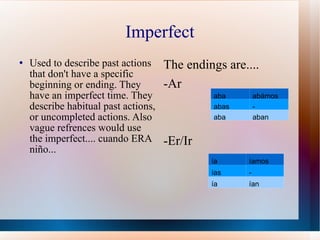
Imperfect Used to describe past actions that don't have a specific beginning or ending. They have an imperfect time. They describe habitual past actions, or uncompleted actions. Also vague refrences would use the imperfect.... cuando ERA niño... The endings are.... -Ar -Er/Ir aba ab á mos abas - aba aban ía íamos ías - ía ían
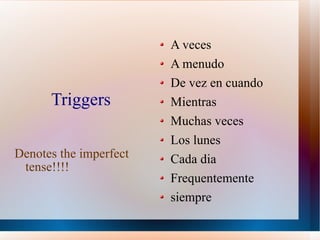
Triggers Denotes the imperfect tense!!!! A veces A menudo De vez en cuando Mientras Muchas veces Los lunes Cada dia Frequentemente siempre
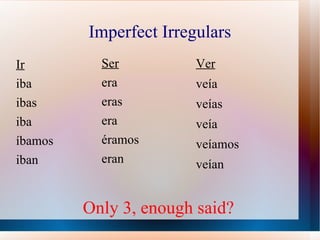
Imperfect Irregulars Ir iba ibas iba íbamos iban Ser era eras era éramos eran Ver veía veías veía veíamos veían Only 3, enough said?
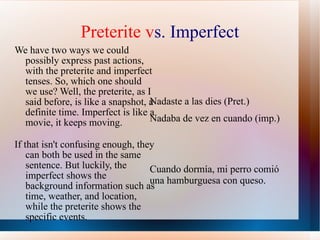
Preterite v s. Imperfect We have two ways we could possibly express past actions, with the preterite and imperfect tenses. So, which one should we use? Well, the preterite, as I said before, is like a snapshot, a definite time. Imperfect is like a movie, it keeps moving.  If that isn't confusing enough, they can both be used in the same sentence. But luckily, the imperfect shows the background information such as time, weather, and location, while the preterite shows the specific events.  Nadaste a las dies (Pret.) Nadaba de vez en cuando (imp.)  Cuando dorm ía, mi perro comió una hamburguesa con queso.
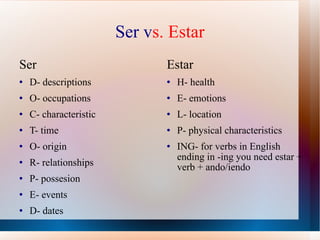
Ser v s.   Estar Ser D- descriptions O- occupations C- characteristic T- time O- origin R- relationships P- possesion E- events D- dates Estar H- health E- emotions L- location P- physical characteristics ING- for verbs in English ending in -ing you need estar + verb + ando/iendo
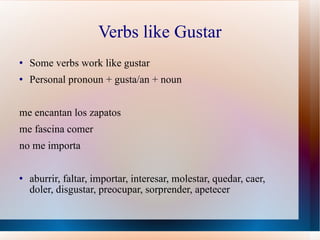
Verbs like Gustar Some verbs work like gustar Personal pronoun + gusta/an + noun me encantan los zapatos me fascina comer  no me importa aburrir, faltar, importar, interesar, molestar, quedar, caer, doler, disgustar, preocupar, sorprender, apetecer
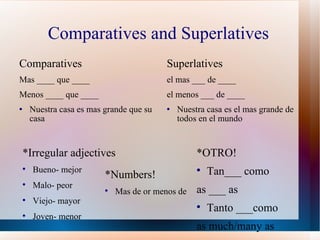
Comparatives and Superlatives Comparatives  Mas ____ que ____ Menos ____ que ____ Nuestra casa es mas grande que su casa Superlatives el mas ___ de ____ el menos ___ de ____ Nuestra casa es el mas grande de todos en el mundo *Irregular adjectives Bueno- mejor Malo- peor Viejo- mayor Joven- menor *Numbers! Mas de or menos de *OTRO! Tan___ como as ___ as Tanto ___como as much/many as
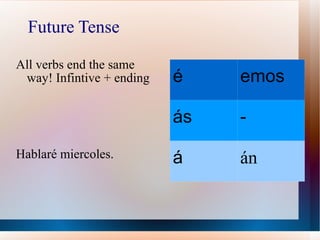
Future Tense All verbs end the same way! Infintive + ending Habl ar é miercoles. é emos ás - á án
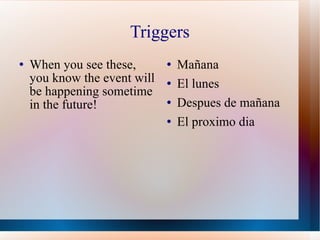
Triggers When you see these, you know the event will be happening sometime in the future! M aña na  El lunes Despues de m añana El proximo dia
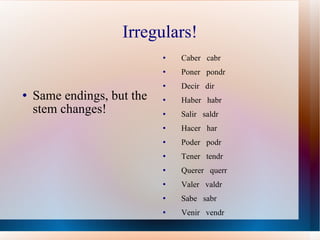
Irregulars! Same endings, but the stem changes! Caber  cabr Poner  pondr Decir  dir Haber  habr Salir  saldr Hacer  har Poder  podr Tener  tendr Querer  querr Valer  valdr Sabe  sabr Venir  vendr
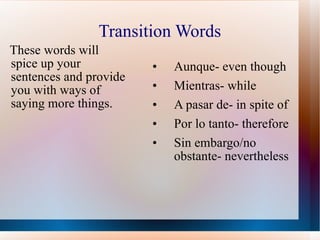
Transition Words These words will spice up your sentences and provide you with ways of saying more things. Aunque- even though Mientras- while A pasar de- in spite of Por lo tanto- therefore Sin embargo/no obstante- nevertheless
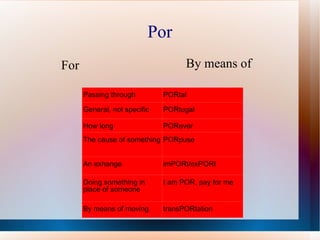
Por For By means of Passing through PORtal General, not specific PORtugal How long PORever The cause of something PORpuse An exhange imPORt/exPORt Doing something in place of someone I am POR, pay for me By means of moving transPORtation
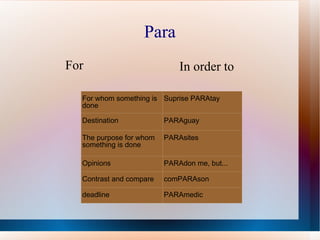
Para For In order to For whom something is done Suprise PARAtay Destination PARAguay The purpose for whom something is done PARAsites Opinions PARAdon me, but... Contrast and compare comPARAson deadline PARAmedic
Grammar Book Sem. 2 Nicholas Arce
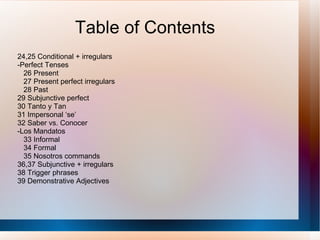
Table of Contents 24,25 Conditional + irregulars -Perfect Tenses 26 Present 27 Present perfect irregulars 28 Past 29 Subjunctive perfect 30 Tanto y Tan 31 Impersonal ‘se’ 32 Saber vs. Conocer -Los Mandatos 33 Informal 34 Formal 35 Nosotros commands 36,37 Subjunctive + irregulars 38 Trigger phrases 39 Demonstrative Adjectives
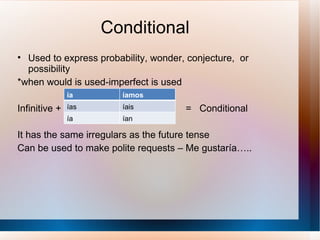
Conditional Used to express probability, wonder, conjecture,  or possibility *when would is used-imperfect is used Infinitive +  =  Conditional It has the same irregulars as the future tense Can be used to make polite requests – Me gustaría….. ía íamos ías íais ía ían
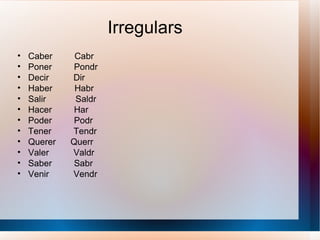
Irregulars Caber  Cabr Poner  Pondr Decir  Dir Haber  Habr Salir  Saldr Hacer  Har Poder  Podr Tener  Tendr Querer  Querr Valer  Valdr Saber  Sabr Venir  Vendr
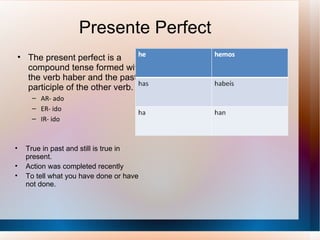
Presente Perfect The present perfect is a compound tense formed with the verb haber and the past participle of the other verb. AR- ado ER- ido IR- ido True in past and still is true in present. Action was completed recently To tell what you have done or have not done.
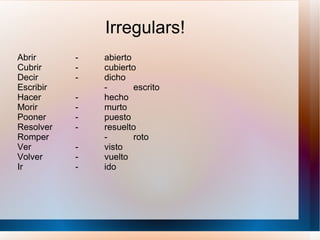
Irregulars! Abrir - abierto Cubrir - cubierto Decir - dicho Escribir - escrito Hacer - hecho Morir - murto Pooner - puesto Resolver - resuelto Romper - roto Ver - visto Volver - vuelto Ir - ido
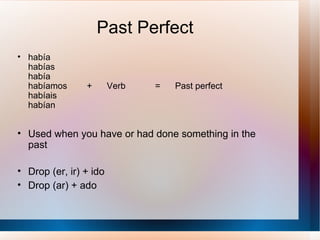
Past Perfect había habías había habíamos  +  Verb  =  Past perfect habíais habían Used when you have or had done something in the past Drop (er, ir) + ido Drop (ar) + ado
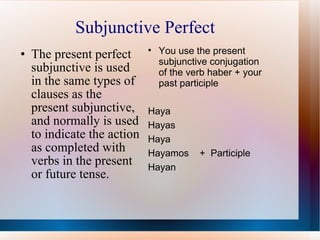
Subjunctive Perfect The present perfect subjunctive is used in the same types of clauses as the present subjunctive, and normally is used to indicate the action as completed with verbs in the present or future tense. You use the present subjunctive conjugation of the verb haber + your past participle Haya Hayas Haya Hayamos  +  Participle Hayan
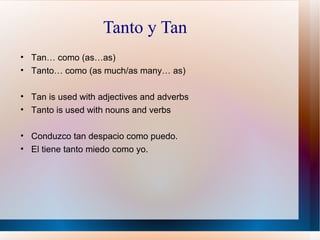
Tanto y Tan Tan… como (as…as) Tanto… como (as much/as many… as) Tan is used with adjectives and adverbs Tanto is used with nouns and verbs Conduzco tan despacio como puedo. El tiene tanto miedo como yo.
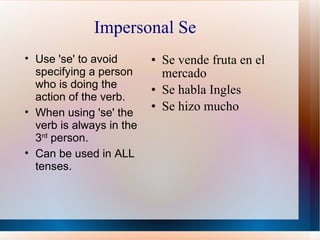
Impersonal Se Se vende fruta en el mercado Se habla Ingles Se hizo mucho Use 'se' to avoid specifying a person who is doing the action of the verb. When using 'se' the verb is always in the 3 rd  person. Can be used in ALL tenses.
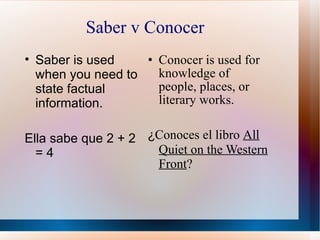
Saber v Conocer Conocer is used for knowledge of people, places, or literary works. ¿ Conoces el libro  All Quiet on the Western Front ? Saber is used when you need to state factual information. Ella sabe que 2 + 2 = 4
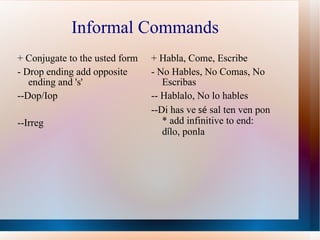
Informal Commands + Conjugate to the usted form - Drop ending add opposite ending and 's' --Dop/Iop --Irreg + Habla, Come, Escribe - No Hables, No Comas, No Escribas -- Hablalo, No lo hables --Di has ve  s é  sal ten ven pon * add infinitive to end: d í lo, ponla
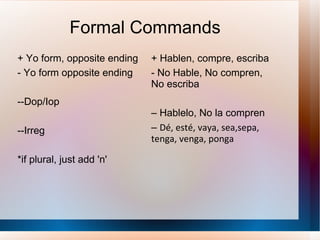
Formal Commands + Yo form, opposite ending - Yo form opposite ending --Dop/Iop --Irreg *if plural, just add 'n' + Hablen, compre, escriba - No Hable, No compren, No escriba –  Hablelo, No la compren –  D é, esté, vaya, sea,sepa, tenga, venga, ponga
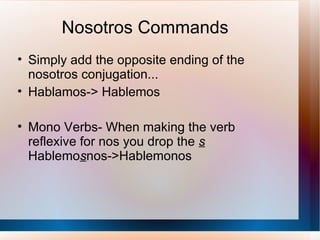
Nosotros Commands Simply add the opposite ending of the nosotros conjugation... Hablamos-> Hablemos Mono Verbs- When making the verb reflexive for nos you drop the  s   Hablemo s nos->Hablemonos
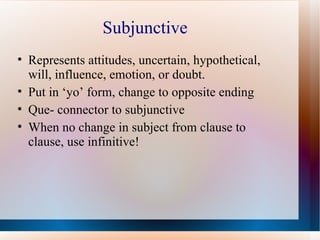
Subjunctive Represents attitudes, uncertain, hypothetical, will, influence, emotion, or doubt. Put in ‘yo’ form, change to opposite ending Que- connector to subjunctive When no change in subject from clause to clause, use infinitive!
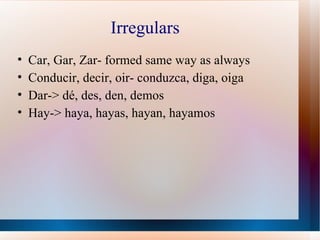
Irregulars Car, Gar, Zar- formed same way as always Conducir, decir, oir- conduzca, diga, oiga Dar-> dé, des, den, demos Hay-> haya, hayas, hayan, hayamos
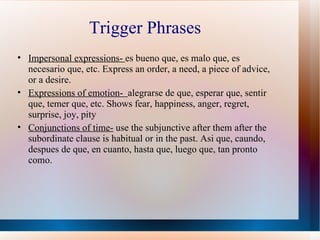
Trigger Phrases Impersonal expressions-  es bueno que, es malo que, es necesario que, etc. Express an order, a need, a piece of advice, or a desire.  Expressions of emotion-  alegrarse de que, esperar que, sentir que, temer que, etc. Shows fear, happiness, anger, regret, surprise, joy, pity Conjunctions of time-  use the subjunctive after them after the subordinate clause is habitual or in the past. Asi que, caundo, despues de que, en cuanto, hasta que, luego que, tan pronto como.
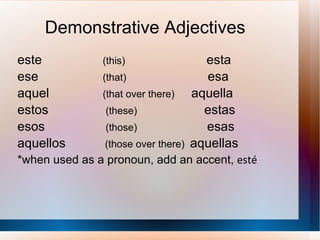
Demonstrative Adjectives este  (this)  esta ese  (that)  esa aquel  (that over there)  aquella estos  (these)  estas esos  (those)  esas aquellos  (those over there)  aquellas *when used as a pronoun, add an accent,  est é

Spanish 3 Grammar Notebook sem 1 and 2

  • 1.
    Spanish 3 GrammaticalConcepts Nicholas Arce
  • 2.
    Table of Contents1- Title 2- Table of Contents 3- Preterite Tense 4- Preterite Triggers 5- Car, Gar, Zar 6- Spock 7- Snake, Snakey 8- Cucuracha 9- Imperfect Tense 10- Imperfect Triggers 11- Irregulars 12-Preterite vs. Imperfect 13- Ser vs. Estar 14- Verbs like Gustar 15- Comparatives and Superlatives 16- Future Tense 17- Future Triggers 18- Future Irregulars 19- Transition Words 20- Por 21- Para
  • 3.
    Preterite This verbform is used for completed actions in the past. Such as you ate yesterday, comiste ayer, or I swam at 8, Na d é a las ocho. They have a definitive start and end. Regular Verb Forms -Ar -Er/Ir é amos aste - ó aron í imos iste - i ó ieron
  • 4.
    Triggers Every verbtense has words which will help you identify which tense to use. For the preterite tense... Ante ayer El dia anterior El jueves pasado El otro dia UN! vez All these will help you identify the perterite tense
  • 5.
    Car, Gar, ZarMost (if not all) verb forms have irregulars. The preterite has quite a few...the first being the car, gar, and zar verbs. For these verbs, take off the ending of the infintive, and for the YO form with verbs en ding in car, gar, or zar, use the endings qu é, gué, and cé respectively. buscar---busqu é llegar---llegué empezar---empecé
  • 6.
    Spock! Irregular conjugationsfor each grouping. No accents! Hacer Dar Ir Ser Ver Dar/Ver -i,-imos,-iste,-io,-ieron Hacer hice, hicimos, hiciste, hizo, hicieron Ir/Ser fui, fuimos, fuiste, fue, fueron
  • 7.
    Snake....Snakey Only thebottom of the chart....(3 rd person) has an irregular conjugation where the vowel changes to a y. Leer le y ó leyeron Oir oy ó oyeron
  • 8.
    Cucurachas! These verbsall have the same endings: e, imos, iste, o, ieron. Anduve, anduvimos, anduviste, anduvo, anduvieron andar anduv- estar estuv- tener tuv- caber cup- haber hub- poder pud- poner pus- saber sup- hacer hic- querer quis- venir vin- *decir dij- *producir produj- *traer traj- ***** for those, the 3 rd person plural drops the 'I' in the conjugation. For example. Trajeron instead of trajieron....
  • 9.
    Imperfect Used todescribe past actions that don't have a specific beginning or ending. They have an imperfect time. They describe habitual past actions, or uncompleted actions. Also vague refrences would use the imperfect.... cuando ERA niño... The endings are.... -Ar -Er/Ir aba ab á mos abas - aba aban ía íamos ías - ía ían
  • 10.
    Triggers Denotes theimperfect tense!!!! A veces A menudo De vez en cuando Mientras Muchas veces Los lunes Cada dia Frequentemente siempre
  • 11.
    Imperfect Irregulars Iriba ibas iba íbamos iban Ser era eras era éramos eran Ver veía veías veía veíamos veían Only 3, enough said?
  • 12.
    Preterite v s.Imperfect We have two ways we could possibly express past actions, with the preterite and imperfect tenses. So, which one should we use? Well, the preterite, as I said before, is like a snapshot, a definite time. Imperfect is like a movie, it keeps moving. If that isn't confusing enough, they can both be used in the same sentence. But luckily, the imperfect shows the background information such as time, weather, and location, while the preterite shows the specific events. Nadaste a las dies (Pret.) Nadaba de vez en cuando (imp.) Cuando dorm ía, mi perro comió una hamburguesa con queso.
  • 13.
    Ser v s. Estar Ser D- descriptions O- occupations C- characteristic T- time O- origin R- relationships P- possesion E- events D- dates Estar H- health E- emotions L- location P- physical characteristics ING- for verbs in English ending in -ing you need estar + verb + ando/iendo
  • 14.
    Verbs like GustarSome verbs work like gustar Personal pronoun + gusta/an + noun me encantan los zapatos me fascina comer no me importa aburrir, faltar, importar, interesar, molestar, quedar, caer, doler, disgustar, preocupar, sorprender, apetecer
  • 15.
    Comparatives and SuperlativesComparatives Mas ____ que ____ Menos ____ que ____ Nuestra casa es mas grande que su casa Superlatives el mas ___ de ____ el menos ___ de ____ Nuestra casa es el mas grande de todos en el mundo *Irregular adjectives Bueno- mejor Malo- peor Viejo- mayor Joven- menor *Numbers! Mas de or menos de *OTRO! Tan___ como as ___ as Tanto ___como as much/many as
  • 16.
    Future Tense Allverbs end the same way! Infintive + ending Habl ar é miercoles. é emos ás - á án
  • 17.
    Triggers When yousee these, you know the event will be happening sometime in the future! M aña na El lunes Despues de m añana El proximo dia
  • 18.
    Irregulars! Same endings,but the stem changes! Caber cabr Poner pondr Decir dir Haber habr Salir saldr Hacer har Poder podr Tener tendr Querer querr Valer valdr Sabe sabr Venir vendr
  • 19.
    Transition Words Thesewords will spice up your sentences and provide you with ways of saying more things. Aunque- even though Mientras- while A pasar de- in spite of Por lo tanto- therefore Sin embargo/no obstante- nevertheless
  • 20.
    Por For Bymeans of Passing through PORtal General, not specific PORtugal How long PORever The cause of something PORpuse An exhange imPORt/exPORt Doing something in place of someone I am POR, pay for me By means of moving transPORtation
  • 21.
    Para For Inorder to For whom something is done Suprise PARAtay Destination PARAguay The purpose for whom something is done PARAsites Opinions PARAdon me, but... Contrast and compare comPARAson deadline PARAmedic
  • 22.
    Grammar Book Sem.2 Nicholas Arce
  • 23.
    Table of Contents24,25 Conditional + irregulars -Perfect Tenses 26 Present 27 Present perfect irregulars 28 Past 29 Subjunctive perfect 30 Tanto y Tan 31 Impersonal ‘se’ 32 Saber vs. Conocer -Los Mandatos 33 Informal 34 Formal 35 Nosotros commands 36,37 Subjunctive + irregulars 38 Trigger phrases 39 Demonstrative Adjectives
  • 24.
    Conditional Used toexpress probability, wonder, conjecture, or possibility *when would is used-imperfect is used Infinitive + = Conditional It has the same irregulars as the future tense Can be used to make polite requests – Me gustaría….. ía íamos ías íais ía ían
  • 25.
    Irregulars Caber Cabr Poner Pondr Decir Dir Haber Habr Salir Saldr Hacer Har Poder Podr Tener Tendr Querer Querr Valer Valdr Saber Sabr Venir Vendr
  • 26.
    Presente Perfect Thepresent perfect is a compound tense formed with the verb haber and the past participle of the other verb. AR- ado ER- ido IR- ido True in past and still is true in present. Action was completed recently To tell what you have done or have not done.
  • 27.
    Irregulars! Abrir -abierto Cubrir - cubierto Decir - dicho Escribir - escrito Hacer - hecho Morir - murto Pooner - puesto Resolver - resuelto Romper - roto Ver - visto Volver - vuelto Ir - ido
  • 28.
    Past Perfect habíahabías había habíamos + Verb = Past perfect habíais habían Used when you have or had done something in the past Drop (er, ir) + ido Drop (ar) + ado
  • 29.
    Subjunctive Perfect Thepresent perfect subjunctive is used in the same types of clauses as the present subjunctive, and normally is used to indicate the action as completed with verbs in the present or future tense. You use the present subjunctive conjugation of the verb haber + your past participle Haya Hayas Haya Hayamos + Participle Hayan
  • 30.
    Tanto y TanTan… como (as…as) Tanto… como (as much/as many… as) Tan is used with adjectives and adverbs Tanto is used with nouns and verbs Conduzco tan despacio como puedo. El tiene tanto miedo como yo.
  • 31.
    Impersonal Se Sevende fruta en el mercado Se habla Ingles Se hizo mucho Use 'se' to avoid specifying a person who is doing the action of the verb. When using 'se' the verb is always in the 3 rd person. Can be used in ALL tenses.
  • 32.
    Saber v ConocerConocer is used for knowledge of people, places, or literary works. ¿ Conoces el libro All Quiet on the Western Front ? Saber is used when you need to state factual information. Ella sabe que 2 + 2 = 4
  • 33.
    Informal Commands +Conjugate to the usted form - Drop ending add opposite ending and 's' --Dop/Iop --Irreg + Habla, Come, Escribe - No Hables, No Comas, No Escribas -- Hablalo, No lo hables --Di has ve s é sal ten ven pon * add infinitive to end: d í lo, ponla
  • 34.
    Formal Commands +Yo form, opposite ending - Yo form opposite ending --Dop/Iop --Irreg *if plural, just add 'n' + Hablen, compre, escriba - No Hable, No compren, No escriba – Hablelo, No la compren – D é, esté, vaya, sea,sepa, tenga, venga, ponga
  • 35.
    Nosotros Commands Simplyadd the opposite ending of the nosotros conjugation... Hablamos-> Hablemos Mono Verbs- When making the verb reflexive for nos you drop the s Hablemo s nos->Hablemonos
  • 36.
    Subjunctive Represents attitudes,uncertain, hypothetical, will, influence, emotion, or doubt. Put in ‘yo’ form, change to opposite ending Que- connector to subjunctive When no change in subject from clause to clause, use infinitive!
  • 37.
    Irregulars Car, Gar,Zar- formed same way as always Conducir, decir, oir- conduzca, diga, oiga Dar-> dé, des, den, demos Hay-> haya, hayas, hayan, hayamos
  • 38.
    Trigger Phrases Impersonalexpressions- es bueno que, es malo que, es necesario que, etc. Express an order, a need, a piece of advice, or a desire. Expressions of emotion- alegrarse de que, esperar que, sentir que, temer que, etc. Shows fear, happiness, anger, regret, surprise, joy, pity Conjunctions of time- use the subjunctive after them after the subordinate clause is habitual or in the past. Asi que, caundo, despues de que, en cuanto, hasta que, luego que, tan pronto como.
  • 39.
    Demonstrative Adjectives este (this) esta ese (that) esa aquel (that over there) aquella estos (these) estas esos (those) esas aquellos (those over there) aquellas *when used as a pronoun, add an accent, est é