Jaclyn Regnery
Table of Contents
   1. Nacionalidades                13. Preterite
   2. Stem Changing Verbs           14. Deber and Infinitive
   3. Indirect Object Pronouns      15. Modal Verbs
   4. Pronoun Placement             16. Present Progressives
   5. Gustar                        17. Adverbs
   6. Affirmative and Negative
    Words
   7. Superlatives
   8. Reflexives
   9. Affirmative Commands
   10. Negative Command
   11. Irregulars
   12. Sequencing Events
Stem Changing Verbs
   o>ue   Almorzar   almuerzo     almorzamos
                      almuerzas almorzaís
                      almuerza     almuerzan
   e>I    Pedir      pido     pedimos
                      pides    pedís
                      pide     piden
   e>ie   Pensar       pienso     pensamos
                      piensas     pensaís
                      piensa     piensan
Indirect Object Pronouns

  Singular                      Plural
  Me                    Nos
  me                    us

  Te                    Os
  familiar you          familiar you

  Le                    Les
  formal you, him/her   you, them
Pronoun Placement
   Affirmative Command
        When using an object pronoun, attach the pronoun to the end of the
    command.
                  Cruza el parque > ¡Crúzalo!
   Negative Command
          Object pronouns precede the verbs in negative commands, just as with
    other         conjugated verbs.
                  ¡No lo uses! > Don‟t use it
   Indirect Object Pronouns/ Direct Object Pronouns can go in four
    places:
       Before conjugated verb
       Attach to an infinitive
       Attach to a gerrund
Gustar

  Singular     Plural
  Me gusta…         Me gustan…
  Te gusta…    Te gustan…
  Le gusta…    Le gustan…
  Nos gusta…        Nos gustan…

  Os gusta…        Os gustan…
  Les gusta…       Les gustan…
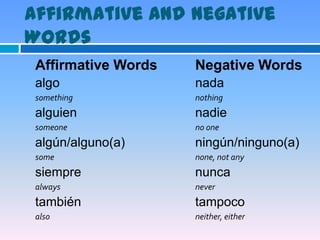
Affirmative and Negative
Words
 Affirmative Words   Negative Words
 algo                nada
 something           nothing
 alguien             nadie
 someone             no one
 algún/alguno(a)     ningún/ninguno(a)
 some                none, not any
 siempre             nunca
 always              never
 también             tampoco
 also                neither, either
Superlatives
 To express extremes with most adjectives, drop
 the final vowel and add the ending –ísimo(a).
 The adjective must agree in gender and number
 with the noun it modifies.
          c>qu        rico(a)>riquísimo(a)
          g>gu        largo(a)>larguísimao(a)
          z>c         feliz>felicísimo(a)
 La idea de Guillermina es interesantisima.
 Guillermina’s idea is very interesting.
Reflexives
   Reflexive pronouns are used with reflexive verbs
    to indicate that the subject of the sentence
    receives the action of the verb.
             Me lavo        Nos lavamos
             Te lavas       Os lavaís
             Se lava        Se lavan
   When there is no reflexive pronoun, the person
    doing the action does not receive the action.
             Pepa se lava.                 Pepa lava el carro.
             Pepa washes herself.   Pepa washes the car.
Affirmative Commands
   Give instructions or commands to someone by
    using the affirmative tú commands of regular
    verbs.
        Caminar:       ¡Camina!
                       ¡Camina en el parque!
        Comer:                ¡Come!
                       ¡Come toda la hamburguesa!
        Abrir:         ¡Abre!
                       ¡Abre la puerta, quiero entrar!
   Drop the „s‟
Negative Commands
   When you tell someone what not to do, you use a
    negative command.
   They are formed by
       Hablo < -es for –ar verbs
       ¡No hables!
       Vuelvo < -as for -er and –ir verbs
       ¡No vuelvas!
         Taking the yo form of the present tense
         Dropping the -o
         Adding the appropriate ending and adding „s‟
                    ar>e
                    ir, er>a
Irregulars
   Affirmative                  Negative
    Infinitive    Command         Infinitive (yo form) Command
    decir               di        tener (tengo)            No
    hacer         haz             tengas
    ir            ve              venir (veno)      No venas
    poner         pon             dar (doy)         No dé/digas
    salir         sal             ir (voy)          No vayas
    ser           sé              ser (soy)         No seas
    tener               ten       hacer (hago)             No
                                  hagas
    venir               ven
                                  estar (estoy)            No
                                  estés
                                  saber (sepo)             No
Sequencing Events

Primero                     First
Entonces                    Then
Segundo                     Second
Luego/Después               Then/After
Por Fin                     Finally
Antes de/Después de         Before/After
Por la maňana/tarde/noche   In the
 morning/afternoon/night
Preterite        =Past Tense

       ar                      er/ir
    e       amos        i              imos
    aste                iste
    o       aron        io             ieron

Hable               Escribi
     Hablamos             Escribimos
Hablaste            Escribiste
Hablo               Escribio    Escribieron
     Hablaron
Trigger Words
-Gar, -Car, -Zar
    In order to preserve the sound of the infinitive, an number of verbs
     change spelling in the preterite tense. The following changes occur
     in the “yo” form only.

-gar                   gue
• Colgar, jugar, llegar, pagar, plegar, regar, rogar, tragar, vagar

-car                   que
• Buscar, clarificar, clasificar, destacar, empacar, justificar,
  practicar, sacar, tocar
-zar                   ce
• Almorzar, autorizar, cazar, comenzar, cruzar, empezar, forzar,
  organizar, simbolizar
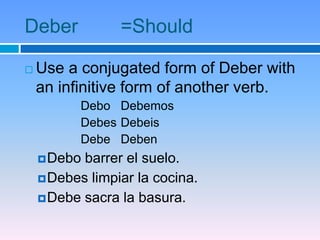
Deber            =Should

   Use a conjugated form of Deber with
    an infinitive form of another verb.
           Debo Debemos
           Debes Debeis
           Debe Deben
     Debo barrer el suelo.
     Debes limpiar la cocina.
     Debe sacra la basura.
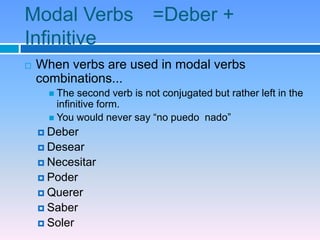
Modal Verbs =Deber +
Infinitive
   When verbs are used in modal verbs
    combinations...
       The   second verb is not conjugated but rather left in the
        infinitive form.
       You would never say “no puedo nado”
     Deber
     Desear
     Necesitar
     Poder
     Querer
     Saber
     Soler
Present Progressives
   When you use pronouns with the present
    progressive, you can put them in either in front
    of the conjugated form of estar or attach them
    to the end of the present participle.
   When the stem of an –er or –ir verbs ends in a
    vowel, change the –iendo or –yendo to form
    the present participle.
       -ar        -ando
       -er/-ir    -iendo
Adverbs
   Irregular Adverbs:
   Mucho– alot
   Muy– very            You can
   Mal– bad
   Bien– good/well
                         change an
   Ya– already          adjective to an
   Tan– so              adverb by
   Demasiado– too       adding –
   Nunca– never
   Poco– little
                         mente.
   Peer- worse
   Siempre- already

Grammar book hsp2

  • 1.
  • 2.
    Table of Contents  1. Nacionalidades  13. Preterite  2. Stem Changing Verbs  14. Deber and Infinitive  3. Indirect Object Pronouns  15. Modal Verbs  4. Pronoun Placement  16. Present Progressives  5. Gustar  17. Adverbs  6. Affirmative and Negative Words  7. Superlatives  8. Reflexives  9. Affirmative Commands  10. Negative Command  11. Irregulars  12. Sequencing Events
  • 4.
    Stem Changing Verbs  o>ue Almorzar almuerzo almorzamos almuerzas almorzaís almuerza almuerzan  e>I Pedir pido pedimos pides pedís pide piden  e>ie Pensar pienso pensamos piensas pensaís piensa piensan
  • 5.
    Indirect Object Pronouns Singular Plural Me Nos me us Te Os familiar you familiar you Le Les formal you, him/her you, them
  • 6.
    Pronoun Placement  Affirmative Command When using an object pronoun, attach the pronoun to the end of the command. Cruza el parque > ¡Crúzalo!  Negative Command Object pronouns precede the verbs in negative commands, just as with other conjugated verbs. ¡No lo uses! > Don‟t use it  Indirect Object Pronouns/ Direct Object Pronouns can go in four places:  Before conjugated verb  Attach to an infinitive  Attach to a gerrund
  • 7.
    Gustar Singular Plural Me gusta… Me gustan… Te gusta… Te gustan… Le gusta… Le gustan… Nos gusta… Nos gustan… Os gusta… Os gustan… Les gusta… Les gustan…
  • 8.
    Affirmative and Negative Words Affirmative Words Negative Words algo nada something nothing alguien nadie someone no one algún/alguno(a) ningún/ninguno(a) some none, not any siempre nunca always never también tampoco also neither, either
  • 9.
    Superlatives To expressextremes with most adjectives, drop the final vowel and add the ending –ísimo(a). The adjective must agree in gender and number with the noun it modifies. c>qu rico(a)>riquísimo(a) g>gu largo(a)>larguísimao(a) z>c feliz>felicísimo(a) La idea de Guillermina es interesantisima. Guillermina’s idea is very interesting.
  • 10.
    Reflexives  Reflexive pronouns are used with reflexive verbs to indicate that the subject of the sentence receives the action of the verb. Me lavo Nos lavamos Te lavas Os lavaís Se lava Se lavan  When there is no reflexive pronoun, the person doing the action does not receive the action. Pepa se lava. Pepa lava el carro. Pepa washes herself. Pepa washes the car.
  • 11.
    Affirmative Commands  Give instructions or commands to someone by using the affirmative tú commands of regular verbs. Caminar: ¡Camina! ¡Camina en el parque! Comer: ¡Come! ¡Come toda la hamburguesa! Abrir: ¡Abre! ¡Abre la puerta, quiero entrar!  Drop the „s‟
  • 12.
    Negative Commands  When you tell someone what not to do, you use a negative command.  They are formed by Hablo < -es for –ar verbs ¡No hables! Vuelvo < -as for -er and –ir verbs ¡No vuelvas!  Taking the yo form of the present tense  Dropping the -o  Adding the appropriate ending and adding „s‟  ar>e  ir, er>a
  • 13.
    Irregulars  Affirmative  Negative Infinitive Command Infinitive (yo form) Command decir di tener (tengo) No hacer haz tengas ir ve venir (veno) No venas poner pon dar (doy) No dé/digas salir sal ir (voy) No vayas ser sé ser (soy) No seas tener ten hacer (hago) No hagas venir ven estar (estoy) No estés saber (sepo) No
  • 14.
    Sequencing Events Primero First Entonces Then Segundo Second Luego/Después Then/After Por Fin Finally Antes de/Después de Before/After Por la maňana/tarde/noche In the morning/afternoon/night
  • 15.
    Preterite =Past Tense ar er/ir e amos i imos aste iste o aron io ieron Hable Escribi Hablamos Escribimos Hablaste Escribiste Hablo Escribio Escribieron Hablaron
  • 16.
  • 17.
    -Gar, -Car, -Zar  In order to preserve the sound of the infinitive, an number of verbs change spelling in the preterite tense. The following changes occur in the “yo” form only. -gar gue • Colgar, jugar, llegar, pagar, plegar, regar, rogar, tragar, vagar -car que • Buscar, clarificar, clasificar, destacar, empacar, justificar, practicar, sacar, tocar -zar ce • Almorzar, autorizar, cazar, comenzar, cruzar, empezar, forzar, organizar, simbolizar
  • 18.
    Deber =Should  Use a conjugated form of Deber with an infinitive form of another verb. Debo Debemos Debes Debeis Debe Deben  Debo barrer el suelo.  Debes limpiar la cocina.  Debe sacra la basura.
  • 19.
    Modal Verbs =Deber+ Infinitive  When verbs are used in modal verbs combinations...  The second verb is not conjugated but rather left in the infinitive form.  You would never say “no puedo nado”  Deber  Desear  Necesitar  Poder  Querer  Saber  Soler
  • 20.
    Present Progressives  When you use pronouns with the present progressive, you can put them in either in front of the conjugated form of estar or attach them to the end of the present participle.  When the stem of an –er or –ir verbs ends in a vowel, change the –iendo or –yendo to form the present participle.  -ar -ando  -er/-ir -iendo
  • 21.
    Adverbs  Irregular Adverbs:  Mucho– alot  Muy– very You can  Mal– bad  Bien– good/well change an  Ya– already adjective to an  Tan– so adverb by  Demasiado– too adding –  Nunca– never  Poco– little mente.  Peer- worse  Siempre- already