Juan Minter
• Nacionalidades
• Stem Changing Verbs
• Para
• Indirect Object Pronouns
• Pronoun placement
• Gustar
• Affirmative and Negative Words
• Superlatives
• Reflexives
• Affirmative tu commands + Irregulars + Pronoun Placement
• Negative tu commands + Irregulars + Pronoun Placement
• Sequencing Events
• Preterite
• Trigger words
• -car, -gar, -zar
• Deber+infinitive
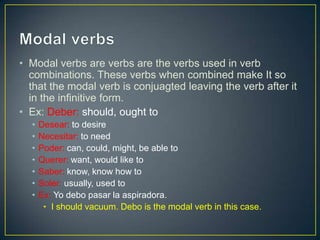
• Modal verbs
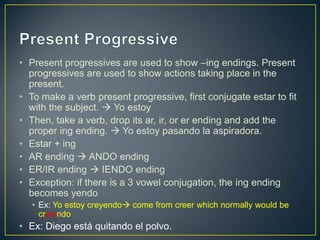
• Present progressive
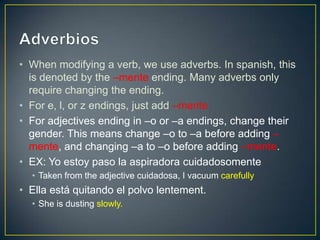
• Adverbios
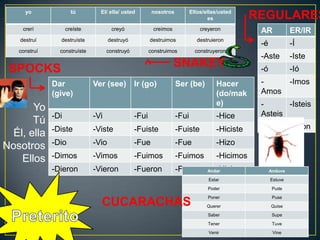
• Preterite in your face
• Demonstrative adjectives and pronouns
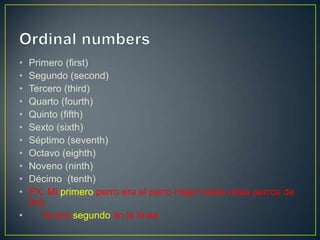
• Ordinal numbers
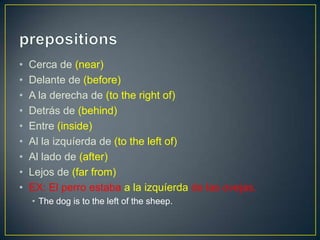
• Prepositions
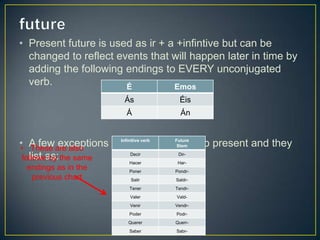
• Future tense
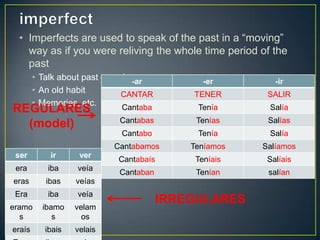
• Imperfect
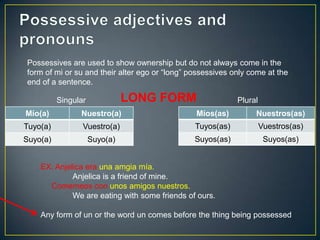
• Possessive adjectives and pronouns
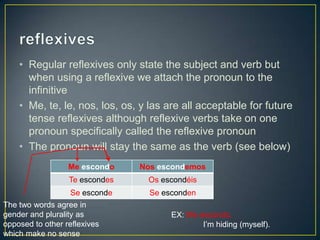
• reflexives
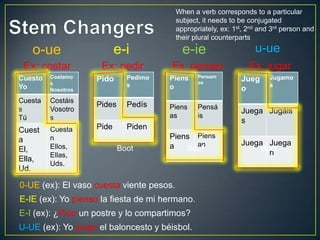
Cuesto
Yo
Costamo
s
Nosotros
Cuesta
s
Tú
Costáis
Vosotro
s
Cuest
a
El,
Ella,
Ud.
Cuesta
n
Ellos,
Ellas,
Uds.
o-ue e-i e-ie u-ue
Pido Pedimo
s
Pides Pedís
Pide Piden
Piens
o
Pensam
os
Piens
as
Pensá
is
Piens
a
Piens
an
Jueg
o
Jugamo
s
Juega
s
Jugáis
Juega Juega
n
Ex: costar Ex: pedir Ex: pensar Ex: jugar
Boot BootBoot
0-UE (ex): El vaso cuesta viente pesos.
E-IE (ex): Yo pienso la fiesta de mi hermano.
E-I (ex): ¿Pido un postre y lo compartimos?
U-UE (ex): Yo juego el baloncesto y béisbol.
When a verb corresponds to a particular
subject, it needs to be conjugated
appropriately, ex: 1st, 2nd and 3rd person and
their plural counterparts
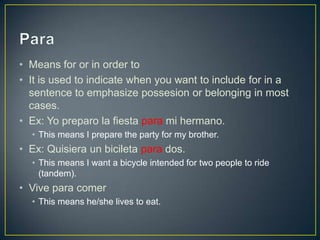
• Means for or in order to
• It is used to indicate when you want to include for in a
sentence to emphasize possesion or belonging in most
cases.
• Ex: Yo preparo la fiesta para mi hermano.
• This means I prepare the party for my brother.
• Ex: Quisiera un bicileta para dos.
• This means I want a bicycle intended for two people to ride
(tandem).
• Vive para comer
• This means he/she lives to eat.
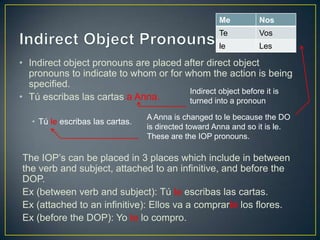
• Indirect object pronouns are placed after direct object
pronouns to indicate to whom or for whom the action is being
specified.
• Tú escribas las cartas a Anna.
• Tú le escribas las cartas.
The IOP‟s can be placed in 3 places which include in between
the verb and subject, attached to an infinitive, and before the
DOP.
Ex (between verb and subject): Tú le escribas las cartas.
Ex (attached to an infinitive): Ellos va a comprarte los flores.
Ex (before the DOP): Yo te lo compro.
Indirect object before it is
turned into a pronoun
Me Nos
Te Vos
le Les
A Anna is changed to le because the DO
is directed toward Anna and so it is le.
These are the IOP pronouns.
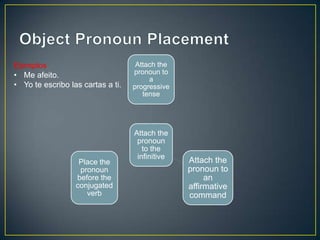
Attach the
pronoun
to the
infinitive
Attach the
pronoun to
a
progressive
tense
Attach the
pronoun to
an
affirmative
command
Place the
pronoun
before the
conjugated
verb
Ejemplos
• Me afeito.
• Yo te escribo las cartas a ti.
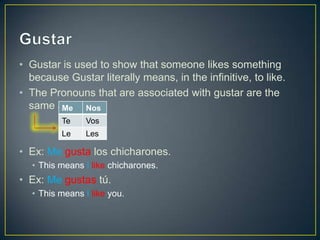
• Gustar is used to show that someone likes something
because Gustar literally means, in the infinitive, to like.
• The Pronouns that are associated with gustar are the
same as IOPs.
• Ex: Me gusta los chicharones.
• This means I like chicharones.
• Ex: Me gustas tú.
• This means I like you.
Me Nos
Te Vos
Le Les
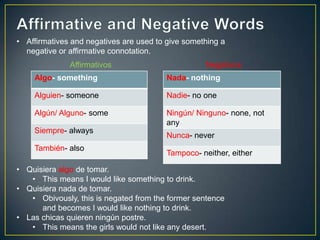
Algo- something
Alguien- someone
Algún/ Alguno- some
Siempre- always
También- also
Affirmativos Negativos
Nada- nothing
Nadie- no one
Ningún/ Ninguno- none, not
any
Nunca- never
Tampoco- neither, either
• Affirmatives and negatives are used to give something a
negative or affirmative connotation.
• Quisiera algo de tomar.
• This means I would like something to drink.
• Quisiera nada de tomar.
• Obivously, this is negated from the former sentence
and becomes I would like nothing to drink.
• Las chicas quieren ningún postre.
• This means the girls would not like any desert.
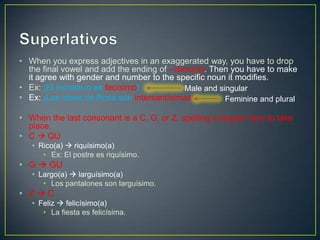
• When you express adjectives in an exaggerated way, you have to drop
the final vowel and add the ending of –ísimo(a). Then you have to make
it agree with gender and number to the specific noun it modifies.
• Ex: ¡El monstruo es feoísimo!
• Ex: ¡Las ideas de Rosa son intersantísimas!
• When the last consonant is a C, G, or Z, spelling changes have to take
place.
• C  QU
• Rico(a)  riquísimo(a)
• Ex: El postre es riquísimo.
• G  GU
• Largo(a)  larguísimo(a)
• Los pantalones son larguísimo.
• Z  C
• Feliz  felicísimo(a)
• La fiesta es felicísima.
Male and singular
Feminine and plural
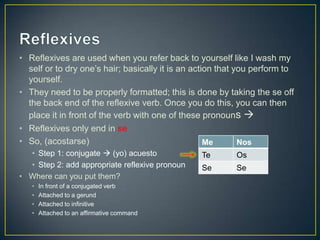
• Reflexives are used when you refer back to yourself like I wash my
self or to dry one‟s hair; basically it is an action that you perform to
yourself.
• They need to be properly formatted; this is done by taking the se off
the back end of the reflexive verb. Once you do this, you can then
place it in front of the verb with one of these pronouns 
• Reflexives only end in se
• So, (acostarse)
• Step 1: conjugate  (yo) acuesto
• Step 2: add appropriate reflexive pronoun
• Where can you put them?
• In front of a conjugated verb
• Attached to a gerund
• Attached to infinitive
• Attached to an affirmative command
Me Nos
Te Os
Se Se
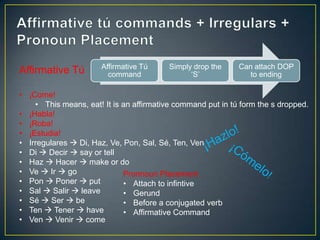
Affirmative Tú
command
Simply drop the
„S‟
Can attach DOP
to endingAffirmative Tú
• ¡Come!
• This means, eat! It is an affirmative command put in tú form the s dropped.
• ¡Habla!
• ¡Roba!
• ¡Estudia!
• Irregulares  Di, Haz, Ve, Pon, Sal, Sé, Ten, Ven
• Di  Decir  say or tell
• Haz  Hacer  make or do
• Ve  Ir  go
• Pon  Poner  put
• Sal  Salir  leave
• Sé  Ser  be
• Ten  Tener  have
• Ven  Venir  come
Pronnoun Placement
• Attach to infintive
• Gerund
• Before a conjugated verb
• Affirmative Command
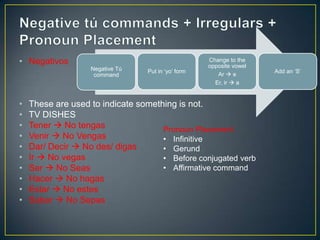
• Negativos
• These are used to indicate something is not.
• TV DISHES
• Tener  No tengas
• Venir  No Vengas
• Dar/ Decir  No des/ digas
• Ir  No vegas
• Ser  No Seas
• Hacer  No hagas
• Estar  No estes
• Saber  No Sepas
Negative Tú
command
Put in „yo‟ form
Change to the
opposite vowel
Ar  e
Er, ir  a
Add an „S‟
Pronoun Placement
• Infinitive
• Gerund
• Before conjugated verb
• Affirmative command
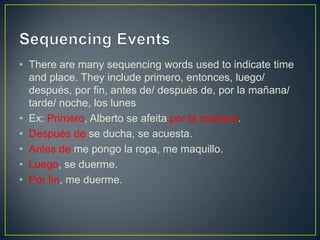
• There are many sequencing words used to indicate time
and place. They include primero, entonces, luego/
después, por fin, antes de/ después de, por la mañana/
tarde/ noche, los lunes
• Ex: Primero, Alberto se afeita por la mañana.
• Después de se ducha, se acuesta.
• Antes de me pongo la ropa, me maquillo.
• Luego, se duerme.
• Por fin, me duerme.
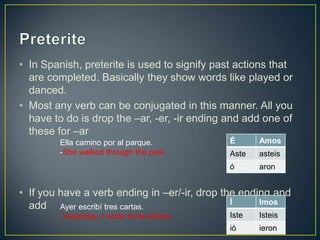
• In Spanish, preterite is used to signify past actions that
are completed. Basically they show words like played or
danced.
• Most any verb can be conjugated in this manner. All you
have to do is drop the –ar, -er, -ir ending and add one of
these for –ar
• If you have a verb ending in –er/-ir, drop the ending and
add
É Amos
Aste asteis
ó aron
Í Imos
Iste Isteis
ió ieron
Ella camino por al parque.
-She walked through the park.
Ayer escribí tres cartas.
-Yesterday, I wrote three letters.
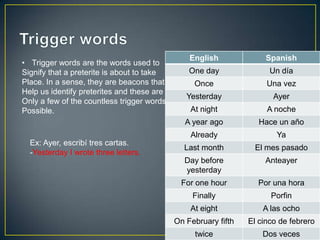
English Spanish
One day Un día
Once Una vez
Yesterday Ayer
At night A noche
A year ago Hace un año
Already Ya
Last month El mes pasado
Day before
yesterday
Anteayer
For one hour Por una hora
Finally Porfin
At eight A las ocho
On February fifth El cinco de febrero
twice Dos veces
• Trigger words are the words used to
Signify that a preterite is about to take
Place. In a sense, they are beacons that
Help us identify preterites and these are
Only a few of the countless trigger words
Possible.
Ex: Ayer, escribí tres cartas.
-Yesterday I wrote three letters.
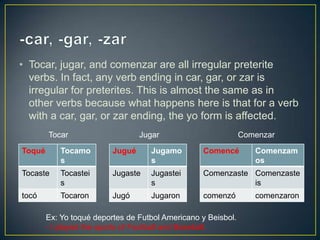
• Tocar, jugar, and comenzar are all irregular preterite
verbs. In fact, any verb ending in car, gar, or zar is
irregular for preterites. This is almost the same as in
other verbs because what happens here is that for a verb
with a car, gar, or zar ending, the yo form is affected.
Toqué Tocamo
s
Tocaste Tocastei
s
tocó Tocaron
Jugué Jugamo
s
Jugaste Jugastei
s
Jugó Jugaron
Comencé Comenzam
os
Comenzaste Comenzaste
is
comenzó comenzaron
Tocar Jugar Comenzar
Ex: Yo toqué deportes de Futbol Americano y Beisbol.
- I played the sports of Football and Baseball.
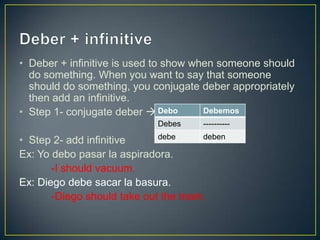
• Deber + infinitive is used to show when someone should
do something. When you want to say that someone
should do something, you conjugate deber appropriately
then add an infinitive.
• Step 1- conjugate deber 
• Step 2- add infinitive
Ex: Yo debo pasar la aspiradora.
-I should vacuum.
Ex: Diego debe sacar la basura.
-Diego should take out the trash.
Debo Debemos
Debes ----------
debe deben
• Modal verbs are verbs are the verbs used in verb
combinations. These verbs when combined make It so
that the modal verb is conjuagted leaving the verb after it
in the infinitive form.
• Ex: Deber: should, ought to
• Desear: to desire
• Necesitar: to need
• Poder: can, could, might, be able to
• Querer: want, would like to
• Saber: know, know how to
• Soler: usually, used to
• Ex: Yo debo pasar la aspiradora.
• I should vacuum. Debo is the modal verb in this case.
• Present progressives are used to show –ing endings. Present
progressives are used to show actions taking place in the
present.
• To make a verb present progressive, first conjugate estar to fit
with the subject.  Yo estoy
• Then, take a verb, drop its ar, ir, or er ending and add the
proper ing ending.  Yo estoy pasando la aspiradora.
• Estar + ing
• AR ending  ANDO ending
• ER/IR ending  IENDO ending
• Exception: if there is a 3 vowel conjugation, the ing ending
becomes yendo
• Ex: Yo estoy creyendo come from creer which normally would be
creiendo
• Ex: Diego está quitando el polvo.
• When modifying a verb, we use adverbs. In spanish, this
is denoted by the –mente ending. Many adverbs only
require changing the ending.
• For e, l, or z endings, just add –mente
• For adjectives ending in –o or –a endings, change their
gender. This means change –o to –a before adding –
mente, and changing –a to –o before adding –mente.
• EX: Yo estoy paso la aspiradora cuidadosomente
• Taken from the adjective cuidadosa, I vacuum carefully
• Ella está quitando el polvo lentement.
• She is dusting slowly.
AR ER/IR
-é -Í
-Aste -Iste
-ó -Ió
-
Amos
-Imos
-
Asteis
-Isteis
-Aron -Ieron
REGULARES
Yo
Tú
Él, ella
Nosotros
Ellos
SPOCKS
Dar
(give)
Ver (see) Ir (go) Ser (be) Hacer
(do/mak
e)
-Di -Vi -Fui -Fui -Hice
-Diste -Viste -Fuiste -Fuiste -Hiciste
-Dio -Vio -Fue -Fue -Hizo
-Dimos -Vimos -Fuimos -Fuimos -Hicimos
-Dieron -Vieron -Fueron -Fueron -Hicieron
yo tú El/ ella/ usted nosotros Ellos/ellas/usted
es
crerí creíste creyó creímos creyeron
destruí destruíste destruyó destruimos destruieron
construí construíste construyó construimos construyeron
SNAKEY
Andar Anduve
Estar Estuve
Poder Pude
Poner Puse
Querer Quise
Saber Supe
Tener Tuve
Venir Vine
CUCARACHAS
Masculine Feminine
Este Esta
Ese Esa
aquel aquella
Singulares
Masculine Feminine
Estos Estas
Esos Esas
aquellos Aquellos
this : these
that : those
that : those
(over there)
Plurals
Masculine Feminine
Éste Ésta
Ése Ésa
Aquél Aquélla
Singulars
Masculine Feminine
Éstos Éstas
Ésos Ésas
Aquéllos Aquéllas
Plurals
ADJECTIVES
PRONOUNS
• Neuter demonstrative pronouns
• Esto
• Eso
• aquello
• EX: Prefiero estas computadoras.
• I prefer those computers.
• Primero (first)
• Segundo (second)
• Tercero (third)
• Quarto (fourth)
• Quinto (fifth)
• Sexto (sixth)
• Séptimo (seventh)
• Octavo (eighth)
• Noveno (ninth)
• Décimo (tenth)
• EX: Mi primero perro era el perro mejor todas otras perros de
mío.
• Yo era segundo en la línea.
• Cerca de (near)
• Delante de (before)
• A la derecha de (to the right of)
• Detrás de (behind)
• Entre (inside)
• Al la izquíerda de (to the left of)
• Al lado de (after)
• Lejos de (far from)
• EX: El perro estaba a la izquíerda de las ovejas.
• The dog is to the left of the sheep.
• Present future is used as ir + a +infintive but can be
changed to reflect events that will happen later in time by
adding the following endings to EVERY unconjugated
verb.
• A few exceptions or irregulars are also present and they
list as:
É Emos
Ás Éis
Á Án
Infinitive verb Future
Stem
Decir Dir-
Hacer Har-
Poner Pondr-
Salir Saldr-
Tener Tendr-
Valer Vald-
Venir Vendr-
Poder Podr-
Querer Querr-
Saber Sabr-
• These are also
followe by the same
endings as in the
previous chart
• Imperfects are used to speak of the past in a “moving”
way as if you were reliving the whole time period of the
past
• Talk about past experiences
• An old habit
• Memories, etc.
-ar -er -ir
CANTAR TENER SALIR
Cantaba Tenía Salía
Cantabas Tenías Salías
Cantabo Tenía Salía
Cantabamos Teníamos Salíamos
Cantabaís Teníais Salíais
Cantaban Tenían salían
ser ir ver
era iba veía
eras ibas veías
Era iba veía
eramo
s
ibamo
s
velam
os
eraís ibais velais
REGULARES
(model)
IRREGULARES
Míos(as) Nuestros(as)
Tuyos(as) Vuestros(as)
Suyos(as) Suyos(as)
Mío(a) Nuestro(a)
Tuyo(a) Vuestro(a)
Suyo(a) Suyo(a)
LONG FORM
Possessives are used to show ownership but do not always come in the
form of mi or su and their alter ego or “long” possessives only come at the
end of a sentence.
Singular Plural
EX: Anjelica era una amgia mía.
Anjelica is a friend of mine.
Comemeos con unos amigos nuestros.
We are eating with some friends of ours.
Any form of un or the word un comes before the thing being possessed
• Regular reflexives only state the subject and verb but
when using a reflexive we attach the pronoun to the
infinitive
• Me, te, le, nos, los, os, y las are all acceptable for future
tense reflexives although reflexive verbs take on one
pronoun specifically called the reflexive pronoun
• The pronoun will stay the same as the verb (see below)
Me escondo Nos escondemos
Te escondes Os escondéis
Se esconde Se esconden
The two words agree in
gender and plurality as
opposed to other reflexives
which make no sense
EX: Me escondo.
I‟m hiding (myself).

Grammar book spanish

  • 1.
  • 2.
    • Nacionalidades • StemChanging Verbs • Para • Indirect Object Pronouns • Pronoun placement • Gustar • Affirmative and Negative Words • Superlatives • Reflexives • Affirmative tu commands + Irregulars + Pronoun Placement • Negative tu commands + Irregulars + Pronoun Placement • Sequencing Events • Preterite • Trigger words • -car, -gar, -zar • Deber+infinitive • Modal verbs • Present progressive • Adverbios • Preterite in your face • Demonstrative adjectives and pronouns • Ordinal numbers • Prepositions • Future tense • Imperfect • Possessive adjectives and pronouns • reflexives
  • 4.
    Cuesto Yo Costamo s Nosotros Cuesta s Tú Costáis Vosotro s Cuest a El, Ella, Ud. Cuesta n Ellos, Ellas, Uds. o-ue e-i e-ieu-ue Pido Pedimo s Pides Pedís Pide Piden Piens o Pensam os Piens as Pensá is Piens a Piens an Jueg o Jugamo s Juega s Jugáis Juega Juega n Ex: costar Ex: pedir Ex: pensar Ex: jugar Boot BootBoot 0-UE (ex): El vaso cuesta viente pesos. E-IE (ex): Yo pienso la fiesta de mi hermano. E-I (ex): ¿Pido un postre y lo compartimos? U-UE (ex): Yo juego el baloncesto y béisbol. When a verb corresponds to a particular subject, it needs to be conjugated appropriately, ex: 1st, 2nd and 3rd person and their plural counterparts
  • 5.
    • Means foror in order to • It is used to indicate when you want to include for in a sentence to emphasize possesion or belonging in most cases. • Ex: Yo preparo la fiesta para mi hermano. • This means I prepare the party for my brother. • Ex: Quisiera un bicileta para dos. • This means I want a bicycle intended for two people to ride (tandem). • Vive para comer • This means he/she lives to eat.
  • 6.
    • Indirect objectpronouns are placed after direct object pronouns to indicate to whom or for whom the action is being specified. • Tú escribas las cartas a Anna. • Tú le escribas las cartas. The IOP‟s can be placed in 3 places which include in between the verb and subject, attached to an infinitive, and before the DOP. Ex (between verb and subject): Tú le escribas las cartas. Ex (attached to an infinitive): Ellos va a comprarte los flores. Ex (before the DOP): Yo te lo compro. Indirect object before it is turned into a pronoun Me Nos Te Vos le Les A Anna is changed to le because the DO is directed toward Anna and so it is le. These are the IOP pronouns.
  • 7.
    Attach the pronoun to the infinitive Attachthe pronoun to a progressive tense Attach the pronoun to an affirmative command Place the pronoun before the conjugated verb Ejemplos • Me afeito. • Yo te escribo las cartas a ti.
  • 8.
    • Gustar isused to show that someone likes something because Gustar literally means, in the infinitive, to like. • The Pronouns that are associated with gustar are the same as IOPs. • Ex: Me gusta los chicharones. • This means I like chicharones. • Ex: Me gustas tú. • This means I like you. Me Nos Te Vos Le Les
  • 9.
    Algo- something Alguien- someone Algún/Alguno- some Siempre- always También- also Affirmativos Negativos Nada- nothing Nadie- no one Ningún/ Ninguno- none, not any Nunca- never Tampoco- neither, either • Affirmatives and negatives are used to give something a negative or affirmative connotation. • Quisiera algo de tomar. • This means I would like something to drink. • Quisiera nada de tomar. • Obivously, this is negated from the former sentence and becomes I would like nothing to drink. • Las chicas quieren ningún postre. • This means the girls would not like any desert.
  • 10.
    • When youexpress adjectives in an exaggerated way, you have to drop the final vowel and add the ending of –ísimo(a). Then you have to make it agree with gender and number to the specific noun it modifies. • Ex: ¡El monstruo es feoísimo! • Ex: ¡Las ideas de Rosa son intersantísimas! • When the last consonant is a C, G, or Z, spelling changes have to take place. • C  QU • Rico(a)  riquísimo(a) • Ex: El postre es riquísimo. • G  GU • Largo(a)  larguísimo(a) • Los pantalones son larguísimo. • Z  C • Feliz  felicísimo(a) • La fiesta es felicísima. Male and singular Feminine and plural
  • 11.
    • Reflexives areused when you refer back to yourself like I wash my self or to dry one‟s hair; basically it is an action that you perform to yourself. • They need to be properly formatted; this is done by taking the se off the back end of the reflexive verb. Once you do this, you can then place it in front of the verb with one of these pronouns  • Reflexives only end in se • So, (acostarse) • Step 1: conjugate  (yo) acuesto • Step 2: add appropriate reflexive pronoun • Where can you put them? • In front of a conjugated verb • Attached to a gerund • Attached to infinitive • Attached to an affirmative command Me Nos Te Os Se Se
  • 12.
    Affirmative Tú command Simply dropthe „S‟ Can attach DOP to endingAffirmative Tú • ¡Come! • This means, eat! It is an affirmative command put in tú form the s dropped. • ¡Habla! • ¡Roba! • ¡Estudia! • Irregulares  Di, Haz, Ve, Pon, Sal, Sé, Ten, Ven • Di  Decir  say or tell • Haz  Hacer  make or do • Ve  Ir  go • Pon  Poner  put • Sal  Salir  leave • Sé  Ser  be • Ten  Tener  have • Ven  Venir  come Pronnoun Placement • Attach to infintive • Gerund • Before a conjugated verb • Affirmative Command
  • 13.
    • Negativos • Theseare used to indicate something is not. • TV DISHES • Tener  No tengas • Venir  No Vengas • Dar/ Decir  No des/ digas • Ir  No vegas • Ser  No Seas • Hacer  No hagas • Estar  No estes • Saber  No Sepas Negative Tú command Put in „yo‟ form Change to the opposite vowel Ar  e Er, ir  a Add an „S‟ Pronoun Placement • Infinitive • Gerund • Before conjugated verb • Affirmative command
  • 14.
    • There aremany sequencing words used to indicate time and place. They include primero, entonces, luego/ después, por fin, antes de/ después de, por la mañana/ tarde/ noche, los lunes • Ex: Primero, Alberto se afeita por la mañana. • Después de se ducha, se acuesta. • Antes de me pongo la ropa, me maquillo. • Luego, se duerme. • Por fin, me duerme.
  • 15.
    • In Spanish,preterite is used to signify past actions that are completed. Basically they show words like played or danced. • Most any verb can be conjugated in this manner. All you have to do is drop the –ar, -er, -ir ending and add one of these for –ar • If you have a verb ending in –er/-ir, drop the ending and add É Amos Aste asteis ó aron Í Imos Iste Isteis ió ieron Ella camino por al parque. -She walked through the park. Ayer escribí tres cartas. -Yesterday, I wrote three letters.
  • 16.
    English Spanish One dayUn día Once Una vez Yesterday Ayer At night A noche A year ago Hace un año Already Ya Last month El mes pasado Day before yesterday Anteayer For one hour Por una hora Finally Porfin At eight A las ocho On February fifth El cinco de febrero twice Dos veces • Trigger words are the words used to Signify that a preterite is about to take Place. In a sense, they are beacons that Help us identify preterites and these are Only a few of the countless trigger words Possible. Ex: Ayer, escribí tres cartas. -Yesterday I wrote three letters.
  • 17.
    • Tocar, jugar,and comenzar are all irregular preterite verbs. In fact, any verb ending in car, gar, or zar is irregular for preterites. This is almost the same as in other verbs because what happens here is that for a verb with a car, gar, or zar ending, the yo form is affected. Toqué Tocamo s Tocaste Tocastei s tocó Tocaron Jugué Jugamo s Jugaste Jugastei s Jugó Jugaron Comencé Comenzam os Comenzaste Comenzaste is comenzó comenzaron Tocar Jugar Comenzar Ex: Yo toqué deportes de Futbol Americano y Beisbol. - I played the sports of Football and Baseball.
  • 18.
    • Deber +infinitive is used to show when someone should do something. When you want to say that someone should do something, you conjugate deber appropriately then add an infinitive. • Step 1- conjugate deber  • Step 2- add infinitive Ex: Yo debo pasar la aspiradora. -I should vacuum. Ex: Diego debe sacar la basura. -Diego should take out the trash. Debo Debemos Debes ---------- debe deben
  • 19.
    • Modal verbsare verbs are the verbs used in verb combinations. These verbs when combined make It so that the modal verb is conjuagted leaving the verb after it in the infinitive form. • Ex: Deber: should, ought to • Desear: to desire • Necesitar: to need • Poder: can, could, might, be able to • Querer: want, would like to • Saber: know, know how to • Soler: usually, used to • Ex: Yo debo pasar la aspiradora. • I should vacuum. Debo is the modal verb in this case.
  • 20.
    • Present progressivesare used to show –ing endings. Present progressives are used to show actions taking place in the present. • To make a verb present progressive, first conjugate estar to fit with the subject.  Yo estoy • Then, take a verb, drop its ar, ir, or er ending and add the proper ing ending.  Yo estoy pasando la aspiradora. • Estar + ing • AR ending  ANDO ending • ER/IR ending  IENDO ending • Exception: if there is a 3 vowel conjugation, the ing ending becomes yendo • Ex: Yo estoy creyendo come from creer which normally would be creiendo • Ex: Diego está quitando el polvo.
  • 21.
    • When modifyinga verb, we use adverbs. In spanish, this is denoted by the –mente ending. Many adverbs only require changing the ending. • For e, l, or z endings, just add –mente • For adjectives ending in –o or –a endings, change their gender. This means change –o to –a before adding – mente, and changing –a to –o before adding –mente. • EX: Yo estoy paso la aspiradora cuidadosomente • Taken from the adjective cuidadosa, I vacuum carefully • Ella está quitando el polvo lentement. • She is dusting slowly.
  • 22.
    AR ER/IR -é -Í -Aste-Iste -ó -Ió - Amos -Imos - Asteis -Isteis -Aron -Ieron REGULARES Yo Tú Él, ella Nosotros Ellos SPOCKS Dar (give) Ver (see) Ir (go) Ser (be) Hacer (do/mak e) -Di -Vi -Fui -Fui -Hice -Diste -Viste -Fuiste -Fuiste -Hiciste -Dio -Vio -Fue -Fue -Hizo -Dimos -Vimos -Fuimos -Fuimos -Hicimos -Dieron -Vieron -Fueron -Fueron -Hicieron yo tú El/ ella/ usted nosotros Ellos/ellas/usted es crerí creíste creyó creímos creyeron destruí destruíste destruyó destruimos destruieron construí construíste construyó construimos construyeron SNAKEY Andar Anduve Estar Estuve Poder Pude Poner Puse Querer Quise Saber Supe Tener Tuve Venir Vine CUCARACHAS
  • 23.
    Masculine Feminine Este Esta EseEsa aquel aquella Singulares Masculine Feminine Estos Estas Esos Esas aquellos Aquellos this : these that : those that : those (over there) Plurals Masculine Feminine Éste Ésta Ése Ésa Aquél Aquélla Singulars Masculine Feminine Éstos Éstas Ésos Ésas Aquéllos Aquéllas Plurals ADJECTIVES PRONOUNS • Neuter demonstrative pronouns • Esto • Eso • aquello • EX: Prefiero estas computadoras. • I prefer those computers.
  • 24.
    • Primero (first) •Segundo (second) • Tercero (third) • Quarto (fourth) • Quinto (fifth) • Sexto (sixth) • Séptimo (seventh) • Octavo (eighth) • Noveno (ninth) • Décimo (tenth) • EX: Mi primero perro era el perro mejor todas otras perros de mío. • Yo era segundo en la línea.
  • 25.
    • Cerca de(near) • Delante de (before) • A la derecha de (to the right of) • Detrás de (behind) • Entre (inside) • Al la izquíerda de (to the left of) • Al lado de (after) • Lejos de (far from) • EX: El perro estaba a la izquíerda de las ovejas. • The dog is to the left of the sheep.
  • 26.
    • Present futureis used as ir + a +infintive but can be changed to reflect events that will happen later in time by adding the following endings to EVERY unconjugated verb. • A few exceptions or irregulars are also present and they list as: É Emos Ás Éis Á Án Infinitive verb Future Stem Decir Dir- Hacer Har- Poner Pondr- Salir Saldr- Tener Tendr- Valer Vald- Venir Vendr- Poder Podr- Querer Querr- Saber Sabr- • These are also followe by the same endings as in the previous chart
  • 27.
    • Imperfects areused to speak of the past in a “moving” way as if you were reliving the whole time period of the past • Talk about past experiences • An old habit • Memories, etc. -ar -er -ir CANTAR TENER SALIR Cantaba Tenía Salía Cantabas Tenías Salías Cantabo Tenía Salía Cantabamos Teníamos Salíamos Cantabaís Teníais Salíais Cantaban Tenían salían ser ir ver era iba veía eras ibas veías Era iba veía eramo s ibamo s velam os eraís ibais velais REGULARES (model) IRREGULARES
  • 28.
    Míos(as) Nuestros(as) Tuyos(as) Vuestros(as) Suyos(as)Suyos(as) Mío(a) Nuestro(a) Tuyo(a) Vuestro(a) Suyo(a) Suyo(a) LONG FORM Possessives are used to show ownership but do not always come in the form of mi or su and their alter ego or “long” possessives only come at the end of a sentence. Singular Plural EX: Anjelica era una amgia mía. Anjelica is a friend of mine. Comemeos con unos amigos nuestros. We are eating with some friends of ours. Any form of un or the word un comes before the thing being possessed
  • 29.
    • Regular reflexivesonly state the subject and verb but when using a reflexive we attach the pronoun to the infinitive • Me, te, le, nos, los, os, y las are all acceptable for future tense reflexives although reflexive verbs take on one pronoun specifically called the reflexive pronoun • The pronoun will stay the same as the verb (see below) Me escondo Nos escondemos Te escondes Os escondéis Se esconde Se esconden The two words agree in gender and plurality as opposed to other reflexives which make no sense EX: Me escondo. I‟m hiding (myself).