By: David Yancey
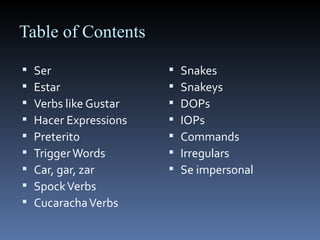
Table of Contents Ser Estar Verbs like Gustar Hacer Expressions Preterito  Trigger Words Car, gar, zar Spock Verbs Cucaracha Verbs Snakes Snakeys DOPs IOPs Commands Irregulars Se impersonal
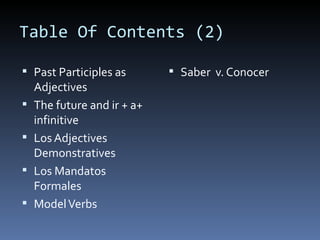
Table Of Contents (2) Past Participles as Adjectives The future and ir + a+ infinitive Los Adjectives Demonstratives Los Mandatos Formales Model Verbs Saber  v. Conocer
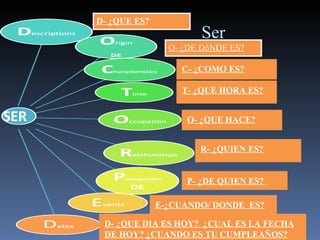
Ser SER   Ser-To be D- ¿QUE ES ?   O- ¿DE DóNDE ES?   C- ¿COMO ES?   T- ¿QUE HORA ES?   O- ¿QUE HACE?   R- ¿QUIEN ES?   P- ¿DE QUIEN ES?   E-¿CUANDO/ DONDE  ES?   D- ¿QUE DIA ES HOY?  ¿CUAL ES LA FECHA DE HOY? ¿CUANDO ES TU CUMPLEAÑOS?
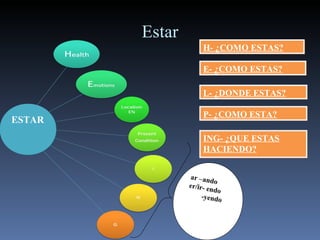
Estar ESTAR H- ¿COMO ESTAS?   ar –ando er/ir- endo -yendo E- ¿COMO ESTAS?   L- ¿DONDE ESTAS?   P- ¿COMO ESTA?   ING- ¿QUE ESTAS HACIENDO?
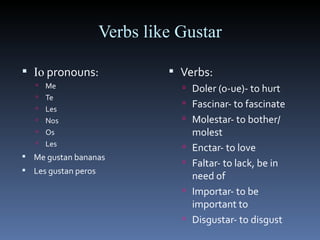
Verbs like Gustar Io  pronouns: Me Te Les Nos Os Les Me gustan bananas Les gustan peros Verbs: Doler (o-ue)- to hurt Fascinar- to fascinate Molestar- to bother/ molest Enctar- to love Faltar- to lack, be in need of Importar- to be important to Disgustar- to disgust
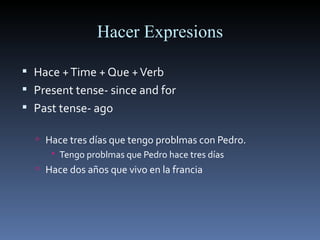
Hacer Expresions Hace + Time + Que + Verb Present tense- since and for Past tense- ago Hace tres días que tengo problmas con Pedro. Tengo problmas que Pedro hace tres días Hace dos años que vivo en la francia
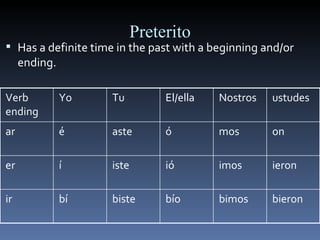
Preterito Has a definite time in the past with a beginning and/or ending.  Verb ending Yo Tu El/ella Nostros ustudes ar é aste ó mos on er í iste ió imos ieron ir bí biste bío bimos bieron
Trigger Words Verbs that deal with wanting Desiring wishing Hoping Needing Liking loving  Etc.
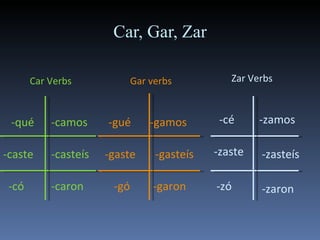
Car, Gar, Zar -qué -caste -có -caron -camos -casteís Car Verbs -gué -gaste -gó -garon -gasteís -gamos Gar verbs -cé -zaste -zó -zaron -zamos -zasteís Zar Verbs
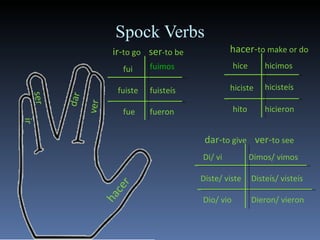
Spock Verbs hacer ver dar ser ir hacer- to make or do hice hiciste hito hicisteís hicimos hicieron dar- to give  ver- to see Di/ vi Diste/ viste Dio/ vio Disteís/ visteís Dimos/ vimos Dieron/ vieron ir- to go  ser -to be fui fuiste fue fuisteís fueron fuimos
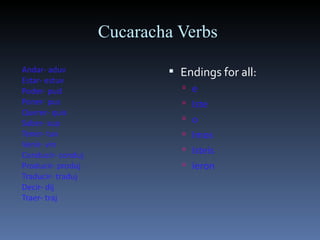
Cucaracha Verbs  Andar- aduv Estar- estuv Poder- pud Poner- pus Querer- quis Saber- sup Tener- tuv Venir- vin Conducir- conduj Producir- produj Traducir- traduj Decir- dij Traer- traj Endings for all: e Iste o Imos Isteis ieron
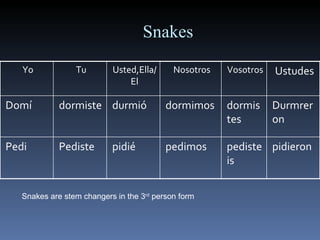
Snakes Snakes are stem changers in the 3 rd  person form Yo Tu Usted,Ella/El Nosotros Vosotros Ustudes Domí dormiste durmió dormimos dormistes Durmreron Pedi Pediste pidié pedimos pedisteis pidieron
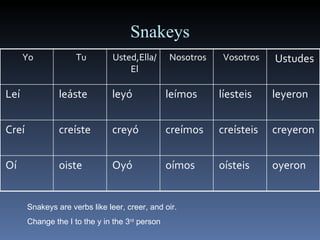
Snakeys Snakeys are verbs like leer, creer, and oir. Change the I to the y in the 3 rd  person Yo Tu Usted,Ella/El Nosotros Vosotros Ustudes Leí leáste leyó leímos líesteis leyeron Creí creíste creyó creímos creísteis creyeron Oí oiste Oyó oímos oísteis oyeron
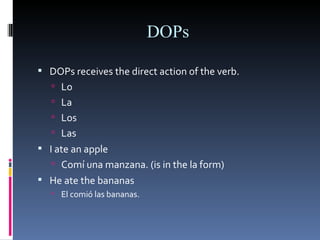
DOPs DOPs receives the direct action of the verb. Lo La Los Las I ate an apple Comí una manzana. (is in the la form)  He ate the bananas El comió las bananas.
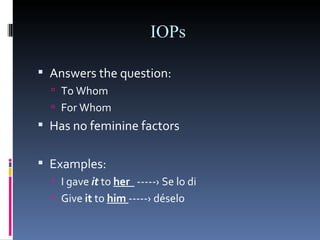
IOPs Answers the question: To Whom For Whom Has no feminine factors Examples: I gave   it   to  her  -----›   Se lo di Give  it  to  him  -----› déselo
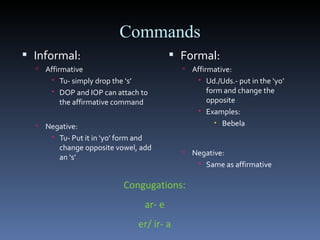
Commands Informal: Affirmative Tu- simply drop the ‘s’ DOP and IOP can attach to the affirmative command Negative: Tu- Put it in ‘yo’ form and change opposite vowel, add an ‘s’ Formal: Affirmative: Ud./Uds.- put in the ‘yo’ form and change the opposite  Examples: Bebela Negative: Same as affirmative Congugations: ar- e er/ ir- a
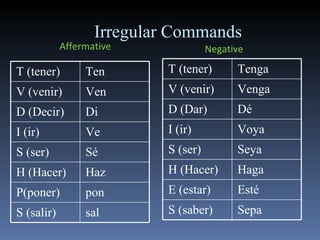
Irregular Commands Affermative Negative T (tener) Tenga V (venir) Venga D (Dar) Dé I (ir) Voya S (ser) Seya H (Hacer) Haga E (estar) Esté S (saber) Sepa T (tener) Ten V (venir) Ven D (Decir) Di I (ir) Ve S (ser) Sé H (Hacer) Haz P(poner) pon S (salir) sal
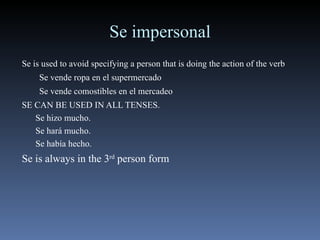
Se impersonal Se is used to avoid specifying a person that is doing the action of the verb Se vende ropa en el supermercado Se vende comostibles en el mercadeo SE CAN BE USED IN ALL TENSES. Se hizo mucho. Se hará mucho. Se había hecho. Se is always in the 3 rd  person form
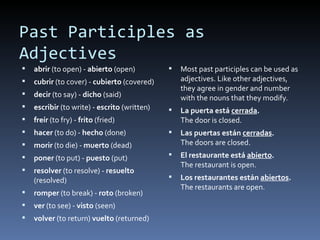
Past Participles as Adjectives abrir  (to open) -  abierto  (open) cubrir  (to cover) -  cubierto  (covered) decir  (to say) -  dicho  (said) escribir  (to write) -  escrito  (written) freír  (to fry) -  frito  (fried) hacer  (to do) -  hecho  (done) morir  (to die) -  muerto  (dead) poner  (to put) -  puesto  (put) resolver  (to resolve) -  resuelto  (resolved) romper  (to break) -  roto  (broken) ver  (to see) -  visto  (seen) volver  (to return)  vuelto  (returned) Most past participles can be used as adjectives. Like other adjectives, they agree in gender and number with the nouns that they modify. La puerta está  cerrada . The door is closed. Las puertas están  cerradas . The doors are closed. El restaurante está  abierto . The restaurant is open. Los restaurantes están  abiertos . The restaurants are open.
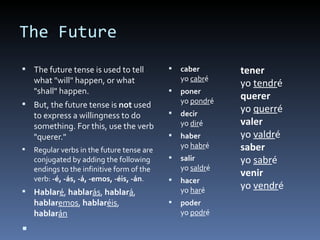
The Future The future tense is used to tell what "will" happen, or what "shall" happen. But, the future tense is  not  used to express a willingness to do something. For this, use the verb "querer." Regular verbs in the future tense are conjugated by adding the following  endings to the infinitive form of the verb:  -é, -ás, -á, -emos, -éis, -án . Hablar é ,  hablar ás ,  hablar á ,  hablar emos ,  hablar éis ,  hablar án caber yo  cabr é poner yo  pondr é decir yo  dir é haber yo  habr é salir yo  saldr é hacer yo  har é poder yo  podr é tener yo  tendr é querer yo  querr é valer yo  valdr é saber yo  sabr é venir yo  vendr é
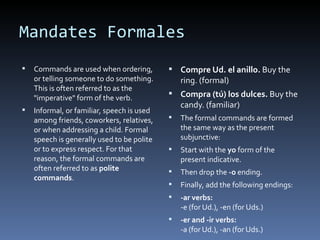
Mandates Formales Commands are used when ordering, or telling someone to do something. This is often referred to as the "imperative" form of the verb. Informal, or familiar, speech is used among friends, coworkers, relatives, or when addressing a child. Formal speech is generally used to be polite or to express respect. For that reason, the formal commands are often referred to as  polite commands . Compre Ud. el anillo.  Buy the ring. (formal)  Compra (tú) los dulces.  Buy the candy. (familiar)  The formal commands are formed the same way as the present subjunctive: Start with the  yo  form of the present indicative.  Then drop the  -o  ending.  Finally, add the following endings:  -ar verbs: -e (for Ud.), -en (for Uds.) -er and -ir verbs: -a (for Ud.), -an (for Uds.)
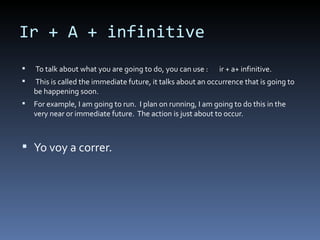
Ir + A + infinitive To talk about what you are going to do, you can use :  ir + a+ infinitive. This is called the immediate future, it talks about an occurrence that is going to be happening soon.  For example, I am going to run.  I plan on running, I am going to do this in the very near or immediate future.  The action is just about to occur. Yo voy a correr.
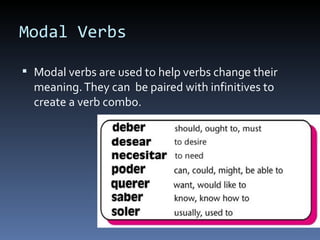
Modal Verbs Modal verbs are used to help verbs change their meaning. They can  be paired with infinitives to create a verb combo.   
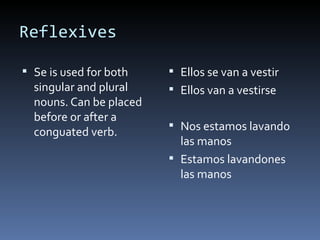
Reflexives Se is used for both singular and plural nouns. Can be placed before or after a conguated verb. Ellos se van a vestir Ellos van a vestirse Nos estamos lavando las manos Estamos lavandones las manos
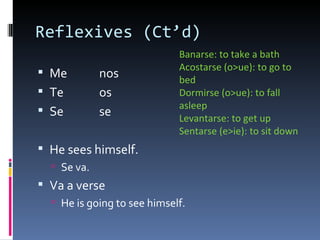
Reflexives (Ct’d) Me nos Te os Se se He sees himself. Se va. Va a verse  He is going to see himself. Banarse: to take a bath Acostarse (o>ue): to go to bed Dormirse (o>ue): to fall asleep Levantarse: to get up Sentarse (e>ie): to sit down
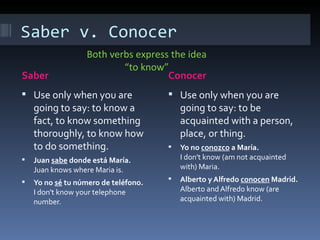
Saber v. Conocer Saber Conocer Use only when you are going to say: to know a fact, to know something thoroughly, to know how to do something. Juan  sabe  donde está María. Juan knows where Maria is. Yo no  sé  tu número de teléfono. I don't know your telephone number. Use only when you are going to say: to be acquainted with a person, place, or thing. Yo no  conozco  a María. I don't know (am not acquainted with) Maria. Alberto y Alfredo  conocen  Madrid. Alberto and Alfredo know (are acquainted with) Madrid. Both verbs express the idea “to know”
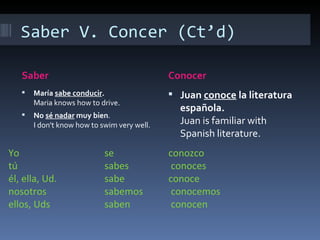
Saber V. Concer (Ct’d) Saber Conocer María  sabe conducir . Maria knows how to drive. No  sé nadar  muy bien . I don't know how to swim very well. Juan  conoce  la literatura española. Juan is familiar with Spanish literature. Yo se  conozco  tú sabes   conoces  él, ella, Ud. sabe    conoce  nosotros  sabemos   conocemos  ellos, Uds saben   conocen

Spanish 2 grammar concepts

  • 1.
  • 2.
    Table of ContentsSer Estar Verbs like Gustar Hacer Expressions Preterito Trigger Words Car, gar, zar Spock Verbs Cucaracha Verbs Snakes Snakeys DOPs IOPs Commands Irregulars Se impersonal
  • 3.
    Table Of Contents(2) Past Participles as Adjectives The future and ir + a+ infinitive Los Adjectives Demonstratives Los Mandatos Formales Model Verbs Saber v. Conocer
  • 4.
    Ser SER Ser-To be D- ¿QUE ES ? O- ¿DE DóNDE ES? C- ¿COMO ES? T- ¿QUE HORA ES? O- ¿QUE HACE? R- ¿QUIEN ES? P- ¿DE QUIEN ES? E-¿CUANDO/ DONDE ES? D- ¿QUE DIA ES HOY? ¿CUAL ES LA FECHA DE HOY? ¿CUANDO ES TU CUMPLEAÑOS?
  • 5.
    Estar ESTAR H-¿COMO ESTAS? ar –ando er/ir- endo -yendo E- ¿COMO ESTAS? L- ¿DONDE ESTAS? P- ¿COMO ESTA? ING- ¿QUE ESTAS HACIENDO?
  • 6.
    Verbs like GustarIo pronouns: Me Te Les Nos Os Les Me gustan bananas Les gustan peros Verbs: Doler (o-ue)- to hurt Fascinar- to fascinate Molestar- to bother/ molest Enctar- to love Faltar- to lack, be in need of Importar- to be important to Disgustar- to disgust
  • 7.
    Hacer Expresions Hace+ Time + Que + Verb Present tense- since and for Past tense- ago Hace tres días que tengo problmas con Pedro. Tengo problmas que Pedro hace tres días Hace dos años que vivo en la francia
  • 8.
    Preterito Has adefinite time in the past with a beginning and/or ending. Verb ending Yo Tu El/ella Nostros ustudes ar é aste ó mos on er í iste ió imos ieron ir bí biste bío bimos bieron
  • 9.
    Trigger Words Verbsthat deal with wanting Desiring wishing Hoping Needing Liking loving Etc.
  • 10.
    Car, Gar, Zar-qué -caste -có -caron -camos -casteís Car Verbs -gué -gaste -gó -garon -gasteís -gamos Gar verbs -cé -zaste -zó -zaron -zamos -zasteís Zar Verbs
  • 11.
    Spock Verbs hacerver dar ser ir hacer- to make or do hice hiciste hito hicisteís hicimos hicieron dar- to give ver- to see Di/ vi Diste/ viste Dio/ vio Disteís/ visteís Dimos/ vimos Dieron/ vieron ir- to go ser -to be fui fuiste fue fuisteís fueron fuimos
  • 12.
    Cucaracha Verbs Andar- aduv Estar- estuv Poder- pud Poner- pus Querer- quis Saber- sup Tener- tuv Venir- vin Conducir- conduj Producir- produj Traducir- traduj Decir- dij Traer- traj Endings for all: e Iste o Imos Isteis ieron
  • 13.
    Snakes Snakes arestem changers in the 3 rd person form Yo Tu Usted,Ella/El Nosotros Vosotros Ustudes Domí dormiste durmió dormimos dormistes Durmreron Pedi Pediste pidié pedimos pedisteis pidieron
  • 14.
    Snakeys Snakeys areverbs like leer, creer, and oir. Change the I to the y in the 3 rd person Yo Tu Usted,Ella/El Nosotros Vosotros Ustudes Leí leáste leyó leímos líesteis leyeron Creí creíste creyó creímos creísteis creyeron Oí oiste Oyó oímos oísteis oyeron
  • 15.
    DOPs DOPs receivesthe direct action of the verb. Lo La Los Las I ate an apple Comí una manzana. (is in the la form) He ate the bananas El comió las bananas.
  • 16.
    IOPs Answers thequestion: To Whom For Whom Has no feminine factors Examples: I gave it to her -----› Se lo di Give it to him -----› déselo
  • 17.
    Commands Informal: AffirmativeTu- simply drop the ‘s’ DOP and IOP can attach to the affirmative command Negative: Tu- Put it in ‘yo’ form and change opposite vowel, add an ‘s’ Formal: Affirmative: Ud./Uds.- put in the ‘yo’ form and change the opposite Examples: Bebela Negative: Same as affirmative Congugations: ar- e er/ ir- a
  • 18.
    Irregular Commands AffermativeNegative T (tener) Tenga V (venir) Venga D (Dar) Dé I (ir) Voya S (ser) Seya H (Hacer) Haga E (estar) Esté S (saber) Sepa T (tener) Ten V (venir) Ven D (Decir) Di I (ir) Ve S (ser) Sé H (Hacer) Haz P(poner) pon S (salir) sal
  • 19.
    Se impersonal Seis used to avoid specifying a person that is doing the action of the verb Se vende ropa en el supermercado Se vende comostibles en el mercadeo SE CAN BE USED IN ALL TENSES. Se hizo mucho. Se hará mucho. Se había hecho. Se is always in the 3 rd person form
  • 20.
    Past Participles asAdjectives abrir (to open) - abierto (open) cubrir (to cover) - cubierto (covered) decir (to say) - dicho (said) escribir (to write) - escrito (written) freír (to fry) - frito (fried) hacer (to do) - hecho (done) morir (to die) - muerto (dead) poner (to put) - puesto (put) resolver (to resolve) - resuelto (resolved) romper (to break) - roto (broken) ver (to see) - visto (seen) volver (to return) vuelto (returned) Most past participles can be used as adjectives. Like other adjectives, they agree in gender and number with the nouns that they modify. La puerta está cerrada . The door is closed. Las puertas están cerradas . The doors are closed. El restaurante está abierto . The restaurant is open. Los restaurantes están abiertos . The restaurants are open.
  • 21.
    The Future Thefuture tense is used to tell what "will" happen, or what "shall" happen. But, the future tense is not used to express a willingness to do something. For this, use the verb "querer." Regular verbs in the future tense are conjugated by adding the following endings to the infinitive form of the verb: -é, -ás, -á, -emos, -éis, -án . Hablar é , hablar ás , hablar á , hablar emos , hablar éis , hablar án caber yo cabr é poner yo pondr é decir yo dir é haber yo habr é salir yo saldr é hacer yo har é poder yo podr é tener yo tendr é querer yo querr é valer yo valdr é saber yo sabr é venir yo vendr é
  • 22.
    Mandates Formales Commandsare used when ordering, or telling someone to do something. This is often referred to as the "imperative" form of the verb. Informal, or familiar, speech is used among friends, coworkers, relatives, or when addressing a child. Formal speech is generally used to be polite or to express respect. For that reason, the formal commands are often referred to as polite commands . Compre Ud. el anillo. Buy the ring. (formal) Compra (tú) los dulces. Buy the candy. (familiar) The formal commands are formed the same way as the present subjunctive: Start with the yo form of the present indicative. Then drop the -o ending. Finally, add the following endings: -ar verbs: -e (for Ud.), -en (for Uds.) -er and -ir verbs: -a (for Ud.), -an (for Uds.)
  • 23.
    Ir + A+ infinitive To talk about what you are going to do, you can use : ir + a+ infinitive. This is called the immediate future, it talks about an occurrence that is going to be happening soon. For example, I am going to run. I plan on running, I am going to do this in the very near or immediate future. The action is just about to occur. Yo voy a correr.
  • 24.
    Modal Verbs Modalverbs are used to help verbs change their meaning. They can be paired with infinitives to create a verb combo.  
  • 25.
    Reflexives Se isused for both singular and plural nouns. Can be placed before or after a conguated verb. Ellos se van a vestir Ellos van a vestirse Nos estamos lavando las manos Estamos lavandones las manos
  • 26.
    Reflexives (Ct’d) Menos Te os Se se He sees himself. Se va. Va a verse He is going to see himself. Banarse: to take a bath Acostarse (o>ue): to go to bed Dormirse (o>ue): to fall asleep Levantarse: to get up Sentarse (e>ie): to sit down
  • 27.
    Saber v. ConocerSaber Conocer Use only when you are going to say: to know a fact, to know something thoroughly, to know how to do something. Juan sabe donde está María. Juan knows where Maria is. Yo no sé tu número de teléfono. I don't know your telephone number. Use only when you are going to say: to be acquainted with a person, place, or thing. Yo no conozco a María. I don't know (am not acquainted with) Maria. Alberto y Alfredo conocen Madrid. Alberto and Alfredo know (are acquainted with) Madrid. Both verbs express the idea “to know”
  • 28.
    Saber V. Concer(Ct’d) Saber Conocer María sabe conducir . Maria knows how to drive. No sé nadar muy bien . I don't know how to swim very well. Juan conoce la literatura española. Juan is familiar with Spanish literature. Yo se conozco tú sabes conoces él, ella, Ud. sabe conoce nosotros sabemos conocemos ellos, Uds saben conocen