Spanish 2 Grammar ConceptsBella Flaherty
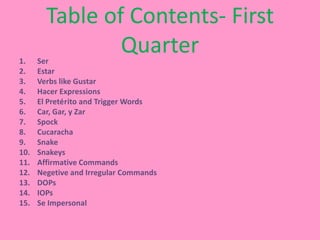
Table of Contents- First QuarterSerEstarVerbs like GustarHacer ExpressionsEl Pretérito and Trigger WordsCar, Gar, y ZarSpock Cucaracha SnakeSnakeysAffirmative CommandsNegetive and Irregular CommandsDOPsIOPs Se Impersonal
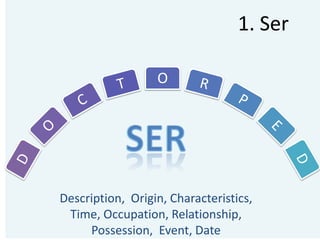
1. SerSERDescription,  Origin, Characteristics, Time, Occupation, Relationship, Possession,  Event, Date
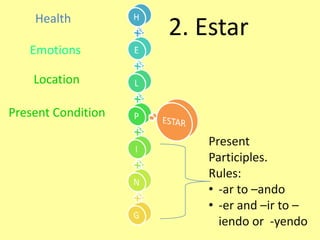
Health2. EstarEmotionsLocationPresent ConditionPresent Participles.Rules:-ar to –ando
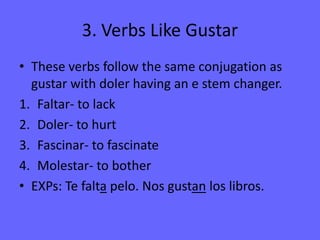
-er and –ir to –iendo or  -yendo3. Verbs Like GustarThese verbs follow the same conjugation as gustar with doler having an e stem changer.Faltar- to lackDoler- to hurtFascinar- to fascinateMolestar- to botherEXPs: Tefaltapelo. Nosgustan los libros.
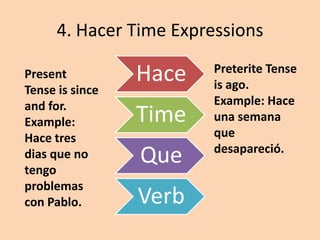
4. Hacer Time ExpressionsPreterite Tense is ago. Example: Haceunasemanaquedesapareció.Present Tense is since and for. Example: Hacetresdiasque no tengoproblemas con Pablo.
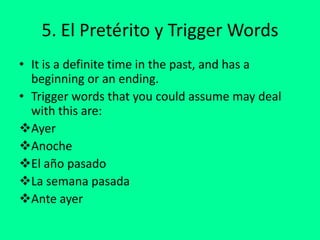
5. El Pretérito y Trigger Words It is a definite time in the past, and has a beginning or an ending.Trigger words that you could assume may deal with this are:Ayer
Anoche
El añopasado
La semanapasada
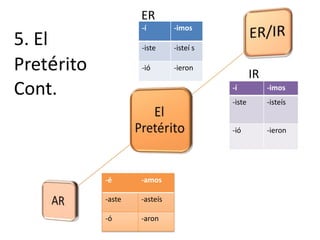
Ante ayerER5. El Pretérito Cont.IR
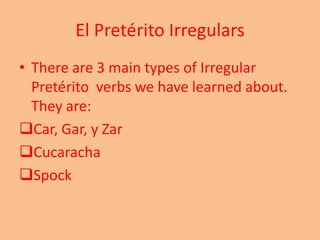
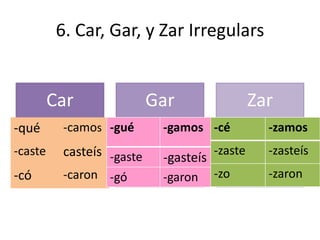
El Pretérito IrregularsThere are 3 main types of Irregular  Pretérito  verbs we have learned about. They are:Car, Gar, y Zar
Cucaracha
Spock6. Car, Gar, y Zar Irregulars
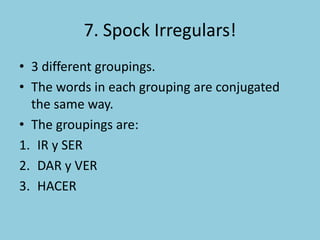
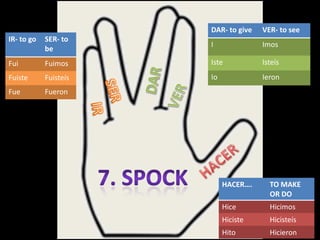
7. Spock Irregulars!3 different groupings.The words in each grouping are conjugated the same way.The groupings are:IR y SERDAR y VERHACER
DARSERVERIRHACER7. SPOCK
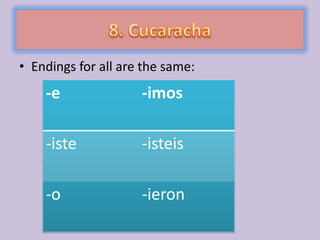
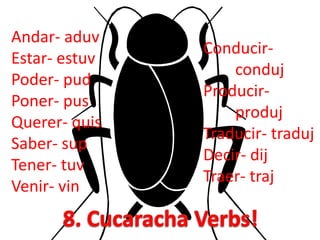
8. Cucaracha Endings for all are the same:
Andar- aduvEstar- estuvPoder- pudPoner- pusQuerer- quisSaber- supTener- tuvVenir- vinConducir- condujProducir- produjTraducir- tradujDecir- dijTraer- traj8. Cucaracha Verbs!
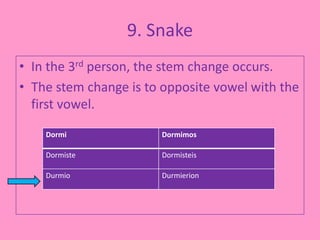
9. SnakeIn the 3rd person, the stem change occurs.The stem change is to opposite vowel with the first vowel.
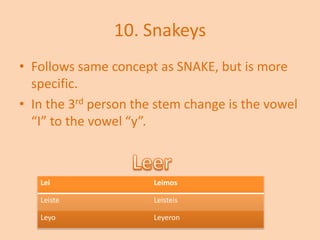
10. SnakeysFollows same concept as SNAKE, but is more specific.In the 3rd person the stem change is the vowel “I” to the vowel “y”.Leer
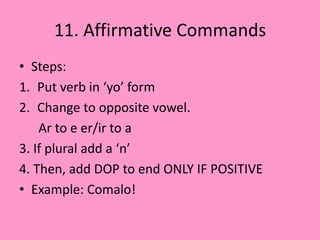
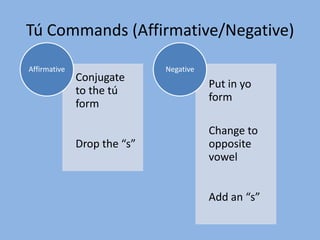
11. Affirmative Commands Steps:Put verb in ‘yo’ formChange to opposite vowel.Ar to e er/ir to a3. If plural add a ‘n’4. Then, add DOP to end ONLY IF POSITIVEExample: Comalo!
Tú Commands (Affirmative/Negative)
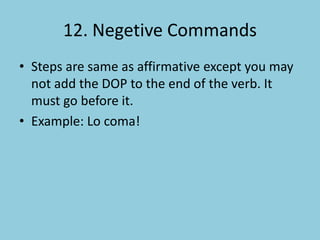
12. Negetive CommandsSteps are same as affirmative except you may not add the DOP to the end of the verb. It must go before it.Example: Lo coma!
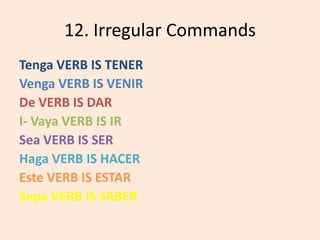
12. Irregular CommandsTenga VERB IS TENERVenga VERB IS VENIRDe VERB IS DARI- Vaya VERB IS IRSea VERB IS SERHaga VERB IS HACEREste VERB IS ESTARSepa VERB IS SABER
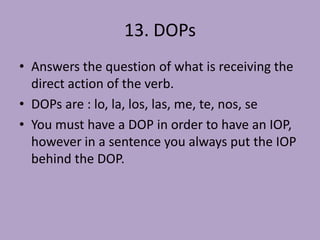
13. DOPsAnswers the question of what is receiving the direct action of the verb.DOPs are : lo, la, los, las, me, te, nos, seYou must have a DOP in order to have an IOP, however in a sentence you always put the IOP behind the DOP.
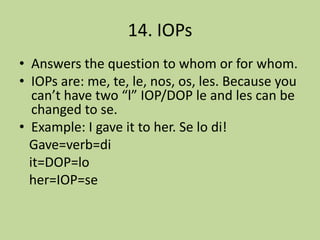
14. IOPsAnswers the question to whom or for whom. IOPs are: me, te, le, nos, os, les. Because you can’t have two “l” IOP/DOP le and les can be changed to se.Example: I gave it to her. Se lo di!   Gave=verb=di  it=DOP=lo  her=IOP=se
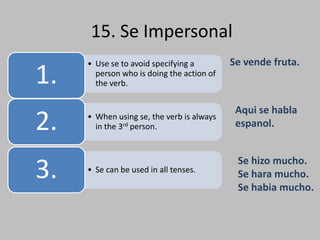
  15. Se ImpersonalSe vendefruta.  vfbfbcvfhfAqui se hablaespanol.Se hizo mucho.Se hara mucho.Se habia mucho.
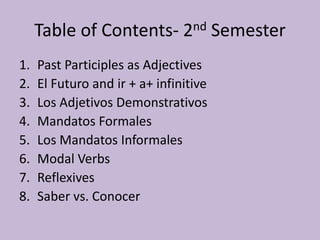
Table of Contents- 2nd Semester Past Participles as AdjectivesEl Futuro and ir + a+ infinitiveLos AdjetivosDemonstrativosMandatosFormalesLos MandatosInformalesModal VerbsReflexivesSaber vs. Conocer
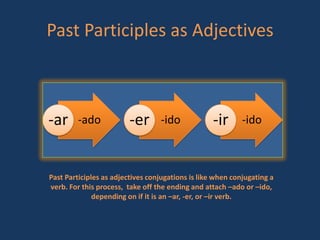
Past Participles as AdjectivesPast Participles as adjectives conjugations is like when conjugating a verb. For this process,  take off the ending and attach –ado or –ido, depending on if it is an –ar, -er, or –ir verb.
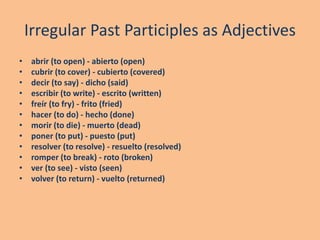
Irregular Past Participles as Adjectivesabrir (to open) - abierto (open)cubrir (to cover) - cubierto (covered)decir (to say) - dicho (said)escribir (to write) - escrito (written)freír (to fry) - frito (fried)hacer (to do) - hecho (done)morir (to die) - muerto (dead)poner (to put) - puesto (put)resolver (to resolve) - resuelto (resolved)romper (to break) - roto (broken)ver (to see) - visto (seen)volver (to return) - vuelto (returned)
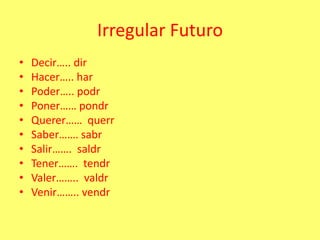
Irregular FuturoDecir….. dirHacer….. harPoder….. podrPoner…… pondrQuerer……  querrSaber……. sabrSalir…….  saldrTener…….  tendrValer……..  valdrVenir…….. vendr
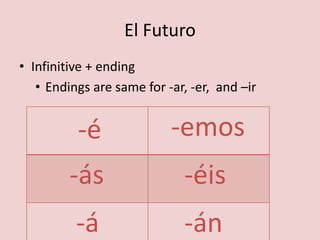
El FuturoInfinitive + endingEndings are same for -ar, -er,  and –ir-é
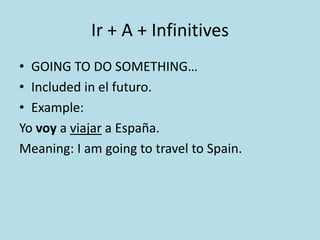
Ir + A + InfinitivesGOING TO DO SOMETHING…Included in el futuro. Example:Yovoy a viajar a España.Meaning: I am going to travel to Spain.
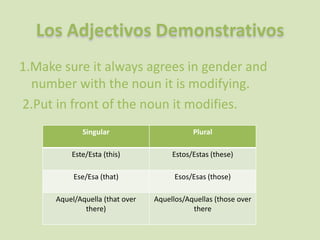
LosAdjectivosDemonstrativos1.Make sure it always agrees in gender and number with the noun it is modifying. 2.Put in front of the noun it modifies.
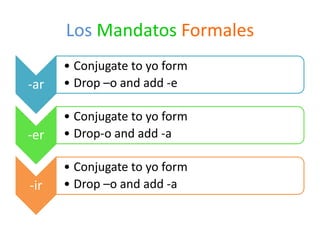
LosMandatosFormales
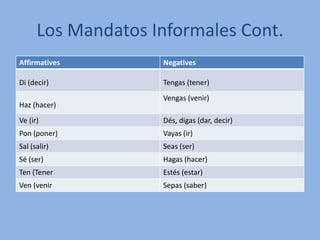
Los MandatosInformales Cont.

Grammar book bella flaherty

  • 1.
    Spanish 2 GrammarConceptsBella Flaherty
  • 2.
    Table of Contents-First QuarterSerEstarVerbs like GustarHacer ExpressionsEl Pretérito and Trigger WordsCar, Gar, y ZarSpock Cucaracha SnakeSnakeysAffirmative CommandsNegetive and Irregular CommandsDOPsIOPs Se Impersonal
  • 3.
    1. SerSERDescription, Origin, Characteristics, Time, Occupation, Relationship, Possession, Event, Date
  • 4.
  • 5.
    -er and –irto –iendo or -yendo3. Verbs Like GustarThese verbs follow the same conjugation as gustar with doler having an e stem changer.Faltar- to lackDoler- to hurtFascinar- to fascinateMolestar- to botherEXPs: Tefaltapelo. Nosgustan los libros.
  • 6.
    4. Hacer TimeExpressionsPreterite Tense is ago. Example: Haceunasemanaquedesapareció.Present Tense is since and for. Example: Hacetresdiasque no tengoproblemas con Pablo.
  • 7.
    5. El Pretéritoy Trigger Words It is a definite time in the past, and has a beginning or an ending.Trigger words that you could assume may deal with this are:Ayer
  • 8.
  • 9.
  • 10.
  • 11.
    Ante ayerER5. ElPretérito Cont.IR
  • 12.
    El Pretérito IrregularsThereare 3 main types of Irregular Pretérito verbs we have learned about. They are:Car, Gar, y Zar
  • 13.
  • 14.
    Spock6. Car, Gar,y Zar Irregulars
  • 15.
    7. Spock Irregulars!3different groupings.The words in each grouping are conjugated the same way.The groupings are:IR y SERDAR y VERHACER
  • 16.
  • 17.
    8. Cucaracha Endingsfor all are the same:
  • 18.
    Andar- aduvEstar- estuvPoder-pudPoner- pusQuerer- quisSaber- supTener- tuvVenir- vinConducir- condujProducir- produjTraducir- tradujDecir- dijTraer- traj8. Cucaracha Verbs!
  • 19.
    9. SnakeIn the3rd person, the stem change occurs.The stem change is to opposite vowel with the first vowel.
  • 20.
    10. SnakeysFollows sameconcept as SNAKE, but is more specific.In the 3rd person the stem change is the vowel “I” to the vowel “y”.Leer
  • 21.
    11. Affirmative CommandsSteps:Put verb in ‘yo’ formChange to opposite vowel.Ar to e er/ir to a3. If plural add a ‘n’4. Then, add DOP to end ONLY IF POSITIVEExample: Comalo!
  • 22.
  • 23.
    12. Negetive CommandsStepsare same as affirmative except you may not add the DOP to the end of the verb. It must go before it.Example: Lo coma!
  • 24.
    12. Irregular CommandsTengaVERB IS TENERVenga VERB IS VENIRDe VERB IS DARI- Vaya VERB IS IRSea VERB IS SERHaga VERB IS HACEREste VERB IS ESTARSepa VERB IS SABER
  • 25.
    13. DOPsAnswers thequestion of what is receiving the direct action of the verb.DOPs are : lo, la, los, las, me, te, nos, seYou must have a DOP in order to have an IOP, however in a sentence you always put the IOP behind the DOP.
  • 26.
    14. IOPsAnswers thequestion to whom or for whom. IOPs are: me, te, le, nos, os, les. Because you can’t have two “l” IOP/DOP le and les can be changed to se.Example: I gave it to her. Se lo di! Gave=verb=di it=DOP=lo her=IOP=se
  • 27.
    15.Se ImpersonalSe vendefruta. vfbfbcvfhfAqui se hablaespanol.Se hizo mucho.Se hara mucho.Se habia mucho.
  • 28.
    Table of Contents-2nd Semester Past Participles as AdjectivesEl Futuro and ir + a+ infinitiveLos AdjetivosDemonstrativosMandatosFormalesLos MandatosInformalesModal VerbsReflexivesSaber vs. Conocer
  • 29.
    Past Participles asAdjectivesPast Participles as adjectives conjugations is like when conjugating a verb. For this process, take off the ending and attach –ado or –ido, depending on if it is an –ar, -er, or –ir verb.
  • 30.
    Irregular Past Participlesas Adjectivesabrir (to open) - abierto (open)cubrir (to cover) - cubierto (covered)decir (to say) - dicho (said)escribir (to write) - escrito (written)freír (to fry) - frito (fried)hacer (to do) - hecho (done)morir (to die) - muerto (dead)poner (to put) - puesto (put)resolver (to resolve) - resuelto (resolved)romper (to break) - roto (broken)ver (to see) - visto (seen)volver (to return) - vuelto (returned)
  • 31.
    Irregular FuturoDecir….. dirHacer…..harPoder….. podrPoner…… pondrQuerer…… querrSaber……. sabrSalir……. saldrTener……. tendrValer…….. valdrVenir…….. vendr
  • 32.
    El FuturoInfinitive +endingEndings are same for -ar, -er, and –ir-é
  • 33.
    Ir + A+ InfinitivesGOING TO DO SOMETHING…Included in el futuro. Example:Yovoy a viajar a España.Meaning: I am going to travel to Spain.
  • 34.
    LosAdjectivosDemonstrativos1.Make sure italways agrees in gender and number with the noun it is modifying. 2.Put in front of the noun it modifies.
  • 35.
  • 36.