
El presenteEl presente
perfectoperfecto
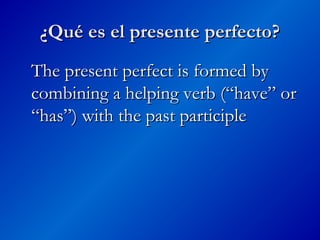
¿Qué es el presente perfecto?¿Qué es el presente perfecto?
The present perfect is formed byThe present perfect is formed by
combining a helping verb (“have” orcombining a helping verb (“have” or
“has”) with the past participle“has”) with the past participle
Por ejemplo…Por ejemplo…
 For example:For example:
 II have playedhave played tennis.tennis.
 SheShe has sunghas sung at weddings.at weddings.
 WeWe have flownhave flown in a plane.in a plane.
Para formar in inglésPara formar in inglés
 To form the present participle we combine theTo form the present participle we combine the
helping verb “have/has” with a past participlehelping verb “have/has” with a past participle
 For example, “IFor example, “I have beenhave been a lifeguard.”a lifeguard.”
 ““I” is the subjectI” is the subject
 ““have” is the helping verbhave” is the helping verb
 ““been” is the past participlebeen” is the past participle
Para formar en españolPara formar en español
 In Spanish we form the present participle byIn Spanish we form the present participle by
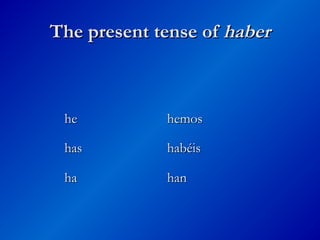
combining the present tense of the verbcombining the present tense of the verb haberhaber
(the helping verb, or(the helping verb, or el verbo auxiliarel verbo auxiliar)) with a pastwith a past
participleparticiple
 For example:For example:
 YoYo he bailadohe bailado..
I have danced.I have danced.
 Nosotros noNosotros no hemos estudiadohemos estudiado para el examen.para el examen.
We haven’t studied for the test.We haven’t studied for the test.
The present tense ofThe present tense of haberhaber
hehe hemoshemos
hashas habéishabéis
haha hanhan
Remember…Remember…
How to form the past participleHow to form the past participle::
 For –For –arar verbs, take the stem of the verb and addverbs, take the stem of the verb and add
––adoado
Example: comprar →Example: comprar → compradocomprado
 ForFor –er–er andand –ir–ir verbs, take the stem of the verbverbs, take the stem of the verb
and addand add –ido–ido
Example: tener →Example: tener → tenidotenido
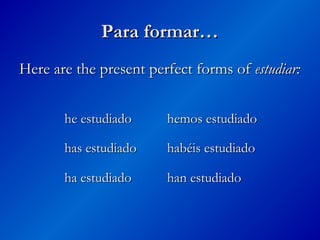
Para formar…Para formar…
Here are the present perfect forms ofHere are the present perfect forms of estudiar:estudiar:
he estudiadohe estudiado hemos estudiadohemos estudiado
has estudiadohas estudiado habéis estudiadohabéis estudiado
ha estudiadoha estudiado han estudiadohan estudiado
Para formar…Para formar…
As you can see I have combined theAs you can see I have combined the
present forms ofpresent forms of haberhaber (the helping verbs)(the helping verbs)
hehe hemoshemos
hashas habéishabéis
haha hanhan
……with thewith the pastpast participle ofparticiple of estudiarestudiar
hehe hemoshemos
hashas habéishabéis
haha hanhan
estudiadoestudiado estudiadoestudiado
Now you try…Now you try…
he ________he ________ hemos _______hemos _______
has ________has ________ habéis ________habéis ________
ha ________ha ________ han ________han ________
On a sheet of paper, see if you can figure
out the present perfect forms for the verb
hablar:
he habladohe hablado hemos habladohemos hablado
has habladohas hablado habéis habladohabéis hablado
ha habladoha hablado han habladohan hablado
Is this what you came up with?
Let’s try another…Let’s try another…
Now see if you can form the present perfectNow see if you can form the present perfect
forms of the verbforms of the verb tomar:tomar:
__ __________ ________ ____ ___________ _______
___ ___________ ________ _____ _____________ ________
__ __________ ________ ___ ___________ ________
Is this what you got?Is this what you got?
he tomadohe tomado hemos tomadohemos tomado
has tomadohas tomado habéis tomadohabéis tomado
ha tomadoha tomado han tomadohan tomado
Now let’s try anNow let’s try an –er–er verbverb
See if you can come up with the present perfectSee if you can come up with the present perfect
forms forforms for comercomer::
__ ________ ______ _____ ___________ ______
___ _________ ______ ______ ____________ ______
__ ________ ______ ___ _________ ______
Is this what you came up with?Is this what you came up with?
he comidohe comido hemos comidohemos comido
has comidohas comido habéis comidohabéis comido
ha comidoha comido han comidohan comido
Let’s try another one…see if you can come upLet’s try another one…see if you can come up
with the present perfect tense ofwith the present perfect tense of irir::
__ _____ ___ _____ ________ ___
___ ______ ___ ______ _________ ___
__ _____ ___ ___ _________ ______
Is this what you came up with?Is this what you came up with?
he idohe ido hemos idohemos ido
has idohas ido habéis idohabéis ido
ha idoha ido han idohan ido
Many of you may have assumed thatMany of you may have assumed that irir had anhad an
irregular past participle. Afterall, itirregular past participle. Afterall, it doesdoes have anhave an
irregularirregular presentpresent participle. Butparticiple. But irir is actuallyis actually
regular in this tense. Here are some verbs thatregular in this tense. Here are some verbs that
areare irregular in the past participle:irregular in the past participle:
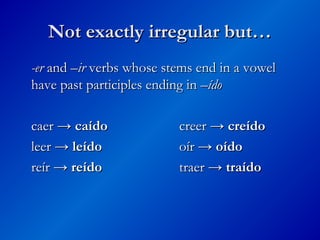
Not exactly irregular but…Not exactly irregular but…
-er-er andand –ir–ir verbs whose stems end in a vowelverbs whose stems end in a vowel
have past participles ending inhave past participles ending in –ído–ído
caer →caer → caídocaído creer →creer → creídocreído
leer →leer → leídoleído oír →oír → oídooído
reír →reír → reídoreído traer →traer → traídotraído
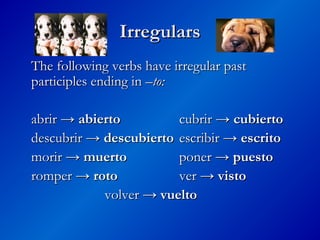
IrregularsIrregulars
The following verbs have irregular pastThe following verbs have irregular past
participles ending inparticiples ending in –to:–to:
abrir →abrir → abiertoabierto cubrir →cubrir → cubiertocubierto
descubrir →descubrir → descubiertodescubierto escribir →escribir → escritoescrito
morir →morir → muertomuerto poner →poner → puestopuesto
romper →romper → rotoroto ver →ver → vistovisto
volver →volver → vueltovuelto
More irregularsMore irregulars
These verbs have irregular past participlesThese verbs have irregular past participles
ending inending in –cho:–cho:
decir →decir → dichodicho
hacer →hacer → hechohecho
¡Practicamos!¡Practicamos!
See if you can form the correct present perfect usingSee if you can form the correct present perfect using
the subject and verb given.the subject and verb given.
Modelo: yo / decidir →Modelo: yo / decidir → He decididoHe decidido
1.1. ella / abrirella / abrir
Ha abiertoHa abierto
2.2. Marta y yo / tocarMarta y yo / tocar
Hemos tocadoHemos tocado
3.3. Gonzalo / crecerGonzalo / crecer
Ha crecidoHa crecido
4.4. Tú y tus amigos / reírTú y tus amigos / reír
Han reídoHan reído óó habéis reídohabéis reído
5.5. Mis padres / hacerMis padres / hacer
Han hechoHan hecho
6.6. Tus abuelos / cubrirTus abuelos / cubrir
Han cubiertoHan cubierto
7.7. Rogelio y Ramón / escribirRogelio y Ramón / escribir
Han escritoHan escrito

PRESENT PERFECT

  • 1.
  • 2.
    ¿Qué es elpresente perfecto?¿Qué es el presente perfecto? The present perfect is formed byThe present perfect is formed by combining a helping verb (“have” orcombining a helping verb (“have” or “has”) with the past participle“has”) with the past participle
  • 3.
    Por ejemplo…Por ejemplo… For example:For example:  II have playedhave played tennis.tennis.  SheShe has sunghas sung at weddings.at weddings.  WeWe have flownhave flown in a plane.in a plane.
  • 4.
    Para formar ininglésPara formar in inglés  To form the present participle we combine theTo form the present participle we combine the helping verb “have/has” with a past participlehelping verb “have/has” with a past participle  For example, “IFor example, “I have beenhave been a lifeguard.”a lifeguard.”  ““I” is the subjectI” is the subject  ““have” is the helping verbhave” is the helping verb  ““been” is the past participlebeen” is the past participle
  • 5.
    Para formar enespañolPara formar en español  In Spanish we form the present participle byIn Spanish we form the present participle by combining the present tense of the verbcombining the present tense of the verb haberhaber (the helping verb, or(the helping verb, or el verbo auxiliarel verbo auxiliar)) with a pastwith a past participleparticiple  For example:For example:  YoYo he bailadohe bailado.. I have danced.I have danced.  Nosotros noNosotros no hemos estudiadohemos estudiado para el examen.para el examen. We haven’t studied for the test.We haven’t studied for the test.
  • 6.
    The present tenseofThe present tense of haberhaber hehe hemoshemos hashas habéishabéis haha hanhan
  • 7.
    Remember…Remember… How to formthe past participleHow to form the past participle::  For –For –arar verbs, take the stem of the verb and addverbs, take the stem of the verb and add ––adoado Example: comprar →Example: comprar → compradocomprado  ForFor –er–er andand –ir–ir verbs, take the stem of the verbverbs, take the stem of the verb and addand add –ido–ido Example: tener →Example: tener → tenidotenido
  • 8.
    Para formar…Para formar… Hereare the present perfect forms ofHere are the present perfect forms of estudiar:estudiar: he estudiadohe estudiado hemos estudiadohemos estudiado has estudiadohas estudiado habéis estudiadohabéis estudiado ha estudiadoha estudiado han estudiadohan estudiado
  • 9.
    Para formar…Para formar… Asyou can see I have combined theAs you can see I have combined the present forms ofpresent forms of haberhaber (the helping verbs)(the helping verbs) hehe hemoshemos hashas habéishabéis haha hanhan
  • 10.
    ……with thewith thepastpast participle ofparticiple of estudiarestudiar hehe hemoshemos hashas habéishabéis haha hanhan estudiadoestudiado estudiadoestudiado estudiadoestudiado estudiadoestudiado estudiadoestudiado estudiadoestudiado
  • 11.
    Now you try…Nowyou try… he ________he ________ hemos _______hemos _______ has ________has ________ habéis ________habéis ________ ha ________ha ________ han ________han ________ On a sheet of paper, see if you can figure out the present perfect forms for the verb hablar:
  • 12.
    he habladohe habladohemos habladohemos hablado has habladohas hablado habéis habladohabéis hablado ha habladoha hablado han habladohan hablado Is this what you came up with?
  • 13.
    Let’s try another…Let’stry another… Now see if you can form the present perfectNow see if you can form the present perfect forms of the verbforms of the verb tomar:tomar: __ __________ ________ ____ ___________ _______ ___ ___________ ________ _____ _____________ ________ __ __________ ________ ___ ___________ ________
  • 14.
    Is this whatyou got?Is this what you got? he tomadohe tomado hemos tomadohemos tomado has tomadohas tomado habéis tomadohabéis tomado ha tomadoha tomado han tomadohan tomado
  • 15.
    Now let’s tryanNow let’s try an –er–er verbverb See if you can come up with the present perfectSee if you can come up with the present perfect forms forforms for comercomer:: __ ________ ______ _____ ___________ ______ ___ _________ ______ ______ ____________ ______ __ ________ ______ ___ _________ ______
  • 16.
    Is this whatyou came up with?Is this what you came up with? he comidohe comido hemos comidohemos comido has comidohas comido habéis comidohabéis comido ha comidoha comido han comidohan comido
  • 17.
    Let’s try anotherone…see if you can come upLet’s try another one…see if you can come up with the present perfect tense ofwith the present perfect tense of irir:: __ _____ ___ _____ ________ ___ ___ ______ ___ ______ _________ ___ __ _____ ___ ___ _________ ______
  • 18.
    Is this whatyou came up with?Is this what you came up with? he idohe ido hemos idohemos ido has idohas ido habéis idohabéis ido ha idoha ido han idohan ido
  • 19.
    Many of youmay have assumed thatMany of you may have assumed that irir had anhad an irregular past participle. Afterall, itirregular past participle. Afterall, it doesdoes have anhave an irregularirregular presentpresent participle. Butparticiple. But irir is actuallyis actually regular in this tense. Here are some verbs thatregular in this tense. Here are some verbs that areare irregular in the past participle:irregular in the past participle:
  • 20.
    Not exactly irregularbut…Not exactly irregular but… -er-er andand –ir–ir verbs whose stems end in a vowelverbs whose stems end in a vowel have past participles ending inhave past participles ending in –ído–ído caer →caer → caídocaído creer →creer → creídocreído leer →leer → leídoleído oír →oír → oídooído reír →reír → reídoreído traer →traer → traídotraído
  • 21.
    IrregularsIrregulars The following verbshave irregular pastThe following verbs have irregular past participles ending inparticiples ending in –to:–to: abrir →abrir → abiertoabierto cubrir →cubrir → cubiertocubierto descubrir →descubrir → descubiertodescubierto escribir →escribir → escritoescrito morir →morir → muertomuerto poner →poner → puestopuesto romper →romper → rotoroto ver →ver → vistovisto volver →volver → vueltovuelto
  • 22.
    More irregularsMore irregulars Theseverbs have irregular past participlesThese verbs have irregular past participles ending inending in –cho:–cho: decir →decir → dichodicho hacer →hacer → hechohecho
  • 23.
    ¡Practicamos!¡Practicamos! See if youcan form the correct present perfect usingSee if you can form the correct present perfect using the subject and verb given.the subject and verb given. Modelo: yo / decidir →Modelo: yo / decidir → He decididoHe decidido 1.1. ella / abrirella / abrir Ha abiertoHa abierto 2.2. Marta y yo / tocarMarta y yo / tocar Hemos tocadoHemos tocado 3.3. Gonzalo / crecerGonzalo / crecer Ha crecidoHa crecido
  • 24.
    4.4. Tú ytus amigos / reírTú y tus amigos / reír Han reídoHan reído óó habéis reídohabéis reído 5.5. Mis padres / hacerMis padres / hacer Han hechoHan hecho 6.6. Tus abuelos / cubrirTus abuelos / cubrir Han cubiertoHan cubierto 7.7. Rogelio y Ramón / escribirRogelio y Ramón / escribir Han escritoHan escrito