By: Nico Slacanin
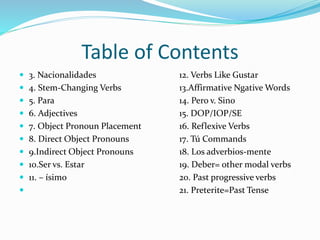
Table of Contents 
 3. Nacionalidades 12. Verbs Like Gustar 
 4. Stem-Changing Verbs 13.Affirmative NgativeWords 
 5. Para 14. Pero v. Sino 
 6. Adjectives 15. DOP/IOP/SE 
 7. Object Pronoun Placement 16. Reflexive Verbs 
 8. Direct Object Pronouns 17. Tú Commands 
 9.Indirect Object Pronouns 18. Los adverbios-mente 
 10.Ser vs. Estar 19. Deber= other modal verbs 
 11. – ísimo 20. Past progressive verbs 
 21. Preterite=Past Tense
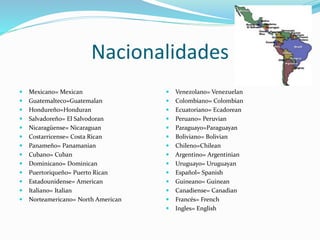
Nacionalidades 
 Mexicano= Mexican 
 Guatemalteco=Guatemalan 
 Hondureño=Honduran 
 Salvadoreño= El Salvodoran 
 Nicaragüense= Nicaraguan 
 Costarricense= Costa Rican 
 Panameño= Panamanian 
 Cubano= Cuban 
 Dominicano= Dominican 
 Puertoriqueño= Puerto Rican 
 Estadounidense= American 
 Italiano= Italian 
 Norteamericano= North American 
 Venezolano= Venezuelan 
 Colombiano= Colombian 
 Ecuatoriano= Ecadorean 
 Peruano= Peruvian 
 Paraguayo=Paraguayan 
 Boliviano= Bolivian 
 Chileno=Chilean 
 Argentino= Argentinian 
 Uruguayo= Uruguayan 
 Español= Spanish 
 Guineano= Guinean 
 Canadiense= Canadian 
 Francés= French 
 Ingles= English
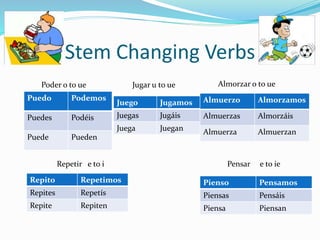
Stem Changing Verbs 
Poder o to ue 
Puedo Podemos 
Puedes Podéis 
Puede Pueden 
Almorzar o to ue 
Almuerzo Almorzamos 
Almuerzas Almorzáis 
Almuerza Almuerzan 
Repetir e to i 
Repito Repetimos 
Repites Repetís 
Repite Repiten 
Pensar e to ie 
Pienso Pensamos 
Piensas Pensáis 
Piensa Piensan 
Jugar u to ue 
Juego Jugamos 
Juegas Jugáis 
Juega Juegan
Para 
 Para is used in Spanish to express for or in 
order to 
 In Spanish, para is used very frequently in 
many certain instances 
 Example: Yo voy al supermercado para mi 
mama.
 Adjectives in spanish follow a gender 
 They always have to agree with the correct gender of the noun 
 Furthermore, they also have to agree whether the noun is plural 
or singular 
 Example: Los libros es muy muy largos. La chica es bonita. 
 To make plural: 
 End in vowel, add “s” 
 End in consonant, add “es” 
 End in z, add “ces”
Object Pronoun Placement 
 The placement of an object pronoun is the same for both indirect 
and direct objects. 
 If the pronoun accompanies a conjugated verb, it is placed before 
the verb. 
 Example: Rose le compra las ropas. 
 However, if there is an infinitive followed by a conjugated verb, 
then the object pronoun can come before the conjugated verb, or 
it can be attached to the end of the infinitive. 
 Example: Rosa quiere comprarle una olla a su padre. 
 The pronoun can also be attached to an affirmative tu command, 
and it can be attached to a progressive tense verb 
 Remember to add an accent when adding a syllable.
Direct Object Pronouns 
Me Nos 
Te Os 
Lo/La Los/Las 
• Remember Direct Objects answer who or what is receiving the action. 
• Use a direct object pronoun to emphasize who or what is receiving the 
verb. Make sure that the pronoun correlates with the antecedent. 
• Example: Yo compro la. Yo compro la comida.
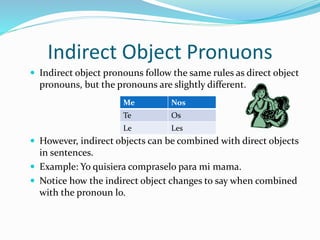
Indirect Object Pronuons 
 Indirect object pronouns follow the same rules as direct object 
pronouns, but the pronouns are slightly different. 
Me Nos 
Te Os 
Le Les 
 However, indirect objects can be combined with direct objects 
in sentences. 
 Example: Yo quisiera compraselo para mi mama. 
 Notice how the indirect object changes to say when combined 
with the pronoun lo.
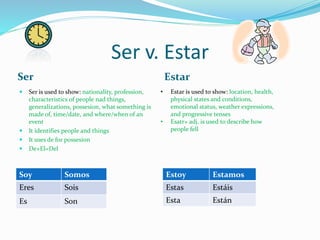
Ser v. Estar 
Ser Estar 
 Ser is used to show: nationality, profession, 
characteristics of people nad things, 
generalizations, possesion, what something is 
made of, time/date, and where/when of an 
event 
 It identifies people and things 
 It uses de for possesion 
 De+El=Del 
Soy Somos 
Eres Sois 
Es Son 
• Estar is used to show: location, health, 
physical states and conditions, 
emotional status, weather expressions, 
and progressive tenses 
• Esatr+ adj. is used to describe how 
people fell 
Estoy Estamos 
Estas Estáis 
Esta Están
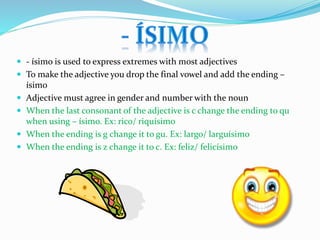
 - ísimo is used to express extremes with most adjectives 
 To make the adjective you drop the final vowel and add the ending – 
ísimo 
 Adjective must agree in gender and number with the noun 
 When the last consonant of the adjective is c change the ending to qu 
when using – ísimo. Ex: rico/ riquísimo 
 When the ending is g change it to gu. Ex: largo/ larguísimo 
 When the ending is z change it to c. Ex: feliz/ felicísimo
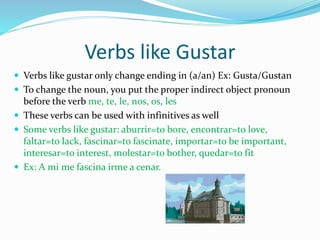
Verbs like Gustar 
 Verbs like gustar only change ending in (a/an) Ex: Gusta/Gustan 
 To change the noun, you put the proper indirect object pronoun 
before the verb me, te, le, nos, os, les 
 These verbs can be used with infinitives as well 
 Some verbs like gustar: aburrir=to bore, encontrar=to love, 
faltar=to lack, fascinar=to fascinate, importar=to be important, 
interesar=to interest, molestar=to bother, quedar=to fit 
 Ex: A mi me fascina irme a cenar.
Affirmative and Negative Words 
Affirmative Negative 
 Affirmative words must match the gender of 
the noun they replace or modify. 
 Algo= something 
 Alguien= someone 
 Algún/Alguno(a)= some 
 Siempre= always 
 También= also 
 Example: ?Algo de tomar? (Something to 
drink?) 
 A double negative is required in spanish when 
a no precedes the verb. 
 However, if anegative word sucha as nunca 
precedes the verb, a double negative is not 
required. 
 Nada= nothing 
 Nadie= no one 
 Ningún/Ninguno= none/not any 
 Nunca= never 
 Tampoco= neither/either 
 Example: Por ahora, nada mas. (For now, 
nothing more.)
Pero vs. Sino 
Pero Sino 
 Pero is usually used to compare to 
contrasting ideas 
 Pero adds on to the first statement 
 Ex: Estudiar no es divertido, pero es 
necesario. 
 Sino is usually used in negative 
sentences or to negate a topic 
 In English sino would mean “but 
rather” or “on the contrary” 
 When used before a conjugated 
verb, you have to put “sino que” 
 Ex: No voy al cine sino que ceno 
con mis padres.
DOP/IOP/SE 
DOP IOP 
 Direct objects receive the action 
and can sometimes be paired 
with the indirect object in 
Spanish 
 In Spanish, most direct objects 
are in the pronoun form. 
 Indirect objects also come in the 
pronoun form most of the time, 
but they almost always have an 
antecedent placed at the end of 
the sentence. 
 The indirect objects pronouns 
are sometimes paired with the 
DOP 
 Ex: Voy a comprarselo el regalo 
para mi papa.
Reflexive Verbs 
 Reflexive verbs describe actions that are done to oneself. 
 Reflexive verbs almost always include a reflexive pronoun to indicate the subject 
 Ex: Secarse= to dry oneself changes to me seco, te secas, se seca, nos secamos, or se secan 
 When using this pronoun, you have to take the reflexive verb and drop the se off the end 
 Then you properly conjugate it depending on the subject 
 Finally, you add the correct pronoun in front to properly indicate the subject of the sentence. 
Reflexive Pronouns 
Me Nos 
Te Os 
Se Se 
 Example: Me lavo en el baño en la cama.
Tú Commands 
Affirmative tú commands Negative tú commands 
 Affirmative tú commands are verbs that direct 
specific instructions to people 
 To form a tú command, put your verb in the tú 
form of conjugation. Then drop the “s” and 
then you have your command. 
 Ex: Comer goes to !Come! 
 Irregular tú commands follow a different set of 
rules. Where the whole verb changes form. 
 Decir-di 
 Hacer-haz 
 Ir-ve 
 Poner-pon 
 Salir-sal 
 Ser-se 
 Tener-ten 
 Venir-ven 
 Negative tú commands are used when you 
don’t want someone to do something 
 In Spanish, to form this command, you change 
the verb into yo form, then you drop the “o” 
and add the opposite vowel ending, and then 
you add an “s”. Finally, add a “no” in front 
 Example: Hablar goes to Hablo then to Hable 
then to No hables 
 Irregular negative commands also change form 
 Tener- No tengas 
 Venir- No vengas 
 Dar/Decir- No digas/No des 
 Ir- No voyas 
 Ser- No seas 
 Hacer- No hagas 
 Estar- No estés 
 Salir- No salgas
Los Adverbios- Mente 
 To change adjectives into adverbs, you have to use the mente 
process 
 If the adjective ends in a consonant or an e simply add a –mente 
to the end. If the adjective ends in an o, change the o to an a and 
then add the mente. 
 Ex: Frecuente goes to Frecuentemente 
 Ex: Lento(a) goes to Lentamente 
 When you have two or more adverbs only put a mente on the last 
adjective, but still change the others to a feminine form if it ends 
in o
Deber and other Modal Verbs 
 A modal verb is used as a helping verb to the action verb. 
 The modal verb is conjugated, and the 2nd or action verb is left in 
the infinitive form 
 Ex: Yo voy a comprar a comida para mi. 
 List of modal verbs: 
 Desear= to need, Poder= to be able to, Querer= to want, Ir= to go, 
Solar= accustom to, Tener= to have, Deber= should/ought to, 
Saber= to know
Present Progressive 
 To make a present progressive you put a conjugated estar before the action verb. 
 Then you add an –ando to the end of an –ar verb, an –iendo to the end of –ir verb, 
and a –yendo to the end of an –ir/er verb 
 Example: Esper goes to Estoy esperando 
 When you have a pronoun place it before the conjugated estar or you attach to the 
end of the present participle. 
 Irregular present progressives change form 
 Leer-Leyendo 
 Oír-Oyendo 
 Traer-Trayendo 
 Pedir-Pidiendo 
 Servir-Sirviendo 
 Decir- Diciendo 
 Dormir-Duermiendo 
 Venir-Viniendo
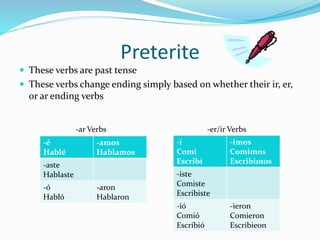
Preterite 
 These verbs are past tense 
 These verbs change ending simply based on whether their ir, er, 
or ar ending verbs 
-é 
Hablé 
-ar Verbs 
-amos 
Hablamos 
-aste 
Hablaste 
-ó 
Habló 
-aron 
Hablaron 
-í 
Comí 
Escribí 
-er/ir Verbs 
-imos 
Comimos 
Escribimos 
-iste 
Comiste 
Escribiste 
-ió 
Comió 
Escribió 
-ieron 
Comieron 
Escribieon

Espanola Grammar Book

  • 1.
  • 2.
    Table of Contents  3. Nacionalidades 12. Verbs Like Gustar  4. Stem-Changing Verbs 13.Affirmative NgativeWords  5. Para 14. Pero v. Sino  6. Adjectives 15. DOP/IOP/SE  7. Object Pronoun Placement 16. Reflexive Verbs  8. Direct Object Pronouns 17. Tú Commands  9.Indirect Object Pronouns 18. Los adverbios-mente  10.Ser vs. Estar 19. Deber= other modal verbs  11. – ísimo 20. Past progressive verbs  21. Preterite=Past Tense
  • 3.
    Nacionalidades  Mexicano=Mexican  Guatemalteco=Guatemalan  Hondureño=Honduran  Salvadoreño= El Salvodoran  Nicaragüense= Nicaraguan  Costarricense= Costa Rican  Panameño= Panamanian  Cubano= Cuban  Dominicano= Dominican  Puertoriqueño= Puerto Rican  Estadounidense= American  Italiano= Italian  Norteamericano= North American  Venezolano= Venezuelan  Colombiano= Colombian  Ecuatoriano= Ecadorean  Peruano= Peruvian  Paraguayo=Paraguayan  Boliviano= Bolivian  Chileno=Chilean  Argentino= Argentinian  Uruguayo= Uruguayan  Español= Spanish  Guineano= Guinean  Canadiense= Canadian  Francés= French  Ingles= English
  • 4.
    Stem Changing Verbs Poder o to ue Puedo Podemos Puedes Podéis Puede Pueden Almorzar o to ue Almuerzo Almorzamos Almuerzas Almorzáis Almuerza Almuerzan Repetir e to i Repito Repetimos Repites Repetís Repite Repiten Pensar e to ie Pienso Pensamos Piensas Pensáis Piensa Piensan Jugar u to ue Juego Jugamos Juegas Jugáis Juega Juegan
  • 5.
    Para  Parais used in Spanish to express for or in order to  In Spanish, para is used very frequently in many certain instances  Example: Yo voy al supermercado para mi mama.
  • 6.
     Adjectives inspanish follow a gender  They always have to agree with the correct gender of the noun  Furthermore, they also have to agree whether the noun is plural or singular  Example: Los libros es muy muy largos. La chica es bonita.  To make plural:  End in vowel, add “s”  End in consonant, add “es”  End in z, add “ces”
  • 7.
    Object Pronoun Placement  The placement of an object pronoun is the same for both indirect and direct objects.  If the pronoun accompanies a conjugated verb, it is placed before the verb.  Example: Rose le compra las ropas.  However, if there is an infinitive followed by a conjugated verb, then the object pronoun can come before the conjugated verb, or it can be attached to the end of the infinitive.  Example: Rosa quiere comprarle una olla a su padre.  The pronoun can also be attached to an affirmative tu command, and it can be attached to a progressive tense verb  Remember to add an accent when adding a syllable.
  • 8.
    Direct Object Pronouns Direct Object Pronouns Me Nos Te Os Lo/La Los/Las • Remember Direct Objects answer who or what is receiving the action. • Use a direct object pronoun to emphasize who or what is receiving the verb. Make sure that the pronoun correlates with the antecedent. • Example: Yo compro la. Yo compro la comida.
  • 9.
    Indirect Object Pronuons  Indirect object pronouns follow the same rules as direct object pronouns, but the pronouns are slightly different. Me Nos Te Os Le Les  However, indirect objects can be combined with direct objects in sentences.  Example: Yo quisiera compraselo para mi mama.  Notice how the indirect object changes to say when combined with the pronoun lo.
  • 10.
    Ser v. Estar Ser Estar  Ser is used to show: nationality, profession, characteristics of people nad things, generalizations, possesion, what something is made of, time/date, and where/when of an event  It identifies people and things  It uses de for possesion  De+El=Del Soy Somos Eres Sois Es Son • Estar is used to show: location, health, physical states and conditions, emotional status, weather expressions, and progressive tenses • Esatr+ adj. is used to describe how people fell Estoy Estamos Estas Estáis Esta Están
  • 11.
     - ísimois used to express extremes with most adjectives  To make the adjective you drop the final vowel and add the ending – ísimo  Adjective must agree in gender and number with the noun  When the last consonant of the adjective is c change the ending to qu when using – ísimo. Ex: rico/ riquísimo  When the ending is g change it to gu. Ex: largo/ larguísimo  When the ending is z change it to c. Ex: feliz/ felicísimo
  • 12.
    Verbs like Gustar  Verbs like gustar only change ending in (a/an) Ex: Gusta/Gustan  To change the noun, you put the proper indirect object pronoun before the verb me, te, le, nos, os, les  These verbs can be used with infinitives as well  Some verbs like gustar: aburrir=to bore, encontrar=to love, faltar=to lack, fascinar=to fascinate, importar=to be important, interesar=to interest, molestar=to bother, quedar=to fit  Ex: A mi me fascina irme a cenar.
  • 13.
    Affirmative and NegativeWords Affirmative Negative  Affirmative words must match the gender of the noun they replace or modify.  Algo= something  Alguien= someone  Algún/Alguno(a)= some  Siempre= always  También= also  Example: ?Algo de tomar? (Something to drink?)  A double negative is required in spanish when a no precedes the verb.  However, if anegative word sucha as nunca precedes the verb, a double negative is not required.  Nada= nothing  Nadie= no one  Ningún/Ninguno= none/not any  Nunca= never  Tampoco= neither/either  Example: Por ahora, nada mas. (For now, nothing more.)
  • 14.
    Pero vs. Sino Pero Sino  Pero is usually used to compare to contrasting ideas  Pero adds on to the first statement  Ex: Estudiar no es divertido, pero es necesario.  Sino is usually used in negative sentences or to negate a topic  In English sino would mean “but rather” or “on the contrary”  When used before a conjugated verb, you have to put “sino que”  Ex: No voy al cine sino que ceno con mis padres.
  • 15.
    DOP/IOP/SE DOP IOP  Direct objects receive the action and can sometimes be paired with the indirect object in Spanish  In Spanish, most direct objects are in the pronoun form.  Indirect objects also come in the pronoun form most of the time, but they almost always have an antecedent placed at the end of the sentence.  The indirect objects pronouns are sometimes paired with the DOP  Ex: Voy a comprarselo el regalo para mi papa.
  • 16.
    Reflexive Verbs Reflexive verbs describe actions that are done to oneself.  Reflexive verbs almost always include a reflexive pronoun to indicate the subject  Ex: Secarse= to dry oneself changes to me seco, te secas, se seca, nos secamos, or se secan  When using this pronoun, you have to take the reflexive verb and drop the se off the end  Then you properly conjugate it depending on the subject  Finally, you add the correct pronoun in front to properly indicate the subject of the sentence. Reflexive Pronouns Me Nos Te Os Se Se  Example: Me lavo en el baño en la cama.
  • 17.
    Tú Commands Affirmativetú commands Negative tú commands  Affirmative tú commands are verbs that direct specific instructions to people  To form a tú command, put your verb in the tú form of conjugation. Then drop the “s” and then you have your command.  Ex: Comer goes to !Come!  Irregular tú commands follow a different set of rules. Where the whole verb changes form.  Decir-di  Hacer-haz  Ir-ve  Poner-pon  Salir-sal  Ser-se  Tener-ten  Venir-ven  Negative tú commands are used when you don’t want someone to do something  In Spanish, to form this command, you change the verb into yo form, then you drop the “o” and add the opposite vowel ending, and then you add an “s”. Finally, add a “no” in front  Example: Hablar goes to Hablo then to Hable then to No hables  Irregular negative commands also change form  Tener- No tengas  Venir- No vengas  Dar/Decir- No digas/No des  Ir- No voyas  Ser- No seas  Hacer- No hagas  Estar- No estés  Salir- No salgas
  • 18.
    Los Adverbios- Mente  To change adjectives into adverbs, you have to use the mente process  If the adjective ends in a consonant or an e simply add a –mente to the end. If the adjective ends in an o, change the o to an a and then add the mente.  Ex: Frecuente goes to Frecuentemente  Ex: Lento(a) goes to Lentamente  When you have two or more adverbs only put a mente on the last adjective, but still change the others to a feminine form if it ends in o
  • 19.
    Deber and otherModal Verbs  A modal verb is used as a helping verb to the action verb.  The modal verb is conjugated, and the 2nd or action verb is left in the infinitive form  Ex: Yo voy a comprar a comida para mi.  List of modal verbs:  Desear= to need, Poder= to be able to, Querer= to want, Ir= to go, Solar= accustom to, Tener= to have, Deber= should/ought to, Saber= to know
  • 20.
    Present Progressive To make a present progressive you put a conjugated estar before the action verb.  Then you add an –ando to the end of an –ar verb, an –iendo to the end of –ir verb, and a –yendo to the end of an –ir/er verb  Example: Esper goes to Estoy esperando  When you have a pronoun place it before the conjugated estar or you attach to the end of the present participle.  Irregular present progressives change form  Leer-Leyendo  Oír-Oyendo  Traer-Trayendo  Pedir-Pidiendo  Servir-Sirviendo  Decir- Diciendo  Dormir-Duermiendo  Venir-Viniendo
  • 21.
    Preterite  Theseverbs are past tense  These verbs change ending simply based on whether their ir, er, or ar ending verbs -é Hablé -ar Verbs -amos Hablamos -aste Hablaste -ó Habló -aron Hablaron -í Comí Escribí -er/ir Verbs -imos Comimos Escribimos -iste Comiste Escribiste -ió Comió Escribió -ieron Comieron Escribieon