Grammar Book Diego Taylor
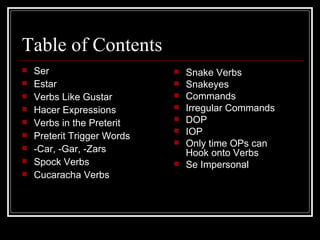
Table of Contents Ser Estar Verbs Like Gustar Hacer Expressions Verbs in the Preterit Preterit Trigger Words -Car, -Gar, -Zars Spock Verbs Cucaracha Verbs Snake Verbs Snakeyes Commands Irregular Commands DOP IOP Only time OPs can Hook onto Verbs Se Impersonal
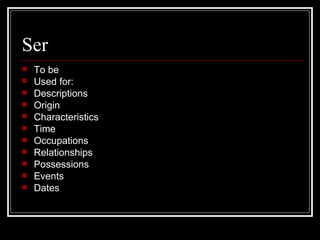
Ser To be Used for: Descriptions Origin Characteristics Time Occupations Relationships Possessions  Events Dates
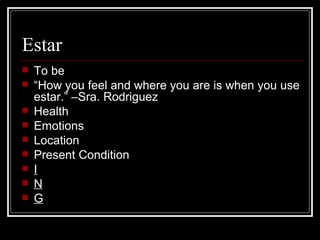
Estar To be “ How you feel and where you are is when you use estar.” –Sra. Rodriguez Health Emotions Location Present Condition  I N G
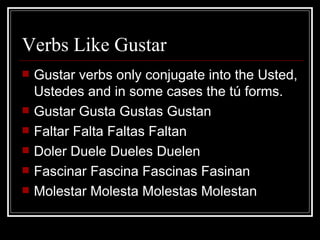
Verbs Like Gustar Gustar verbs only conjugate into the Usted, Ustedes and in some cases the tú forms.  Gustar Gusta Gustas Gustan Faltar Falta Faltas Faltan Doler Duele Dueles Duelen Fascinar Fascina Fascinas Fasinan Molestar Molesta Molestas Molestan
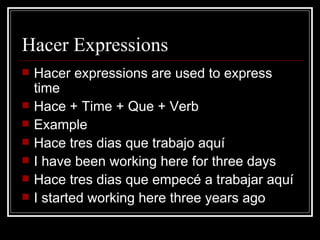
Hacer Expressions  Hacer expressions are used to express time  Hace + Time + Que + Verb Example Hace tres dias que trabajo aquí I have been working here for three days Hace tres dias que empec é a trabajar aquí I started working here three years ago
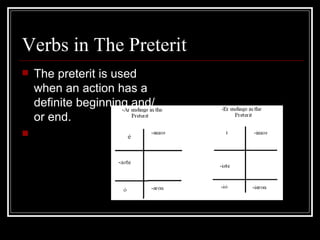
Verbs in The Preterit The preterit is used when an action has a definite beginning and/or end.
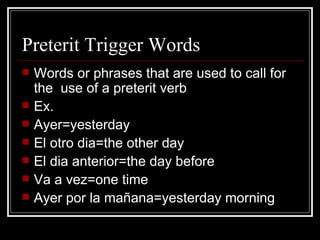
Preterit Trigger Words Words or phrases that are used to call for the  use of a preterit verb Ex. Ayer=yesterday El otro dia=the other day El dia anterior=the day before Va a vez=one time Ayer por la mañana=yesterday morning
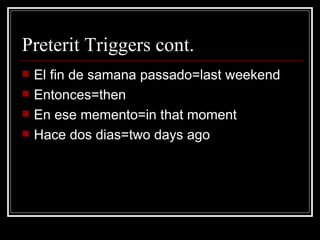
Preterit Triggers cont.  El fin de samana passado=last weekend  Entonces=then En ese memento=in that moment Hace dos dias=two days ago
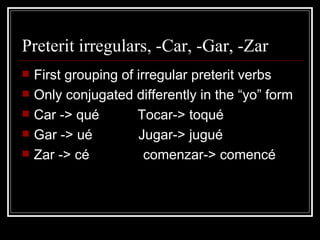
Preterit irregulars, -Car, -Gar, -Zar First grouping of irregular preterit verbs Only conjugated differently in the “yo” form Car -> qué  Tocar-> toqué Gar -> ué  Jugar-> jugué  Zar -> cé  comenzar-> comencé
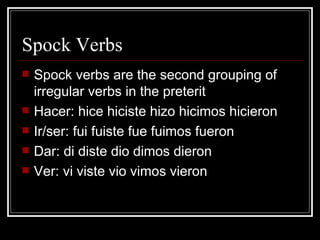
Spock Verbs Spock verbs are the second grouping of irregular verbs in the preterit Hacer: hice hiciste hizo hicimos hicieron Ir/ser: fui fuiste fue fuimos fueron Dar: di diste dio dimos dieron Ver: vi viste vio vimos vieron
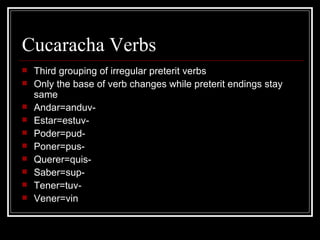
Cucaracha Verbs Third grouping of irregular preterit verbs Only the base of verb changes while preterit endings stay same Andar=anduv- Estar=estuv- Poder=pud- Poner=pus- Querer=quis- Saber=sup- Tener=tuv- Vener=vin
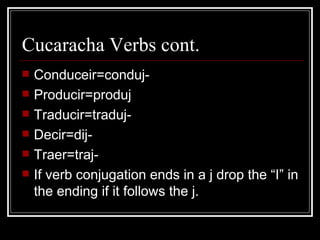
Cucaracha Verbs cont. Conduceir=conduj- Producir=produj Traducir=traduj- Decir=dij- Traer=traj- If verb conjugation ends in a j drop the “I” in the ending if it follows the j.
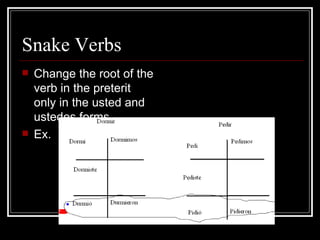
Snake Verbs Change the root of the verb in the preterit only in the usted and ustedes forms. Ex.
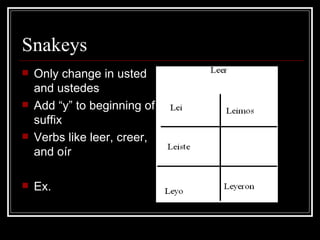
Snakeys Only change in usted and ustedes Add “y” to beginning of suffix Verbs like leer, creer, and oír Ex.
Commands Affirmative commands in the “tu” form are formed by simply dropping the “s” at the end Affirmative commands in the usted and ustedes forms change the verb to the “yo” form and change to opposite vowel Opposite vowel means if verb is –ar change the “o” to “e” and if an –er verb change “o” to “a” A Direct object, DO, can be added to an affermitive
Commands cont. For negative commands in the “tu” form put in “yo” for, change to opposite vowel and add an “s” For the negative usted and ustedes form follow same rule as above but place “no” before the verb Warning: DOP and IOP do not connect to negative verb commands
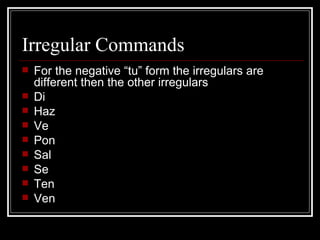
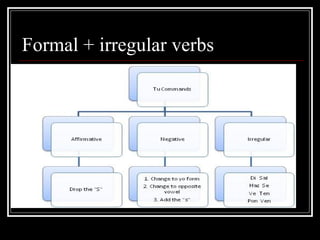
Irregular Commands For the negative “tu” form the irregulars are different then the other irregulars Di Haz Ve Pon Sal Se Ten Ven
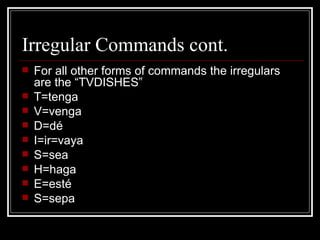
Irregular Commands cont. For all other forms of commands the irregulars are the “TVDISHES” T=tenga V=venga D=dé I=ir=vaya S=sea H=haga E=esté S=sepa
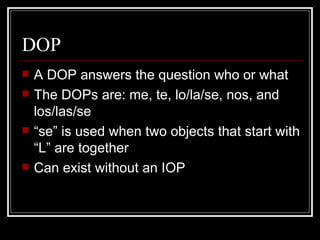
DOP A DOP answers the question who or what The DOPs are: me, te, lo/la/se, nos, and los/las/se “ se” is used when two objects that start with “L” are together Can exist without an IOP
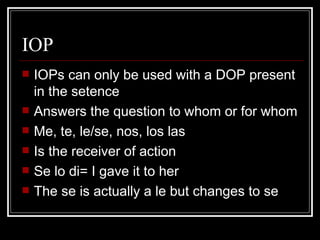
IOP IOPs can only be used with a DOP present in the setence Answers the question to whom or for whom Me, te, le/se, nos, los las Is the receiver of action  Se lo di= I gave it to her The se is actually a le but changes to se
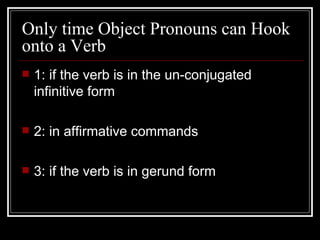
Only time Object Pronouns can Hook onto a Verb 1: if the verb is in the un-conjugated infinitive form 2: in affirmative commands 3: if the verb is in gerund form
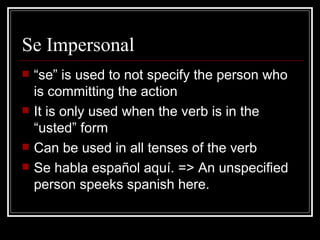
Se Impersonal “ se” is used to not specify the person who is committing the action It is only used when the verb is in the “usted” form Can be used in all tenses of the verb Se habla español aquí. => An unspecified person speeks spanish here.
Grammer Book Part 2
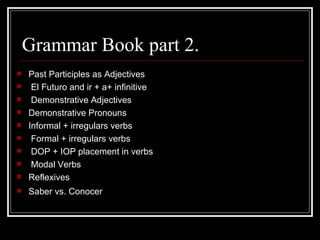
Grammar Book part 2.  Past Participles as Adjectives   El Futuro and ir + a+ infinitive   Demonstrative Adjectives Demonstrative Pronouns Informal + irregulars verbs   Formal + irregulars verbs   DOP + IOP placement in verbs   Modal Verbs Reflexives Saber vs. Conocer
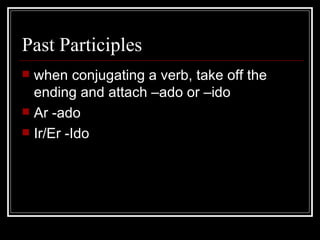
Past Participles  when conjugating a verb, take off the ending and attach –ado or –ido Ar -ado Ir/Er -Ido
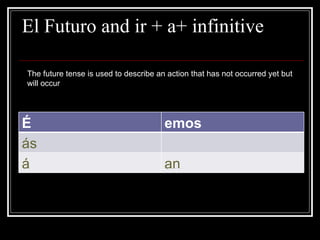
  El Futuro and ir + a+ infinitive The future tense is used to describe an action that has not occurred yet but will occur É emos ás á an
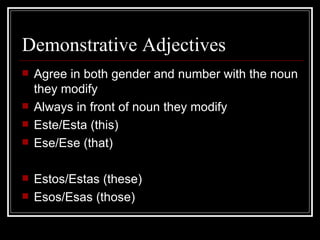
Demonstrative Adjectives Agree in both gender and number with the noun they modify Always in front of noun they modify Este/Esta (this) Ese/Ese (that) Estos/Estas (these) Esos/Esas (those)
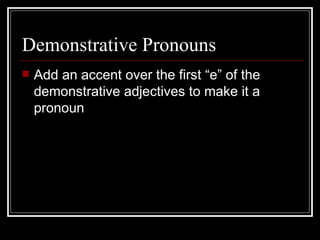
Demonstrative Pronouns Add an accent over the first “e” of the demonstrative adjectives to make it a pronoun
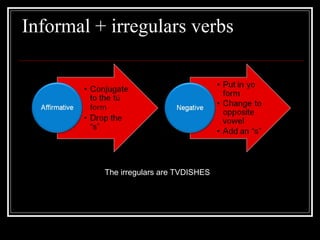
Informal + irregulars verbs The irregulars are TVDISHES
Formal + irregular verbs
DOP + IOP placement in verbs 1: if the verb is in the un-conjugated infinitive form 2: in affirmative commands 3: if the verb is in gerund form  Negative commands the DOP/IOP is placed in front of verb
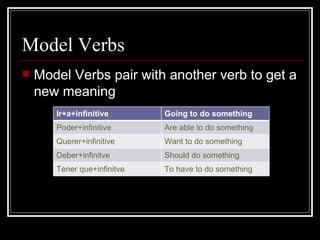
Model Verbs Model Verbs pair with another verb to get a new meaning  Ir+a+infinitive Going to do something Poder+infinitive Are able to do something Querer+infinitive Want to do something Deber+infinitve Should do something Tener que+infinitve To have to do something
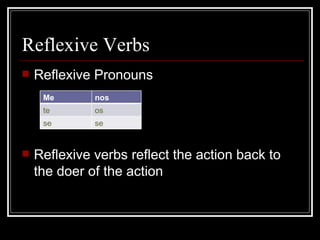
Reflexive Verbs Reflexive Pronouns Reflexive verbs reflect the action back to the doer of the action Me nos te os se se
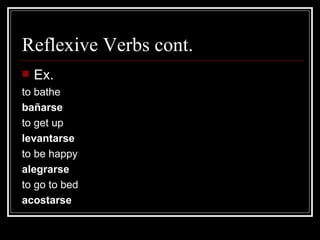
Reflexive Verbs cont. Ex. to bathe bañarse to get up levantarse to be happy alegrarse to go to bed acostarse
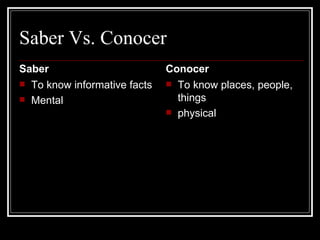
Saber Vs. Conocer Saber To know informative facts Mental Conocer To know places, people, things physical

Spanish grammer book

  • 1.
  • 2.
    Table of ContentsSer Estar Verbs Like Gustar Hacer Expressions Verbs in the Preterit Preterit Trigger Words -Car, -Gar, -Zars Spock Verbs Cucaracha Verbs Snake Verbs Snakeyes Commands Irregular Commands DOP IOP Only time OPs can Hook onto Verbs Se Impersonal
  • 3.
    Ser To beUsed for: Descriptions Origin Characteristics Time Occupations Relationships Possessions Events Dates
  • 4.
    Estar To be“ How you feel and where you are is when you use estar.” –Sra. Rodriguez Health Emotions Location Present Condition I N G
  • 5.
    Verbs Like GustarGustar verbs only conjugate into the Usted, Ustedes and in some cases the tú forms. Gustar Gusta Gustas Gustan Faltar Falta Faltas Faltan Doler Duele Dueles Duelen Fascinar Fascina Fascinas Fasinan Molestar Molesta Molestas Molestan
  • 6.
    Hacer Expressions Hacer expressions are used to express time Hace + Time + Que + Verb Example Hace tres dias que trabajo aquí I have been working here for three days Hace tres dias que empec é a trabajar aquí I started working here three years ago
  • 7.
    Verbs in ThePreterit The preterit is used when an action has a definite beginning and/or end.
  • 8.
    Preterit Trigger WordsWords or phrases that are used to call for the use of a preterit verb Ex. Ayer=yesterday El otro dia=the other day El dia anterior=the day before Va a vez=one time Ayer por la mañana=yesterday morning
  • 9.
    Preterit Triggers cont. El fin de samana passado=last weekend Entonces=then En ese memento=in that moment Hace dos dias=two days ago
  • 10.
    Preterit irregulars, -Car,-Gar, -Zar First grouping of irregular preterit verbs Only conjugated differently in the “yo” form Car -> qué Tocar-> toqué Gar -> ué Jugar-> jugué Zar -> cé comenzar-> comencé
  • 11.
    Spock Verbs Spockverbs are the second grouping of irregular verbs in the preterit Hacer: hice hiciste hizo hicimos hicieron Ir/ser: fui fuiste fue fuimos fueron Dar: di diste dio dimos dieron Ver: vi viste vio vimos vieron
  • 12.
    Cucaracha Verbs Thirdgrouping of irregular preterit verbs Only the base of verb changes while preterit endings stay same Andar=anduv- Estar=estuv- Poder=pud- Poner=pus- Querer=quis- Saber=sup- Tener=tuv- Vener=vin
  • 13.
    Cucaracha Verbs cont.Conduceir=conduj- Producir=produj Traducir=traduj- Decir=dij- Traer=traj- If verb conjugation ends in a j drop the “I” in the ending if it follows the j.
  • 14.
    Snake Verbs Changethe root of the verb in the preterit only in the usted and ustedes forms. Ex.
  • 15.
    Snakeys Only changein usted and ustedes Add “y” to beginning of suffix Verbs like leer, creer, and oír Ex.
  • 16.
    Commands Affirmative commandsin the “tu” form are formed by simply dropping the “s” at the end Affirmative commands in the usted and ustedes forms change the verb to the “yo” form and change to opposite vowel Opposite vowel means if verb is –ar change the “o” to “e” and if an –er verb change “o” to “a” A Direct object, DO, can be added to an affermitive
  • 17.
    Commands cont. Fornegative commands in the “tu” form put in “yo” for, change to opposite vowel and add an “s” For the negative usted and ustedes form follow same rule as above but place “no” before the verb Warning: DOP and IOP do not connect to negative verb commands
  • 18.
    Irregular Commands Forthe negative “tu” form the irregulars are different then the other irregulars Di Haz Ve Pon Sal Se Ten Ven
  • 19.
    Irregular Commands cont.For all other forms of commands the irregulars are the “TVDISHES” T=tenga V=venga D=dé I=ir=vaya S=sea H=haga E=esté S=sepa
  • 20.
    DOP A DOPanswers the question who or what The DOPs are: me, te, lo/la/se, nos, and los/las/se “ se” is used when two objects that start with “L” are together Can exist without an IOP
  • 21.
    IOP IOPs canonly be used with a DOP present in the setence Answers the question to whom or for whom Me, te, le/se, nos, los las Is the receiver of action Se lo di= I gave it to her The se is actually a le but changes to se
  • 22.
    Only time ObjectPronouns can Hook onto a Verb 1: if the verb is in the un-conjugated infinitive form 2: in affirmative commands 3: if the verb is in gerund form
  • 23.
    Se Impersonal “se” is used to not specify the person who is committing the action It is only used when the verb is in the “usted” form Can be used in all tenses of the verb Se habla español aquí. => An unspecified person speeks spanish here.
  • 24.
  • 25.
    Grammar Book part2. Past Participles as Adjectives   El Futuro and ir + a+ infinitive   Demonstrative Adjectives Demonstrative Pronouns Informal + irregulars verbs   Formal + irregulars verbs   DOP + IOP placement in verbs   Modal Verbs Reflexives Saber vs. Conocer
  • 26.
    Past Participles when conjugating a verb, take off the ending and attach –ado or –ido Ar -ado Ir/Er -Ido
  • 27.
      El Futuroand ir + a+ infinitive The future tense is used to describe an action that has not occurred yet but will occur É emos ás á an
  • 28.
    Demonstrative Adjectives Agreein both gender and number with the noun they modify Always in front of noun they modify Este/Esta (this) Ese/Ese (that) Estos/Estas (these) Esos/Esas (those)
  • 29.
    Demonstrative Pronouns Addan accent over the first “e” of the demonstrative adjectives to make it a pronoun
  • 30.
    Informal + irregularsverbs The irregulars are TVDISHES
  • 31.
  • 32.
    DOP + IOPplacement in verbs 1: if the verb is in the un-conjugated infinitive form 2: in affirmative commands 3: if the verb is in gerund form Negative commands the DOP/IOP is placed in front of verb
  • 33.
    Model Verbs ModelVerbs pair with another verb to get a new meaning Ir+a+infinitive Going to do something Poder+infinitive Are able to do something Querer+infinitive Want to do something Deber+infinitve Should do something Tener que+infinitve To have to do something
  • 34.
    Reflexive Verbs ReflexivePronouns Reflexive verbs reflect the action back to the doer of the action Me nos te os se se
  • 35.
    Reflexive Verbs cont.Ex. to bathe bañarse to get up levantarse to be happy alegrarse to go to bed acostarse
  • 36.
    Saber Vs. ConocerSaber To know informative facts Mental Conocer To know places, people, things physical