2nd  Semester Grammar BookSelena Pollack                Period 5
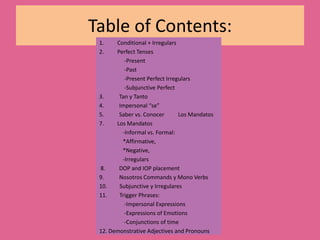
Table of Contents:Conditional + IrregularsPerfect Tenses                  -Present                   -Past                  -Present Perfect Irregulars                   -Subjunctive Perfect3.           Tan y Tanto4.           Impersonal “se”5.           Saber vs. ConocerLos MandatosLos Mandatos                -Informal vs. Formal:*Affirmative, *Negative,                  -Irregulars 8.          DOP and IOP placement9.           Nosotros Commands y Mono Verbs10.         Subjunctive y Irregulares11.         Trigger Phrases:                   -Impersonal Expressions                  -Expressions of Emotions                  -Conjunctions of time12. Demonstrative Adjectives and Pronouns
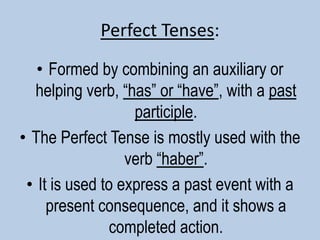
Perfect Tenses:Formed by combining an auxiliary or helping verb, “has” or “have”, with a past participle. The Perfect Tense is mostly used with the verb “haber”. It is used to express a past event with a present consequence, and it shows a completed action.
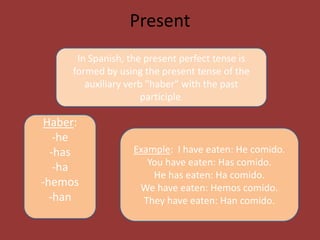
PresentIn Spanish, the present perfect tense is formed by using the present tense of the auxiliary verb "haber" with the past participle.Haber: -he-has-ha-hemos-hanExample:  I have eaten: He comido.You have eaten: Has comido.He has eaten: Ha comido.We have eaten: Hemoscomido.They have eaten: Han comido.
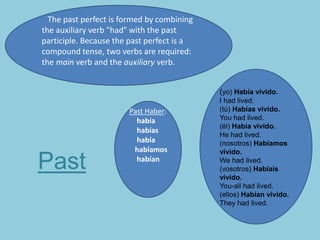
Past   The past perfect is formed by combining the auxiliary verb "had" with the past participle. Because the past perfect is a compound tense, two verbs are required: the main verb and the auxiliary verb.(yo) Habíavivido.I had lived.(tú) Habíasvivido.You had lived.(él) Habíavivido.He had lived.(nosotros) Habíamosvivido.We had lived.(vosotros) Habíaisvivido.You-all had lived.(ellos) Habíanvivido.They had lived.Past Haber:      había      habías     había    habíamos     habíanPast
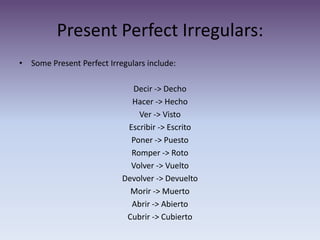
Present Perfect Irregulars: Some Present Perfect Irregulars include: Decir -> DechoHacer -> HechoVer -> VistoEscribir -> EscritoPoner -> PuestoRomper -> RotoVolver -> VueltoDevolver -> DevueltoMorir -> MuertoAbrir -> AbiertoCubrir -> Cubierto
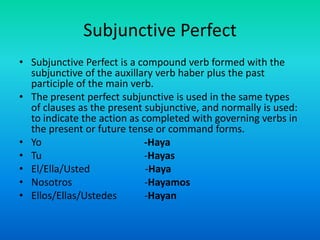
Subjunctive PerfectSubjunctive Perfect is a compound verb formed with the subjunctive of the auxillary verb haber plus the past participle of the main verb. The present perfect subjunctive is used in the same types of clauses as the present subjunctive, and normally is used: to indicate the action as completed with governing verbs in the present or future tense or command forms.Yo -HayaTu                                         -HayasEl/Ella/Usted                      -HayaNosotros                             -HayamosEllos/Ellas/Ustedes           -Hayan
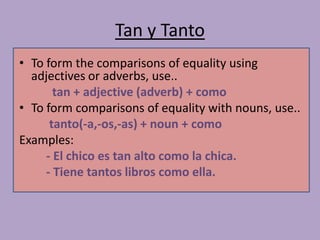
Tan y TantoTo form the comparisons of equality using adjectives or adverbs, use..tan + adjective (adverb) + comoTo form comparisons of equality with nouns, use..tanto(-a,-os,-as) + noun + comoExamples: -El chicoes tan alto como la chica.          - Tienetantoslibroscomoella.
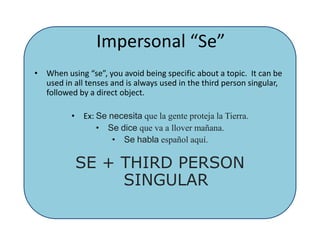
Impersonal “Se”When using “se”, you avoid being specific about a topic.  It can be used in all tenses and is always used in the third person singular, followed by a direct object. Ex: Senecesitaque la genteproteja la Tierra.Sedicequeva a llovermañana.Sehablaespañolaquí.SE + THIRD PERSON SINGULAR
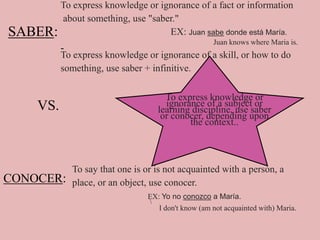
To express knowledge or ignorance of a fact or informationabout something, use "saber."                                              EX: Juan sabedondeestáMaría.                                               Juan knows where Maria is.-To express knowledge or ignorance of a skill, or how to do something, use saber + infinitive.SABER:VS. To express knowledge or ignorance of a subject or learning discipline, use saber or conocer, depending upon the context..To say that one is or is not acquainted with a person, a place, or an object, use conocer.                                         EX: Yo no conozco a María.\                                             I don't know (am not acquainted with) Maria.CONOCER:
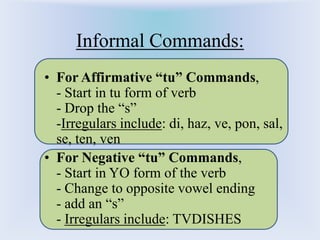
Informal Commands: For Affirmative “tu” Commands,                         - Start in tu form of verb                                - Drop the “s”                                             -Irregulars include: di, haz, ve, pon, sal, se, ten, ven
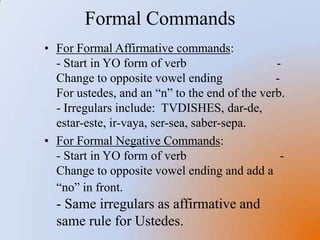
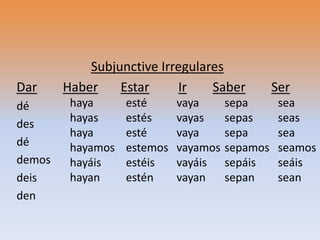
For Negative “tu” Commands,                       - Start in YO form of the verb                       - Change to opposite vowel ending                         - add an “s”                                                - Irregulars include: TVDISHESFormal CommandsFor Formal Affirmative commands:                - Start in YO form of verb                             -Change to opposite vowel ending                 -For ustedes, and an “n” to the end of the verb.                                                        - Irregulars include:  TVDISHES, dar-de, estar-este, ir-vaya, ser-sea, saber-sepa.
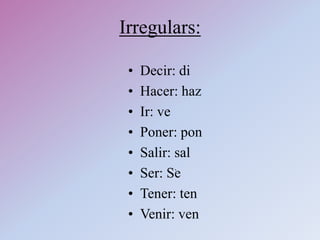
For Formal Negative Commands:                    - Start in YO form of verb                              - Change to opposite vowel ending and add a “no” in front.                                               - Same irregulars as affirmative and same rule for Ustedes.                                Irregulars: Decir: di
Hacer: haz
Ir: ve
Poner: pon
Salir: sal
Ser: Se
Tener: ten
Venir: ven`
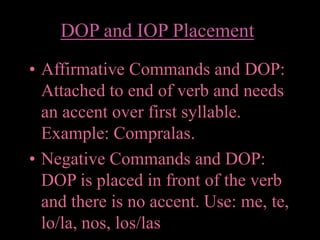
DOP and IOP Placement: Affirmative Commands and DOP: Attached to end of verb and needs an accent over first syllable. Example: Compralas.
Negative Commands and DOP: DOP is placed in front of the verb and there is no accent. Use: me, te, lo/la, nos, los/las‘
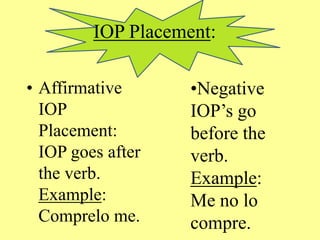
IOP Placement: Affirmative IOP Placement: IOP goes after the verb. Example: Comprelo me.
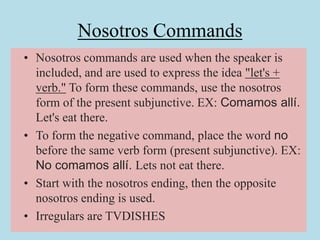
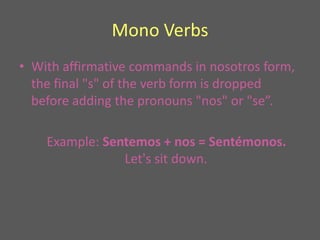
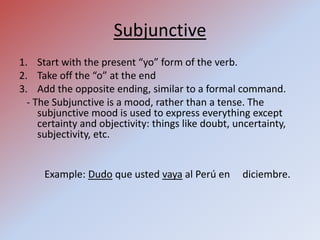
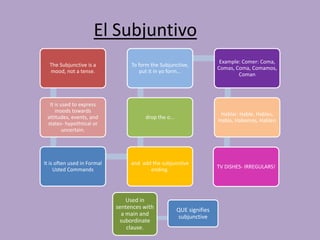
Negative IOP’s go before the verb.    Example: Me no lo compre.Nosotros CommandsNosotros commands are used when the speaker is included, and are used to express the idea "let's + verb." To form these commands, use the nosotros form of the present subjunctive. EX: Comamosallí.  Let's eat there.
To form the negative command, place the word no before the same verb form (present subjunctive). EX: No comamosallí. Lets not eat there.

Grammar book semester 2

  • 1.
    2nd SemesterGrammar BookSelena Pollack Period 5
  • 2.
    Table of Contents:Conditional+ IrregularsPerfect Tenses -Present -Past -Present Perfect Irregulars -Subjunctive Perfect3. Tan y Tanto4. Impersonal “se”5. Saber vs. ConocerLos MandatosLos Mandatos -Informal vs. Formal:*Affirmative, *Negative, -Irregulars 8. DOP and IOP placement9. Nosotros Commands y Mono Verbs10. Subjunctive y Irregulares11. Trigger Phrases: -Impersonal Expressions -Expressions of Emotions -Conjunctions of time12. Demonstrative Adjectives and Pronouns
  • 4.
    Perfect Tenses:Formed bycombining an auxiliary or helping verb, “has” or “have”, with a past participle. The Perfect Tense is mostly used with the verb “haber”. It is used to express a past event with a present consequence, and it shows a completed action.
  • 5.
    PresentIn Spanish, thepresent perfect tense is formed by using the present tense of the auxiliary verb "haber" with the past participle.Haber: -he-has-ha-hemos-hanExample: I have eaten: He comido.You have eaten: Has comido.He has eaten: Ha comido.We have eaten: Hemoscomido.They have eaten: Han comido.
  • 6.
    Past The past perfect is formed by combining the auxiliary verb "had" with the past participle. Because the past perfect is a compound tense, two verbs are required: the main verb and the auxiliary verb.(yo) Habíavivido.I had lived.(tú) Habíasvivido.You had lived.(él) Habíavivido.He had lived.(nosotros) Habíamosvivido.We had lived.(vosotros) Habíaisvivido.You-all had lived.(ellos) Habíanvivido.They had lived.Past Haber: había habías había habíamos habíanPast
  • 7.
    Present Perfect Irregulars:Some Present Perfect Irregulars include: Decir -> DechoHacer -> HechoVer -> VistoEscribir -> EscritoPoner -> PuestoRomper -> RotoVolver -> VueltoDevolver -> DevueltoMorir -> MuertoAbrir -> AbiertoCubrir -> Cubierto
  • 8.
    Subjunctive PerfectSubjunctive Perfectis a compound verb formed with the subjunctive of the auxillary verb haber plus the past participle of the main verb. The present perfect subjunctive is used in the same types of clauses as the present subjunctive, and normally is used: to indicate the action as completed with governing verbs in the present or future tense or command forms.Yo -HayaTu -HayasEl/Ella/Usted -HayaNosotros -HayamosEllos/Ellas/Ustedes -Hayan
  • 9.
    Tan y TantoToform the comparisons of equality using adjectives or adverbs, use..tan + adjective (adverb) + comoTo form comparisons of equality with nouns, use..tanto(-a,-os,-as) + noun + comoExamples: -El chicoes tan alto como la chica. - Tienetantoslibroscomoella.
  • 10.
    Impersonal “Se”When using“se”, you avoid being specific about a topic. It can be used in all tenses and is always used in the third person singular, followed by a direct object. Ex: Senecesitaque la genteproteja la Tierra.Sedicequeva a llovermañana.Sehablaespañolaquí.SE + THIRD PERSON SINGULAR
  • 11.
    To express knowledgeor ignorance of a fact or informationabout something, use "saber." EX: Juan sabedondeestáMaría. Juan knows where Maria is.-To express knowledge or ignorance of a skill, or how to do something, use saber + infinitive.SABER:VS. To express knowledge or ignorance of a subject or learning discipline, use saber or conocer, depending upon the context..To say that one is or is not acquainted with a person, a place, or an object, use conocer. EX: Yo no conozco a María.\ I don't know (am not acquainted with) Maria.CONOCER:
  • 12.
    Informal Commands: ForAffirmative “tu” Commands, - Start in tu form of verb - Drop the “s” -Irregulars include: di, haz, ve, pon, sal, se, ten, ven
  • 13.
    For Negative “tu”Commands, - Start in YO form of the verb - Change to opposite vowel ending - add an “s” - Irregulars include: TVDISHESFormal CommandsFor Formal Affirmative commands: - Start in YO form of verb -Change to opposite vowel ending -For ustedes, and an “n” to the end of the verb. - Irregulars include: TVDISHES, dar-de, estar-este, ir-vaya, ser-sea, saber-sepa.
  • 14.
    For Formal NegativeCommands: - Start in YO form of verb - Change to opposite vowel ending and add a “no” in front. - Same irregulars as affirmative and same rule for Ustedes. Irregulars: Decir: di
  • 15.
  • 16.
  • 17.
  • 18.
  • 19.
  • 20.
  • 21.
  • 22.
    DOP and IOPPlacement: Affirmative Commands and DOP: Attached to end of verb and needs an accent over first syllable. Example: Compralas.
  • 23.
    Negative Commands andDOP: DOP is placed in front of the verb and there is no accent. Use: me, te, lo/la, nos, los/las‘
  • 24.
    IOP Placement: AffirmativeIOP Placement: IOP goes after the verb. Example: Comprelo me.
  • 25.
    Negative IOP’s gobefore the verb. Example: Me no lo compre.Nosotros CommandsNosotros commands are used when the speaker is included, and are used to express the idea "let's + verb." To form these commands, use the nosotros form of the present subjunctive. EX: Comamosallí. Let's eat there.
  • 26.
    To form thenegative command, place the word no before the same verb form (present subjunctive). EX: No comamosallí. Lets not eat there.