Grammar Book SP3 semesters 1 &2 Isabel Vogt
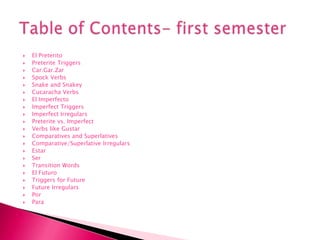
El PreteritoPreterite TriggersCar.Gar.ZarSpock VerbsSnake and SnakeyCucaracha VerbsEl ImperfectoImperfect TriggersImperfect IrregularsPreterite vs. ImperfectVerbs like GustarComparatives and Superlatives Comparative/Superlative IrregularsEstarSerTransition WordsEl FuturoTriggers for FutureFuture IrregularsPorParaTable of Contents- first semester
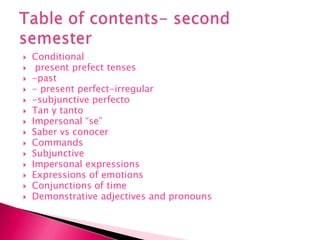
Conditional  present prefect tenses -past- present perfect-irregular-subjunctive perfectoTan y tantoImpersonal “se” Saber vs conocerCommands Subjunctive Impersonal expressionsExpressions of emotions Conjunctions of timeDemonstrative adjectives and pronouns Table of contents- second semester
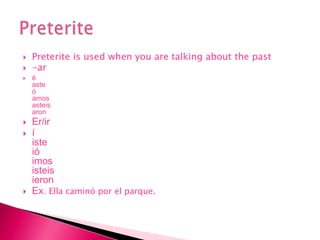
Preterite is used when you are talking about the past-aréasteóamosasteisaronEr/ir íisteióimosisteisieronEx. Ella caminó por el parque. Preterite
Words that are used with the preterite to signal the preterite is being used. Ayer AnteayerAnocheLa semanapasada Ex. Ayer lavé mi carroTrigger words
Irregular preterite-car –gar –zar only take place in the “yo” form, otherwise use the regular preterite conjugationVerbs that end in –car conjugate to quéEx. Sacarsaqué, sacaste, sacó, sacamos, sacaronVerbs that end in –gar conjugate to guéEx. Llegarllegué, llegaste, llegó, llegamos, llegaronVerbs that end in –zarconguate to cé ex. Cruzarcrucé, cruzaste, cruzó, cruzamos, cruzaron-car –gar –zar
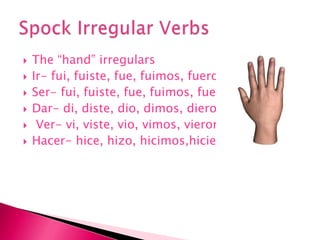
The “hand” irregulars Ir- fui, fuiste, fue, fuimos, fueronSer- fui, fuiste, fue, fuimos, fueronDar- di, diste, dio, dimos, dieronVer- vi, viste, vio, vimos, vieronHacer- hice, hizo, hicimos,hicieronSpock Irregular Verbs
Snake (e>i) pedir, preferir, competir, reptir, servir. (o>u) dormir, morir,sirviódurmióSnakeyLeer, creer, oirI changes to y in 3rd person LeyóCreyóoyóSnakey + snake verbs
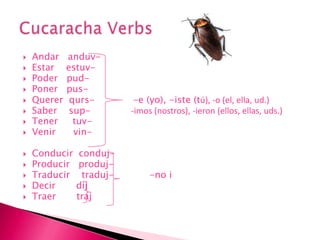
Andaranduv-        Estarestuv-Poderpud-  Poner   pus-Quererqurs-             -e (yo), -iste (tú), -o (el, ella, ud.)Saber    sup-              -imos (nostros), -ieron (ellos, ellas, uds.)Tenertuv-Venirvin- Conducirconduj-                    Producirproduj- Traducirtraduj-            -no iDecirdijTraer       trajCucaracha Verbs
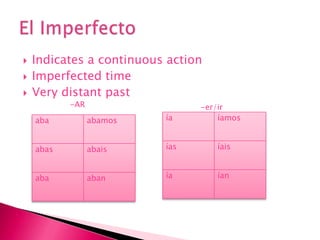
Indicates a continuous actionImperfected timeVery distant pastEl Imperfecto-AR-er/ir
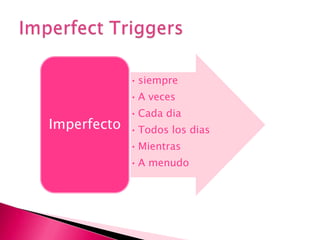
Imperfect Triggers
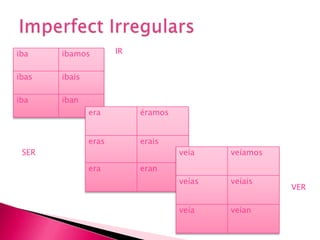
Imperfect IrregularsIRSERVER
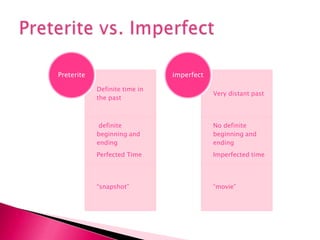
Preterite vs. Imperfect
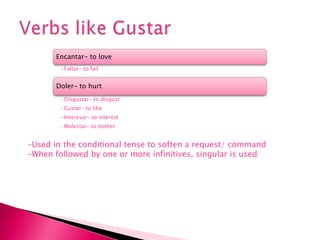
Verbs like GustarUsed in the conditional tense to soften a request/ command
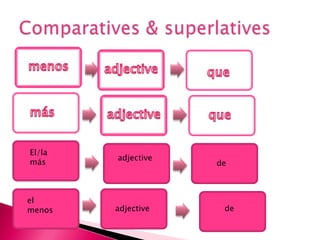
When followed by one or more infinitives, singular is usedComparatives & superlatives menosadjectiveadjectivequemásqueEl/la másadjectivedeel menosadjectivede
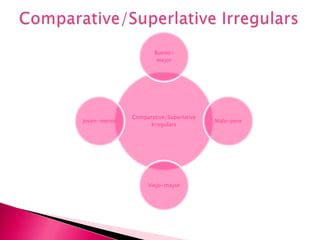
Comparative/Superlative Irregulars
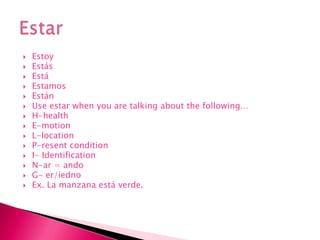
EstoyEstásEstáEstamosEstánUse estar when you are talking about the following… H-healthE-motionL-locationP-resent conditionI- IdentificationN-ar = andoG- er/iednoEx. La manzanaestáverde.Estar
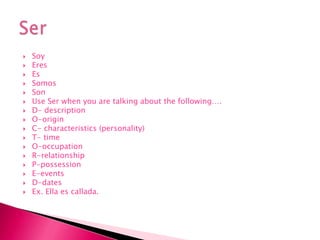
SoyEresEs SomosSonUse Ser when you are talking about the following….D- description O-origin C- characteristics (personality)T- time O-occupationR-relationshipP-possession E-events D-dates Ex. Ella escallada. Ser
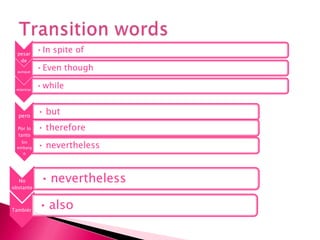
Transition words
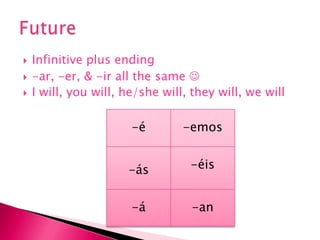
Infinitive plus ending-ar, -er, & -ir all the same  I will, you will, he/she will, they will, we will Future
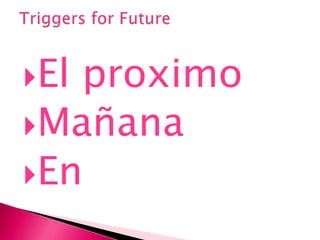
El proximoMañanaEn  Triggers for Future
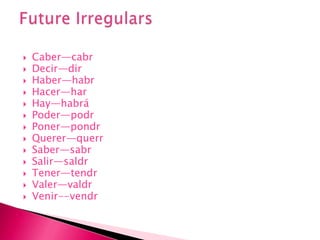
Caber—cabrDecir—dirHaber—habrHacer—harHay—habráPoder—podrPoner—pondrQuerer—querrSaber—sabrSalir—saldrTener—tendrValer—valdrVenir--vendrFuture Irregulars
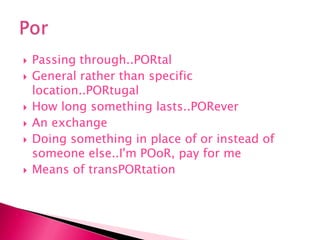
Passing through..PORtalGeneral rather than specific location..PORtugalHow long something lasts..POReverAn exchangeDoing something in place of or instead of someone else..I'm POoR, pay for meMeans of transPORtationPor
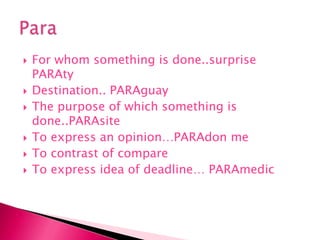
For whom something is done..surprise PARAtyDestination.. PARAguayThe purpose of which something is done..PARAsiteTo express an opinion…PARAdon meTo contrast of compareTo express idea of deadline… PARAmedicPara
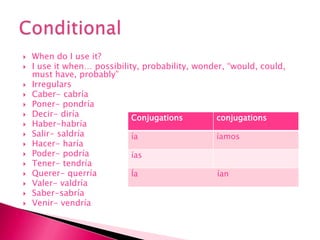
When do I use it?I use it when… possibility, probability, wonder, “would, could, must have, probably”IrregularsCaber- cabríaPoner- pondríaDecir- diríaHaber-habríaSalir- saldríaHacer- haríaPoder- podríaTener- tendríaQuerer- querríaValer- valdríaSaber-sabríaVenir- vendríaConditional
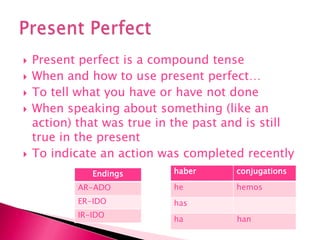
Present perfect is a compound tenseWhen and how to use present perfect…To tell what you have or have not doneWhen speaking about something (like an action) that was true in the past and is still true in the presentTo indicate an action was completed recentlyPresent Perfect
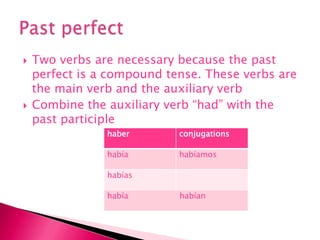
Past perfect Two verbs are necessary because the past perfect is a compound tense. These verbs are the main verb and the auxiliary verb Combine the auxiliary verb “had” with the past participle
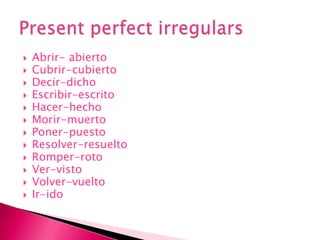
Abrir- abiertoCubrir-cubiertoDecir-dichoEscribir-escritoHacer-hechoMorir-muertoPoner-puestoResolver-resueltoRomper-rotoVer-vistoVolver-vueltoIr-idoPresent perfect irregulars
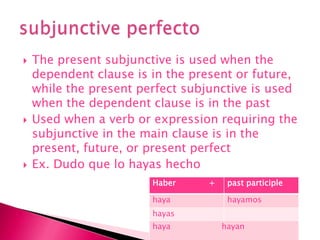
The present subjunctive is used when the dependent clause is in the present or future, while the present perfect subjunctive is used when the dependent clause is in the pastUsed when a verb or expression requiring the subjunctive in the main clause is in the present, future, or present perfectEx. Dudoque lo hayashechosubjunctive perfecto
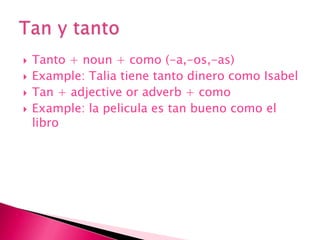
Tanto + noun + como (-a,-os,-as) Example: Talia tienetantodinerocomo IsabelTan + adjective or adverb + comoExample: la peliculaes tan buenocomo el libroTan y tanto
Se can be used in all tenses Use se to avoid talking about a specific person who is doing the action of the verbUsing se, the verb is always in 3rd person “Se” Impersonal
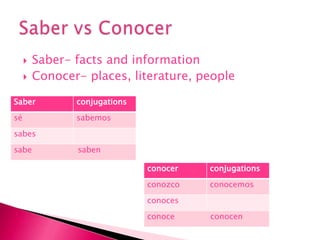
Saber- facts and informationConocer- places, literature, people  Saber vs Conocer
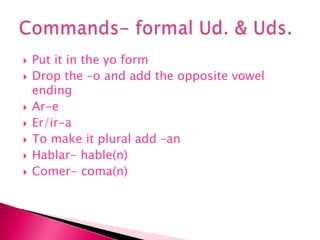
Put it in the yo formDrop the –o and add the opposite vowel endingAr-eEr/ir-aTo make it plural add –anHablar- hable(n)Comer- coma(n)Commands- formal Ud. & Uds.
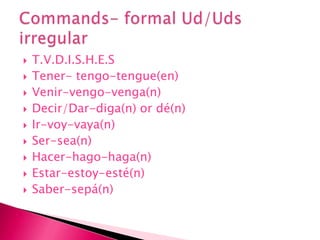
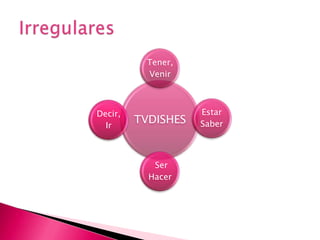
T.V.D.I.S.H.E.STener- tengo-tengue(en)Venir-vengo-venga(n)Decir/Dar-diga(n) or dé(n)Ir-voy-vaya(n)Ser-sea(n)Hacer-hago-haga(n)Estar-estoy-esté(n)Saber-sepá(n) Commands- formal Ud/Uds irregular
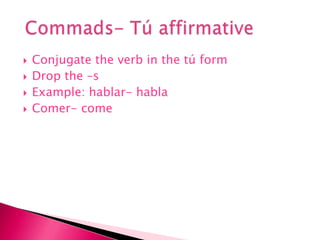
Conjugate the verb in the tú form Drop the –sExample: hablar- hablaComer- comeCommads- Tú affirmative
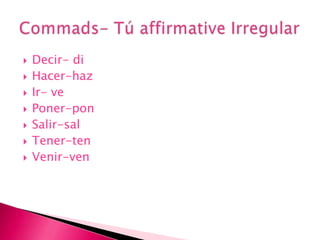
Decir- diHacer-hazIr- vePoner-ponSalir-salTener-tenVenir-venCommads- Tú affirmative Irregular
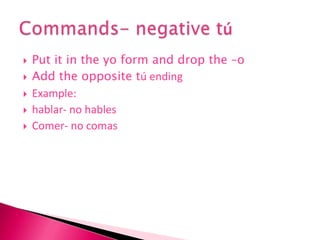
Put it in the yo form and drop the –oAdd the opposite tú endingExample: hablar- no hablesComer- no comasCommands- negative tú
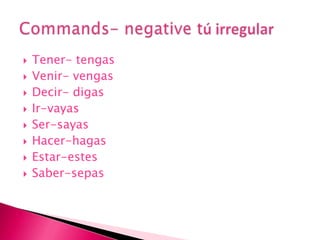
Tener- tengasVenir- vengasDecir- digasIr-vayasSer-sayasHacer-hagasEstar-estesSaber-sepasCommands- negative tú irregular
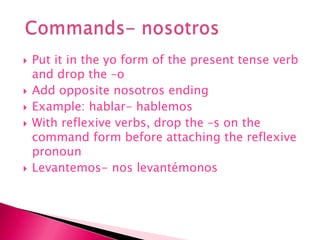
Put it in the yo form of the present tense verb and drop the –oAdd opposite nosotros endingExample: hablar- hablemosWith reflexive verbs, drop the –s on the command form before attaching the reflexive pronounLevantemos- noslevantémonos Commands- nosotros
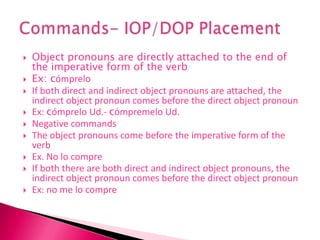
Object pronouns are directly attached to the end of the imperative form of the verbEx: cómpreloIf both direct and indirect object pronouns are attached, the indirect object pronoun comes before the direct object pronounEx: cómpreloUd.- cómpremeloUd. Negative commandsThe object pronouns come before the imperative form of the verbEx. No lo compreIf both there are both direct and indirect object pronouns, the indirect object pronoun comes before the direct object pronounEx: no me lo compreCommands- IOP/DOP Placement
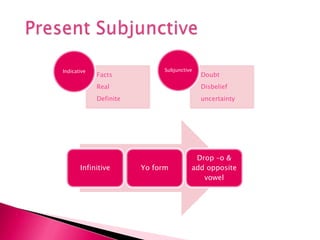
 Present Subjunctive
Irregulares
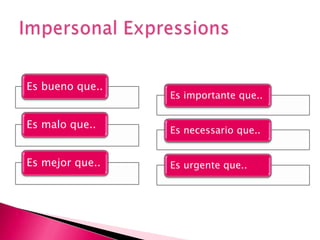
Impersonal Expressions
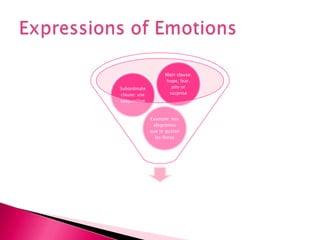
Expressions of Emotions
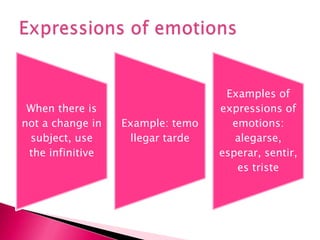
Expressions of emotions
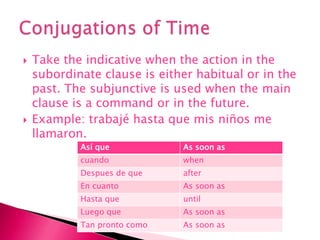
Take the indicative when the action in the subordinate clause is either habitual or in the past. The subjunctive is used when the main clause is a command or in the future. Example: trabajéhastaquemisniños me llamaron.  Conjugations of Time
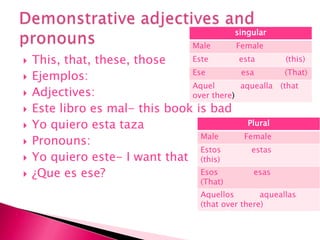
This, that, these, those Ejemplos:Adjectives:Este libroes mal- this book is badYoquieroestatazaPronouns:Yoquieroeste- I want that¿Queesese?  Demonstrative adjectives and pronouns

Grammar book sp3

  • 1.
    Grammar Book SP3semesters 1 &2 Isabel Vogt
  • 2.
    El PreteritoPreterite TriggersCar.Gar.ZarSpockVerbsSnake and SnakeyCucaracha VerbsEl ImperfectoImperfect TriggersImperfect IrregularsPreterite vs. ImperfectVerbs like GustarComparatives and Superlatives Comparative/Superlative IrregularsEstarSerTransition WordsEl FuturoTriggers for FutureFuture IrregularsPorParaTable of Contents- first semester
  • 3.
    Conditional presentprefect tenses -past- present perfect-irregular-subjunctive perfectoTan y tantoImpersonal “se” Saber vs conocerCommands Subjunctive Impersonal expressionsExpressions of emotions Conjunctions of timeDemonstrative adjectives and pronouns Table of contents- second semester
  • 4.
    Preterite is usedwhen you are talking about the past-aréasteóamosasteisaronEr/ir íisteióimosisteisieronEx. Ella caminó por el parque. Preterite
  • 5.
    Words that areused with the preterite to signal the preterite is being used. Ayer AnteayerAnocheLa semanapasada Ex. Ayer lavé mi carroTrigger words
  • 6.
    Irregular preterite-car –gar–zar only take place in the “yo” form, otherwise use the regular preterite conjugationVerbs that end in –car conjugate to quéEx. Sacarsaqué, sacaste, sacó, sacamos, sacaronVerbs that end in –gar conjugate to guéEx. Llegarllegué, llegaste, llegó, llegamos, llegaronVerbs that end in –zarconguate to cé ex. Cruzarcrucé, cruzaste, cruzó, cruzamos, cruzaron-car –gar –zar
  • 7.
    The “hand” irregularsIr- fui, fuiste, fue, fuimos, fueronSer- fui, fuiste, fue, fuimos, fueronDar- di, diste, dio, dimos, dieronVer- vi, viste, vio, vimos, vieronHacer- hice, hizo, hicimos,hicieronSpock Irregular Verbs
  • 8.
    Snake (e>i) pedir,preferir, competir, reptir, servir. (o>u) dormir, morir,sirviódurmióSnakeyLeer, creer, oirI changes to y in 3rd person LeyóCreyóoyóSnakey + snake verbs
  • 9.
    Andaranduv- Estarestuv-Poderpud- Poner pus-Quererqurs- -e (yo), -iste (tú), -o (el, ella, ud.)Saber sup- -imos (nostros), -ieron (ellos, ellas, uds.)Tenertuv-Venirvin- Conducirconduj- Producirproduj- Traducirtraduj- -no iDecirdijTraer trajCucaracha Verbs
  • 10.
    Indicates a continuousactionImperfected timeVery distant pastEl Imperfecto-AR-er/ir
  • 11.
  • 12.
  • 13.
  • 14.
    Verbs like GustarUsedin the conditional tense to soften a request/ command
  • 15.
    When followed byone or more infinitives, singular is usedComparatives & superlatives menosadjectiveadjectivequemásqueEl/la másadjectivedeel menosadjectivede
  • 16.
  • 17.
    EstoyEstásEstáEstamosEstánUse estar whenyou are talking about the following… H-healthE-motionL-locationP-resent conditionI- IdentificationN-ar = andoG- er/iednoEx. La manzanaestáverde.Estar
  • 18.
    SoyEresEs SomosSonUse Serwhen you are talking about the following….D- description O-origin C- characteristics (personality)T- time O-occupationR-relationshipP-possession E-events D-dates Ex. Ella escallada. Ser
  • 19.
  • 20.
    Infinitive plus ending-ar,-er, & -ir all the same  I will, you will, he/she will, they will, we will Future
  • 21.
    El proximoMañanaEn Triggers for Future
  • 22.
  • 23.
    Passing through..PORtalGeneral ratherthan specific location..PORtugalHow long something lasts..POReverAn exchangeDoing something in place of or instead of someone else..I'm POoR, pay for meMeans of transPORtationPor
  • 24.
    For whom somethingis done..surprise PARAtyDestination.. PARAguayThe purpose of which something is done..PARAsiteTo express an opinion…PARAdon meTo contrast of compareTo express idea of deadline… PARAmedicPara
  • 25.
    When do Iuse it?I use it when… possibility, probability, wonder, “would, could, must have, probably”IrregularsCaber- cabríaPoner- pondríaDecir- diríaHaber-habríaSalir- saldríaHacer- haríaPoder- podríaTener- tendríaQuerer- querríaValer- valdríaSaber-sabríaVenir- vendríaConditional
  • 26.
    Present perfect isa compound tenseWhen and how to use present perfect…To tell what you have or have not doneWhen speaking about something (like an action) that was true in the past and is still true in the presentTo indicate an action was completed recentlyPresent Perfect
  • 27.
    Past perfect Twoverbs are necessary because the past perfect is a compound tense. These verbs are the main verb and the auxiliary verb Combine the auxiliary verb “had” with the past participle
  • 28.
  • 29.
    The present subjunctiveis used when the dependent clause is in the present or future, while the present perfect subjunctive is used when the dependent clause is in the pastUsed when a verb or expression requiring the subjunctive in the main clause is in the present, future, or present perfectEx. Dudoque lo hayashechosubjunctive perfecto
  • 30.
    Tanto + noun+ como (-a,-os,-as) Example: Talia tienetantodinerocomo IsabelTan + adjective or adverb + comoExample: la peliculaes tan buenocomo el libroTan y tanto
  • 31.
    Se can beused in all tenses Use se to avoid talking about a specific person who is doing the action of the verbUsing se, the verb is always in 3rd person “Se” Impersonal
  • 32.
    Saber- facts andinformationConocer- places, literature, people Saber vs Conocer
  • 33.
    Put it inthe yo formDrop the –o and add the opposite vowel endingAr-eEr/ir-aTo make it plural add –anHablar- hable(n)Comer- coma(n)Commands- formal Ud. & Uds.
  • 34.
    T.V.D.I.S.H.E.STener- tengo-tengue(en)Venir-vengo-venga(n)Decir/Dar-diga(n) ordé(n)Ir-voy-vaya(n)Ser-sea(n)Hacer-hago-haga(n)Estar-estoy-esté(n)Saber-sepá(n) Commands- formal Ud/Uds irregular
  • 35.
    Conjugate the verbin the tú form Drop the –sExample: hablar- hablaComer- comeCommads- Tú affirmative
  • 36.
  • 37.
    Put it inthe yo form and drop the –oAdd the opposite tú endingExample: hablar- no hablesComer- no comasCommands- negative tú
  • 38.
    Tener- tengasVenir- vengasDecir-digasIr-vayasSer-sayasHacer-hagasEstar-estesSaber-sepasCommands- negative tú irregular
  • 39.
    Put it inthe yo form of the present tense verb and drop the –oAdd opposite nosotros endingExample: hablar- hablemosWith reflexive verbs, drop the –s on the command form before attaching the reflexive pronounLevantemos- noslevantémonos Commands- nosotros
  • 40.
    Object pronouns aredirectly attached to the end of the imperative form of the verbEx: cómpreloIf both direct and indirect object pronouns are attached, the indirect object pronoun comes before the direct object pronounEx: cómpreloUd.- cómpremeloUd. Negative commandsThe object pronouns come before the imperative form of the verbEx. No lo compreIf both there are both direct and indirect object pronouns, the indirect object pronoun comes before the direct object pronounEx: no me lo compreCommands- IOP/DOP Placement
  • 41.
  • 42.
  • 43.
  • 44.
  • 45.
  • 46.
    Take the indicativewhen the action in the subordinate clause is either habitual or in the past. The subjunctive is used when the main clause is a command or in the future. Example: trabajéhastaquemisniños me llamaron. Conjugations of Time
  • 47.
    This, that, these,those Ejemplos:Adjectives:Este libroes mal- this book is badYoquieroestatazaPronouns:Yoquieroeste- I want that¿Queesese? Demonstrative adjectives and pronouns