Grammar Book

   Tito Head
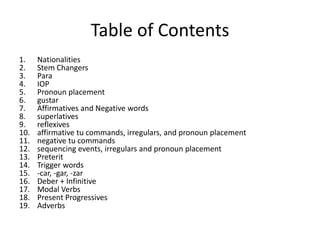
Table of Contents
1.    Nationalities
2.    Stem Changers
3.    Para
4.    IOP
5.    Pronoun placement
6.    gustar
7.    Affirmatives and Negative words
8.    superlatives
9.    reflexives
10.   affirmative tu commands, irregulars, and pronoun placement
11.   negative tu commands
12.   sequencing events, irregulars and pronoun placement
13.   Preterit
14.   Trigger words
15.   -car, -gar, -zar
16.   Deber + Infinitive
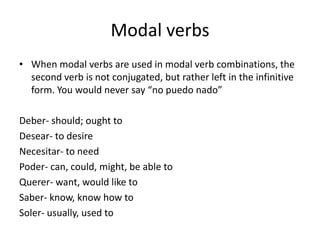
17.   Modal Verbs
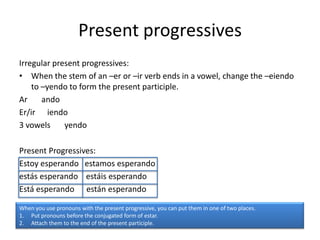
18.   Present Progressives
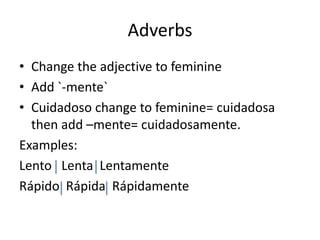
19.   Adverbs
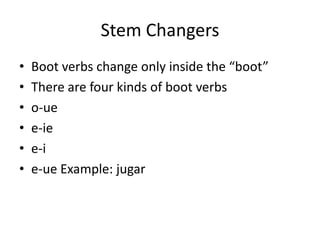
Stem Changers
•   Boot verbs change only inside the “boot”
•   There are four kinds of boot verbs
•   o-ue
•   e-ie
•   e-i
•   e-ue Example: jugar
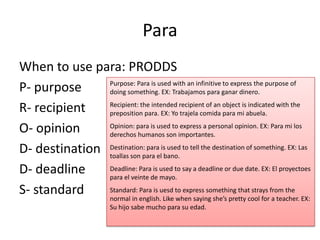
Para
When to use para: PRODDS
               Purpose: Para is used with an infinitive to express the purpose of
P- purpose     doing something. EX: Trabajamos para ganar dinero.

R- recipient   Recipient: the intended recipient of an object is indicated with the
               preposition para. EX: Yo trajela comida para mi abuela.

O- opinion     Opinion: para is used to express a personal opinion. EX: Para mi los
               derechos humanos son importantes.

D- destination Destination:para elisbano. to tell the destination of something. EX: Las
               toallas son
                            para used


D- deadline    Deadline: Para is used to say a deadline or due date. EX: El proyectoes
               para el veinte de mayo.

S- standard    Standard: Para is uesd to express something that strays from the
               normal in english. Like when saying she’s pretty cool for a teacher. EX:
                           Su hijo sabe mucho para su edad.
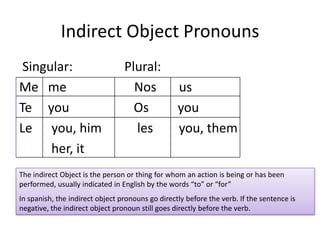
Indirect Object Pronouns
 Singular:                       Plural:
Me me                              Nos            us
Te you                             Os             you
Le you, him                        les            you, them
      her, it
The indirect Object is the person or thing for whom an action is being or has been
performed, usually indicated in English by the words “to” or “for”
In spanish, the indirect object pronouns go directly before the verb. If the sentence is
negative, the indirect object pronoun still goes directly before the verb.
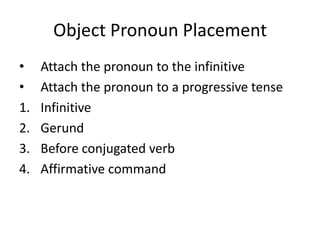
Object Pronoun Placement
•    Attach the pronoun to the infinitive
•    Attach the pronoun to a progressive tense
1.   Infinitive
2.   Gerund
3.   Before conjugated verb
4.   Affirmative command
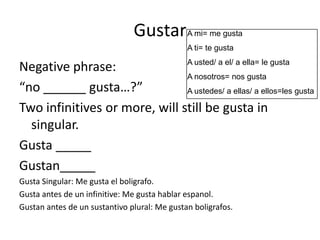
Gustar A mi= me gusta
                                              A ti= te gusta
                               A usted/ a el/ a ella= le gusta
Negative phrase:
                               A nosotros= nos gusta
“no ______ gusta…?”            A ustedes/ a ellas/ a ellos=les gusta

Two infinitives or more, will still be gusta in
  singular.
Gusta _____
Gustan_____
Gusta Singular: Me gusta el boligrafo.
Gusta antes de un infinitive: Me gusta hablar espanol.
Gustan antes de un sustantivo plural: Me gustan boligrafos.
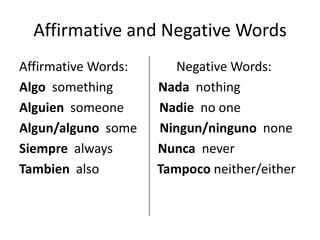
Affirmative and Negative Words
Affirmative Words:      Negative Words:
Algo something       Nada nothing
Alguien someone      Nadie no one
Algun/alguno some    Ningun/ninguno none
Siempre always       Nunca never
Tambien also         Tampoco neither/either
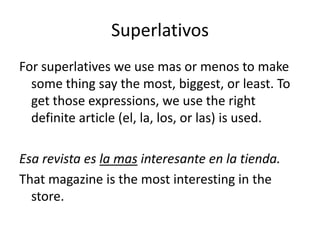
Superlativos
For superlatives we use mas or menos to make
  some thing say the most, biggest, or least. To
  get those expressions, we use the right
  definite article (el, la, los, or las) is used.

Esa revista es la mas interesante en la tienda.
That magazine is the most interesting in the
  store.
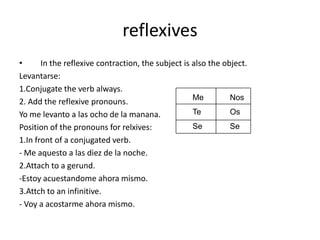
reflexives
•      In the reflexive contraction, the subject is also the object.
Levantarse:
1.Conjugate the verb always.
                                                    Me         Nos
2. Add the reflexive pronouns.
Yo me levanto a las ocho de la manana.              Te         Os
Position of the pronouns for relxives:              Se         Se
1.In front of a conjugated verb.
- Me aquesto a las diez de la noche.
2.Attach to a gerund.
-Estoy acuestandome ahora mismo.
3.Attch to an infinitive.
- Voy a acostarme ahora mismo.
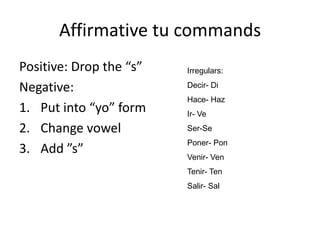
Affirmative tu commands
Positive: Drop the “s”   Irregulars:

Negative:                Decir- Di
                         Hace- Haz
1. Put into “yo” form    Ir- Ve
2. Change vowel          Ser-Se
                         Poner- Pon
3. Add ”s”               Venir- Ven
                         Tenir- Ten
                         Salir- Sal
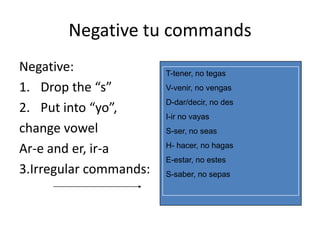
Negative tu commands
Negative:               T-tener, no tegas
1. Drop the “s”         V-venir, no vengas
                        D-dar/decir, no des
2. Put into “yo”,
                        I-ir no vayas
change vowel            S-ser, no seas

Ar-e and er, ir-a       H- hacer, no hagas
                        E-estar, no estes
3.Irregular commands:   S-saber, no sepas
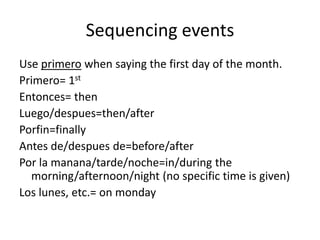
Sequencing events
Use primero when saying the first day of the month.
Primero= 1st
Entonces= then
Luego/despues=then/after
Porfin=finally
Antes de/despues de=before/after
Por la manana/tarde/noche=in/during the
  morning/afternoon/night (no specific time is given)
Los lunes, etc.= on monday
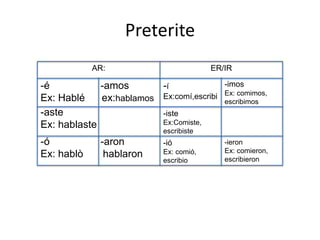
Preterite
            AR:                         ER/IR

-é           -amos       -í                -imos
                                           Ex: comimos,
Ex: Hablé    ex:hablamos Ex:comí,escribi   escribimos
-aste                    -iste
Ex: hablaste             Ex:Comiste,
                           escribiste
-ó           -aron         -ió             -ieron
                           Ex: comió,      Ex: comieron,
Ex: hablò     hablaron                     escribieron
                           escribio
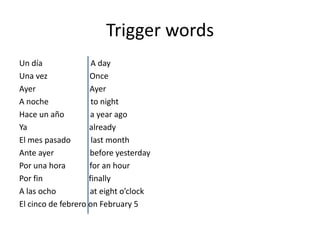
Trigger words
Un día               A day
Una vez             Once
Ayer                Ayer
A noche              to night
Hace un año         a year ago
Ya                  already
El mes pasado        last month
Ante ayer           before yesterday
Por una hora        for an hour
Por fin             finally
A las ocho          at eight o’clock
El cinco de febrero on February 5
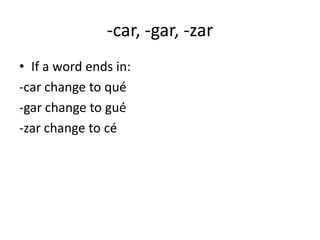
-car, -gar, -zar
• If a word ends in:
-car change to qué
-gar change to gué
-zar change to cé
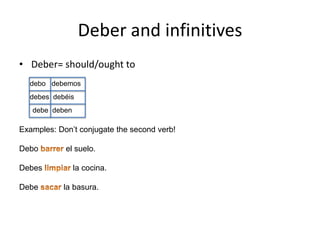
Deber and infinitives
• Deber= should/ought to
  debo debemos
  debes debéis
   debe deben

Examples: Don’t conjugate the second verb!

Debo        el suelo.

Debes           la cocina.

Debe       la basura.
Modal verbs
• When modal verbs are used in modal verb combinations, the
  second verb is not conjugated, but rather left in the infinitive
  form. You would never say “no puedo nado”

Deber- should; ought to
Desear- to desire
Necesitar- to need
Poder- can, could, might, be able to
Querer- want, would like to
Saber- know, know how to
Soler- usually, used to
Present progressives
Irregular present progressives:
• When the stem of an –er or –ir verb ends in a vowel, change the –eiendo
    to –yendo to form the present participle.
Ar     ando
Er/ir iendo
3 vowels     yendo

Present Progressives:
Estoy esperando estamos esperando
estás esperando estáis esperando
Está esperando están esperando

When you use pronouns with the present progressive, you can put them in one of two places.
1. Put pronouns before the conjugated form of estar.
2. Attach them to the end of the present participle.
Adverbs
• Change the adjective to feminine
• Add `-mente`
• Cuidadoso change to feminine= cuidadosa
  then add –mente= cuidadosamente.
Examples:
Lento Lenta Lentamente
Rápido Rápida Rápidamente

Grammar booktaylor head

  • 1.
    Grammar Book Tito Head
  • 2.
    Table of Contents 1. Nationalities 2. Stem Changers 3. Para 4. IOP 5. Pronoun placement 6. gustar 7. Affirmatives and Negative words 8. superlatives 9. reflexives 10. affirmative tu commands, irregulars, and pronoun placement 11. negative tu commands 12. sequencing events, irregulars and pronoun placement 13. Preterit 14. Trigger words 15. -car, -gar, -zar 16. Deber + Infinitive 17. Modal Verbs 18. Present Progressives 19. Adverbs
  • 4.
    Stem Changers • Boot verbs change only inside the “boot” • There are four kinds of boot verbs • o-ue • e-ie • e-i • e-ue Example: jugar
  • 5.
    Para When to usepara: PRODDS Purpose: Para is used with an infinitive to express the purpose of P- purpose doing something. EX: Trabajamos para ganar dinero. R- recipient Recipient: the intended recipient of an object is indicated with the preposition para. EX: Yo trajela comida para mi abuela. O- opinion Opinion: para is used to express a personal opinion. EX: Para mi los derechos humanos son importantes. D- destination Destination:para elisbano. to tell the destination of something. EX: Las toallas son para used D- deadline Deadline: Para is used to say a deadline or due date. EX: El proyectoes para el veinte de mayo. S- standard Standard: Para is uesd to express something that strays from the normal in english. Like when saying she’s pretty cool for a teacher. EX: Su hijo sabe mucho para su edad.
  • 6.
    Indirect Object Pronouns Singular: Plural: Me me Nos us Te you Os you Le you, him les you, them her, it The indirect Object is the person or thing for whom an action is being or has been performed, usually indicated in English by the words “to” or “for” In spanish, the indirect object pronouns go directly before the verb. If the sentence is negative, the indirect object pronoun still goes directly before the verb.
  • 7.
    Object Pronoun Placement • Attach the pronoun to the infinitive • Attach the pronoun to a progressive tense 1. Infinitive 2. Gerund 3. Before conjugated verb 4. Affirmative command
  • 8.
    Gustar A mi=me gusta A ti= te gusta A usted/ a el/ a ella= le gusta Negative phrase: A nosotros= nos gusta “no ______ gusta…?” A ustedes/ a ellas/ a ellos=les gusta Two infinitives or more, will still be gusta in singular. Gusta _____ Gustan_____ Gusta Singular: Me gusta el boligrafo. Gusta antes de un infinitive: Me gusta hablar espanol. Gustan antes de un sustantivo plural: Me gustan boligrafos.
  • 9.
    Affirmative and NegativeWords Affirmative Words: Negative Words: Algo something Nada nothing Alguien someone Nadie no one Algun/alguno some Ningun/ninguno none Siempre always Nunca never Tambien also Tampoco neither/either
  • 10.
    Superlativos For superlatives weuse mas or menos to make some thing say the most, biggest, or least. To get those expressions, we use the right definite article (el, la, los, or las) is used. Esa revista es la mas interesante en la tienda. That magazine is the most interesting in the store.
  • 11.
    reflexives • In the reflexive contraction, the subject is also the object. Levantarse: 1.Conjugate the verb always. Me Nos 2. Add the reflexive pronouns. Yo me levanto a las ocho de la manana. Te Os Position of the pronouns for relxives: Se Se 1.In front of a conjugated verb. - Me aquesto a las diez de la noche. 2.Attach to a gerund. -Estoy acuestandome ahora mismo. 3.Attch to an infinitive. - Voy a acostarme ahora mismo.
  • 12.
    Affirmative tu commands Positive:Drop the “s” Irregulars: Negative: Decir- Di Hace- Haz 1. Put into “yo” form Ir- Ve 2. Change vowel Ser-Se Poner- Pon 3. Add ”s” Venir- Ven Tenir- Ten Salir- Sal
  • 13.
    Negative tu commands Negative: T-tener, no tegas 1. Drop the “s” V-venir, no vengas D-dar/decir, no des 2. Put into “yo”, I-ir no vayas change vowel S-ser, no seas Ar-e and er, ir-a H- hacer, no hagas E-estar, no estes 3.Irregular commands: S-saber, no sepas
  • 14.
    Sequencing events Use primerowhen saying the first day of the month. Primero= 1st Entonces= then Luego/despues=then/after Porfin=finally Antes de/despues de=before/after Por la manana/tarde/noche=in/during the morning/afternoon/night (no specific time is given) Los lunes, etc.= on monday
  • 15.
    Preterite AR: ER/IR -é -amos -í -imos Ex: comimos, Ex: Hablé ex:hablamos Ex:comí,escribi escribimos -aste -iste Ex: hablaste Ex:Comiste, escribiste -ó -aron -ió -ieron Ex: comió, Ex: comieron, Ex: hablò hablaron escribieron escribio
  • 16.
    Trigger words Un día A day Una vez Once Ayer Ayer A noche to night Hace un año a year ago Ya already El mes pasado last month Ante ayer before yesterday Por una hora for an hour Por fin finally A las ocho at eight o’clock El cinco de febrero on February 5
  • 17.
    -car, -gar, -zar •If a word ends in: -car change to qué -gar change to gué -zar change to cé
  • 18.
    Deber and infinitives •Deber= should/ought to debo debemos debes debéis debe deben Examples: Don’t conjugate the second verb! Debo el suelo. Debes la cocina. Debe la basura.
  • 19.
    Modal verbs • Whenmodal verbs are used in modal verb combinations, the second verb is not conjugated, but rather left in the infinitive form. You would never say “no puedo nado” Deber- should; ought to Desear- to desire Necesitar- to need Poder- can, could, might, be able to Querer- want, would like to Saber- know, know how to Soler- usually, used to
  • 20.
    Present progressives Irregular presentprogressives: • When the stem of an –er or –ir verb ends in a vowel, change the –eiendo to –yendo to form the present participle. Ar ando Er/ir iendo 3 vowels yendo Present Progressives: Estoy esperando estamos esperando estás esperando estáis esperando Está esperando están esperando When you use pronouns with the present progressive, you can put them in one of two places. 1. Put pronouns before the conjugated form of estar. 2. Attach them to the end of the present participle.
  • 21.
    Adverbs • Change theadjective to feminine • Add `-mente` • Cuidadoso change to feminine= cuidadosa then add –mente= cuidadosamente. Examples: Lento Lenta Lentamente Rápido Rápida Rápidamente