By: Juan Pablo Pollack
   1. Nationalities
   2. Stem Changing Verbs
   3.Para
   4. Pronoun Placement
   5. Indirect Object Pronouns
   6. Gustar
   7. Affirmative/Negative Words
   8. Superlatives
   9. Reflexives
   10. Affirmative tú Commands
   11. Negative tú Commands
   12. Sequencing events
   13. Preterite
   14.Trigger Words
   15. –Car, -Gar, -Zar
   16. Deber + Infinitive
   17. Modal Verbs
   18. Present Progressive
   19. Adverbs
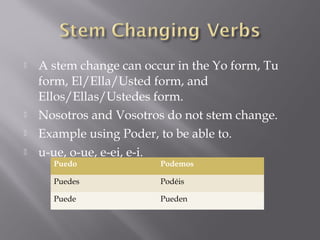
   A stem change can occur in the Yo form, Tu
    form, El/Ella/Usted form, and
    Ellos/Ellas/Ustedes form.
   Nosotros and Vosotros do not stem change.
   Example using Poder, to be able to.
   u-ue, o-ue, e-ei, e-i.
      Puedo              Podemos

      Puedes             Podéis

      Puede              Pueden
   Para is used in the Spanish language as for is
    used in the English language.
   Ex: Yo cocino la cena para mis padres.
   Indirect Objects are nouns that tell to whom or
    for whom.
   To determine which pronoun to use, refer to the
    indirect object. Le, Te, Me, Nos, Os, Les.
   IOP’s are placed: Before conjugated verb,
    attached to an infinitive, or attached to a gerrund.
   Example: El hombre le vende el carro a mi padre.
   You would choose le because it refers to mi padre
    which is él.
   1. Attached to the pronoun to the infinitive.
   2. Attach the pronoun to a progressive tense
    verb or “ing” verb.
   3. Attach the pronoun to an affirmative
    command.
   4. Place the pronoun before a conjugated verb.
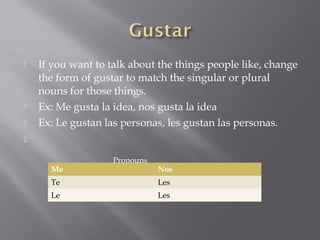
   If you want to talk about the things people like, change
    the form of gustar to match the singular or plural
    nouns for those things.
   Ex: Me gusta la idea, nos gusta la idea
   Ex: Le gustan las personas, les gustan las personas.


                    Pronouns
      Me                       Nos
      Te                       Les
      Le                       Les
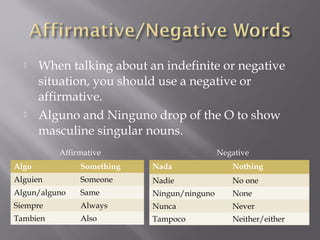
    When talking about an indefinite or negative
       situation, you should use a negative or
       affirmative.
      Alguno and Ninguno drop of the O to show
       masculine singular nouns.
          Affirmative                       Negative
Algo           Something   Nada                Nothing
Alguien        Someone     Nadie               No one
Algun/alguno   Same        Ningun/ninguno      None
Siempre        Always      Nunca               Never
Tambien        Also        Tampoco             Neither/either
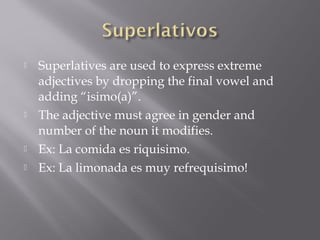
   Superlatives are used to express extreme
    adjectives by dropping the final vowel and
    adding “isimo(a)”.
   The adjective must agree in gender and
    number of the noun it modifies.
   Ex: La comida es riquisimo.
   Ex: La limonada es muy refrequisimo!
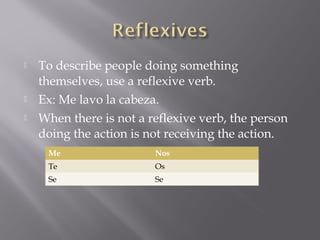
   To describe people doing something
    themselves, use a reflexive verb.
   Ex: Me lavo la cabeza.
   When there is not a reflexive verb, the person
    doing the action is not receiving the action.
     Me                  Nos
     Te                  Os
     Se                  Se
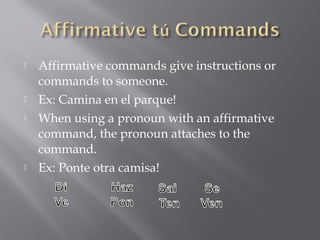
   Affirmative commands give instructions or
    commands to someone.
   Ex: Camina en el parque!
   When using a pronoun with an affirmative
    command, the pronoun attaches to the
    command.
   Ex: Ponte otra camisa!
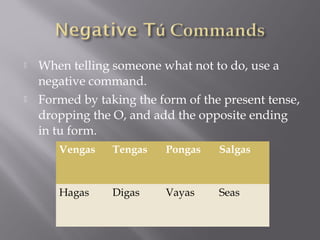
   When telling someone what not to do, use a
    negative command.
   Formed by taking the form of the present tense,
    dropping the O, and add the opposite ending
    in tu form.
       Vengas    Tengas   Pongas    Salgas


       Hagas     Digas    Vayas     Seas
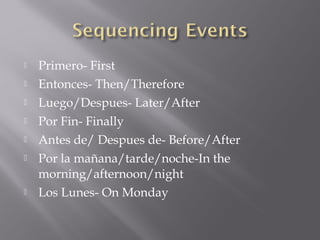
   Primero- First
   Entonces- Then/Therefore
   Luego/Despues- Later/After
   Por Fin- Finally
   Antes de/ Despues de- Before/After
   Por la mañana/tarde/noche-In the
    morning/afternoon/night
   Los Lunes- On Monday
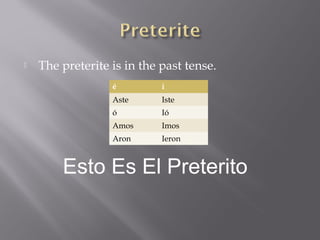
   The preterite is in the past tense.
                  é         í
                  Aste      Iste
                  ó         Ió
                  Amos      Imos
                  Aron      Ieron


        Esto Es El Preterito
   Preteito  trigger words from preterito
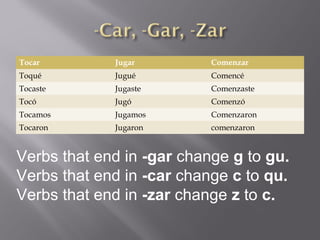
Tocar        Jugar         Comenzar
Toqué        Jugué         Comencé
Tocaste      Jugaste       Comenzaste
Tocó         Jugó          Comenzó
Tocamos      Jugamos       Comenzaron
Tocaron      Jugaron       comenzaron


Verbs that end in -gar change g to gu.
Verbs that end in -car change c to qu.
Verbs that end in -zar change z to c.
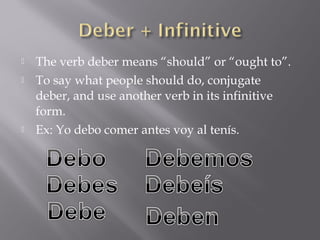
   The verb deber means “should” or “ought to”.
   To say what people should do, conjugate
    deber, and use another verb in its infinitive
    form.
   Ex: Yo debo comer antes voy al tenís.
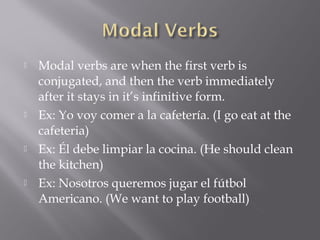
   Modal verbs are when the first verb is
    conjugated, and then the verb immediately
    after it stays in it’s infinitive form.
   Ex: Yo voy comer a la cafetería. (I go eat at the
    cafeteria)
   Ex: Él debe limpiar la cocina. (He should clean
    the kitchen)
   Ex: Nosotros queremos jugar el fútbol
    Americano. (We want to play football)
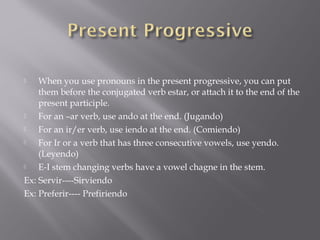
   When you use pronouns in the present progressive, you can put
    them before the conjugated verb estar, or attach it to the end of the
    present participle.
   For an –ar verb, use ando at the end. (Jugando)
   For an ir/er verb, use iendo at the end. (Comiendo)
   For Ir or a verb that has three consecutive vowels, use yendo.
    (Leyendo)
   E-I stem changing verbs have a vowel chagne in the stem.
Ex: Servir----Sirviendo
Ex: Preferir---- Prefiriendo
  To describe how something is done, use adverbs.
  When an adjective ends in E, I, or Z, add
-mente to the end.
   Ex: Frecuente----Frecuentemente
  Ex: Facil----Facilmente
  Ex: Feliz----Felizmente
  For adjectives ending in and A or O, add -mente to the feminine form.
  Ex: Rápido----Rápidamente
  Ex: Trabajadoro----Trabajadoramente
  When you use two adverbs, drop the –mente from the first one.
  Ex: Lenta y Traquilamente.

Grammar book final jp

  • 1.
  • 2.
    1. Nationalities  2. Stem Changing Verbs  3.Para  4. Pronoun Placement  5. Indirect Object Pronouns  6. Gustar  7. Affirmative/Negative Words  8. Superlatives  9. Reflexives  10. Affirmative tú Commands  11. Negative tú Commands  12. Sequencing events  13. Preterite  14.Trigger Words  15. –Car, -Gar, -Zar  16. Deber + Infinitive  17. Modal Verbs  18. Present Progressive  19. Adverbs
  • 4.
    A stem change can occur in the Yo form, Tu form, El/Ella/Usted form, and Ellos/Ellas/Ustedes form.  Nosotros and Vosotros do not stem change.  Example using Poder, to be able to.  u-ue, o-ue, e-ei, e-i. Puedo Podemos Puedes Podéis Puede Pueden
  • 5.
    Para is used in the Spanish language as for is used in the English language.  Ex: Yo cocino la cena para mis padres.
  • 6.
    Indirect Objects are nouns that tell to whom or for whom.  To determine which pronoun to use, refer to the indirect object. Le, Te, Me, Nos, Os, Les.  IOP’s are placed: Before conjugated verb, attached to an infinitive, or attached to a gerrund.  Example: El hombre le vende el carro a mi padre.  You would choose le because it refers to mi padre which is él.
  • 7.
    1. Attached to the pronoun to the infinitive.  2. Attach the pronoun to a progressive tense verb or “ing” verb.  3. Attach the pronoun to an affirmative command.  4. Place the pronoun before a conjugated verb.
  • 8.
    If you want to talk about the things people like, change the form of gustar to match the singular or plural nouns for those things.  Ex: Me gusta la idea, nos gusta la idea  Ex: Le gustan las personas, les gustan las personas.  Pronouns Me Nos Te Les Le Les
  • 9.
    When talking about an indefinite or negative situation, you should use a negative or affirmative.  Alguno and Ninguno drop of the O to show masculine singular nouns. Affirmative Negative Algo Something Nada Nothing Alguien Someone Nadie No one Algun/alguno Same Ningun/ninguno None Siempre Always Nunca Never Tambien Also Tampoco Neither/either
  • 10.
    Superlatives are used to express extreme adjectives by dropping the final vowel and adding “isimo(a)”.  The adjective must agree in gender and number of the noun it modifies.  Ex: La comida es riquisimo.  Ex: La limonada es muy refrequisimo!
  • 11.
    To describe people doing something themselves, use a reflexive verb.  Ex: Me lavo la cabeza.  When there is not a reflexive verb, the person doing the action is not receiving the action. Me Nos Te Os Se Se
  • 12.
    Affirmative commands give instructions or commands to someone.  Ex: Camina en el parque!  When using a pronoun with an affirmative command, the pronoun attaches to the command.  Ex: Ponte otra camisa!
  • 13.
    When telling someone what not to do, use a negative command.  Formed by taking the form of the present tense, dropping the O, and add the opposite ending in tu form. Vengas Tengas Pongas Salgas Hagas Digas Vayas Seas
  • 14.
    Primero- First  Entonces- Then/Therefore  Luego/Despues- Later/After  Por Fin- Finally  Antes de/ Despues de- Before/After  Por la mañana/tarde/noche-In the morning/afternoon/night  Los Lunes- On Monday
  • 15.
    The preterite is in the past tense. é í Aste Iste ó Ió Amos Imos Aron Ieron Esto Es El Preterito
  • 16.
    Preteito  trigger words from preterito
  • 17.
    Tocar Jugar Comenzar Toqué Jugué Comencé Tocaste Jugaste Comenzaste Tocó Jugó Comenzó Tocamos Jugamos Comenzaron Tocaron Jugaron comenzaron Verbs that end in -gar change g to gu. Verbs that end in -car change c to qu. Verbs that end in -zar change z to c.
  • 18.
    The verb deber means “should” or “ought to”.  To say what people should do, conjugate deber, and use another verb in its infinitive form.  Ex: Yo debo comer antes voy al tenís.
  • 19.
    Modal verbs are when the first verb is conjugated, and then the verb immediately after it stays in it’s infinitive form.  Ex: Yo voy comer a la cafetería. (I go eat at the cafeteria)  Ex: Él debe limpiar la cocina. (He should clean the kitchen)  Ex: Nosotros queremos jugar el fútbol Americano. (We want to play football)
  • 20.
    When you use pronouns in the present progressive, you can put them before the conjugated verb estar, or attach it to the end of the present participle.  For an –ar verb, use ando at the end. (Jugando)  For an ir/er verb, use iendo at the end. (Comiendo)  For Ir or a verb that has three consecutive vowels, use yendo. (Leyendo)  E-I stem changing verbs have a vowel chagne in the stem. Ex: Servir----Sirviendo Ex: Preferir---- Prefiriendo
  • 21.
     Todescribe how something is done, use adverbs.  When an adjective ends in E, I, or Z, add -mente to the end.  Ex: Frecuente----Frecuentemente  Ex: Facil----Facilmente  Ex: Feliz----Felizmente  For adjectives ending in and A or O, add -mente to the feminine form.  Ex: Rápido----Rápidamente  Ex: Trabajadoro----Trabajadoramente  When you use two adverbs, drop the –mente from the first one.  Ex: Lenta y Traquilamente.