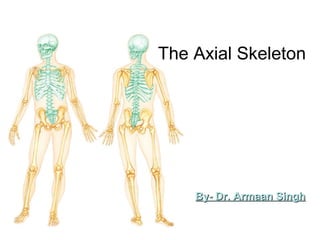
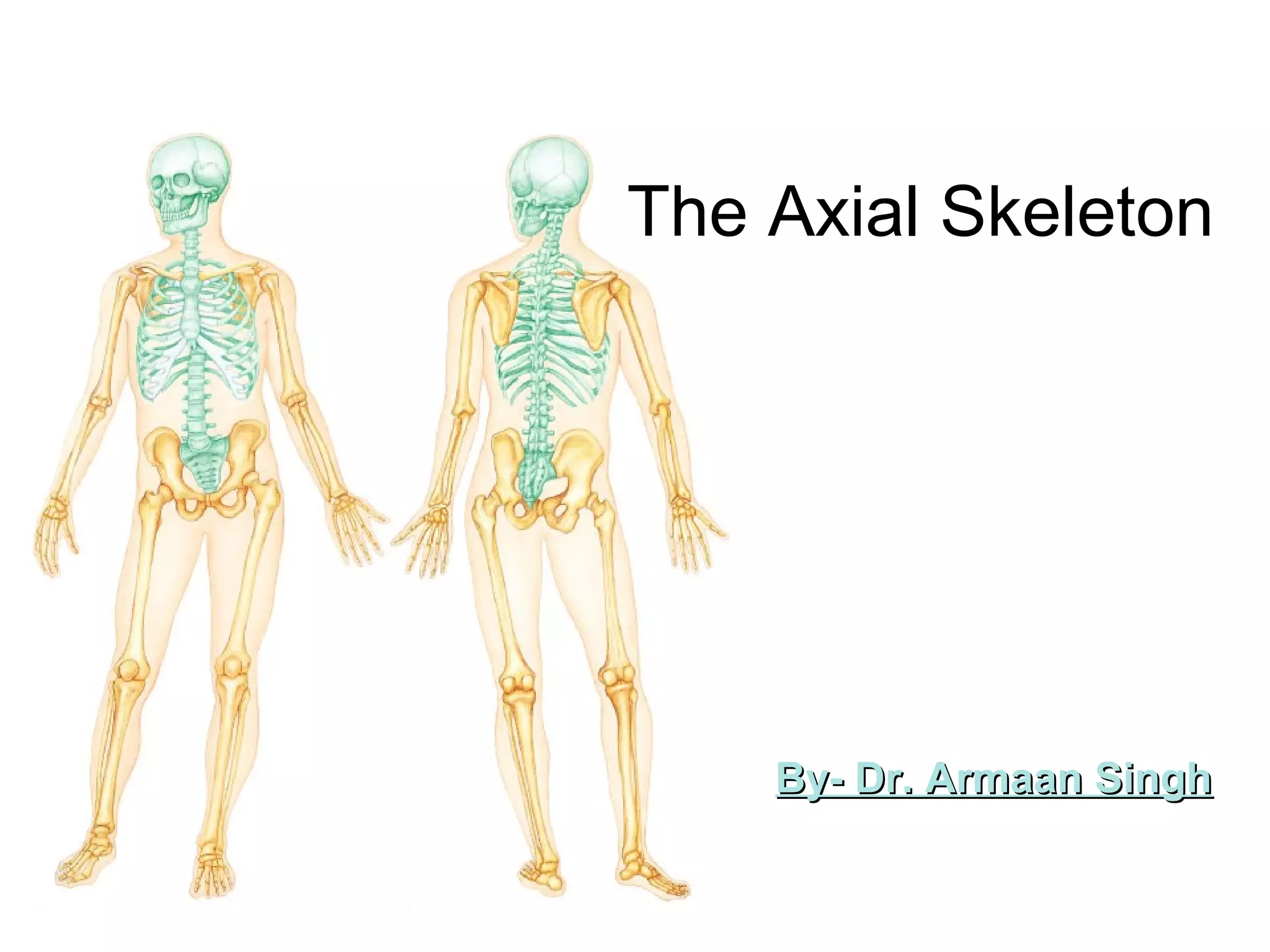
The Axial Skeleton
By- Dr. Armaan SinghBy- Dr. Armaan Singh
I highly recommend Professor Wissman’s
sites
 For bones:
http://homepage.smc.edu/wissmann_paul/bones/EBbonestuto
 Check out all his links:
http://homepage.smc.edu/wissmann_paul/anatomy1/
Also check out:
 Site for xrays & other diagnostic procedures:
http://www.radiologyinfo.org/en/sitemap/category.cfm?
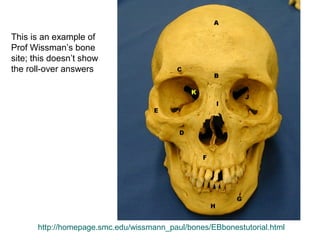
http://homepage.smc.edu/wissmann_paul/bones/EBbonestutorial.html
This is an example of
Prof Wissman’s bone
site; this doesn’t show
the roll-over answers
THE SKELETAL SYSTEM
The Axial Skeleton
 The skeleton consists of
Bones (206)
Cartilages
Joints – also called articulations, are the
junctions between skeletal elements
Ligaments – connect bones
 Divided into axial and appendicular
 Axial skeleton - forms long axis of body
Skull
Vertebral column
Thoracic cage
 Appendicular skeleton – appendages and
what they attach to
Upper limbs (arms)
Pectoral girdle (shoulder)
Lower limbs (legs)
Pelvic girdle
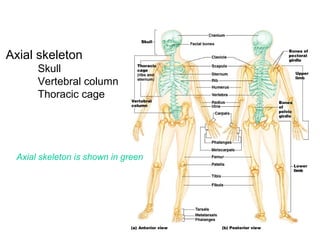
Axial skeleton
Skull
Vertebral column
Thoracic cage
Axial skeleton is shown in green
The Skull
 Cranial bones (or cranium)
 Enclose the cranial cavity, which supports and protects
the brain
 Attachment sites for some head and neck muscles
 Facial bones (anterior aspect of skull)
 Form framework of face
 Form cavities for sense organs of sight, taste and smell
 Provides openings for passage of air and food
 Hold the teeth
 Anchor the muscles of the face
Cranium
 Vault – “calvaria” = skullcap
 Forms superior, lateral and
posterior aspects of skull,
and forehead
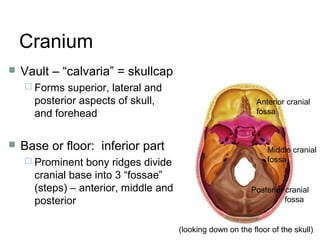
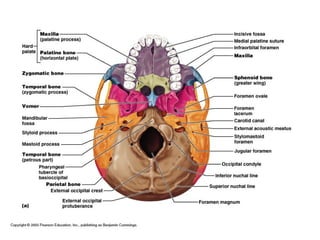
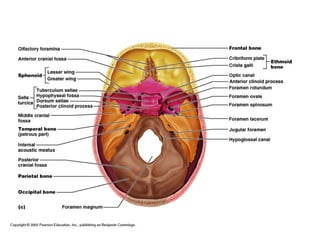
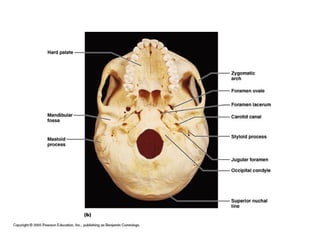
 Base or floor: inferior part
 Prominent bony ridges divide
cranial base into 3 “fossae”
(steps) – anterior, middle and
posterior
Anterior cranial
fossa
Middle cranial
fossa
Posterior cranial
fossa
(looking down on the floor of the skull)
Cranial bones
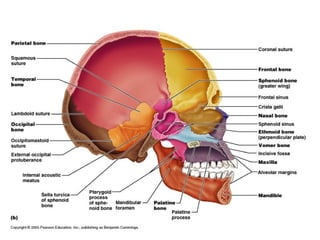
 Frontal bone
 Parietal bones (paired)
 Occipital bone
 Temporal bones (paired)
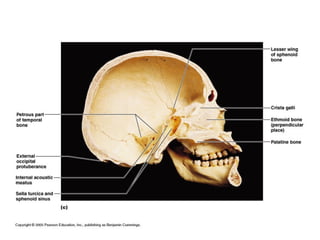
 Sphenoid bone
 Ethmoid bone
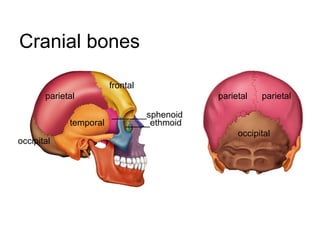
Cranial bones
parietal parietal
frontal
temporal
parietal
occipital
_______sphenoid
_____ethmoid
occipital
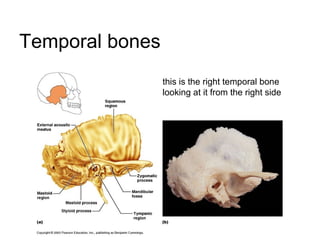
Temporal bones
this is the right temporal bone
looking at it from the right side
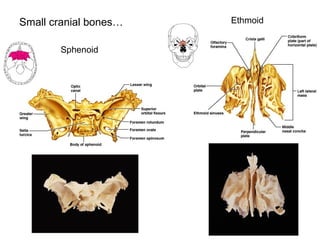
Sphenoid
EthmoidSmall cranial bones…
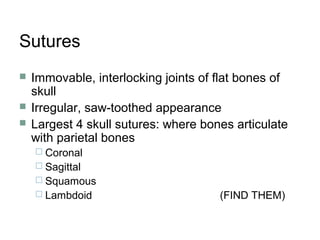
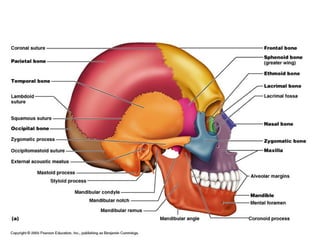
Sutures
 Immovable, interlocking joints of flat bones of
skull
 Irregular, saw-toothed appearance
 Largest 4 skull sutures: where bones articulate
with parietal bones
 Coronal
 Sagittal
 Squamous
 Lambdoid (FIND THEM)
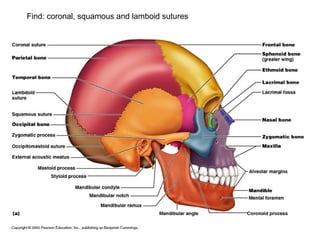
Find: coronal, squamous and lamboid sutures
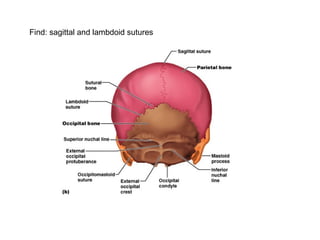
Find: sagittal and lambdoid sutures
 Cranial “cavity” – houses brain
 Smaller cavities
Housing middle and inner ear
Nasal cavity
Orbits
Sinuses
 Openings (foramina, canals, fissures) for:
Spinal cord
Blood vessels
Twelve cranial nerves: I-XII
Remember, the skull is composed of:
1. Cranial bones (or cranium)
[these were just reviewed]
and
2. Facial bones (anterior aspect of skull)
 Form framework of face
 Form cavities for sense organs of sight, taste
and smell
 Provides openings for passage of air and food
 Hold the teeth
 Anchor the muscles of the face
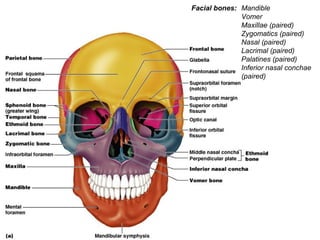
Facial bones
 Mandible
 Vomer
 Maxillae (paired)
 Zygomatics (paired)
 Nasal (paired)
 Lacrimal (paired)
 Palatines (paired)
 Inferior nasal conchae (paired)
Mandible
Vomer
Maxillae (paired)
Zygomatics (paired)
Nasal (paired)
Lacrimal (paired)
Palatines (paired)
Inferior nasal conchae
(paired)
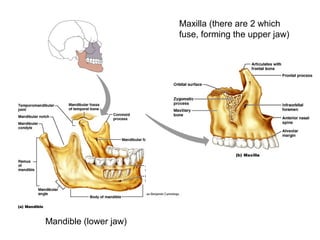
Facial bones:
Mandible (lower jaw)
Maxilla (there are 2 which
fuse, forming the upper jaw)
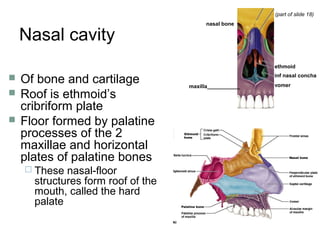
Nasal cavity
 Of bone and cartilage
 Roof is ethmoid’s
cribriform plate
 Floor formed by palatine
processes of the 2
maxillae and horizontal
plates of palatine bones
 These nasal-floor
structures form roof of the
mouth, called the hard
palate
nasal bone
ethmoid
vomer
inf nasal concha
(part of slide 18)
maxilla___________
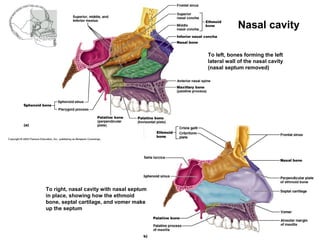
Nasal cavity
To left, bones forming the left
lateral wall of the nasal cavity
(nasal septum removed)
To right, nasal cavity with nasal septum
in place, showing how the ethmoid
bone, septal cartilage, and vomer make
up the septum
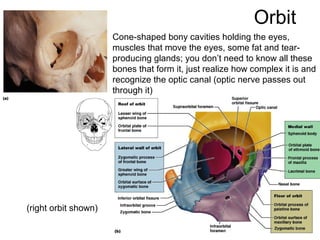
Orbit
Cone-shaped bony cavities holding the eyes,
muscles that move the eyes, some fat and tear-
producing glands; you don’t need to know all these
bones that form it, just realize how complex it is and
recognize the optic canal (optic nerve passes out
through it)
(right orbit shown)
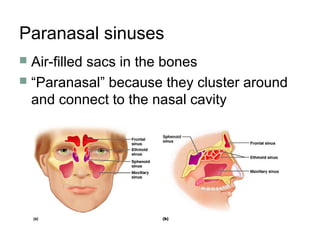
Paranasal sinuses
 Air-filled sacs in the bones
 “Paranasal” because they cluster around
and connect to the nasal cavity
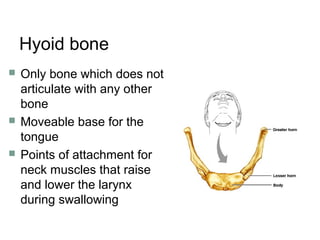
Hyoid bone
 Only bone which does not
articulate with any other
bone
 Moveable base for the
tongue
 Points of attachment for
neck muscles that raise
and lower the larynx
during swallowing
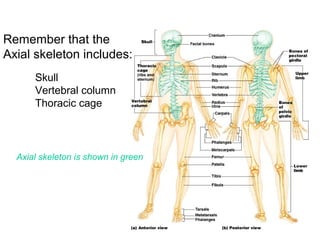
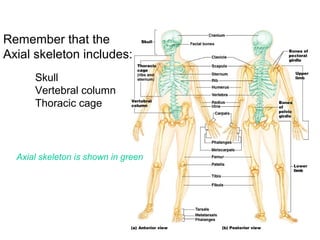
Remember that the
Axial skeleton includes:
Skull
Vertebral column
Thoracic cage
Axial skeleton is shown in green
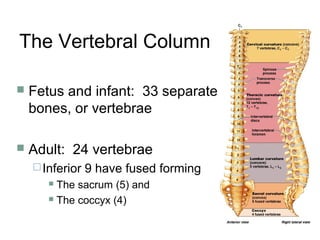
The Vertebral Column
 Fetus and infant: 33 separate
bones, or vertebrae
 Adult: 24 vertebrae
Inferior 9 have fused forming
 The sacrum (5) and
 The coccyx (4)
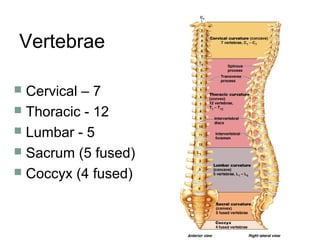
Vertebrae
 Cervical – 7
 Thoracic - 12
 Lumbar - 5
 Sacrum (5 fused)
 Coccyx (4 fused)
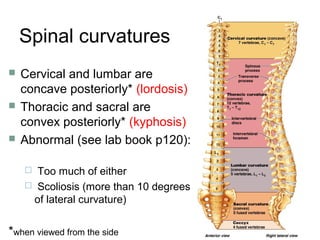
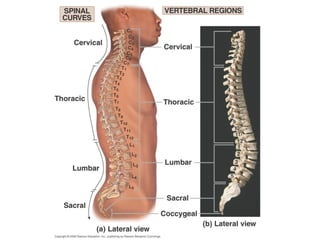
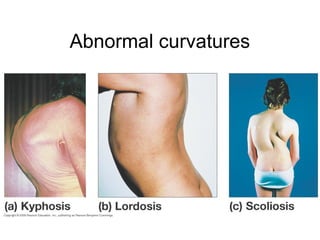
Spinal curvatures
 Cervical and lumbar are
concave posteriorly* (lordosis)
 Thoracic and sacral are
convex posteriorly* (kyphosis)
 Abnormal (see lab book p120):
 Too much of either
 Scoliosis (more than 10 degrees
of lateral curvature)
*when viewed from the side
Abnormal curvatures
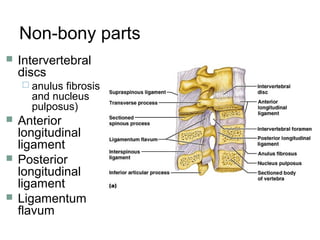
Non-bony parts
 Intervertebral
discs
 anulus fibrosis
and nucleus
pulposus)
 Anterior
longitudinal
ligament
 Posterior
longitudinal
ligament
 Ligamentum
flavum
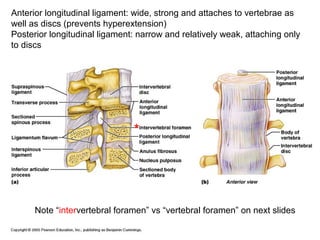
Anterior longitudinal ligament: wide, strong and attaches to vertebrae as
well as discs (prevents hyperextension)
Posterior longitudinal ligament: narrow and relatively weak, attaching only
to discs
Note “intervertebral foramen” vs “vertebral foramen” on next slides
*
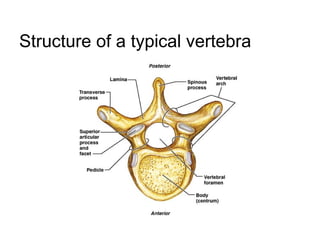
Structure of a typical vertebra
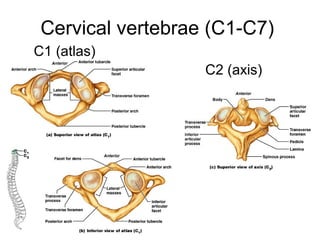
Cervical vertebrae (C1-C7)
C1 (atlas)
C2 (axis)
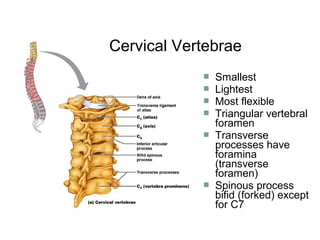
 Smallest
 Lightest
 Most flexible
 Triangular vertebral
foramen
 Transverse
processes have
foramina
(transverse
foramen)
 Spinous process
bifid (forked) except
for C7
Cervical Vertebrae
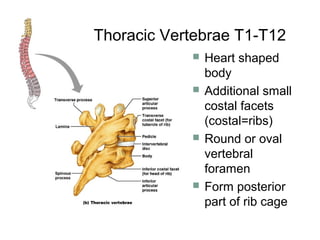
 Heart shaped
body
 Additional small
costal facets
(costal=ribs)
 Round or oval
vertebral
foramen
 Form posterior
part of rib cage
Thoracic Vertebrae T1-T12
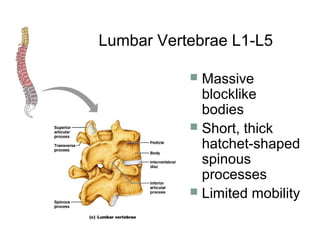
 Massive
blocklike
bodies
 Short, thick
hatchet-shaped
spinous
processes
 Limited mobility
Lumbar Vertebrae L1-L5
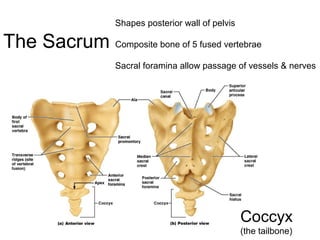
The Sacrum
Shapes posterior wall of pelvis
Composite bone of 5 fused vertebrae
Sacral foramina allow passage of vessels & nerves
Coccyx
(the tailbone)
Remember that the
Axial skeleton includes:
Skull
Vertebral column
Thoracic cage
Axial skeleton is shown in green
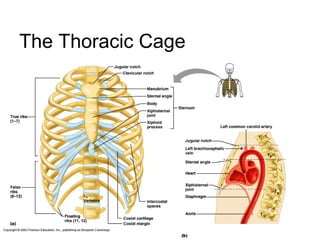
The Thoracic Cage
Sternum Ribs
 Manubrium
 Body
 Xiphoid process
 True ribs 1-7
 False ribs 8-12
 Floating ribs 11,12
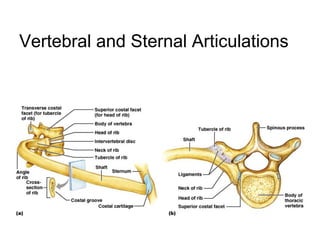
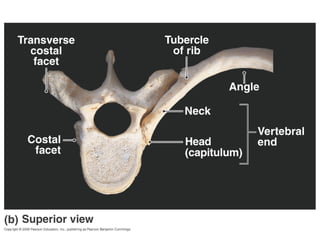
Vertebral and Sternal Articulations
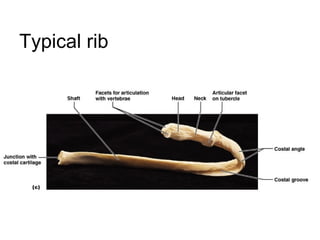
Typical rib
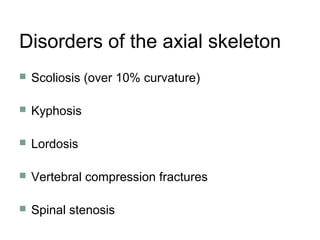
Disorders of the axial skeleton
 Scoliosis (over 10% curvature)
 Kyphosis
 Lordosis
 Vertebral compression fractures
 Spinal stenosis
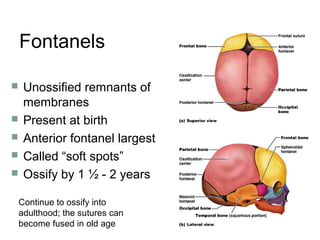
Fontanels
 Unossified remnants of
membranes
 Present at birth
 Anterior fontanel largest
 Called “soft spots”
 Ossify by 1 ½ - 2 years
Continue to ossify into
adulthood; the sutures can
become fused in old age
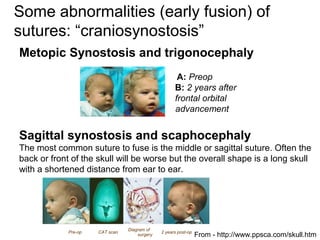
Some abnormalities (early fusion) of
sutures: “craniosynostosis”
Metopic Synostosis and trigonocephaly
A: Preop
B: 2 years after
frontal orbital
advancement
Pre-op CAT scan
Diagram of
surgery
2 years post-op
Sagittal synostosis and scaphocephaly
The most common suture to fuse is the middle or sagittal suture. Often the
back or front of the skull will be worse but the overall shape is a long skull
with a shortened distance from ear to ear.
From - http://www.ppsca.com/skull.htm

Axial skeleton

  • 1.
    The Axial Skeleton By-Dr. Armaan SinghBy- Dr. Armaan Singh
  • 2.
    I highly recommendProfessor Wissman’s sites  For bones: http://homepage.smc.edu/wissmann_paul/bones/EBbonestuto  Check out all his links: http://homepage.smc.edu/wissmann_paul/anatomy1/ Also check out:  Site for xrays & other diagnostic procedures: http://www.radiologyinfo.org/en/sitemap/category.cfm?
  • 3.
    http://homepage.smc.edu/wissmann_paul/bones/EBbonestutorial.html This is anexample of Prof Wissman’s bone site; this doesn’t show the roll-over answers
  • 4.
    THE SKELETAL SYSTEM TheAxial Skeleton  The skeleton consists of Bones (206) Cartilages Joints – also called articulations, are the junctions between skeletal elements Ligaments – connect bones  Divided into axial and appendicular
  • 5.
     Axial skeleton- forms long axis of body Skull Vertebral column Thoracic cage  Appendicular skeleton – appendages and what they attach to Upper limbs (arms) Pectoral girdle (shoulder) Lower limbs (legs) Pelvic girdle
  • 6.
    Axial skeleton Skull Vertebral column Thoraciccage Axial skeleton is shown in green
  • 7.
    The Skull  Cranialbones (or cranium)  Enclose the cranial cavity, which supports and protects the brain  Attachment sites for some head and neck muscles  Facial bones (anterior aspect of skull)  Form framework of face  Form cavities for sense organs of sight, taste and smell  Provides openings for passage of air and food  Hold the teeth  Anchor the muscles of the face
  • 8.
    Cranium  Vault –“calvaria” = skullcap  Forms superior, lateral and posterior aspects of skull, and forehead  Base or floor: inferior part  Prominent bony ridges divide cranial base into 3 “fossae” (steps) – anterior, middle and posterior Anterior cranial fossa Middle cranial fossa Posterior cranial fossa (looking down on the floor of the skull)
  • 9.
    Cranial bones  Frontalbone  Parietal bones (paired)  Occipital bone  Temporal bones (paired)  Sphenoid bone  Ethmoid bone
  • 10.
  • 11.
    Temporal bones this isthe right temporal bone looking at it from the right side
  • 12.
  • 13.
    Sutures  Immovable, interlockingjoints of flat bones of skull  Irregular, saw-toothed appearance  Largest 4 skull sutures: where bones articulate with parietal bones  Coronal  Sagittal  Squamous  Lambdoid (FIND THEM)
  • 14.
    Find: coronal, squamousand lamboid sutures
  • 15.
    Find: sagittal andlambdoid sutures
  • 16.
     Cranial “cavity”– houses brain  Smaller cavities Housing middle and inner ear Nasal cavity Orbits Sinuses  Openings (foramina, canals, fissures) for: Spinal cord Blood vessels Twelve cranial nerves: I-XII
  • 17.
    Remember, the skullis composed of: 1. Cranial bones (or cranium) [these were just reviewed] and 2. Facial bones (anterior aspect of skull)  Form framework of face  Form cavities for sense organs of sight, taste and smell  Provides openings for passage of air and food  Hold the teeth  Anchor the muscles of the face
  • 18.
    Facial bones  Mandible Vomer  Maxillae (paired)  Zygomatics (paired)  Nasal (paired)  Lacrimal (paired)  Palatines (paired)  Inferior nasal conchae (paired)
  • 19.
    Mandible Vomer Maxillae (paired) Zygomatics (paired) Nasal(paired) Lacrimal (paired) Palatines (paired) Inferior nasal conchae (paired) Facial bones:
  • 26.
    Mandible (lower jaw) Maxilla(there are 2 which fuse, forming the upper jaw)
  • 27.
    Nasal cavity  Ofbone and cartilage  Roof is ethmoid’s cribriform plate  Floor formed by palatine processes of the 2 maxillae and horizontal plates of palatine bones  These nasal-floor structures form roof of the mouth, called the hard palate nasal bone ethmoid vomer inf nasal concha (part of slide 18) maxilla___________
  • 28.
    Nasal cavity To left,bones forming the left lateral wall of the nasal cavity (nasal septum removed) To right, nasal cavity with nasal septum in place, showing how the ethmoid bone, septal cartilage, and vomer make up the septum
  • 29.
    Orbit Cone-shaped bony cavitiesholding the eyes, muscles that move the eyes, some fat and tear- producing glands; you don’t need to know all these bones that form it, just realize how complex it is and recognize the optic canal (optic nerve passes out through it) (right orbit shown)
  • 30.
    Paranasal sinuses  Air-filledsacs in the bones  “Paranasal” because they cluster around and connect to the nasal cavity
  • 31.
    Hyoid bone  Onlybone which does not articulate with any other bone  Moveable base for the tongue  Points of attachment for neck muscles that raise and lower the larynx during swallowing
  • 32.
    Remember that the Axialskeleton includes: Skull Vertebral column Thoracic cage Axial skeleton is shown in green
  • 33.
    The Vertebral Column Fetus and infant: 33 separate bones, or vertebrae  Adult: 24 vertebrae Inferior 9 have fused forming  The sacrum (5) and  The coccyx (4)
  • 34.
    Vertebrae  Cervical –7  Thoracic - 12  Lumbar - 5  Sacrum (5 fused)  Coccyx (4 fused)
  • 35.
    Spinal curvatures  Cervicaland lumbar are concave posteriorly* (lordosis)  Thoracic and sacral are convex posteriorly* (kyphosis)  Abnormal (see lab book p120):  Too much of either  Scoliosis (more than 10 degrees of lateral curvature) *when viewed from the side
  • 37.
  • 38.
    Non-bony parts  Intervertebral discs anulus fibrosis and nucleus pulposus)  Anterior longitudinal ligament  Posterior longitudinal ligament  Ligamentum flavum
  • 39.
    Anterior longitudinal ligament:wide, strong and attaches to vertebrae as well as discs (prevents hyperextension) Posterior longitudinal ligament: narrow and relatively weak, attaching only to discs Note “intervertebral foramen” vs “vertebral foramen” on next slides *
  • 40.
    Structure of atypical vertebra
  • 41.
  • 42.
     Smallest  Lightest Most flexible  Triangular vertebral foramen  Transverse processes have foramina (transverse foramen)  Spinous process bifid (forked) except for C7 Cervical Vertebrae
  • 43.
     Heart shaped body Additional small costal facets (costal=ribs)  Round or oval vertebral foramen  Form posterior part of rib cage Thoracic Vertebrae T1-T12
  • 44.
     Massive blocklike bodies  Short,thick hatchet-shaped spinous processes  Limited mobility Lumbar Vertebrae L1-L5
  • 45.
    The Sacrum Shapes posteriorwall of pelvis Composite bone of 5 fused vertebrae Sacral foramina allow passage of vessels & nerves Coccyx (the tailbone)
  • 46.
    Remember that the Axialskeleton includes: Skull Vertebral column Thoracic cage Axial skeleton is shown in green
  • 47.
  • 48.
    Sternum Ribs  Manubrium Body  Xiphoid process  True ribs 1-7  False ribs 8-12  Floating ribs 11,12
  • 49.
    Vertebral and SternalArticulations
  • 50.
  • 52.
    Disorders of theaxial skeleton  Scoliosis (over 10% curvature)  Kyphosis  Lordosis  Vertebral compression fractures  Spinal stenosis
  • 53.
    Fontanels  Unossified remnantsof membranes  Present at birth  Anterior fontanel largest  Called “soft spots”  Ossify by 1 ½ - 2 years Continue to ossify into adulthood; the sutures can become fused in old age
  • 54.
    Some abnormalities (earlyfusion) of sutures: “craniosynostosis” Metopic Synostosis and trigonocephaly A: Preop B: 2 years after frontal orbital advancement Pre-op CAT scan Diagram of surgery 2 years post-op Sagittal synostosis and scaphocephaly The most common suture to fuse is the middle or sagittal suture. Often the back or front of the skull will be worse but the overall shape is a long skull with a shortened distance from ear to ear. From - http://www.ppsca.com/skull.htm