Warm-Up Activity
• Fill in the names of the bones in the skeleton
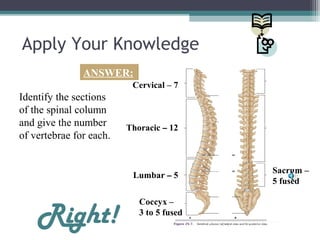
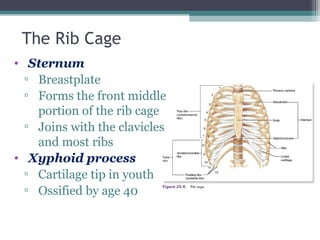
diagram.
Warm-Up
1. What are the 4 types of bones? Give an
example of each.
2. Give 3 ways you can tell a female skeleton from
a male skeleton.
3. What hormones are involved in the skeletal
system?
Skeletal System
Chapters 6 & 7
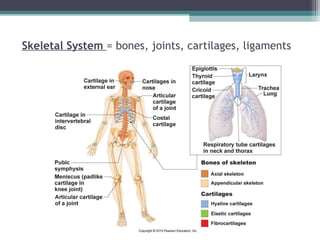
Skeletal System = bones, joints, cartilages, ligaments
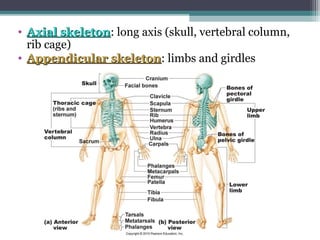
• Axial skeletonAxial skeleton: long axis (skull, vertebral column,
rib cage)
• Appendicular skeletonAppendicular skeleton: limbs and girdles
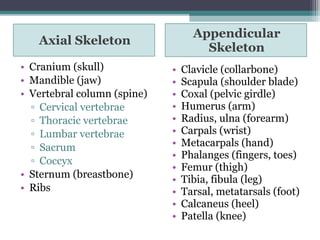
Axial Skeleton
Appendicular
Skeleton
• Cranium (skull)
• Mandible (jaw)
• Vertebral column (spine)
▫ Cervical vertebrae
▫ Thoracic vertebrae
▫ Lumbar vertebrae
▫ Sacrum
▫ Coccyx
• Sternum (breastbone)
• Ribs
• Clavicle (collarbone)
• Scapula (shoulder blade)
• Coxal (pelvic girdle)
• Humerus (arm)
• Radius, ulna (forearm)
• Carpals (wrist)
• Metacarpals (hand)
• Phalanges (fingers, toes)
• Femur (thigh)
• Tibia, fibula (leg)
• Tarsal, metatarsals (foot)
• Calcaneus (heel)
• Patella (knee)
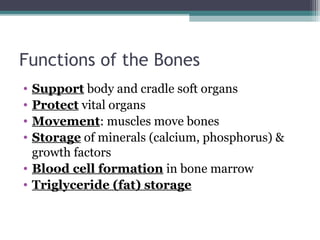
Functions of the Bones
• Support body and cradle soft organs
• Protect vital organs
• Movement: muscles move bones
• Storage of minerals (calcium, phosphorus) &
growth factors
• Blood cell formation in bone marrow
• Triglyceride (fat) storage
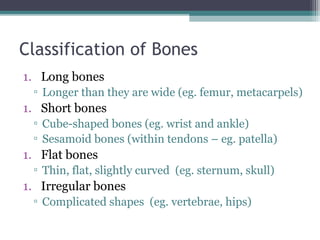
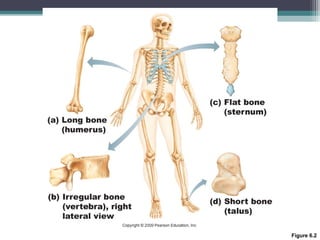
Classification of Bones
1. Long bones
▫ Longer than they are wide (eg. femur, metacarpels)
1. Short bones
▫ Cube-shaped bones (eg. wrist and ankle)
▫ Sesamoid bones (within tendons – eg. patella)
1. Flat bones
▫ Thin, flat, slightly curved (eg. sternum, skull)
1. Irregular bones
▫ Complicated shapes (eg. vertebrae, hips)
Figure 6.2
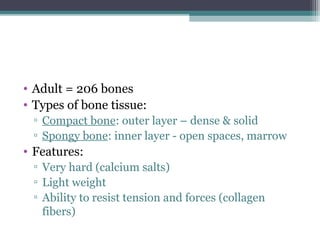
• Adult = 206 bones
• Types of bone tissue:
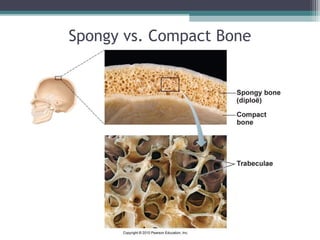
▫ Compact bone: outer layer – dense & solid
▫ Spongy bone: inner layer - open spaces, marrow
• Features:
▫ Very hard (calcium salts)
▫ Light weight
▫ Ability to resist tension and forces (collagen
fibers)
Spongy vs. Compact Bone
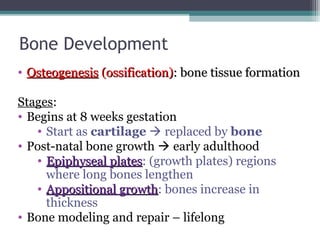
Bone Development
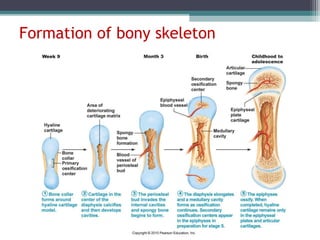
• OsteogenesisOsteogenesis (ossification)(ossification): bone tissue formation: bone tissue formation
Stages:
• Begins at 8 weeks gestation
• Start as cartilage  replaced by bone
• Post-natal bone growth  early adulthood
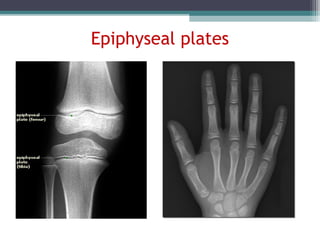
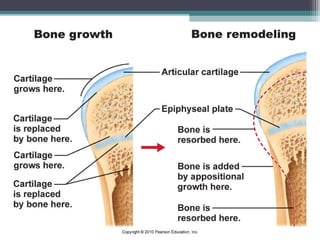
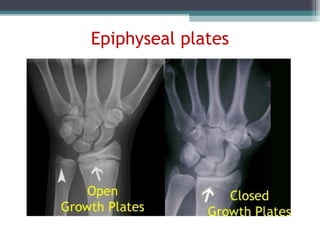
• Epiphyseal platesEpiphyseal plates: (growth plates) regions
where long bones lengthen
• Appositional growthAppositional growth: bones increase in
thickness
• Bone modeling and repair – lifelong
Formation of bony skeleton
Epiphyseal plates
Epiphyseal plates
Hormonal Control
• Growth hormonesGrowth hormones: stimulate longitudinal bone
growth
• Thyroid hormoneThyroid hormone: control activity of growth
hormone
• Testosterone & estrogensTestosterone & estrogens (at puberty):
• Adolescent growth spurt
• Close epiphyseal plates  end growth
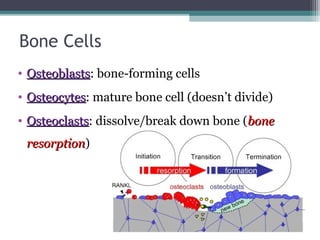
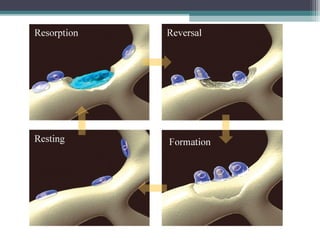
Bone Cells
• OsteoblastsOsteoblasts: bone-forming cells
• OsteocytesOsteocytes: mature bone cell (doesn’t divide)
• OsteoclastsOsteoclasts: dissolve/break down bone (bonebone
resorptionresorption)
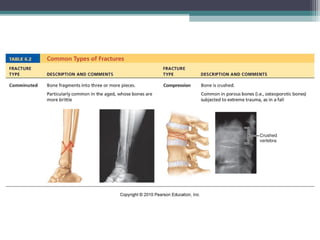
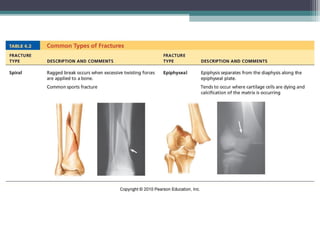
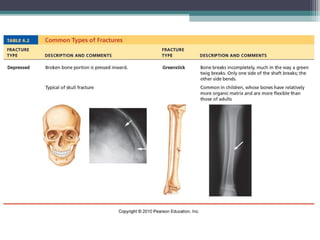
Fractures (Breaks)
Classified by:
1.Position of bone – nondisplaced (normal) or
displaced (bone out of alignment)
2.Completeness of break – complete (broken
through) or incomplete
3.Orientation to long axis of bone – linear
(parallel to bone) or transverse (perpendicular to
bone)
4.If bone penetrates skin – open (compound)
fracture or closed (simple) fracture
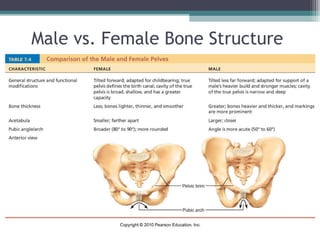
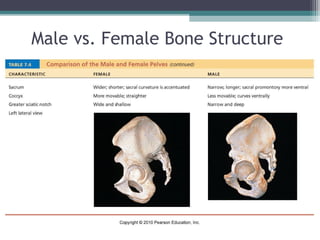
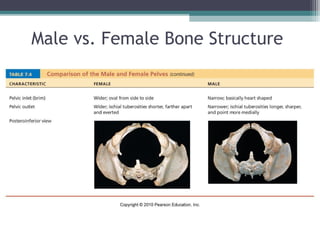
Male vs. Female Bone Structure
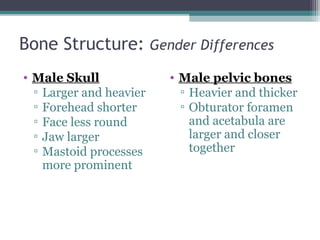
Bone Structure: Gender Differences
• Male Skull
▫ Larger and heavier
▫ Forehead shorter
▫ Face less round
▫ Jaw larger
▫ Mastoid processes
more prominent
• Male pelvic bones
▫ Heavier and thicker
▫ Obturator foramen
and acetabula are
larger and closer
together
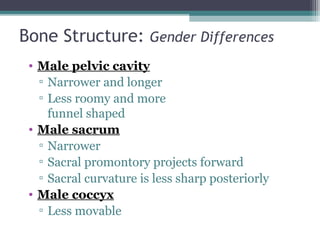
• Male pelvic cavity
▫ Narrower and longer
▫ Less roomy and more
funnel shaped
• Male sacrum
▫ Narrower
▫ Sacral promontory projects forward
▫ Sacral curvature is less sharp posteriorly
• Male coccyx
▫ Less movable
Bone Structure: Gender Differences
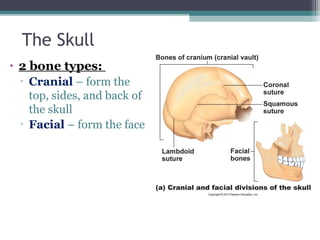
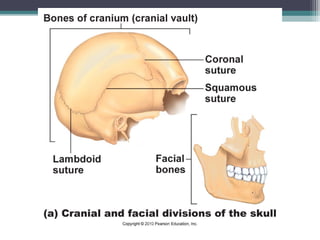
The Skull
• 2 bone types:
▫ Cranial – form the
top, sides, and back of
the skull
▫ Facial – form the face
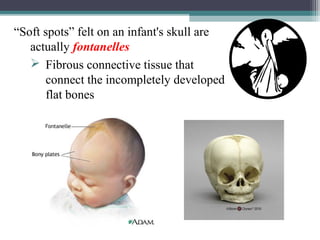
“Soft spots” felt on an infant's skull are
actually fontanelles
 Fibrous connective tissue that
connect the incompletely developed
flat bones
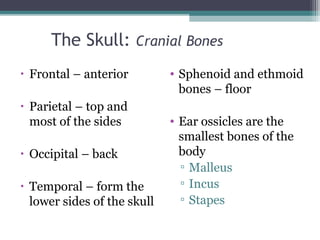
The Skull: Cranial Bones
• Frontal – anterior
• Parietal – top and
most of the sides
• Occipital – back
• Temporal – form the
lower sides of the skull
• Sphenoid and ethmoid
bones – floor
• Ear ossicles are the
smallest bones of the
body
▫ Malleus
▫ Incus
▫ Stapes
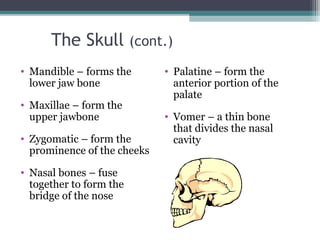
The Skull (cont.)
• Mandible – forms the
lower jaw bone
• Maxillae – form the
upper jawbone
• Zygomatic – form the
prominence of the cheeks
• Nasal bones – fuse
together to form the
bridge of the nose
• Palatine – form the
anterior portion of the
palate
• Vomer – a thin bone
that divides the nasal
cavity
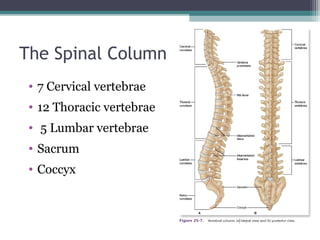
The Spinal Column
• 7 Cervical vertebrae
• 12 Thoracic vertebrae
• 5 Lumbar vertebrae
• Sacrum
• Coccyx
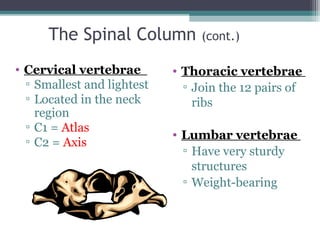
The Spinal Column (cont.)
• Cervical vertebrae
▫ Smallest and lightest
▫ Located in the neck
region
▫ C1 = Atlas
▫ C2 = Axis
• Thoracic vertebrae
▫ Join the 12 pairs of
ribs
• Lumbar vertebrae
▫ Have very sturdy
structures
▫ Weight-bearing
The Spinal Column (cont.)
• Sacrum
▫ Triangular-shaped bone  5 fused vertebrae
• Coccyx
▫ Small, triangular bone  3-5 fused vertebrae
▫ Considered unnecessary
▫ Also called the tailbone
Apply Your Knowledge
Identify the sections
of the spinal column
and give the number
of vertebrae for each.
Thoracic – 12
Lumbar – 5
Sacrum –
5 fused
Coccyx –
3 to 5 fused
Cervical – 7
ANSWER:
Right!
The Rib Cage
• Sternum
▫ Breastplate
▫ Forms the front middle
portion of the rib cage
▫ Joins with the clavicles
and most ribs
• Xyphoid process
▫ Cartilage tip in youth
▫ Ossified by age 40
The Rib Cage (cont.)
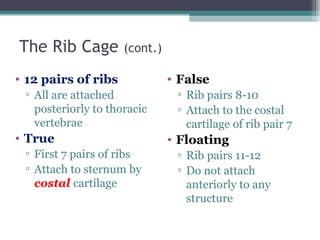
• 12 pairs of ribs
▫ All are attached
posteriorly to thoracic
vertebrae
• True
▫ First 7 pairs of ribs
▫ Attach to sternum by
costal cartilage
• False
▫ Rib pairs 8-10
▫ Attach to the costal
cartilage of rib pair 7
• Floating
▫ Rib pairs 11-12
▫ Do not attach
anteriorly to any
structure
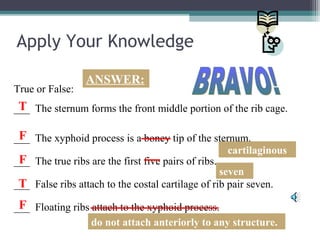
Apply Your Knowledge
True or False:
___ The sternum forms the front middle portion of the rib cage.
___ The xyphoid process is a boney tip of the sternum.
___ The true ribs are the first five pairs of ribs.
___ False ribs attach to the costal cartilage of rib pair seven.
___ Floating ribs attach to the xyphoid process.
T
T
ANSWER:
F
cartilaginous
F
seven
F
do not attach anteriorly to any structure.
Common Diseases and Disorders
• Arthritis – general term meaning joint
inflammation
• Osteoarthritis – degenerative joint disease,
primarily of weight-bearing joints
• Rheumatoid Arthritis – chronic systemic
inflammatory disease of smaller joints and
surrounding tissues
• Bursitis – inflammation of a bursa (fluid-
filled sac that cushions tendons)
• Carpal Tunnel Syndrome – overuse of
wrist; the median nerve in the wrist becomes
compressed
• Ewing’s Family of Tumors (EFT) – a
group of tumors that affect different tissue
types; primarily bone
• Gout – a type of arthritis; deposits of uric acid
crystals in the joints
Common Diseases and Disorders
• Kyphosis – abnormal curvature of the spine
(humpback)
• Lordosis – exaggerated inward curvature of
the lumbar spine (swayback)
• Osteogenesis imperfecta – brittle-bone
disease
• Osteoporosis – a condition in which bones
thin (become porous) over time
Common Diseases and Disorders
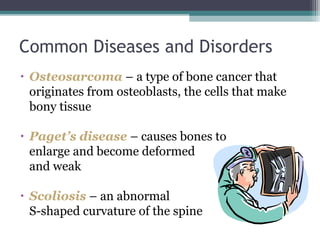
• Osteosarcoma – a type of bone cancer that
originates from osteoblasts, the cells that make
bony tissue
• Paget’s disease – causes bones to
enlarge and become deformed
and weak
• Scoliosis – an abnormal
S-shaped curvature of the spine
Common Diseases and Disorders

Anatomy & Physiology Lecture Notes - Skeletal system

  • 1.
    Warm-Up Activity • Fillin the names of the bones in the skeleton diagram.
  • 2.
    Warm-Up 1. What arethe 4 types of bones? Give an example of each. 2. Give 3 ways you can tell a female skeleton from a male skeleton. 3. What hormones are involved in the skeletal system?
  • 3.
  • 4.
    Skeletal System =bones, joints, cartilages, ligaments
  • 5.
    • Axial skeletonAxialskeleton: long axis (skull, vertebral column, rib cage) • Appendicular skeletonAppendicular skeleton: limbs and girdles
  • 6.
    Axial Skeleton Appendicular Skeleton • Cranium(skull) • Mandible (jaw) • Vertebral column (spine) ▫ Cervical vertebrae ▫ Thoracic vertebrae ▫ Lumbar vertebrae ▫ Sacrum ▫ Coccyx • Sternum (breastbone) • Ribs • Clavicle (collarbone) • Scapula (shoulder blade) • Coxal (pelvic girdle) • Humerus (arm) • Radius, ulna (forearm) • Carpals (wrist) • Metacarpals (hand) • Phalanges (fingers, toes) • Femur (thigh) • Tibia, fibula (leg) • Tarsal, metatarsals (foot) • Calcaneus (heel) • Patella (knee)
  • 7.
    Functions of theBones • Support body and cradle soft organs • Protect vital organs • Movement: muscles move bones • Storage of minerals (calcium, phosphorus) & growth factors • Blood cell formation in bone marrow • Triglyceride (fat) storage
  • 8.
    Classification of Bones 1.Long bones ▫ Longer than they are wide (eg. femur, metacarpels) 1. Short bones ▫ Cube-shaped bones (eg. wrist and ankle) ▫ Sesamoid bones (within tendons – eg. patella) 1. Flat bones ▫ Thin, flat, slightly curved (eg. sternum, skull) 1. Irregular bones ▫ Complicated shapes (eg. vertebrae, hips)
  • 9.
  • 10.
    • Adult =206 bones • Types of bone tissue: ▫ Compact bone: outer layer – dense & solid ▫ Spongy bone: inner layer - open spaces, marrow • Features: ▫ Very hard (calcium salts) ▫ Light weight ▫ Ability to resist tension and forces (collagen fibers)
  • 11.
  • 12.
    Bone Development • OsteogenesisOsteogenesis(ossification)(ossification): bone tissue formation: bone tissue formation Stages: • Begins at 8 weeks gestation • Start as cartilage  replaced by bone • Post-natal bone growth  early adulthood • Epiphyseal platesEpiphyseal plates: (growth plates) regions where long bones lengthen • Appositional growthAppositional growth: bones increase in thickness • Bone modeling and repair – lifelong
  • 13.
  • 14.
  • 16.
  • 17.
    Hormonal Control • GrowthhormonesGrowth hormones: stimulate longitudinal bone growth • Thyroid hormoneThyroid hormone: control activity of growth hormone • Testosterone & estrogensTestosterone & estrogens (at puberty): • Adolescent growth spurt • Close epiphyseal plates  end growth
  • 18.
    Bone Cells • OsteoblastsOsteoblasts:bone-forming cells • OsteocytesOsteocytes: mature bone cell (doesn’t divide) • OsteoclastsOsteoclasts: dissolve/break down bone (bonebone resorptionresorption)
  • 20.
    Fractures (Breaks) Classified by: 1.Positionof bone – nondisplaced (normal) or displaced (bone out of alignment) 2.Completeness of break – complete (broken through) or incomplete 3.Orientation to long axis of bone – linear (parallel to bone) or transverse (perpendicular to bone) 4.If bone penetrates skin – open (compound) fracture or closed (simple) fracture
  • 24.
    Male vs. FemaleBone Structure
  • 25.
    Male vs. FemaleBone Structure
  • 26.
    Male vs. FemaleBone Structure
  • 27.
    Bone Structure: GenderDifferences • Male Skull ▫ Larger and heavier ▫ Forehead shorter ▫ Face less round ▫ Jaw larger ▫ Mastoid processes more prominent • Male pelvic bones ▫ Heavier and thicker ▫ Obturator foramen and acetabula are larger and closer together
  • 28.
    • Male pelviccavity ▫ Narrower and longer ▫ Less roomy and more funnel shaped • Male sacrum ▫ Narrower ▫ Sacral promontory projects forward ▫ Sacral curvature is less sharp posteriorly • Male coccyx ▫ Less movable Bone Structure: Gender Differences
  • 29.
    The Skull • 2bone types: ▫ Cranial – form the top, sides, and back of the skull ▫ Facial – form the face
  • 30.
    “Soft spots” felton an infant's skull are actually fontanelles  Fibrous connective tissue that connect the incompletely developed flat bones
  • 32.
    The Skull: CranialBones • Frontal – anterior • Parietal – top and most of the sides • Occipital – back • Temporal – form the lower sides of the skull • Sphenoid and ethmoid bones – floor • Ear ossicles are the smallest bones of the body ▫ Malleus ▫ Incus ▫ Stapes
  • 33.
    The Skull (cont.) •Mandible – forms the lower jaw bone • Maxillae – form the upper jawbone • Zygomatic – form the prominence of the cheeks • Nasal bones – fuse together to form the bridge of the nose • Palatine – form the anterior portion of the palate • Vomer – a thin bone that divides the nasal cavity
  • 34.
    The Spinal Column •7 Cervical vertebrae • 12 Thoracic vertebrae • 5 Lumbar vertebrae • Sacrum • Coccyx
  • 35.
    The Spinal Column(cont.) • Cervical vertebrae ▫ Smallest and lightest ▫ Located in the neck region ▫ C1 = Atlas ▫ C2 = Axis • Thoracic vertebrae ▫ Join the 12 pairs of ribs • Lumbar vertebrae ▫ Have very sturdy structures ▫ Weight-bearing
  • 36.
    The Spinal Column(cont.) • Sacrum ▫ Triangular-shaped bone  5 fused vertebrae • Coccyx ▫ Small, triangular bone  3-5 fused vertebrae ▫ Considered unnecessary ▫ Also called the tailbone
  • 37.
    Apply Your Knowledge Identifythe sections of the spinal column and give the number of vertebrae for each. Thoracic – 12 Lumbar – 5 Sacrum – 5 fused Coccyx – 3 to 5 fused Cervical – 7 ANSWER: Right!
  • 38.
    The Rib Cage •Sternum ▫ Breastplate ▫ Forms the front middle portion of the rib cage ▫ Joins with the clavicles and most ribs • Xyphoid process ▫ Cartilage tip in youth ▫ Ossified by age 40
  • 39.
    The Rib Cage(cont.) • 12 pairs of ribs ▫ All are attached posteriorly to thoracic vertebrae • True ▫ First 7 pairs of ribs ▫ Attach to sternum by costal cartilage • False ▫ Rib pairs 8-10 ▫ Attach to the costal cartilage of rib pair 7 • Floating ▫ Rib pairs 11-12 ▫ Do not attach anteriorly to any structure
  • 40.
    Apply Your Knowledge Trueor False: ___ The sternum forms the front middle portion of the rib cage. ___ The xyphoid process is a boney tip of the sternum. ___ The true ribs are the first five pairs of ribs. ___ False ribs attach to the costal cartilage of rib pair seven. ___ Floating ribs attach to the xyphoid process. T T ANSWER: F cartilaginous F seven F do not attach anteriorly to any structure.
  • 41.
    Common Diseases andDisorders • Arthritis – general term meaning joint inflammation • Osteoarthritis – degenerative joint disease, primarily of weight-bearing joints • Rheumatoid Arthritis – chronic systemic inflammatory disease of smaller joints and surrounding tissues
  • 42.
    • Bursitis –inflammation of a bursa (fluid- filled sac that cushions tendons) • Carpal Tunnel Syndrome – overuse of wrist; the median nerve in the wrist becomes compressed • Ewing’s Family of Tumors (EFT) – a group of tumors that affect different tissue types; primarily bone • Gout – a type of arthritis; deposits of uric acid crystals in the joints Common Diseases and Disorders
  • 43.
    • Kyphosis –abnormal curvature of the spine (humpback) • Lordosis – exaggerated inward curvature of the lumbar spine (swayback) • Osteogenesis imperfecta – brittle-bone disease • Osteoporosis – a condition in which bones thin (become porous) over time Common Diseases and Disorders
  • 44.
    • Osteosarcoma –a type of bone cancer that originates from osteoblasts, the cells that make bony tissue • Paget’s disease – causes bones to enlarge and become deformed and weak • Scoliosis – an abnormal S-shaped curvature of the spine Common Diseases and Disorders