Forensic Pathology NotesForensic Pathology Notes
By- Dr. Armaan SinghBy- Dr. Armaan Singh
- postmortem investigation of
sudden or unexpected death or
trauma to the living
Role of the Forensic PathologistRole of the Forensic Pathologist
4 broad determinations to be made:
A. Cause of Death – medical diagnosis denoting
disease or injury
B. Mechanism of Death – altered physiology by
which disease/injury produces death
(arrhythmia, exsanguination)
C. Manner of Death
1. Homicide 2. Suicide 3. Accidental 4. Natural Causes
5. Unknown
D. Time of Death
Time of DeathTime of Death
Can estimate time of death from
• body temperature (algor mortis)
estimate: [98.6 o
F – rectal temp]/1.5
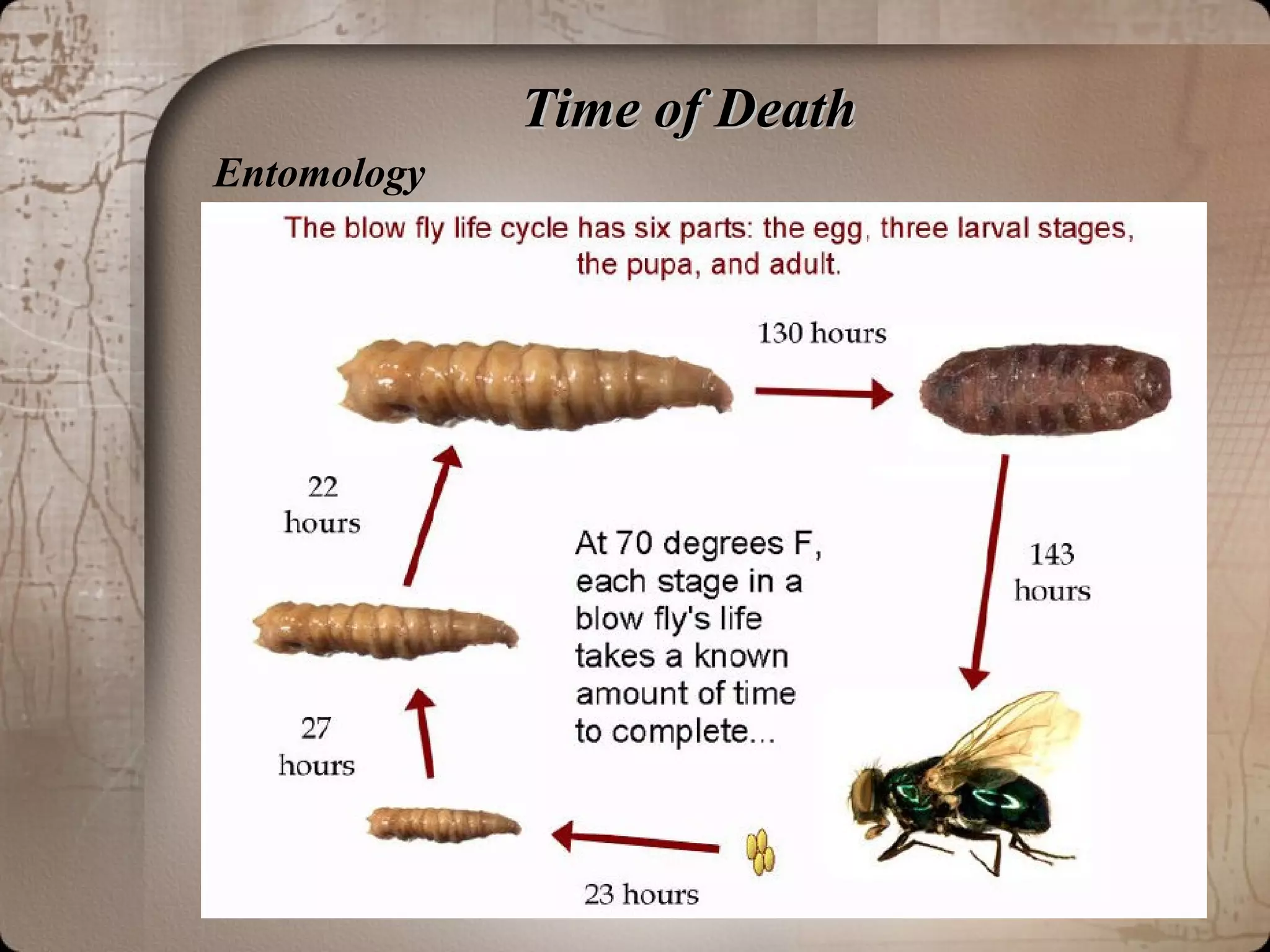
• insect action (forensic entomology)
• stomach contents (stage of digestion)
• last known activity (last sighting, newspaper/mail)
• normal postmortem changes
Time of DeathTime of Death
Entomology
Time of DeathTime of Death
Can estimate time of death from
• body temperature (algor mortis)
estimate: [98.6 o
F – rectal temp]/1.5
• insect action (forensic entomology)
• stomach contents (stage of digestion)
• last known activity (last sighting, newspaper/mail)
• normal postmortem changes
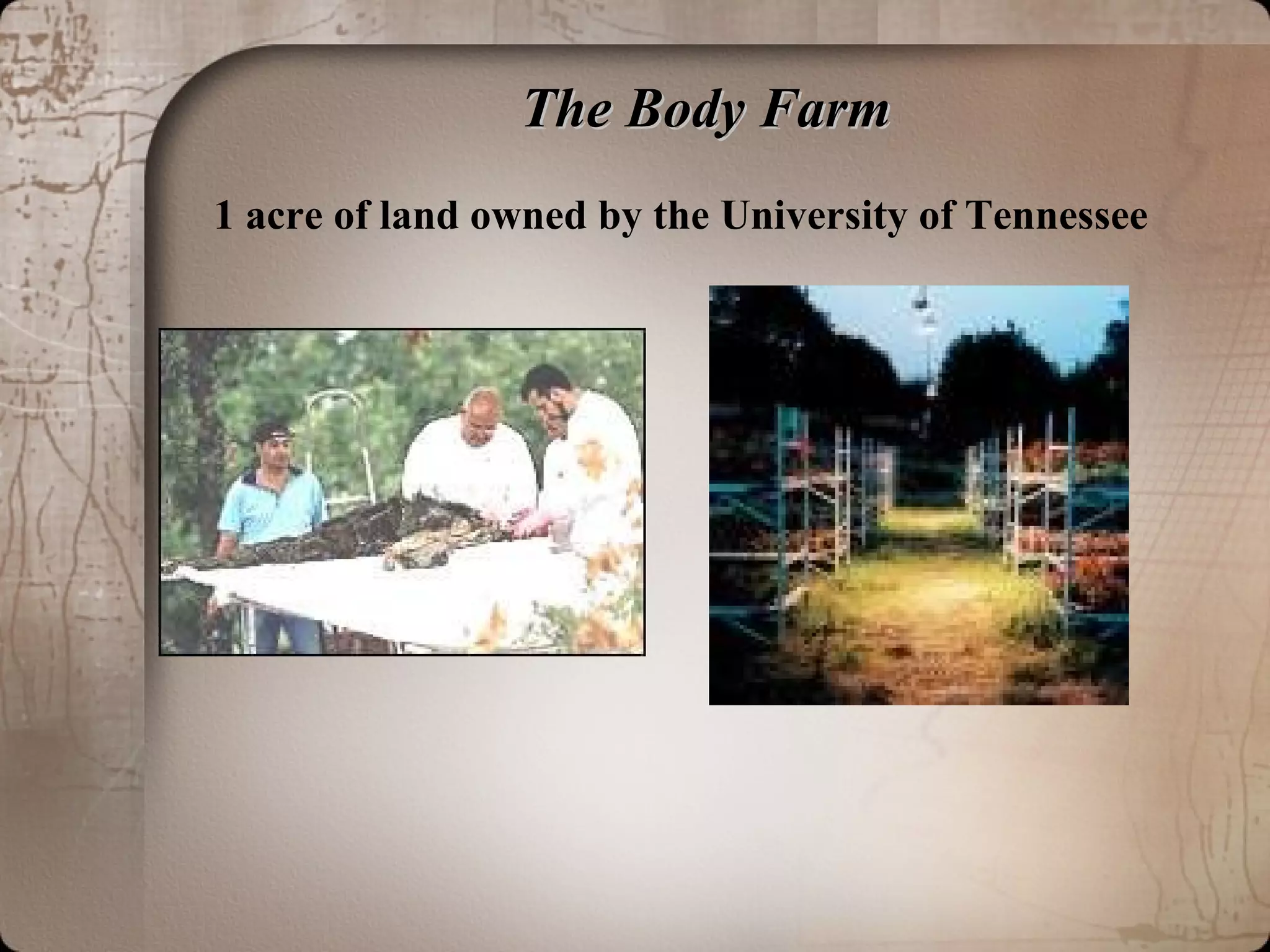
The Body FarmThe Body Farm
1 acre of land owned by the University of Tennessee
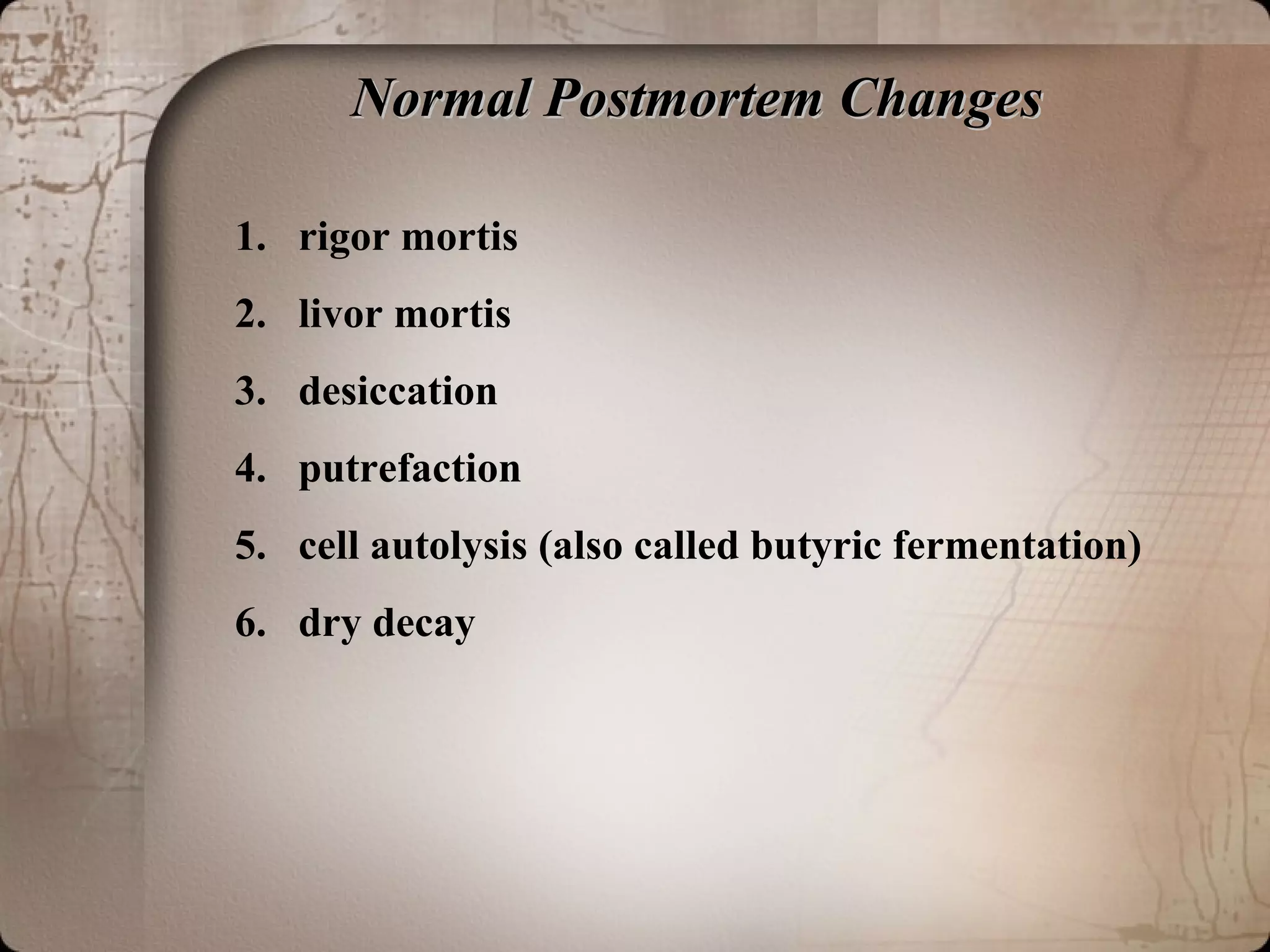
Normal Postmortem ChangesNormal Postmortem Changes
1. rigor mortis
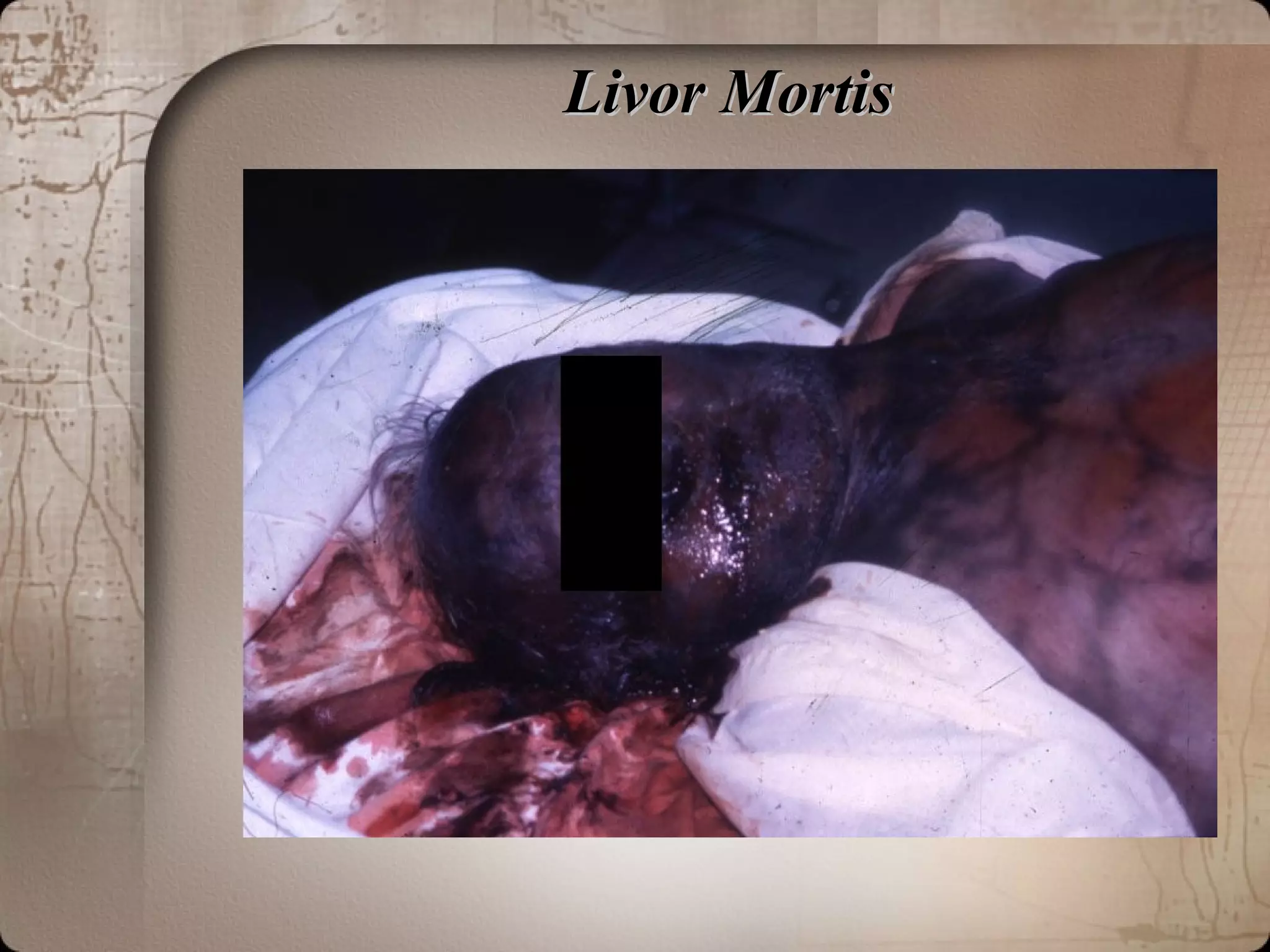
2. livor mortis
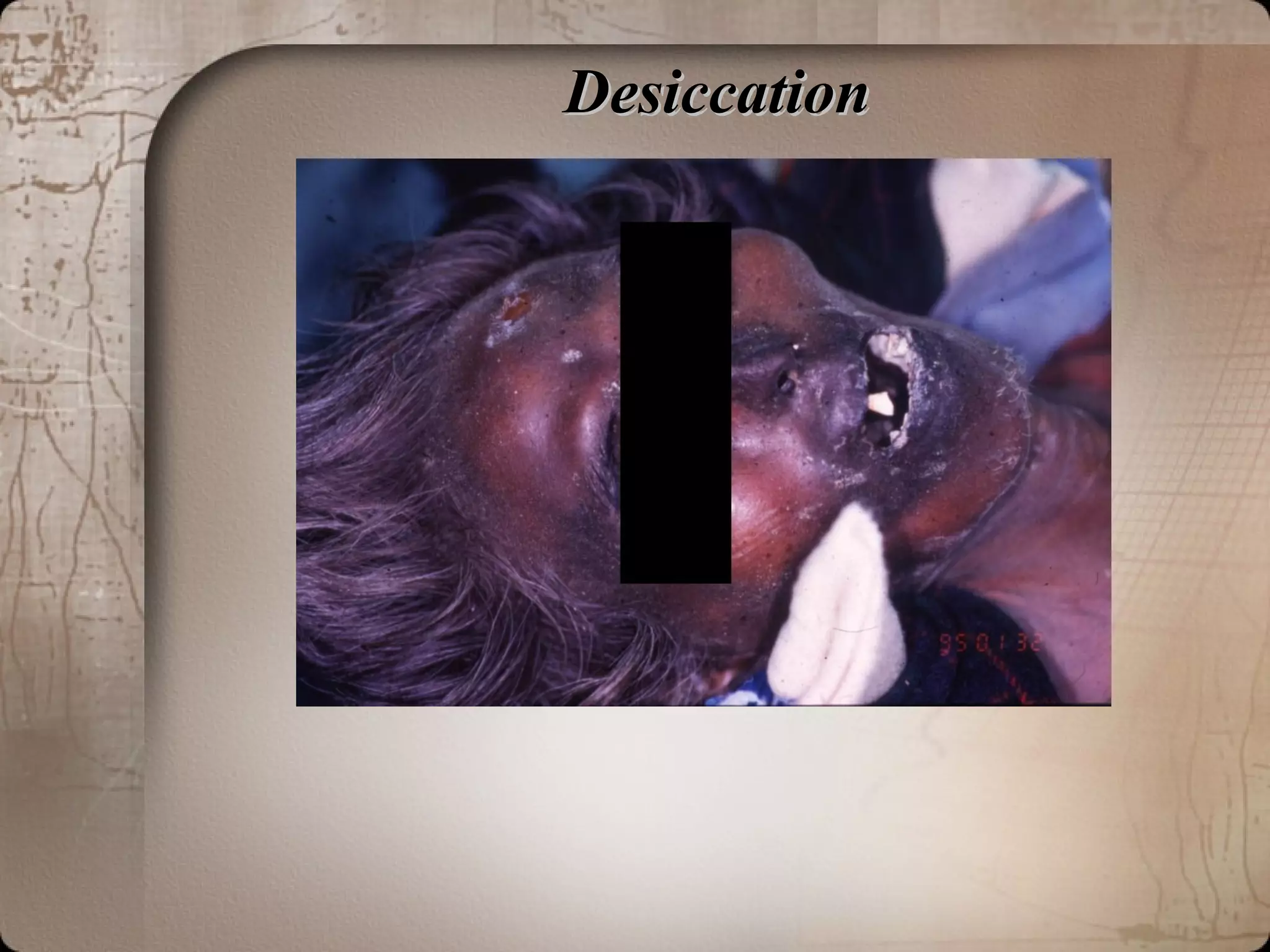
3. desiccation
4. putrefaction
5. cell autolysis (also called butyric fermentation)
6. dry decay
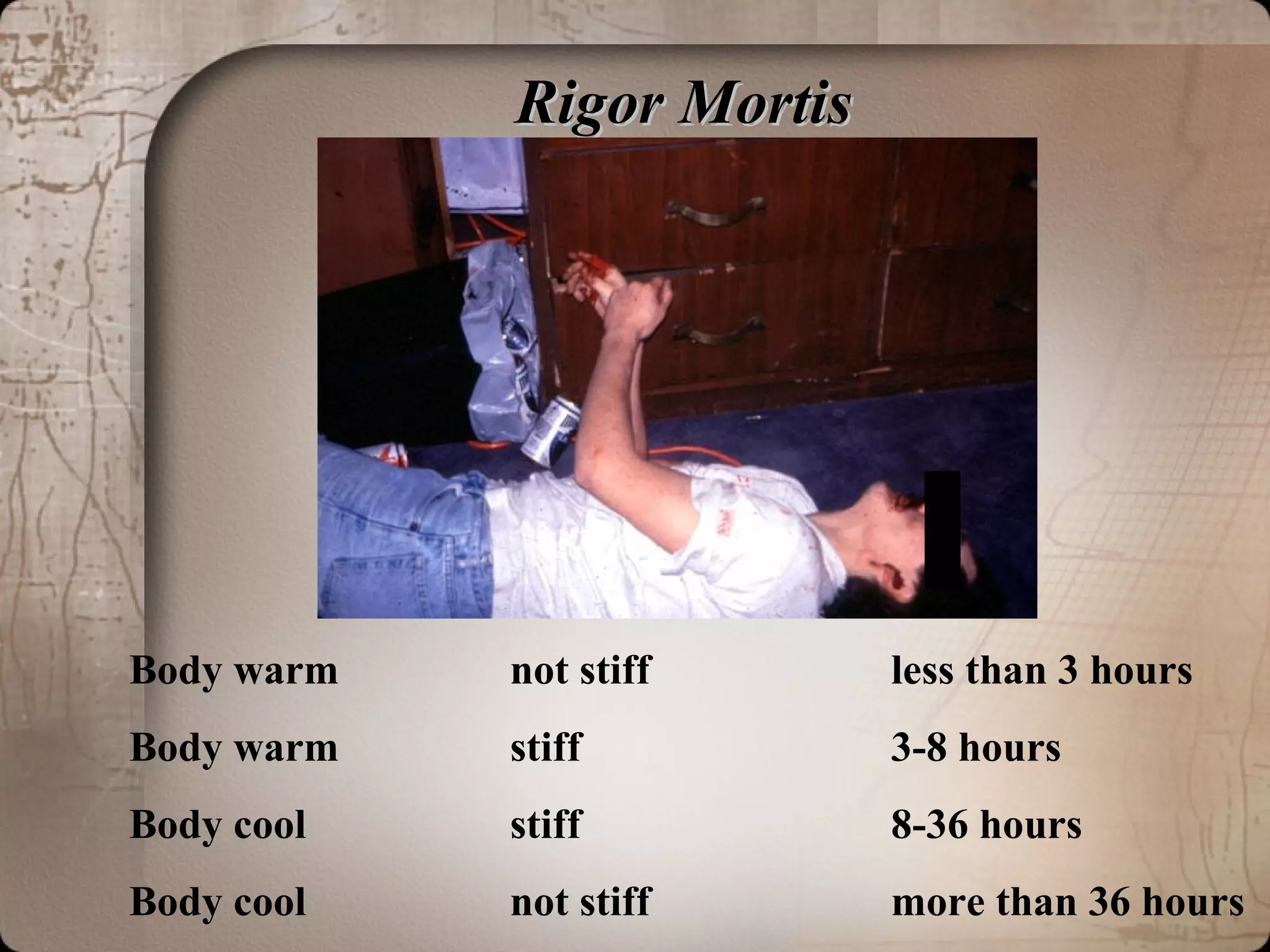
Rigor MortisRigor Mortis
Body warm not stiff less than 3 hours
Body warm stiff 3-8 hours
Body cool stiff 8-36 hours
Body cool not stiff more than 36 hours
Livor MortisLivor Mortis
DesiccationDesiccation
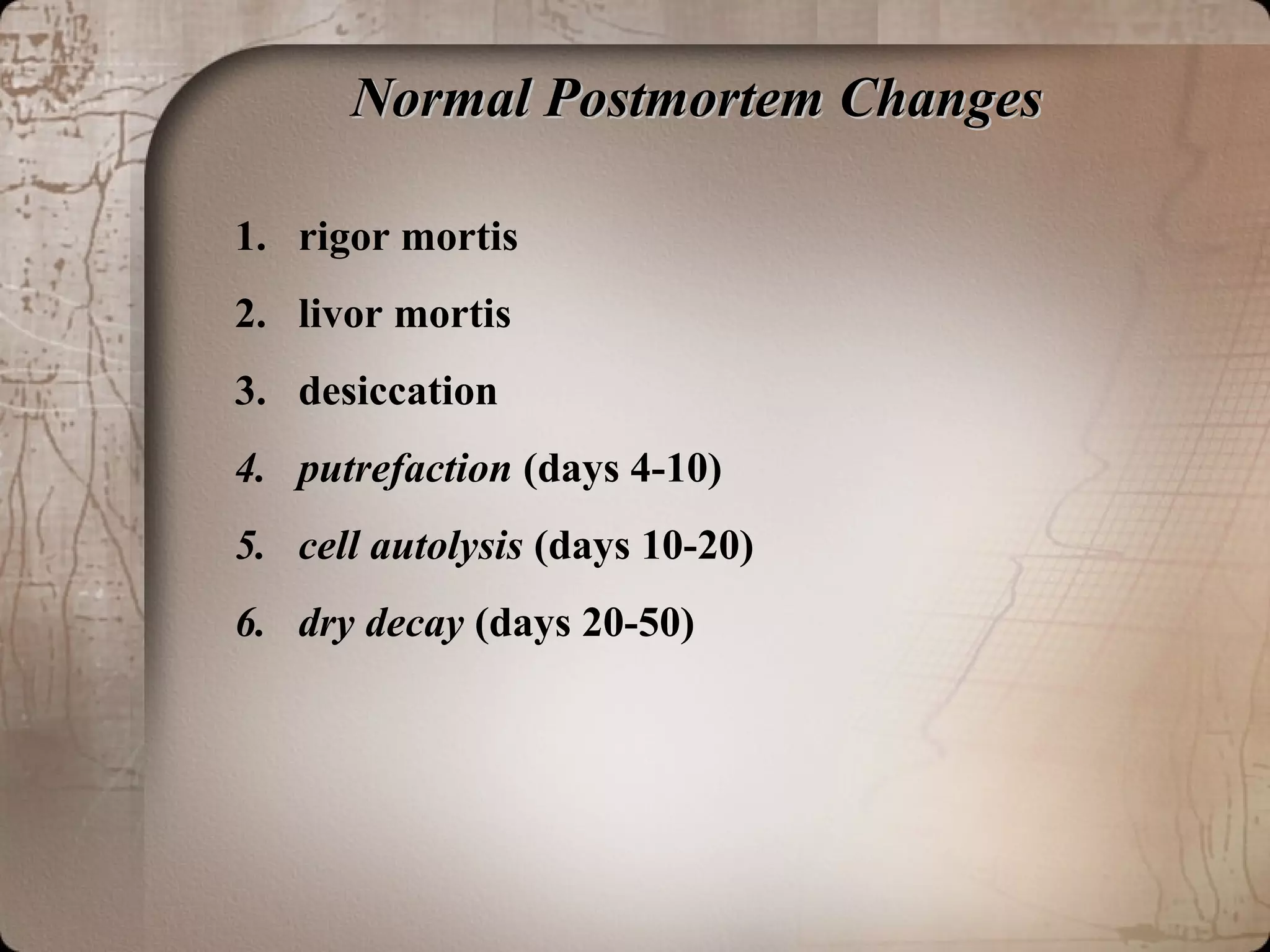
Normal Postmortem ChangesNormal Postmortem Changes
1. rigor mortis
2. livor mortis
3. desiccation
4. putrefaction (days 4-10)
5. cell autolysis (days 10-20)
6. dry decay (days 20-50)
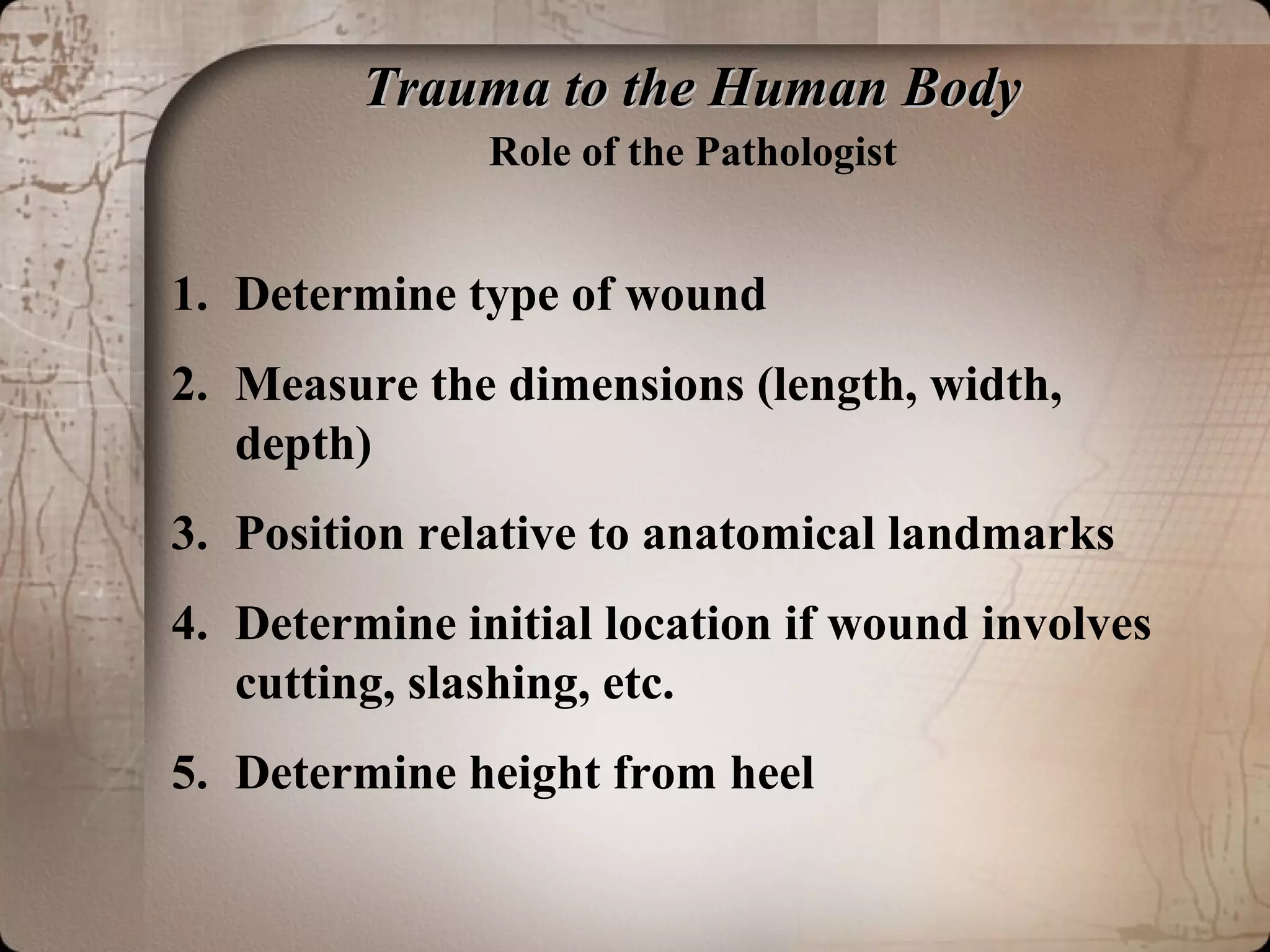
Trauma to the Human BodyTrauma to the Human Body
Role of the Pathologist
1. Determine type of wound
2. Measure the dimensions (length, width,
depth)
3. Position relative to anatomical landmarks
4. Determine initial location if wound involves
cutting, slashing, etc.
5. Determine height from heel
Types of Wounds (Trauma)Types of Wounds (Trauma)
1. Lacerations
2. Incised Wound
3. Puncture
4. Abrasion
5. Contusion
6. Gunshot
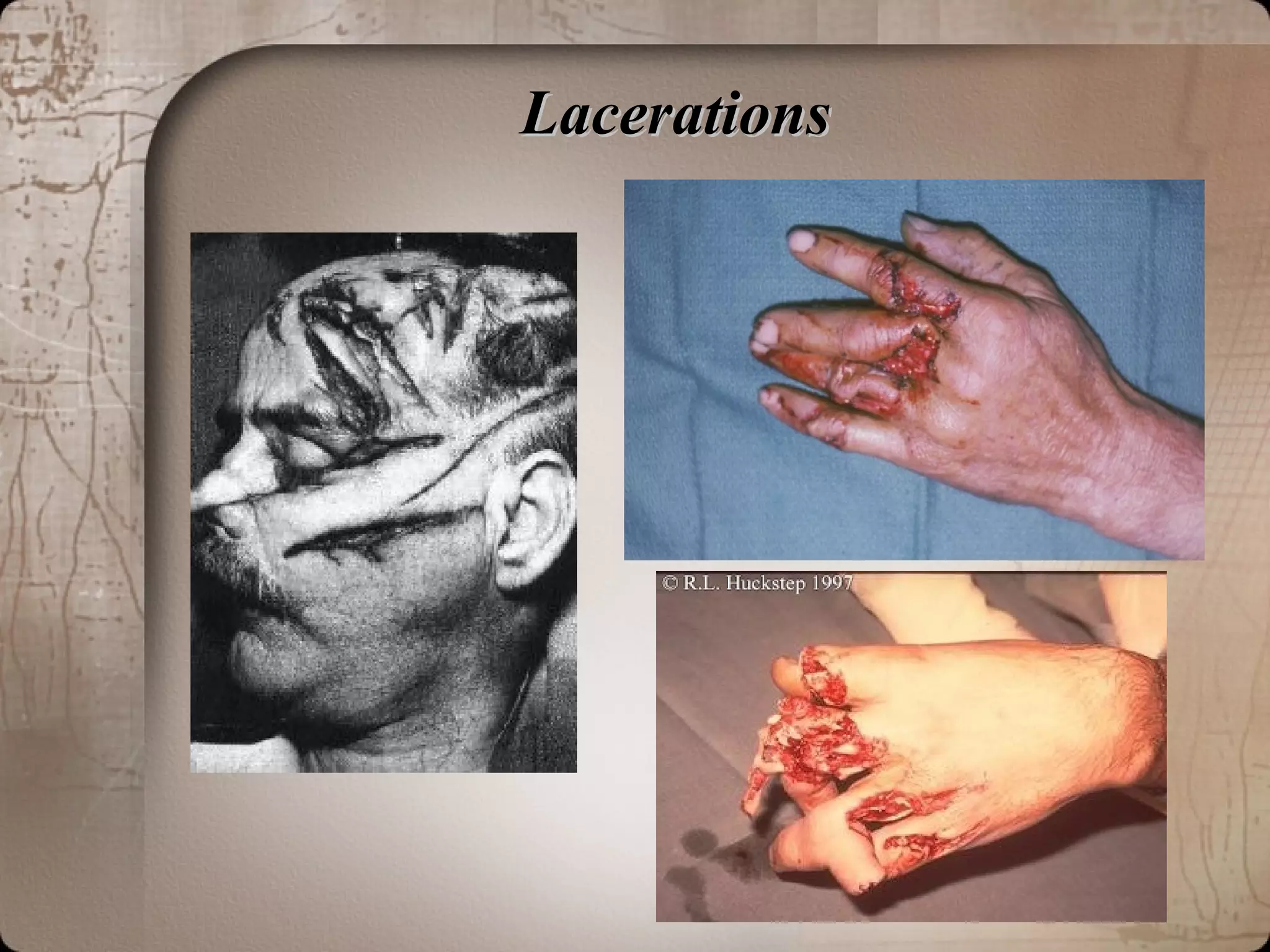
LacerationsLacerations
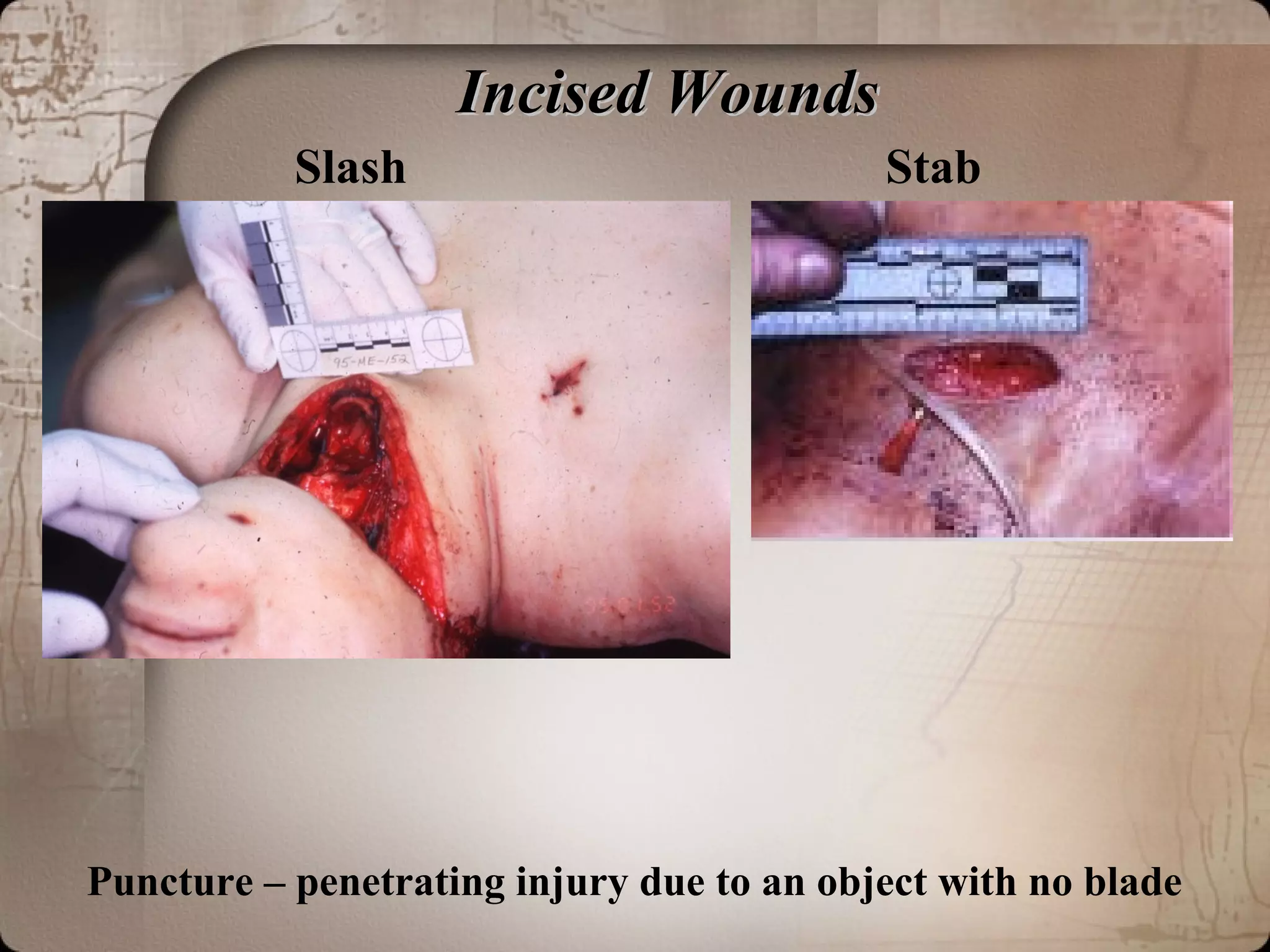
Incised WoundsIncised Wounds
Slash Stab
Puncture – penetrating injury due to an object with no blade
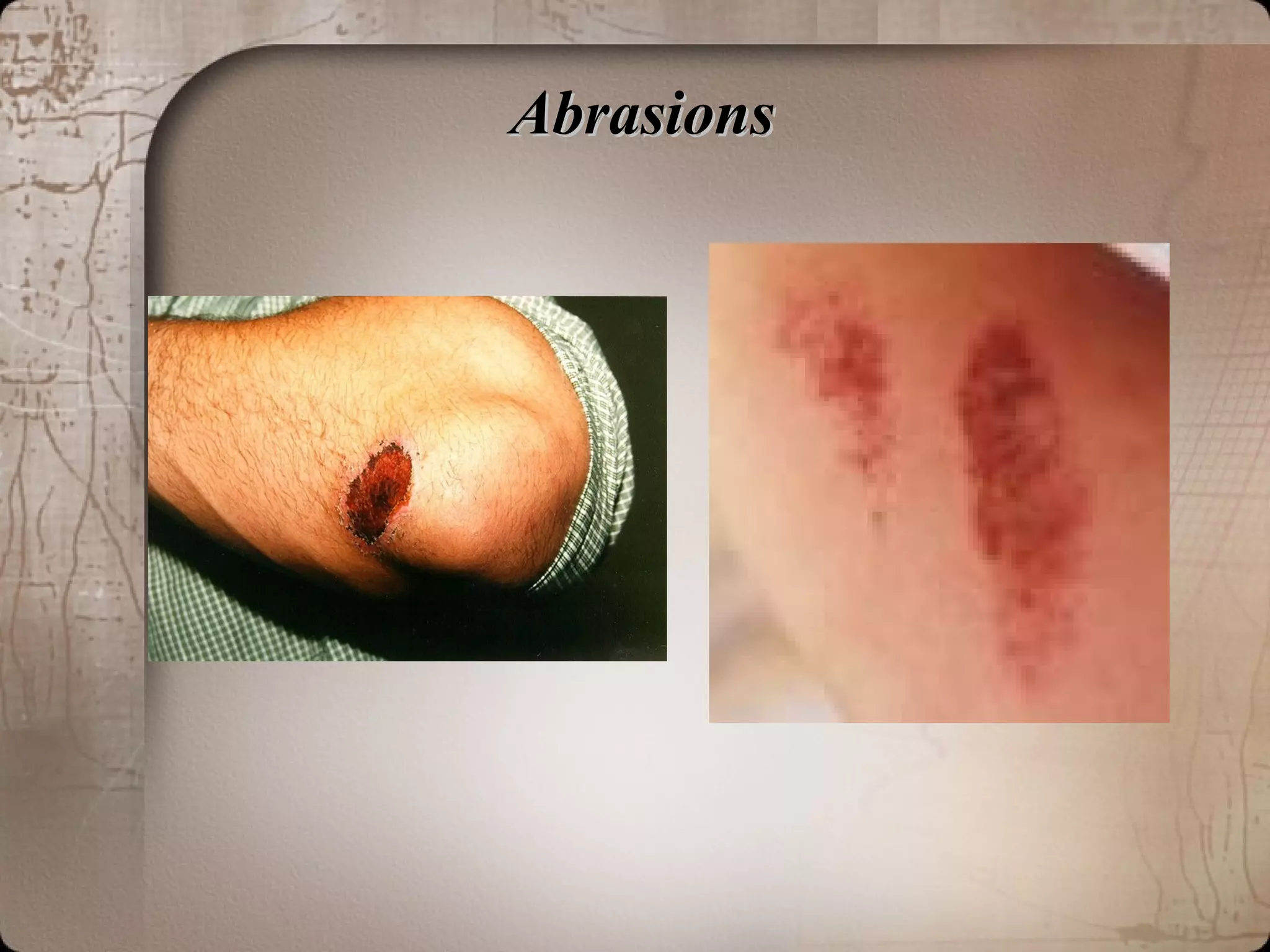
AbrasionsAbrasions
ContusionsContusions
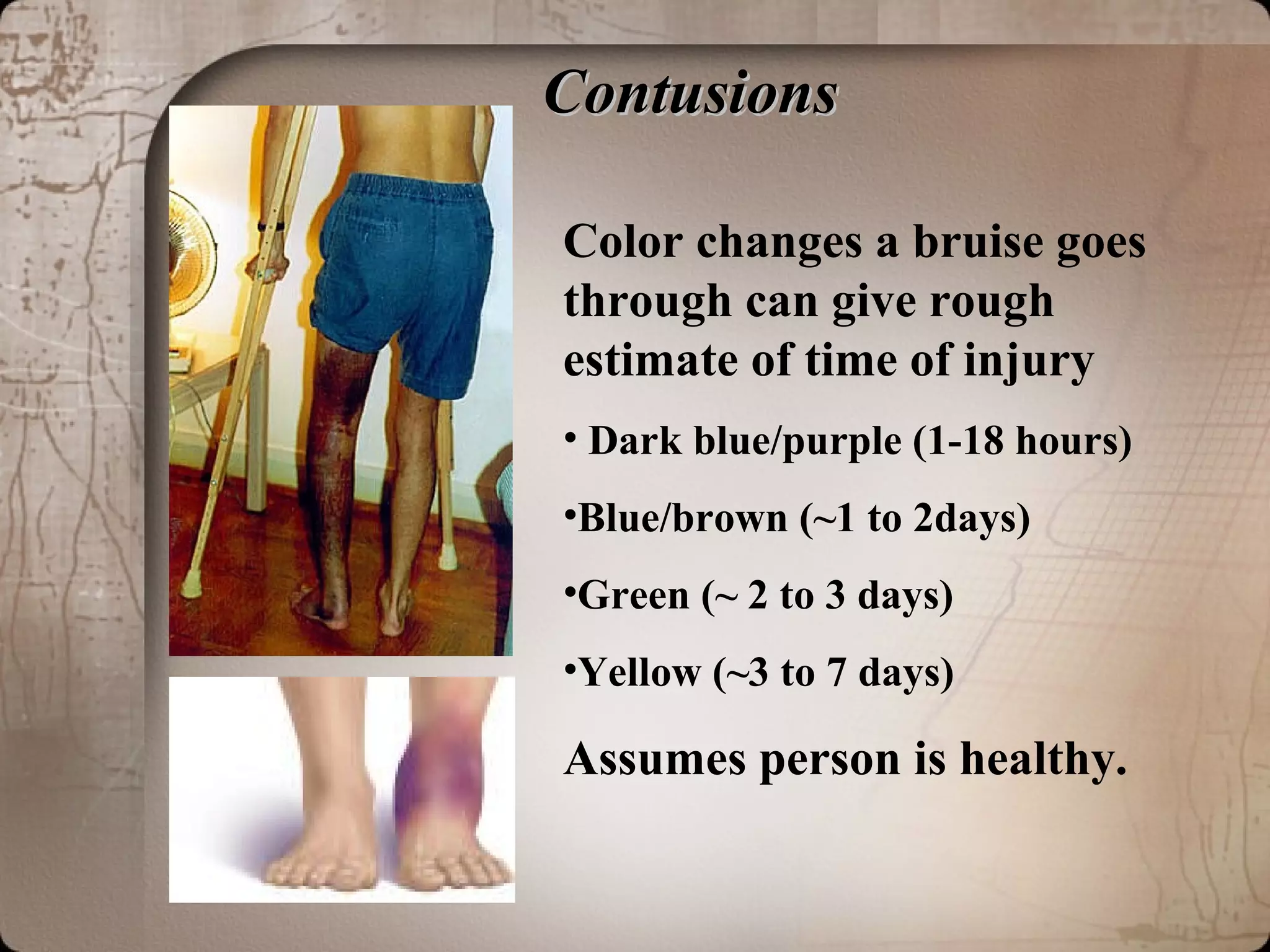
Color changes a bruise goes
through can give rough
estimate of time of injury
• Dark blue/purple (1-18 hours)
•Blue/brown (~1 to 2days)
•Green (~ 2 to 3 days)
•Yellow (~3 to 7 days)
Assumes person is healthy.
Gunshot WoundsGunshot Wounds
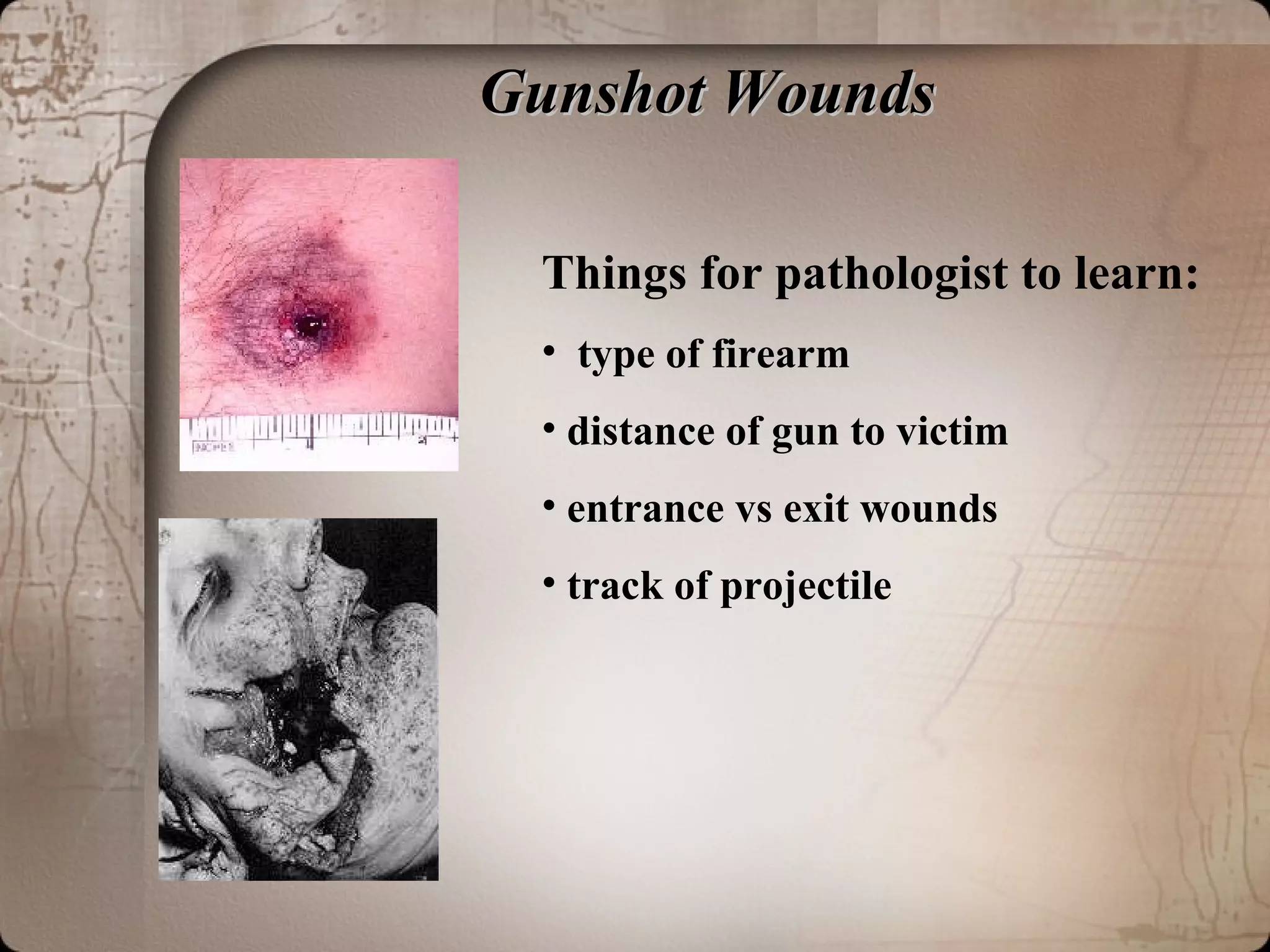
Things for pathologist to learn:
• type of firearm
• distance of gun to victim
• entrance vs exit wounds
• track of projectile
Gunshot WoundsGunshot Wounds
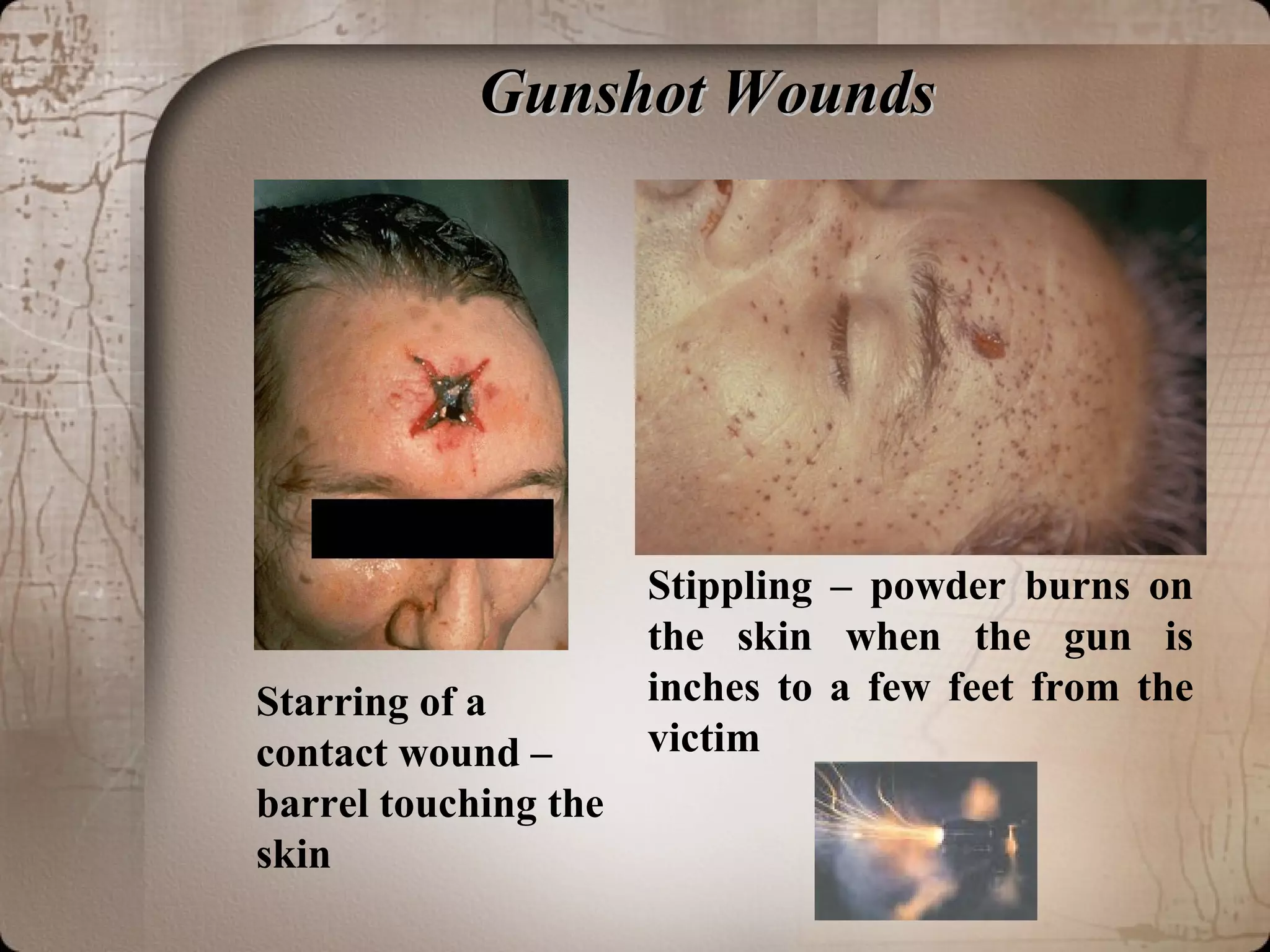
Starring of a
contact wound –
barrel touching the
skin
Stippling – powder burns on
the skin when the gun is
inches to a few feet from the
victim
Who Am I? (Who was I?)
Autopsy Procedures
AutopsyAutopsy
Steps Involved:
1. External Examination
a. measurements - length, weight
b. inspection of external surface for injury,
discoloration, “cause of death”
signs
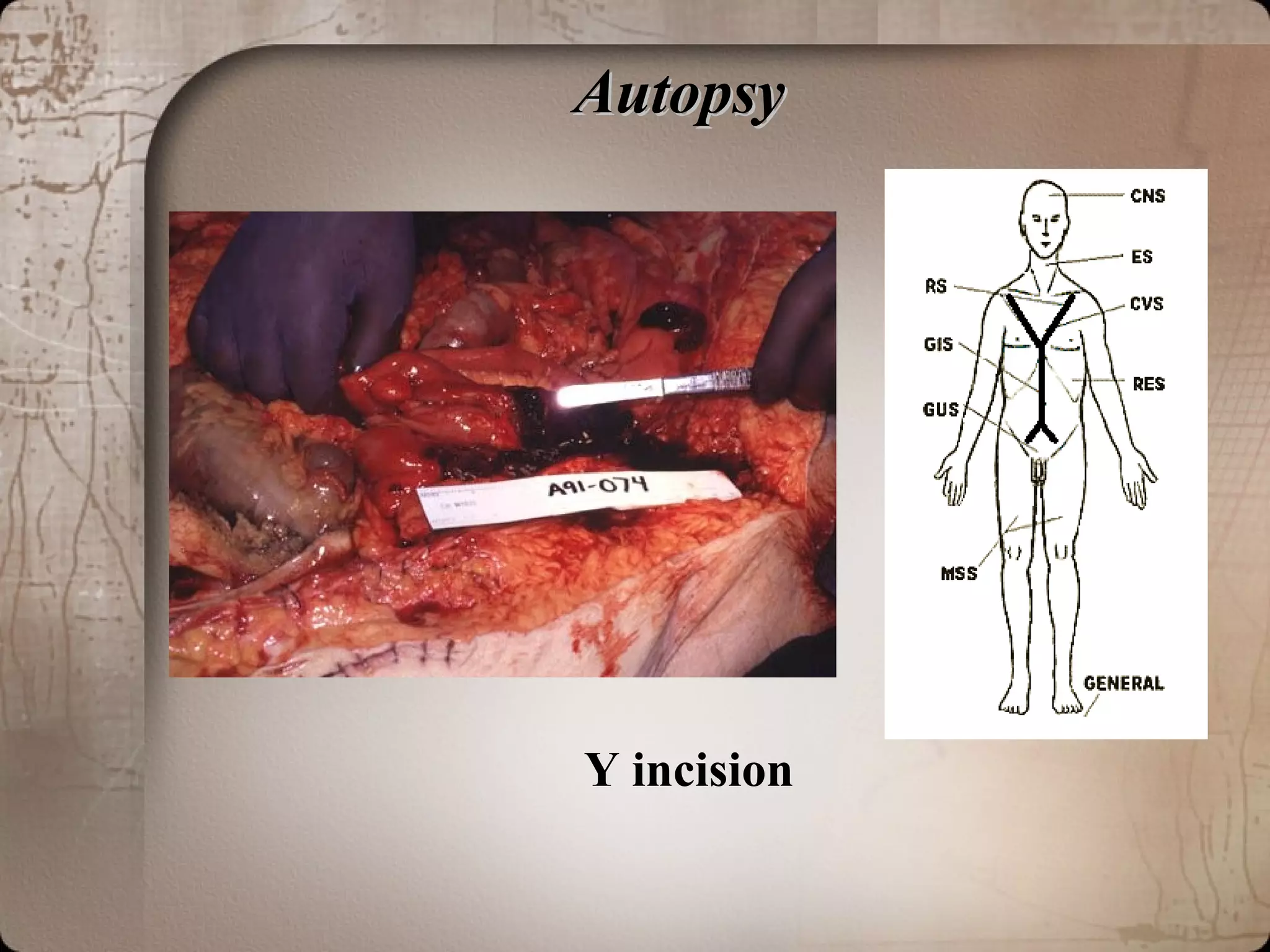
2. Opening of Trunk
a. ‘Y’ incision
b. Open rib cage
c. Condition of heart
d. Remove organs
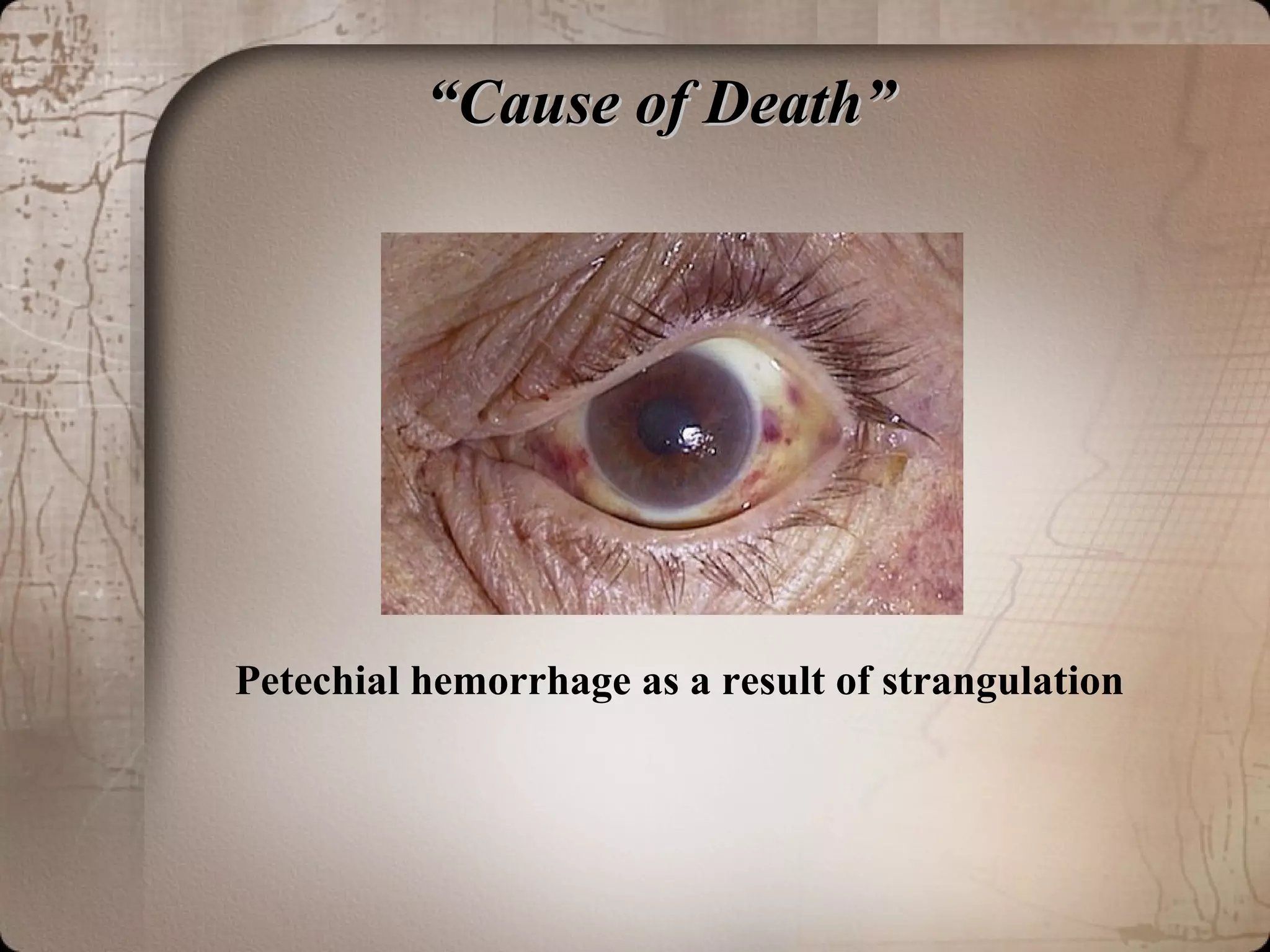
““Cause of Death”Cause of Death”
Petechial hemorrhage as a result of strangulation
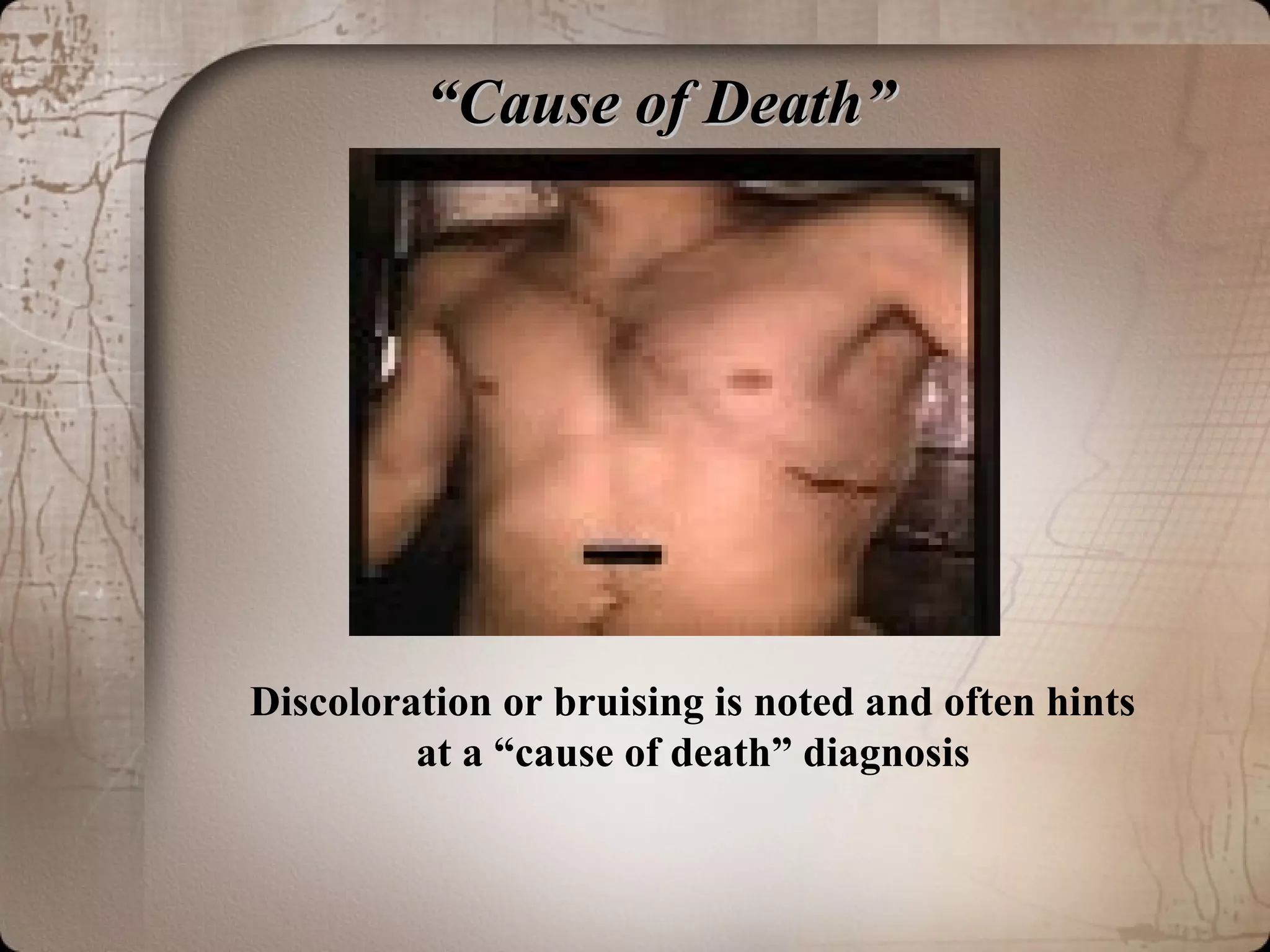
““Cause of Death”Cause of Death”
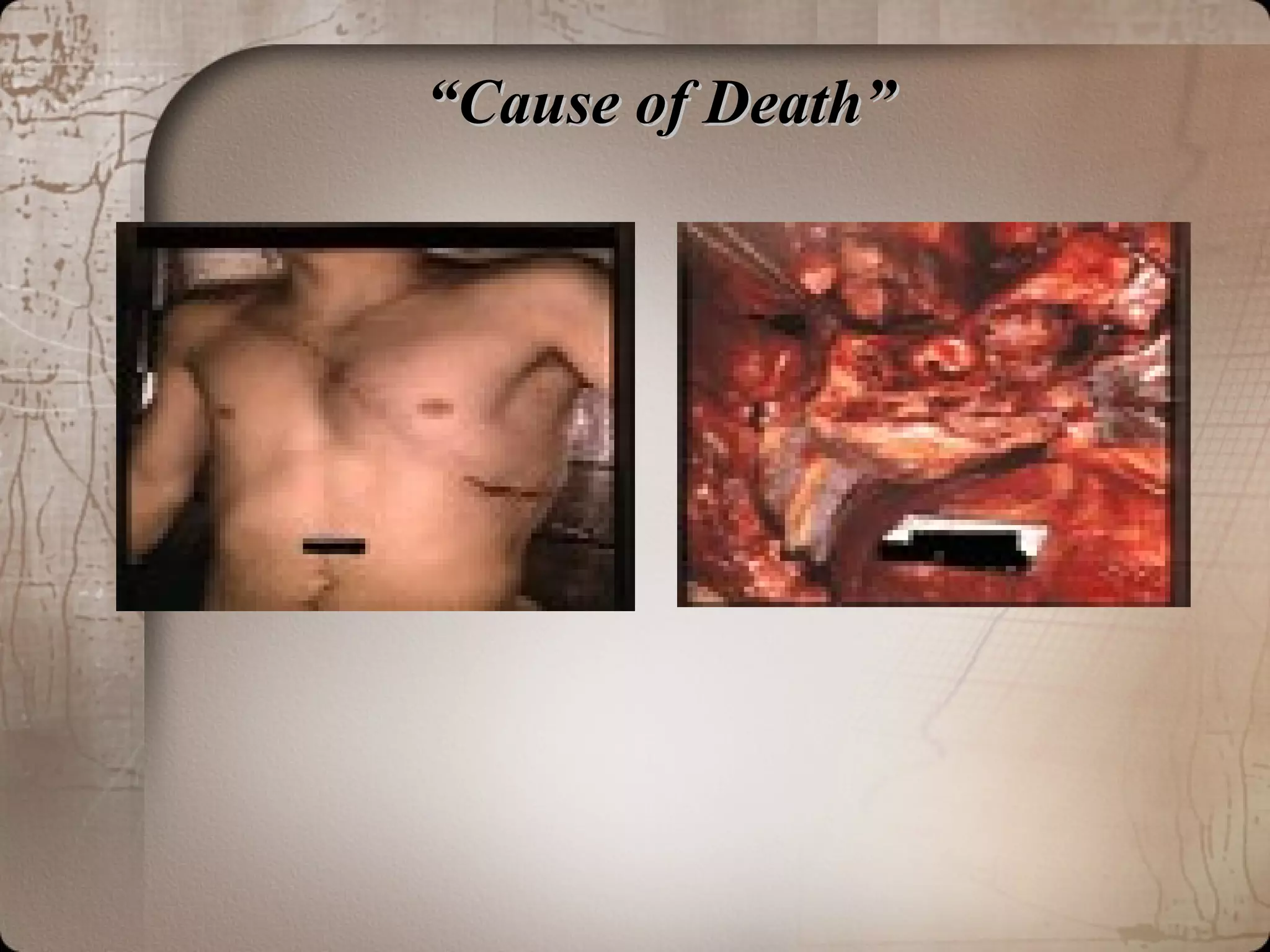
Discoloration or bruising is noted and often hints
at a “cause of death” diagnosis
AutopsyAutopsy
Steps Involved:
1. External Examination
a. measurements - length, weight
b. inspection of external surface
2. Opening of Trunk
a. ‘Y’ incision
b. Open rib cage
c. Condition of heart
d. Remove organs
AutopsyAutopsy
Y incision
AutopsyAutopsy
2d. Remove Organs:
• must cut ligaments holding organs in the body cavity
and through the trachea and rectum
• transfer organ block to a dissecting table
• examine organs in proper order (weigh, physical exam
in and out, take tissue samples, save other appropriate
samples)
heart  liver  spleen  kidneys pancreas
 bladder  genitalia  complete G.I. tract
- save postage stamp sized amount of tissue
- examine tissue under a microscope for bacteria,
disease
““Cause of Death”Cause of Death”
AutopsyAutopsy
Steps Involved:
3. Remove brain
cut around cranium using “Stryker saw”
store for 2 weeks in 10% formaldehyde
4. Closing

Forensic pathology notes by dr. armaan singh

  • 1.
    Forensic Pathology NotesForensicPathology Notes By- Dr. Armaan SinghBy- Dr. Armaan Singh - postmortem investigation of sudden or unexpected death or trauma to the living
  • 2.
    Role of theForensic PathologistRole of the Forensic Pathologist 4 broad determinations to be made: A. Cause of Death – medical diagnosis denoting disease or injury B. Mechanism of Death – altered physiology by which disease/injury produces death (arrhythmia, exsanguination) C. Manner of Death 1. Homicide 2. Suicide 3. Accidental 4. Natural Causes 5. Unknown D. Time of Death
  • 3.
    Time of DeathTimeof Death Can estimate time of death from • body temperature (algor mortis) estimate: [98.6 o F – rectal temp]/1.5 • insect action (forensic entomology) • stomach contents (stage of digestion) • last known activity (last sighting, newspaper/mail) • normal postmortem changes
  • 4.
    Time of DeathTimeof Death Entomology
  • 5.
    Time of DeathTimeof Death Can estimate time of death from • body temperature (algor mortis) estimate: [98.6 o F – rectal temp]/1.5 • insect action (forensic entomology) • stomach contents (stage of digestion) • last known activity (last sighting, newspaper/mail) • normal postmortem changes
  • 6.
    The Body FarmTheBody Farm 1 acre of land owned by the University of Tennessee
  • 7.
    Normal Postmortem ChangesNormalPostmortem Changes 1. rigor mortis 2. livor mortis 3. desiccation 4. putrefaction 5. cell autolysis (also called butyric fermentation) 6. dry decay
  • 8.
    Rigor MortisRigor Mortis Bodywarm not stiff less than 3 hours Body warm stiff 3-8 hours Body cool stiff 8-36 hours Body cool not stiff more than 36 hours
  • 9.
  • 10.
  • 11.
    Normal Postmortem ChangesNormalPostmortem Changes 1. rigor mortis 2. livor mortis 3. desiccation 4. putrefaction (days 4-10) 5. cell autolysis (days 10-20) 6. dry decay (days 20-50)
  • 12.
    Trauma to theHuman BodyTrauma to the Human Body Role of the Pathologist 1. Determine type of wound 2. Measure the dimensions (length, width, depth) 3. Position relative to anatomical landmarks 4. Determine initial location if wound involves cutting, slashing, etc. 5. Determine height from heel
  • 13.
    Types of Wounds(Trauma)Types of Wounds (Trauma) 1. Lacerations 2. Incised Wound 3. Puncture 4. Abrasion 5. Contusion 6. Gunshot
  • 14.
  • 15.
    Incised WoundsIncised Wounds SlashStab Puncture – penetrating injury due to an object with no blade
  • 16.
  • 17.
    ContusionsContusions Color changes abruise goes through can give rough estimate of time of injury • Dark blue/purple (1-18 hours) •Blue/brown (~1 to 2days) •Green (~ 2 to 3 days) •Yellow (~3 to 7 days) Assumes person is healthy.
  • 18.
    Gunshot WoundsGunshot Wounds Thingsfor pathologist to learn: • type of firearm • distance of gun to victim • entrance vs exit wounds • track of projectile
  • 19.
    Gunshot WoundsGunshot Wounds Starringof a contact wound – barrel touching the skin Stippling – powder burns on the skin when the gun is inches to a few feet from the victim
  • 20.
    Who Am I?(Who was I?) Autopsy Procedures
  • 22.
    AutopsyAutopsy Steps Involved: 1. ExternalExamination a. measurements - length, weight b. inspection of external surface for injury, discoloration, “cause of death” signs 2. Opening of Trunk a. ‘Y’ incision b. Open rib cage c. Condition of heart d. Remove organs
  • 23.
    ““Cause of Death”Causeof Death” Petechial hemorrhage as a result of strangulation
  • 24.
    ““Cause of Death”Causeof Death” Discoloration or bruising is noted and often hints at a “cause of death” diagnosis
  • 25.
    AutopsyAutopsy Steps Involved: 1. ExternalExamination a. measurements - length, weight b. inspection of external surface 2. Opening of Trunk a. ‘Y’ incision b. Open rib cage c. Condition of heart d. Remove organs
  • 26.
  • 27.
    AutopsyAutopsy 2d. Remove Organs: •must cut ligaments holding organs in the body cavity and through the trachea and rectum • transfer organ block to a dissecting table • examine organs in proper order (weigh, physical exam in and out, take tissue samples, save other appropriate samples) heart  liver  spleen  kidneys pancreas  bladder  genitalia  complete G.I. tract - save postage stamp sized amount of tissue - examine tissue under a microscope for bacteria, disease
  • 28.
  • 29.
    AutopsyAutopsy Steps Involved: 3. Removebrain cut around cranium using “Stryker saw” store for 2 weeks in 10% formaldehyde 4. Closing