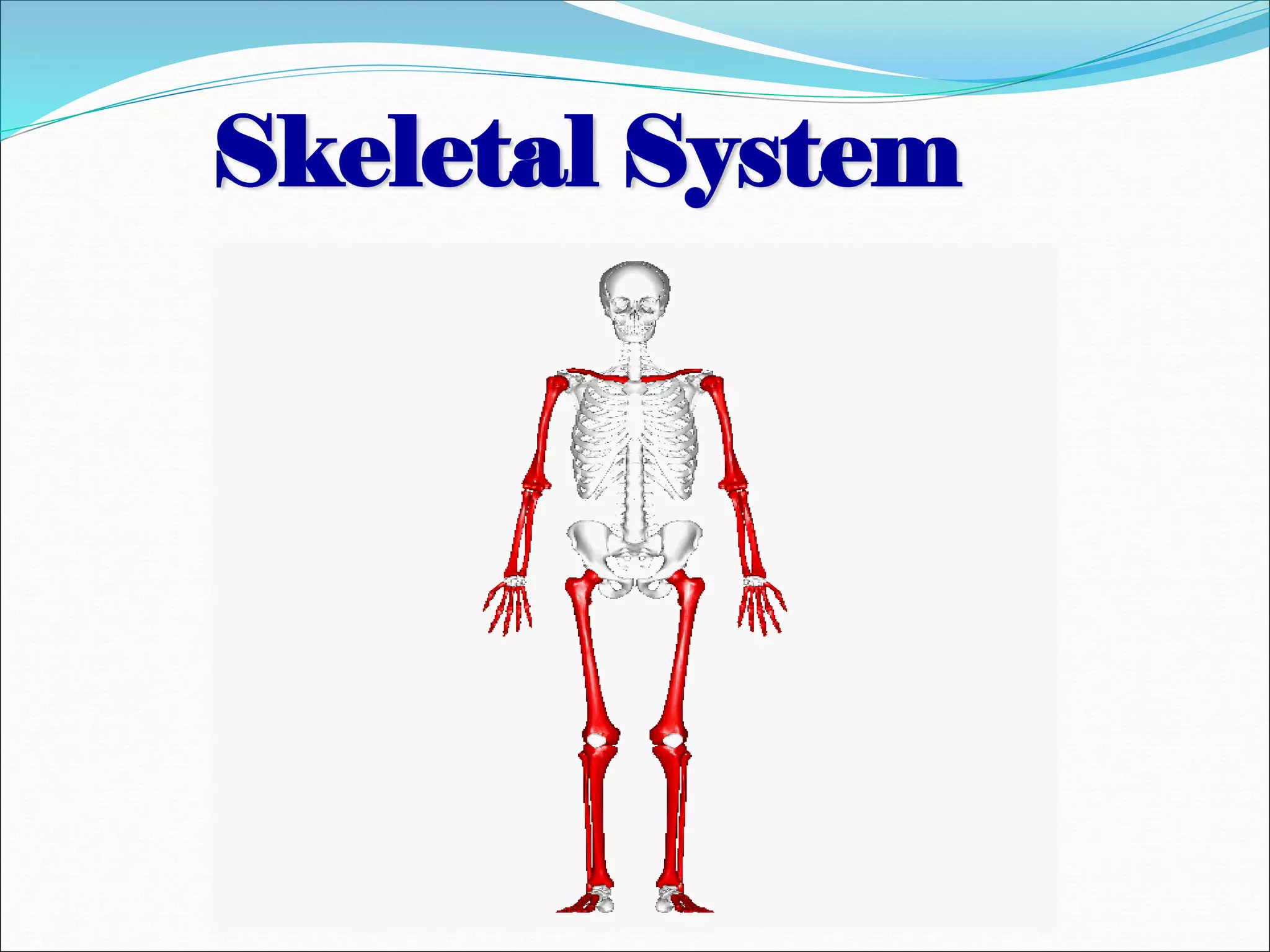
Skeletal System
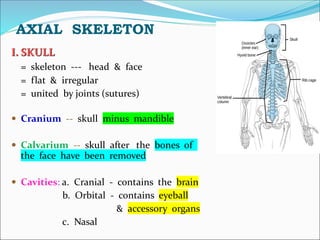
AXIAL SKELETON
I. SKULL
= skeleton --- head & face
= flat & irregular
= united by joints (sutures)
 Cranium -- skull minus mandible
 Calvarium -- skull after the bones of
the face have been removed
 Cavities: a. Cranial - contains the brain
b. Orbital - contains eyeball
& accessory organs
c. Nasal
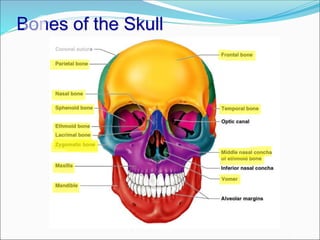
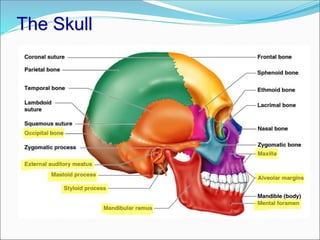
Bones of the Skull
The Skull
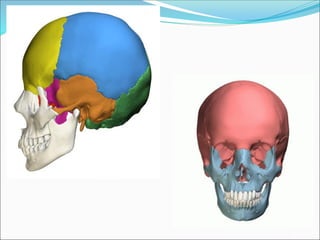
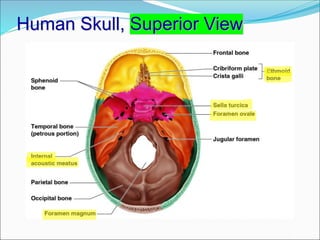
Human Skull, Superior View
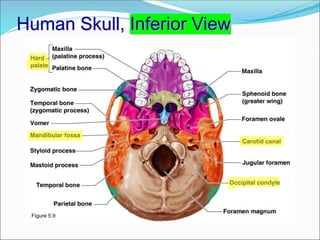
Human Skull, Inferior View
Figure 5.9
Divisions of the bones of the skull
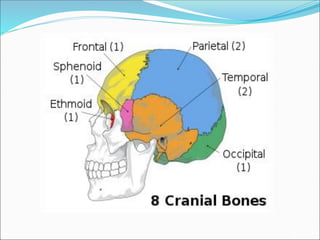
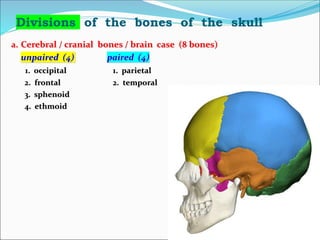
a. Cerebral / cranial bones / brain case (8 bones)
unpaired (4) paired (4)
1. occipital 1. parietal
2. frontal 2. temporal
3. sphenoid
4. ethmoid
Divisions of the bones of the skull
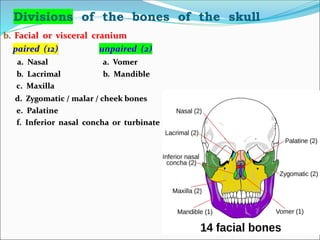
b. Facial or visceral cranium
paired (12) unpaired (2)
a. Nasal a. Vomer
b. Lacrimal b. Mandible
c. Maxilla
d. Zygomatic / malar / cheek bones
e. Palatine
f. Inferior nasal concha or turbinate
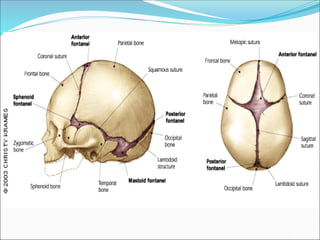
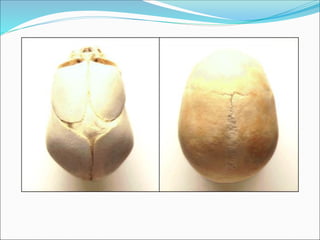
Fontanelle
= membrane filled spaces found in the skull of
newborn infants
e.g.: 1. anterior = largest
2. posterior
3. anterolateral (sphenoidal)
4. posterolateral (mastoid)
AXIAL SKELETON
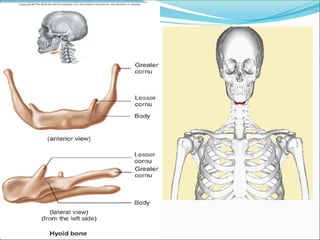
I. HYOID BONE
= small U-shape; lies in front of the neck
= base of the tongue is attached
= lies between mandible & thyroid cartilage
II. OSSICLES
= small bones of the ear
a. Stapes (stirrup) 2
b. Incus (anvil) 2
c. Malleus (hammer) 2
AXIAL SKELETON
I. VERTEBRAL COLUMN
= long, curved, slightly movable pillar
= united together by cartilage & ligaments
= 71 – 75 cm. long
= formed by series of bones -- vertebrae
FUNCTION:
1. support of the trunk
2. contains & protects the spinal cord &
nerves
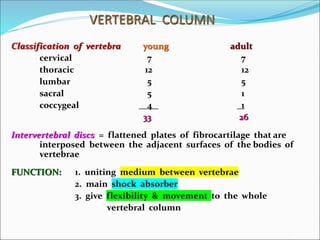
VERTEBRAL COLUMN
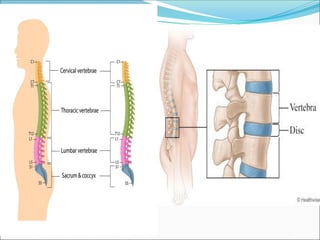
Classification of vertebra young adult
cervical 7 7
thoracic 12 12
lumbar 5 5
sacral 5 1
coccygeal 4 1
33 26
Intervertebral discs = flattened plates of fibrocartilage that are
interposed between the adjacent surfaces of the bodies of
vertebrae
FUNCTION: 1. uniting medium between vertebrae
2. main shock absorber
3. give flexibility & movement to the whole
vertebral column
VERTEBRAL COLUMN
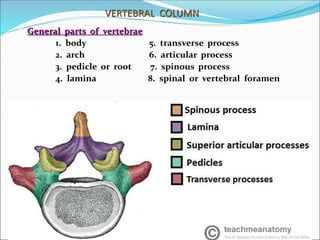
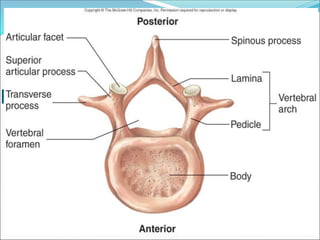
General parts of vertebrae
1. body 5. transverse process
2. arch 6. articular process
3. pedicle or root 7. spinous process
4. lamina 8. spinal or vertebral foramen
Fig. 6.18
Special characteristics of
individual vertebrae
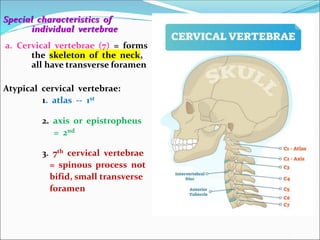
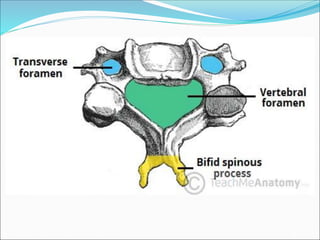
a. Cervical vertebrae (7) = forms
the skeleton of the neck,
all have transverse foramen
Atypical cervical vertebrae:
1. atlas -- 1st
2. axis or epistropheus
= 2nd
3. 7th cervical vertebrae
= spinous process not
bifid, small transverse
foramen
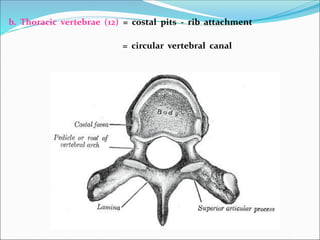
b. Thoracic vertebrae (12) = costal pits - rib attachment
= circular vertebral canal
VERTEBRAL COLUMN
Special characteristics of individual vertebrae cont’n
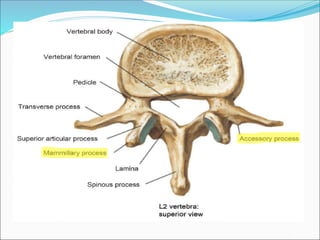
c. Lumbar vertebrae (5) = presence of mamillary & accessory processes
= triangular vertebral foramen
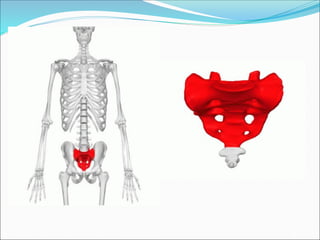
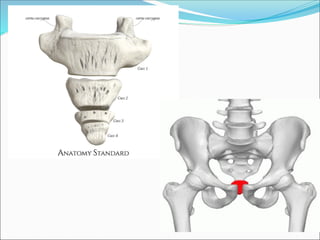
d. Sacrum = inverted triangular bone situated between hip bones
e. Coccygeal vertebrae (1) = 4 small incomplete vertebrae
fused to form the coccyx / tail bone; triangular
AXIAL SKELETON
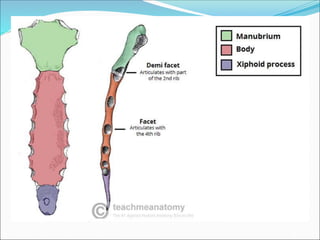
I. STERNUM (breast bone)
= flat bone, found on anterior thoracic wall
= composed of 2 plates of compact bone with a layer of spongy
bone in between containing red bone marrow
PARTS:
a. Manubrium
b. Corpus or body
c. Xiphoid process
AXIAL SKELETON
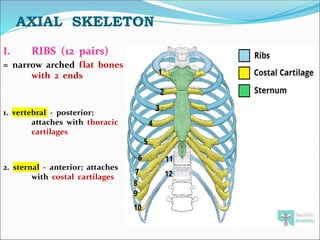
I. RIBS (12 pairs)
= narrow arched flat bones
with 2 ends
1. vertebral - posterior;
attaches with thoracic
cartilages
2. sternal - anterior; attaches
with costal cartilages
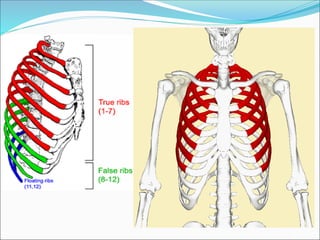
Classification of ribs:
a. Sternal or true ribs (1st to 7th)
- ribs whose costal cartilages are directly attached to sternum
b. Asternal or false ribs (8th to 12th)
- ribs whose costal cartilages are not attached directly to the
sternum but to 7th
subdivisions: 1. false rib proper - 8th, 9th, 10th ribs
2. floating or hanging ribs – 11th & 12th
APPENDICULAR SKELETON
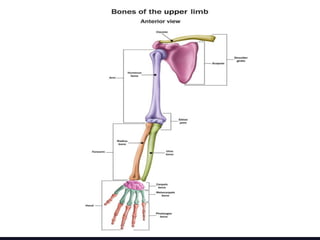
BONES of the UPPER EXTREMITY (UE)
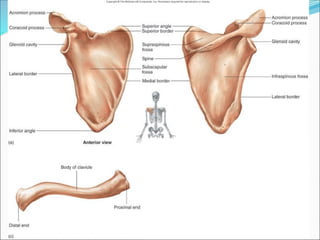
1. Clavicle (collar bone)
2. Scapula (shoulder blade) – articulates with humerus & clavicle
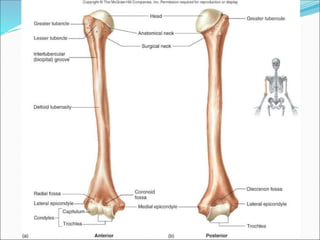
3. Humerus (arm bone) - longest & largest bone of UE
articulates with scapula (above) ,radius & ulna (below)
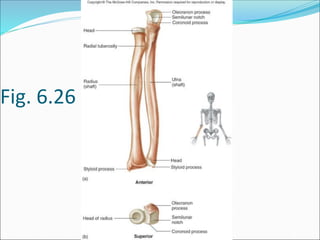
4. Radius - lateral bone of the forearm; cup- shaped head
5. Ulna - principal bone of the forearm; longer & larger than
radius
APPENDICULAR SKELETON
BONES of the UPPER EXTREMITY (UE) cont’n
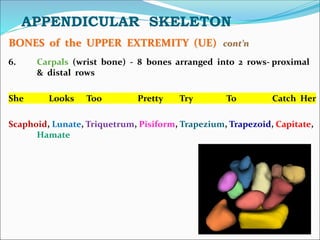
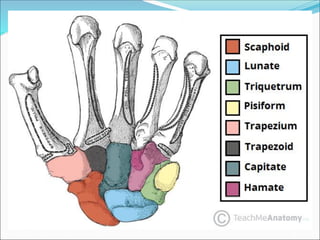
6. Carpals (wrist bone) - 8 bones arranged into 2 rows- proximal
& distal rows
She Looks Too Pretty Try To Catch Her
Scaphoid, Lunate, Triquetrum, Pisiform, Trapezium, Trapezoid, Capitate,
Hamate
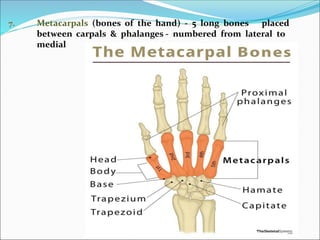
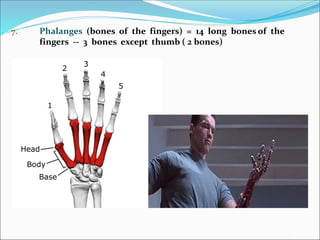
7. Metacarpals (bones of the hand) - 5 long bones placed
between carpals & phalanges - numbered from lateral to
medial
7. Phalanges (bones of the fingers) = 14 long bones of the
fingers -- 3 bones except thumb ( 2 bones)
Fig. 6.26
APPENDICULAR SKELETON
BONES of the LOWER EXTREMITY (LE)
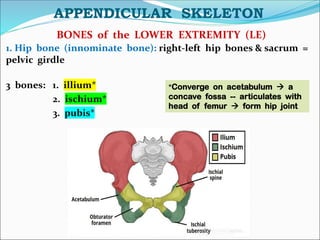
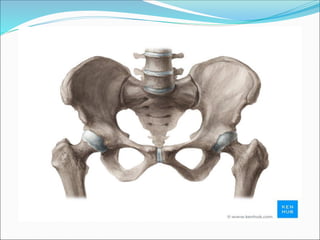
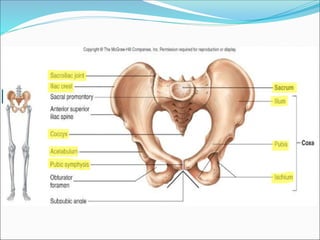
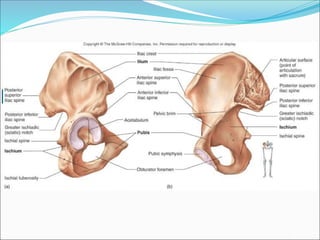
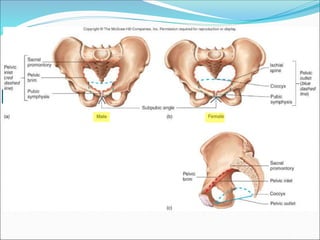
1. Hip bone (innominate bone): right-left hip bones & sacrum =
pelvic girdle
3 bones: 1. illium*
2. ischium*
3. pubis*
*Converge on acetabulum → a
concave fossa -- articulates with
head of femur → form hip joint
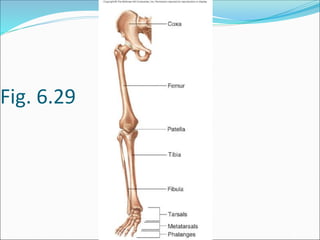
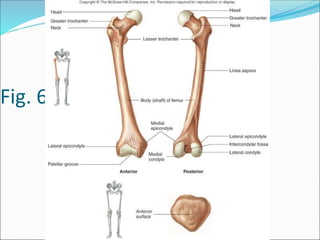
2. Femur (thigh) = longest, strongest, largest bone in the body
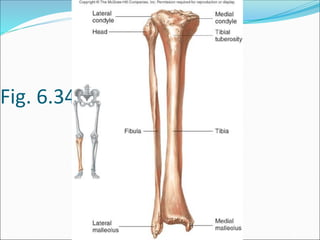
3. Tibia (shin bone) = long bone; larger of the 2 bones of the leg
4. Fibula (peroneal bone) = long slender bone placed parallel
with the tibia but located laterally
Fig. 6.29
Fig. 6.30
Fig. 6.31
Fig. 6.32
Fig. 6.33
Fig. 6.34
APPENDICULAR SKELETON
BONES of the LOWER EXTREMITY (LE) cont’n
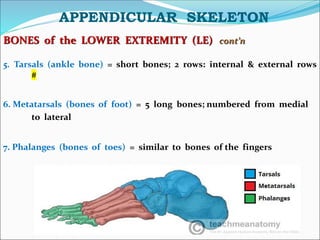
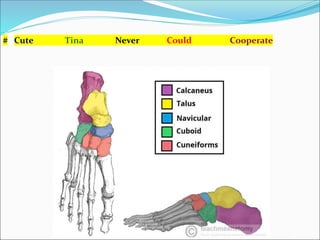
5. Tarsals (ankle bone) = short bones; 2 rows: internal & external rows
#
6. Metatarsals (bones of foot) = 5 long bones; numbered from medial
to lateral
7. Phalanges (bones of toes) = similar to bones of the fingers
# Cute Tina Never Could Cooperate
Composition of bone matrix
1) Inorganic salts: the hardness of bone result from the deposition of
high specialized chemical crystal of calcium & phosphorous called
hydroxyapatite, the process called calcification in addition to mg,
Na, sulphate and fluoride.
2) Organic substance: collagen fiber & mixture protein and poly
saccharides called ground substance, provide support and
adhesion between cellular and fibrous.
 Chondroitin and glucosamine are required for repair and
maintenance of bone and cartilage.
Bone Marrow
 Two types of marrow are present during a person’s
lifetime:
 Red marrow
 Found in virtually all bones in an infant’s or child’s body
 Functions to produce red blood cells
 Yellow marrow
 As an individual ages, red marrow is replaced by yellow marrow
 Marrow cells become saturated with fat and are no longer active in blood
cell production
Bone Marrow
 The main bones in an adult that still contain red marrow
include the ribs, bodies of the vertebrae, the humerus,
the pelvis, and the femur
 Yellow marrow can alter to red marrow during times of
decreased blood supply, such as with anemia, exposure
to radiation, and certain diseases
Microscopic Structure of Compact
Bone
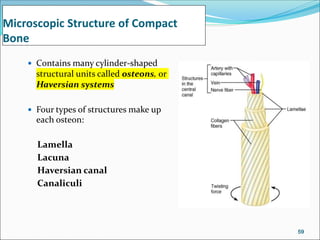
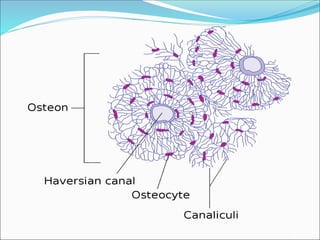
 Contains many cylinder-shaped
structural units called osteons, or
Haversian systems
 Four types of structures make up
each osteon:
Lamella
Lacuna
Haversian canal
Canaliculi
59
Microscopic Structure of
Compact Bone
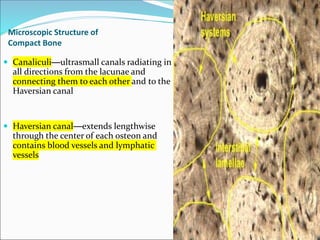
 Canaliculi—ultrasmall canals radiating in
all directions from the lacunae and
connecting them to each other and to the
Haversian canal
 Haversian canal—extends lengthwise
through the center of each osteon and
contains blood vessels and lymphatic
vessels
61
Diseases and Conditions
of the Skeletal System
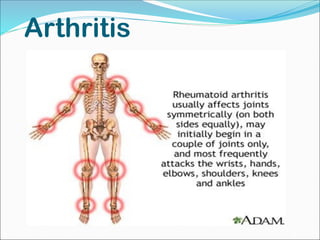
Arthritis
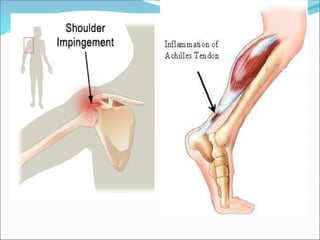
Bursitis
 Inflammation of the Bursa (fluid filled sac
surrounding the joint).
 A bursa can become inflamed from injury,
infection (rare in the shoulder), or due to an
underlying rheumatic condition.
 Bursitis is typically identified by localized
pain or swelling, tenderness, and pain with
motion of the tissues in the affected area.
Carpal Tunnel Syndrome
 Any condition that causes swelling or a change
in position of the tissue within the carpal tunnel
can squeeze and irritate the median nerve.
Irritation of the median nerve in this manner
causes tingling and numbness of the thumb,
index, and the middle fingers, a condition known
as "carpal tunnel syndrome."
Osteoporosis
 Osteoporosis is a term that means "porous
bones."
 Skeletal disease affecting women & men.
 Osteoporosis is a condition in which bones
have lost minerals especially calciumム
making them weaker, more brittle, and
susceptible to fractures (broken bones).
 Any bone in the body can be affected by
osteoporosis, but the most common places
where fractures occur are the back (spine),
hips, and wrists.
Scoliosis
 Scoliosis is an abnormal curvature of the
spine. If your child has scoliosis, the view
from behind may reveal one or more
abnormal curves.Scoliosis runs in families,
but doctors often don't know the cause.
More girls than boys have severe scoliosis.
Adult scoliosis may be a worsening of a
condition that began in childhood, but
wasn't diagnosed or treated. In other
cases, scoliosis may result from a
degenerative joint condition in the spine.
Kyphosis
 With kyphosis, your spine may look normal or
you may develop a hump. Kyphosis can
occur as a result of developmental problems;
degenerative diseases, such as arthritis of
the spine; osteoporosis with compression
fractures of the vertebrae; or trauma to the
spine. It can affect children, adolescents and
adults.
Lordosis
 A normal spine, when viewed from behind
appears straight. However, a spine affected by
lordosis shows evidence of a curvature of the
back bones (vertebrae) in the lower back area,
giving the child a "swayback" appearance.
Rickets
 Rickets is the softening and weakening of bones
in children, usually because of an extreme and
prolonged vitamin D deficiency.
 Some skeletal deformities caused by rickets may
need corrective surgery.
Scurvy
 The human body lacks the ability to
synthesize and make vitamin C and therefore
depends on exogenous dietary sources to
meet vitamin C needs. Consumption of fruits
and vegetables or diets fortified with vitamin
C are essential to avoid ascorbic acid
deficiency. Even though scurvy is
uncommon, it still occurs and can affect
adults and children who have chronic dietary
vitamin C deficiency.
Talipes Equinovarus-
“Clubfoot”
 Clubfoot is a deformity of the whole foot that
is present at birth. There are several types of
clubfoot that are jointly known as 'talipes', as
the deformity is mostly in the talus (a bone in
the ankle). The most common of the talipes is
what is known as "talipes equino varus" - it is
so common that the word clubfoot is
commonly used to refer to this. In talipes
equino varus, the child is born with the foot
pointing down and twisted inwards at the
ankle.

SKELETAL SYSTEM ANATOMY

  • 1.
  • 2.
    AXIAL SKELETON I. SKULL =skeleton --- head & face = flat & irregular = united by joints (sutures)  Cranium -- skull minus mandible  Calvarium -- skull after the bones of the face have been removed  Cavities: a. Cranial - contains the brain b. Orbital - contains eyeball & accessory organs c. Nasal
  • 4.
  • 6.
  • 7.
  • 8.
    Human Skull, InferiorView Figure 5.9
  • 9.
    Divisions of thebones of the skull a. Cerebral / cranial bones / brain case (8 bones) unpaired (4) paired (4) 1. occipital 1. parietal 2. frontal 2. temporal 3. sphenoid 4. ethmoid
  • 10.
    Divisions of thebones of the skull b. Facial or visceral cranium paired (12) unpaired (2) a. Nasal a. Vomer b. Lacrimal b. Mandible c. Maxilla d. Zygomatic / malar / cheek bones e. Palatine f. Inferior nasal concha or turbinate
  • 12.
    Fontanelle = membrane filledspaces found in the skull of newborn infants e.g.: 1. anterior = largest 2. posterior 3. anterolateral (sphenoidal) 4. posterolateral (mastoid)
  • 15.
    AXIAL SKELETON I. HYOIDBONE = small U-shape; lies in front of the neck = base of the tongue is attached = lies between mandible & thyroid cartilage
  • 17.
    II. OSSICLES = smallbones of the ear a. Stapes (stirrup) 2 b. Incus (anvil) 2 c. Malleus (hammer) 2
  • 18.
    AXIAL SKELETON I. VERTEBRALCOLUMN = long, curved, slightly movable pillar = united together by cartilage & ligaments = 71 – 75 cm. long = formed by series of bones -- vertebrae FUNCTION: 1. support of the trunk 2. contains & protects the spinal cord & nerves
  • 19.
    VERTEBRAL COLUMN Classification ofvertebra young adult cervical 7 7 thoracic 12 12 lumbar 5 5 sacral 5 1 coccygeal 4 1 33 26 Intervertebral discs = flattened plates of fibrocartilage that are interposed between the adjacent surfaces of the bodies of vertebrae FUNCTION: 1. uniting medium between vertebrae 2. main shock absorber 3. give flexibility & movement to the whole vertebral column
  • 21.
    VERTEBRAL COLUMN General partsof vertebrae 1. body 5. transverse process 2. arch 6. articular process 3. pedicle or root 7. spinous process 4. lamina 8. spinal or vertebral foramen
  • 22.
  • 23.
    Special characteristics of individualvertebrae a. Cervical vertebrae (7) = forms the skeleton of the neck, all have transverse foramen Atypical cervical vertebrae: 1. atlas -- 1st 2. axis or epistropheus = 2nd 3. 7th cervical vertebrae = spinous process not bifid, small transverse foramen
  • 25.
    b. Thoracic vertebrae(12) = costal pits - rib attachment = circular vertebral canal
  • 26.
    VERTEBRAL COLUMN Special characteristicsof individual vertebrae cont’n c. Lumbar vertebrae (5) = presence of mamillary & accessory processes = triangular vertebral foramen d. Sacrum = inverted triangular bone situated between hip bones e. Coccygeal vertebrae (1) = 4 small incomplete vertebrae fused to form the coccyx / tail bone; triangular
  • 30.
    AXIAL SKELETON I. STERNUM(breast bone) = flat bone, found on anterior thoracic wall = composed of 2 plates of compact bone with a layer of spongy bone in between containing red bone marrow PARTS: a. Manubrium b. Corpus or body c. Xiphoid process
  • 32.
    AXIAL SKELETON I. RIBS(12 pairs) = narrow arched flat bones with 2 ends 1. vertebral - posterior; attaches with thoracic cartilages 2. sternal - anterior; attaches with costal cartilages
  • 33.
    Classification of ribs: a.Sternal or true ribs (1st to 7th) - ribs whose costal cartilages are directly attached to sternum b. Asternal or false ribs (8th to 12th) - ribs whose costal cartilages are not attached directly to the sternum but to 7th subdivisions: 1. false rib proper - 8th, 9th, 10th ribs 2. floating or hanging ribs – 11th & 12th
  • 35.
    APPENDICULAR SKELETON BONES ofthe UPPER EXTREMITY (UE) 1. Clavicle (collar bone) 2. Scapula (shoulder blade) – articulates with humerus & clavicle 3. Humerus (arm bone) - longest & largest bone of UE articulates with scapula (above) ,radius & ulna (below) 4. Radius - lateral bone of the forearm; cup- shaped head 5. Ulna - principal bone of the forearm; longer & larger than radius
  • 38.
    APPENDICULAR SKELETON BONES ofthe UPPER EXTREMITY (UE) cont’n 6. Carpals (wrist bone) - 8 bones arranged into 2 rows- proximal & distal rows She Looks Too Pretty Try To Catch Her Scaphoid, Lunate, Triquetrum, Pisiform, Trapezium, Trapezoid, Capitate, Hamate
  • 40.
    7. Metacarpals (bonesof the hand) - 5 long bones placed between carpals & phalanges - numbered from lateral to medial
  • 41.
    7. Phalanges (bonesof the fingers) = 14 long bones of the fingers -- 3 bones except thumb ( 2 bones)
  • 43.
  • 44.
    APPENDICULAR SKELETON BONES ofthe LOWER EXTREMITY (LE) 1. Hip bone (innominate bone): right-left hip bones & sacrum = pelvic girdle 3 bones: 1. illium* 2. ischium* 3. pubis* *Converge on acetabulum → a concave fossa -- articulates with head of femur → form hip joint
  • 46.
    2. Femur (thigh)= longest, strongest, largest bone in the body 3. Tibia (shin bone) = long bone; larger of the 2 bones of the leg 4. Fibula (peroneal bone) = long slender bone placed parallel with the tibia but located laterally
  • 47.
  • 48.
  • 49.
  • 50.
  • 51.
  • 52.
  • 53.
    APPENDICULAR SKELETON BONES ofthe LOWER EXTREMITY (LE) cont’n 5. Tarsals (ankle bone) = short bones; 2 rows: internal & external rows # 6. Metatarsals (bones of foot) = 5 long bones; numbered from medial to lateral 7. Phalanges (bones of toes) = similar to bones of the fingers
  • 54.
    # Cute TinaNever Could Cooperate
  • 55.
    Composition of bonematrix 1) Inorganic salts: the hardness of bone result from the deposition of high specialized chemical crystal of calcium & phosphorous called hydroxyapatite, the process called calcification in addition to mg, Na, sulphate and fluoride. 2) Organic substance: collagen fiber & mixture protein and poly saccharides called ground substance, provide support and adhesion between cellular and fibrous.  Chondroitin and glucosamine are required for repair and maintenance of bone and cartilage.
  • 56.
    Bone Marrow  Twotypes of marrow are present during a person’s lifetime:  Red marrow  Found in virtually all bones in an infant’s or child’s body  Functions to produce red blood cells  Yellow marrow  As an individual ages, red marrow is replaced by yellow marrow  Marrow cells become saturated with fat and are no longer active in blood cell production
  • 57.
    Bone Marrow  Themain bones in an adult that still contain red marrow include the ribs, bodies of the vertebrae, the humerus, the pelvis, and the femur  Yellow marrow can alter to red marrow during times of decreased blood supply, such as with anemia, exposure to radiation, and certain diseases
  • 58.
    Microscopic Structure ofCompact Bone  Contains many cylinder-shaped structural units called osteons, or Haversian systems  Four types of structures make up each osteon: Lamella Lacuna Haversian canal Canaliculi 59
  • 60.
    Microscopic Structure of CompactBone  Canaliculi—ultrasmall canals radiating in all directions from the lacunae and connecting them to each other and to the Haversian canal  Haversian canal—extends lengthwise through the center of each osteon and contains blood vessels and lymphatic vessels 61
  • 61.
    Diseases and Conditions ofthe Skeletal System
  • 62.
  • 63.
    Bursitis  Inflammation ofthe Bursa (fluid filled sac surrounding the joint).  A bursa can become inflamed from injury, infection (rare in the shoulder), or due to an underlying rheumatic condition.  Bursitis is typically identified by localized pain or swelling, tenderness, and pain with motion of the tissues in the affected area.
  • 65.
    Carpal Tunnel Syndrome Any condition that causes swelling or a change in position of the tissue within the carpal tunnel can squeeze and irritate the median nerve. Irritation of the median nerve in this manner causes tingling and numbness of the thumb, index, and the middle fingers, a condition known as "carpal tunnel syndrome."
  • 66.
    Osteoporosis  Osteoporosis isa term that means "porous bones."  Skeletal disease affecting women & men.  Osteoporosis is a condition in which bones have lost minerals especially calciumム making them weaker, more brittle, and susceptible to fractures (broken bones).  Any bone in the body can be affected by osteoporosis, but the most common places where fractures occur are the back (spine), hips, and wrists.
  • 67.
    Scoliosis  Scoliosis isan abnormal curvature of the spine. If your child has scoliosis, the view from behind may reveal one or more abnormal curves.Scoliosis runs in families, but doctors often don't know the cause. More girls than boys have severe scoliosis. Adult scoliosis may be a worsening of a condition that began in childhood, but wasn't diagnosed or treated. In other cases, scoliosis may result from a degenerative joint condition in the spine.
  • 68.
    Kyphosis  With kyphosis,your spine may look normal or you may develop a hump. Kyphosis can occur as a result of developmental problems; degenerative diseases, such as arthritis of the spine; osteoporosis with compression fractures of the vertebrae; or trauma to the spine. It can affect children, adolescents and adults.
  • 69.
    Lordosis  A normalspine, when viewed from behind appears straight. However, a spine affected by lordosis shows evidence of a curvature of the back bones (vertebrae) in the lower back area, giving the child a "swayback" appearance.
  • 70.
    Rickets  Rickets isthe softening and weakening of bones in children, usually because of an extreme and prolonged vitamin D deficiency.  Some skeletal deformities caused by rickets may need corrective surgery.
  • 71.
    Scurvy  The humanbody lacks the ability to synthesize and make vitamin C and therefore depends on exogenous dietary sources to meet vitamin C needs. Consumption of fruits and vegetables or diets fortified with vitamin C are essential to avoid ascorbic acid deficiency. Even though scurvy is uncommon, it still occurs and can affect adults and children who have chronic dietary vitamin C deficiency.
  • 72.
    Talipes Equinovarus- “Clubfoot”  Clubfootis a deformity of the whole foot that is present at birth. There are several types of clubfoot that are jointly known as 'talipes', as the deformity is mostly in the talus (a bone in the ankle). The most common of the talipes is what is known as "talipes equino varus" - it is so common that the word clubfoot is commonly used to refer to this. In talipes equino varus, the child is born with the foot pointing down and twisted inwards at the ankle.