ANATOMY AND PHYSIOLOGY OF
LYMPHATIC SYSTEM
BY:DIPALI HARKHANI
WHAT IS LYMPHATIC SYSTEM?
• The lymphatic system is part of
the circulatory system and an important
part of the immune system, comprising a
network of lymphatic vessels that carry a
clear fluid called lymph (from
Latin, lympha meaning
"water”)directionally towards the heart.
COMPOSITION OF LYMPH
• The composition of lymph is similar to
that of plasma but the constituents have
some additional substances that are too
large to pass through blood capillary
walls
• Ex.macroparticles from damaged area
• Dameged cells by disease and bacteria.
LYMPH VESSELS
• These originate as blind end tubes in the interstitial
spaces.
• Structurely,they are same as blood capillaries.
• Their walls are more permeable to all interstitial fluid
including proteins and cell debris.
• The capillaries joint to form larger lypmph vessels.
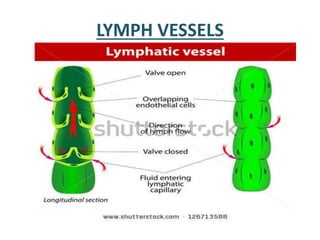
• Lymph vessels have numerous cup shaped valves that
prevent back flow of movements of lymph in vessels.
• Lymph vessels join together to form two larger ducts
• (i) The Thoracic duct
• (ii) The right Lymphatic duct
LYMPH VESSELS
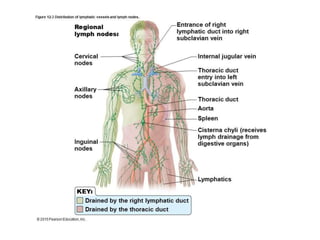
(i) THE THORACIC DUCT
• What is duct?
A duct is a circumscribed channel leading from
an organ.
Length-40cm
Ascends through the diaphragm and passes
upwards in the thoracic cavity.
it drains Lymph from
Both legs
The pelvicabdominal cavities
Left half of the The Thorax
Head & Neck
The Left upper Limbs.
(ii) THE RIGHT LYMPHATIC DUCT
• IT LIES IN THE ROOT OF THE NECK AND OPEN
INTO RIGHT SUBCLAVIAN VEIN.
• IT DRAINS LYMPH FROM
RIGHT HALF OF THE THORAX
NECK
RIGHT UPPER LIMB
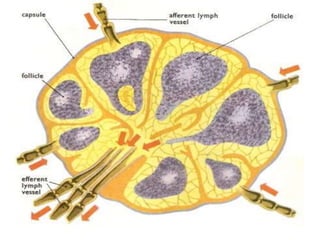
LYMPH NODES
• All the small and medium size lymph vessels open
into lymph nodes.
• The size of a node arise from pin head to the largest
is about the size of an almond
• Structure
• Has a fibrous capsule,dips down into the node
forming trabecula that divide the node into
compartments.
• Below the capsule is sub capsular substance.
• The outer portion is called cortex.
• The inner portion is called medulla.
LYMPH NODES
• It has tightly packed.
lymphocytes,macrophages and plasma cells.
• Functions
• Phagocytic action.
• Production of antibodies.
• Enlargement of lymph nodes,when the area of
drainage is infected.
• Activate T and B lymphocytes.
• Filtration of lymph.
LYMPHATIC TISSUE OR LYMPHATIC
ORGANS
• The lymphatic organs are found in a number of situations
n the body.
• such as
(i)Tonsils
(ii)Spleen
(iii)Bone Marrow
(iv)Thymus Gland
(i)Lonsils
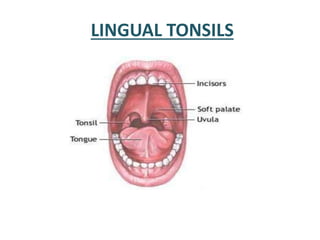
Lingual Tonsils are the paired and lie at the base of the
tongue.
LINGUAL TONSILS
(ii)SPLEEN
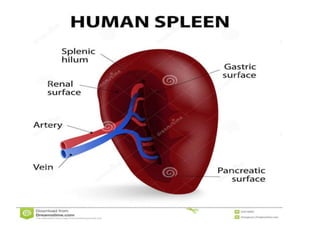
• The Spleen is formed partly by lymphatic system.
• Location-left hypochondriac region
• Length-12 cm
• Width-7 cm
• Thick-2.5 cm
• Shape-oval
• Relations-
Posteriorly & Superiorly- Diaphragm
Inferiorly-Left colic flexure of large intestine
Anteriorly-Fundus of the stomach
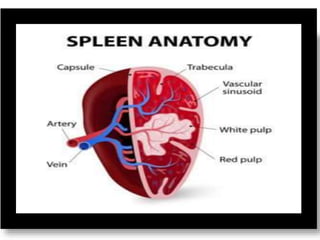
STRUCTURE OF SPLEEN
• Enclosed in peritoneum.
• Covered by a capsule.
• The trabaculae subdivides the structure into lobules.
• The spleen don’t has no afferent lymphatic vessels.
• So it does not filter lymph.
• Spleen consists red and white pulp.
• Blood supply
• Splenic artery
• Splenic vein
• Lymphatic vessels
• Nerves
FUNCTIONS OF SPLEEN
• Phagocytosis of Bacteria
• Break down of RBC.
• Production of Antibodies.
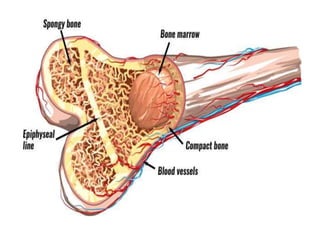
(iii)BONE MARROW
• The Red Bone Marrow is a key element of
the lymphatic system,
• Being one of the primary lymphoid organs that
generate lymphocytes from immature
hematopoietic progenitor cells.
• The bone marrow and Thymus constitute the
primary lymphoid tissues involved in the
production and early selection of lymphocytes.
• Furthermore, bone marrow performs a valve-like
function to prevent the backflow of lymphatic
fluid in the lymphatic system.
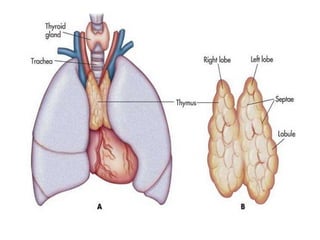
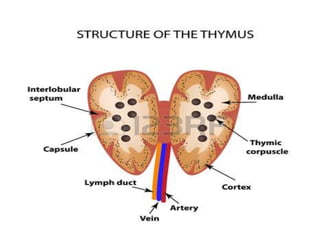
(iv) THYMUS GLAND
• Weight-15 gms
Relations-
Anteriorly-Sternum.
Posteriorly –Aortic arch.
Superiorly- Root of neck.
Inferiorly-Heart.
Laterally-Lungs.
Lobes- two
Each lobule has aggregation of lymphocytes.
The cortex is composed of aggregation of lymphocytes.
Medulla contains less lymphocytes.
The Thymus gland develops mature T lymphocytes.
BLOOD SUPPLY TO THE THYMUS GLAND
• Inferior thyroid artery.
• Internal thoracic artery.
• Nerves derived from vagus nerve.
• Functions
• Activation of T-lymphocytes
• Production of antibodies.
• Production of Thymosin hormone.
[Thymosins are small proteins present in many
animal tissues. they are named thymosins because
they were originally isolated from the thymus]

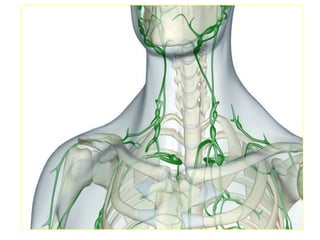
Anatomy of Lymphatic system

  • 1.
    ANATOMY AND PHYSIOLOGYOF LYMPHATIC SYSTEM BY:DIPALI HARKHANI
  • 2.
    WHAT IS LYMPHATICSYSTEM? • The lymphatic system is part of the circulatory system and an important part of the immune system, comprising a network of lymphatic vessels that carry a clear fluid called lymph (from Latin, lympha meaning "water”)directionally towards the heart.
  • 3.
    COMPOSITION OF LYMPH •The composition of lymph is similar to that of plasma but the constituents have some additional substances that are too large to pass through blood capillary walls • Ex.macroparticles from damaged area • Dameged cells by disease and bacteria.
  • 4.
    LYMPH VESSELS • Theseoriginate as blind end tubes in the interstitial spaces. • Structurely,they are same as blood capillaries. • Their walls are more permeable to all interstitial fluid including proteins and cell debris. • The capillaries joint to form larger lypmph vessels. • Lymph vessels have numerous cup shaped valves that prevent back flow of movements of lymph in vessels. • Lymph vessels join together to form two larger ducts • (i) The Thoracic duct • (ii) The right Lymphatic duct
  • 5.
  • 6.
    (i) THE THORACICDUCT • What is duct? A duct is a circumscribed channel leading from an organ. Length-40cm Ascends through the diaphragm and passes upwards in the thoracic cavity. it drains Lymph from Both legs The pelvicabdominal cavities Left half of the The Thorax Head & Neck The Left upper Limbs.
  • 7.
    (ii) THE RIGHTLYMPHATIC DUCT • IT LIES IN THE ROOT OF THE NECK AND OPEN INTO RIGHT SUBCLAVIAN VEIN. • IT DRAINS LYMPH FROM RIGHT HALF OF THE THORAX NECK RIGHT UPPER LIMB
  • 9.
    LYMPH NODES • Allthe small and medium size lymph vessels open into lymph nodes. • The size of a node arise from pin head to the largest is about the size of an almond • Structure • Has a fibrous capsule,dips down into the node forming trabecula that divide the node into compartments. • Below the capsule is sub capsular substance. • The outer portion is called cortex. • The inner portion is called medulla.
  • 12.
    LYMPH NODES • Ithas tightly packed. lymphocytes,macrophages and plasma cells. • Functions • Phagocytic action. • Production of antibodies. • Enlargement of lymph nodes,when the area of drainage is infected. • Activate T and B lymphocytes. • Filtration of lymph.
  • 13.
    LYMPHATIC TISSUE ORLYMPHATIC ORGANS • The lymphatic organs are found in a number of situations n the body. • such as (i)Tonsils (ii)Spleen (iii)Bone Marrow (iv)Thymus Gland (i)Lonsils Lingual Tonsils are the paired and lie at the base of the tongue.
  • 14.
  • 15.
    (ii)SPLEEN • The Spleenis formed partly by lymphatic system. • Location-left hypochondriac region • Length-12 cm • Width-7 cm • Thick-2.5 cm • Shape-oval • Relations- Posteriorly & Superiorly- Diaphragm Inferiorly-Left colic flexure of large intestine Anteriorly-Fundus of the stomach
  • 16.
    STRUCTURE OF SPLEEN •Enclosed in peritoneum. • Covered by a capsule. • The trabaculae subdivides the structure into lobules. • The spleen don’t has no afferent lymphatic vessels. • So it does not filter lymph. • Spleen consists red and white pulp. • Blood supply • Splenic artery • Splenic vein • Lymphatic vessels • Nerves
  • 19.
    FUNCTIONS OF SPLEEN •Phagocytosis of Bacteria • Break down of RBC. • Production of Antibodies.
  • 20.
    (iii)BONE MARROW • TheRed Bone Marrow is a key element of the lymphatic system, • Being one of the primary lymphoid organs that generate lymphocytes from immature hematopoietic progenitor cells. • The bone marrow and Thymus constitute the primary lymphoid tissues involved in the production and early selection of lymphocytes. • Furthermore, bone marrow performs a valve-like function to prevent the backflow of lymphatic fluid in the lymphatic system.
  • 22.
    (iv) THYMUS GLAND •Weight-15 gms Relations- Anteriorly-Sternum. Posteriorly –Aortic arch. Superiorly- Root of neck. Inferiorly-Heart. Laterally-Lungs. Lobes- two Each lobule has aggregation of lymphocytes. The cortex is composed of aggregation of lymphocytes. Medulla contains less lymphocytes. The Thymus gland develops mature T lymphocytes.
  • 25.
    BLOOD SUPPLY TOTHE THYMUS GLAND • Inferior thyroid artery. • Internal thoracic artery. • Nerves derived from vagus nerve. • Functions • Activation of T-lymphocytes • Production of antibodies. • Production of Thymosin hormone. [Thymosins are small proteins present in many animal tissues. they are named thymosins because they were originally isolated from the thymus]