Skeletal system
Miss. Sheetal Patil M. Pharm
Rani Chennamma College Of Pharmacy,
Belagavi
SKELATAL SYSTEM
 Bone tissues makes up about 18% of the total human body weight.
 The skeletal system supports and protects the body while giving it shape and
form.
 Osteology: It is the branch of science that deals with the study of the skeletal
system, their structure and functions.
 Skeletal System Composed Of
 Bones
 Cartilage
 Joints
 Ligaments
 Dense connective tissues
 Adipose tissue
 Functions Of Skeletal System
1. Support: Hard framework that supports and the soft organs of the body and
provide attachment for the tendons of skeletal muscles.
2. Protection: Skeleton protects vital internal organs from injury, e.g. cranial
ones protects the brain.
3. Movement: Allows for muscle attachment to bones and brings about
movement.
4. Storage: Yellow bone marrow consist of adipose cells, which stores
triglycerides.
5. Blood Cell Formation: The bone marrow is responsible for blood cell
production (RBC, WBC and platelets) a process is called hemopoiesis.
6. Mineral Homeostasis: Bone store several minerals like calcium and
phosphourus which strengthen the bone.
 Classification Of Bone Based On Shape
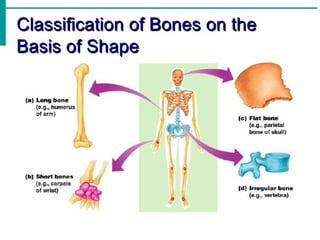
 Bones can be classified into five types based on shape:
1. Long
2. Short
3. Flat
4. Irregular
5. Sesamoid
6. Long Bones
 Greater length than width and are slightly curved for strength.
 e.g., Femur, tibia, fibula, humerus, ulna, radius, phalanges.
2. Short bones
 Cube-shaped and are nearly equal in length and width.
 e.g., Carpal, tarsal
3. Flat bones
 Thin and composed of two nearly parallel plates of compact bone tissue
enclosing a layer of spongy bone tissue.
 e.g., Cranial, sternum, ribs, scapulae.
4. Irregular bones
 Complex shapes and cannot be grouped into any of the previous categories.
 E.g., Vertebrae, hip bones, some facial bones, calcaneus.
5. Sesamoid bones
 Protect tendons from excessive wear and tear.
 e.g., Patellae, foot, hand.
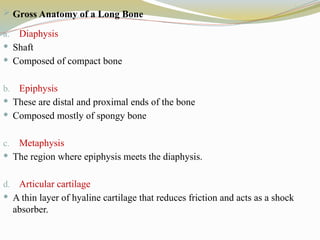
 Gross Anatomy of a Long Bone
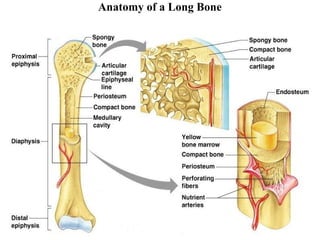
a. Diaphysis
 Shaft
 Composed of compact bone
b. Epiphysis
 These are distal and proximal ends of the bone
 Composed mostly of spongy bone
c. Metaphysis
 The region where epiphysis meets the diaphysis.
d. Articular cartilage
 A thin layer of hyaline cartilage that reduces friction and acts as a shock
absorber.
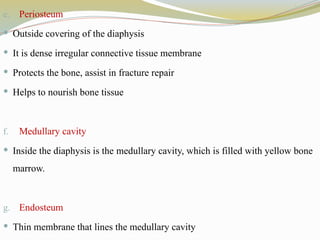
e. Periosteum
 Outside covering of the diaphysis
 It is dense irregular connective tissue membrane
 Protects the bone, assist in fracture repair
 Helps to nourish bone tissue
f. Medullary cavity
 Inside the diaphysis is the medullary cavity, which is filled with yellow bone
marrow.
g. Endosteum
 Thin membrane that lines the medullary cavity
Anatomy of a Long Bone
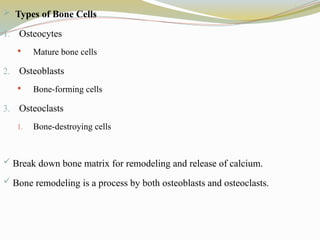
 Types of Bone Cells
1. Osteocytes
 Mature bone cells
2. Osteoblasts
 Bone-forming cells
3. Osteoclasts
1. Bone-destroying cells
 Break down bone matrix for remodeling and release of calcium.
 Bone remodeling is a process by both osteoblasts and osteoclasts.
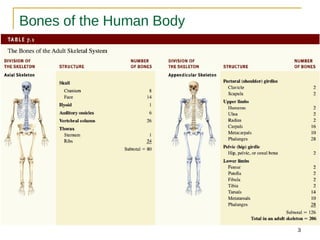
 Divisions Of The Skeletal System
 The human skeleton consists of 206 named bones.
 Bones of the skeleton are grouped into two principal divisions:
1. Axial skeleton
 Skull bones, auditory ossicles (ear bones), hyoid bone, ribs, sternum
(breastbone) and bones of the vertebral column
2. Appendicular skeleton
 Consists of the bones of the upper and lower limbs (extremities), plus the
bones forming the girdles that connect the limbs to the axial skeleton.
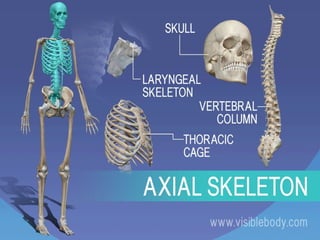
THE AXIAL SKELETON
 The axial skeleton consists of :
1. Skull.
2. Vertebral column (spinal column)
3. Hyoid bone
4. Sternum
5. Ribs
6. Auditory ossicles (ear bones)
Sinuses
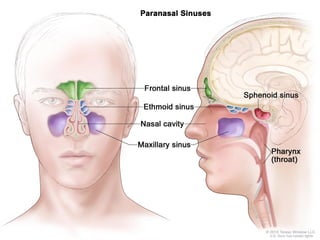
 The sinuses are hollow spaces in the skull and the face bones around nose.
 These sinuses collectively are called the paranasal sinuses.
 There are four pairs of sinuses, named for the bones that they’re located in:
1. The maxillary sinuses are located on each side of nose, near the cheek
bones.
2. The frontal sinuses are located above the eyes, near forehead.
3. The ethmoid sinuses are located on each side of the bridge of nose, near
eyes. There are three small pairs of the ethmoid sinuses.
4. The sphenoid sinuses are behind the eyes, deeper into skull.
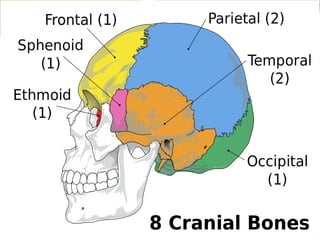
1. Skull
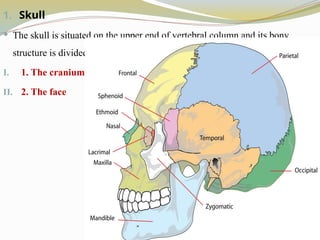
 The skull is situated on the upper end of vertebral column and its bony
structure is divided into 2 parts.
I. 1. The cranium
II. 2. The face
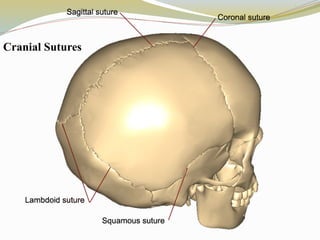
 Cranial Sutures
 The cranial sutures are fibrous joints connecting the bones of the skull.
1. Frontonasal suture - Joint between the frontal bone and nasal bones.
2. Sagittal suture - Joint between two parietal bones.
3. Lambdoid suture - Joint between the parietal bone and occipital bone.
4. Coronal suture - Joint between the frontal bone and the parietal bone.
5. Squamous suture - Joint between the parietal bone and temporal bone.
Cranial Sutures
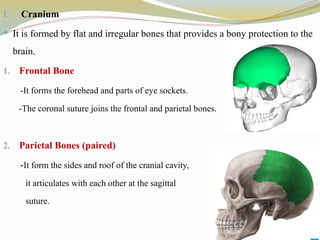
I. Cranium
 It is formed by flat and irregular bones that provides a bony protection to the
brain.
1. Frontal Bone
-It forms the forehead and parts of eye sockets.
-The coronal suture joins the frontal and parietal bones.
2. Parietal Bones (paired)
-It form the sides and roof of the cranial cavity,
it articulates with each other at the sagittal
suture.
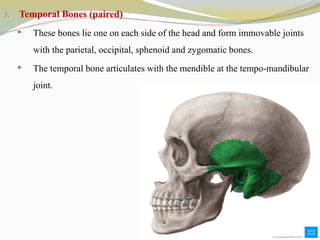
3. Temporal Bones (paired)
 These bones lie one on each side of the head and form immovable joints
with the parietal, occipital, sphenoid and zygomatic bones.
 The temporal bone articulates with the mendible at the tempo-mandibular
joint.
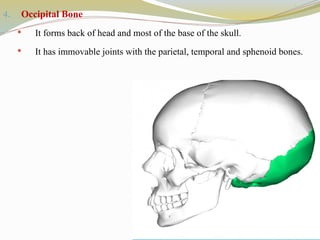
4. Occipital Bone
 It forms back of head and most of the base of the skull.
 It has immovable joints with the parietal, temporal and sphenoid bones.
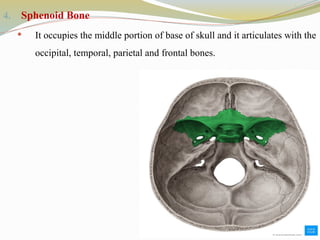
4. Sphenoid Bone
 It occupies the middle portion of base of skull and it articulates with the
occipital, temporal, parietal and frontal bones.
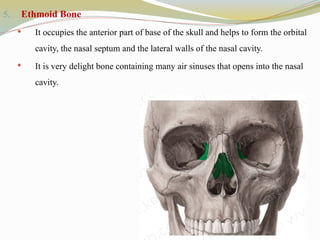
5. Ethmoid Bone
 It occupies the anterior part of base of the skull and helps to form the orbital
cavity, the nasal septum and the lateral walls of the nasal cavity.
 It is very delight bone containing many air sinuses that opens into the nasal
cavity.
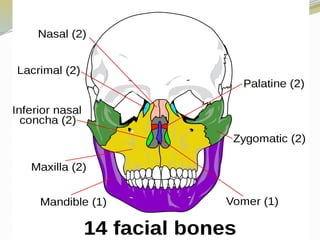
II. The Face (Facial bones)
1. Nasal Bones (paired)
 Form the bridge of the nose.
2. Maxillae (paired)
 Form the upper jawbone.
 Form most of the hard palate, floors of the orbit and floor of nasal cavity.
3. Zygomatic Bones (paired)
 Commonly called cheekbones, form the prominences of the cheeks.
4. Lacrimal Bones (paired)
 Form a part of the medial wall of each orbit.
5. Palatine Bones (paired)
 Form the posterior portion of the hard palate.
6. Inferior Nasal Conchae (paired)
 Form a part of the inferior lateral wall of the nasal cavity.
7. Vomer
 Forms the inferior portion of the nasal septum.
8. Mandible
 Lower jawbone.
 The largest, strongest facial bone.
 The only movable skull bone.
 Nasal Septum- Divides the interior of the nasal cavity into right and left sides.
 Orbits – Eye socket.
 Foramina – Openings for blood vessels , nerves , or ligaments of the skull.
 Functions of the skull bones
 The bones of the skull provide protection for the brain and the organs of
vision, taste, hearing, equilibrium, and smell.
 It stabilize the position of the brain.
 The bones also provide attachment for muscles that move the head and
control facial expressions and chewing.
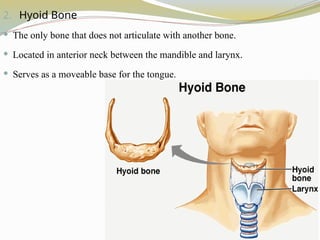
2. Hyoid Bone
 The only bone that does not articulate with another bone.
 Located in anterior neck between the mandible and larynx.
 Serves as a moveable base for the tongue.
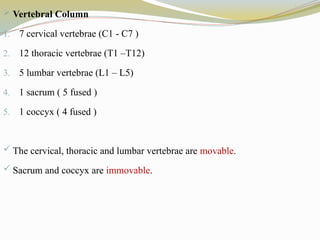
3. Vertebral Column
 The vertebral column, also called the spine, spinal column or backbone.
 Composed of a series of bones called vertebrae (singular is vertebra), which
is separated and united by an intervertebral disc.
 Average length of vertebral column is about 71 cm in adult male and 61 cm
in adult female.
 Total number of vertebrae during early development is 33.
 As a child grows, several vertebrae in the sacral and coccygeal regions fuse.
 Adults have 26 vertebrae.
 Sacrum and coccyx bones become fused.
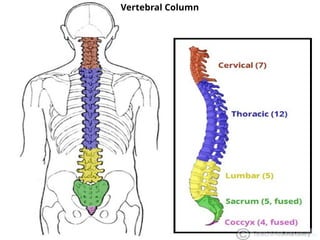
 Vertebral Column
1. 7 cervical vertebrae (C1 - C7 )
2. 12 thoracic vertebrae (T1 –T12)
3. 5 lumbar vertebrae (L1 – L5)
4. 1 sacrum ( 5 fused )
5. 1 coccyx ( 4 fused )
 The cervical, thoracic and lumbar vertebrae are movable.
 Sacrum and coccyx are immovable.
Vertebral Column
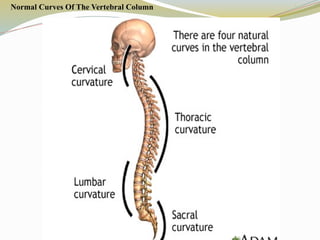
 Normal Curves Of The Vertebral Column
 In adult, it shows four slight bends called normal curve:
1. Cervical and lumbar curve are convex (bulging out).
2. Thoracic and sacral curve are concave (cupping in).
 The thoracic and sacral curves are called primary curves because they form
first during fetal development.
 The cervical and lumbar curves are called secondary curves because they
form later, several months after birth. All curve fully developed by age 10.
Normal Curves Of The Vertebral Column
 Parts of Typical vertebrae
 Typical vertebrae consists of:
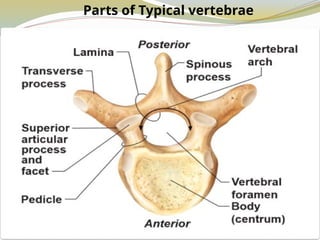
1. A body
2. A vertebral arch (pedicles and lamina)
3. Seven processes: two transverse processes, one spinous process, four
articular processes.
Parts of Typical vertebrae
1. Body of vertebra
 Largest part of vertebra. It is a thick, disc-shaped weight bearing portion.
 Its inferior and superior surfaces are roughened and give attachment to the
intervertebral disc.
 Anterior and lateral surfaces contain nutrient foramina – pathway for blood vessels.
2. Vertebral Arch (pedicles and lamina)
 Extend backwards from the body of the vertebra.
 Consists of a pair of pedicles and a pair of laminae.
 The pedicle project backward from the body to unite with the laminae.
3. 7 processes arise from the vertebral arch
 Two transverse process
 One spinous process
 Four articular
 Regions of the vertebral column
 Five regions of the vertebral column with gradual transition in the structure
of their vertebrae are:
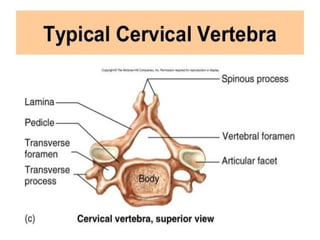
1. Cervical region (C1-C7)
a) C1-C7- Formed framework of the neck.
b) C3-C6- Have similarities:
 Smaller bodies, short.
 Larger vertebral arch – hence larger vertebral foramen (cervical
enlargement).
 Transverse process consist transverse foramina (vertebral artery).
 Spinous process short and bifid.
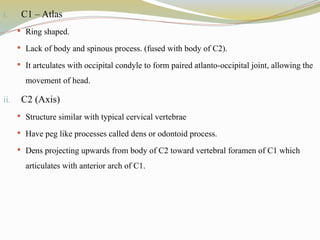
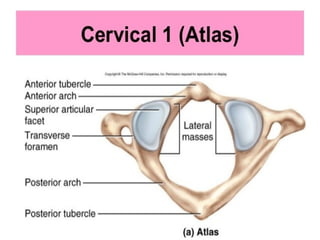
i. C1 – Atlas
 Ring shaped.
 Lack of body and spinous process. (fused with body of C2).
 It artculates with occipital condyle to form paired atlanto-occipital joint, allowing the
movement of head.
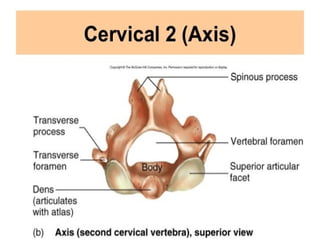
ii. C2 (Axis)
 Structure similar with typical cervical vertebrae
 Have peg like processes called dens or odontoid process.
 Dens projecting upwards from body of C2 toward vertebral foramen of C1 which
articulates with anterior arch of C1.
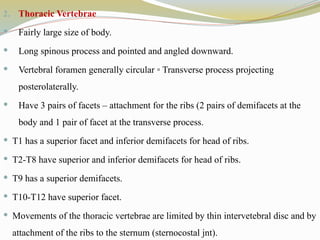
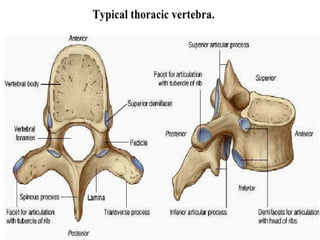
2. Thoracic Vertebrae
 Fairly large size of body.
 Long spinous process and pointed and angled downward.
 Vertebral foramen generally circular ◦ Transverse process projecting
posterolaterally.
 Have 3 pairs of facets – attachment for the ribs (2 pairs of demifacets at the
body and 1 pair of facet at the transverse process.
 T1 has a superior facet and inferior demifacets for head of ribs.
 T2-T8 have superior and inferior demifacets for head of ribs.
 T9 has a superior demifacets.
 T10-T12 have superior facet.
 Movements of the thoracic vertebrae are limited by thin intervetebral disc and by
attachment of the ribs to the sternum (sternocostal jnt).
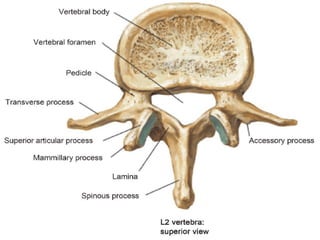
III. Lumbar Vertebrae (L1-L5)
 The largest and strongest, weight bearing vertebrae.
 Thickest body.
 Spinous process is thickest and broad and project posteriorly for attachment
for the large back muscles.
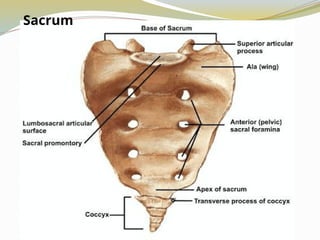
IV. Sacrum
 Inverted triangular in-shaped.
 Fusion of 5 sacral vertebrae – fusion started 16-18 years old and completed at
30.
 Sacrum serve strong foundation for the pelvic girdle attachment (sacroiliac
joint).
Sacrum
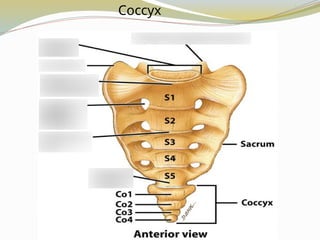
V. Coccyx Vertebrae (co1-co4)
 Inverted Triangular in shaped.
 Fusion of 4 coccyx vertebrae.
 Dorsal surface, 2 projection called coccygeal cornua – attachment for
sacrococcygeal ligament and also attachment for pelvic floor muscles.
Coccyx
4. Bones Of Thorax
 Thoracic Cage is a skeletal framework which supports the thorax.
 The skeletal part of thorax consist of thoracic vertebrae, ribs, costal
cartilages, and sternum form the thoracic cage.
 It gives protection for the internal organs (heart and lungs) of the thoracic
cavity and supports the superior trunk, pectoral girdle and upper limbs.
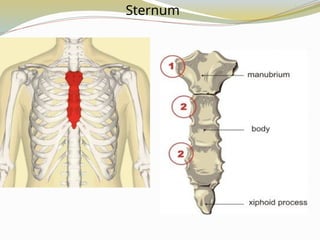
1. Sternum
 The Sternum or Breast Bone is a long flat bone, which is enlarged about 7 cm
long. It is located in the anterior median part of the chest wall.
 Sternum comprises of 3 parts:
i. Manubrium
ii. Body
iii. Xiphoid
Sternum
i. Manubrium
 Manubrium is the wider, superior portion of the sternum.
 The clavicular notch forms sternoclavicular joint, between the sternum and
clavicle. The first ribs also attach to the manubrium.
ii. Body
• The elongated, central portion of the sternum is the body.
• The manubrium and body join together at the sternal angle.
• The body of the sternum articulates with second to tenth ribs.
iii. The Xiphoid Process of Sternum
• It is the lowest and smallest part of the sternum.
• It provides attachment for some abdominal muscles.
2. Ribs
 Each rib is a curved, flattened bone that contributes to the wall of the thorax.
 The ribs articulate posteriorly with the T1–T12 thoracic vertebrae, and most
attach anteriorly via their costal cartilages to the sternum.
 There are 12 pairs of ribs. The ribs are numbered 1–12 in accordance with the
thoracic vertebrae.
 Most ribs are then attached, either directly or indirectly, to the sternum via their
costal cartilage.
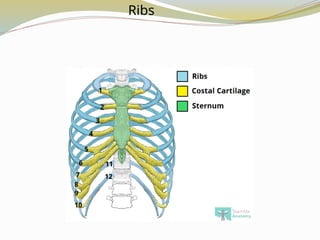
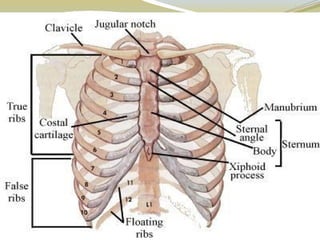
 Ribs 1–7 are classified as true ribs (vertebrosternal ribs). The costal cartilage
from each of these ribs attaches directly to the sternum.
 Ribs 8–12 are called false ribs (vertebrochondral ribs). The costal cartilages
from these ribs do not attach directly to the sternum.
 For ribs 8–10, the costal cartilages are attached to the cartilage of the next
higher rib. Thus, the cartilage of rib 10 attaches to the cartilage of rib 9, rib 9
then attaches to rib 8, and rib 8 is attached to rib 7.
 The last two false ribs (11–12) are also called floating ribs. These are short
ribs that do not attach to the sternum at all.
Ribs
Thank You

B. Pharm_I Sem_Unit II_Chapter 2_Axial Skeleton - Copy.pptx

  • 1.
    Skeletal system Miss. SheetalPatil M. Pharm Rani Chennamma College Of Pharmacy, Belagavi
  • 3.
    SKELATAL SYSTEM  Bonetissues makes up about 18% of the total human body weight.  The skeletal system supports and protects the body while giving it shape and form.  Osteology: It is the branch of science that deals with the study of the skeletal system, their structure and functions.
  • 4.
     Skeletal SystemComposed Of  Bones  Cartilage  Joints  Ligaments  Dense connective tissues  Adipose tissue
  • 5.
     Functions OfSkeletal System 1. Support: Hard framework that supports and the soft organs of the body and provide attachment for the tendons of skeletal muscles. 2. Protection: Skeleton protects vital internal organs from injury, e.g. cranial ones protects the brain. 3. Movement: Allows for muscle attachment to bones and brings about movement. 4. Storage: Yellow bone marrow consist of adipose cells, which stores triglycerides. 5. Blood Cell Formation: The bone marrow is responsible for blood cell production (RBC, WBC and platelets) a process is called hemopoiesis. 6. Mineral Homeostasis: Bone store several minerals like calcium and phosphourus which strengthen the bone.
  • 6.
     Classification OfBone Based On Shape  Bones can be classified into five types based on shape: 1. Long 2. Short 3. Flat 4. Irregular 5. Sesamoid 6. Long Bones  Greater length than width and are slightly curved for strength.  e.g., Femur, tibia, fibula, humerus, ulna, radius, phalanges.
  • 7.
    2. Short bones Cube-shaped and are nearly equal in length and width.  e.g., Carpal, tarsal 3. Flat bones  Thin and composed of two nearly parallel plates of compact bone tissue enclosing a layer of spongy bone tissue.  e.g., Cranial, sternum, ribs, scapulae. 4. Irregular bones  Complex shapes and cannot be grouped into any of the previous categories.  E.g., Vertebrae, hip bones, some facial bones, calcaneus. 5. Sesamoid bones  Protect tendons from excessive wear and tear.  e.g., Patellae, foot, hand.
  • 9.
     Gross Anatomyof a Long Bone a. Diaphysis  Shaft  Composed of compact bone b. Epiphysis  These are distal and proximal ends of the bone  Composed mostly of spongy bone c. Metaphysis  The region where epiphysis meets the diaphysis. d. Articular cartilage  A thin layer of hyaline cartilage that reduces friction and acts as a shock absorber.
  • 10.
    e. Periosteum  Outsidecovering of the diaphysis  It is dense irregular connective tissue membrane  Protects the bone, assist in fracture repair  Helps to nourish bone tissue f. Medullary cavity  Inside the diaphysis is the medullary cavity, which is filled with yellow bone marrow. g. Endosteum  Thin membrane that lines the medullary cavity
  • 11.
    Anatomy of aLong Bone
  • 12.
     Types ofBone Cells 1. Osteocytes  Mature bone cells 2. Osteoblasts  Bone-forming cells 3. Osteoclasts 1. Bone-destroying cells  Break down bone matrix for remodeling and release of calcium.  Bone remodeling is a process by both osteoblasts and osteoclasts.
  • 13.
     Divisions OfThe Skeletal System  The human skeleton consists of 206 named bones.  Bones of the skeleton are grouped into two principal divisions: 1. Axial skeleton  Skull bones, auditory ossicles (ear bones), hyoid bone, ribs, sternum (breastbone) and bones of the vertebral column 2. Appendicular skeleton  Consists of the bones of the upper and lower limbs (extremities), plus the bones forming the girdles that connect the limbs to the axial skeleton.
  • 15.
    THE AXIAL SKELETON The axial skeleton consists of : 1. Skull. 2. Vertebral column (spinal column) 3. Hyoid bone 4. Sternum 5. Ribs 6. Auditory ossicles (ear bones)
  • 16.
    Sinuses  The sinusesare hollow spaces in the skull and the face bones around nose.  These sinuses collectively are called the paranasal sinuses.  There are four pairs of sinuses, named for the bones that they’re located in: 1. The maxillary sinuses are located on each side of nose, near the cheek bones. 2. The frontal sinuses are located above the eyes, near forehead. 3. The ethmoid sinuses are located on each side of the bridge of nose, near eyes. There are three small pairs of the ethmoid sinuses. 4. The sphenoid sinuses are behind the eyes, deeper into skull.
  • 18.
    1. Skull  Theskull is situated on the upper end of vertebral column and its bony structure is divided into 2 parts. I. 1. The cranium II. 2. The face
  • 19.
     Cranial Sutures The cranial sutures are fibrous joints connecting the bones of the skull. 1. Frontonasal suture - Joint between the frontal bone and nasal bones. 2. Sagittal suture - Joint between two parietal bones. 3. Lambdoid suture - Joint between the parietal bone and occipital bone. 4. Coronal suture - Joint between the frontal bone and the parietal bone. 5. Squamous suture - Joint between the parietal bone and temporal bone.
  • 20.
  • 21.
    I. Cranium  Itis formed by flat and irregular bones that provides a bony protection to the brain. 1. Frontal Bone -It forms the forehead and parts of eye sockets. -The coronal suture joins the frontal and parietal bones. 2. Parietal Bones (paired) -It form the sides and roof of the cranial cavity, it articulates with each other at the sagittal suture.
  • 22.
    3. Temporal Bones(paired)  These bones lie one on each side of the head and form immovable joints with the parietal, occipital, sphenoid and zygomatic bones.  The temporal bone articulates with the mendible at the tempo-mandibular joint.
  • 23.
    4. Occipital Bone It forms back of head and most of the base of the skull.  It has immovable joints with the parietal, temporal and sphenoid bones.
  • 24.
    4. Sphenoid Bone It occupies the middle portion of base of skull and it articulates with the occipital, temporal, parietal and frontal bones.
  • 25.
    5. Ethmoid Bone It occupies the anterior part of base of the skull and helps to form the orbital cavity, the nasal septum and the lateral walls of the nasal cavity.  It is very delight bone containing many air sinuses that opens into the nasal cavity.
  • 27.
    II. The Face(Facial bones) 1. Nasal Bones (paired)  Form the bridge of the nose. 2. Maxillae (paired)  Form the upper jawbone.  Form most of the hard palate, floors of the orbit and floor of nasal cavity. 3. Zygomatic Bones (paired)  Commonly called cheekbones, form the prominences of the cheeks. 4. Lacrimal Bones (paired)  Form a part of the medial wall of each orbit. 5. Palatine Bones (paired)  Form the posterior portion of the hard palate.
  • 28.
    6. Inferior NasalConchae (paired)  Form a part of the inferior lateral wall of the nasal cavity. 7. Vomer  Forms the inferior portion of the nasal septum. 8. Mandible  Lower jawbone.  The largest, strongest facial bone.  The only movable skull bone.  Nasal Septum- Divides the interior of the nasal cavity into right and left sides.  Orbits – Eye socket.  Foramina – Openings for blood vessels , nerves , or ligaments of the skull.
  • 30.
     Functions ofthe skull bones  The bones of the skull provide protection for the brain and the organs of vision, taste, hearing, equilibrium, and smell.  It stabilize the position of the brain.  The bones also provide attachment for muscles that move the head and control facial expressions and chewing.
  • 31.
    2. Hyoid Bone The only bone that does not articulate with another bone.  Located in anterior neck between the mandible and larynx.  Serves as a moveable base for the tongue.
  • 32.
    3. Vertebral Column The vertebral column, also called the spine, spinal column or backbone.  Composed of a series of bones called vertebrae (singular is vertebra), which is separated and united by an intervertebral disc.  Average length of vertebral column is about 71 cm in adult male and 61 cm in adult female.  Total number of vertebrae during early development is 33.  As a child grows, several vertebrae in the sacral and coccygeal regions fuse.  Adults have 26 vertebrae.  Sacrum and coccyx bones become fused.
  • 33.
     Vertebral Column 1.7 cervical vertebrae (C1 - C7 ) 2. 12 thoracic vertebrae (T1 –T12) 3. 5 lumbar vertebrae (L1 – L5) 4. 1 sacrum ( 5 fused ) 5. 1 coccyx ( 4 fused )  The cervical, thoracic and lumbar vertebrae are movable.  Sacrum and coccyx are immovable.
  • 34.
  • 35.
     Normal CurvesOf The Vertebral Column  In adult, it shows four slight bends called normal curve: 1. Cervical and lumbar curve are convex (bulging out). 2. Thoracic and sacral curve are concave (cupping in).  The thoracic and sacral curves are called primary curves because they form first during fetal development.  The cervical and lumbar curves are called secondary curves because they form later, several months after birth. All curve fully developed by age 10.
  • 36.
    Normal Curves OfThe Vertebral Column
  • 37.
     Parts ofTypical vertebrae  Typical vertebrae consists of: 1. A body 2. A vertebral arch (pedicles and lamina) 3. Seven processes: two transverse processes, one spinous process, four articular processes.
  • 38.
  • 39.
    1. Body ofvertebra  Largest part of vertebra. It is a thick, disc-shaped weight bearing portion.  Its inferior and superior surfaces are roughened and give attachment to the intervertebral disc.  Anterior and lateral surfaces contain nutrient foramina – pathway for blood vessels. 2. Vertebral Arch (pedicles and lamina)  Extend backwards from the body of the vertebra.  Consists of a pair of pedicles and a pair of laminae.  The pedicle project backward from the body to unite with the laminae. 3. 7 processes arise from the vertebral arch  Two transverse process  One spinous process  Four articular
  • 40.
     Regions ofthe vertebral column  Five regions of the vertebral column with gradual transition in the structure of their vertebrae are: 1. Cervical region (C1-C7) a) C1-C7- Formed framework of the neck. b) C3-C6- Have similarities:  Smaller bodies, short.  Larger vertebral arch – hence larger vertebral foramen (cervical enlargement).  Transverse process consist transverse foramina (vertebral artery).  Spinous process short and bifid.
  • 42.
    i. C1 –Atlas  Ring shaped.  Lack of body and spinous process. (fused with body of C2).  It artculates with occipital condyle to form paired atlanto-occipital joint, allowing the movement of head. ii. C2 (Axis)  Structure similar with typical cervical vertebrae  Have peg like processes called dens or odontoid process.  Dens projecting upwards from body of C2 toward vertebral foramen of C1 which articulates with anterior arch of C1.
  • 45.
    2. Thoracic Vertebrae Fairly large size of body.  Long spinous process and pointed and angled downward.  Vertebral foramen generally circular ◦ Transverse process projecting posterolaterally.  Have 3 pairs of facets – attachment for the ribs (2 pairs of demifacets at the body and 1 pair of facet at the transverse process.  T1 has a superior facet and inferior demifacets for head of ribs.  T2-T8 have superior and inferior demifacets for head of ribs.  T9 has a superior demifacets.  T10-T12 have superior facet.  Movements of the thoracic vertebrae are limited by thin intervetebral disc and by attachment of the ribs to the sternum (sternocostal jnt).
  • 47.
    III. Lumbar Vertebrae(L1-L5)  The largest and strongest, weight bearing vertebrae.  Thickest body.  Spinous process is thickest and broad and project posteriorly for attachment for the large back muscles.
  • 49.
    IV. Sacrum  Invertedtriangular in-shaped.  Fusion of 5 sacral vertebrae – fusion started 16-18 years old and completed at 30.  Sacrum serve strong foundation for the pelvic girdle attachment (sacroiliac joint).
  • 50.
  • 51.
    V. Coccyx Vertebrae(co1-co4)  Inverted Triangular in shaped.  Fusion of 4 coccyx vertebrae.  Dorsal surface, 2 projection called coccygeal cornua – attachment for sacrococcygeal ligament and also attachment for pelvic floor muscles.
  • 52.
  • 53.
    4. Bones OfThorax  Thoracic Cage is a skeletal framework which supports the thorax.  The skeletal part of thorax consist of thoracic vertebrae, ribs, costal cartilages, and sternum form the thoracic cage.  It gives protection for the internal organs (heart and lungs) of the thoracic cavity and supports the superior trunk, pectoral girdle and upper limbs.
  • 54.
    1. Sternum  TheSternum or Breast Bone is a long flat bone, which is enlarged about 7 cm long. It is located in the anterior median part of the chest wall.  Sternum comprises of 3 parts: i. Manubrium ii. Body iii. Xiphoid
  • 55.
  • 56.
    i. Manubrium  Manubriumis the wider, superior portion of the sternum.  The clavicular notch forms sternoclavicular joint, between the sternum and clavicle. The first ribs also attach to the manubrium. ii. Body • The elongated, central portion of the sternum is the body. • The manubrium and body join together at the sternal angle. • The body of the sternum articulates with second to tenth ribs. iii. The Xiphoid Process of Sternum • It is the lowest and smallest part of the sternum. • It provides attachment for some abdominal muscles.
  • 57.
    2. Ribs  Eachrib is a curved, flattened bone that contributes to the wall of the thorax.  The ribs articulate posteriorly with the T1–T12 thoracic vertebrae, and most attach anteriorly via their costal cartilages to the sternum.  There are 12 pairs of ribs. The ribs are numbered 1–12 in accordance with the thoracic vertebrae.  Most ribs are then attached, either directly or indirectly, to the sternum via their costal cartilage.  Ribs 1–7 are classified as true ribs (vertebrosternal ribs). The costal cartilage from each of these ribs attaches directly to the sternum.
  • 58.
     Ribs 8–12are called false ribs (vertebrochondral ribs). The costal cartilages from these ribs do not attach directly to the sternum.  For ribs 8–10, the costal cartilages are attached to the cartilage of the next higher rib. Thus, the cartilage of rib 10 attaches to the cartilage of rib 9, rib 9 then attaches to rib 8, and rib 8 is attached to rib 7.  The last two false ribs (11–12) are also called floating ribs. These are short ribs that do not attach to the sternum at all.
  • 59.
  • 61.