ASSEMBLY MODELING
By :
Ameya Nijasure
Introduction
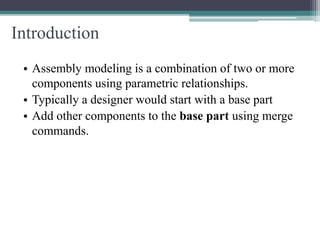
• Assembly modeling is a combination of two or more
components using parametric relationships.
• Typically a designer would start with a base part
• Add other components to the base part using merge
commands.
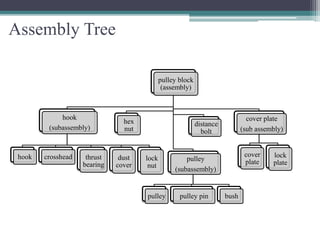
pulley block
(assembly)
hook
(subassembly)
hook crosshead thrust
bearing
dust
cover
lock
nut
hex
nut
distance
bolt
pulley
(subassembly)
pulley pulley pin bush
cover plate
(sub assembly)
cover
plate
lock
plate
Assembly Tree
Exploded view
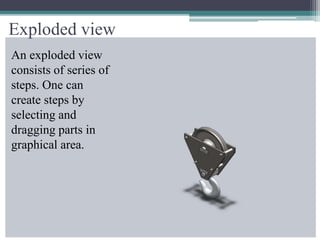
An exploded view
consists of series of
steps. One can
create steps by
selecting and
dragging parts in
graphical area.
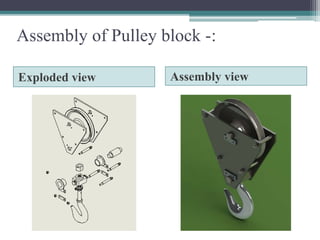
Assembly of Pulley block -:
Exploded view Assembly view
Bottom-up assembly approach -:
• Allows the designer to use part drawings that already
exist (off the shelf).
• Provides the designer with more control over
individual parts.
• Multiple copies (instances) of parts can be inserted
into the assembly.
Top-down assembly approach -:
• The approach is ideal for large assemblies consisting
of thousands of parts.
• The approach is used to deal with large designs
including multiple design teams.
• It lends itself well to the conceptual design phase
• E.g. :
▫ Piping and fittings
▫ Welds
▫ Lock pins
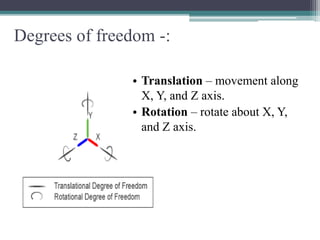
Degrees of freedom -:
• Translation – movement along
X, Y, and Z axis.
• Rotation – rotate about X, Y,
and Z axis.
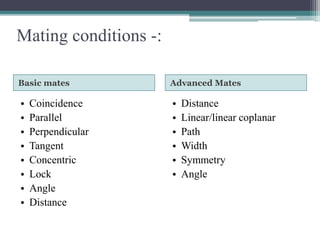
Mating conditions -:
Basic mates Advanced Mates
• Coincidence
• Parallel
• Perpendicular
• Tangent
• Concentric
• Lock
• Angle
• Distance
• Distance
• Linear/linear coplanar
• Path
• Width
• Symmetry
• Angle
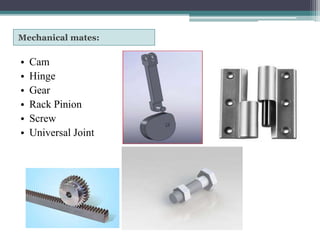
Mechanical mates:
• Cam
• Hinge
• Gear
• Rack Pinion
• Screw
• Universal Joint
References
• Vedaraman Sriraman “Assembly Modeling”
Southwest Texas State University 1991
• ZeidJ. (1991). CAD/CAM theory and practice.New
York, NY: Mc Graw - Hill, Inc.
• http://www.pinterest.com/pin/332633122448473315/
(Date : 05/11/2014)
• http://www.engr.sjsu.edu/youssefi/me265/notes/8%20
-20Assembly%20Modeling.pdf (Date : 25/10/2014)
Thank You….

Assembly modeling ppt

  • 1.
  • 2.
    Introduction • Assembly modelingis a combination of two or more components using parametric relationships. • Typically a designer would start with a base part • Add other components to the base part using merge commands.
  • 3.
    pulley block (assembly) hook (subassembly) hook crossheadthrust bearing dust cover lock nut hex nut distance bolt pulley (subassembly) pulley pulley pin bush cover plate (sub assembly) cover plate lock plate Assembly Tree
  • 4.
    Exploded view An explodedview consists of series of steps. One can create steps by selecting and dragging parts in graphical area.
  • 5.
    Assembly of Pulleyblock -: Exploded view Assembly view
  • 6.
    Bottom-up assembly approach-: • Allows the designer to use part drawings that already exist (off the shelf). • Provides the designer with more control over individual parts. • Multiple copies (instances) of parts can be inserted into the assembly.
  • 7.
    Top-down assembly approach-: • The approach is ideal for large assemblies consisting of thousands of parts. • The approach is used to deal with large designs including multiple design teams. • It lends itself well to the conceptual design phase • E.g. : ▫ Piping and fittings ▫ Welds ▫ Lock pins
  • 8.
    Degrees of freedom-: • Translation – movement along X, Y, and Z axis. • Rotation – rotate about X, Y, and Z axis.
  • 9.
    Mating conditions -: Basicmates Advanced Mates • Coincidence • Parallel • Perpendicular • Tangent • Concentric • Lock • Angle • Distance • Distance • Linear/linear coplanar • Path • Width • Symmetry • Angle
  • 10.
    Mechanical mates: • Cam •Hinge • Gear • Rack Pinion • Screw • Universal Joint
  • 11.
    References • Vedaraman Sriraman“Assembly Modeling” Southwest Texas State University 1991 • ZeidJ. (1991). CAD/CAM theory and practice.New York, NY: Mc Graw - Hill, Inc. • http://www.pinterest.com/pin/332633122448473315/ (Date : 05/11/2014) • http://www.engr.sjsu.edu/youssefi/me265/notes/8%20 -20Assembly%20Modeling.pdf (Date : 25/10/2014)
  • 12.