CHAPTER 1.3: DIMENSIONS CHAPTER 1.3  DIMENSIONAL ANALYSIS
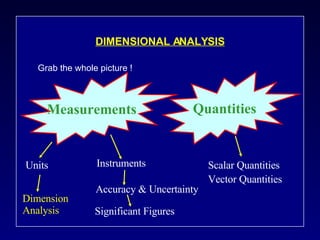
Grab the whole picture ! DIMENSIONAL ANALYSIS Measurements Quantities Units Instruments Vector Quantities Scalar Quantities Accuracy & Uncertainty Dimension  Analysis Significant Figures
DIMENSIONS What is “Dimension” ?
Many physical quantities can be expressed in terms  of a   combination of   fundamental dimensions such as   [Length] L [Time] T [Mass] M [Current]  A [Temperature]  θ [Amount]  N The symbol [  ] means dimension or stands for dimension
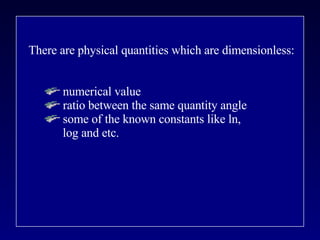
There are physical quantities which are dimensionless: numerical value ratio between the same quantity angle some of the known constants like ln,  log and etc.
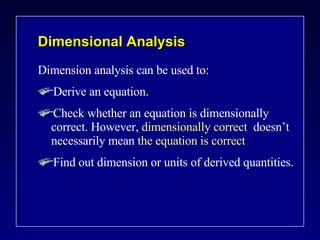
Dimensional Analysis Dimension analysis can be used to: Derive an equation. Check whether an equation is dimensionally  correct. However,  dimensionally correct  doesn’t necessarily mean  the equation is correct Find out dimension or units of derived quantities.
Derived an Equation (Quantities) Example 1 Velocity  = displacement / time [velocity] = [displacement] / [time] =  L / T =  LT -1 v  =  s / t
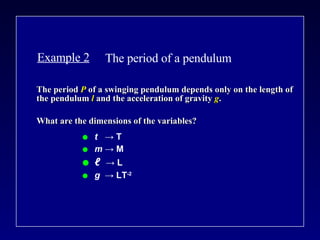
What are the dimensions of the variables? t   ->  T m   ->  M ℓ   ->   L g   ->  LT -2 Example 2 The period of a pendulum The period   P   of a swinging pendulum depends only on the length of the pendulum   l   and the acceleration of gravity   g .
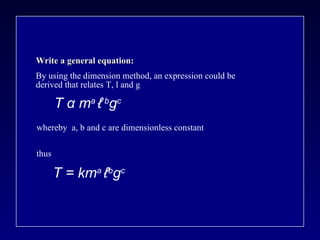
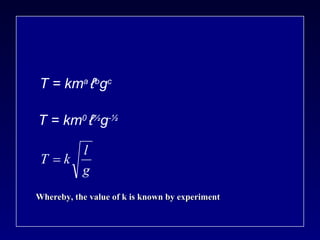
T = km a  ℓ b g c Write a general equation: T  α  m a  ℓ   b g c By using the dimension method, an expression could be  derived that relates T, l and g whereby  a, b and c are dimensionless constant thus
Write out the dimensions of the variables T   = M a L b (LT -2 ) c T   = M a L b L c T -2c T 1   = M a L b+c T -2c [T]  = [m a ][ ℓ   b ][g c ] Using indices a  = 0 -2c = 1 -> c = -½ b + c  = 0 b = -c = ½
T = km a  ℓ b g c T = km 0  ℓ ½ g - ½ Whereby, the value of k is known by experiment
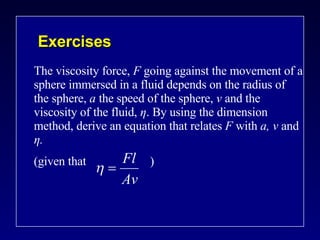
Exercises The viscosity force,  F  going against the movement of a sphere immersed in a fluid depends on the radius of the sphere,  a  the speed of the sphere,  v  and the viscosity of the fluid,  η . By using the dimension method, derive an equation that relates  F  with  a,   v  and  η . (given that  )
To check whether a specific formula or an equation is homogenous Example 1 S = vt [s] = [v] [t] L.H.S [s] = L R.H.S [v] [t] = LT -1 (T) [v] [t]  = L Thus, the left hand side = right hand side, rendering the equation as homogenous
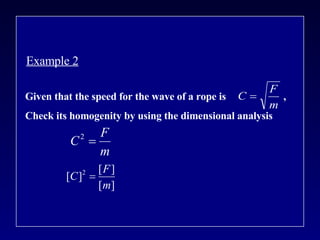
Example 2 Given that the speed for the wave of a rope is  , Check its homogenity by using the dimensional analysis
L.H.S [C] = (LT -1 ) 2 [C] = L 2 T -2 R.H.S [F] = MLT -2  , = LT -2 [M] = M Conclusion : The above equation is not homogenous  (L.H.S  ≠ R.H.S)
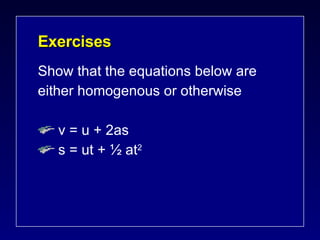
Exercises Show that the equations below are either homogenous or otherwise v = u + 2as s = ut +  ½ at 2
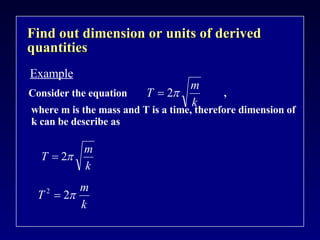
Find out dimension or units of derived quantities Example Consider the equation  , where m is the mass and T is a time, therefore dimension of k can be describe as
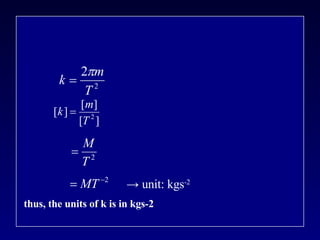
->  unit: kgs -2 thus, the units of k is in kgs-2
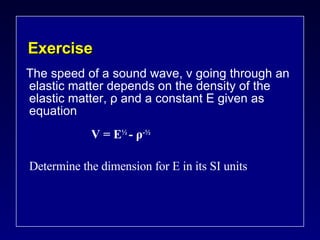
Exercise The speed of a sound wave, v going through an elastic matter depends on the density of the elastic matter,  ρ  and a constant E given as equation  V = E ½  -  ρ -½ Determine the dimension for E in its SI units
SCALAR AND VECTOR
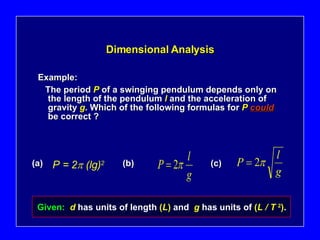
Dimensional Analysis Example: The period   P   of a swinging pendulum depends only on the length of the pendulum   l   and the acceleration of gravity   g .   Which of the following formulas for   P   could   be correct ? (a) (b) (c) Given:  d   has units of length   ( L )   and   g   has units of   ( L / T  2 ) . P = 2   (lg) 2
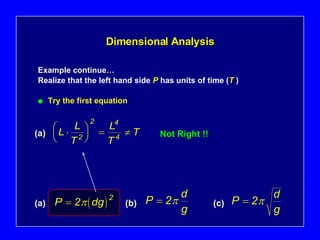
Dimensional Analysis Example continue… Realize that the left hand side   P   has units of time ( T   ) Try the first equation (a) (b) (c) (a) Not Right !!
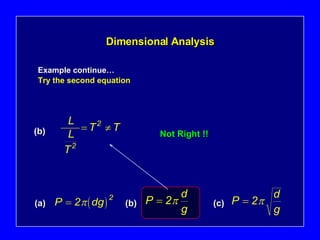
Example continue… Try the second equation Dimensional Analysis (a) (b) (c) (b) Not Right !!
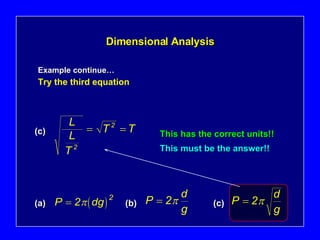
Dimensional Analysis (a) (b) (c) (c) This has the correct units!! This must be the answer!! Example continue… Try the third equation

Chapter 1(3)DIMENSIONAL ANALYSIS

  • 1.
    CHAPTER 1.3: DIMENSIONSCHAPTER 1.3 DIMENSIONAL ANALYSIS
  • 2.
    Grab the wholepicture ! DIMENSIONAL ANALYSIS Measurements Quantities Units Instruments Vector Quantities Scalar Quantities Accuracy & Uncertainty Dimension Analysis Significant Figures
  • 3.
    DIMENSIONS What is“Dimension” ?
  • 4.
    Many physical quantitiescan be expressed in terms of a combination of fundamental dimensions such as [Length] L [Time] T [Mass] M [Current] A [Temperature] θ [Amount] N The symbol [ ] means dimension or stands for dimension
  • 5.
    There are physicalquantities which are dimensionless: numerical value ratio between the same quantity angle some of the known constants like ln, log and etc.
  • 6.
    Dimensional Analysis Dimensionanalysis can be used to: Derive an equation. Check whether an equation is dimensionally correct. However, dimensionally correct doesn’t necessarily mean the equation is correct Find out dimension or units of derived quantities.
  • 7.
    Derived an Equation(Quantities) Example 1 Velocity = displacement / time [velocity] = [displacement] / [time] = L / T = LT -1 v = s / t
  • 8.
    What are thedimensions of the variables? t -> T m -> M ℓ -> L g -> LT -2 Example 2 The period of a pendulum The period P of a swinging pendulum depends only on the length of the pendulum l and the acceleration of gravity g .
  • 9.
    T = kma ℓ b g c Write a general equation: T α m a ℓ b g c By using the dimension method, an expression could be derived that relates T, l and g whereby a, b and c are dimensionless constant thus
  • 10.
    Write out thedimensions of the variables T = M a L b (LT -2 ) c T = M a L b L c T -2c T 1 = M a L b+c T -2c [T] = [m a ][ ℓ b ][g c ] Using indices a = 0 -2c = 1 -> c = -½ b + c = 0 b = -c = ½
  • 11.
    T = kma ℓ b g c T = km 0 ℓ ½ g - ½ Whereby, the value of k is known by experiment
  • 12.
    Exercises The viscosityforce, F going against the movement of a sphere immersed in a fluid depends on the radius of the sphere, a the speed of the sphere, v and the viscosity of the fluid, η . By using the dimension method, derive an equation that relates F with a, v and η . (given that )
  • 13.
    To check whethera specific formula or an equation is homogenous Example 1 S = vt [s] = [v] [t] L.H.S [s] = L R.H.S [v] [t] = LT -1 (T) [v] [t] = L Thus, the left hand side = right hand side, rendering the equation as homogenous
  • 14.
    Example 2 Giventhat the speed for the wave of a rope is , Check its homogenity by using the dimensional analysis
  • 15.
    L.H.S [C] =(LT -1 ) 2 [C] = L 2 T -2 R.H.S [F] = MLT -2 , = LT -2 [M] = M Conclusion : The above equation is not homogenous (L.H.S ≠ R.H.S)
  • 16.
    Exercises Show thatthe equations below are either homogenous or otherwise v = u + 2as s = ut + ½ at 2
  • 17.
    Find out dimensionor units of derived quantities Example Consider the equation , where m is the mass and T is a time, therefore dimension of k can be describe as
  • 18.
    -> unit:kgs -2 thus, the units of k is in kgs-2
  • 19.
    Exercise The speedof a sound wave, v going through an elastic matter depends on the density of the elastic matter, ρ and a constant E given as equation V = E ½ - ρ -½ Determine the dimension for E in its SI units
  • 20.
  • 21.
    Dimensional Analysis Example:The period P of a swinging pendulum depends only on the length of the pendulum l and the acceleration of gravity g . Which of the following formulas for P could be correct ? (a) (b) (c) Given: d has units of length ( L ) and g has units of ( L / T 2 ) . P = 2  (lg) 2
  • 22.
    Dimensional Analysis Examplecontinue… Realize that the left hand side P has units of time ( T ) Try the first equation (a) (b) (c) (a) Not Right !!
  • 23.
    Example continue… Trythe second equation Dimensional Analysis (a) (b) (c) (b) Not Right !!
  • 24.
    Dimensional Analysis (a)(b) (c) (c) This has the correct units!! This must be the answer!! Example continue… Try the third equation