Tolerance Analysis
Dr. P. M. Pandey
http://paniit.iitd.ac.in/~pmpandey
Causes of Workpiece Variation
• The machines which perform operations on the
workpiece may have inherent inaccuracies built
into them.
• The tools used on the machines are subject to
dulling, general wear, chipping, breaking, and
differences occurs due to regrinding
• The material used is subjected to variations
• The involvement of human elements
• Any other cause by Chance.
Term used in dimensioning workpiece
dimensions
• Nominal Size: It has no specified limits or accuracy
but indicates a close approximation to some standard
size. For eg. a half inch nut will fit into a half inch bolt.
• Basic Size: It is the exact theoretical size from which
the limits are established through the applications of
allowances and tolerances.
• Allowance: an allowance is an intentional difference
between maximum material limits of mating parts.
• Tolerance: A tolerance is the total permissible variation
from the specified basic size of the part.
• Limit: Limits are extreme permissible dimension of the
part
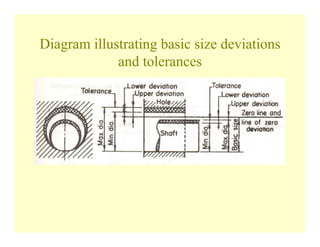
Diagram illustrating basic size deviations
and tolerances
Expressing Tolerances
The problem of selective
assembly
Hole or Shaft basis
IS:919-1963 (revised): Recommendations for
Limits and Fits for Engineering
• Eighteen standard grades of tolerances with
designations IT01, IT0, IT01-----IT16.
• Twenty seven fundamental deviations indicated
by letters. Capital letters are used for hole and
small letter are used for shaft.
• The values of these tolerance grades or
fundamental deviations depend on the basic size
of the assembly.
• One example of fit may be 60mm H8/f7 Shaft
basis.
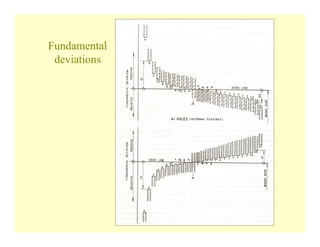
Fundamental
deviations
Commonly used fits for holes
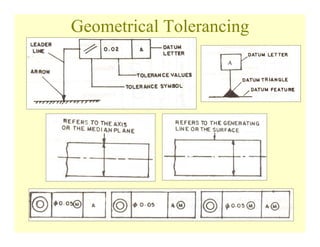
Geometrical Tolerancing
Geometric characteristics symbol
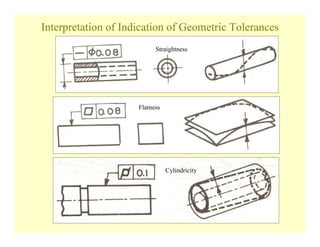
Interpretation of Indication of Geometric Tolerances
Straightness
Flatness
Cylindricity
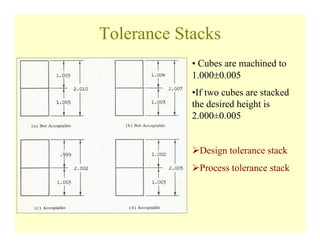
Tolerance Stacks
• Cubes are machined to
1.000±0.005
•If two cubes are stacked
the desired height is
2.000±0.005
Design tolerance stack
Process tolerance stack
Effect of tolerance stacking
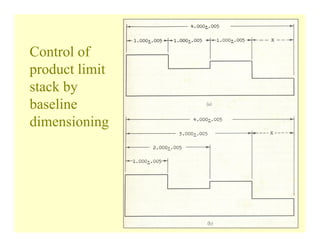
Control of
product limit
stack by
baseline
dimensioning
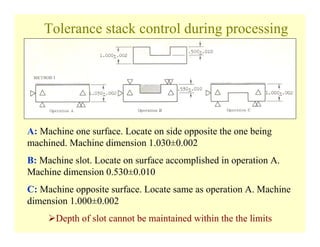
Tolerance stack control during processing
A: Machine one surface. Locate on side opposite the one being
machined. Machine dimension 1.030±0.002
B: Machine slot. Locate on surface accomplished in operation A.
Machine dimension 0.530±0.010
C: Machine opposite surface. Locate same as operation A. Machine
dimension 1.000±0.002
Depth of slot cannot be maintained within the the limits
A: Same as in method I.
B: same as in method I except tolerance on slot have been tightened
to ±0.006.
C: same as in method I.
Depth of the slot is as specified, however tightening tolerances
will result into higher costs.
A: same as in method I.
B: Machine opposite surface. Locate from surface accomplished
in operation A. Machine dimension 1.000±0.002
C: Machine slot. Locate on surface accomplished in either
operation A or B. Machine dimension 0.500±0.010
This is the best method as no tolerance tightening is done and
dimensions are achieved within the specifications.
Cost of Arbitrary tolerance selection
Tolerance analysis

Tolerance analysis

  • 1.
    Tolerance Analysis Dr. P.M. Pandey http://paniit.iitd.ac.in/~pmpandey
  • 2.
    Causes of WorkpieceVariation • The machines which perform operations on the workpiece may have inherent inaccuracies built into them. • The tools used on the machines are subject to dulling, general wear, chipping, breaking, and differences occurs due to regrinding • The material used is subjected to variations • The involvement of human elements • Any other cause by Chance.
  • 3.
    Term used indimensioning workpiece dimensions • Nominal Size: It has no specified limits or accuracy but indicates a close approximation to some standard size. For eg. a half inch nut will fit into a half inch bolt. • Basic Size: It is the exact theoretical size from which the limits are established through the applications of allowances and tolerances. • Allowance: an allowance is an intentional difference between maximum material limits of mating parts. • Tolerance: A tolerance is the total permissible variation from the specified basic size of the part. • Limit: Limits are extreme permissible dimension of the part
  • 4.
    Diagram illustrating basicsize deviations and tolerances
  • 5.
  • 6.
    The problem ofselective assembly
  • 7.
  • 8.
    IS:919-1963 (revised): Recommendationsfor Limits and Fits for Engineering • Eighteen standard grades of tolerances with designations IT01, IT0, IT01-----IT16. • Twenty seven fundamental deviations indicated by letters. Capital letters are used for hole and small letter are used for shaft. • The values of these tolerance grades or fundamental deviations depend on the basic size of the assembly. • One example of fit may be 60mm H8/f7 Shaft basis.
  • 9.
  • 10.
  • 11.
  • 12.
  • 14.
    Interpretation of Indicationof Geometric Tolerances Straightness Flatness Cylindricity
  • 17.
    Tolerance Stacks • Cubesare machined to 1.000±0.005 •If two cubes are stacked the desired height is 2.000±0.005 Design tolerance stack Process tolerance stack
  • 18.
  • 19.
    Control of product limit stackby baseline dimensioning
  • 20.
    Tolerance stack controlduring processing A: Machine one surface. Locate on side opposite the one being machined. Machine dimension 1.030±0.002 B: Machine slot. Locate on surface accomplished in operation A. Machine dimension 0.530±0.010 C: Machine opposite surface. Locate same as operation A. Machine dimension 1.000±0.002 Depth of slot cannot be maintained within the the limits
  • 21.
    A: Same asin method I. B: same as in method I except tolerance on slot have been tightened to ±0.006. C: same as in method I. Depth of the slot is as specified, however tightening tolerances will result into higher costs.
  • 22.
    A: same asin method I. B: Machine opposite surface. Locate from surface accomplished in operation A. Machine dimension 1.000±0.002 C: Machine slot. Locate on surface accomplished in either operation A or B. Machine dimension 0.500±0.010 This is the best method as no tolerance tightening is done and dimensions are achieved within the specifications.
  • 23.
    Cost of Arbitrarytolerance selection