PROCESS PLANNING & COST ESTIMATION
Unit – I
INTRODUCTION TO PROCESS PLANNING
B.Prabhu
AP /Mechanical,
Kamaraj College of Engineering & Technology,
Madurai
Introduction
• Manufacturing:
the making of products from raw materials using
various processes, equipment, operations and
manpower according to a detailed plan.
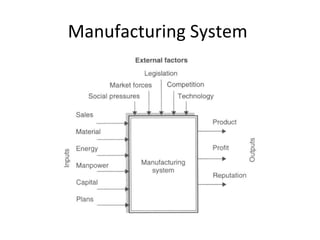
Manufacturing System
PROCESS PLANNING
• comprises the selection and sequencing of processes and
operations to transform a chosen raw material into a
finished component.
• It is the act of preparing detailed work instructions to
produce a component. This includes the selection of
manufacturing processes and operations, production
equipment, tooling and jigs and fixtures.
• It will also normally include determining manufacturing
parameters and specifying criteria for the selection of
quality assurance (QA) methods to ensure product quality
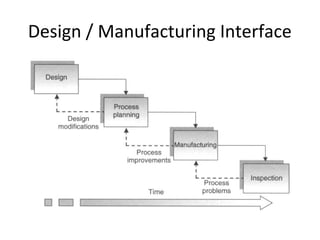
Design / Manufacturing Interface
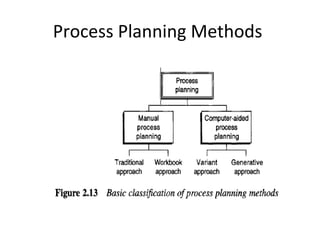
Process Planning Methods
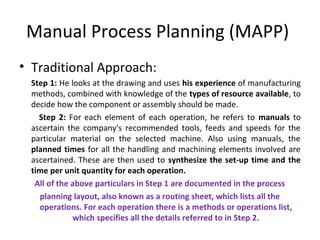
Manual Process Planning (MAPP)
• Traditional Approach:
Step 1: He looks at the drawing and uses his experience of manufacturing
methods, combined with knowledge of the types of resource available, to
decide how the component or assembly should be made.
Step 2: For each element of each operation, he refers to manuals to
ascertain the company's recommended tools, feeds and speeds for the
particular material on the selected machine. Also using manuals, the
planned times for all the handling and machining elements involved are
ascertained. These are then used to synthesize the set-up time and the
time per unit quantity for each operation.
All of the above particulars in Step 1 are documented in the process
planning layout, also known as a routing sheet, which lists all the
operations. For each operation there is a methods or operations list,
which specifies all the details referred to in Step 2.
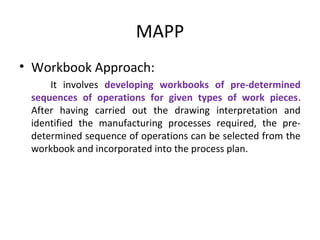
MAPP
• Workbook Approach:
It involves developing workbooks of pre-determined
sequences of operations for given types of work pieces.
After having carried out the drawing interpretation and
identified the manufacturing processes required, the pre-
determined sequence of operations can be selected from the
workbook and incorporated into the process plan.
MAPP – Merits / Demerits
• Merits: low-cost task and is flexible
• Demerits:
Excessive clerical content : excessive paperwork
Lack of consistency in planning
Late design modifications
Changing technology
Computer Aided Process Planning
(CAPP)
• represents the link between design and
manufacturing in a CAD/CAM system.
• Variant or Retrieval Method of Process
Planning (Retrieval CAPP System)
• Generative method of process planning
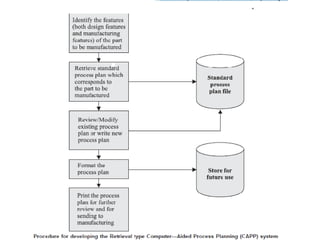
Variant or Retrieval CAPP
• the computer makes a search of its storage or a data base or
a no. of standard or completed process plans that have been
previously developed by the company’s process planners.
• The process plan retrieved is then modified or suitably
varied (i.e., altered) by the process planner, to suit the exact
requirements of the current part design.
• Group Technology concepts, parts classification and coding
Generative CAPP
• In this method the computer uses the stored manufacturing
and design data to generate a complete list of all possible
process plans that could be used to manufacture the current
part.
• It then exhaustively searches this list for the one which
optimizes the cost function.
• This method always yields the optimum process plan
for manufacturing a particular part.
ARTIFICIAL INTELLIGENCE
CAPP – MERITS / DEMERITS
• Process rationalization and standardization
• CAPP helps in arriving at standard and consistent
process plans
• Increased productivity of process planners
• Reduced lead time for process planning
• Improved legibility and readability
• Incorporation of other application programmes
Purpose / Objective / Importance
of Process planning
• Find the systematic determination of the engg
processes & Systems
• Identify the make / Buy decision
• Make a smooth level of production
• Predict the quantity of production, Effective
use of facilities
• Reduce the manufacturing cost of production
Informations – Process planning
• Product data
• Volume of production
• Quality requirements
• Equipments & Personal available
• Time available to perform the work / Delivery
date
Process Selection
• Factors:
• Shape requirements – Solid / Hollow / Chamfer / Thread /
Groove / Hole
• Size Requirements – Volume of production
Small Size – Process layout; large Size – Fixed layout
• Tolerance requirments : Precision : Grinding > Turning
• Surface finish requirements : Reaming > Drilling
• Material requirements : Hard mtl – Carbide / Ceramic tool
Soft mtl – Jigs & fixtures need
Process selection procedure
• Developing a statement of manufacturing
operations to be performed
• Establish a provisional process
• Develop a list of process alternatives
• Step by step comparison of provisional
process with process alternatives
• Communicate the finalised process plan
• Perform & Execution
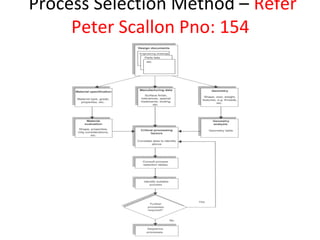
Process Selection Method – Refer
Peter Scallon Pno: 154
Production Equipment Selection
• Factors:
 Technical factors:
 Physical size – M/c able to cope with weight of W/P
 M/c Accuracy – able to produce the products with
specification limit, geometric tolerance
 Surface Finish
 Operational factors:
 Batch size - Break Even anlaysis to find EOQ, Best M/c
 Capacity
 Availability
Production Equipment procedure
• Refer Notes
Tooling Selection
• Factors
Manufacturing Practice / Process
M/c tool characteristics
Processing time
Availability
Processing capability
Tooling Selection – Procedure
• Evaluation of Process / Machine Selection
• Analysis of machining operations
• Analysis of W/p characteristics
• Tooling analysis
• Selection of tooling
Process Planning Activities /
Procedure
• Engineering drawings interpretation ;
• knowledge of materials for manufacture;
• knowledge of manufacturing processes;
• knowledge of jigs and fixtures;
• knowledge of the relative costs of materials, processes and
tooling;
• an ability to calculate manufacturing parameters and costs;
• knowledge of inspection/QA procedures and specifications.
Process Planning Activities
• Drawing Interpretation
 contain a variety of information which can help assess the
processing requirements.
 The interpretation of the drawing will include assessing the
part geometry, dimensions and associated tolerances,
geometric tolerances, surface finish specifications, the
material specification and the number of parts required
Drawing Interpretation Uses
• to identify the relevant drawing information that helps the
process planner identify critical processing factors.
• identify appropriate supplementary information from the
drawing to aid the process planning;
• identify and interpret dimensional information from the
drawing;
• identify and interpret geometric information from the
drawing;
• identify the critical processing factors for the component
from the dimensional and geometric information.
to identify the relevant drawing information that helps the
process planner identify critical processing factors.
• Engineering Drawing
Detail Drawing; Assembly drawing; combined drawing
Detail drawings
contain all the information required to manufacture the item
or items represented. This information will include all
dimensions, tolerances, surface finish specifications, and
material specifications.
Types : : single-part drawings; collective drawings
Engineering Drawing
• Assembly drawings
contain all the information required to
assemble two or more parts together
Types:
• single-part assembly drawings; collective
assembly drawings
2. Identifying useful supplementary information apart from
geometry
• material and specification;
• notes on special material treatments;
• notes on surface finish;
• general tolerances;
• keys to geometrical tolerances;
• notes on equivalent parts;
• notes on screw thread forms;
• tool references;
• gauge references;
• quantity to be produced;
• parts lists (in the case of assembly drawings).
3. Identify and interpret dimensional information from the
drawing
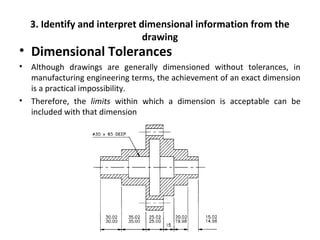
• Dimensional Tolerances
• Although drawings are generally dimensioned without tolerances, in
manufacturing engineering terms, the achievement of an exact dimension
is a practical impossibility.
• Therefore, the limits within which a dimension is acceptable can be
included with that dimension
• Bilateral / Unilateral tolerances
Allowance is allowable for upper & lower limits – Bilateral tolerances
Allowance is allowable for either upper or lower limits – Unilateral tolerances
• Limits & Fits
Limits - Two extreme permissible sizes of dimension between actual size of
dimension is contained.
Fits (Degree of tightness of looseness) - relationship existing between two
mating parts with respect to amount of play or interference which is
present when they are assembled together.
Types ; Clearance fit , Interference fit, Transition fit
• Hole basis
• Shaft basis
• Clearance fit - the shaft is made smaller than the hole
under all extremes of tolerance, that is, the upper size of the
shaft is smaller than the lower size of the hole, allowing it to
rotate within the hole
Ex: shaft bearings and where it is a requirement for one part
to slide within another.
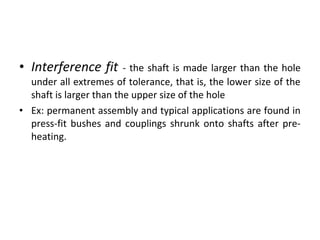
• Interference fit - the shaft is made larger than the hole
under all extremes of tolerance, that is, the lower size of the
shaft is larger than the upper size of the hole
• Ex: permanent assembly and typical applications are found in
press-fit bushes and couplings shrunk onto shafts after pre-
heating.
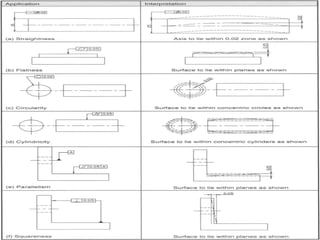
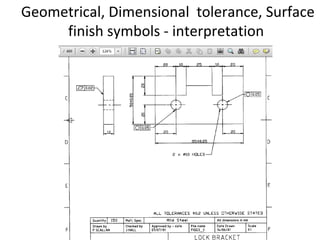
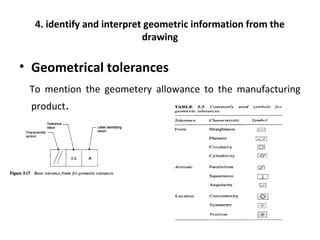
4. identify and interpret geometric information from the
drawing
• Geometrical tolerances
To mention the geometery allowance to the manufacturing
product.
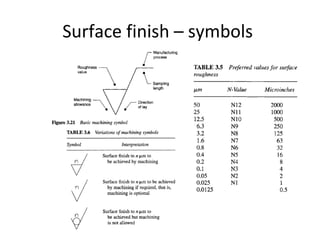
Surface finish – symbols
Material Evaluation – Objective
• identify and describe the common materials used for
manufacture;
• identify and describe the main properties of materials;
• identify and describe common material selection processes;
• identify and describe the common processes used for
manufacture;
• carry out an overall evaluation of the selection of materials
for manufacture in terms of processes;
• select suitable processes for a given part/product based on
the critical
• processing factors identified during the drawing
interpretation.
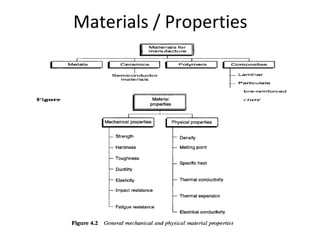
Materials / Properties
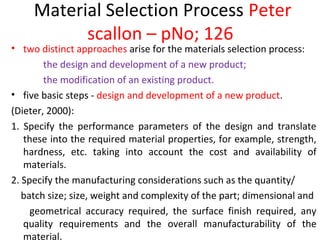
Material Selection Process Peter
scallon – pNo; 126
• two distinct approaches arise for the materials selection process:
the design and development of a new product;
the modification of an existing product.
• five basic steps - design and development of a new product.
(Dieter, 2000):
1. Specify the performance parameters of the design and translate
these into the required material properties, for example, strength,
hardness, etc. taking into account the cost and availability of
materials.
2. Specify the manufacturing considerations such as the quantity/
batch size; size, weight and complexity of the part; dimensional and
geometrical accuracy required, the surface finish required, any
quality requirements and the overall manufacturability of the
material.
Material Selection process contd…
• Draw up a shortlist of candidate materials from the largest
possible database of materials deemed suitable for the
application.
• Evaluate the candidate materials in more detail. Compare
each, based on product performance, cost, availability and
manufacturability. The result of this evaluation should be the
selection of a single material.
• Develop design data and/or a design specification for the
chosen material.
Existing product – matl selection
• Evaluate the current product in terms of the materials
performance, manufacturing process requirements and cost.
• Identify which characteristics have to be improved for
enhanced product performance.
• Search for alternative materials and/or manufacturing routes.
• Compile a shortlist of materials and manufacturing routes.
Evaluate each in terms of the cost of manufactured parts.
• Evaluate the results of Step 4 and employ the best
alternative.
Material selection methods
• selection with computer-aided databases;
• performance indices;
• decision matrices;
• selection with expert systems;
• value analysis (particularly for materials
substitution);
• failure analysis;
• cost-benefit analysis.
Material evaluation method
Evaluation should focus on three main areas
(DeGarmo et al., 1988):
• shape or geometry considerations;
• Material property requirements;
• manufacturing considerations.
shape or geometry considerations
• What is the relative size of the component?
• How complex is the shape? Is it symmetrical at all? Uniform
cross sections?
• Will it be more than one piece?
• Are there enough dimensions to enable manufacture?
• Are there any dimensional tolerances outside the general
tolerance requirements?
• How does this part mate in a sub-assembly or assembly?
• What are the surface finish requirements?
• Have allowances been made for wear during service?
• Are there any minor design modifications that can
significantly improve manufacturability, that is, design for
manufacture?
Material property requirements
• mechanical properties;
• physical properties;
• service environment.
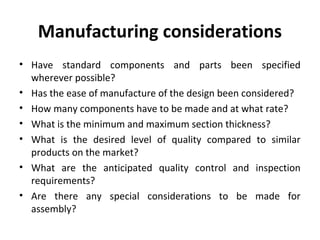
Manufacturing considerations
• Have standard components and parts been specified
wherever possible?
• Has the ease of manufacture of the design been considered?
• How many components have to be made and at what rate?
• What is the minimum and maximum section thickness?
• What is the desired level of quality compared to similar
products on the market?
• What are the anticipated quality control and inspection
requirements?
• Are there any special considerations to be made for
assembly?
Geometrical, Dimensional tolerance, Surface
finish symbols - interpretation
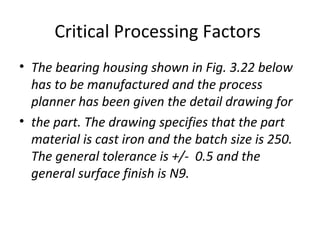
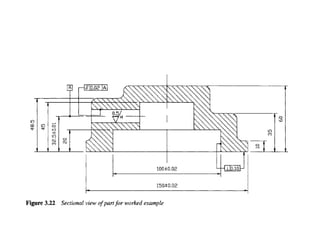
Critical Processing Factors
• The bearing housing shown in Fig. 3.22 below
has to be manufactured and the process
planner has been given the detail drawing for
• the part. The drawing specifies that the part
material is cast iron and the batch size is 250.
The general tolerance is +/- 0.5 and the
general surface finish is N9.
Questions
• Methods (Approaches) of Process planning – Refer Peter scallon, Pno
58 & Elanchezhian – Pno 44
• Process selection – factors, Method – Refer Peter scallon 152
• Equipment selection – factors, Procedure – Refer Peter scallon 197
• Tooling selection – factors, Procedure Refer Peter scallon 207
• Material selection & Evaluation – Aim, Process, Method – Refer peter
scallon 126
• Drawing Interpretation – peter scallon – Pno: 69 & notes
• Drawing Interpretation – with analysing symbols (2 Analysis type
question – Symbols Interpretation – Refer Notes & Critical Processing
factors – Refer Peter scallon – pno: 101)
• Process Planning Procedure / Activities - Elanchezhian – Pno 39,
Information reqd - Elanchezhian – Pno 38.

Process Planning & Cost Estimation

  • 1.
    PROCESS PLANNING &COST ESTIMATION Unit – I INTRODUCTION TO PROCESS PLANNING B.Prabhu AP /Mechanical, Kamaraj College of Engineering & Technology, Madurai
  • 2.
    Introduction • Manufacturing: the makingof products from raw materials using various processes, equipment, operations and manpower according to a detailed plan.
  • 3.
  • 4.
    PROCESS PLANNING • comprisesthe selection and sequencing of processes and operations to transform a chosen raw material into a finished component. • It is the act of preparing detailed work instructions to produce a component. This includes the selection of manufacturing processes and operations, production equipment, tooling and jigs and fixtures. • It will also normally include determining manufacturing parameters and specifying criteria for the selection of quality assurance (QA) methods to ensure product quality
  • 5.
  • 6.
  • 7.
    Manual Process Planning(MAPP) • Traditional Approach: Step 1: He looks at the drawing and uses his experience of manufacturing methods, combined with knowledge of the types of resource available, to decide how the component or assembly should be made. Step 2: For each element of each operation, he refers to manuals to ascertain the company's recommended tools, feeds and speeds for the particular material on the selected machine. Also using manuals, the planned times for all the handling and machining elements involved are ascertained. These are then used to synthesize the set-up time and the time per unit quantity for each operation. All of the above particulars in Step 1 are documented in the process planning layout, also known as a routing sheet, which lists all the operations. For each operation there is a methods or operations list, which specifies all the details referred to in Step 2.
  • 8.
    MAPP • Workbook Approach: Itinvolves developing workbooks of pre-determined sequences of operations for given types of work pieces. After having carried out the drawing interpretation and identified the manufacturing processes required, the pre- determined sequence of operations can be selected from the workbook and incorporated into the process plan.
  • 9.
    MAPP – Merits/ Demerits • Merits: low-cost task and is flexible • Demerits: Excessive clerical content : excessive paperwork Lack of consistency in planning Late design modifications Changing technology
  • 10.
    Computer Aided ProcessPlanning (CAPP) • represents the link between design and manufacturing in a CAD/CAM system. • Variant or Retrieval Method of Process Planning (Retrieval CAPP System) • Generative method of process planning
  • 11.
    Variant or RetrievalCAPP • the computer makes a search of its storage or a data base or a no. of standard or completed process plans that have been previously developed by the company’s process planners. • The process plan retrieved is then modified or suitably varied (i.e., altered) by the process planner, to suit the exact requirements of the current part design. • Group Technology concepts, parts classification and coding
  • 13.
    Generative CAPP • Inthis method the computer uses the stored manufacturing and design data to generate a complete list of all possible process plans that could be used to manufacture the current part. • It then exhaustively searches this list for the one which optimizes the cost function. • This method always yields the optimum process plan for manufacturing a particular part. ARTIFICIAL INTELLIGENCE
  • 14.
    CAPP – MERITS/ DEMERITS • Process rationalization and standardization • CAPP helps in arriving at standard and consistent process plans • Increased productivity of process planners • Reduced lead time for process planning • Improved legibility and readability • Incorporation of other application programmes
  • 15.
    Purpose / Objective/ Importance of Process planning • Find the systematic determination of the engg processes & Systems • Identify the make / Buy decision • Make a smooth level of production • Predict the quantity of production, Effective use of facilities • Reduce the manufacturing cost of production
  • 16.
    Informations – Processplanning • Product data • Volume of production • Quality requirements • Equipments & Personal available • Time available to perform the work / Delivery date
  • 17.
    Process Selection • Factors: •Shape requirements – Solid / Hollow / Chamfer / Thread / Groove / Hole • Size Requirements – Volume of production Small Size – Process layout; large Size – Fixed layout • Tolerance requirments : Precision : Grinding > Turning • Surface finish requirements : Reaming > Drilling • Material requirements : Hard mtl – Carbide / Ceramic tool Soft mtl – Jigs & fixtures need
  • 18.
    Process selection procedure •Developing a statement of manufacturing operations to be performed • Establish a provisional process • Develop a list of process alternatives • Step by step comparison of provisional process with process alternatives • Communicate the finalised process plan • Perform & Execution
  • 19.
    Process Selection Method– Refer Peter Scallon Pno: 154
  • 20.
    Production Equipment Selection •Factors:  Technical factors:  Physical size – M/c able to cope with weight of W/P  M/c Accuracy – able to produce the products with specification limit, geometric tolerance  Surface Finish  Operational factors:  Batch size - Break Even anlaysis to find EOQ, Best M/c  Capacity  Availability
  • 21.
  • 22.
    Tooling Selection • Factors ManufacturingPractice / Process M/c tool characteristics Processing time Availability Processing capability
  • 23.
    Tooling Selection –Procedure • Evaluation of Process / Machine Selection • Analysis of machining operations • Analysis of W/p characteristics • Tooling analysis • Selection of tooling
  • 24.
    Process Planning Activities/ Procedure • Engineering drawings interpretation ; • knowledge of materials for manufacture; • knowledge of manufacturing processes; • knowledge of jigs and fixtures; • knowledge of the relative costs of materials, processes and tooling; • an ability to calculate manufacturing parameters and costs; • knowledge of inspection/QA procedures and specifications.
  • 25.
    Process Planning Activities •Drawing Interpretation  contain a variety of information which can help assess the processing requirements.  The interpretation of the drawing will include assessing the part geometry, dimensions and associated tolerances, geometric tolerances, surface finish specifications, the material specification and the number of parts required
  • 26.
    Drawing Interpretation Uses •to identify the relevant drawing information that helps the process planner identify critical processing factors. • identify appropriate supplementary information from the drawing to aid the process planning; • identify and interpret dimensional information from the drawing; • identify and interpret geometric information from the drawing; • identify the critical processing factors for the component from the dimensional and geometric information.
  • 27.
    to identify therelevant drawing information that helps the process planner identify critical processing factors. • Engineering Drawing Detail Drawing; Assembly drawing; combined drawing Detail drawings contain all the information required to manufacture the item or items represented. This information will include all dimensions, tolerances, surface finish specifications, and material specifications. Types : : single-part drawings; collective drawings
  • 28.
    Engineering Drawing • Assemblydrawings contain all the information required to assemble two or more parts together Types: • single-part assembly drawings; collective assembly drawings
  • 29.
    2. Identifying usefulsupplementary information apart from geometry • material and specification; • notes on special material treatments; • notes on surface finish; • general tolerances; • keys to geometrical tolerances; • notes on equivalent parts; • notes on screw thread forms; • tool references; • gauge references; • quantity to be produced; • parts lists (in the case of assembly drawings).
  • 30.
    3. Identify andinterpret dimensional information from the drawing • Dimensional Tolerances • Although drawings are generally dimensioned without tolerances, in manufacturing engineering terms, the achievement of an exact dimension is a practical impossibility. • Therefore, the limits within which a dimension is acceptable can be included with that dimension
  • 31.
    • Bilateral /Unilateral tolerances Allowance is allowable for upper & lower limits – Bilateral tolerances Allowance is allowable for either upper or lower limits – Unilateral tolerances • Limits & Fits Limits - Two extreme permissible sizes of dimension between actual size of dimension is contained. Fits (Degree of tightness of looseness) - relationship existing between two mating parts with respect to amount of play or interference which is present when they are assembled together. Types ; Clearance fit , Interference fit, Transition fit
  • 32.
    • Hole basis •Shaft basis • Clearance fit - the shaft is made smaller than the hole under all extremes of tolerance, that is, the upper size of the shaft is smaller than the lower size of the hole, allowing it to rotate within the hole Ex: shaft bearings and where it is a requirement for one part to slide within another.
  • 33.
    • Interference fit- the shaft is made larger than the hole under all extremes of tolerance, that is, the lower size of the shaft is larger than the upper size of the hole • Ex: permanent assembly and typical applications are found in press-fit bushes and couplings shrunk onto shafts after pre- heating.
  • 34.
    4. identify andinterpret geometric information from the drawing • Geometrical tolerances To mention the geometery allowance to the manufacturing product.
  • 36.
  • 37.
    Material Evaluation –Objective • identify and describe the common materials used for manufacture; • identify and describe the main properties of materials; • identify and describe common material selection processes; • identify and describe the common processes used for manufacture; • carry out an overall evaluation of the selection of materials for manufacture in terms of processes; • select suitable processes for a given part/product based on the critical • processing factors identified during the drawing interpretation.
  • 38.
  • 39.
    Material Selection ProcessPeter scallon – pNo; 126 • two distinct approaches arise for the materials selection process: the design and development of a new product; the modification of an existing product. • five basic steps - design and development of a new product. (Dieter, 2000): 1. Specify the performance parameters of the design and translate these into the required material properties, for example, strength, hardness, etc. taking into account the cost and availability of materials. 2. Specify the manufacturing considerations such as the quantity/ batch size; size, weight and complexity of the part; dimensional and geometrical accuracy required, the surface finish required, any quality requirements and the overall manufacturability of the material.
  • 40.
    Material Selection processcontd… • Draw up a shortlist of candidate materials from the largest possible database of materials deemed suitable for the application. • Evaluate the candidate materials in more detail. Compare each, based on product performance, cost, availability and manufacturability. The result of this evaluation should be the selection of a single material. • Develop design data and/or a design specification for the chosen material.
  • 41.
    Existing product –matl selection • Evaluate the current product in terms of the materials performance, manufacturing process requirements and cost. • Identify which characteristics have to be improved for enhanced product performance. • Search for alternative materials and/or manufacturing routes. • Compile a shortlist of materials and manufacturing routes. Evaluate each in terms of the cost of manufactured parts. • Evaluate the results of Step 4 and employ the best alternative.
  • 42.
    Material selection methods •selection with computer-aided databases; • performance indices; • decision matrices; • selection with expert systems; • value analysis (particularly for materials substitution); • failure analysis; • cost-benefit analysis.
  • 43.
    Material evaluation method Evaluationshould focus on three main areas (DeGarmo et al., 1988): • shape or geometry considerations; • Material property requirements; • manufacturing considerations.
  • 44.
    shape or geometryconsiderations • What is the relative size of the component? • How complex is the shape? Is it symmetrical at all? Uniform cross sections? • Will it be more than one piece? • Are there enough dimensions to enable manufacture? • Are there any dimensional tolerances outside the general tolerance requirements? • How does this part mate in a sub-assembly or assembly? • What are the surface finish requirements? • Have allowances been made for wear during service? • Are there any minor design modifications that can significantly improve manufacturability, that is, design for manufacture?
  • 45.
    Material property requirements •mechanical properties; • physical properties; • service environment.
  • 46.
    Manufacturing considerations • Havestandard components and parts been specified wherever possible? • Has the ease of manufacture of the design been considered? • How many components have to be made and at what rate? • What is the minimum and maximum section thickness? • What is the desired level of quality compared to similar products on the market? • What are the anticipated quality control and inspection requirements? • Are there any special considerations to be made for assembly?
  • 47.
    Geometrical, Dimensional tolerance,Surface finish symbols - interpretation
  • 48.
    Critical Processing Factors •The bearing housing shown in Fig. 3.22 below has to be manufactured and the process planner has been given the detail drawing for • the part. The drawing specifies that the part material is cast iron and the batch size is 250. The general tolerance is +/- 0.5 and the general surface finish is N9.
  • 50.
    Questions • Methods (Approaches)of Process planning – Refer Peter scallon, Pno 58 & Elanchezhian – Pno 44 • Process selection – factors, Method – Refer Peter scallon 152 • Equipment selection – factors, Procedure – Refer Peter scallon 197 • Tooling selection – factors, Procedure Refer Peter scallon 207 • Material selection & Evaluation – Aim, Process, Method – Refer peter scallon 126 • Drawing Interpretation – peter scallon – Pno: 69 & notes • Drawing Interpretation – with analysing symbols (2 Analysis type question – Symbols Interpretation – Refer Notes & Critical Processing factors – Refer Peter scallon – pno: 101) • Process Planning Procedure / Activities - Elanchezhian – Pno 39, Information reqd - Elanchezhian – Pno 38.