Discover how LNG regasification works and its role in cleaner energy source. Learn about LNG fuelling stations and what is INOXCVA contribution to efficient natural gas distribution.
Blog: https://inoxcva.com/blog/how-does-lng-regasification-work/
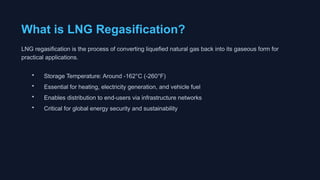
What is LNGRegasification?
LNG regasification is the process of converting liquefied natural gas back into its gaseous form for
practical applications.
• Storage Temperature: Around -162°C (-260°F)
• Essential for heating, electricity generation, and vehicle fuel
• Enables distribution to end-users via infrastructure networks
• Critical for global energy security and sustainability
3.
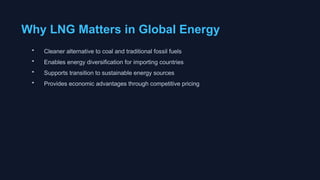
Why LNG Mattersin Global Energy
• Cleaner alternative to coal and traditional fossil fuels
• Enables energy diversification for importing countries
• Supports transition to sustainable energy sources
• Provides economic advantages through competitive pricing
4.
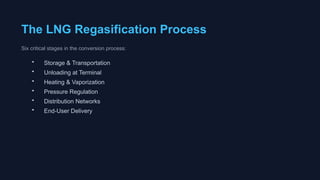
The LNG RegasificationProcess
Six critical stages in the conversion process:
• Storage & Transportation
• Unloading at Terminal
• Heating & Vaporization
• Pressure Regulation
• Distribution Networks
• End-User Delivery
5.
Stage 1: Storage& Transportation
• LNG transported in specialized cryogenic tanks
• Maintains ultra-low temperatures during transit
• Prevents evaporation and energy loss
• Engineered for safety and efficiency during long-distance transport
6.
Stage 2: Unloadingat Terminal
Upon arrival at regasification terminal:
• LNG carriers unload cargo into insulated storage tanks
• Critical to maintain low-temperature conditions
• Prevents premature vaporization
• Ensures product quality and safety compliance
7.
Stage 3: Heating& Vaporization Methods
Three primary heating technologies:
• Open Rack Vaporizers (ORV): Use seawater or ambient air
• Submerged Combustion Vaporizers (SCV): Flame submerged in water
• Heat Exchangers: Transfer heat from hot medium like seawater
8.
Heating Technology Comparison
ORV
Usesseawater or ambient air as heat source
SCV
Submerged flame provides controlled heating
Heat Exchangers
Efficient heat transfer mechanism
9.
Stage 4: PressureRegulation
After heating, gaseous natural gas must be regulated:
• Ensures compliance with pipeline distribution standards
• Maintains safe operating pressures throughout network
• Prevents equipment damage and safety hazards
• Optimizes flow for efficient end-user delivery
10.
Stages 5 &6: Distribution & Delivery
Multiple distribution channels to reach consumers:
• Primary: Pipeline networks for widespread coverage
• Alternative: Truck transport for localized delivery
• Secondary: Smaller ships for regional distribution
• End-uses: Vehicle fuel, industrial heating, electricity generation
11.
The Role ofLNG Fuelling Stations
• Critical infrastructure in the LNG supply chain
• Receive regasified natural gas for distribution
• Power vehicles and supply energy to industries
• Enable transition to cleaner energy sources
• Support localized demand management
12.
Benefits: Environmental Impact
Environmentaladvantages of LNG utilization:
• Produces significantly fewer emissions than coal and oil
• Reduces overall carbon footprint when burned
• Cleaner combustion with lower pollutant levels
• Supports global climate and sustainability goals
13.
Benefits: Energy Security& Economics
• Energy Security: Diversifies energy sources for nations
• Import Capability: Reduces dependence on local reserves
• Cost Efficiency: Lower energy costs for consumers
• Economic Growth: Promotes business and industrial development
14.
Challenges: Infrastructure &Safety
• Infrastructure Costs: Expensive terminals and fuelling stations
• Capital Requirements: High upfront investment needed
• Safety Concerns: LNG is highly flammable
• Risk Management: Critical during transport and processing
15.
Challenges: Environmental Considerations
•Environmental impacts of regasification processes
• Careful management of thermal discharge
• Monitoring of emission levels during operations
• Balance between benefits and environmental costs
16.
Industry Leadership &Innovation
Companies advancing LNG regasification technology:
• INOXCVA: Leading advancements in efficiency and safety
• Continuous improvements in terminal operations
• Innovation in vaporizer technologies
• Enhanced fuelling station infrastructure networks
17.
The Future ofLNG Regasification
• Continued technological improvements in efficiency
• Enhanced safety protocols and monitoring systems
• Expansion of global fuelling station networks
• Integration with renewable energy systems
• Critical role in sustainable energy transition
18.
Key Takeaways
• LNGregasification converts ultra-cold liquid to usable gas
• Six-stage process from storage to end-user delivery
• Environmental and economic benefits drive adoption
• Infrastructure investments support energy security
• Innovation essential for sustainable global energy future