CAD/CAM
TOPIC: CONVENTIONAL AND CAD DESIGN PROCESS
By
J KUMAR CHANDRA,
ASST. PROF.,
DEPARTMENT OF ME,
NNRG-HYDERABAD
DESIGN PROCESS(CONVENTIONAL)
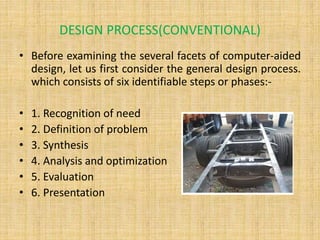
• Before examining the several facets of computer-aided
design, let us first consider the general design process.
which consists of six identifiable steps or phases:-
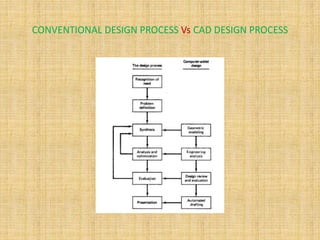
• 1. Recognition of need
• 2. Definition of problem
• 3. Synthesis
• 4. Analysis and optimization
• 5. Evaluation
• 6. Presentation
DESIGN PROCESS(CONVENTIONAL)
1. Recognition of need
Someone recognizes the need that can
be satisfied by a new design
2. Problem definition
Specification of the item
3. Synthesis
creation and conceptualization
DESIGN PROCESS(CONVENTIONAL)
4. Analysis and optimization
the concept is analyzed and redesigned
5. Evaluation
compare design against original specification or
checking errors.
6. Presentation
documenting the design (e.g. drawing)
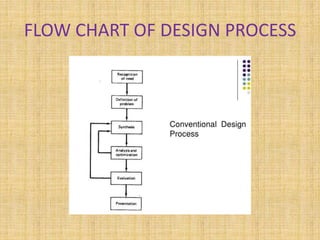
FLOW CHART OF DESIGN PROCESS
DESIGN PROCESS(NON-CONVENTIONAL)
• in CAD design process, the process can be completed
with in only 4 steps
• 1. Geometric modeling
• 2. Engineering analysis
• 3. Design review and evaluation
• 4. Automated drafting
Geometric modeling
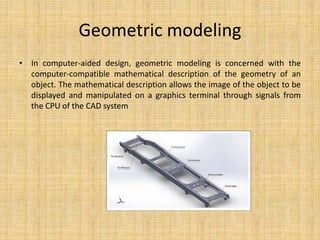
• In computer-aided design, geometric modeling is concerned with the
computer-compatible mathematical description of the geometry of an
object. The mathematical description allows the image of the object to be
displayed and manipulated on a graphics terminal through signals from
the CPU of the CAD system
Engineering analysis
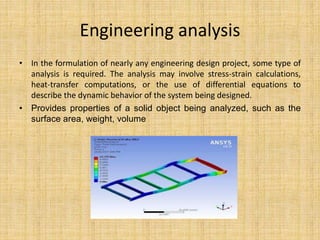
• In the formulation of nearly any engineering design project, some type of
analysis is required. The analysis may involve stress-strain calculations,
heat-transfer computations, or the use of differential equations to
describe the dynamic behavior of the system being designed.
• Provides properties of a solid object being analyzed, such as the
surface area, weight, volume
Design review and evaluation
• Checking the accuracy of the design can be accomplished conveniently on
the graphics terminal. Semiautomatic dimensioning and tolerance
routines which assign size specifications to surfaces indicated by the user
help to reduce the possibility of dimensioning errors
Automated drafting
• Automated drafting involves the creation of hard-
copy engineering drawings directly from the CAD
data base
CONVENTIONAL DESIGN PROCESS Vs CAD DESIGN PROCESS
BENEFITS OF CAD DESIGN PROCESS OVER
CONVENTIONAL DESIGN PROCESS
• 1. Improved engineering productivity
• 2. Shorter lead times
• 3. Better designs provided
• 4. Customer modifications are easier to make
• 5. Faster response to requests for quotations
• 6. Avoidance of subcontracting to meet schedules
• 7. Minimized transcription errors
• 8. Improved accuracy of design
• 9. In analysis, easier recognition of component interactions
• 10. Provides better functional analysis to reduce prototype
testing
• 11. Assistance in preparation of documentation

cad design process VS conventional design process

  • 1.
    CAD/CAM TOPIC: CONVENTIONAL ANDCAD DESIGN PROCESS By J KUMAR CHANDRA, ASST. PROF., DEPARTMENT OF ME, NNRG-HYDERABAD
  • 2.
    DESIGN PROCESS(CONVENTIONAL) • Beforeexamining the several facets of computer-aided design, let us first consider the general design process. which consists of six identifiable steps or phases:- • 1. Recognition of need • 2. Definition of problem • 3. Synthesis • 4. Analysis and optimization • 5. Evaluation • 6. Presentation
  • 3.
    DESIGN PROCESS(CONVENTIONAL) 1. Recognitionof need Someone recognizes the need that can be satisfied by a new design 2. Problem definition Specification of the item 3. Synthesis creation and conceptualization
  • 4.
    DESIGN PROCESS(CONVENTIONAL) 4. Analysisand optimization the concept is analyzed and redesigned 5. Evaluation compare design against original specification or checking errors. 6. Presentation documenting the design (e.g. drawing)
  • 5.
    FLOW CHART OFDESIGN PROCESS
  • 6.
    DESIGN PROCESS(NON-CONVENTIONAL) • inCAD design process, the process can be completed with in only 4 steps • 1. Geometric modeling • 2. Engineering analysis • 3. Design review and evaluation • 4. Automated drafting
  • 7.
    Geometric modeling • Incomputer-aided design, geometric modeling is concerned with the computer-compatible mathematical description of the geometry of an object. The mathematical description allows the image of the object to be displayed and manipulated on a graphics terminal through signals from the CPU of the CAD system
  • 8.
    Engineering analysis • Inthe formulation of nearly any engineering design project, some type of analysis is required. The analysis may involve stress-strain calculations, heat-transfer computations, or the use of differential equations to describe the dynamic behavior of the system being designed. • Provides properties of a solid object being analyzed, such as the surface area, weight, volume
  • 9.
    Design review andevaluation • Checking the accuracy of the design can be accomplished conveniently on the graphics terminal. Semiautomatic dimensioning and tolerance routines which assign size specifications to surfaces indicated by the user help to reduce the possibility of dimensioning errors
  • 10.
    Automated drafting • Automateddrafting involves the creation of hard- copy engineering drawings directly from the CAD data base
  • 11.
    CONVENTIONAL DESIGN PROCESSVs CAD DESIGN PROCESS
  • 12.
    BENEFITS OF CADDESIGN PROCESS OVER CONVENTIONAL DESIGN PROCESS • 1. Improved engineering productivity • 2. Shorter lead times • 3. Better designs provided • 4. Customer modifications are easier to make • 5. Faster response to requests for quotations • 6. Avoidance of subcontracting to meet schedules • 7. Minimized transcription errors • 8. Improved accuracy of design • 9. In analysis, easier recognition of component interactions • 10. Provides better functional analysis to reduce prototype testing • 11. Assistance in preparation of documentation