SHREE SA’D VIDYA MANDAL
INSTITUTE OF TECHNOLOGY
DEPARTMENT OF CIVIL
ENGINEERING
Damped force vibrating Model
Laplace Transforms
Prepared by:-
Name
 Arvindsai Nair
 Dhaval Chavda
 Saptak Patel
 Abhiraj Rathod
Enrollment no.
130454106002
130454106001
140453106015
140453106014
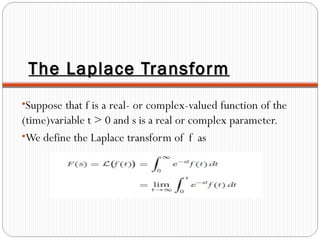
The Laplace TransformThe Laplace Transform
•Suppose that f is a real- or complex-valued function of the
(time)variable t > 0 and s is a real or complex parameter.
•We define the Laplace transform of f as
The Laplace TransformThe Laplace Transform
•Whenever the limit exists (as a finite number). When it
does, the integral is said to converge.
•If the limit does not exist, the integral is said to diverge
and there is no Laplace transform defined for f .
The Laplace TransformThe Laplace Transform
•The notation L ( f ) will also be used to denote the Laplace
transform of f.
•The symbol L is the Laplace transformation, which acts on
functions f =f (t) and generates a new function,
F(s)=L(f(t))
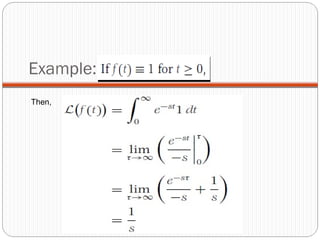
Example:
Then,
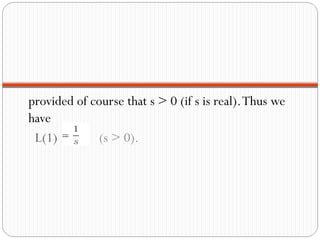
provided of course that s > 0 (if s is real).Thus we
have
L(1) = (s > 0).
The Laplace Transform of δ(t –
a)
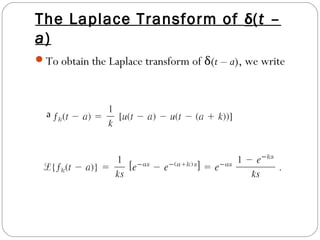
To obtain the Laplace transform of δ(t – a), we write
and take the transform
The Laplace Transform of δ(t –
a)
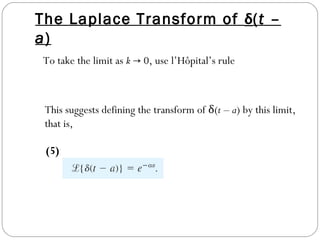
To take the limit as k → 0, use l’Hôpital’s rule
This suggests defining the transform of δ(t – a) by this limit,
that is,
(5)
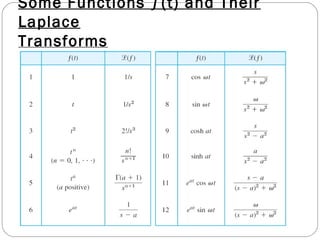
Some Functions ƒ(t) and Their
Laplace
Transforms
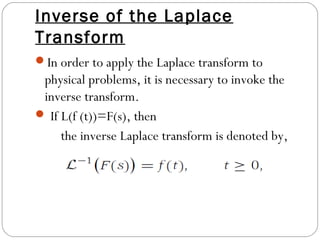
Inverse of the Laplace
Transform
In order to apply the Laplace transform to
physical problems, it is necessary to invoke the
inverse transform.
 If L(f (t))=F(s), then
the inverse Laplace transform is denoted by,
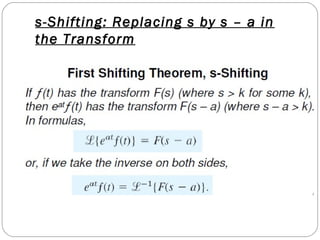
s-Shifting: Replacing s by s – a in
the Transform
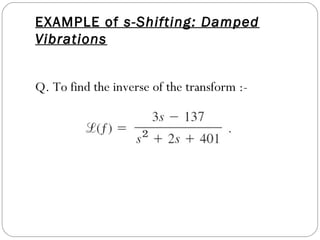
EXAMPLE of s-Shifting: Damped
Vibrations
Q. To find the inverse of the transform :-
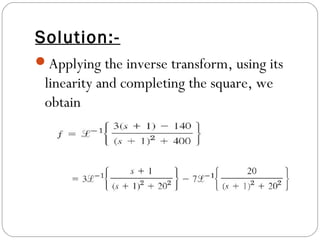
Solution:-
Applying the inverse transform, using its
linearity and completing the square, we
obtain
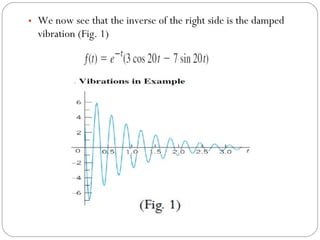
• We now see that the inverse of the right side is the damped
vibration (Fig. 1)
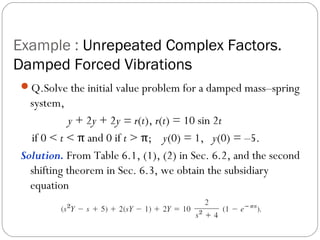
Example : Unrepeated Complex Factors.
Damped Forced Vibrations
Q.Solve the initial value problem for a damped mass–spring
system,
y + 2y + 2y = r(t), r(t) = 10 sin 2t
if 0 < t < π and 0 if t > π; y(0) = 1, y(0) = –5.
Solution. From Table 6.1, (1), (2) in Sec. 6.2, and the second
shifting theorem in Sec. 6.3, we obtain the subsidiary
equation
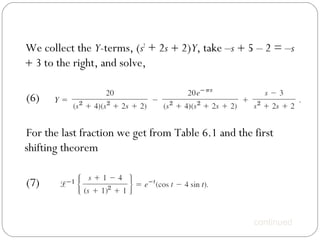
We collect the Y-terms, (s2
+ 2s + 2)Y, take –s + 5 – 2 = –s
+ 3 to the right, and solve,
(6)
For the last fraction we get from Table 6.1 and the first
shifting theorem
(7)
continued
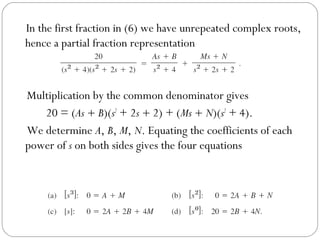
In the first fraction in (6) we have unrepeated complex roots,
hence a partial fraction representation
Multiplication by the common denominator gives
20 = (As + B)(s2
+ 2s + 2) + (Ms + N)(s2
+ 4).
We determine A, B, M, N. Equating the coefficients of each
power of s on both sides gives the four equations
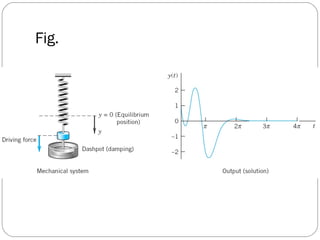
Fig.
Damped force vibrating Model Laplace Transforms

Damped force vibrating Model Laplace Transforms

  • 1.
    SHREE SA’D VIDYAMANDAL INSTITUTE OF TECHNOLOGY DEPARTMENT OF CIVIL ENGINEERING
  • 2.
    Damped force vibratingModel Laplace Transforms
  • 3.
    Prepared by:- Name  ArvindsaiNair  Dhaval Chavda  Saptak Patel  Abhiraj Rathod Enrollment no. 130454106002 130454106001 140453106015 140453106014
  • 4.
    The Laplace TransformTheLaplace Transform •Suppose that f is a real- or complex-valued function of the (time)variable t > 0 and s is a real or complex parameter. •We define the Laplace transform of f as
  • 5.
    The Laplace TransformTheLaplace Transform •Whenever the limit exists (as a finite number). When it does, the integral is said to converge. •If the limit does not exist, the integral is said to diverge and there is no Laplace transform defined for f .
  • 6.
    The Laplace TransformTheLaplace Transform •The notation L ( f ) will also be used to denote the Laplace transform of f. •The symbol L is the Laplace transformation, which acts on functions f =f (t) and generates a new function, F(s)=L(f(t))
  • 7.
  • 8.
    provided of coursethat s > 0 (if s is real).Thus we have L(1) = (s > 0).
  • 9.
    The Laplace Transformof δ(t – a) To obtain the Laplace transform of δ(t – a), we write and take the transform
  • 10.
    The Laplace Transformof δ(t – a) To take the limit as k → 0, use l’Hôpital’s rule This suggests defining the transform of δ(t – a) by this limit, that is, (5)
  • 11.
    Some Functions ƒ(t)and Their Laplace Transforms
  • 12.
    Inverse of theLaplace Transform In order to apply the Laplace transform to physical problems, it is necessary to invoke the inverse transform.  If L(f (t))=F(s), then the inverse Laplace transform is denoted by,
  • 13.
    s-Shifting: Replacing sby s – a in the Transform
  • 14.
    EXAMPLE of s-Shifting:Damped Vibrations Q. To find the inverse of the transform :-
  • 15.
    Solution:- Applying the inversetransform, using its linearity and completing the square, we obtain
  • 16.
    • We nowsee that the inverse of the right side is the damped vibration (Fig. 1)
  • 18.
    Example : UnrepeatedComplex Factors. Damped Forced Vibrations Q.Solve the initial value problem for a damped mass–spring system, y + 2y + 2y = r(t), r(t) = 10 sin 2t if 0 < t < π and 0 if t > π; y(0) = 1, y(0) = –5. Solution. From Table 6.1, (1), (2) in Sec. 6.2, and the second shifting theorem in Sec. 6.3, we obtain the subsidiary equation
  • 19.
    We collect theY-terms, (s2 + 2s + 2)Y, take –s + 5 – 2 = –s + 3 to the right, and solve, (6) For the last fraction we get from Table 6.1 and the first shifting theorem (7) continued
  • 20.
    In the firstfraction in (6) we have unrepeated complex roots, hence a partial fraction representation Multiplication by the common denominator gives 20 = (As + B)(s2 + 2s + 2) + (Ms + N)(s2 + 4). We determine A, B, M, N. Equating the coefficients of each power of s on both sides gives the four equations
  • 21.