1
ODE 2
Boundary-Value Problems
2
Boundary-Value Vs. Initial-Value ODE
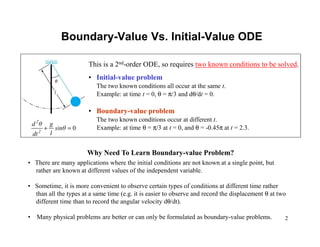
This is a 2nd-order ODE, so requires two known conditions to be solved.
• Initial-value problem
The two known conditions all occur at the same t.
Example: at time t = 0, θ = π/3 and dθ/dt = 0.
• Boundary-value problem
The two known conditions occur at different t.
Example: at time θ = π/3 at t = 0, and θ = -0.45π at t = 2.3.0=+ sinθ
l
g
dt
θd
2
2
Why Need To Learn Boundary-value Problem?
• There are many applications where the initial conditions are not known at a single point, but
rather are known at different values of the independent variable.
• Sometime, it is more convenient to observe certain types of conditions at different time rather
than all the types at a same time (e.g. it is easier to observe and record the displacement θ at two
different time than to record the angular velocity dθ/dt).
• Many physical problems are better or can only be formulated as boundary-value problems.
3
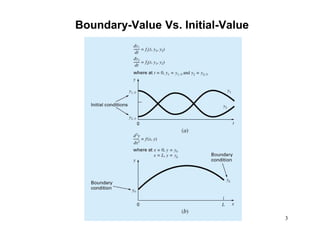
Boundary-Value Vs. Initial-Value
4
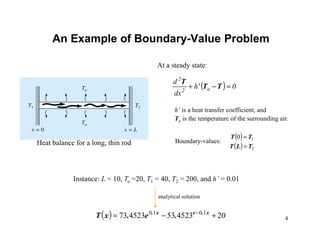
An Example of Boundary-Value Problem
( )
( ) 2
10
TLT
TT
=
=
( ) 0h'
dx
d
a2
2
=−+ TT
T
Heat balance for a long, thin rod
( ) 20452353452373 1010
+−= − x.ex.
.e.xT
analytical solution
At a steady state:
h’ is a heat transfer coefficient, and
Ta is the temperature of the surrounding air.
Boundary-values:
Instance: L = 10, Ta =20, T1 = 40, T2 = 200, and h’ = 0.01
5
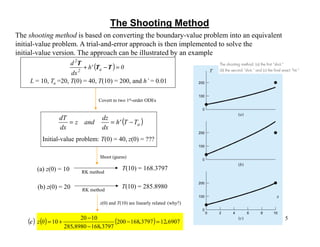
The Shooting Method
( ) 0h'
dx
d
a2
2
=−+ TT
T
( )aTTh'
dx
dz
andz
dx
dT
−==
( ) ( ) ( ) 6907123797168200
37971688980285
1020
10 ..
..
c =−
−
−
+=0z
Covert to two 1st-order ODEs
Initial-value problem: T(0) = 40, z(0) = ???
L = 10, Ta =20, T(0) = 40, T(10) = 200, and h’ = 0.01
Shoot (guess)
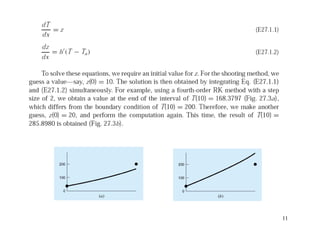
(a) z(0) = 10 RK method
T(10) = 168.3797
(b) z(0) = 20 RK method
T(10) = 285.8980
z(0) and T(10) are linearly related (why?)
T
x
The shooting method is based on converting the boundary-value problem into an equivalent
initial-value problem. A trial-and-error approach is then implemented to solve the
initial-value version. The approach can be illustrated by an example
6
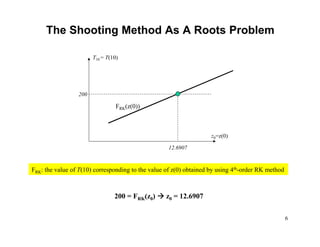
The Shooting Method As A Roots Problem
FRK: the value of T(10) corresponding to the value of z(0) obtained by using 4th-order RK method
200 = FRK(z0) z0 = 12.6907
T10 = T(10)
z0=z(0)
200
12.6907
FRK(z(0))
7
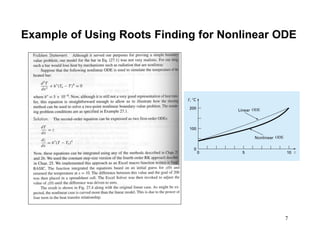
Example of Using Roots Finding for Nonlinear ODE
ODE
ODE
8
Finite-Difference Approach
(An Example)
2
11 2
x∆
+−
= −+
=
iii
xx
2
2
TTT
dx
Td
i
( ) 0h'
dx
d
a2
2
=−+ TT
T
( ) 0
2
2
11
=−
∆
+− −+
ai
iii
T-Th'
x
TTT
( ) aiii Txh'TTxh'T 2
1
2
1 2 ∆=−∆++− +−
Instance: Ta =20, T(0) = 40, T(10) = 200, and h’ = 0.01; use ∆x = 2














=


























−
−−
−−
−
8200
80
80
840
042100
104210
010421
001042
4
3
2
1
.
.
.
.
.
.
.
.
T
T
T
T
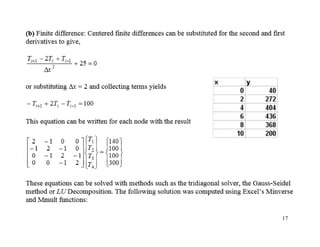
[ ] [ ]2004795159538212477859396986540543210 ....=TTTTTT
Centered finite difference
9
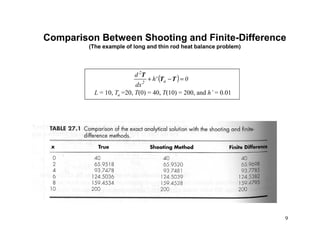
Comparison Between Shooting and Finite-Difference
(The example of long and thin rod heat balance problem)
( ) 0h'
dx
d
a2
2
=−+ TT
T
L = 10, Ta =20, T(0) = 40, T(10) = 200, and h’ = 0.01
Homework
10
1-
2-
3-
11
12
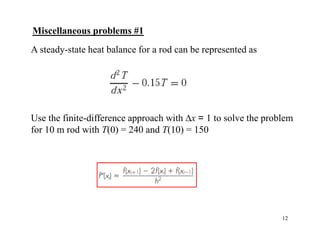
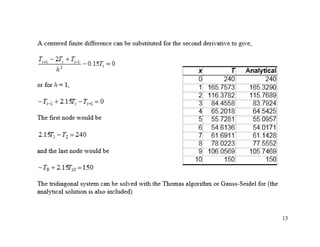
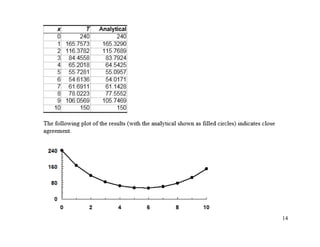
A steady-state heat balance for a rod can be represented as
Use the finite-difference approach with ∆x = 1 to solve the problem
for 10 m rod with T(0) = 240 and T(10) = 150
Miscellaneous problems #1
13
14
15
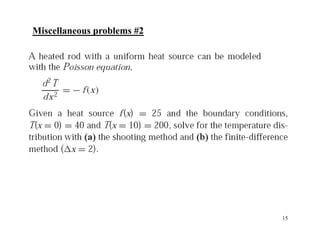
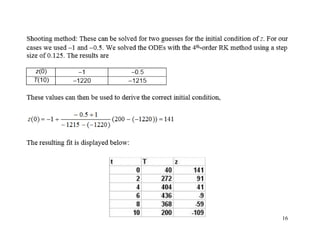
Miscellaneous problems #2
16
17
Finite Difference Method
Example 1
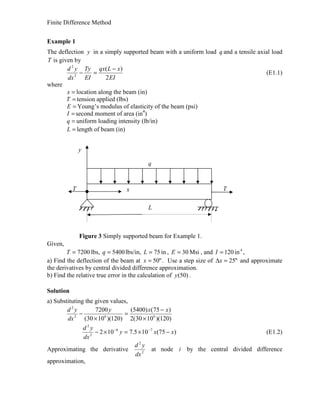
The deflection y in a simply supported beam with a uniform load q and a tensile axial load
T is given by
EI
xLqx
EI
Ty
dx
yd
2
)(
2
2
−
=− (E1.1)
where
=x location along the beam (in)
=T tension applied (lbs)
=E Young’s modulus of elasticity of the beam (psi)
=I second moment of area (in4
)
=q uniform loading intensity (lb/in)
=L length of beam (in)
Figure 3 Simply supported beam for Example 1.
Given,
7200=T lbs, 5400=q lbs/in, in75=L , Msi30=E , and 4
in120=I ,
a) Find the deflection of the beam at "50=x . Use a step size of "25=∆x and approximate
the derivatives by central divided difference approximation.
b) Find the relative true error in the calculation of )50(y .
Solution
a) Substituting the given values,
)120)(1030(2
)75()5400(
)120)(1030(
7200
662
2
×
−
=
×
−
xxy
dx
yd
)75(105.7102 76
2
2
xxy
dx
yd
−×=×− −−
(E1.2)
Approximating the derivative 2
2
dx
yd
at node i by the central divided difference
approximation,
q
y
L
x TT
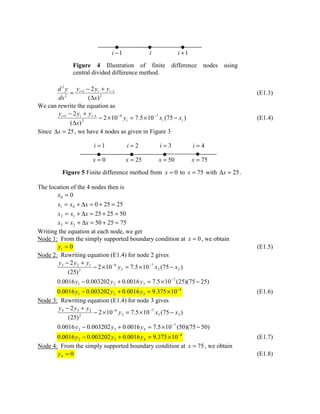
Figure 4 Illustration of finite difference nodes using
central divided difference method.
2
11
2
2
)(
2
x
yyy
dx
yd iii
∆
+−
≈ −+
(E1.3)
We can rewrite the equation as
)75(105.7102
)(
2 76
2
11
iii
iii
xxy
x
yyy
−×=×−
∆
+− −−−+
(E1.4)
Since 25=∆x , we have 4 nodes as given in Figure 3
Figure 5 Finite difference method from 0=x to 75=x with 25=∆x .
The location of the 4 nodes then is
00 =x
2525001 =+=∆+= xxx
50252512 =+=∆+= xxx
75255023 =+=∆+= xxx
Writing the equation at each node, we get
Node 1: From the simply supported boundary condition at 0=x , we obtain
01 =y (E1.5)
Node 2: Rewriting equation (E1.4) for node 2 gives
)75(105.7102
)25(
2
22
7
2
6
2
123
xxy
yyy
−×=×−
+− −−
)2575)(25(105.70016.0003202.00016.0 7
321 −×=+− −
yyy
4
321 10375.90016.0003202.00016.0 −
×=+− yyy (E1.6)
Node 3: Rewriting equation (E1.4) for node 3 gives
)75(105.7102
)25(
2
33
7
3
6
2
234
xxy
yyy
−×=×−
+− −−
)5075)(50(105.70016.0003202.00016.0 7
432 −×=+− −
yyy
4
432 10375.90016.0003202.00016.0 −
×=+− yyy (E1.7)
Node 4: From the simply supported boundary condition at 75=x , we obtain
04 =y (E1.8)
0=x 25=x 50=x
1=i 2=i 3=i 4=i
75=x
1−i i 1+i
Finite Difference Method
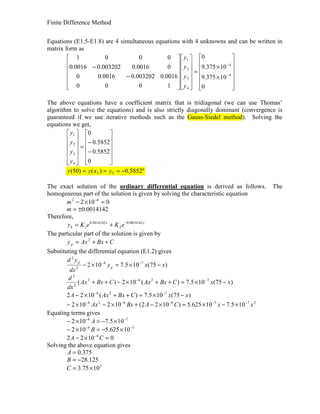
Equations (E1.5-E1.8) are 4 simultaneous equations with 4 unknowns and can be written in
matrix form as














×
×
=
























−
−
−
−
0
10375.9
10375.9
0
1000
0016.0003202.00016.00
00016.0003202.00016.0
0001
4
4
4
3
2
1
y
y
y
y
The above equations have a coefficient matrix that is tridiagonal (we can use Thomas’
algorithm to solve the equations) and is also strictly diagonally dominant (convergence is
guaranteed if we use iterative methods such as the Gauss-Siedel method). Solving the
equations we get,












−
−
=












0
5852.0
5852.0
0
4
3
2
1
y
y
y
y
"5852.0)()50( 22 −=≈= yxyy
The exact solution of the ordinary differential equation is derived as follows. The
homogeneous part of the solution is given by solving the characteristic equation
0102 62
=×− −
m
0014142.0±=m
Therefore,
xx
h eKeKy 0014142.0
2
0014142.0
1
−
+=
The particular part of the solution is given by
CBxAxyp ++= 2
Substituting the differential equation (E1.2) gives
)75(105.7102 76
2
2
xxy
dx
yd
p
p
−×=×− −−
)75(105.7)(102)( 7262
2
2
xxCBxAxCBxAx
dx
d
−×=++×−++ −−
)75(105.7)(1022 726
xxCBxAxA −×=++×− −−
2756626
105.710625.5)1022(102102 xxCABxAx −−−−−
×−×=×−+×−×−
Equating terms gives
76
105.7102 −−
×−=×− A
56
10625.5102 −−
×−=×− B
01022 6
=×− −
CA
Solving the above equation gives
375.0=A
125.28−=B
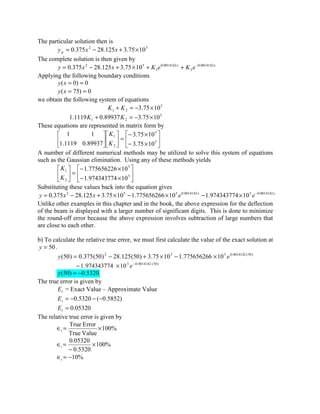
5
1075.3 ×=C
The particular solution then is
52
1075.3125.28375.0 ×+−= xxyp
The complete solution is then given by
xx
eKeKxxy 0014142.0
2
0014142.0
1
52
1075.3125.28375.0 −
++×+−=
Applying the following boundary conditions
0)0( ==xy
0)75( ==xy
we obtain the following system of equations
5
21 1075.3 ×−=+ KK
5
21 1075.389937.01119.1 ×−=+ KK
These equations are represented in matrix form by






×−
×−
=











5
5
2
1
1075.3
1075.3
89937.01119.1
11
K
K
A number of different numerical methods may be utilized to solve this system of equations
such as the Gaussian elimination. Using any of these methods yields






×−
×−
=





5
5
2
1
10974343774.1
10775656226.1
K
K
Substituting these values back into the equation gives
xx
eexxy 0014142.050014142.0552
10974343774.110775656266.11075.3125.28375.0 −
×−×−×+−=
Unlike other examples in this chapter and in the book, the above expression for the deflection
of the beam is displayed with a larger number of significant digits. This is done to minimize
the round-off error because the above expression involves subtraction of large numbers that
are close to each other.
b) To calculate the relative true error, we must first calculate the value of the exact solution at
50=y .
)50(0014142.0552
10775656266.11075.3)50(125.28)50(375.0)50( ey ×−×+−=
)50(0014142.05
10974343774.1 −
×− e
5320.0)50( −=y
The true error is given by
tE = Exact Value – Approximate Value
)5852.0(5320.0 −−−=tE
05320.0=tE
The relative true error is given by
%100
ValueTrue
ErrorTrue
×=∈t
%100
5320.0
05320.0
×
−
=∈t
%10−=∈t
18
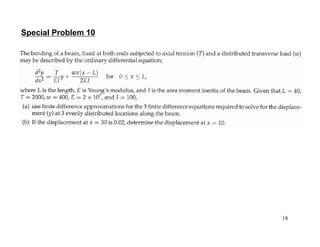
Special Problem 10
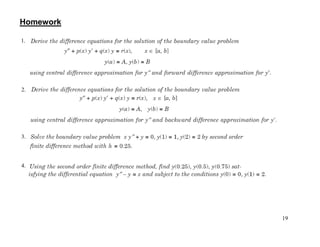
Homework
19
1.
2.
3.
4.
18
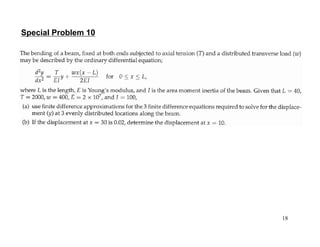
Special Problem 10

Applied numerical methods lec14

  • 1.
  • 2.
    2 Boundary-Value Vs. Initial-ValueODE This is a 2nd-order ODE, so requires two known conditions to be solved. • Initial-value problem The two known conditions all occur at the same t. Example: at time t = 0, θ = π/3 and dθ/dt = 0. • Boundary-value problem The two known conditions occur at different t. Example: at time θ = π/3 at t = 0, and θ = -0.45π at t = 2.3.0=+ sinθ l g dt θd 2 2 Why Need To Learn Boundary-value Problem? • There are many applications where the initial conditions are not known at a single point, but rather are known at different values of the independent variable. • Sometime, it is more convenient to observe certain types of conditions at different time rather than all the types at a same time (e.g. it is easier to observe and record the displacement θ at two different time than to record the angular velocity dθ/dt). • Many physical problems are better or can only be formulated as boundary-value problems.
  • 3.
  • 4.
    4 An Example ofBoundary-Value Problem ( ) ( ) 2 10 TLT TT = = ( ) 0h' dx d a2 2 =−+ TT T Heat balance for a long, thin rod ( ) 20452353452373 1010 +−= − x.ex. .e.xT analytical solution At a steady state: h’ is a heat transfer coefficient, and Ta is the temperature of the surrounding air. Boundary-values: Instance: L = 10, Ta =20, T1 = 40, T2 = 200, and h’ = 0.01
  • 5.
    5 The Shooting Method () 0h' dx d a2 2 =−+ TT T ( )aTTh' dx dz andz dx dT −== ( ) ( ) ( ) 6907123797168200 37971688980285 1020 10 .. .. c =− − − +=0z Covert to two 1st-order ODEs Initial-value problem: T(0) = 40, z(0) = ??? L = 10, Ta =20, T(0) = 40, T(10) = 200, and h’ = 0.01 Shoot (guess) (a) z(0) = 10 RK method T(10) = 168.3797 (b) z(0) = 20 RK method T(10) = 285.8980 z(0) and T(10) are linearly related (why?) T x The shooting method is based on converting the boundary-value problem into an equivalent initial-value problem. A trial-and-error approach is then implemented to solve the initial-value version. The approach can be illustrated by an example
  • 6.
    6 The Shooting MethodAs A Roots Problem FRK: the value of T(10) corresponding to the value of z(0) obtained by using 4th-order RK method 200 = FRK(z0) z0 = 12.6907 T10 = T(10) z0=z(0) 200 12.6907 FRK(z(0))
  • 7.
    7 Example of UsingRoots Finding for Nonlinear ODE ODE ODE
  • 8.
    8 Finite-Difference Approach (An Example) 2 112 x∆ +− = −+ = iii xx 2 2 TTT dx Td i ( ) 0h' dx d a2 2 =−+ TT T ( ) 0 2 2 11 =− ∆ +− −+ ai iii T-Th' x TTT ( ) aiii Txh'TTxh'T 2 1 2 1 2 ∆=−∆++− +− Instance: Ta =20, T(0) = 40, T(10) = 200, and h’ = 0.01; use ∆x = 2               =                           − −− −− − 8200 80 80 840 042100 104210 010421 001042 4 3 2 1 . . . . . . . . T T T T [ ] [ ]2004795159538212477859396986540543210 ....=TTTTTT Centered finite difference
  • 9.
    9 Comparison Between Shootingand Finite-Difference (The example of long and thin rod heat balance problem) ( ) 0h' dx d a2 2 =−+ TT T L = 10, Ta =20, T(0) = 40, T(10) = 200, and h’ = 0.01
  • 10.
  • 11.
  • 12.
    12 A steady-state heatbalance for a rod can be represented as Use the finite-difference approach with ∆x = 1 to solve the problem for 10 m rod with T(0) = 240 and T(10) = 150 Miscellaneous problems #1
  • 13.
  • 14.
  • 15.
  • 16.
  • 17.
  • 18.
    Finite Difference Method Example1 The deflection y in a simply supported beam with a uniform load q and a tensile axial load T is given by EI xLqx EI Ty dx yd 2 )( 2 2 − =− (E1.1) where =x location along the beam (in) =T tension applied (lbs) =E Young’s modulus of elasticity of the beam (psi) =I second moment of area (in4 ) =q uniform loading intensity (lb/in) =L length of beam (in) Figure 3 Simply supported beam for Example 1. Given, 7200=T lbs, 5400=q lbs/in, in75=L , Msi30=E , and 4 in120=I , a) Find the deflection of the beam at "50=x . Use a step size of "25=∆x and approximate the derivatives by central divided difference approximation. b) Find the relative true error in the calculation of )50(y . Solution a) Substituting the given values, )120)(1030(2 )75()5400( )120)(1030( 7200 662 2 × − = × − xxy dx yd )75(105.7102 76 2 2 xxy dx yd −×=×− −− (E1.2) Approximating the derivative 2 2 dx yd at node i by the central divided difference approximation, q y L x TT
  • 19.
    Figure 4 Illustrationof finite difference nodes using central divided difference method. 2 11 2 2 )( 2 x yyy dx yd iii ∆ +− ≈ −+ (E1.3) We can rewrite the equation as )75(105.7102 )( 2 76 2 11 iii iii xxy x yyy −×=×− ∆ +− −−−+ (E1.4) Since 25=∆x , we have 4 nodes as given in Figure 3 Figure 5 Finite difference method from 0=x to 75=x with 25=∆x . The location of the 4 nodes then is 00 =x 2525001 =+=∆+= xxx 50252512 =+=∆+= xxx 75255023 =+=∆+= xxx Writing the equation at each node, we get Node 1: From the simply supported boundary condition at 0=x , we obtain 01 =y (E1.5) Node 2: Rewriting equation (E1.4) for node 2 gives )75(105.7102 )25( 2 22 7 2 6 2 123 xxy yyy −×=×− +− −− )2575)(25(105.70016.0003202.00016.0 7 321 −×=+− − yyy 4 321 10375.90016.0003202.00016.0 − ×=+− yyy (E1.6) Node 3: Rewriting equation (E1.4) for node 3 gives )75(105.7102 )25( 2 33 7 3 6 2 234 xxy yyy −×=×− +− −− )5075)(50(105.70016.0003202.00016.0 7 432 −×=+− − yyy 4 432 10375.90016.0003202.00016.0 − ×=+− yyy (E1.7) Node 4: From the simply supported boundary condition at 75=x , we obtain 04 =y (E1.8) 0=x 25=x 50=x 1=i 2=i 3=i 4=i 75=x 1−i i 1+i
  • 20.
    Finite Difference Method Equations(E1.5-E1.8) are 4 simultaneous equations with 4 unknowns and can be written in matrix form as               × × =                         − − − − 0 10375.9 10375.9 0 1000 0016.0003202.00016.00 00016.0003202.00016.0 0001 4 4 4 3 2 1 y y y y The above equations have a coefficient matrix that is tridiagonal (we can use Thomas’ algorithm to solve the equations) and is also strictly diagonally dominant (convergence is guaranteed if we use iterative methods such as the Gauss-Siedel method). Solving the equations we get,             − − =             0 5852.0 5852.0 0 4 3 2 1 y y y y "5852.0)()50( 22 −=≈= yxyy The exact solution of the ordinary differential equation is derived as follows. The homogeneous part of the solution is given by solving the characteristic equation 0102 62 =×− − m 0014142.0±=m Therefore, xx h eKeKy 0014142.0 2 0014142.0 1 − += The particular part of the solution is given by CBxAxyp ++= 2 Substituting the differential equation (E1.2) gives )75(105.7102 76 2 2 xxy dx yd p p −×=×− −− )75(105.7)(102)( 7262 2 2 xxCBxAxCBxAx dx d −×=++×−++ −− )75(105.7)(1022 726 xxCBxAxA −×=++×− −− 2756626 105.710625.5)1022(102102 xxCABxAx −−−−− ×−×=×−+×−×− Equating terms gives 76 105.7102 −− ×−=×− A 56 10625.5102 −− ×−=×− B 01022 6 =×− − CA Solving the above equation gives 375.0=A 125.28−=B 5 1075.3 ×=C
  • 21.
    The particular solutionthen is 52 1075.3125.28375.0 ×+−= xxyp The complete solution is then given by xx eKeKxxy 0014142.0 2 0014142.0 1 52 1075.3125.28375.0 − ++×+−= Applying the following boundary conditions 0)0( ==xy 0)75( ==xy we obtain the following system of equations 5 21 1075.3 ×−=+ KK 5 21 1075.389937.01119.1 ×−=+ KK These equations are represented in matrix form by       ×− ×− =            5 5 2 1 1075.3 1075.3 89937.01119.1 11 K K A number of different numerical methods may be utilized to solve this system of equations such as the Gaussian elimination. Using any of these methods yields       ×− ×− =      5 5 2 1 10974343774.1 10775656226.1 K K Substituting these values back into the equation gives xx eexxy 0014142.050014142.0552 10974343774.110775656266.11075.3125.28375.0 − ×−×−×+−= Unlike other examples in this chapter and in the book, the above expression for the deflection of the beam is displayed with a larger number of significant digits. This is done to minimize the round-off error because the above expression involves subtraction of large numbers that are close to each other. b) To calculate the relative true error, we must first calculate the value of the exact solution at 50=y . )50(0014142.0552 10775656266.11075.3)50(125.28)50(375.0)50( ey ×−×+−= )50(0014142.05 10974343774.1 − ×− e 5320.0)50( −=y The true error is given by tE = Exact Value – Approximate Value )5852.0(5320.0 −−−=tE 05320.0=tE The relative true error is given by %100 ValueTrue ErrorTrue ×=∈t %100 5320.0 05320.0 × − =∈t %10−=∈t
  • 22.
  • 23.
  • 24.