1
Curve Fitting and Interpolation
Least-Squares Regression
2
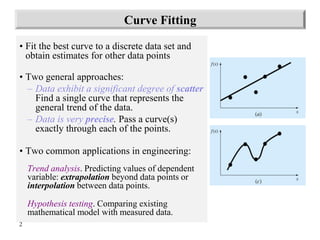
• Fit the best curve to a discrete data set and
obtain estimates for other data points
• Two general approaches:
– Data exhibit a significant degree of scatter
Find a single curve that represents the
general trend of the data.
– Data is very precise. Pass a curve(s)
exactly through each of the points.
• Two common applications in engineering:
Trend analysis. Predicting values of dependent
variable: extrapolation beyond data points or
interpolation between data points.
Hypothesis testing. Comparing existing
mathematical model with measured data.
Curve Fitting
3
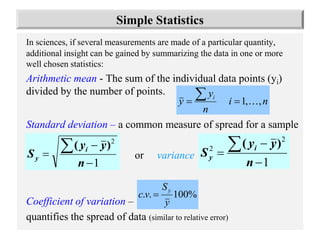
In sciences, if several measurements are made of a particular quantity,
additional insight can be gained by summarizing the data in one or more
well chosen statistics:
Arithmetic mean - The sum of the individual data points (yi)
divided by the number of points.
Standard deviation – a common measure of spread for a sample
or variance
Coefficient of variation –
quantifies the spread of data (similar to relative error)
n
i
n
y
y i
,
,
1 



1
2




n
y
y
S i
y
)
(
1
2
2




n
y
y
S i
y
)
(
Simple Statistics
%
100
.
.
y
S
v
c
y

4
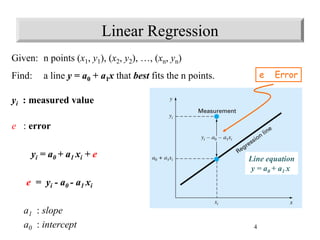
yi : measured value
e : error
yi = a0 + a1 xi + e
e = yi - a0 - a1 xi
a1 : slope
a0 : intercept
Linear Regression
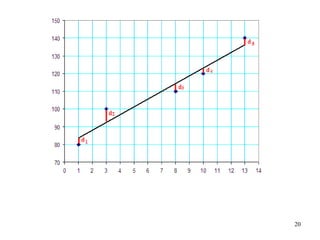
e Error
Line equation
y = a0 + a1 x
Given: n points (x1, y1), (x2, y2), …, (xn, yn)
Find: a line y = a0 + a1x that best fits the n points.
5
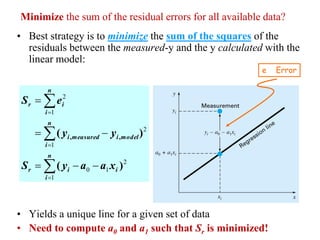
• Best strategy is to minimize the sum of the squares of the
residuals between the measured-y and the y calculated with the
linear model:
• Yields a unique line for a given set of data
• Need to compute a0 and a1 such that Sr is minimized!












n
i
i
i
r
n
i
model
i
measured
i
n
i
i
r
x
a
a
y
S
y
y
e
S
1
2
1
0
1
2
1
2
)
(
)
( ,
,
e Error
Minimize the sum of the residual errors for all available data?
  0
0
)
(
2
0
0
)
(
2
2
1
0
1
1
1
0
1






















 


 


i
i
i
i
i
i
o
i
r
i
i
i
o
i
o
r
x
a
x
a
x
y
x
x
a
a
y
a
S
x
a
a
y
x
a
a
y
a
S
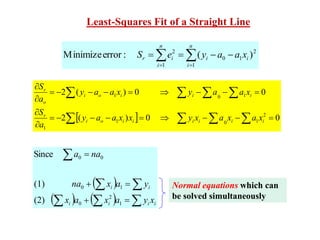
Normal equations which can
be solved simultaneously
 
    i
i
i
i
i
i
x
y
a
x
a
x
y
a
x
na
na
a











1
2
0
1
0
0
0
(2)
(1)
Since

 





n
i
i
i
n
i
i
r x
a
a
y
e
S
1
2
1
0
1
2
)
(
:
error
Minimize
Least-Squares Fit of a Straight Line
7
Least-Squares Fit of a Line
 
 






0
2 1
0
0
i
i
r
x
a
a
y
a
S
 
 






0
]
[
2 1
0
1
i
i
i
r
x
x
a
a
y
a
S
  


 i
i y
a
x
na 1
0
To minimize Sr:
where and
 
 

  

 2
2
1
i
i
i
i
i
i
x
x
n
y
x
y
x
n
a
    



 i
i
i
i y
x
a
x
a
x 1
2
0
x
a
y
a 1
0 

n
y
y i


n
x
x i


y = a0 + a1x
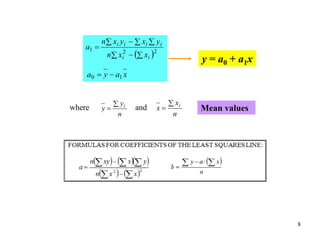
Mean values
8
where and
 
 

  

 2
2
1
i
i
i
i
i
i
x
x
n
y
x
y
x
n
a
x
a
y
a 1
0 

n
y
y i


n
x
x i


y = a0 + a1x
Mean values
9
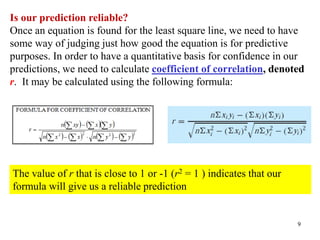
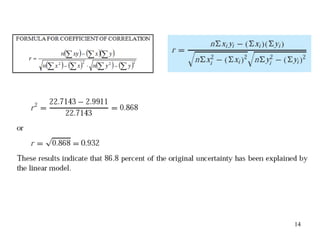
Is our prediction reliable?
Once an equation is found for the least square line, we need to have
some way of judging just how good the equation is for predictive
purposes. In order to have a quantitative basis for confidence in our
predictions, we need to calculate coefficient of correlation, denoted
r. It may be calculated using the following formula:
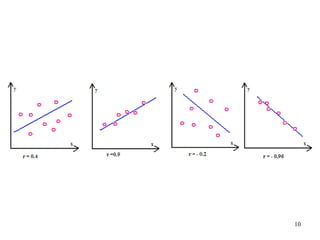
The value of r that is close to 1 or -1 (r2 = 1 ) indicates that our
formula will give us a reliable prediction
10
11
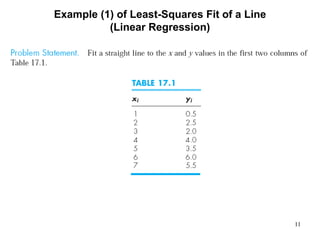
Example (1) of Least-Squares Fit of a Line
(Linear Regression)
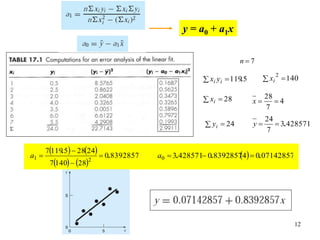
12
7

n
5
119.

 i
i y
x 140
2

 i
x
  28
i
x 4
7
28


x
24

 i
y 428571
3
7
24
.


y
   
   
8392857
0
28
140
7
24
28
5
119
7
2
1 .
.




a   07142857
0
4
8392857
0
428571
3
0 .
.
. 


a
y = a0 + a1x
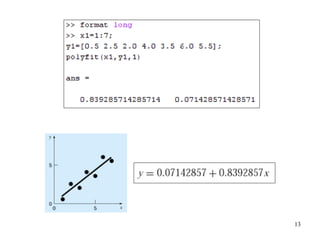
13
14
15
16
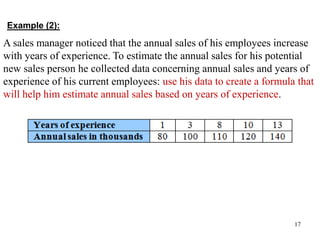
Example (2):
17
A sales manager noticed that the annual sales of his employees increase
with years of experience. To estimate the annual sales for his potential
new sales person he collected data concerning annual sales and years of
experience of his current employees: use his data to create a formula that
will help him estimate annual sales based on years of experience.
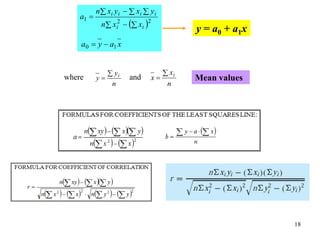
18
where and
 
 

  

 2
2
1
i
i
i
i
i
i
x
x
n
y
x
y
x
n
a
x
a
y
a 1
0 

n
y
y i


n
x
x i


y = a0 + a1x
Mean values
19
20
21
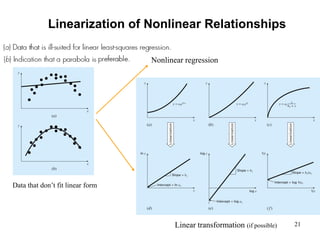
Linearization of Nonlinear Relationships
Nonlinear regression
Linear transformation (if possible)
Data that don’t fit linear form
22
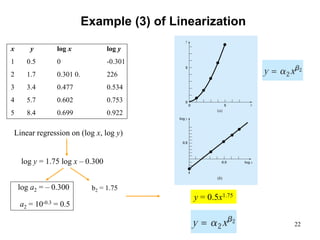
Example (3) of Linearization
Linear regression on (log x, log y)
b2 = 1.75
x y log x log y
1 0.5 0 -0.301
2 1.7 0.301 0. 226
3 3.4 0.477 0.534
4 5.7 0.602 0.753
5 8.4 0.699 0.922
log y = 1.75 log x – 0.300
log a2 = – 0.300
a2 = 10-0.3 = 0.5
y = 0.5x1.75
23
Polynomial Regression
)
1
( 


m
n
S
s r
x
y /
 
2
1
2
2
1
0
 






n
i
m
i
m
i
i
i
r x
a
x
a
x
a
a
y
S ...
 
2
1
2
2
1
0
 




n
i
i
i
i
r x
a
x
a
a
y
S
Given: n points (x1, y1), (x2, y2), …, (xn, yn)
Find: a polynomial y = a0 + a1x + a2x2 + … amxm that minimizes
Example: 2nd-order polynomial y = a0 + a1x + a2x2
 
 







0
2 2
2
1
0
0
i
i
i
r
x
a
x
a
a
y
a
S
 
 







0
]
[
2 2
2
1
0
1
i
i
i
i
r
x
x
a
x
a
a
y
a
S
 
 







0
]
[
2
2
2
2
1
0
2
i
i
i
i
r
x
x
a
x
a
a
y
a
S
    




 i
i
i y
a
x
a
x
na 2
2
1
0
      





 i
i
i
i
i y
x
a
x
a
x
a
x 2
3
1
2
0
      





 i
i
i
i
i y
x
a
x
a
x
a
x
2
2
4
1
3
0
2
Standard error:
24
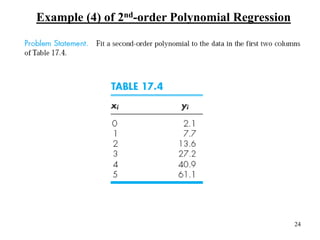
Example (4) of 2nd-order Polynomial Regression
25
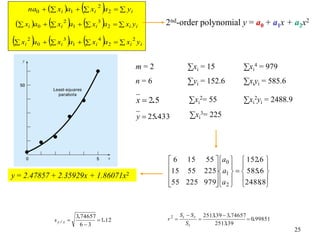
m = 2 ∑xi = 15 ∑xi
4 = 979
n = 6 ∑yi = 152.6 ∑xiyi = 585.6
∑xi
2= 55 ∑xi
2yi = 2488.9
∑xi
3= 225































8
2488
6
585
6
152
979
225
55
225
55
15
55
15
6
2
1
0
.
.
.
a
a
a
5
2.

x
y = 2.47857 + 2.35929x + 1.86071x2
12
1
3
6
74657
3
.
.
/ 


x
y
s 99851
0
39
2513
74657
3
39
2513
2
.
.
.
.





t
r
t
S
S
S
r
433
25.

y
    




 i
i
i y
a
x
a
x
na 2
2
1
0
      





 i
i
i
i
i y
x
a
x
a
x
a
x 2
3
1
2
0
      





 i
i
i
i
i y
x
a
x
a
x
a
x
2
2
4
1
3
0
2
2nd-order polynomial y = a0 + a1x + a2x2
26
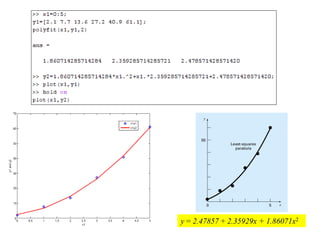
y = 2.47857 + 2.35929x + 1.86071x2
Example (5):
27
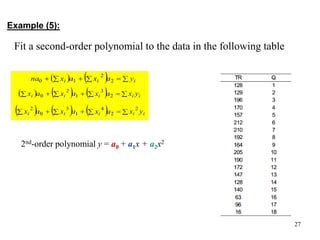
Fit a second-order polynomial to the data in the following table
    




 i
i
i y
a
x
a
x
na 2
2
1
0
      





 i
i
i
i
i y
x
a
x
a
x
a
x 2
3
1
2
0
      





 i
i
i
i
i y
x
a
x
a
x
a
x
2
2
4
1
3
0
2
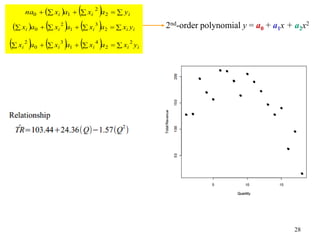
2nd-order polynomial y = a0 + a1x + a2x2
28
    




 i
i
i y
a
x
a
x
na 2
2
1
0
      





 i
i
i
i
i y
x
a
x
a
x
a
x 2
3
1
2
0
      





 i
i
i
i
i y
x
a
x
a
x
a
x
2
2
4
1
3
0
2
2nd-order polynomial y = a0 + a1x + a2x2
29
Multiple Linear Regression
 
 







0
]
[
2 2
2
2
1
1
0
2
i
i
i
i
r
x
x
a
x
a
a
y
a
S
 
2
1
2
2
1
1
0
 




n
i
i
i
i
r x
a
x
a
a
y
S
Given: n points 3D (y1, x11, x12) (y2, x12, x22), …, (yn, x1n, x2n)
Find: a plane y = a0 + a1x1 + a2x2 that minimizes
 
 







0
2 2
2
1
1
0
0
i
i
i
r
x
a
x
a
a
y
a
S
 
 







0
]
[
2 1
2
2
1
1
0
1
i
i
i
i
r
x
x
a
x
a
a
y
a
S
    




 i
i
i y
a
x
a
x
na 2
2
1
1
0
      





 i
i
i
i
i
i y
x
a
x
x
a
x
a
x 1
2
2
1
1
2
1
0
1
      





 i
i
i
i
i
i y
x
a
x
a
x
x
a
x 2
2
2
2
1
2
1
0
2
Generation to m dimensions:
hyper plane y = a0 + a1x1 + a2x2 + … + amxm
30
General Linear Least Squares


















































n
m
mn
n
n
m
m
n e
e
e
a
a
a
z
z
z
z
z
z
z
z
z
y
y
y










2
1
1
0
1
0
2
12
02
1
11
01
2
1
Linear least squares: y = a0 + a1x1
Multi-linear least squares: y = a0 + a1x1 + a2x2 + … + amxm
Polynomial least squares: y = a0 + a1x + a2x2 + … amxm
2
1 0
1
2
 












 

n
i
m
j
ji
j
i
n
i
i
r z
a
y
e
S
   
      
 
Y
Z
A
Z
Z
T
T

y = a0z0 + a1z1 + a2z2 + … + amzm
{Y} = [Z] {A} + {E}
[C] {A} = {D}
([C] is symmetric, e.g. linear and polynomial)

Applied numerical methods lec8

  • 1.
    1 Curve Fitting andInterpolation Least-Squares Regression
  • 2.
    2 • Fit thebest curve to a discrete data set and obtain estimates for other data points • Two general approaches: – Data exhibit a significant degree of scatter Find a single curve that represents the general trend of the data. – Data is very precise. Pass a curve(s) exactly through each of the points. • Two common applications in engineering: Trend analysis. Predicting values of dependent variable: extrapolation beyond data points or interpolation between data points. Hypothesis testing. Comparing existing mathematical model with measured data. Curve Fitting
  • 3.
    3 In sciences, ifseveral measurements are made of a particular quantity, additional insight can be gained by summarizing the data in one or more well chosen statistics: Arithmetic mean - The sum of the individual data points (yi) divided by the number of points. Standard deviation – a common measure of spread for a sample or variance Coefficient of variation – quantifies the spread of data (similar to relative error) n i n y y i , , 1     1 2     n y y S i y ) ( 1 2 2     n y y S i y ) ( Simple Statistics % 100 . . y S v c y 
  • 4.
    4 yi : measuredvalue e : error yi = a0 + a1 xi + e e = yi - a0 - a1 xi a1 : slope a0 : intercept Linear Regression e Error Line equation y = a0 + a1 x Given: n points (x1, y1), (x2, y2), …, (xn, yn) Find: a line y = a0 + a1x that best fits the n points.
  • 5.
    5 • Best strategyis to minimize the sum of the squares of the residuals between the measured-y and the y calculated with the linear model: • Yields a unique line for a given set of data • Need to compute a0 and a1 such that Sr is minimized!             n i i i r n i model i measured i n i i r x a a y S y y e S 1 2 1 0 1 2 1 2 ) ( ) ( , , e Error Minimize the sum of the residual errors for all available data?
  • 6.
      0 0 ) ( 2 0 0 ) ( 2 2 1 0 1 1 1 0 1                              i i i i i i o i r i i i o i o r x a x a x y x x a a y a S x a a y x a a y a S Normal equations which can be solved simultaneously       i i i i i i x y a x a x y a x na na a            1 2 0 1 0 0 0 (2) (1) Since         n i i i n i i r x a a y e S 1 2 1 0 1 2 ) ( : error Minimize Least-Squares Fit of a Straight Line
  • 7.
    7 Least-Squares Fit ofa Line           0 2 1 0 0 i i r x a a y a S           0 ] [ 2 1 0 1 i i i r x x a a y a S       i i y a x na 1 0 To minimize Sr: where and           2 2 1 i i i i i i x x n y x y x n a          i i i i y x a x a x 1 2 0 x a y a 1 0   n y y i   n x x i   y = a0 + a1x Mean values
  • 8.
    8 where and          2 2 1 i i i i i i x x n y x y x n a x a y a 1 0   n y y i   n x x i   y = a0 + a1x Mean values
  • 9.
    9 Is our predictionreliable? Once an equation is found for the least square line, we need to have some way of judging just how good the equation is for predictive purposes. In order to have a quantitative basis for confidence in our predictions, we need to calculate coefficient of correlation, denoted r. It may be calculated using the following formula: The value of r that is close to 1 or -1 (r2 = 1 ) indicates that our formula will give us a reliable prediction
  • 10.
  • 11.
    11 Example (1) ofLeast-Squares Fit of a Line (Linear Regression)
  • 12.
    12 7  n 5 119.   i i y x140 2   i x   28 i x 4 7 28   x 24   i y 428571 3 7 24 .   y         8392857 0 28 140 7 24 28 5 119 7 2 1 . .     a   07142857 0 4 8392857 0 428571 3 0 . . .    a y = a0 + a1x
  • 13.
  • 14.
  • 15.
  • 16.
  • 17.
    Example (2): 17 A salesmanager noticed that the annual sales of his employees increase with years of experience. To estimate the annual sales for his potential new sales person he collected data concerning annual sales and years of experience of his current employees: use his data to create a formula that will help him estimate annual sales based on years of experience.
  • 18.
    18 where and          2 2 1 i i i i i i x x n y x y x n a x a y a 1 0   n y y i   n x x i   y = a0 + a1x Mean values
  • 19.
  • 20.
  • 21.
    21 Linearization of NonlinearRelationships Nonlinear regression Linear transformation (if possible) Data that don’t fit linear form
  • 22.
    22 Example (3) ofLinearization Linear regression on (log x, log y) b2 = 1.75 x y log x log y 1 0.5 0 -0.301 2 1.7 0.301 0. 226 3 3.4 0.477 0.534 4 5.7 0.602 0.753 5 8.4 0.699 0.922 log y = 1.75 log x – 0.300 log a2 = – 0.300 a2 = 10-0.3 = 0.5 y = 0.5x1.75
  • 23.
    23 Polynomial Regression ) 1 (    m n S sr x y /   2 1 2 2 1 0         n i m i m i i i r x a x a x a a y S ...   2 1 2 2 1 0       n i i i i r x a x a a y S Given: n points (x1, y1), (x2, y2), …, (xn, yn) Find: a polynomial y = a0 + a1x + a2x2 + … amxm that minimizes Example: 2nd-order polynomial y = a0 + a1x + a2x2            0 2 2 2 1 0 0 i i i r x a x a a y a S            0 ] [ 2 2 2 1 0 1 i i i i r x x a x a a y a S            0 ] [ 2 2 2 2 1 0 2 i i i i r x x a x a a y a S           i i i y a x a x na 2 2 1 0              i i i i i y x a x a x a x 2 3 1 2 0              i i i i i y x a x a x a x 2 2 4 1 3 0 2 Standard error:
  • 24.
    24 Example (4) of2nd-order Polynomial Regression
  • 25.
    25 m = 2∑xi = 15 ∑xi 4 = 979 n = 6 ∑yi = 152.6 ∑xiyi = 585.6 ∑xi 2= 55 ∑xi 2yi = 2488.9 ∑xi 3= 225                                8 2488 6 585 6 152 979 225 55 225 55 15 55 15 6 2 1 0 . . . a a a 5 2.  x y = 2.47857 + 2.35929x + 1.86071x2 12 1 3 6 74657 3 . . /    x y s 99851 0 39 2513 74657 3 39 2513 2 . . . .      t r t S S S r 433 25.  y           i i i y a x a x na 2 2 1 0              i i i i i y x a x a x a x 2 3 1 2 0              i i i i i y x a x a x a x 2 2 4 1 3 0 2 2nd-order polynomial y = a0 + a1x + a2x2
  • 26.
    26 y = 2.47857+ 2.35929x + 1.86071x2
  • 27.
    Example (5): 27 Fit asecond-order polynomial to the data in the following table           i i i y a x a x na 2 2 1 0              i i i i i y x a x a x a x 2 3 1 2 0              i i i i i y x a x a x a x 2 2 4 1 3 0 2 2nd-order polynomial y = a0 + a1x + a2x2
  • 28.
    28          i i i y a x a x na 2 2 1 0              i i i i i y x a x a x a x 2 3 1 2 0              i i i i i y x a x a x a x 2 2 4 1 3 0 2 2nd-order polynomial y = a0 + a1x + a2x2
  • 29.
    29 Multiple Linear Regression           0 ] [ 2 2 2 2 1 1 0 2 i i i i r x x a x a a y a S   2 1 2 2 1 1 0       n i i i i r x a x a a y S Given: n points 3D (y1, x11, x12) (y2, x12, x22), …, (yn, x1n, x2n) Find: a plane y = a0 + a1x1 + a2x2 that minimizes            0 2 2 2 1 1 0 0 i i i r x a x a a y a S            0 ] [ 2 1 2 2 1 1 0 1 i i i i r x x a x a a y a S           i i i y a x a x na 2 2 1 1 0              i i i i i i y x a x x a x a x 1 2 2 1 1 2 1 0 1              i i i i i i y x a x a x x a x 2 2 2 2 1 2 1 0 2 Generation to m dimensions: hyper plane y = a0 + a1x1 + a2x2 + … + amxm
  • 30.
    30 General Linear LeastSquares                                                   n m mn n n m m n e e e a a a z z z z z z z z z y y y           2 1 1 0 1 0 2 12 02 1 11 01 2 1 Linear least squares: y = a0 + a1x1 Multi-linear least squares: y = a0 + a1x1 + a2x2 + … + amxm Polynomial least squares: y = a0 + a1x + a2x2 + … amxm 2 1 0 1 2                  n i m j ji j i n i i r z a y e S              Y Z A Z Z T T  y = a0z0 + a1z1 + a2z2 + … + amzm {Y} = [Z] {A} + {E} [C] {A} = {D} ([C] is symmetric, e.g. linear and polynomial)