1
Chapter 25ODE : Initial-value problem 1
2
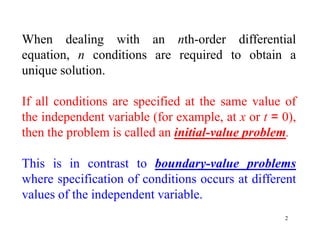
When dealing with an nth-order differential
equation, n conditions are required to obtain a
unique solution.
If all conditions are specified at the same value of
the independent variable (for example, at x or t = 0),
then the problem is called an initial-value problem.
This is in contrast to boundary-value problems
where specification of conditions occurs at different
values of the independent variable.
3
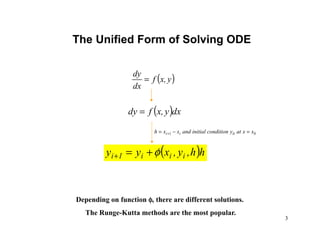
The Unified Form of Solving ODE
( )dxyx,fdy =
( )hh,y,xyy iii1i φ+=+
Depending on function φφφφ, there are different solutions.
The Runge-Kutta methods are the most popular.
00ii xxatyconditioninitialandxxh =−= +1
( )yx,f
dx
dy
=
4
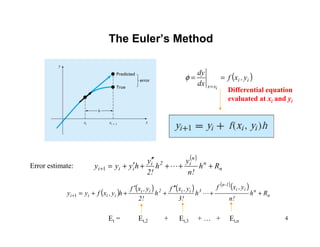
The Euler’s Method
( )ii
xx
y,xf
dx
dy
i
==
=
φ
Error estimate:
( )
n
n
n
i2i
iii Rh
n!
y
h
2!
y
hyyy +++
′′
+′+=+ L1
( ) ( ) ( ) ( )( )
n
nii
1-n
3ii2ii
iiii Rh
n!
y,xf
h
3!
y,xf
h
2!
y,xf
hy,xfyy ++
′′
+
′
++=+ L1
Et = Et,2 + Et,3 + … + Et,n
Differential equation
evaluated at xi and yi
5
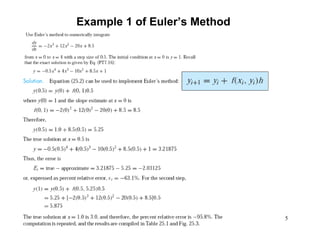
Example 1 of Euler’s Method
6
7
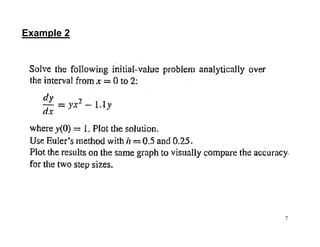
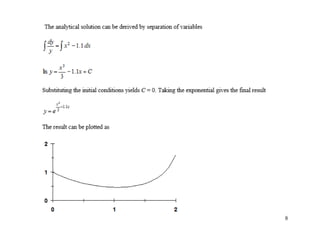
Example 2
8
9
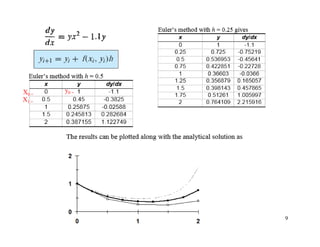
X0 =
y0 =
X1 =
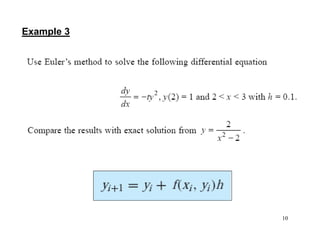
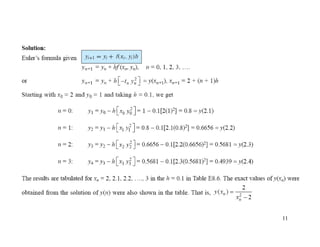
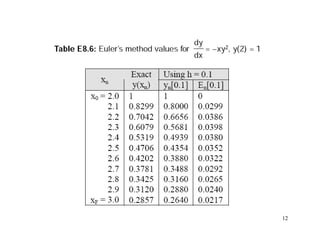
Example 3
10
11
12
13
14
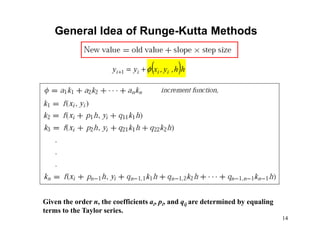
General Idea of Runge-Kutta Methods
Given the order n, the coefficients ai, pi, and qij are determined by equaling
terms to the Taylor series.
( )hh,y,xyy iiii φ+=+1
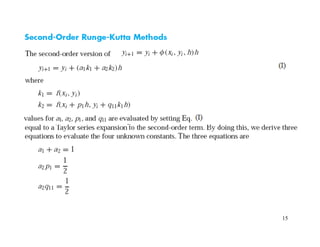
15
16
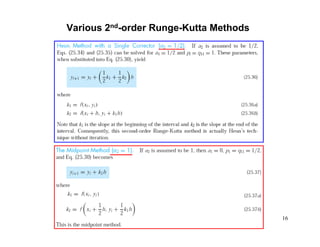
Various 2nd-order Runge-Kutta Methods
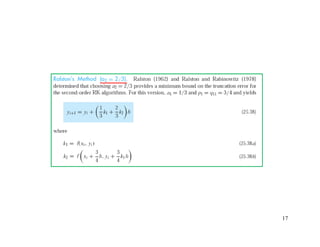
17
18
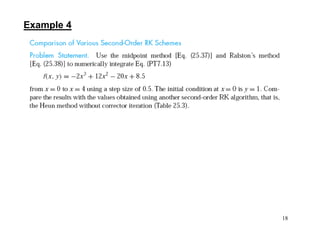
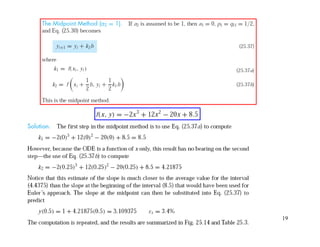
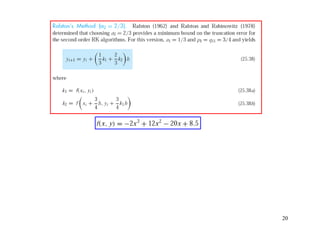
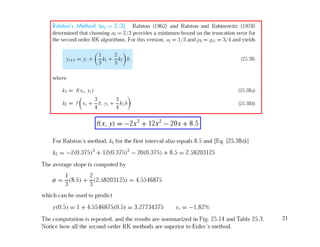
Example 4
19
20
21
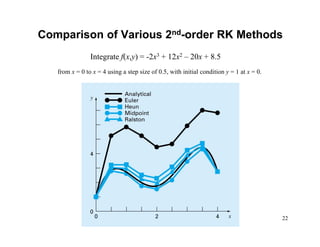
22
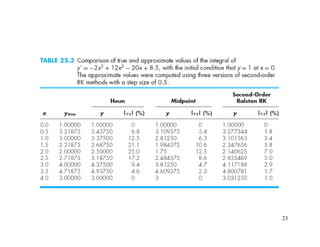
Comparison of Various 2nd-order RK Methods
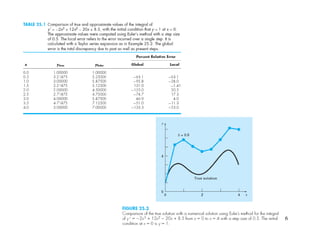
Integrate f(x,y) = -2x3 + 12x2 – 20x + 8.5
from x = 0 to x = 4 using a step size of 0.5, with initial condition y = 1 at x = 0.
23
24
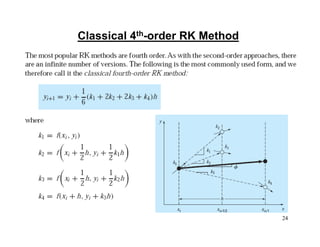
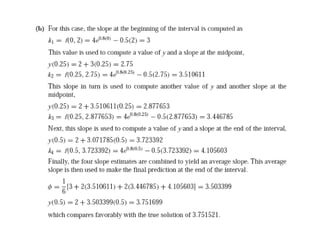
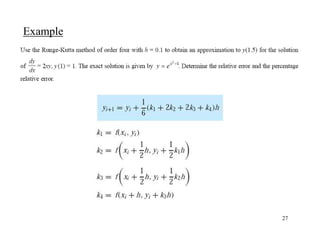
Classical 4th-order RK Method
25
26
27
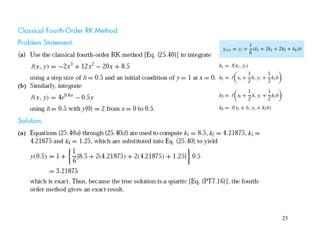
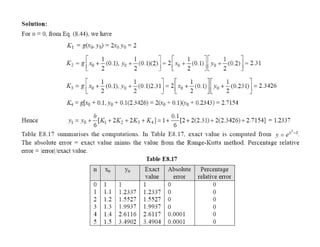
Example
28
29
30
31
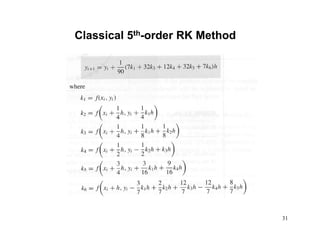
Classical 5th-order RK Method
32
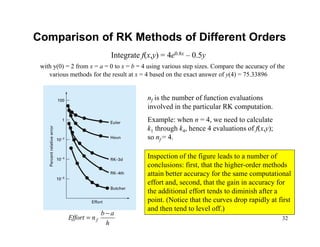
Comparison of RK Methods of Different Orders
Integrate f(x,y) = 4e0.8x – 0.5y
with y(0) = 2 from x = a = 0 to x = b = 4 using various step sizes. Compare the accuracy of the
various methods for the result at x = 4 based on the exact answer of y(4) = 75.33896
h
ab
nEffort f
−
=
nf is the number of function evaluations
involved in the particular RK computation.
Example: when n = 4, we need to calculate
k1 through k4, hence 4 evaluations of f(x,y);
so nf = 4.
Inspection of the figure leads to a number of
conclusions: first, that the higher-order methods
attain better accuracy for the same computational
effort and, second, that the gain in accuracy for
the additional effort tends to diminish after a
point. (Notice that the curves drop rapidly at first
and then tend to level off.)
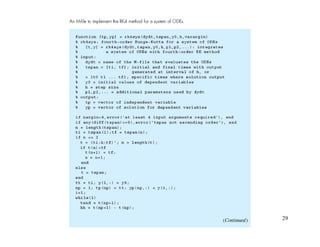
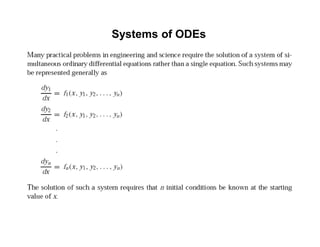
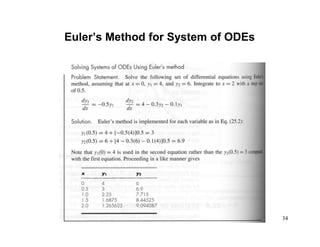
Systems of ODEs
34
Euler’s Method for System of ODEs
35
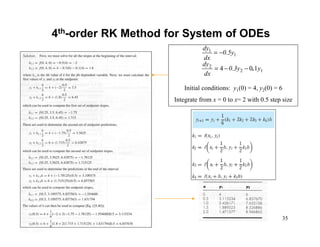
4th-order RK Method for System of ODEs
12
2
1
1
104 y0.3y
dx
dy
0.5y
dx
dy
.−−=
−=
Initial conditions: y1(0) = 4, y2(0) = 6
Integrate from x = 0 to x= 2 with 0.5 step size
36
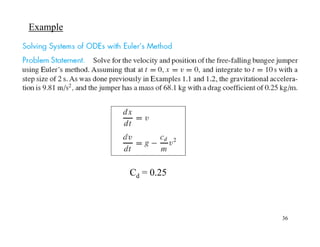
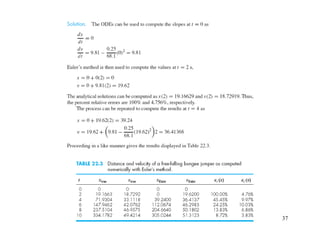
Example
Cd = 0.25
37
38
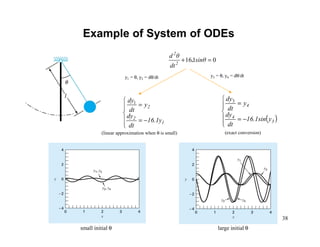
Example of System of ODEs
( )





−=
=
3
4
4
y16.1sin
dt
dy
y
dt
dy3






−=
=
1
2
2
16.1y
dt
dy
y
dt
dy1
y1 = θ, y2 = dθ/dt
0116 =+ sinθ
dt
θd
2
2
.
(linear approximation when θ is small)
y3 = θ, y4 = dθ/dt
(exact conversion)
small initial θ large initial θ
39
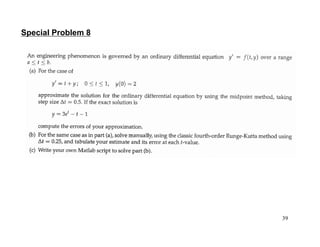
Special Problem 8
40
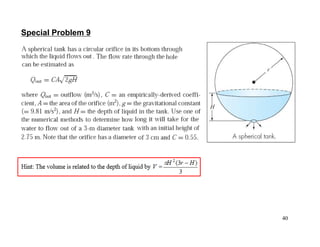
Special Problem 9
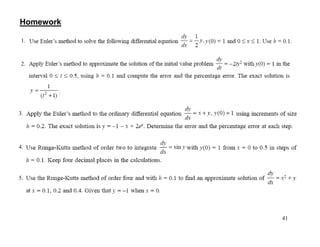
Homework
41
1.
2.
3.
4.
5.
Homework
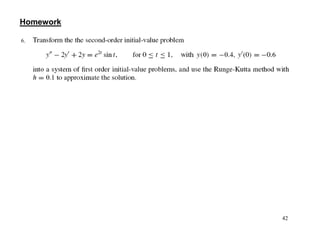
42
6.

Applied numerical methods lec12

  • 1.
    1 Chapter 25ODE :Initial-value problem 1
  • 2.
    2 When dealing withan nth-order differential equation, n conditions are required to obtain a unique solution. If all conditions are specified at the same value of the independent variable (for example, at x or t = 0), then the problem is called an initial-value problem. This is in contrast to boundary-value problems where specification of conditions occurs at different values of the independent variable.
  • 3.
    3 The Unified Formof Solving ODE ( )dxyx,fdy = ( )hh,y,xyy iii1i φ+=+ Depending on function φφφφ, there are different solutions. The Runge-Kutta methods are the most popular. 00ii xxatyconditioninitialandxxh =−= +1 ( )yx,f dx dy =
  • 4.
    4 The Euler’s Method ()ii xx y,xf dx dy i == = φ Error estimate: ( ) n n n i2i iii Rh n! y h 2! y hyyy +++ ′′ +′+=+ L1 ( ) ( ) ( ) ( )( ) n nii 1-n 3ii2ii iiii Rh n! y,xf h 3! y,xf h 2! y,xf hy,xfyy ++ ′′ + ′ ++=+ L1 Et = Et,2 + Et,3 + … + Et,n Differential equation evaluated at xi and yi
  • 5.
    5 Example 1 ofEuler’s Method
  • 6.
  • 7.
  • 8.
  • 9.
  • 10.
  • 11.
  • 12.
  • 13.
  • 14.
    14 General Idea ofRunge-Kutta Methods Given the order n, the coefficients ai, pi, and qij are determined by equaling terms to the Taylor series. ( )hh,y,xyy iiii φ+=+1
  • 15.
  • 16.
  • 17.
  • 18.
  • 19.
  • 20.
  • 21.
  • 22.
    22 Comparison of Various2nd-order RK Methods Integrate f(x,y) = -2x3 + 12x2 – 20x + 8.5 from x = 0 to x = 4 using a step size of 0.5, with initial condition y = 1 at x = 0.
  • 23.
  • 24.
  • 25.
  • 26.
  • 27.
  • 28.
  • 29.
  • 30.
  • 31.
  • 32.
    32 Comparison of RKMethods of Different Orders Integrate f(x,y) = 4e0.8x – 0.5y with y(0) = 2 from x = a = 0 to x = b = 4 using various step sizes. Compare the accuracy of the various methods for the result at x = 4 based on the exact answer of y(4) = 75.33896 h ab nEffort f − = nf is the number of function evaluations involved in the particular RK computation. Example: when n = 4, we need to calculate k1 through k4, hence 4 evaluations of f(x,y); so nf = 4. Inspection of the figure leads to a number of conclusions: first, that the higher-order methods attain better accuracy for the same computational effort and, second, that the gain in accuracy for the additional effort tends to diminish after a point. (Notice that the curves drop rapidly at first and then tend to level off.)
  • 33.
  • 34.
  • 35.
    35 4th-order RK Methodfor System of ODEs 12 2 1 1 104 y0.3y dx dy 0.5y dx dy .−−= −= Initial conditions: y1(0) = 4, y2(0) = 6 Integrate from x = 0 to x= 2 with 0.5 step size
  • 36.
  • 37.
  • 38.
    38 Example of Systemof ODEs ( )      −= = 3 4 4 y16.1sin dt dy y dt dy3       −= = 1 2 2 16.1y dt dy y dt dy1 y1 = θ, y2 = dθ/dt 0116 =+ sinθ dt θd 2 2 . (linear approximation when θ is small) y3 = θ, y4 = dθ/dt (exact conversion) small initial θ large initial θ
  • 39.
  • 40.
  • 41.
  • 42.