1
Chapter 6
Open Methods
2
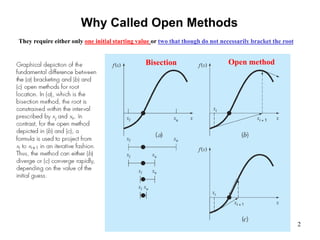
Why Called Open Methods
They require either only one initial starting value or two that though do not necessarily bracket the root
Bisection Open method
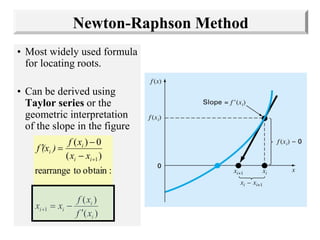
Newton-Raphson Method
• Most widely used formula
for locating roots.
• Can be derived using
Taylor series or the
geometric interpretation
of the slope in the figure
)
(
)
(
:
obtain
to
rearrange
)
(
0
)
(
1
1
i
i
i
i
i
i
i
i
x
f
x
f
x
x
x
x
x
f
)
(x
f









4
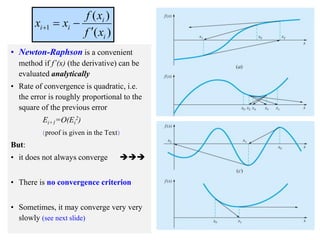
• Newton-Raphson is a convenient
method if f’(x) (the derivative) can be
evaluated analytically
• Rate of convergence is quadratic, i.e.
the error is roughly proportional to the
square of the previous error
Ei+1=O(Ei
2)
(proof is given in the Text)
But:
• it does not always converge 
• There is no convergence criterion
• Sometimes, it may converge very very
slowly (see next slide)
)
(
)
(
1
i
i
i
i
x
f
x
f
x
x




5
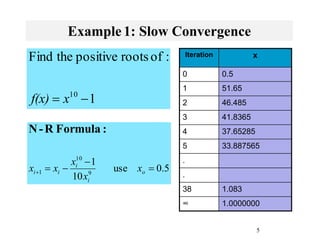
Example 1: Slow Convergence
1
:
of
roots
positive
the
Find
10

 x
f(x)
Iteration x
0 0.5
1 51.65
2 46.485
3 41.8365
4 37.65285
5 33.887565
.
.
38 1.083
∞ 1.0000000
5
.
0
use
10
1
9
10
1 



 o
i
i
i
i x
x
x
x
x
:
Formula
R
-
N
6
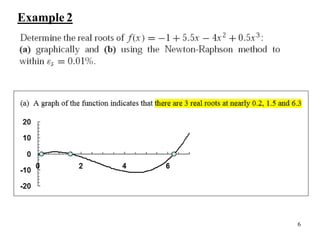
Example 2
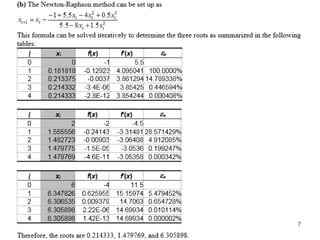
7
8
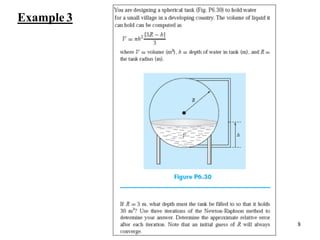
Example 3
9
10
11
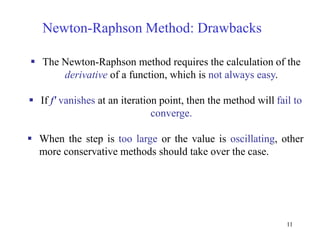
Newton-Raphson Method: Drawbacks
 The Newton-Raphson method requires the calculation of the
derivative of a function, which is not always easy.
 If f' vanishes at an iteration point, then the method will fail to
converge.
 When the step is too large or the value is oscillating, other
more conservative methods should take over the case.
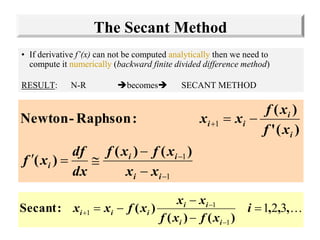
The Secant Method
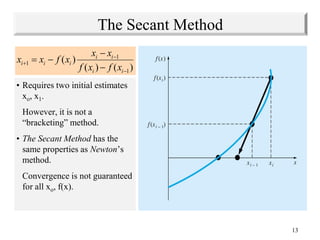
• If derivative f’(x) can not be computed analytically then we need to
compute it numerically (backward finite divided difference method)
RESULT: N-R becomes SECANT METHOD
1
1
1










i
i
i
i
i
i
i
i
i
x
x
x
f
x
f
dx
df
x
f
x
f
x
f
x
x
)
(
)
(
)
(
)
(
'
)
(
:
Raphson
-
Newton

,
,
,
)
(
)
(
)
(
:
Secant 3
2
1
1
1
1 






 i
x
f
x
f
x
x
x
f
x
x
i
i
i
i
i
i
i
13
• Requires two initial estimates
xo, x1.
However, it is not a
“bracketing” method.
• The Secant Method has the
same properties as Newton’s
method.
Convergence is not guaranteed
for all xo, f(x).
)
(
)
(
)
(
1
1
1







i
i
i
i
i
i
i
x
f
x
f
x
x
x
f
x
x
The Secant Method
14
)
(
'
)
(
:
Raphson
-
Newton
i
i
i
i
x
f
x
f
x
x 

1
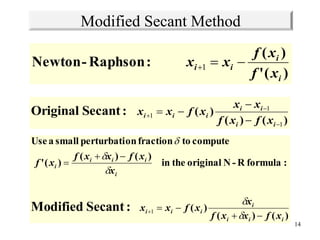
Modified Secant Method
)
(
)
(
)
(
:
Secant
Original
1
1
1







i
i
i
i
i
i
i
x
f
x
f
x
x
x
f
x
x
)
(
)
(
)
(
:
formula
R
-
N
original
the
in
)
(
)
(
)
(
'
compute
to
fraction
on
perturbati
small
a
Use
:
Secant
Modified
i
i
i
i
i
i
i
i
i
i
i
i
x
f
x
x
f
x
x
f
x
x
x
x
f
x
x
f
x
f













1
15
16
)
(
)
(
)
(
1
1
1
:
Secant
Original







i
i
i
i
i
i
i
x
f
x
f
x
x
x
f
x
x
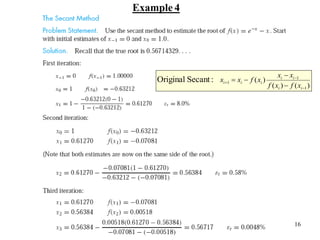
Example 4
17
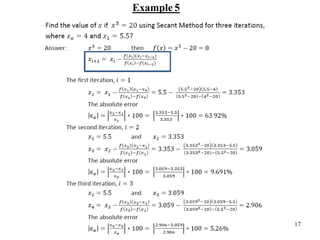
Example 5
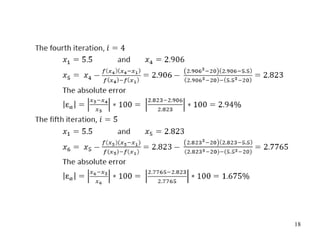
18
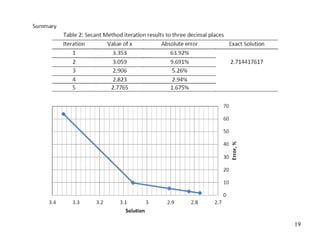
19
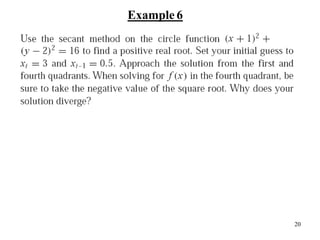
20
Example 6
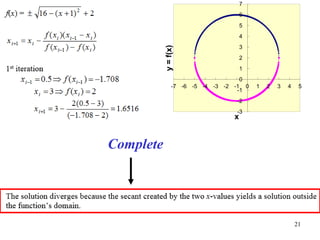
21
Complete
22
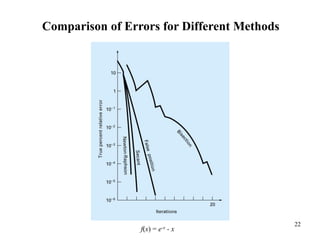
Comparison of Errors for Different Methods
f(x) = e-x - x
23
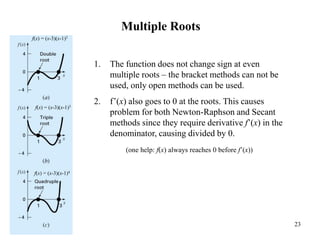
Multiple Roots
f(x) = (x-3)(x-1)2
f(x) = (x-3)(x-1)3
f(x) = (x-3)(x-1)4
1. The function does not change sign at even
multiple roots – the bracket methods can not be
used, only open methods can be used.
2. f’(x) also goes to 0 at the roots. This causes
problem for both Newton-Raphson and Secant
methods since they require derivative f’(x) in the
denominator, causing divided by 0.
(one help: f(x) always reaches 0 before f’(x))
24
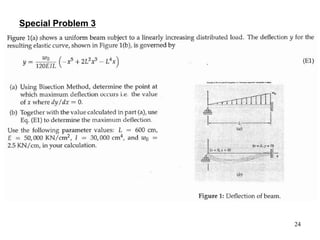
Special Problem 3
25
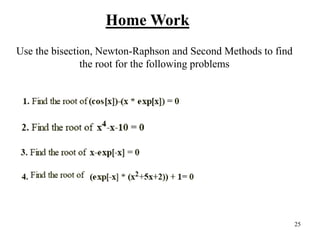
Use the bisection, Newton-Raphson and Second Methods to find
the root for the following problems
Home Work
26
5.

Applied numerical methods lec5

  • 1.
  • 2.
    2 Why Called OpenMethods They require either only one initial starting value or two that though do not necessarily bracket the root Bisection Open method
  • 3.
    Newton-Raphson Method • Mostwidely used formula for locating roots. • Can be derived using Taylor series or the geometric interpretation of the slope in the figure ) ( ) ( : obtain to rearrange ) ( 0 ) ( 1 1 i i i i i i i i x f x f x x x x x f ) (x f         
  • 4.
    4 • Newton-Raphson isa convenient method if f’(x) (the derivative) can be evaluated analytically • Rate of convergence is quadratic, i.e. the error is roughly proportional to the square of the previous error Ei+1=O(Ei 2) (proof is given in the Text) But: • it does not always converge  • There is no convergence criterion • Sometimes, it may converge very very slowly (see next slide) ) ( ) ( 1 i i i i x f x f x x    
  • 5.
    5 Example 1: SlowConvergence 1 : of roots positive the Find 10   x f(x) Iteration x 0 0.5 1 51.65 2 46.485 3 41.8365 4 37.65285 5 33.887565 . . 38 1.083 ∞ 1.0000000 5 . 0 use 10 1 9 10 1      o i i i i x x x x x : Formula R - N
  • 6.
  • 7.
  • 8.
  • 9.
  • 10.
  • 11.
    11 Newton-Raphson Method: Drawbacks The Newton-Raphson method requires the calculation of the derivative of a function, which is not always easy.  If f' vanishes at an iteration point, then the method will fail to converge.  When the step is too large or the value is oscillating, other more conservative methods should take over the case.
  • 12.
    The Secant Method •If derivative f’(x) can not be computed analytically then we need to compute it numerically (backward finite divided difference method) RESULT: N-R becomes SECANT METHOD 1 1 1           i i i i i i i i i x x x f x f dx df x f x f x f x x ) ( ) ( ) ( ) ( ' ) ( : Raphson - Newton  , , , ) ( ) ( ) ( : Secant 3 2 1 1 1 1         i x f x f x x x f x x i i i i i i i
  • 13.
    13 • Requires twoinitial estimates xo, x1. However, it is not a “bracketing” method. • The Secant Method has the same properties as Newton’s method. Convergence is not guaranteed for all xo, f(x). ) ( ) ( ) ( 1 1 1        i i i i i i i x f x f x x x f x x The Secant Method
  • 14.
    14 ) ( ' ) ( : Raphson - Newton i i i i x f x f x x   1 Modified SecantMethod ) ( ) ( ) ( : Secant Original 1 1 1        i i i i i i i x f x f x x x f x x ) ( ) ( ) ( : formula R - N original the in ) ( ) ( ) ( ' compute to fraction on perturbati small a Use : Secant Modified i i i i i i i i i i i i x f x x f x x f x x x x f x x f x f              1
  • 15.
  • 16.
  • 17.
  • 18.
  • 19.
  • 20.
  • 21.
  • 22.
    22 Comparison of Errorsfor Different Methods f(x) = e-x - x
  • 23.
    23 Multiple Roots f(x) =(x-3)(x-1)2 f(x) = (x-3)(x-1)3 f(x) = (x-3)(x-1)4 1. The function does not change sign at even multiple roots – the bracket methods can not be used, only open methods can be used. 2. f’(x) also goes to 0 at the roots. This causes problem for both Newton-Raphson and Secant methods since they require derivative f’(x) in the denominator, causing divided by 0. (one help: f(x) always reaches 0 before f’(x))
  • 24.
  • 25.
    25 Use the bisection,Newton-Raphson and Second Methods to find the root for the following problems Home Work
  • 26.