
1
Chapter 5
Bracketing Method
2
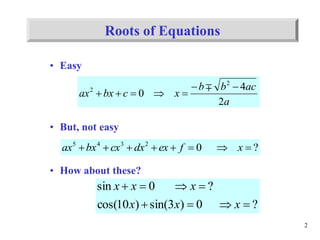
• Easy
• But, not easy
• How about these?
a
acbb
xcbxax
2
4
0
2
2 


?02345
 xfexdxcxbxax
Roots of Equations
?0)3sin()10cos(
?0sin


xxx
xxx
Graphical Approach
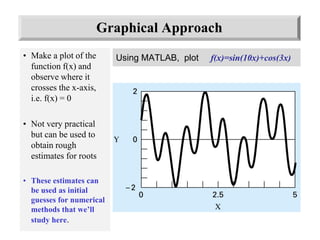
• Make a plot of the
function f(x) and
observe where it
crosses the x-axis,
i.e. f(x) = 0
• Not very practical
but can be used to
obtain rough
estimates for roots
• These estimates can
be used as initial
guesses for numerical
methods that we’ll
study here.
Using MATLAB, plot f(x)=sin(10x)+cos(3x)
4
Why Called Bracketing Methods?
They require two initial guesses which “bracket”
either side of the root.
5
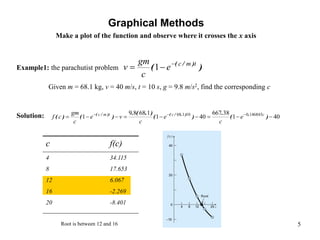
Example1: the parachutist problem
Given m = 68.1 kg, v = 40 m/s, t = 10 s, g = 9.8 m/s2, find the corresponding c
Graphical Methods
401
38667
401
16889
1 146843010168
 
)(
.
)(
).(.
)()( .)./()/( cctmc
e
c
e
c
ve
c
gm
cf
)( )/( tmc
e
c
gm
v 
 1
Make a plot of the function and observe where it crosses the x axis
Solution:
c f(c)
4 34.115
8 17.653
12 6.067
16 -2.269
20 -8.401
Root is between 12 and 16
6
Estimate Properties of Roots By Graphical Methods
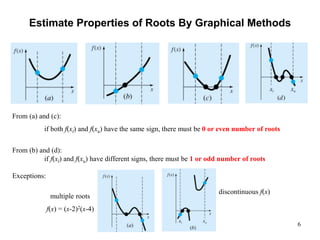
From (a) and (c):
if both f(xl) and f(xu) have the same sign, there must be 0 or even number of roots
From (b) and (d):
if f(xl) and f(xu) have different signs, there must be 1 or odd number of roots
Exceptions:
multiple roots
f(x) = (x-2)2(x-4)
discontinuous f(x)
7
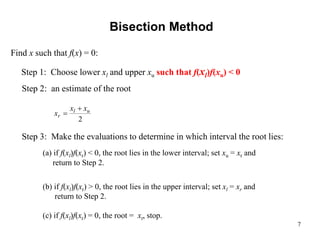
Find x such that f(x) = 0:
Step 1: Choose lower xl and upper xu such that f(xl)f(xu) < 0
Step 2: an estimate of the root
Step 3: Make the evaluations to determine in which interval the root lies:
(a) if f(xl)f(xr) < 0, the root lies in the lower interval; set xu = xr and
return to Step 2.
(b) if f(xl)f(xr) > 0, the root lies in the upper interval; set xl = xr and
return to Step 2.
(c) if f(xl)f(xr) = 0, the root = xr, stop.
Bisection Method
2
ul
r
xx
x


8
s
t
rt
t
x
xx
 

 %100
||
||
snew
r
old
r
new
r
a
x
xx
 

 %
||
||
100
Error Estimates
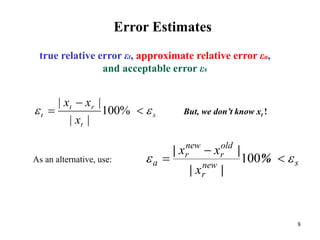
But, we don’t know xt !
As an alternative, use:
true relative error εt, approximate relative error εa,
and acceptable error εs
9
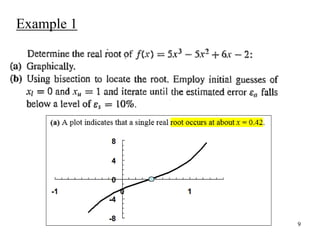
Example 1
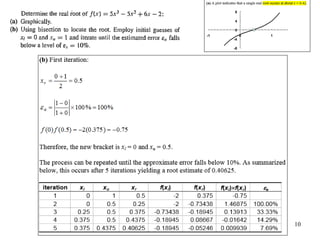
10
11
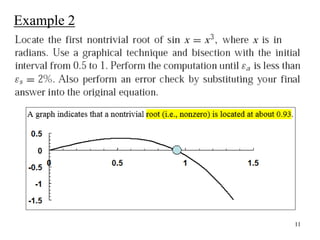
Example 2
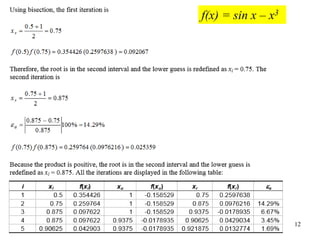
12
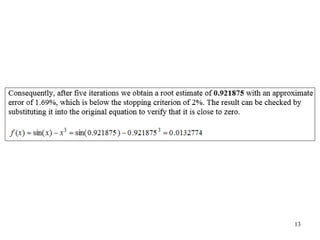
f(x) = sin x – x3
13
14
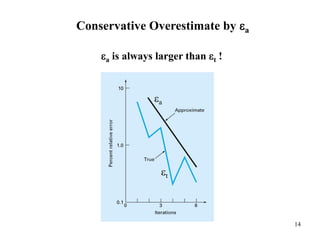
Conservative Overestimate by a
a is always larger than t !
a
t
15
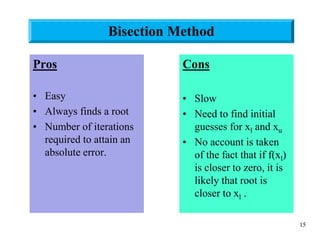
Bisection Method
Pros
• Easy
• Always finds a root
• Number of iterations
required to attain an
absolute error.
Cons
• Slow
• Need to find initial
guesses for xl and xu
• No account is taken
of the fact that if f(xl)
is closer to zero, it is
likely that root is
closer to xl .
16
17
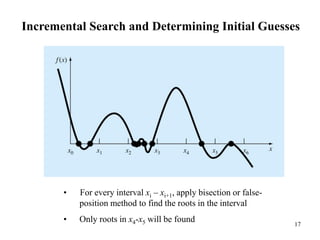
Incremental Search and Determining Initial Guesses
• For every interval xi – xi+1, apply bisection or false-
position method to find the roots in the interval
• Only roots in x4-x5 will be found

Applied numerical methods lec4

  • 1.
  • 2.
    2 • Easy • But,not easy • How about these? a acbb xcbxax 2 4 0 2 2    ?02345  xfexdxcxbxax Roots of Equations ?0)3sin()10cos( ?0sin   xxx xxx
  • 3.
    Graphical Approach • Makea plot of the function f(x) and observe where it crosses the x-axis, i.e. f(x) = 0 • Not very practical but can be used to obtain rough estimates for roots • These estimates can be used as initial guesses for numerical methods that we’ll study here. Using MATLAB, plot f(x)=sin(10x)+cos(3x)
  • 4.
    4 Why Called BracketingMethods? They require two initial guesses which “bracket” either side of the root.
  • 5.
    5 Example1: the parachutistproblem Given m = 68.1 kg, v = 40 m/s, t = 10 s, g = 9.8 m/s2, find the corresponding c Graphical Methods 401 38667 401 16889 1 146843010168   )( . )( ).(. )()( .)./()/( cctmc e c e c ve c gm cf )( )/( tmc e c gm v   1 Make a plot of the function and observe where it crosses the x axis Solution: c f(c) 4 34.115 8 17.653 12 6.067 16 -2.269 20 -8.401 Root is between 12 and 16
  • 6.
    6 Estimate Properties ofRoots By Graphical Methods From (a) and (c): if both f(xl) and f(xu) have the same sign, there must be 0 or even number of roots From (b) and (d): if f(xl) and f(xu) have different signs, there must be 1 or odd number of roots Exceptions: multiple roots f(x) = (x-2)2(x-4) discontinuous f(x)
  • 7.
    7 Find x suchthat f(x) = 0: Step 1: Choose lower xl and upper xu such that f(xl)f(xu) < 0 Step 2: an estimate of the root Step 3: Make the evaluations to determine in which interval the root lies: (a) if f(xl)f(xr) < 0, the root lies in the lower interval; set xu = xr and return to Step 2. (b) if f(xl)f(xr) > 0, the root lies in the upper interval; set xl = xr and return to Step 2. (c) if f(xl)f(xr) = 0, the root = xr, stop. Bisection Method 2 ul r xx x  
  • 8.
    8 s t rt t x xx     %100 || || snew r old r new r a x xx    % || || 100 Error Estimates But, we don’t know xt ! As an alternative, use: true relative error εt, approximate relative error εa, and acceptable error εs
  • 9.
  • 10.
  • 11.
  • 12.
    12 f(x) = sinx – x3
  • 13.
  • 14.
    14 Conservative Overestimate bya a is always larger than t ! a t
  • 15.
    15 Bisection Method Pros • Easy •Always finds a root • Number of iterations required to attain an absolute error. Cons • Slow • Need to find initial guesses for xl and xu • No account is taken of the fact that if f(xl) is closer to zero, it is likely that root is closer to xl .
  • 16.
  • 17.
    17 Incremental Search andDetermining Initial Guesses • For every interval xi – xi+1, apply bisection or false- position method to find the roots in the interval • Only roots in x4-x5 will be found