G.H.PATEL COLLEGE OF ENGINEERING &
TECHNOLOGY
ANAND
Chapter : 4
Linear Transformations
2110015__150110111041(Shreyans Patel)
150110111042(Smit Patel)
150110111043(Piyush Kabra)
150110111044(Hardik Ramani)
150110111045(Shivam Roy)
GENERAL LINEAR TRANSFORMATIONS
INTRODUCTION :-
Linear Transformation is a function from one vector space to
another vector space satisfying certain conditions. In
particular, a linear transformation from Rn to Rm is know as
the Euclidean linear transformation . Linear transformation
have important applications in physics, engineering and
various branches of mathematics.
Introduction to Linear Transformations
 Function T that maps a vector space V into a vector space W:
V: the domain of T
W: the codomain of T
DEFINITION :-
 Let V and W be two vectors spaces. Then a
function T : V W is called a linear transformation from V to W if for all u, U
Ɛ V and all scalars k,
 T(u + v) = T(u) T(v);
 T(ku) = kT(u).
 If V = W, the linear transformation T: V V is called a linear operator on V.
PROPERTIES OF LINEAR TRANSFORMATION
:-
Let T : V W be a linear transformation. Then
T(0) = o
T(-v) = -T(u) for all u Ɛ V
T(u-v) = T(u) – T(v) for all u, u Ɛ V
T(k1v1 + k2v2+ ….. +knvn) = k1T(v1) + k2T(v2) + ….. +knT(vn),
Where v1,v2,….vn Ɛ V and k1, k2, …. Kn are scalars.
Standard Linear Transformations
 Matrix Transformation: let T : Rn Rm be a linear transformation. Then
there always exists an m × n matrix A such that
T(x) = Ax
 This transformation is called the matrix transformation or the Euclidean linear
transformation. Here A is called the standard matrix for T. It is denoted by [T].
 For example, T : R3 R2 defined by
T(x,y,z) = (x = y-z, 2y = 3z, 3x+2y+5z) is a matrix transformation.
 ZERO TRANSFORMATION
 Let V and W be vector spaces.
The mapping T : V W defined by
T(u)
= 0 for all u Ɛ V
 Is called the zero transformation. It is
easy to verify that T is a linear
transformation.
 IDENTITY TRANSFORMATION
 Let V be any vector space.
The mapping I : V V defined by
I(u) = u for all u Ɛ V
 Is called the identity operator on V. it is
for the reader to verify that I is linear.
Linear transformation from images of basic vectors
 A linear transformation is completely determined by the images of any set of basis
vectors. Let T : V W be a linear transformation and {v1,v2,……vn} can be
any basis for V. Then the image T(v) of any vector u Ɛ V can be calculated using
the following steps.
 STEP 1: Express u as a linear combination of the basis vectors v1,v2,……,vn,say
V = k1v1 + k2v2+ ….. +knvn.
 STEP 2: Apply the linear transformation T on v as
T(v) = T(k1v1 + k2v2+ ….. +knvn)
T(v) = k1T( v1)+ k2 T(v2)+ ….. +knT(vn)
Composition of linear Transformations
 Let T1 : U V and T2 : V W be linear transformation. Then the composition of
T2 with T1 denoted by T2 with T1 is the linear transformation defined by,
(T2 O T1)(u) = T2(T1(u)), where u Ɛ U.
 Suppose that T1 : Rn Rm and T2 : Rm RK are linear transformation. Then
there exist matrics A and B of order m × n and k × m respectively such that
T1(x) = Ax and T2 (x) = Bx
Thus A = [T1] and B = [T2].
Now,
(T2 0 T1)(x) = T2 T1(x) = T2 (Ax) = B(Ax) (BA)(x) = ([T1][T2])(x)
So we have
T2 0 T1 = [T2] [T1]
Similarly, for three such linear transformations
T3 0 T2 0 T1 = [T2] [T1][T3]
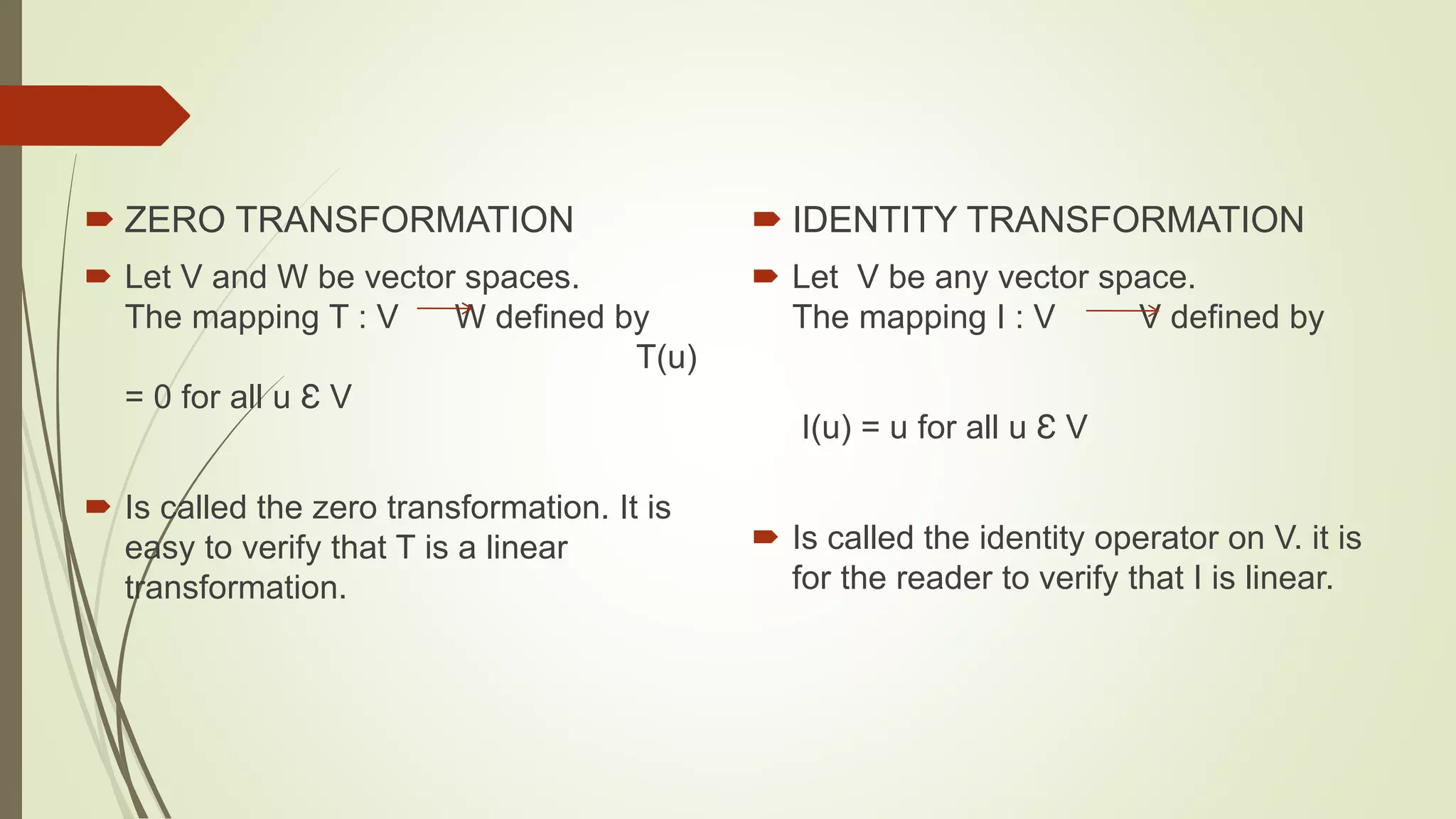
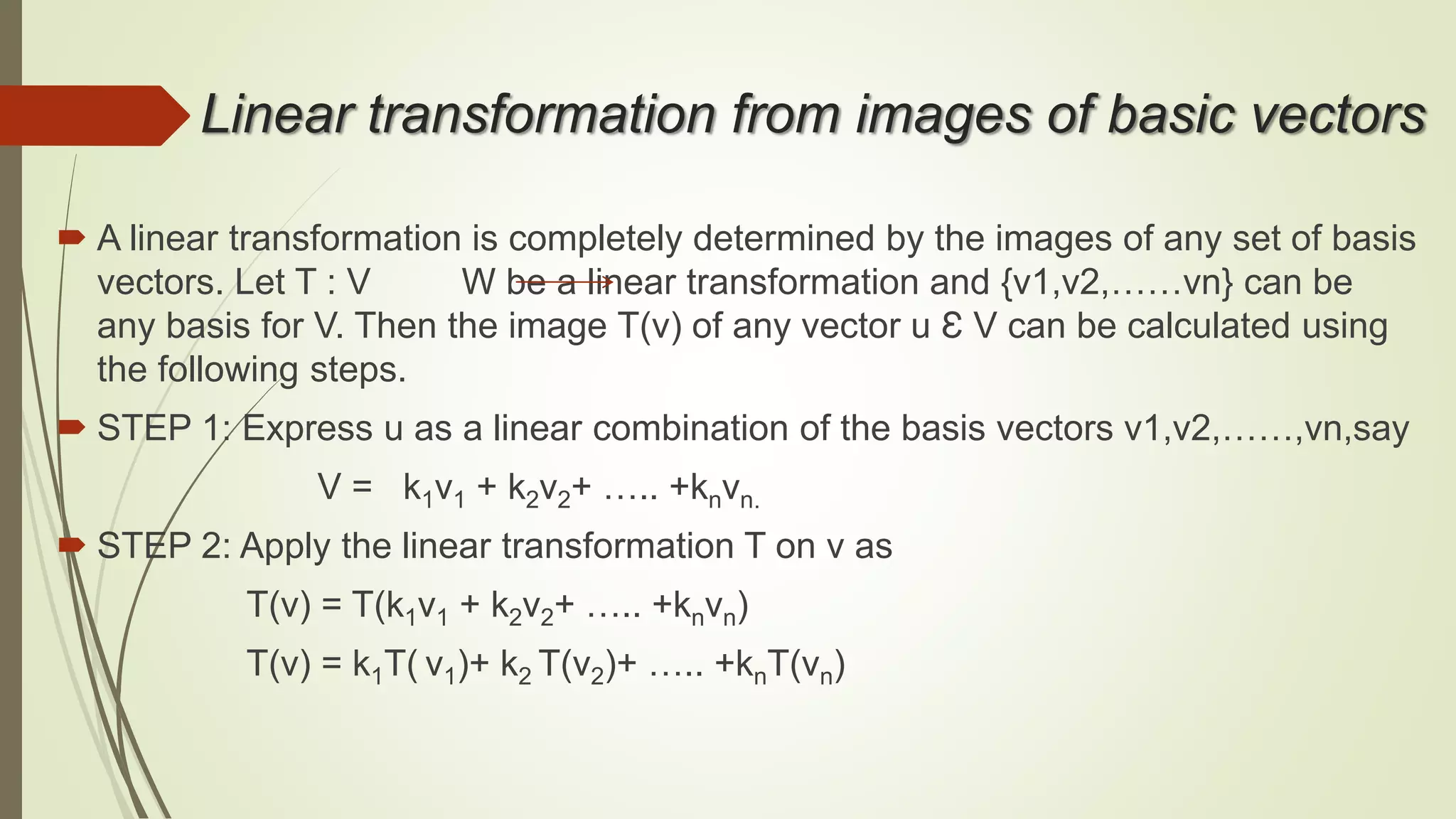
 Ex 1: (A function from R2 into R2 )
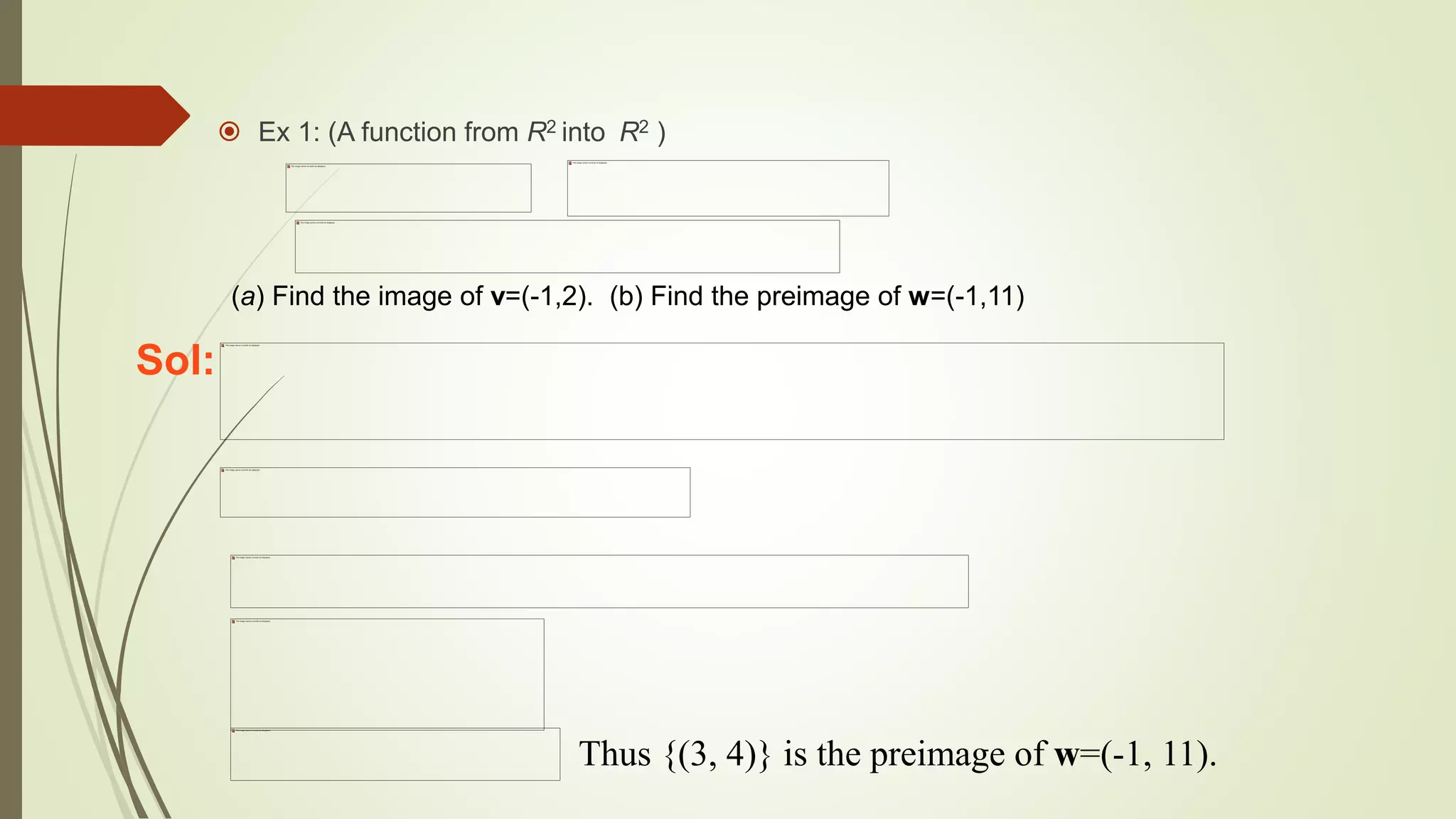
(a) Find the image of v=(-1,2). (b) Find the preimage of w=(-1,11)
Sol:
Thus {(3, 4)} is the preimage of w=(-1, 11).
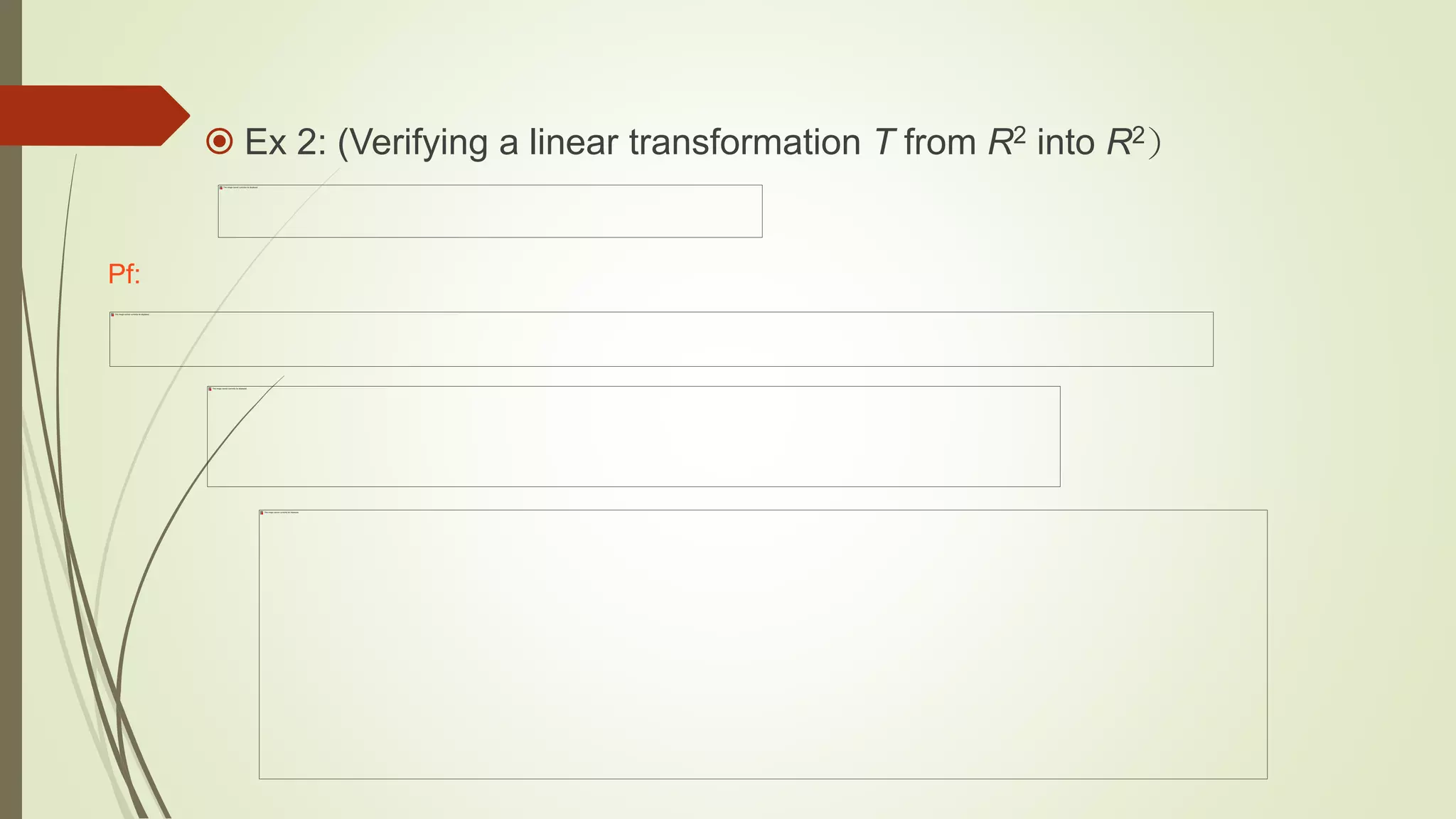
 Ex 2: (Verifying a linear transformation T from R2 into R2)
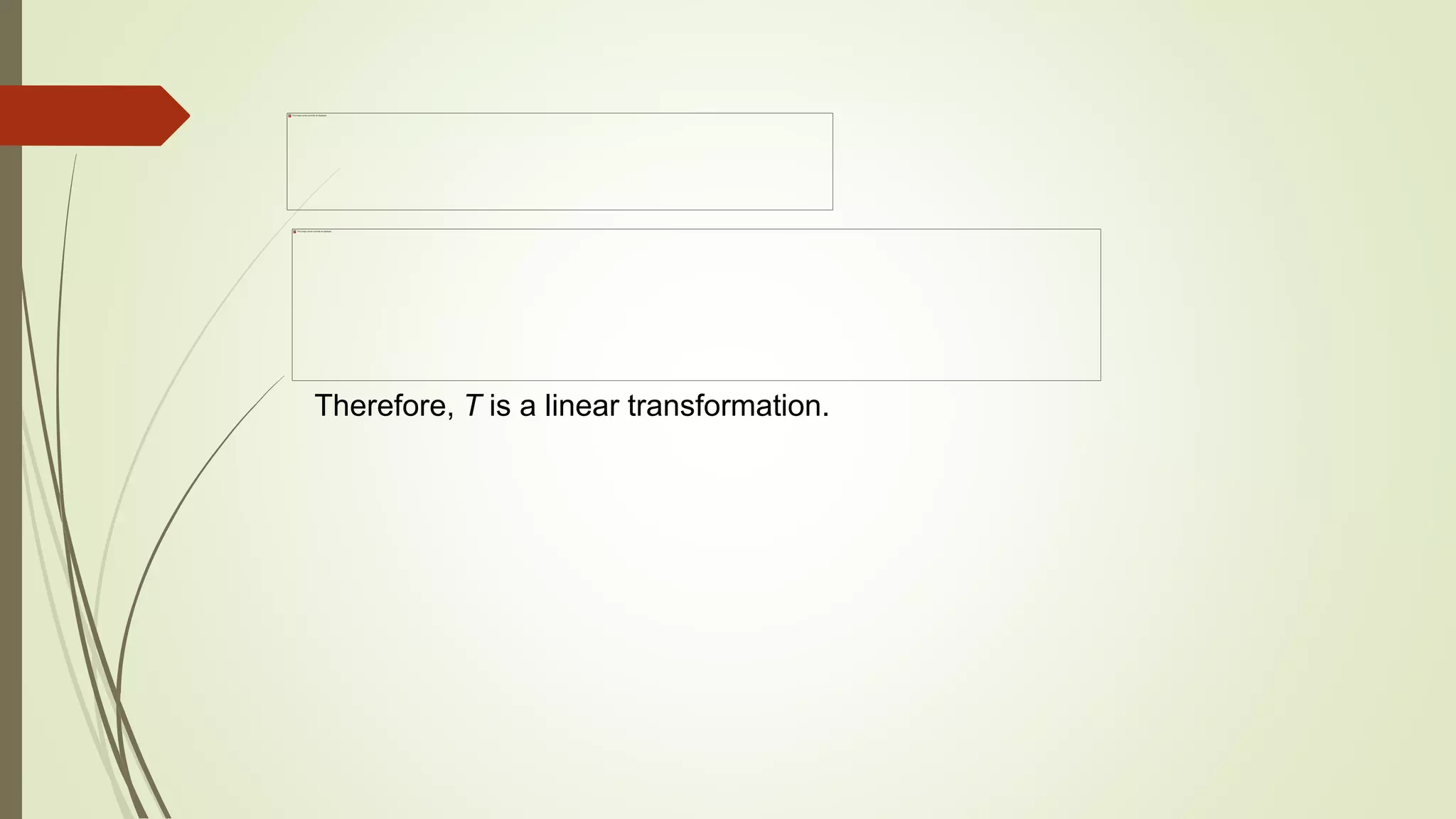
Pf:
Therefore, T is a linear transformation.
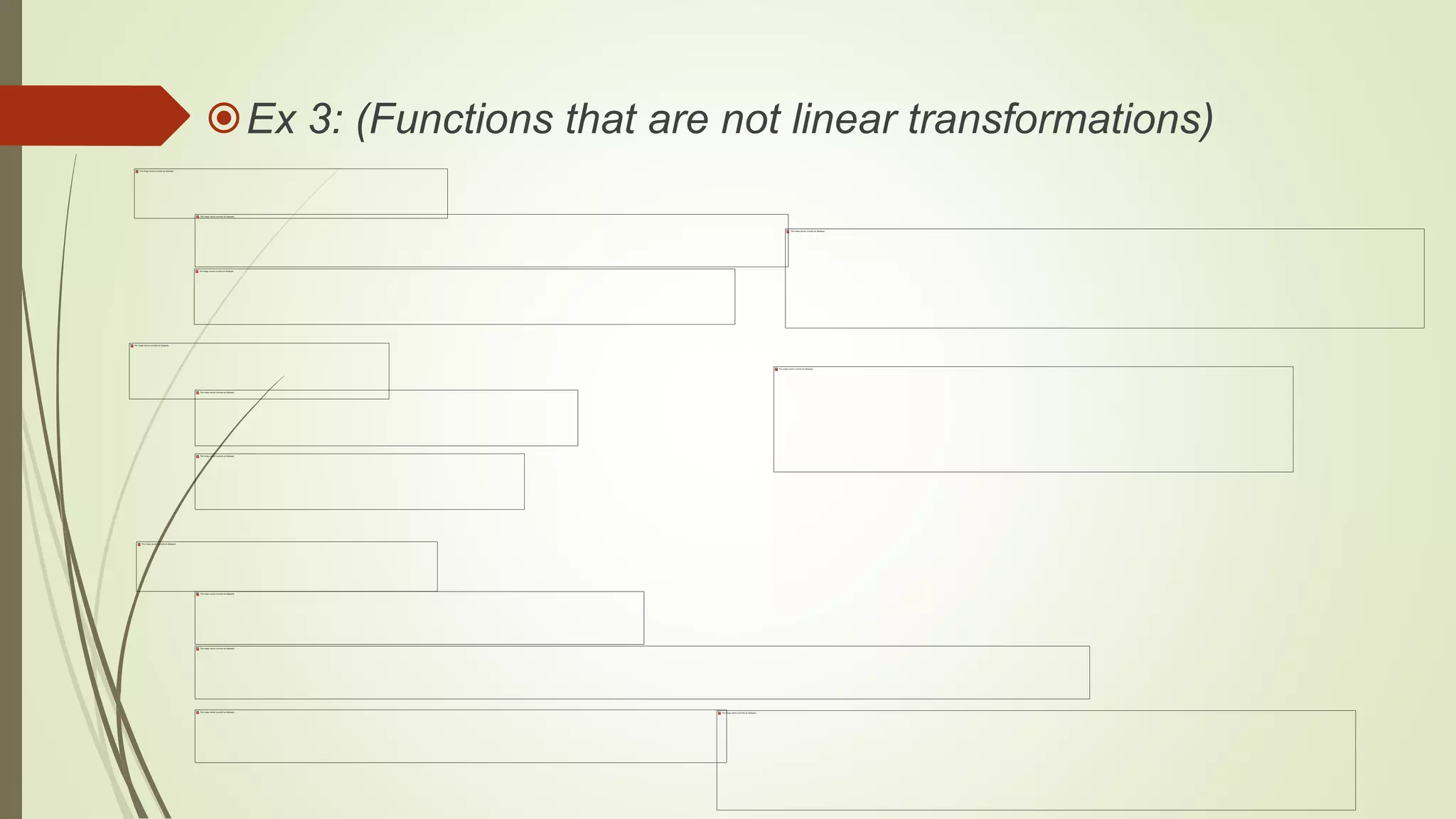
Ex 3: (Functions that are not linear transformations)
 Notes: Two uses of the term “linear”.
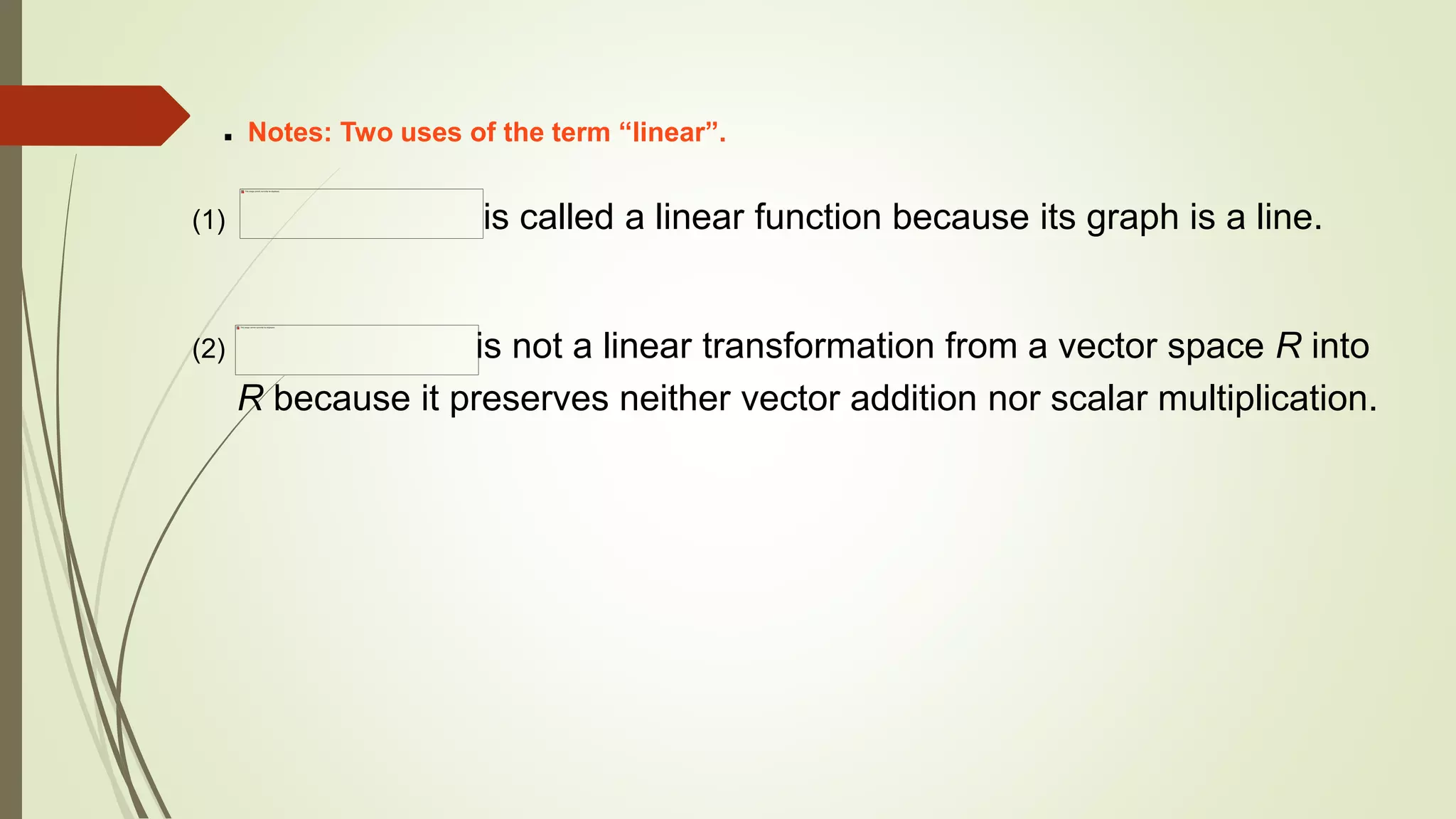
(1) is called a linear function because its graph is a line.
(2) is not a linear transformation from a vector space R into
R because it preserves neither vector addition nor scalar multiplication.
 Ex 4: (Linear transformations and bases)
Let be a linear transformation such that
Sol:
(T is a L.T.)
Find T(2, 3, -2).
Applications of Linear
Operators
 1. Reflection with respect to x-axis:?
 For example, the reflection for the triangle with vertices is
 The plot is given below.
2. Reflection with respect to y=-x :
 Thus, the reflection for the triangle with vertices (-1,4),(3,1),(2,6) is
 The plot is given below
3. Rotation: Counterclockwise
 For example, as
 Thus, the rotation for the triangle with vertices is
Rotation: Counterclockwise
 The plot is given below.
Rotation: Counterclockwise
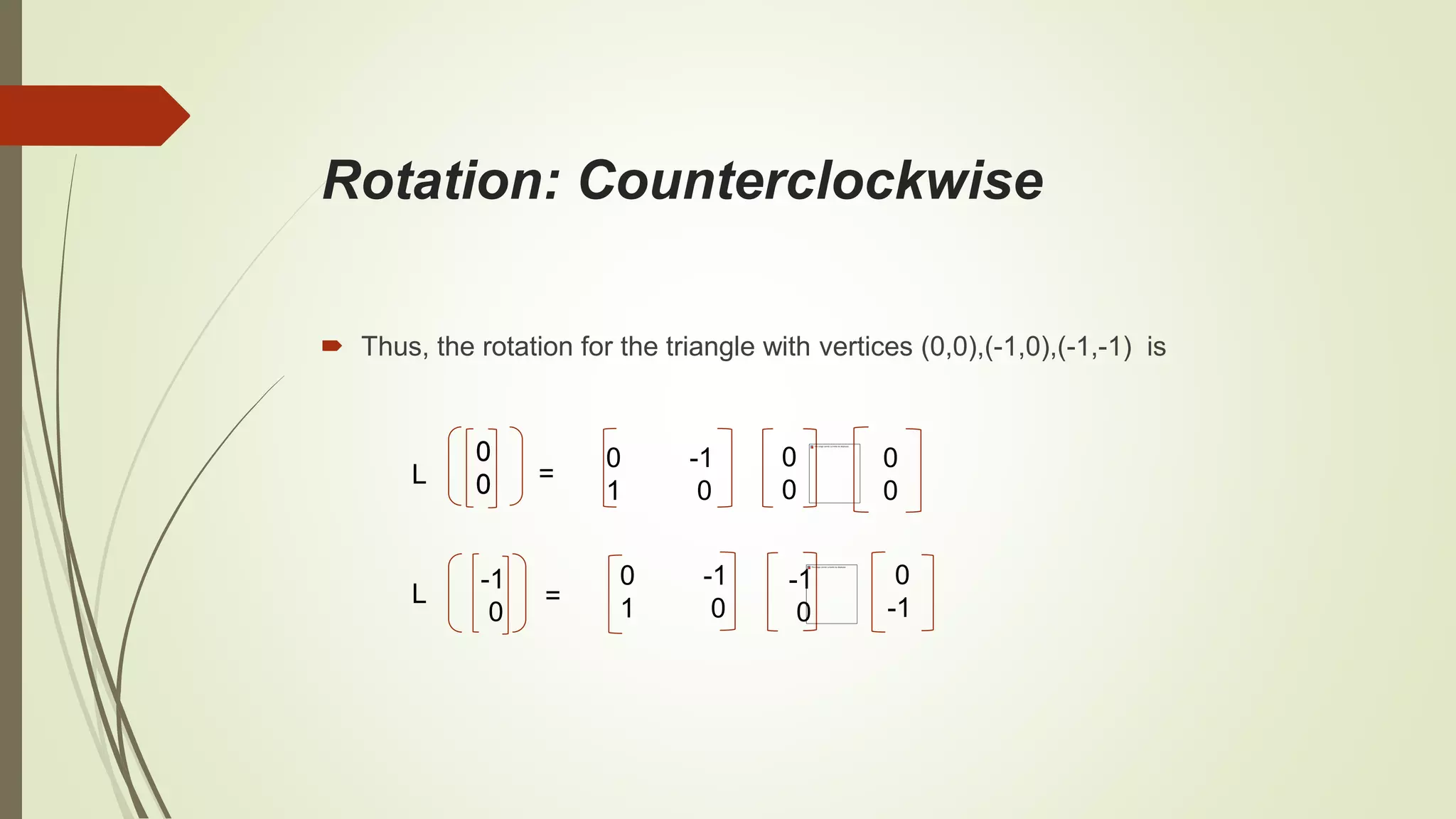
 Thus, the rotation for the triangle with vertices (0,0),(0,1),(-1,1) is
=L
0 -1
1 0
0
0
0
0
0
0
L
0
0
0
1
=
0 -1
1 0
0
1
-1
0
Rotation: Counterclockwise
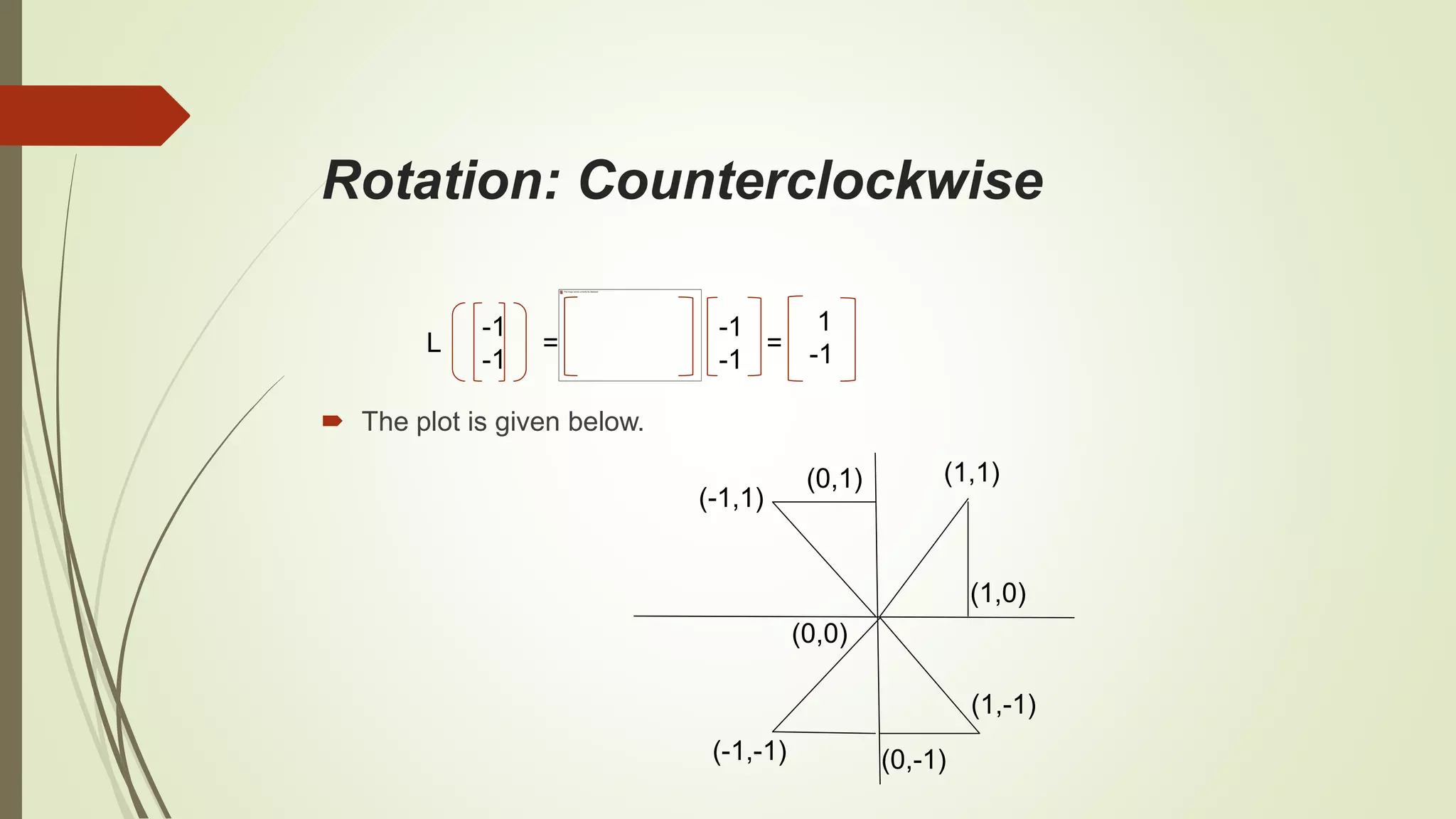
 The plot is given below.
L
-1
1
=
-1
1
=
-1
-1
(-1,1)
(0,1) (1,1)
(0,0)
(-1,-1) (0,-1)
(1,0)
Rotation: Counterclockwise
 Thus, the rotation for the triangle with vertices (0,0),(-1,0),(-1,-1) is
=L
0 -1
1 0
0
0
0
0
0
0
L
0
0
-1
0
=
0 -1
1 0
-1
0
0
-1
Rotation: Counterclockwise
 The plot is given below.
L
-1
-1
=
-1
-1
=
1
-1
(-1,1)
(0,1) (1,1)
(0,0)
(-1,-1) (0,-1)
(1,-1)
(1,0)
Rotation: Counterclockwise
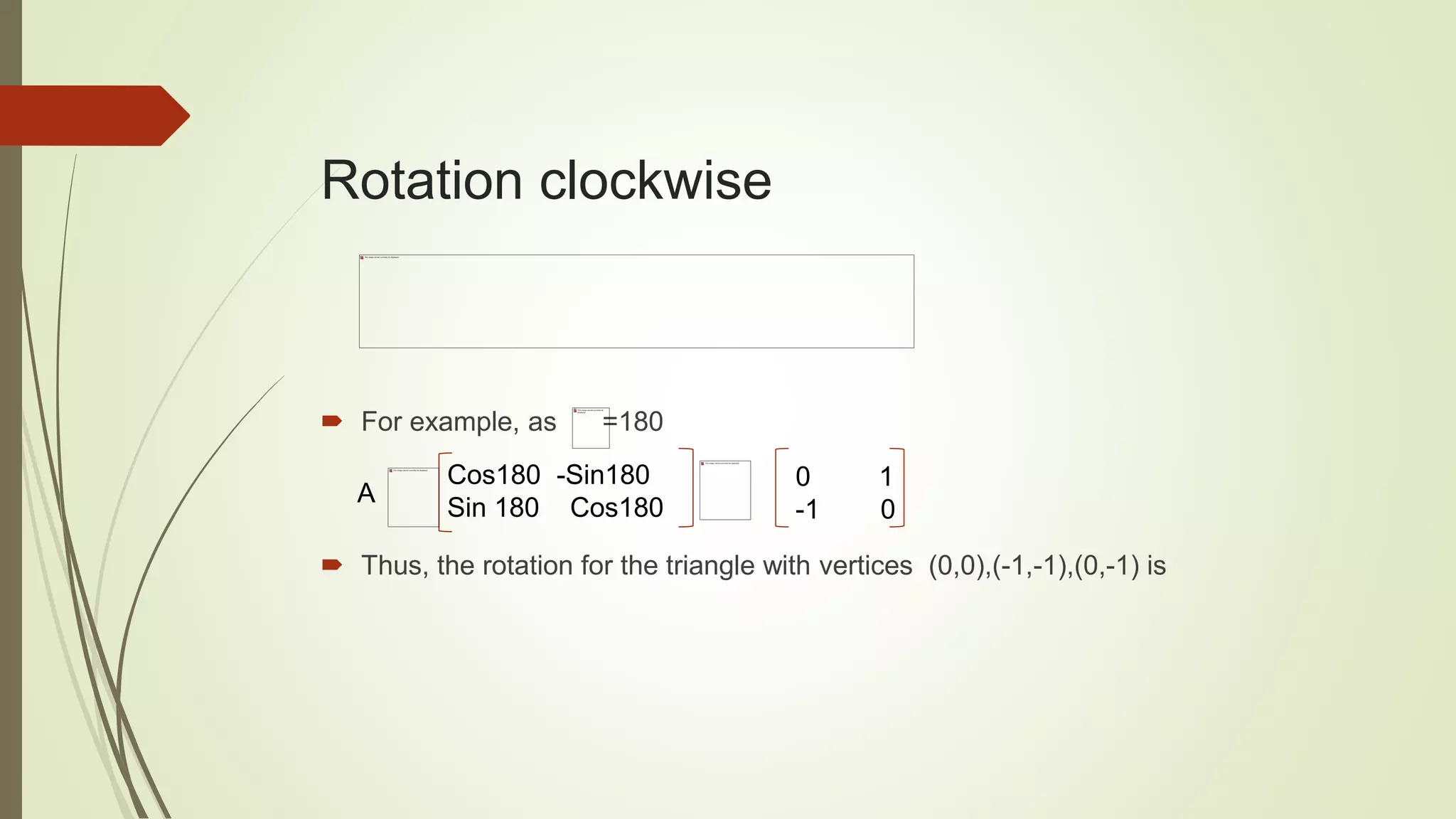
Rotation clockwise
 For example, as =180
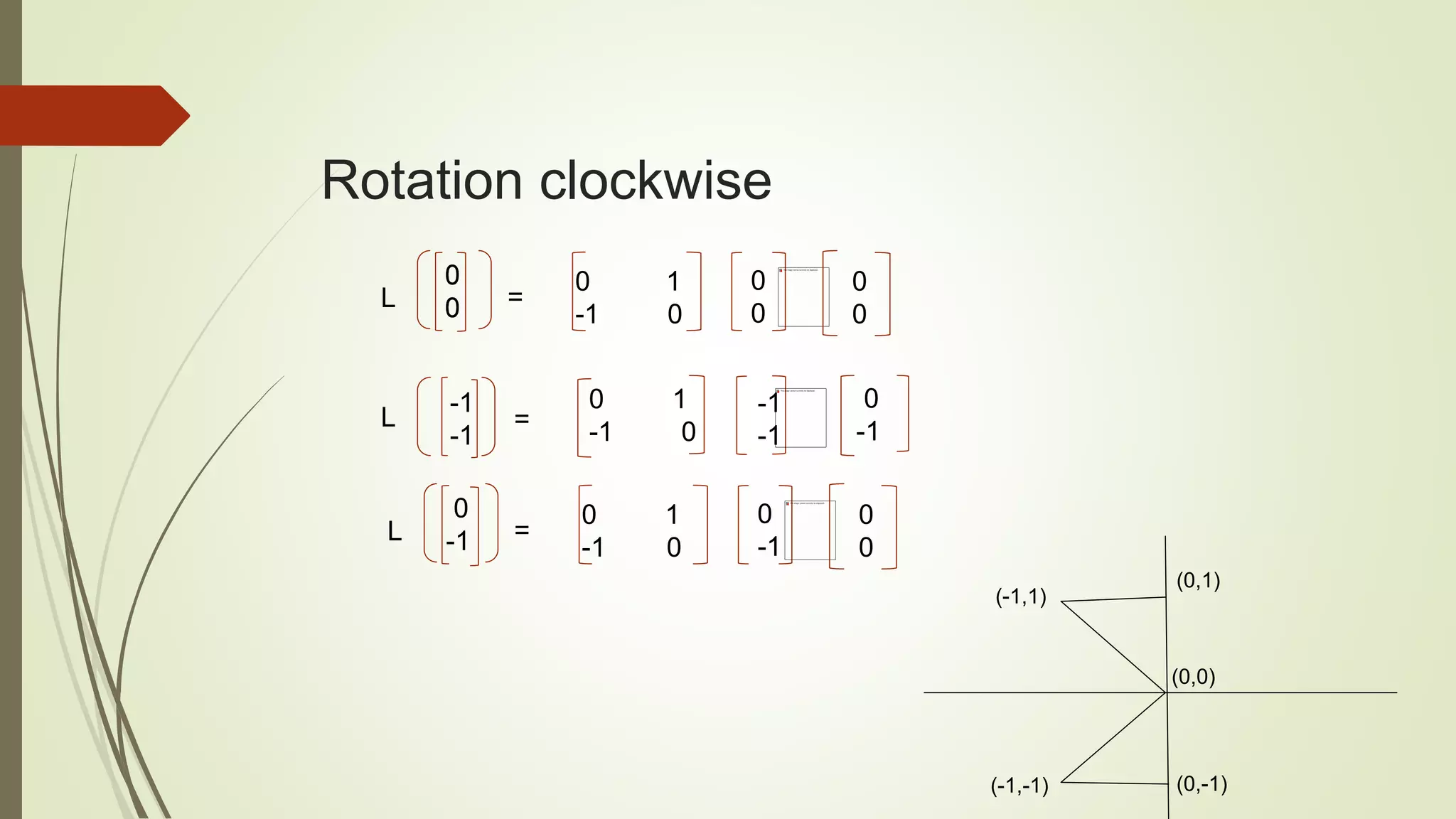
 Thus, the rotation for the triangle with vertices (0,0),(-1,-1),(0,-1) is
A
0 1
-1 0
Cos180 -Sin180
Sin 180 Cos180
Rotation clockwise
=L
0 1
-1 0
0
0
0
0
0
0
L
0
0
-1
-1
=
0 1
-1 0
-1
-1
0
-1
=L
0 1
-1 0
0
-1
0
-1
0
0
(-1,-1)
(0,0)
(0,-1)
(-1,1)
(0,1)
Rotation clockwise
Shear in the x-direction:
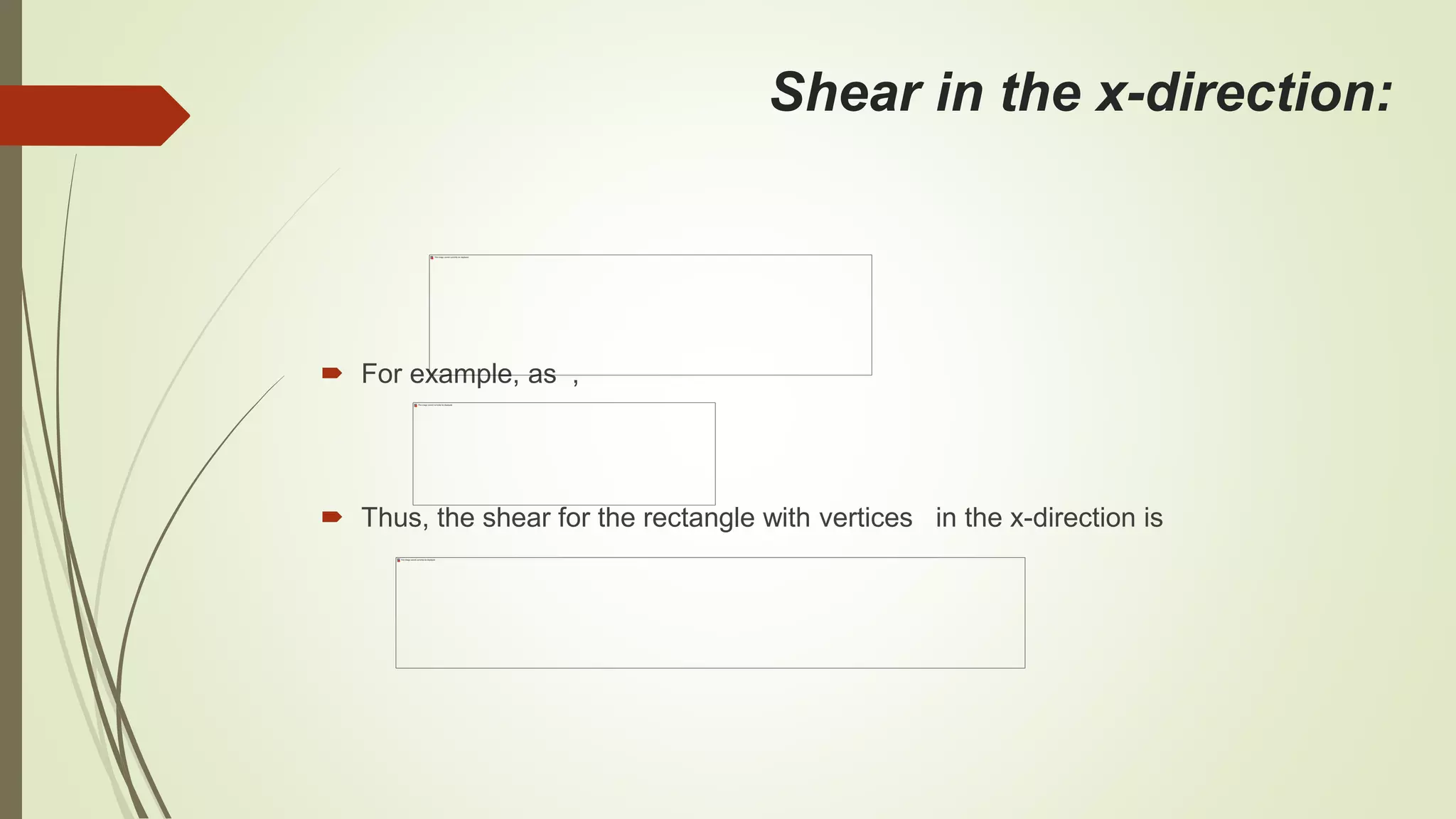
 For example, as ,
 Thus, the shear for the rectangle with vertices in the x-direction is
Shear in the x-direction:
 The plot is given below.
THANKS

Linear transformation and application

  • 1.
    G.H.PATEL COLLEGE OFENGINEERING & TECHNOLOGY ANAND Chapter : 4 Linear Transformations 2110015__150110111041(Shreyans Patel) 150110111042(Smit Patel) 150110111043(Piyush Kabra) 150110111044(Hardik Ramani) 150110111045(Shivam Roy)
  • 2.
  • 3.
    INTRODUCTION :- Linear Transformationis a function from one vector space to another vector space satisfying certain conditions. In particular, a linear transformation from Rn to Rm is know as the Euclidean linear transformation . Linear transformation have important applications in physics, engineering and various branches of mathematics.
  • 4.
    Introduction to LinearTransformations  Function T that maps a vector space V into a vector space W: V: the domain of T W: the codomain of T
  • 5.
    DEFINITION :-  LetV and W be two vectors spaces. Then a function T : V W is called a linear transformation from V to W if for all u, U Ɛ V and all scalars k,  T(u + v) = T(u) T(v);  T(ku) = kT(u).  If V = W, the linear transformation T: V V is called a linear operator on V.
  • 6.
    PROPERTIES OF LINEARTRANSFORMATION :- Let T : V W be a linear transformation. Then T(0) = o T(-v) = -T(u) for all u Ɛ V T(u-v) = T(u) – T(v) for all u, u Ɛ V T(k1v1 + k2v2+ ….. +knvn) = k1T(v1) + k2T(v2) + ….. +knT(vn), Where v1,v2,….vn Ɛ V and k1, k2, …. Kn are scalars.
  • 7.
    Standard Linear Transformations Matrix Transformation: let T : Rn Rm be a linear transformation. Then there always exists an m × n matrix A such that T(x) = Ax  This transformation is called the matrix transformation or the Euclidean linear transformation. Here A is called the standard matrix for T. It is denoted by [T].  For example, T : R3 R2 defined by T(x,y,z) = (x = y-z, 2y = 3z, 3x+2y+5z) is a matrix transformation.
  • 8.
     ZERO TRANSFORMATION Let V and W be vector spaces. The mapping T : V W defined by T(u) = 0 for all u Ɛ V  Is called the zero transformation. It is easy to verify that T is a linear transformation.  IDENTITY TRANSFORMATION  Let V be any vector space. The mapping I : V V defined by I(u) = u for all u Ɛ V  Is called the identity operator on V. it is for the reader to verify that I is linear.
  • 9.
    Linear transformation fromimages of basic vectors  A linear transformation is completely determined by the images of any set of basis vectors. Let T : V W be a linear transformation and {v1,v2,……vn} can be any basis for V. Then the image T(v) of any vector u Ɛ V can be calculated using the following steps.  STEP 1: Express u as a linear combination of the basis vectors v1,v2,……,vn,say V = k1v1 + k2v2+ ….. +knvn.  STEP 2: Apply the linear transformation T on v as T(v) = T(k1v1 + k2v2+ ….. +knvn) T(v) = k1T( v1)+ k2 T(v2)+ ….. +knT(vn)
  • 10.
    Composition of linearTransformations  Let T1 : U V and T2 : V W be linear transformation. Then the composition of T2 with T1 denoted by T2 with T1 is the linear transformation defined by, (T2 O T1)(u) = T2(T1(u)), where u Ɛ U.  Suppose that T1 : Rn Rm and T2 : Rm RK are linear transformation. Then there exist matrics A and B of order m × n and k × m respectively such that T1(x) = Ax and T2 (x) = Bx Thus A = [T1] and B = [T2]. Now, (T2 0 T1)(x) = T2 T1(x) = T2 (Ax) = B(Ax) (BA)(x) = ([T1][T2])(x)
  • 11.
    So we have T20 T1 = [T2] [T1] Similarly, for three such linear transformations T3 0 T2 0 T1 = [T2] [T1][T3]
  • 12.
     Ex 1:(A function from R2 into R2 ) (a) Find the image of v=(-1,2). (b) Find the preimage of w=(-1,11) Sol: Thus {(3, 4)} is the preimage of w=(-1, 11).
  • 13.
     Ex 2:(Verifying a linear transformation T from R2 into R2) Pf:
  • 14.
    Therefore, T isa linear transformation.
  • 15.
    Ex 3: (Functionsthat are not linear transformations)
  • 16.
     Notes: Twouses of the term “linear”. (1) is called a linear function because its graph is a line. (2) is not a linear transformation from a vector space R into R because it preserves neither vector addition nor scalar multiplication.
  • 17.
     Ex 4:(Linear transformations and bases) Let be a linear transformation such that Sol: (T is a L.T.) Find T(2, 3, -2).
  • 18.
  • 19.
     1. Reflectionwith respect to x-axis:?  For example, the reflection for the triangle with vertices is  The plot is given below.
  • 20.
    2. Reflection withrespect to y=-x :  Thus, the reflection for the triangle with vertices (-1,4),(3,1),(2,6) is  The plot is given below
  • 21.
    3. Rotation: Counterclockwise For example, as  Thus, the rotation for the triangle with vertices is
  • 22.
  • 23.
    Rotation: Counterclockwise  Thus,the rotation for the triangle with vertices (0,0),(0,1),(-1,1) is =L 0 -1 1 0 0 0 0 0 0 0 L 0 0 0 1 = 0 -1 1 0 0 1 -1 0
  • 24.
    Rotation: Counterclockwise  Theplot is given below. L -1 1 = -1 1 = -1 -1 (-1,1) (0,1) (1,1) (0,0) (-1,-1) (0,-1) (1,0)
  • 25.
    Rotation: Counterclockwise  Thus,the rotation for the triangle with vertices (0,0),(-1,0),(-1,-1) is =L 0 -1 1 0 0 0 0 0 0 0 L 0 0 -1 0 = 0 -1 1 0 -1 0 0 -1
  • 26.
    Rotation: Counterclockwise  Theplot is given below. L -1 -1 = -1 -1 = 1 -1 (-1,1) (0,1) (1,1) (0,0) (-1,-1) (0,-1) (1,-1) (1,0)
  • 27.
  • 28.
    Rotation clockwise  Forexample, as =180  Thus, the rotation for the triangle with vertices (0,0),(-1,-1),(0,-1) is A 0 1 -1 0 Cos180 -Sin180 Sin 180 Cos180
  • 29.
    Rotation clockwise =L 0 1 -10 0 0 0 0 0 0 L 0 0 -1 -1 = 0 1 -1 0 -1 -1 0 -1 =L 0 1 -1 0 0 -1 0 -1 0 0 (-1,-1) (0,0) (0,-1) (-1,1) (0,1)
  • 30.
  • 31.
    Shear in thex-direction:  For example, as ,  Thus, the shear for the rectangle with vertices in the x-direction is
  • 32.
    Shear in thex-direction:  The plot is given below.
  • 33.