Functions of a Complex Variable
UNIT-1
Dr. M K Singh
Associate Professor
Jahangirabad Institute of Technology,
Barabanki
Functions of A Complex Variables I
Functions of a complex variable provide us some powerful and
widely useful tools in theoretical physics.
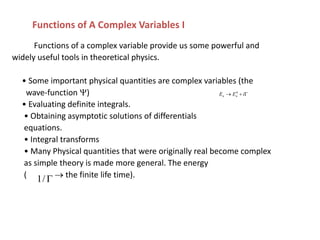
• Some important physical quantities are complex variables (the
wave-function )
• Evaluating definite integrals.
• Obtaining asymptotic solutions of differentials
equations.
• Integral transforms
• Many Physical quantities that were originally real become complex
as simple theory is made more general. The energy
(  the finite life time).
 iEE nn
0
/1
We here go through the complex algebra briefly.
A complex number z = (x,y) = x + iy, Where.
We will see that the ordering of two real numbers (x,y) is significant,
i.e. in general x + iy  y + ix
X: the real part, labeled by Re(z); y: the imaginary part, labeled by Im(z)
Three frequently used representations:
(1) Cartesian representation: x+iy
(2) polar representation, we may write
z=r(cos  + i sin) or
r – the modulus or magnitude of z
 - the argument or phase of z
1i
i
erz 
r – the modulus or magnitude of z
 - the argument or phase of z
The relation between Cartesian
and polar representation:
The choice of polar representation or Cartesian representation is a
matter of convenience. Addition and subtraction of complex variables
are easier in the Cartesian representation. Multiplication, division,
powers, roots are easier to handle in polar form,
 
 
1/ 22 2
1
tan /
r z x y
y x 
  

 21
2121
 
 i
errzz
   21
2121 //  
 i
errzz
innn
erz 
z1 ± z2 = (x1 ± x2 )+i(y1 ± y2 )
z1z2 = (x1x2 - y1y2 )+i(x1y2 + x2y1)
From z, complex functions f(z) may be constructed. They can be
written
f(z) = u(x,y) + iv(x,y)
in which v and u are real functions.
For example if , we have
The relationship between z and f(z) is best pictured as a
mapping operation, we address it in detail later.
)arg()arg()arg( 2121 zzzz 
2121 zzzz 
    xyiyxzf 222

Using the polar form,
2
)( zzf 
Function: Mapping operation
x
y Z-plane
u
v
The function w(x,y)=u(x,y)+iv(x,y) maps points in the xy plane into points
in the uv plane.
nin
i
ie
ie
)sin(cos
sincos






We get a not so obvious formula
Since
n
inin )sin(cossincos  
Complex Conjugation: replacing i by –i, which is denoted by (*),
We then have
Hence
Note:
ln z is a multi-valued function. To avoid ambiguity, we usually set n=0
and limit the phase to an interval of length of 2. The value of lnz with
n=0 is called the principal value of lnz.
iyxz *
222*
ryxzz 
  21*
zzz  Special features: single-valued function of a
real variable ---- multi-valued function
i
rez    ni
re 2
 irlnzln   nirz 2lnln 
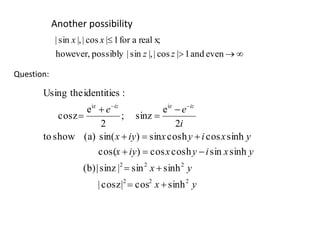
Another possibility


evenand1|cos||,sin|possiblyhowever,
x;realafor1|cos||,sin|
zz
xx
Question:
yx
yx
yxiyxiyx
yxiyxiyx
i
ee iziz
222
222
iziz
sinhcos|cosz|
sinhsin|sinz|(b)
sinhsincoshcos)cos(
sinhcoscoshsin)sin((a)showto
2
e
sinz;
2
e
cosz
:identitiestheUsing









Analytic functions
If f(z) is differentiable at and in some small region around ,
we say that f(z) is analytic at
Differentiable: Cauthy-Riemann conditions are satisfied
the partial derivatives of u and v are continuous
Analytic function:
Property 1:
Property 2: established a relation between u and v
022
 vu
Example:
Find the analytic functions w(z) = u(x, y)+iv(x, y)
if (a) u(x, y) = x3
-3xy2
;(v = 3x3
y- y3
+c)
(b) v(x, y) = e-y
sin x;(v = ?)
0zz 
0zz 
0z
Cauchy-Riemann Equations
     
 
   
 
0 0 0
0 0
0
0
0
1 0 0
2 0 0
Let , , be diff. at
then lim exists
with
In particular, can be computed along
: , i.e.
: , i.e.
z
f z u x y iv x y z x iy
f z z f z
f z
z
z x i y
f z
C y y x x z x
C x x y y
 
   
  
 

    

    
  z i y


 
Cauchy-Riemann Equations
 
0 0 0 0
0
0 0 0 0
( , ) ( , )
( , ) ( , )
u v
x y i x y
x x
f z
u v
i x y x y
y y
 
 
     
 
Cauchy-Riemann Equations
• We have proved the following theorem.
u v
x y
u v
y x
 
 

   
 
Theorem
A necessary condition for a fun.
f(z)=u(x,y)+iv(x,y)
to be diff. at a point z0 is that the C-R eq. hold at
z0.
Consequently, if f is analytic in an open set G,
then the C-R eq. must hold at every point of G.
Theorem
A necessary condition for a fun.
f(z)=u(x,y)+iv(x,y)
to be diff. at a point z0 is that the C-R eq. hold at
z0.
Consequently, if f is analytic in an open set G,
then the C-R eq. must hold at every point of G.
Application of Theorem
To show that a function is NOT analytic, it
suffices to show that the C-R eq. are not
satisfied
Cauchy – Riemann conditions
Having established complex functions, we now proceed to
differentiate them. The derivative of f(z), like that of a real function, is
defined by
provided that the limit is independent of the particular approach to the
point z. For real variable, we require that
Now, with z (or zo) some point in a plane, our requirement that the
limit be independent of the direction of approach is very restrictive.
Consider
       zf
dz
df
z
zf
z
zfzzf
zz


 



 00
limlim
     o
xxxx
xfxfxf
oo



limlim
yixz  
viuf  
,
yix
viu
z
f







Let us take limit by the two different approaches as in the figure. First,
with y = 0, we let x0,
Assuming the partial derivatives exist. For a second approach, we set
x = 0 and then let y 0. This leads to
If we have a derivative, the above two results must be identical. So,







 x
v
i
x
u
z
f
xz 





 00
limlim
x
v
i
x
u






y
v
y
u
i
z
f
z 





 

 0
lim
y
v
x
u





,
x
v
y
u





These are the famous Cauchy-Riemann conditions. These Cauchy-
Riemann conditions are necessary for the existence of a derivative, that
is, if exists, the C-R conditions must hold.
Conversely, if the C-R conditions are satisfied and the partial
derivatives of u(x,y) and v(x,y) are continuous, exists.
 xf
 zf
Cauchy’s integral Theorem
We now turn to integration.
in close analogy to the integral of a real function
The contour is divided into n intervals .Let
with for j. Then
'
00 zz 
01  jjj zzz
   




0
0
1
lim
z
z
n
j
jj
n
dzzfzf 
n
The right-hand side of the above equation is called the contour (path) integral
of f(z)
.and
bewteencurveon thepointaiswhere
,andpointsthechoosing
ofdetailstheoftindependen
isandexistslimitthat theprovided
1
j
j
jj
j
zz
z


As an alternative, the contour may be defined by
with the path C specified. This reduces the complex integral to the
complex sum of real integrals. It’s somewhat analogous to the case of
the vector integral.
An important example
        
22
11
2
1
,,
yx
yxc
z
zc
idydxyxivyxudzzf
     
22
11
22
11
yx
yx
yx
yxcc
udyvdxivdyudx

c
n
dzz
where C is a circle of radius r>0 around the origin z=0 in the
direction of counterclockwise.
In polar coordinates, we parameterize
and , and have
which is independent of r.
Cauchy’s integral theorem
– If a function f(z) is analytical (therefore single-valued) [and its partial
derivatives are continuous] through some simply connected region R, for
every closed path C in R,

 i
rez
 
diredz i
   
 


2
0
1
1exp
22
1
dni
r
dzz
i
n
c
n
1-nfor1
-1nfor0
{



  0 dzzf
c
•Multiply connected regions
The original statement of our theorem demanded a simply connected
region. This restriction may easily be relaxed by the creation of a
barrier, a contour line. Consider the multiply connected region of
Fig.1.6 In which f(z) is not defined for the interior R
Cauchy’s integral theorem is not valid for the contour C, but we can
construct a C for which the theorem holds. If line segments DE and
GA arbitrarily close together, then
    
E
D
A
G
dzzfdzzf
'
2
'
1 CEFGCABD 
 
 
 dzzfdzzf
EFGGADEABD
ABDEFGA
C








 
  0dzzf
EFGABD






 
    

21 CC
dzzfdzzf
Cauchy’s Integral Formula
Cauchy’s integral formula: If f(z) is analytic on and within a closed contour C
then
in which z0 is some point in the interior region bounded by C. Note that
here z-z0 0 and the integral is well defined.
Although f(z) is assumed analytic, the integrand (f(z)/z-z0) is not
analytic at z=z0 unless f(z0)=0. If the contour is deformed as in Fig.1.8
Cauchy’s integral theorem applies.
So we have
   0
0
2 zif
zz
dzzf
C


   
  



C C
dz
zz
zf
zz
dzzf
2
0
00
Let , here r is small and will eventually be made to
approach zero
(r0)
Here is a remarkable result. The value of an analytic function is given at
an interior point at z=z0 once the values on the boundary C are
specified.
What happens if z0 is exterior to C?
In this case the entire integral is analytic on and within C, so the
integral vanishes.

 i
0 rezz
    


drie
re
rezf
dz
zz
dzzf i
C C
i
i
 



2 2
0
0
   00 2
2
zifdzif
C
  
Derivatives
Cauchy’s integral formula may be used to obtain an expression for
the derivation of f(z)
Moreover, for the n-th order of derivative
 
 
0
0 0
1
2
f z dzd
f z
dz i z z
 
   
 
Ñ
   
 




C
zf
zz
dzzf
i exteriorz,0
interiorz,
2
1
0
00
0
   
  







 2
000 2
11
2
1
zz
dzzf
izzdz
d
dzzf
i 
    
  

 1
0
0
2
!
n
n
zz
dzzf
i
n
zf

.findorigin,about thecirclea
withinandonanalyticisa)(If1.
Examples
0
n
n
n
n
a
zzf 

     jn
jn
nj
j
zaajzf 


1
!
   j
j
ajf !0 
    
 
 12
1
!
0
n
n
n
z
dzzf
in
f
a

In the above case, on a circle of radius r about the origin,
then (Cauchy’s inequality)
Proof:
where
Lowville's theorem: If f(z) is analytic and bounded in the complex
plane, it is a constant.
Proof: For any z0, construct a circle of radius R around z0,
  Mzf 
Mra n
n 
    nn
rz
nn
r
M
r
r
rM
z
dzzf
a  

 11
2
2
2
1



   rfMaxrM rz 
   
  22
0
0
2
22
1
R
RM
zz
dzzf
i
zf
R






R
M

Since R is arbitrary, let , we have
Conversely, the slightest deviation of an analytic function from a
constant value implies that there must be at least one singularity
somewhere in the infinite complex plane. Apart from the trivial constant
functions, then, singularities are a fact of life, and we must learn to live
with them, and to use them further.
R
  .const)z(f,e.i,0zf 
Laurent Expansion
Taylor Expansion
Suppose we are trying to expand f(z) about z=z0, i.e.,
and we have z=z1 as the nearest point for which f(z) is not analytic. We
construct a circle C centered at z=z0 with radius
From the Cauchy integral formula,
   



0n
n
0n zzazf
010 zzzz 
     
    







C 00C
zzzz
zdzf
i2
1
zz
zdzf
i2
1
zf
 
       



C 000 zzzz1zz
zdzf
i2
1
Here z is a point on C and z is any point interior to C. For |t| <1, we
note the identity
So we may write
which is our desired Taylor expansion, just as for real variable power
series, this expansion is unique for a given z0.




 0
2
1
1
1
n
n
ttt
t

 
   
 






C n
n
n
zz
zdzfzz
i
zf
0
1
0
0
2
1

   
  






0
1
0
0
2
1
n C
n
n
zz
zdzf
zz
i
 
  




0
0
0
!n
n
n
n
zf
zz
Schwarz reflection principle
From the binomial expansion of for integer n (as an
assignment), it is easy to see, for real x0
Schwarz reflection principle:
If a function f(z) is (1) analytic over some region including the real axis
and (2) real when z is real, then
We expand f(z) about some point (nonsingular) point x0 on the real axis
because f(z) is analytic at z=x0.
Since f(z) is real when z is real, the n-th derivate must be real.
   n
0xzzg 
        *n
0
**n
0
*
zgxzxzzg 
   **
zfzf 
   
  




0
0
0
!n
n
n
n
xf
xzzf
   
  
 *
0
0
0
**
!
zf
n
xf
xzzf
n
n
n
 


Laurent Series
We frequently encounter functions that are analytic in annular
region
Drawing an imaginary contour line to convert our region into a simply
connected region, we apply Cauchy’s integral formula for C2 and C1,
with radii r2 and r1, and obtain
We let r2 r and r1 R, so for C1, while for C2, .
We expand two denominators as we did before
(Laurent Series)
   
zz
zdzf
i
zf
CC












 
21
2
1

00 zzzz  00 zzzz 
   
      
 
      












 
21
000000 112
1
CC
zzzzzz
zdzf
zzzzzz
zdzf
i
zf

   
   
    zdzfzz
zzizz
zdzf
zz
i
n
n C
n
n C
n
n





   






0
01
00
1
0
0
21
1
2
1
2
1

   



n
n
n zzazf 0
where
Here C may be any contour with the annular region
r < |z-z0| < R encircling z0 once in a counterclockwise sense.
Laurent Series need not to come from evaluation of
contour integrals. Other techniques such as ordinary series
expansion may provide the coefficients.
Numerous examples of Laurent series appear in the next chapter.
 
  



C
nn
zz
zdzf
i
a 1
0
2
1

 




0
222
1
m
mnimn
i
n
er
drie
i
a 



 
  












0
21 2
1
1
1
2
1
m
n
m
nn
z
zd
z
izz
zd
zi
a

     1
1zzzf






0
1,22
2
1
m
mni
i








1-nfor0
-1nfor1
an
  



 1
32
1
1
1
1
n
n
zzzz
zzz

The Laurent expansion becomes
Example:
(1) Find Taylor expansion ln(1+z) at point z
(2) find Laurent series of the function
If we employ the polar form





1
1
)1()1ln(
n
n
n
n
z
z
• Theorem
Suppose that a function f is analytic throughout an annular
domain R1< |z − z0| < R2, centered at z0 , and let C denote any
positively oriented simple closed contour around z0 and lying in
that domain. Then, at each point in the domain, f (z) has the
series representation
Laurent Series
0 1 0 2
0 1 0
( ) ( ) ,( | | )
( )
n n
n n
n n
b
f z a z z R z z R
z z
 
 
     

 
1
0
1 ( )
,( 0,1,2,...)
2 ( )
n n
C
f z dz
a n
i z z 
 

1
0
1 ( )
,( 1,2,...)
2 ( )
n n
C
f z dz
b n
i z z  
 

• Theorem (Cont’)
Laurent Series
0 1 0 2( ) ( ) ,( | | )n
n
n
f z c z z R z z R


    
0 1 0 2
0 1 0
( ) ( ) ,( | | )
( )
n n
n n
n n
b
f z a z z R z z R
z z
 
 
     

 
1
0
1 ( )
,( 0,1,2,...)
2 ( )
n n
C
f z dz
a n
i z z 
 

1
0
1 ( )
,( 1,2,...)
2 ( )
n n
C
f z dz
b n
i z z  
 

1
0
1 ( )
,( 0, 1, 2,...)
2 ( )
n n
C
f z dz
c n
i z z 
   

1 1
0
0
( )
( )
nn
nn
n n
b
b z z
z z
 


 
 

 
, 1
, 0
n
n
n
b n
c
a n
  
 

• Laurent’s Theorem
If f is analytic throughout the disk |z-z0|<R2,
Laurent Series
0
0
( ) ( )n
n
n
f z a z z


 
1
01
0
1 ( ) 1
( ) ( ) ,( 1,2,...)
2 ( ) 2
n
n n
C C
f z dz
b z z f z dz n
i z z i 

 
   
 
Analytic in the region |z-z0|<R2
0,( 1,2,...)nb n 
( )
0
1
0
( )1 ( )
,( 0,1,2,...)
2 ( ) !
n
n n
C
f zf z dz
a n
i z z n 
  

reduces to Taylor
Series about z0
0 1 0 2
0 1 0
( ) ( ) ,( | | )
( )
n n
n n
n n
b
f z a z z R z z R
z z
 
 
     

 
• Example 1
Replacing z by 1/z in the Maclaurin series expansion
We have the Laurent series representation
Examples
2 3
0
1 ...(| | )
! 1! 2! 3!
n
z
n
z z z z
e z
n


       
1/
2 3
0
1 1 1 1
1 ...(0 | | )
! 1! 2! 3!
z
n
n
e z
n z z z z


        
There is no positive powers of z, and all coefficients of the positive powers are zeros.
1
1 ( )
,( 1,2,...)
2 ( 0)
n n
C
f z dz
b n
i z  
 

1/
1/
1 1 1
1 1
1
2 ( 0) 2
z
z
C C
e dz
b e dz
i z i  
  
 
1/
2z
C
e dz i
where c is any positively oriented simple closed
contours around the origin
• Example 2
The function f(z)=1/(z-i)2 is already in the form of a
Laurent series, where z0=i,. That is
where c-2=1 and all of the other coefficients are zero.
Examples
2
1
( ) ,(0 | | )
( )
n
n
n
c z i z i
z i


     


3
0
1
,( 0, 1, 2,...)
2 ( )
n n
C
dz
c n
i z z 
   

3
0, 2
2 , 2( )n
C
ndz
i nz i 
 
 
  

where c is any positively oriented simple contour
around the point z0=i
Examples
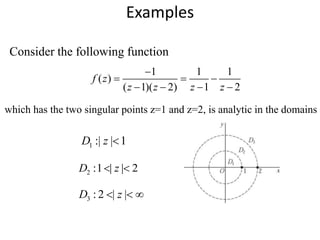
Consider the following function
1 1 1
( )
( 1)( 2) 1 2
f z
z z z z

  
   
which has the two singular points z=1 and z=2, is analytic in the domains
1 :| | 1D z 
3 : 2 | |D z  
2 :1 | | 2D z 
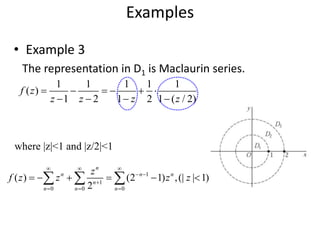
• Example 3
The representation in D1 is Maclaurin series.
Examples
1 1 1 1 1
( )
1 2 1 2 1 ( / 2)
f z
z z z z
     
   
1
1
0 0 0
( ) (2 1) ,(| | 1)
2
n
n n n
n
n n n
z
f z z z z
  
 

  
       
where |z|<1 and |z/2|<1
• Example 4
Because 1<|z|<2 when z is a point in D2, we know
Examples
1 1 1 1 1 1
( )
1 2 1 (1/ ) 2 1 ( / 2)
f z
z z z z z
     
   
where |1/z|<1 and |z/2|<1
1 1 1
0 0 1 0
1 1
( ) ,(1 | | 2)
2 2
n n
n n n n
n n n n
z z
f z z
z z
   
  
   
        
• Theorem 1
If a power series
converges when z = z1 (z1 ≠ z0), then it is absolutely
convergent at each point z in the open disk |z − z0| < R1
where R1 = |z1 − z0|
Some Useful Theorems
0
0
( )n
n
n
a z z



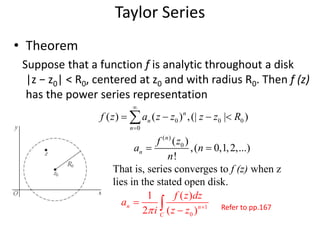
• Theorem
Suppose that a function f is analytic throughout a disk
|z − z0| < R0, centered at z0 and with radius R0. Then f (z)
has the power series representation
Taylor Series
0 0 0
0
( ) ( ) ,(| | )n
n
n
f z a z z z z R


   
( )
0( )
,( 0,1,2,...)
!
n
n
f z
a n
n
 
That is, series converges to f (z) when z
lies in the stated open disk.
1
0
1 ( )
2 ( )
n n
C
f z dz
a
i z z 

 Refer to pp.167
Proof the Taylor’s Theorem
( )
0 0
0
(0)
( ) ,(| | )
!
n
n
n
f
f z z z z R
n


  
Proof:
Let C0 denote and positively oriented circle |z|=r0, where r<r0<R0
Since f is analytic inside and on the circle C0 and since the
point z is interior to C0, the Cauchy integral formula holds
0
0
1 ( )
( ) , ,| |
2 C
f s ds
f z z z R
i s z
  

1 1 1 1 1
, ( / ),| | 1
1 ( / ) 1
   
  
w z s w
s z s z s s w
Proof the Taylor’s Theorem
1
1
0
1 1 1
( )
N
n N
n N
n
z z
s z s s z s



 
 

0
1 ( )
( )
2 C
f s ds
f z
i s z


0 0
1
1
0
1 ( ) 1 ( )
( )
2 2 ( )
N
n N
n N
n C C
f s ds f s ds
f z z z
i s i s z s 



 

  
( )
(0)
!
n
f
n
Refer to pp.167
0
( )1
0
(0) ( )
( )
! 2 ( )
n NN
n
N
n C
f z f s ds
f z z
n i s z s


 

 
ρN
Proof the Taylor’s Theorem
0
( )
lim lim 0
2 ( )
N
N NN N
C
z f s ds
i s z s

 
 

( ) ( ) ( )1
0 0 0
(0) (0) (0)
( ) lim( ) 0
! ! !
n n nN
n n n
N
N
n n n
f f f
f z z z z
n n n

  

  
      
When
0
0
0 0
( ) | |
| | | | 2
2 ( ) 2 ( )
N N
N N N
C
z f s ds r M
r
i s z s r r r
 
 
 
 
Where M denotes the maximum value of |f(s)| on C0
0
0 0
| | ( )N
N
Mr r
r r r
 

lim 0N
N



0
( ) 1
r
r

Example
expand f(z) into a series involving powers of z.
We can not find a Maclaurin series for f(z) since it is not analytic at
z=0. But we do know that expansion
Hence, when 0<|z|<1
Examples
2 2
3 5 3 2 3 2
1 2 1 2(1 ) 1 1 1
( ) (2 )
1 1
z z
f z
z z z z z z
  
   
  
2 4 6 8
2
1
1 ...(| | 1)
1
z z z z z
z
      

2 4 6 8 3 5
3 3
1 1 1
( ) (2 1 ...) ...f z z z z z z z z
z z z
            
Negative powers
Residue theorem
Calculus of residues
Functions of a Complex Variable
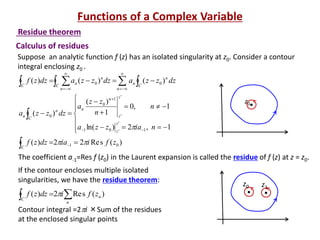
Suppose an analytic function f (z) has an isolated singularity at z0. Consider a contour
integral enclosing z0 .
z0
)(sRe22)(
1,2)ln(
1,0
1
)(
)(
)()()(
01
1
'
'01
'
'
1
0
0
00
zfiiadzzf
niazza
n
n
zz
a
dzzza
dzzzadzzzadzzf
C
z
z
z
z
n
n
C
n
n
n
C
n
n
C
n
n
n
C
























  
The coefficient a-1=Res f (z0) in the Laurent expansion is called the residue of f (z) at z = z0.
If the contour encloses multiple isolated
singularities, we have the residue theorem:
 
n
n
C
zfidzzf )(sRe2)( 
z0 z1
Contour integral =2i ×Sum of the residues
at the enclosed singular points
Residue formula:
To find a residue, we need to do the Laurent expansion and pick up the coefficient a-1.
However, in many cases we have a useful residue formula
 
 
 
 )()(lim
)!1(
1
)(sRe
)!1())(2()1)((lim)(lim
)(lim
)!1(
1
)()(lim
)!1(
1
:Proof
.)()(lim)(sRe
,polesimpleaforly,Particular
)()(lim
)!1(
1
)(sRe
,orderofpoleaFor
01
1
01
1
1
1
001
1
01
1
01
1
00
01
1
0
0
00
00
0
0
zfzz
dz
d
m
zfa
mazznmnmnazza
dz
d
zza
dz
d
m
zfzz
dz
d
m
zfzzzf
zfzz
dz
d
m
zf
m
m
m
m
zz
n
n
n
zz
mn
mn
nm
m
zz
mn
mn
nm
m
zz
m
m
m
zz
zz
m
m
m
zz










































 
 
  .0,)()(lim
!
1
:tscoefficientheallfindway toaisethat therprovedactuallyWe
.)()(lim
)!1(
1
usgives1upPick.Also
.)()(lim
!
1
,)()()(
expansionTaylorbyanalytic,is)()(Because
)()()(
)()(
:#2MethodProof
0
01
1
1
00
0
0
0
00
0
0
0
0

























kzfzz
dz
d
k
a
a
zfzz
dz
d
m
amkab
zfzz
dz
d
k
bzzbzfzz
zfzz
zzazfzz
zzazf
m
k
k
zz
mk
m
m
m
zz
mkk
m
k
k
zz
k
k
k
k
m
m
mn
mn
n
m
n
mn
n
Cauchy’s integral theorem and Cauchy’s integral formula revisited:
(in the view of the residue theorem):
   
     
 
 
.
!
)()(
)!11(
1
lim
isatresidueitsformula,residuethetoAccording
1.orderofpoleaisIt.
)(')()(
)'3
!
)(
22
)(
)(
)(
)3
)(2
)(
)('
)()(
)2
0)(Res2)()1
))((')()()(:functionAnalytic
0
)(
1
0
1
01)1(
1)1(
0
0
0
1
0
0
1
0
0
)(
1
00
1
01
0
0
0
0
0
0
0
0
000
0
0
0 n
zf
zz
zf
zz
dz
d
n
zz
n
zz
zf
zz
zf
zz
zf
n
zf
iiadz
zz
zf
zza
zz
zf
zifdz
zz
zf
zf
zz
zf
zz
zf
zfidzzf
zzzfzfzzazf
n
n
n
n
n
zz
nnn
n
n
C n
m
nm
mn
C
C
m
m
m



















































Evaluation of definite integrals -1
Calculus of residues
 
 
 
 
 
      2222
2
22
2
22
2
22
2
0
22
0
2
2
2
2
2
0
111
2
111
2
1
,
111
1
2
11
)1(1
)(
1111
)(Res)0(Res
.
)(
1
))((
1
lim)(Res
.
1
))((
1
lim)0(Res
circle.theofoutiscircle,in theis||||,1||
.1101/2,0poles,simple3haveWe
)1/2(
11
2
111
2//11
2//1
1.||andrealis,
sin1
sin
Example
aa
a
aa
a
i
ia
I
aa
a
a
a
i
a
a
izzz
zz
zz
z
zz
zff
zzz
z
zzzzz
z
zzzf
zzzzzzz
z
zf
zzzzzz
a
a
i
zaizzz
dz
aizzz
z
ia
dz
aizazz
z
iiz
dz
izza
izz
I
aa
a
d
I
zz
z
CCC





















































































C
r=1
z+
z-
z0
Evaluation of definite integrals -2
Calculus of residues
II. Integrals along the whole real axis:



dxxf )(
Assumption 1: f (z) is analytic in the upper or lower half of the complex plane, except
isolated finite number of poles.
∩
R
Condition for closure on a semicircular path:
   






 



  dzzfdzzfdzzfdzzfdzzfdxxf
RCR
R
RR
)(lim)(lim)()()(lim)(
  .0,
1
~)(lim0lim)(lim
)(lim)(lim)(lim
1max
0
00









 
  
z
zfRfRdeRf
deiReRfdeiReRfdzzf
RR
i
R
ii
R
ii
RR
Assumption 2: when |z| , | f (z)| goes to zero faster than 1/|z|.
Then, plane.halfupperon the)(ofesiduesR2)(lim)( zfidzzfdxxf
CR
 




 
.arctan
1
Or
.
))((
1
lim2)(Res2
planehalfupperon the
1
1
ofesiduesR2
1
:1Example
2
2
2



























x
x
dx
iziz
iziifi
z
iI
x
dx
I
iz
 
 
  .
2
'
)()(
1
lim2)(Res2
planehalfupperon the
1
ofesiduesR2
.0,
:2Example
322
2
222
222
aaizaiz
iaziiafi
az
iI
a
ax
dx
I
aiz






















Unit1

  • 1.
    Functions of aComplex Variable UNIT-1 Dr. M K Singh Associate Professor Jahangirabad Institute of Technology, Barabanki
  • 2.
    Functions of AComplex Variables I Functions of a complex variable provide us some powerful and widely useful tools in theoretical physics. • Some important physical quantities are complex variables (the wave-function ) • Evaluating definite integrals. • Obtaining asymptotic solutions of differentials equations. • Integral transforms • Many Physical quantities that were originally real become complex as simple theory is made more general. The energy (  the finite life time).  iEE nn 0 /1
  • 3.
    We here gothrough the complex algebra briefly. A complex number z = (x,y) = x + iy, Where. We will see that the ordering of two real numbers (x,y) is significant, i.e. in general x + iy  y + ix X: the real part, labeled by Re(z); y: the imaginary part, labeled by Im(z) Three frequently used representations: (1) Cartesian representation: x+iy (2) polar representation, we may write z=r(cos  + i sin) or r – the modulus or magnitude of z  - the argument or phase of z 1i i erz 
  • 4.
    r – themodulus or magnitude of z  - the argument or phase of z The relation between Cartesian and polar representation: The choice of polar representation or Cartesian representation is a matter of convenience. Addition and subtraction of complex variables are easier in the Cartesian representation. Multiplication, division, powers, roots are easier to handle in polar form,     1/ 22 2 1 tan / r z x y y x       21 2121    i errzz    21 2121 //    i errzz innn erz  z1 ± z2 = (x1 ± x2 )+i(y1 ± y2 ) z1z2 = (x1x2 - y1y2 )+i(x1y2 + x2y1)
  • 5.
    From z, complexfunctions f(z) may be constructed. They can be written f(z) = u(x,y) + iv(x,y) in which v and u are real functions. For example if , we have The relationship between z and f(z) is best pictured as a mapping operation, we address it in detail later. )arg()arg()arg( 2121 zzzz  2121 zzzz      xyiyxzf 222  Using the polar form, 2 )( zzf 
  • 6.
    Function: Mapping operation x yZ-plane u v The function w(x,y)=u(x,y)+iv(x,y) maps points in the xy plane into points in the uv plane. nin i ie ie )sin(cos sincos       We get a not so obvious formula Since n inin )sin(cossincos  
  • 7.
    Complex Conjugation: replacingi by –i, which is denoted by (*), We then have Hence Note: ln z is a multi-valued function. To avoid ambiguity, we usually set n=0 and limit the phase to an interval of length of 2. The value of lnz with n=0 is called the principal value of lnz. iyxz * 222* ryxzz    21* zzz  Special features: single-valued function of a real variable ---- multi-valued function i rez    ni re 2  irlnzln   nirz 2lnln 
  • 8.
  • 9.
    Analytic functions If f(z)is differentiable at and in some small region around , we say that f(z) is analytic at Differentiable: Cauthy-Riemann conditions are satisfied the partial derivatives of u and v are continuous Analytic function: Property 1: Property 2: established a relation between u and v 022  vu Example: Find the analytic functions w(z) = u(x, y)+iv(x, y) if (a) u(x, y) = x3 -3xy2 ;(v = 3x3 y- y3 +c) (b) v(x, y) = e-y sin x;(v = ?) 0zz  0zz  0z
  • 10.
    Cauchy-Riemann Equations              0 0 0 0 0 0 0 0 1 0 0 2 0 0 Let , , be diff. at then lim exists with In particular, can be computed along : , i.e. : , i.e. z f z u x y iv x y z x iy f z z f z f z z z x i y f z C y y x x z x C x x y y                          z i y    
  • 11.
    Cauchy-Riemann Equations   00 0 0 0 0 0 0 0 ( , ) ( , ) ( , ) ( , ) u v x y i x y x x f z u v i x y x y y y            
  • 12.
    Cauchy-Riemann Equations • Wehave proved the following theorem. u v x y u v y x           
  • 13.
    Theorem A necessary conditionfor a fun. f(z)=u(x,y)+iv(x,y) to be diff. at a point z0 is that the C-R eq. hold at z0. Consequently, if f is analytic in an open set G, then the C-R eq. must hold at every point of G.
  • 14.
    Theorem A necessary conditionfor a fun. f(z)=u(x,y)+iv(x,y) to be diff. at a point z0 is that the C-R eq. hold at z0. Consequently, if f is analytic in an open set G, then the C-R eq. must hold at every point of G.
  • 15.
    Application of Theorem Toshow that a function is NOT analytic, it suffices to show that the C-R eq. are not satisfied
  • 16.
    Cauchy – Riemannconditions Having established complex functions, we now proceed to differentiate them. The derivative of f(z), like that of a real function, is defined by provided that the limit is independent of the particular approach to the point z. For real variable, we require that Now, with z (or zo) some point in a plane, our requirement that the limit be independent of the direction of approach is very restrictive. Consider        zf dz df z zf z zfzzf zz         00 limlim      o xxxx xfxfxf oo    limlim yixz   viuf   , yix viu z f       
  • 17.
    Let us takelimit by the two different approaches as in the figure. First, with y = 0, we let x0, Assuming the partial derivatives exist. For a second approach, we set x = 0 and then let y 0. This leads to If we have a derivative, the above two results must be identical. So,         x v i x u z f xz        00 limlim x v i x u       y v y u i z f z           0 lim y v x u      , x v y u     
  • 18.
    These are thefamous Cauchy-Riemann conditions. These Cauchy- Riemann conditions are necessary for the existence of a derivative, that is, if exists, the C-R conditions must hold. Conversely, if the C-R conditions are satisfied and the partial derivatives of u(x,y) and v(x,y) are continuous, exists.  xf  zf
  • 19.
    Cauchy’s integral Theorem Wenow turn to integration. in close analogy to the integral of a real function The contour is divided into n intervals .Let with for j. Then ' 00 zz  01  jjj zzz         0 0 1 lim z z n j jj n dzzfzf  n The right-hand side of the above equation is called the contour (path) integral of f(z) .and bewteencurveon thepointaiswhere ,andpointsthechoosing ofdetailstheoftindependen isandexistslimitthat theprovided 1 j j jj j zz z  
  • 20.
    As an alternative,the contour may be defined by with the path C specified. This reduces the complex integral to the complex sum of real integrals. It’s somewhat analogous to the case of the vector integral. An important example          22 11 2 1 ,, yx yxc z zc idydxyxivyxudzzf       22 11 22 11 yx yx yx yxcc udyvdxivdyudx  c n dzz where C is a circle of radius r>0 around the origin z=0 in the direction of counterclockwise.
  • 21.
    In polar coordinates,we parameterize and , and have which is independent of r. Cauchy’s integral theorem – If a function f(z) is analytical (therefore single-valued) [and its partial derivatives are continuous] through some simply connected region R, for every closed path C in R,   i rez   diredz i         2 0 1 1exp 22 1 dni r dzz i n c n 1-nfor1 -1nfor0 {      0 dzzf c
  • 22.
    •Multiply connected regions Theoriginal statement of our theorem demanded a simply connected region. This restriction may easily be relaxed by the creation of a barrier, a contour line. Consider the multiply connected region of Fig.1.6 In which f(z) is not defined for the interior R Cauchy’s integral theorem is not valid for the contour C, but we can construct a C for which the theorem holds. If line segments DE and GA arbitrarily close together, then      E D A G dzzfdzzf
  • 23.
    ' 2 ' 1 CEFGCABD      dzzfdzzf EFGGADEABD ABDEFGA C             0dzzf EFGABD               21 CC dzzfdzzf
  • 24.
    Cauchy’s Integral Formula Cauchy’sintegral formula: If f(z) is analytic on and within a closed contour C then in which z0 is some point in the interior region bounded by C. Note that here z-z0 0 and the integral is well defined. Although f(z) is assumed analytic, the integrand (f(z)/z-z0) is not analytic at z=z0 unless f(z0)=0. If the contour is deformed as in Fig.1.8 Cauchy’s integral theorem applies. So we have    0 0 2 zif zz dzzf C             C C dz zz zf zz dzzf 2 0 00
  • 25.
    Let , herer is small and will eventually be made to approach zero (r0) Here is a remarkable result. The value of an analytic function is given at an interior point at z=z0 once the values on the boundary C are specified. What happens if z0 is exterior to C? In this case the entire integral is analytic on and within C, so the integral vanishes.   i 0 rezz        drie re rezf dz zz dzzf i C C i i      2 2 0 0    00 2 2 zifdzif C   
  • 26.
    Derivatives Cauchy’s integral formulamay be used to obtain an expression for the derivation of f(z) Moreover, for the n-th order of derivative     0 0 0 1 2 f z dzd f z dz i z z         Ñ           C zf zz dzzf i exteriorz,0 interiorz, 2 1 0 00 0                2 000 2 11 2 1 zz dzzf izzdz d dzzf i            1 0 0 2 ! n n zz dzzf i n zf 
  • 27.
    .findorigin,about thecirclea withinandonanalyticisa)(If1. Examples 0 n n n n a zzf       jn jn nj j zaajzf    1 !    j j ajf !0          12 1 ! 0 n n n z dzzf in f a 
  • 28.
    In the abovecase, on a circle of radius r about the origin, then (Cauchy’s inequality) Proof: where Lowville's theorem: If f(z) is analytic and bounded in the complex plane, it is a constant. Proof: For any z0, construct a circle of radius R around z0,   Mzf  Mra n n      nn rz nn r M r r rM z dzzf a     11 2 2 2 1       rfMaxrM rz        22 0 0 2 22 1 R RM zz dzzf i zf R       R M 
  • 29.
    Since R isarbitrary, let , we have Conversely, the slightest deviation of an analytic function from a constant value implies that there must be at least one singularity somewhere in the infinite complex plane. Apart from the trivial constant functions, then, singularities are a fact of life, and we must learn to live with them, and to use them further. R   .const)z(f,e.i,0zf 
  • 30.
    Laurent Expansion Taylor Expansion Supposewe are trying to expand f(z) about z=z0, i.e., and we have z=z1 as the nearest point for which f(z) is not analytic. We construct a circle C centered at z=z0 with radius From the Cauchy integral formula,        0n n 0n zzazf 010 zzzz                    C 00C zzzz zdzf i2 1 zz zdzf i2 1 zf              C 000 zzzz1zz zdzf i2 1
  • 31.
    Here z isa point on C and z is any point interior to C. For |t| <1, we note the identity So we may write which is our desired Taylor expansion, just as for real variable power series, this expansion is unique for a given z0.      0 2 1 1 1 n n ttt t                C n n n zz zdzfzz i zf 0 1 0 0 2 1               0 1 0 0 2 1 n C n n zz zdzf zz i          0 0 0 !n n n n zf zz
  • 32.
    Schwarz reflection principle Fromthe binomial expansion of for integer n (as an assignment), it is easy to see, for real x0 Schwarz reflection principle: If a function f(z) is (1) analytic over some region including the real axis and (2) real when z is real, then We expand f(z) about some point (nonsingular) point x0 on the real axis because f(z) is analytic at z=x0. Since f(z) is real when z is real, the n-th derivate must be real.    n 0xzzg          *n 0 **n 0 * zgxzxzzg     ** zfzf             0 0 0 !n n n n xf xzzf         * 0 0 0 ** ! zf n xf xzzf n n n    
  • 33.
    Laurent Series We frequentlyencounter functions that are analytic in annular region
  • 34.
    Drawing an imaginarycontour line to convert our region into a simply connected region, we apply Cauchy’s integral formula for C2 and C1, with radii r2 and r1, and obtain We let r2 r and r1 R, so for C1, while for C2, . We expand two denominators as we did before (Laurent Series)     zz zdzf i zf CC               21 2 1  00 zzzz  00 zzzz                                    21 000000 112 1 CC zzzzzz zdzf zzzzzz zdzf i zf              zdzfzz zzizz zdzf zz i n n C n n C n n                0 01 00 1 0 0 21 1 2 1 2 1         n n n zzazf 0
  • 35.
    where Here C maybe any contour with the annular region r < |z-z0| < R encircling z0 once in a counterclockwise sense. Laurent Series need not to come from evaluation of contour integrals. Other techniques such as ordinary series expansion may provide the coefficients. Numerous examples of Laurent series appear in the next chapter.         C nn zz zdzf i a 1 0 2 1 
  • 36.
          0 222 1 m mnimn i n er drie i a                     0 21 2 1 1 1 2 1 m n m nn z zd z izz zd zi a       1 1zzzf       0 1,22 2 1 m mni i         1-nfor0 -1nfor1 an        1 32 1 1 1 1 n n zzzz zzz  The Laurent expansion becomes Example: (1) Find Taylor expansion ln(1+z) at point z (2) find Laurent series of the function If we employ the polar form      1 1 )1()1ln( n n n n z z
  • 37.
    • Theorem Suppose thata function f is analytic throughout an annular domain R1< |z − z0| < R2, centered at z0 , and let C denote any positively oriented simple closed contour around z0 and lying in that domain. Then, at each point in the domain, f (z) has the series representation Laurent Series 0 1 0 2 0 1 0 ( ) ( ) ,( | | ) ( ) n n n n n n b f z a z z R z z R z z              1 0 1 ( ) ,( 0,1,2,...) 2 ( ) n n C f z dz a n i z z     1 0 1 ( ) ,( 1,2,...) 2 ( ) n n C f z dz b n i z z     
  • 38.
    • Theorem (Cont’) LaurentSeries 0 1 0 2( ) ( ) ,( | | )n n n f z c z z R z z R        0 1 0 2 0 1 0 ( ) ( ) ,( | | ) ( ) n n n n n n b f z a z z R z z R z z              1 0 1 ( ) ,( 0,1,2,...) 2 ( ) n n C f z dz a n i z z     1 0 1 ( ) ,( 1,2,...) 2 ( ) n n C f z dz b n i z z      1 0 1 ( ) ,( 0, 1, 2,...) 2 ( ) n n C f z dz c n i z z       1 1 0 0 ( ) ( ) nn nn n n b b z z z z            , 1 , 0 n n n b n c a n      
  • 39.
    • Laurent’s Theorem Iff is analytic throughout the disk |z-z0|<R2, Laurent Series 0 0 ( ) ( )n n n f z a z z     1 01 0 1 ( ) 1 ( ) ( ) ,( 1,2,...) 2 ( ) 2 n n n C C f z dz b z z f z dz n i z z i           Analytic in the region |z-z0|<R2 0,( 1,2,...)nb n  ( ) 0 1 0 ( )1 ( ) ,( 0,1,2,...) 2 ( ) ! n n n C f zf z dz a n i z z n      reduces to Taylor Series about z0 0 1 0 2 0 1 0 ( ) ( ) ,( | | ) ( ) n n n n n n b f z a z z R z z R z z             
  • 40.
    • Example 1 Replacingz by 1/z in the Maclaurin series expansion We have the Laurent series representation Examples 2 3 0 1 ...(| | ) ! 1! 2! 3! n z n z z z z e z n           1/ 2 3 0 1 1 1 1 1 ...(0 | | ) ! 1! 2! 3! z n n e z n z z z z            There is no positive powers of z, and all coefficients of the positive powers are zeros. 1 1 ( ) ,( 1,2,...) 2 ( 0) n n C f z dz b n i z      1/ 1/ 1 1 1 1 1 1 2 ( 0) 2 z z C C e dz b e dz i z i        1/ 2z C e dz i where c is any positively oriented simple closed contours around the origin
  • 41.
    • Example 2 Thefunction f(z)=1/(z-i)2 is already in the form of a Laurent series, where z0=i,. That is where c-2=1 and all of the other coefficients are zero. Examples 2 1 ( ) ,(0 | | ) ( ) n n n c z i z i z i           3 0 1 ,( 0, 1, 2,...) 2 ( ) n n C dz c n i z z       3 0, 2 2 , 2( )n C ndz i nz i          where c is any positively oriented simple contour around the point z0=i
  • 42.
    Examples Consider the followingfunction 1 1 1 ( ) ( 1)( 2) 1 2 f z z z z z         which has the two singular points z=1 and z=2, is analytic in the domains 1 :| | 1D z  3 : 2 | |D z   2 :1 | | 2D z 
  • 43.
    • Example 3 Therepresentation in D1 is Maclaurin series. Examples 1 1 1 1 1 ( ) 1 2 1 2 1 ( / 2) f z z z z z           1 1 0 0 0 ( ) (2 1) ,(| | 1) 2 n n n n n n n n z f z z z z                  where |z|<1 and |z/2|<1
  • 44.
    • Example 4 Because1<|z|<2 when z is a point in D2, we know Examples 1 1 1 1 1 1 ( ) 1 2 1 (1/ ) 2 1 ( / 2) f z z z z z z           where |1/z|<1 and |z/2|<1 1 1 1 0 0 1 0 1 1 ( ) ,(1 | | 2) 2 2 n n n n n n n n n n z z f z z z z                    
  • 45.
    • Theorem 1 Ifa power series converges when z = z1 (z1 ≠ z0), then it is absolutely convergent at each point z in the open disk |z − z0| < R1 where R1 = |z1 − z0| Some Useful Theorems 0 0 ( )n n n a z z   
  • 46.
    • Theorem Suppose thata function f is analytic throughout a disk |z − z0| < R0, centered at z0 and with radius R0. Then f (z) has the power series representation Taylor Series 0 0 0 0 ( ) ( ) ,(| | )n n n f z a z z z z R       ( ) 0( ) ,( 0,1,2,...) ! n n f z a n n   That is, series converges to f (z) when z lies in the stated open disk. 1 0 1 ( ) 2 ( ) n n C f z dz a i z z    Refer to pp.167
  • 47.
    Proof the Taylor’sTheorem ( ) 0 0 0 (0) ( ) ,(| | ) ! n n n f f z z z z R n      Proof: Let C0 denote and positively oriented circle |z|=r0, where r<r0<R0 Since f is analytic inside and on the circle C0 and since the point z is interior to C0, the Cauchy integral formula holds 0 0 1 ( ) ( ) , ,| | 2 C f s ds f z z z R i s z     1 1 1 1 1 , ( / ),| | 1 1 ( / ) 1        w z s w s z s z s s w
  • 48.
    Proof the Taylor’sTheorem 1 1 0 1 1 1 ( ) N n N n N n z z s z s s z s         0 1 ( ) ( ) 2 C f s ds f z i s z   0 0 1 1 0 1 ( ) 1 ( ) ( ) 2 2 ( ) N n N n N n C C f s ds f s ds f z z z i s i s z s           ( ) (0) ! n f n Refer to pp.167 0 ( )1 0 (0) ( ) ( ) ! 2 ( ) n NN n N n C f z f s ds f z z n i s z s        ρN
  • 49.
    Proof the Taylor’sTheorem 0 ( ) lim lim 0 2 ( ) N N NN N C z f s ds i s z s       ( ) ( ) ( )1 0 0 0 (0) (0) (0) ( ) lim( ) 0 ! ! ! n n nN n n n N N n n n f f f f z z z z n n n                When 0 0 0 0 ( ) | | | | | | 2 2 ( ) 2 ( ) N N N N N C z f s ds r M r i s z s r r r         Where M denotes the maximum value of |f(s)| on C0 0 0 0 | | ( )N N Mr r r r r    lim 0N N    0 ( ) 1 r r 
  • 50.
    Example expand f(z) intoa series involving powers of z. We can not find a Maclaurin series for f(z) since it is not analytic at z=0. But we do know that expansion Hence, when 0<|z|<1 Examples 2 2 3 5 3 2 3 2 1 2 1 2(1 ) 1 1 1 ( ) (2 ) 1 1 z z f z z z z z z z           2 4 6 8 2 1 1 ...(| | 1) 1 z z z z z z         2 4 6 8 3 5 3 3 1 1 1 ( ) (2 1 ...) ...f z z z z z z z z z z z              Negative powers
  • 51.
    Residue theorem Calculus ofresidues Functions of a Complex Variable Suppose an analytic function f (z) has an isolated singularity at z0. Consider a contour integral enclosing z0 . z0 )(sRe22)( 1,2)ln( 1,0 1 )( )( )()()( 01 1 ' '01 ' ' 1 0 0 00 zfiiadzzf niazza n n zz a dzzza dzzzadzzzadzzf C z z z z n n C n n n C n n C n n n C                            The coefficient a-1=Res f (z0) in the Laurent expansion is called the residue of f (z) at z = z0. If the contour encloses multiple isolated singularities, we have the residue theorem:   n n C zfidzzf )(sRe2)(  z0 z1 Contour integral =2i ×Sum of the residues at the enclosed singular points
  • 52.
    Residue formula: To finda residue, we need to do the Laurent expansion and pick up the coefficient a-1. However, in many cases we have a useful residue formula        )()(lim )!1( 1 )(sRe )!1())(2()1)((lim)(lim )(lim )!1( 1 )()(lim )!1( 1 :Proof .)()(lim)(sRe ,polesimpleaforly,Particular )()(lim )!1( 1 )(sRe ,orderofpoleaFor 01 1 01 1 1 1 001 1 01 1 01 1 00 01 1 0 0 00 00 0 0 zfzz dz d m zfa mazznmnmnazza dz d zza dz d m zfzz dz d m zfzzzf zfzz dz d m zf m m m m zz n n n zz mn mn nm m zz mn mn nm m zz m m m zz zz m m m zz                                          
  • 53.
         .0,)()(lim ! 1 :tscoefficientheallfindway toaisethat therprovedactuallyWe .)()(lim )!1( 1 usgives1upPick.Also .)()(lim ! 1 ,)()()( expansionTaylorbyanalytic,is)()(Because )()()( )()( :#2MethodProof 0 01 1 1 00 0 0 0 00 0 0 0 0                          kzfzz dz d k a a zfzz dz d m amkab zfzz dz d k bzzbzfzz zfzz zzazfzz zzazf m k k zz mk m m m zz mkk m k k zz k k k k m m mn mn n m n mn n
  • 54.
    Cauchy’s integral theoremand Cauchy’s integral formula revisited: (in the view of the residue theorem):               . ! )()( )!11( 1 lim isatresidueitsformula,residuethetoAccording 1.orderofpoleaisIt. )(')()( )'3 ! )( 22 )( )( )( )3 )(2 )( )(' )()( )2 0)(Res2)()1 ))((')()()(:functionAnalytic 0 )( 1 0 1 01)1( 1)1( 0 0 0 1 0 0 1 0 0 )( 1 00 1 01 0 0 0 0 0 0 0 0 000 0 0 0 n zf zz zf zz dz d n zz n zz zf zz zf zz zf n zf iiadz zz zf zza zz zf zifdz zz zf zf zz zf zz zf zfidzzf zzzfzfzzazf n n n n n zz nnn n n C n m nm mn C C m m m                                                    Evaluation of definite integrals -1 Calculus of residues
  • 55.
                   2222 2 22 2 22 2 22 2 0 22 0 2 2 2 2 2 0 111 2 111 2 1 , 111 1 2 11 )1(1 )( 1111 )(Res)0(Res . )( 1 ))(( 1 lim)(Res . 1 ))(( 1 lim)0(Res circle.theofoutiscircle,in theis||||,1|| .1101/2,0poles,simple3haveWe )1/2( 11 2 111 2//11 2//1 1.||andrealis, sin1 sin Example aa a aa a i ia I aa a a a i a a izzz zz zz z zz zff zzz z zzzzz z zzzf zzzzzzz z zf zzzzzz a a i zaizzz dz aizzz z ia dz aizazz z iiz dz izza izz I aa a d I zz z CCC                                                                                      C r=1 z+ z- z0
  • 56.
    Evaluation of definiteintegrals -2 Calculus of residues II. Integrals along the whole real axis:    dxxf )( Assumption 1: f (z) is analytic in the upper or lower half of the complex plane, except isolated finite number of poles. ∩ R Condition for closure on a semicircular path:                  dzzfdzzfdzzfdzzfdzzfdxxf RCR R RR )(lim)(lim)()()(lim)(   .0, 1 ~)(lim0lim)(lim )(lim)(lim)(lim 1max 0 00               z zfRfRdeRf deiReRfdeiReRfdzzf RR i R ii R ii RR Assumption 2: when |z| , | f (z)| goes to zero faster than 1/|z|. Then, plane.halfupperon the)(ofesiduesR2)(lim)( zfidzzfdxxf CR      
  • 57.
      .arctan 1 Or . ))(( 1 lim2)(Res2 planehalfupperon the 1 1 ofesiduesR2 1 :1Example 2 2 2                            x x dx iziz iziifi z iI x dx I iz      . 2 ' )()( 1 lim2)(Res2 planehalfupperon the 1 ofesiduesR2 .0, :2Example 322 2 222 222 aaizaiz iaziiafi az iI a ax dx I aiz                     