1
Approximations and Round-Off Errors
2
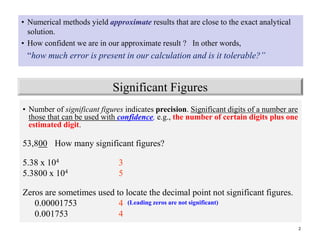
Significant Figures
• Number of significant figures indicates precision. Significant digits of a number are
those that can be used with confidence, e.g., the number of certain digits plus one
estimated digit.
53,800 How many significant figures?
5.38 x 10⁴ 3
5.3800 x 10⁴ 5
Zeros are sometimes used to locate the decimal point not significant figures.
0.00001753 4
0.001753 4
• Numerical methods yield approximate results that are close to the exact analytical
solution.
• How confident we are in our approximate result ? In other words,
“how much error is present in our calculation and is it tolerable?”
(Leading zeros are not significant)
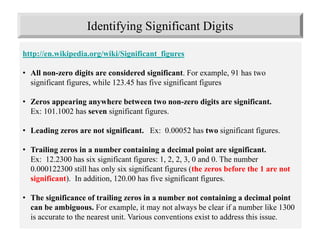
Identifying Significant Digits
http://en.wikipedia.org/wiki/Significant_figures
• All non-zero digits are considered significant. For example, 91 has two
significant figures, while 123.45 has five significant figures
• Zeros appearing anywhere between two non-zero digits are significant.
Ex: 101.1002 has seven significant figures.
• Leading zeros are not significant. Ex: 0.00052 has two significant figures.
• Trailing zeros in a number containing a decimal point are significant.
Ex: 12.2300 has six significant figures: 1, 2, 2, 3, 0 and 0. The number
0.000122300 still has only six significant figures (the zeros before the 1 are not
significant). In addition, 120.00 has five significant figures.
• The significance of trailing zeros in a number not containing a decimal point
can be ambiguous. For example, it may not always be clear if a number like 1300
is accurate to the nearest unit. Various conventions exist to address this issue.
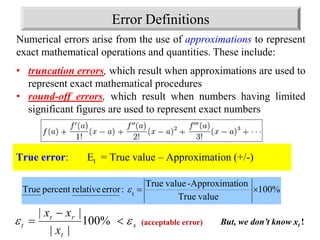
Error Definitions
True error: Et = True value – Approximation (+/-)
%100
valueTrue
ionApproximat-valueTrue
:errorrelativepercentTrue t

Numerical errors arise from the use of approximations to represent
exact mathematical operations and quantities. These include:
• truncation errors, which result when approximations are used to
represent exact mathematical procedures
• round-off errors, which result when numbers having limited
significant figures are used to represent exact numbers
s
t
rt
t
x
xx
 

 %100
||
||
But, we don’t know xt !(acceptable error)
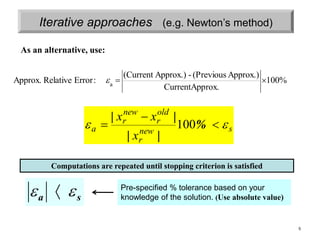
5
%100
rox.CurrentApp
Approx.)(Previous-Approx.)(Current
:ErrorRelativeApprox. a

Iterative approaches (e.g. Newton’s method)
Computations are repeated until stopping criterion is satisfied
sa   Pre-specified % tolerance based on your
knowledge of the solution. (Use absolute value)
snew
r
old
r
new
r
a
x
xx
 

 %
||
||
100
As an alternative, use:
6
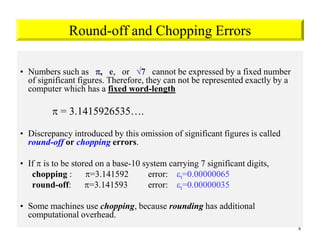
Round-off and Chopping Errors
• Numbers such as p, e, or √7 cannot be expressed by a fixed number
of significant figures. Therefore, they can not be represented exactly by a
computer which has a fixed word-length
p = 3.1415926535….
• Discrepancy introduced by this omission of significant figures is called
round-off or chopping errors.
• If p is to be stored on a base-10 system carrying 7 significant digits,
chopping : p=3.141592 error: t=0.00000065
round-off: p=3.141593 error: t=0.00000035
• Some machines use chopping, because rounding has additional
computational overhead.
7
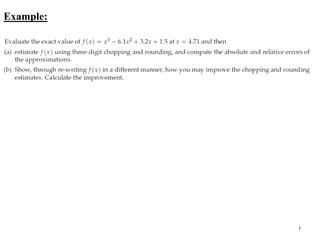
Example:
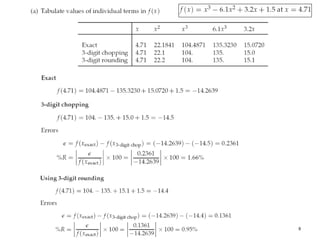
8
9
10
Example:
11
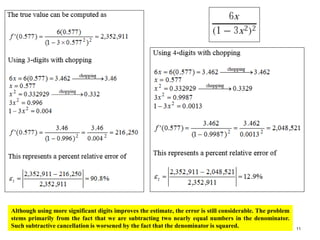
Although using more significant digits improves the estimate, the error is still considerable. The problem
stems primarily from the fact that we are subtracting two nearly equal numbers in the denominator.
Such subtractive cancellation is worsened by the fact that the denominator is squared.
12
Homework
Read chapter 3 (Approximations and Round-Off Errors)
in the reference book and try to solve its problems.

Applied numerical methods lec3

  • 1.
  • 2.
    2 Significant Figures • Numberof significant figures indicates precision. Significant digits of a number are those that can be used with confidence, e.g., the number of certain digits plus one estimated digit. 53,800 How many significant figures? 5.38 x 10⁴ 3 5.3800 x 10⁴ 5 Zeros are sometimes used to locate the decimal point not significant figures. 0.00001753 4 0.001753 4 • Numerical methods yield approximate results that are close to the exact analytical solution. • How confident we are in our approximate result ? In other words, “how much error is present in our calculation and is it tolerable?” (Leading zeros are not significant)
  • 3.
    Identifying Significant Digits http://en.wikipedia.org/wiki/Significant_figures •All non-zero digits are considered significant. For example, 91 has two significant figures, while 123.45 has five significant figures • Zeros appearing anywhere between two non-zero digits are significant. Ex: 101.1002 has seven significant figures. • Leading zeros are not significant. Ex: 0.00052 has two significant figures. • Trailing zeros in a number containing a decimal point are significant. Ex: 12.2300 has six significant figures: 1, 2, 2, 3, 0 and 0. The number 0.000122300 still has only six significant figures (the zeros before the 1 are not significant). In addition, 120.00 has five significant figures. • The significance of trailing zeros in a number not containing a decimal point can be ambiguous. For example, it may not always be clear if a number like 1300 is accurate to the nearest unit. Various conventions exist to address this issue.
  • 4.
    Error Definitions True error:Et = True value – Approximation (+/-) %100 valueTrue ionApproximat-valueTrue :errorrelativepercentTrue t  Numerical errors arise from the use of approximations to represent exact mathematical operations and quantities. These include: • truncation errors, which result when approximations are used to represent exact mathematical procedures • round-off errors, which result when numbers having limited significant figures are used to represent exact numbers s t rt t x xx     %100 || || But, we don’t know xt !(acceptable error)
  • 5.
    5 %100 rox.CurrentApp Approx.)(Previous-Approx.)(Current :ErrorRelativeApprox. a  Iterative approaches(e.g. Newton’s method) Computations are repeated until stopping criterion is satisfied sa   Pre-specified % tolerance based on your knowledge of the solution. (Use absolute value) snew r old r new r a x xx     % || || 100 As an alternative, use:
  • 6.
    6 Round-off and ChoppingErrors • Numbers such as p, e, or √7 cannot be expressed by a fixed number of significant figures. Therefore, they can not be represented exactly by a computer which has a fixed word-length p = 3.1415926535…. • Discrepancy introduced by this omission of significant figures is called round-off or chopping errors. • If p is to be stored on a base-10 system carrying 7 significant digits, chopping : p=3.141592 error: t=0.00000065 round-off: p=3.141593 error: t=0.00000035 • Some machines use chopping, because rounding has additional computational overhead.
  • 7.
  • 8.
  • 9.
  • 10.
  • 11.
    11 Although using moresignificant digits improves the estimate, the error is still considerable. The problem stems primarily from the fact that we are subtracting two nearly equal numbers in the denominator. Such subtractive cancellation is worsened by the fact that the denominator is squared.
  • 12.
    12 Homework Read chapter 3(Approximations and Round-Off Errors) in the reference book and try to solve its problems.