MICROGRID
Prepared by:
Naik Dhaval (17MSE008)
Presented to:
Prof. Pankaj Yadav
CONTENT
Main Topic:
Microgrid systems and status in INDIA
Sub Topics
1) Definition
2) Advantage and Challenges
3) Status in INDIA
4) Missions of solar in INDIA
WHAT IS GRID?
• An electric grid is a network of synchronized power providers and consumers that
are connected by transmission and distribution lines and operated by one or more
control centres. When most people talk about the power "grid," they're referring to
the transmission system for electricity.
NATIONAL ELECTRIC GRID:
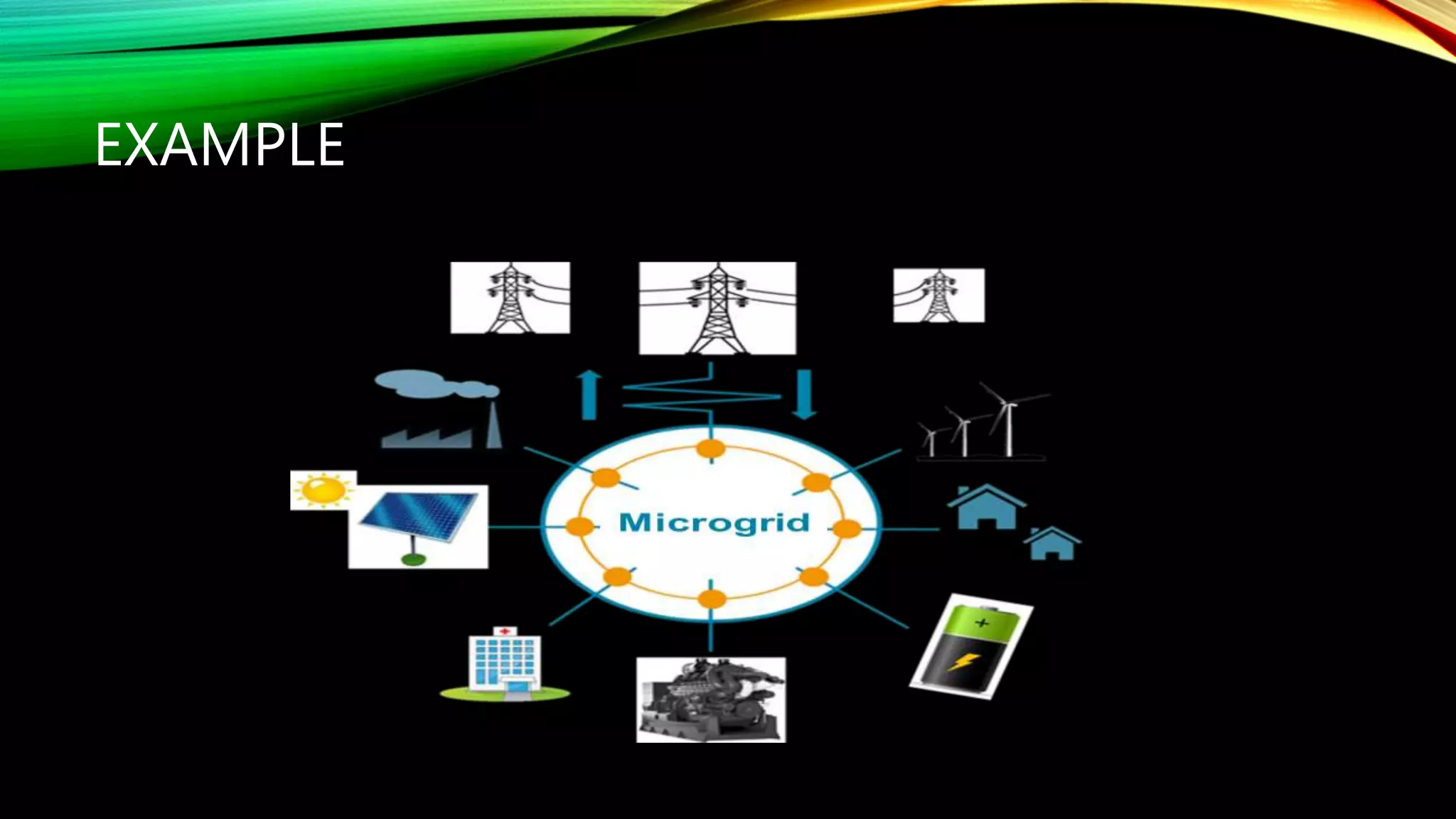
MICRO GRID :
The U.S. Department of Energy Exchange Group defines a micro grid as a
group of interconnected loads and distributed energy resources within clearly defined
electrical boundaries that acts as a single controllable entity with respect to the grid
A microgrid can connect and disconnect from the grid to enable it to operate in both
connected or island-mode.
EXAMPLE
TYPES OF MICRO GRID:
• Institutional Micro grids
• Remote “Off-grid” Micro grids
• Military Base Micro grids
• Commercial and Industrial Micro grids
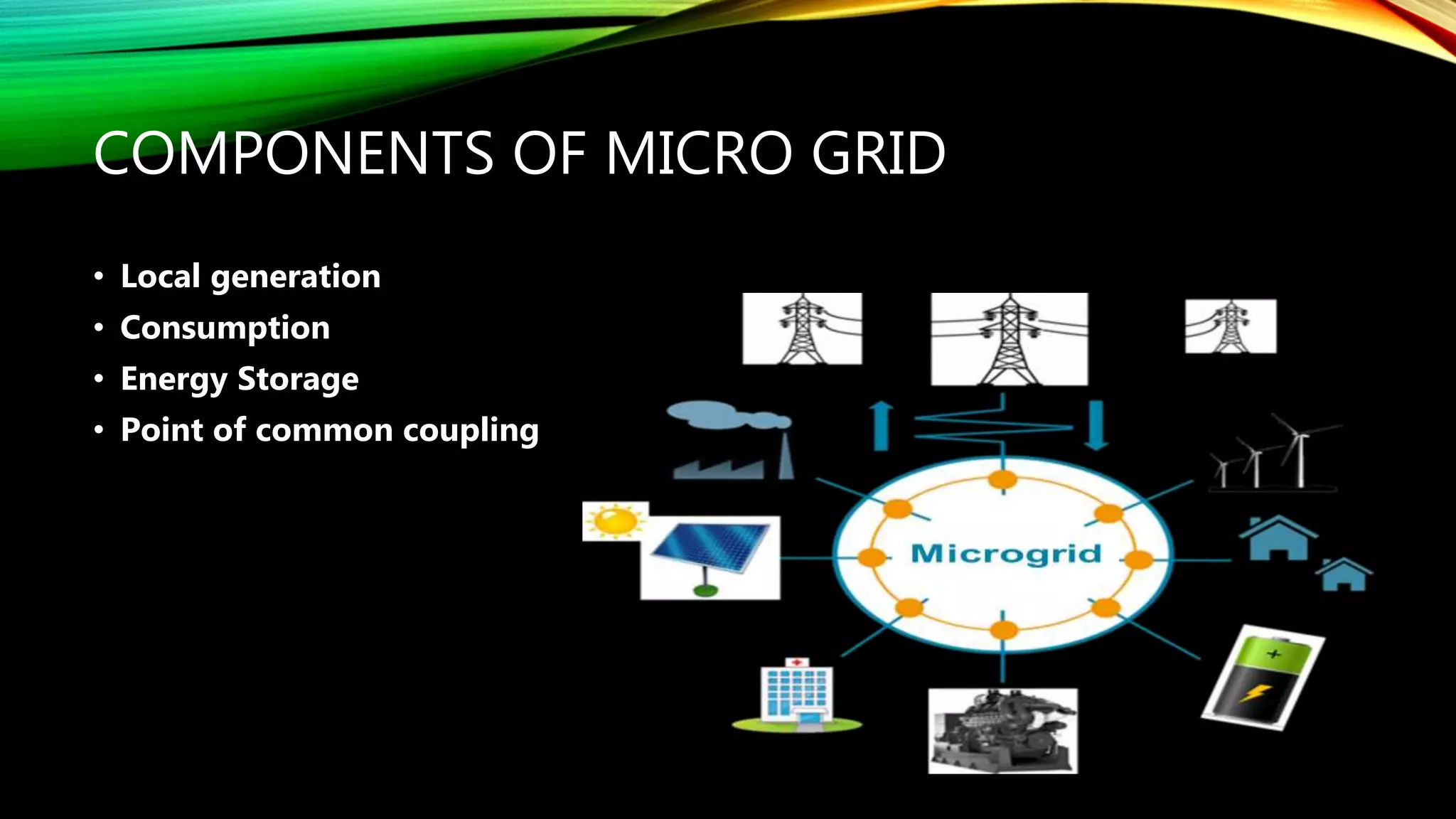
COMPONENTS OF MICRO GRID
• Local generation
• Consumption
• Energy Storage
• Point of common coupling
ADVANTAGES
• Can operate in on grid and off grid mode (Islanding)
• Micro grids facilitate the integration of renewable energy generation such as
photovoltaic, wind and fuel cell generations without requiring re-design of the
national distribution system.
• Modern optimization methods can also be incorporated into the microgrid energy
management system to improve efficiency, economics, and resiliency.
CHALLENGES:
• The presence of generator units in the network at low voltage levels can cause
reverse power flows that may lead to complications in protection coordination,
undesirable power flow patterns, fault current distribution, and voltage control.
• transition activities between the grid-connected and standalone modes of operation
in a micro grid can create transient stability.
• The operation of microgrids contain very much uncertainty in which the economical
and reliable operation of microgrids rely on.
STATUS IN INDIA:
(Cumulative deployment of renewable energy as on 31/10/2017); source MNRE
CONCLUSION:
• The technique is not mature till date and a lot of works have to be done before it
can be put in the normal usage.
• the micro grid feasibility has a lot of factors which should be dealt collectively.
REFERENCE:
• https://en.wikipedia.org/wiki/Microgrid
• Lasseter, R.,”MicroGrids,” IEEE PES Winter Meeting, January 2002
Thank You

17 mse008 microgrid

  • 1.
    MICROGRID Prepared by: Naik Dhaval(17MSE008) Presented to: Prof. Pankaj Yadav
  • 2.
    CONTENT Main Topic: Microgrid systemsand status in INDIA Sub Topics 1) Definition 2) Advantage and Challenges 3) Status in INDIA 4) Missions of solar in INDIA
  • 3.
    WHAT IS GRID? •An electric grid is a network of synchronized power providers and consumers that are connected by transmission and distribution lines and operated by one or more control centres. When most people talk about the power "grid," they're referring to the transmission system for electricity.
  • 4.
  • 5.
    MICRO GRID : TheU.S. Department of Energy Exchange Group defines a micro grid as a group of interconnected loads and distributed energy resources within clearly defined electrical boundaries that acts as a single controllable entity with respect to the grid A microgrid can connect and disconnect from the grid to enable it to operate in both connected or island-mode.
  • 6.
  • 7.
    TYPES OF MICROGRID: • Institutional Micro grids • Remote “Off-grid” Micro grids • Military Base Micro grids • Commercial and Industrial Micro grids
  • 8.
    COMPONENTS OF MICROGRID • Local generation • Consumption • Energy Storage • Point of common coupling
  • 9.
    ADVANTAGES • Can operatein on grid and off grid mode (Islanding) • Micro grids facilitate the integration of renewable energy generation such as photovoltaic, wind and fuel cell generations without requiring re-design of the national distribution system. • Modern optimization methods can also be incorporated into the microgrid energy management system to improve efficiency, economics, and resiliency.
  • 10.
    CHALLENGES: • The presenceof generator units in the network at low voltage levels can cause reverse power flows that may lead to complications in protection coordination, undesirable power flow patterns, fault current distribution, and voltage control. • transition activities between the grid-connected and standalone modes of operation in a micro grid can create transient stability. • The operation of microgrids contain very much uncertainty in which the economical and reliable operation of microgrids rely on.
  • 11.
    STATUS IN INDIA: (Cumulativedeployment of renewable energy as on 31/10/2017); source MNRE
  • 12.
    CONCLUSION: • The techniqueis not mature till date and a lot of works have to be done before it can be put in the normal usage. • the micro grid feasibility has a lot of factors which should be dealt collectively.
  • 13.
    REFERENCE: • https://en.wikipedia.org/wiki/Microgrid • Lasseter,R.,”MicroGrids,” IEEE PES Winter Meeting, January 2002
  • 14.