Characterization of Carrier
Lifetime
Presentation as part of internal assessment in course
Semiconductor Processing & Characterization
M.Tech Solar, PDPU.
Presented to
Prof. Manoj Kumar
Presented by
Aditya Soni
(17MSE001)
Jay Joshi
(17MSE005)
Mrunmayee Unawane
(17MSE016)
CARRIER LIFETIMES – WHY
MEASURE THEM
In IC Industries,
• Carrier lifetime determines
performance of devices.
• It is a sensitive measure of
material quality and
cleanliness.
• It gives information about
defect densities as low as
to 1o11 cm-3
8/18/2018
In Solar Cells,
•Carrier lifetime of minority
carriers determines
performance of the solar cell.
•Longer the minority carries
retain the energy
corresponding to the
conduction band, higher their
probability to cross the SCR
and contribute in conduction.
Band diagram of Solar
Cell under illumination.
ℎ𝜈
CARRIER LIFETIMES – WHAT
ARE THEY
Recombination lifetime
𝜏 𝑟:
Excess carriers decay by
recombining
 𝜏 𝑟 is the average time after
which the electron goes
back in the valence band
and recombines with it’s
hole.
8/18/2018
E
v
Ec
𝑛𝑜𝑛 𝑟𝑎𝑑𝑖𝑎𝑡𝑖𝑣𝑒 𝑒𝑚𝑚𝑖𝑠𝑖𝑜𝑛
𝑅−𝐺 𝐶𝑒𝑛𝑡𝑒𝑟𝑠
E
v
Ec
• Band to Band recombination
• SRH Recombination
• Auger recombination
E
v
Ec
CARRIER LIFETIMES – WHAT
ARE THEY
Generation lifetime 𝜏 𝑔:
In case of lack of carriers,
electron-hole pairs are
generated.
 𝜏 𝑔 is the average time
which the electron hole
is generated.
 Misnomer - Generation
Time.
8/18/2018
• Thermal Generation
• Optical Generation
• Impact Ionization
generation
E
v
Ec
Ef
T = o K T > o K
E
v
Ec
ℎ𝜈 > 𝐸 𝑔
An carrier with enough
kinetic energy can knock
a bound electron out of
its bound state and
promote it to a state in
the conduction band,
creating an electron-hole
pair.
RECOMBINATION LIFETIME
8/18/2018
𝜏 𝑆𝑅𝐻 =
𝜏 𝑝 𝑛 𝑜 + 𝑛 + ∆𝑛 + 𝜏 𝑛(𝑝o+𝑝 + ∆𝑝)
𝑝o +𝑛o +∆𝑛
𝜏 𝑅𝑎𝑑 =
1
𝐵(𝑝o +𝑛o +∆𝑛)
𝜏 𝐴𝑢𝑔𝑒𝑟 =
1
𝐶 𝑝(𝑝o
2
+2𝑝o∆𝑛 + ∆𝑛2) + 𝐶 𝑛(𝑛o
2
+ 2𝑛o∆𝑛 + ∆𝑛2)
𝑁 𝑇= 𝐷𝑒𝑛𝑠𝑖𝑡𝑦
𝑣𝑡ℎ= 𝑇ℎ𝑒𝑟𝑚𝑎𝑙 𝑉𝑒𝑙𝑜𝑐𝑖𝑡𝑦
𝜎 𝑝 = 𝑐𝑎𝑝𝑡𝑢𝑟𝑒 𝑐𝑟𝑜𝑠𝑠-𝑠𝑒𝑐𝑡𝑖𝑜𝑛𝑠 𝑜𝑓 ℎ𝑜𝑙𝑒𝑠
𝜎n = 𝑐𝑎𝑝𝑡𝑢𝑟𝑒 𝑐𝑟𝑜𝑠𝑠-𝑠𝑒𝑐𝑡𝑖𝑜𝑛𝑠 𝑜𝑓 electrons
𝑛 = 𝑒𝑙𝑒𝑐𝑡𝑟𝑜𝑛 𝑐𝑜𝑛𝑐𝑒𝑛𝑡𝑟𝑎𝑡𝑖𝑜𝑛
𝑝 = ℎ𝑜𝑙𝑒 𝑐𝑜𝑛𝑐𝑒𝑛𝑡𝑟𝑎𝑡𝑖𝑜𝑛
𝑛o = 𝑒𝑞𝑢𝑖𝑙𝑙𝑖𝑏𝑟𝑖𝑢𝑚 𝑒− 𝑐𝑜𝑛𝑐𝑒𝑛𝑡𝑟𝑎𝑡𝑖𝑜𝑛
𝑝o = 𝑒𝑞𝑢𝑖𝑙𝑙𝑖𝑏𝑟𝑖𝑢𝑚 ℎ+ 𝑐𝑜𝑛𝑐𝑒𝑛𝑡𝑟𝑎𝑡𝑖𝑜𝑛
Δ𝑛= 𝑒𝑥𝑐𝑒𝑠𝑠 𝑒− 𝑐𝑜𝑛𝑐𝑒𝑛𝑡𝑟𝑎𝑡𝑖𝑜𝑛
𝛥𝑝= 𝑒𝑥𝑐𝑒𝑠𝑠 ℎ+ 𝑐𝑜𝑛𝑐𝑒𝑛𝑡𝑟𝑎𝑡𝑖𝑜𝑛
𝜏 𝑝 =
1
𝜎 𝑝 𝑣 𝑡ℎ 𝑁𝑡
𝜏 𝑛 =
1
𝜎 𝑛 𝑣 𝑡ℎ 𝑁𝑡
𝟏
𝝉 𝒓
=
𝟏
𝝉 𝑹𝒂𝒅
+
𝟏
𝝉 𝑺𝑹𝑯
+
𝟏
𝝉 𝑨𝒖𝒈𝒆𝒓
RECOMBINATION LIFETIME
8/18/2018
𝜏 𝐴𝑢𝑔𝑒𝑟 =
1
𝐶 𝑝(𝑝o
2
+2𝑝o∆𝑛 + ∆𝑛2) + 𝐶 𝑛(𝑛o
2
+ 2𝑛o∆𝑛 + ∆𝑛2)
𝜏 𝑅𝑎𝑑 =
1
𝐵(𝑝o +𝑛o +∆𝑛)
RECOMBINATION LIFETIME
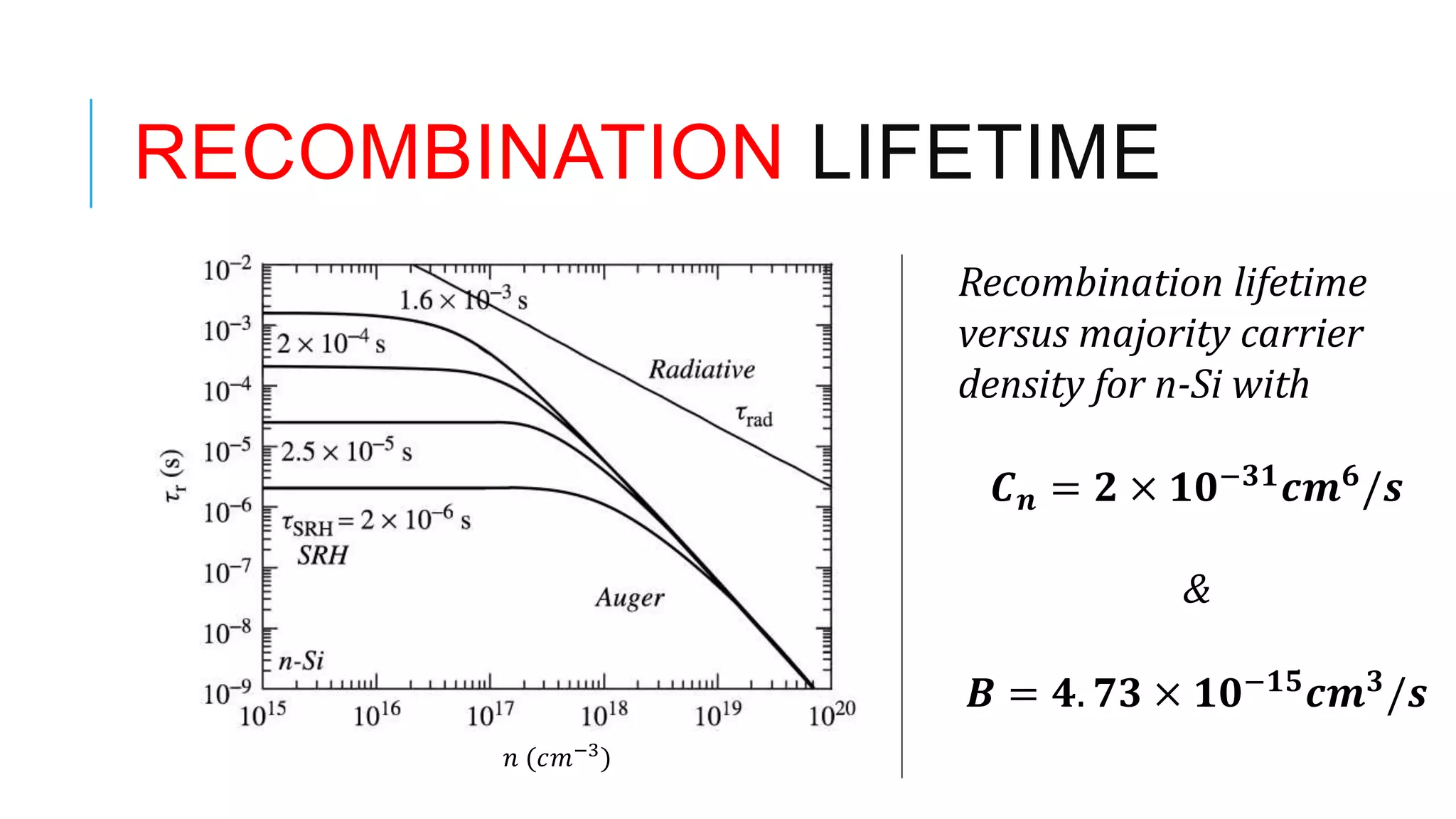
𝑛 (𝑐𝑚−3)
Recombination lifetime
versus majority carrier
density for n-Si with
𝑪 𝒏 = 𝟐 × 𝟏𝟎−𝟑𝟏 𝒄𝒎 𝟔/𝒔
&
𝑩 = 𝟒. 𝟕𝟑 × 𝟏𝟎−𝟏𝟓 𝒄𝒎 𝟑/𝒔
GENERATION LIFETIME
8/18/2018
𝜏 𝑔 = 𝜏 𝑝 𝑒𝑥𝑝
𝐸 𝑇 − 𝐸𝑖
𝑘𝑇
+ 𝜏 𝑛 𝑒𝑥𝑝 −
𝐸 𝑇 − 𝐸𝑖
𝑘𝑇
E 𝑇 = Energy Level
Ei = Intrinsic Energy Level
𝜏 𝑝 =
1
𝜎 𝑝 𝑣 𝑡ℎ 𝑁𝑡
𝜏 𝑛 =
1
𝜎 𝑛 𝑣 𝑡ℎ 𝑁𝑡
OPTICAL METHODS
Different methods available
 Photoluminescence method (PL)
 Free carrier absorption (FCA)
 Photoconductance Decay (PCD)
 Short circuit current / open circuit voltage decay (SCCD /
 Surface Voltage
 Steady state short circuit current method (SSSCC)
 Electron beam induced current (EBIC)
 Quasi steady state photoconductance (QSSP)
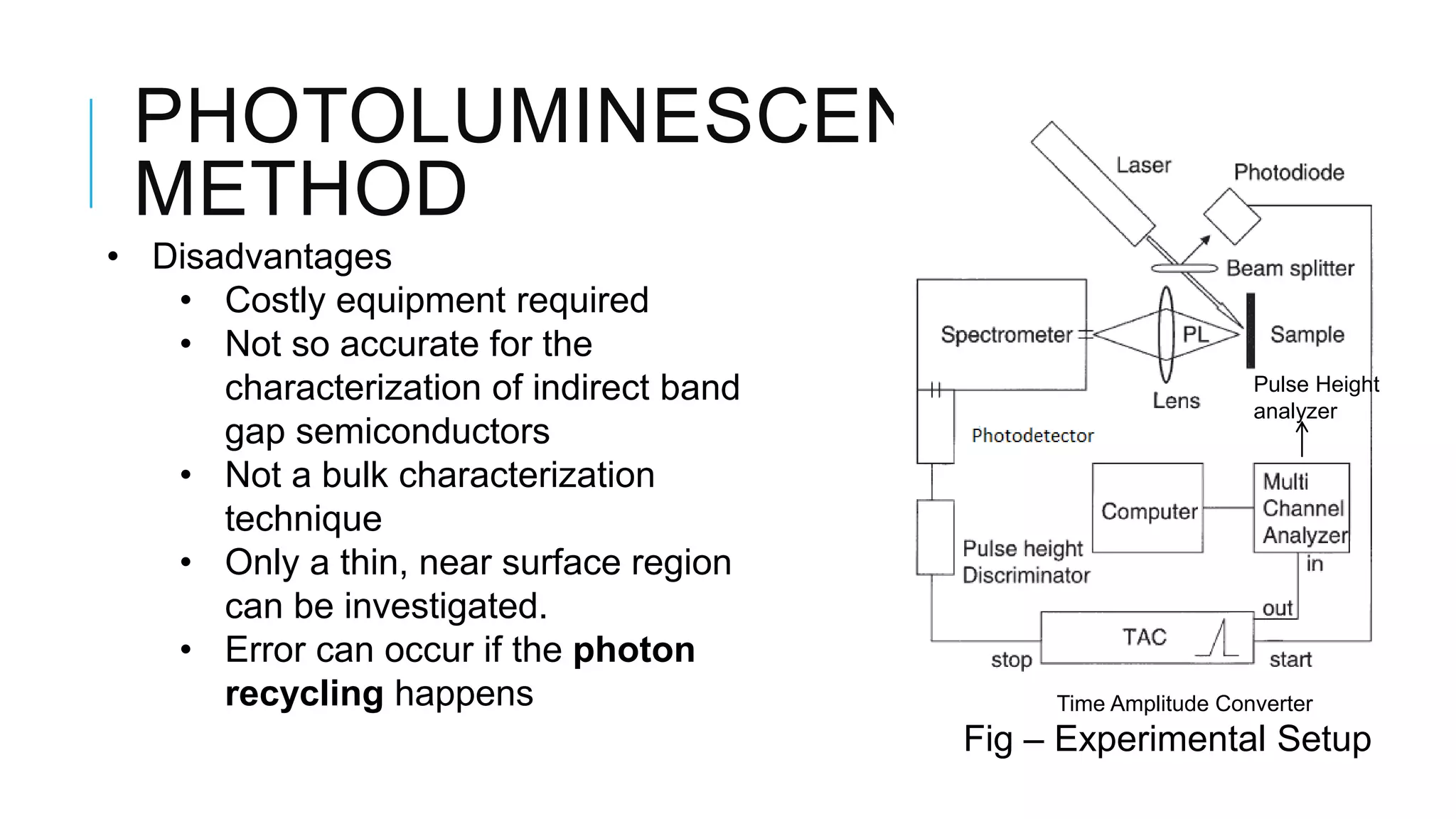
PHOTOLUMINESCENCE
METHOD
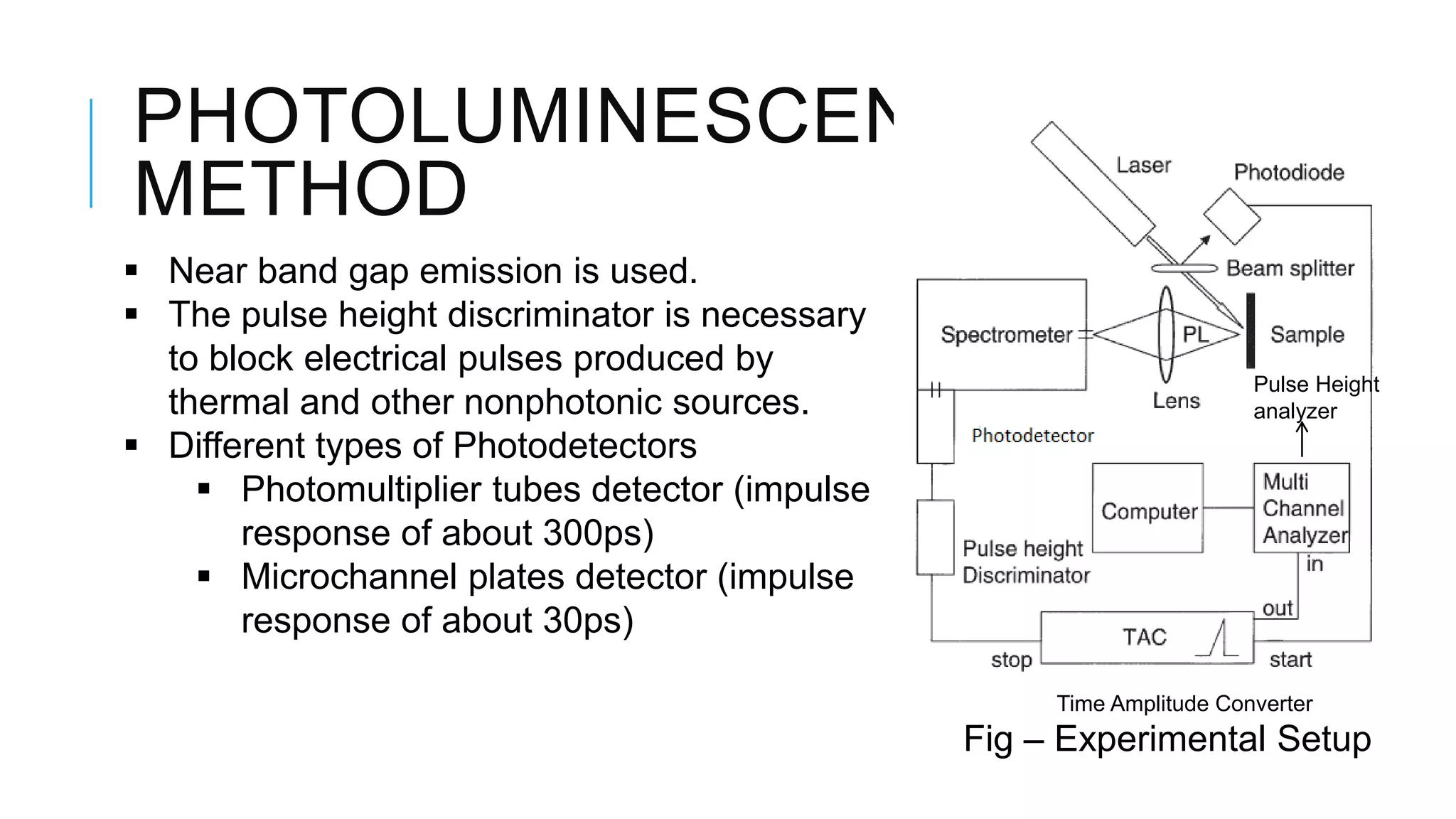
 Near band gap emission is used.
 The pulse height discriminator is necessary
to block electrical pulses produced by
thermal and other nonphotonic sources.
 Different types of Photodetectors
 Photomultiplier tubes detector (impulse
response of about 300ps)
 Microchannel plates detector (impulse
response of about 30ps)
Fig – Experimental Setup
Time Amplitude Converter
Pulse Height
analyzer
PHOTOLUMINESCENCE
METHOD
• Advantages
• Non contact method
• Also can be used for
determining the composition of
compound Semiconductors,
such as 𝐴𝑙 𝑥 𝐺𝑎1−𝑥 𝐴𝑠 by using
shallow emission or deep level
emissions
Fig – Experimental Setup
Time Amplitude Converter
Pulse Height
analyzer
PHOTOLUMINESCENCE
METHOD
• Disadvantages
• Costly equipment required
• Not so accurate for the
characterization of indirect band
gap semiconductors
• Not a bulk characterization
technique
• Only a thin, near surface region
can be investigated.
• Error can occur if the photon
recycling happens
Fig – Experimental Setup
Time Amplitude Converter
Pulse Height
analyzer
PHOTON RECYCLING
 Basically, it is the recapturing of photon
 It may give you the carrier lifetime well above the theoretical value
 It could be corrected by adding the photon recycling factor in the final
equation
ℎ𝜈
E
v
Ec
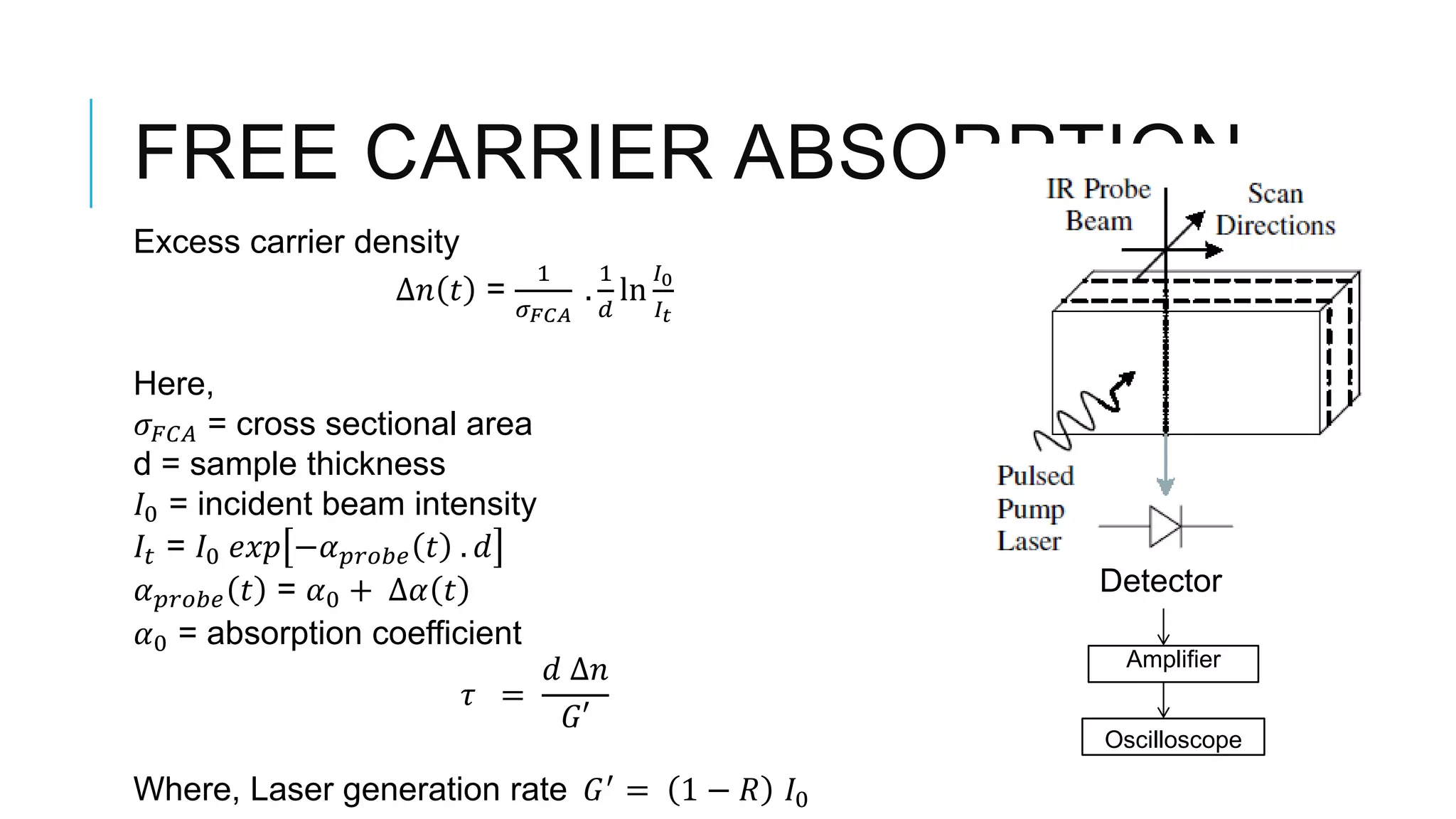
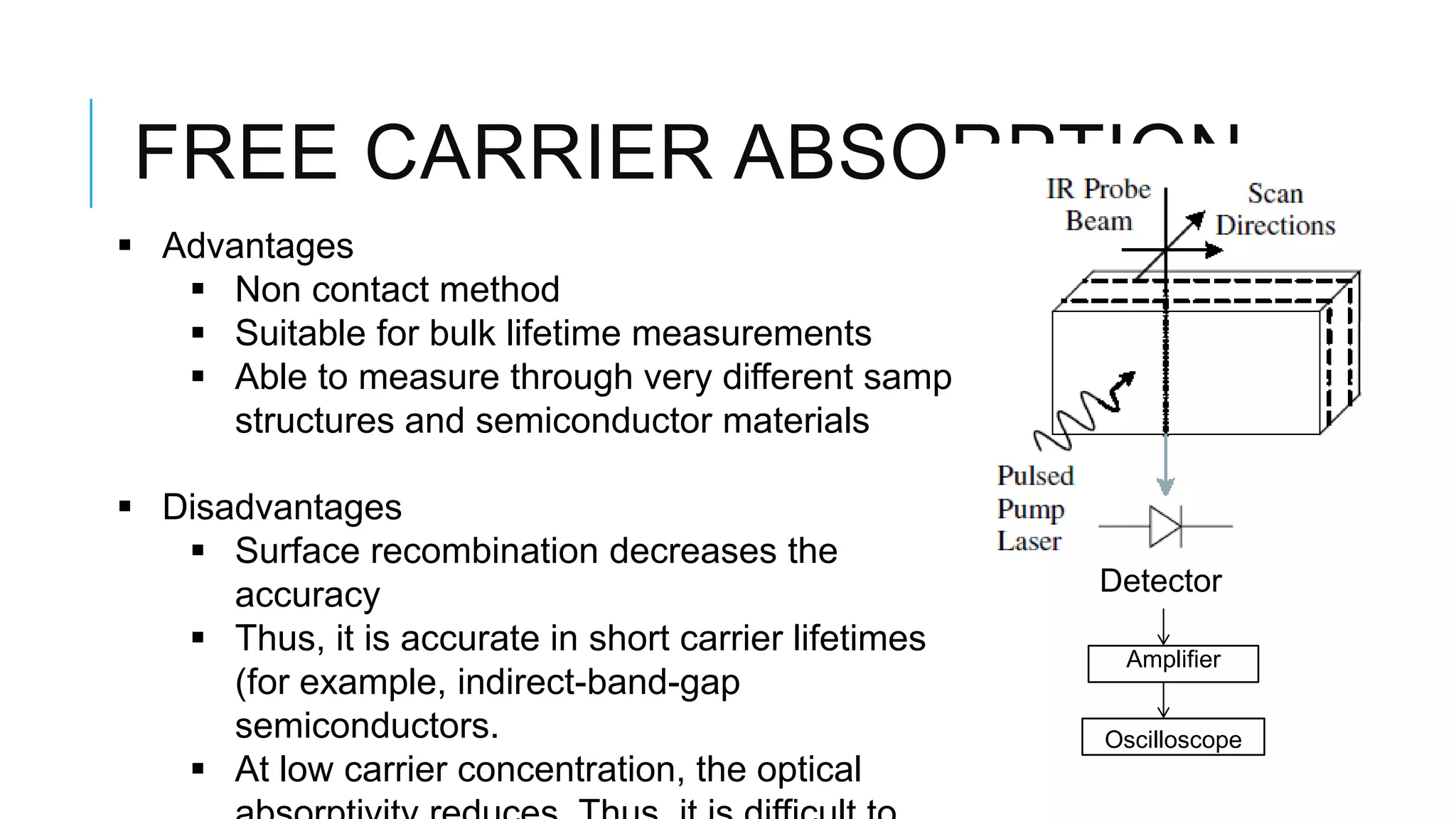
FREE CARRIER ABSORPTION
Excess carrier density
∆𝑛 𝑡 =
1
𝜎 𝐹𝐶𝐴
.
1
𝑑
ln
𝐼0
𝐼𝑡
Here,
𝜎 𝐹𝐶𝐴 = cross sectional area
d = sample thickness
𝐼0 = incident beam intensity
𝐼𝑡 = 𝐼0 𝑒𝑥𝑝 −𝛼 𝑝𝑟𝑜𝑏𝑒 𝑡 . 𝑑
𝛼 𝑝𝑟𝑜𝑏𝑒 𝑡 = 𝛼0 + ∆𝛼 𝑡
𝛼0 = absorption coefficient
𝜏 =
𝑑 ∆𝑛
𝐺′
Where, Laser generation rate 𝐺′
= 1 − 𝑅 𝐼0
Detector
Amplifier
Oscilloscope
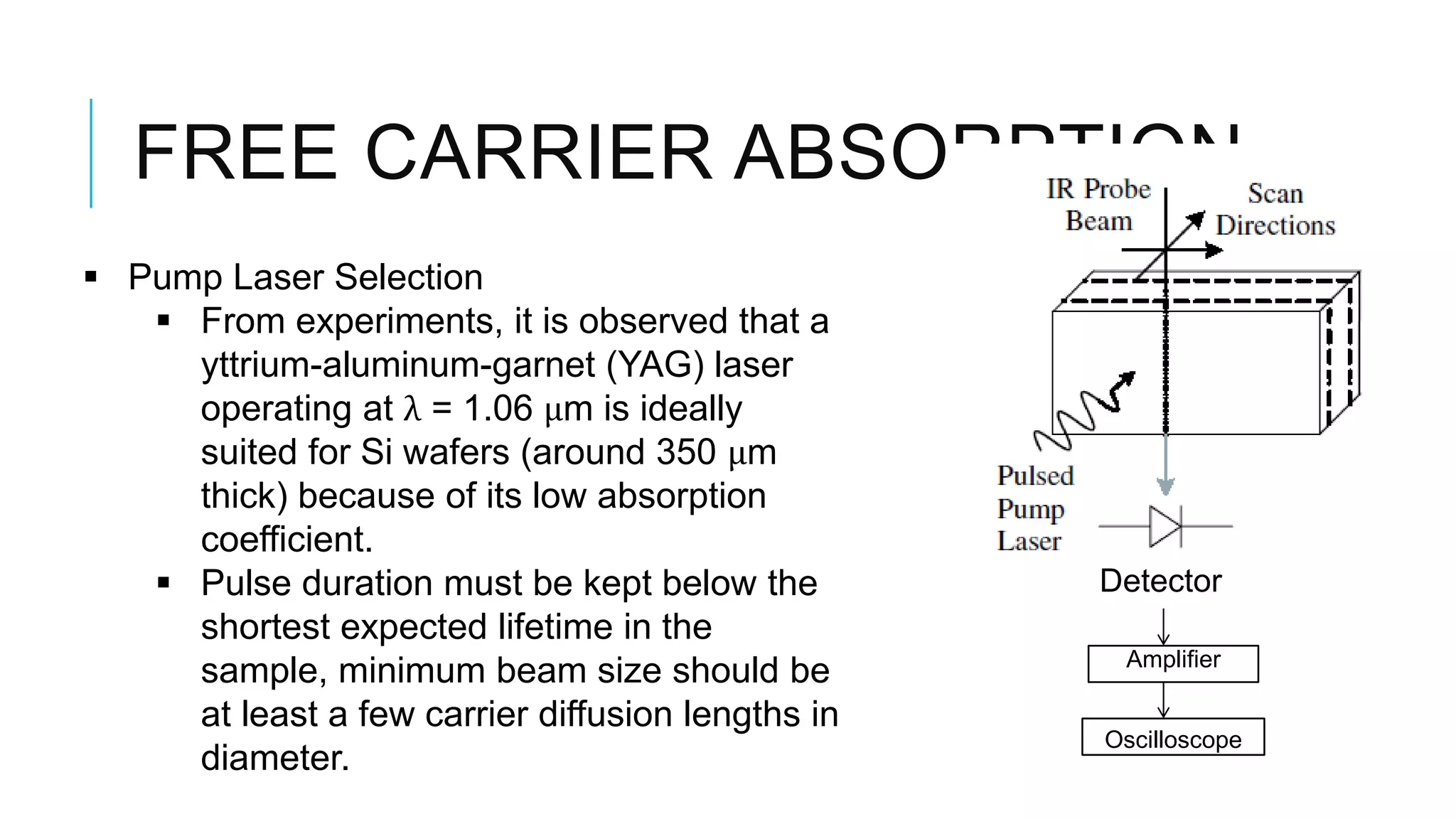
FREE CARRIER ABSORPTION
Detector
 Pump Laser Selection
 From experiments, it is observed that a
yttrium-aluminum-garnet (YAG) laser
operating at λ = 1.06 μm is ideally
suited for Si wafers (around 350 μm
thick) because of its low absorption
coefficient.
 Pulse duration must be kept below the
shortest expected lifetime in the
sample, minimum beam size should be
at least a few carrier diffusion lengths in
diameter.
Amplifier
Oscilloscope
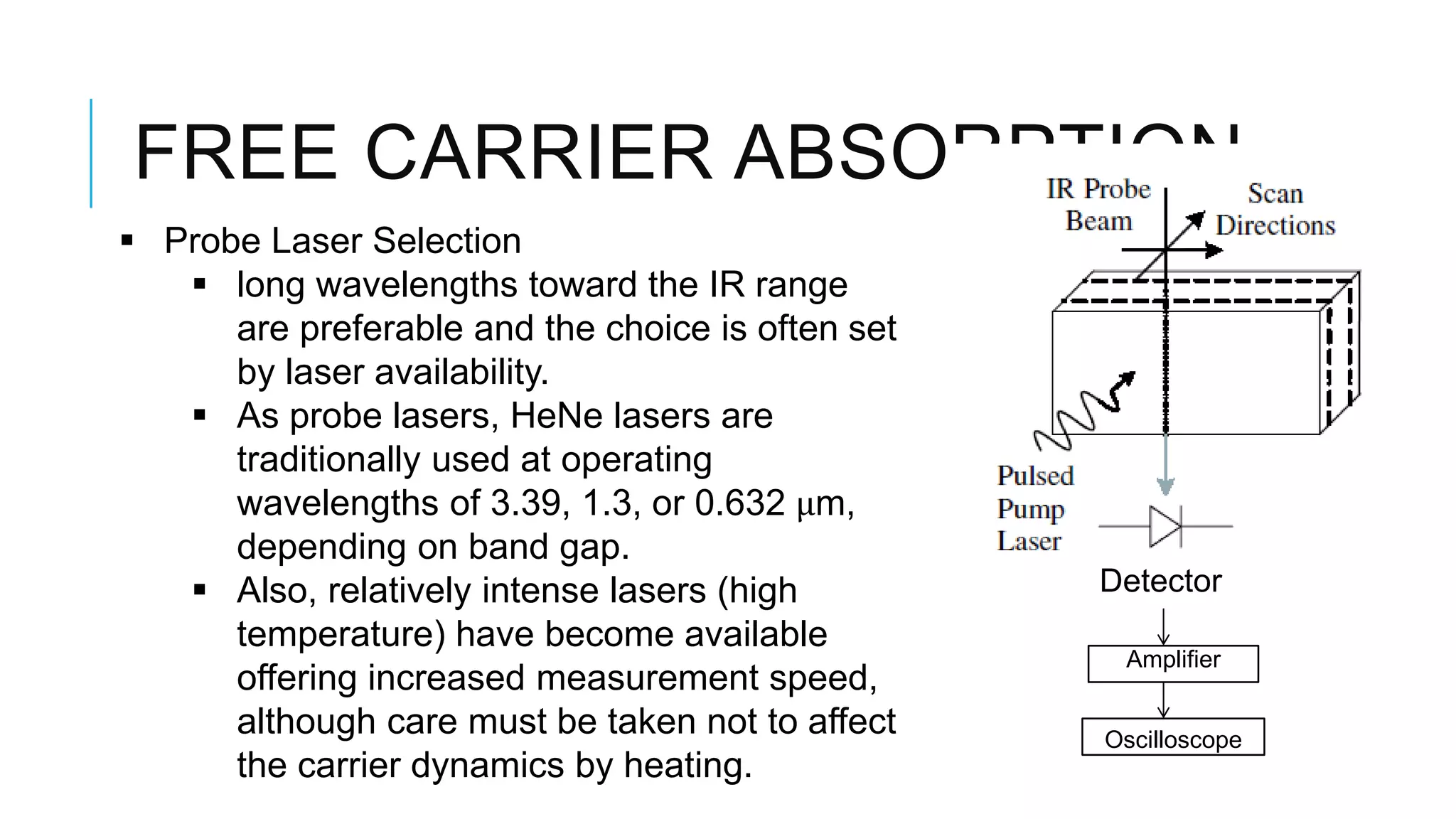
FREE CARRIER ABSORPTION
 Probe Laser Selection
 long wavelengths toward the IR range
are preferable and the choice is often set
by laser availability.
 As probe lasers, HeNe lasers are
traditionally used at operating
wavelengths of 3.39, 1.3, or 0.632 μm,
depending on band gap.
 Also, relatively intense lasers (high
temperature) have become available
offering increased measurement speed,
although care must be taken not to affect
the carrier dynamics by heating.
Detector
Amplifier
Oscilloscope
FREE CARRIER ABSORPTION
 Detection Electronics
 Reduction of noise is the priority
here.
 To reduce noise, oscilloscopes with
minimum bandwidth is selected.
 Digital oscilloscope is preferred over
the analog because of the provision
of digital averaging.
Detector
Amplifier
Oscilloscope
FREE CARRIER ABSORPTION
 Advantages
 Non contact method
 Suitable for bulk lifetime measurements
 Able to measure through very different sample
structures and semiconductor materials
 Disadvantages
 Surface recombination decreases the
accuracy
 Thus, it is accurate in short carrier lifetimes
(for example, indirect-band-gap
semiconductors.
 At low carrier concentration, the optical
Detector
Amplifier
Oscilloscope
PHOTOCONDUCTANCE
DECAY
 Methodology
𝜕∆𝑛(𝑡)
𝜕𝑡
= G – R = G -
∆𝑛(𝑡)
𝜏 𝑒𝑓𝑓
(Continuity equation)
For PCD, G(t) <<
𝜕∆𝑛(𝑡)
𝜕𝑡
Therefore, 𝜏 𝑒𝑓𝑓(∆𝑛) = -
∆𝑛(𝑡)
𝜕∆𝑛(𝑡)
𝜕𝑡
(We need to find ∆𝑛)
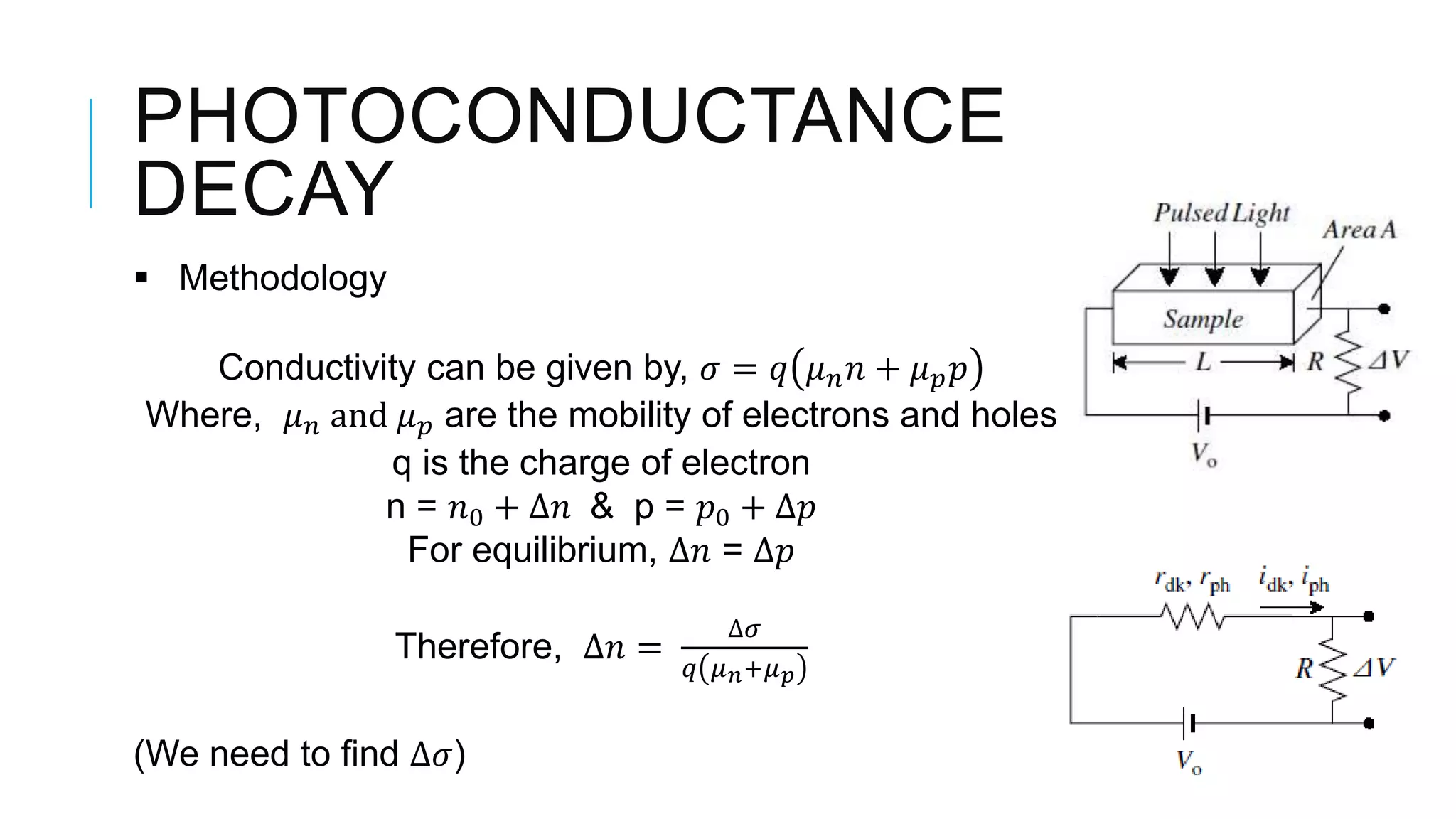
PHOTOCONDUCTANCE
DECAY
 Methodology
Conductivity can be given by, 𝜎 = 𝑞 𝜇 𝑛 𝑛 + 𝜇 𝑝 𝑝
Where, 𝜇 𝑛 and 𝜇 𝑝 are the mobility of electrons and holes
q is the charge of electron
n = 𝑛0 + ∆𝑛 & p = 𝑝0 + ∆𝑝
For equilibrium, ∆𝑛 = ∆𝑝
Therefore, ∆𝑛 =
∆𝜎
𝑞 𝜇 𝑛+𝜇 𝑝
(We need to find ∆𝜎)
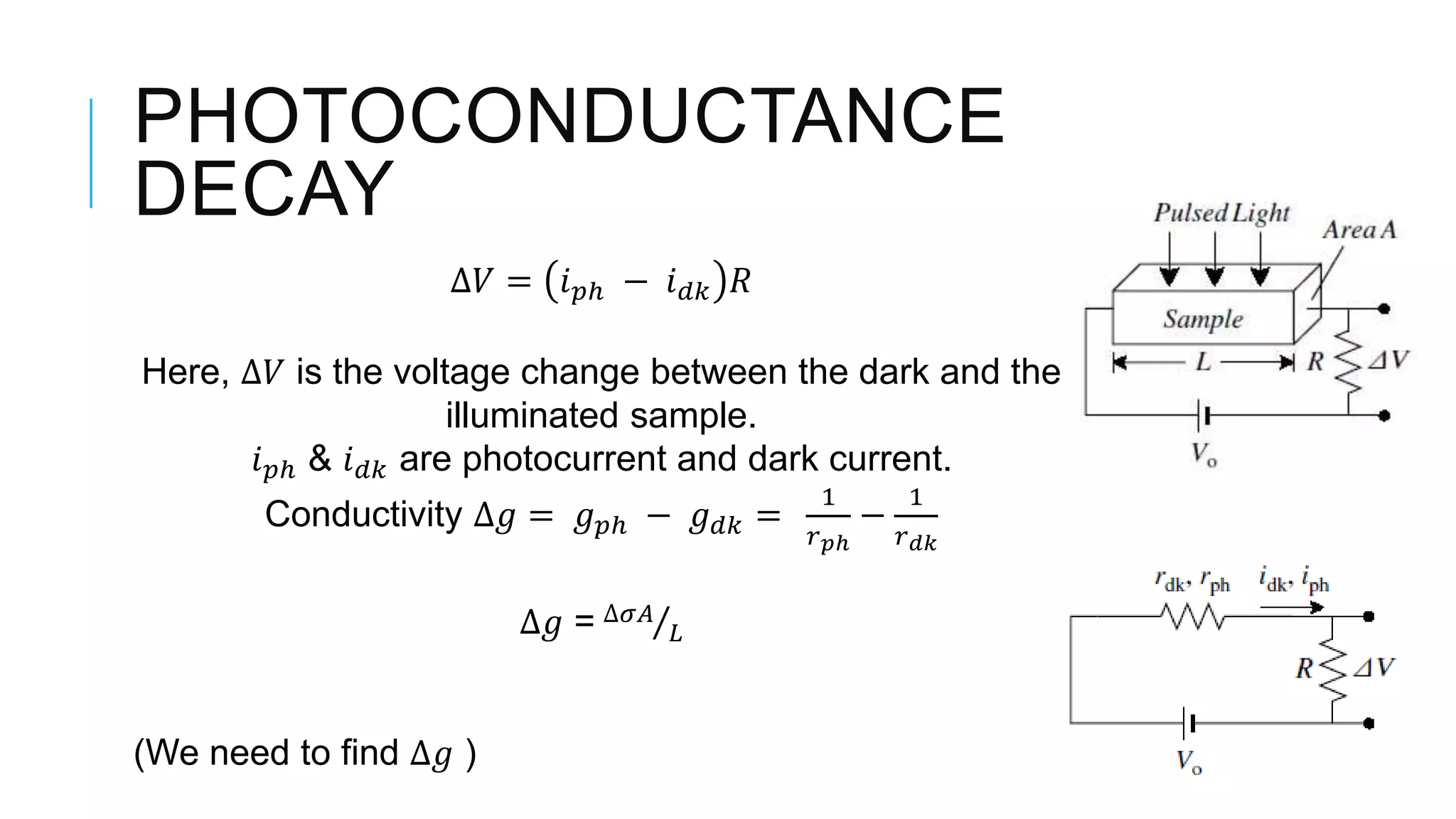
PHOTOCONDUCTANCE
DECAY
∆𝑉 = 𝑖 𝑝ℎ − 𝑖 𝑑𝑘 𝑅
Here, ∆𝑉 is the voltage change between the dark and the
illuminated sample.
𝑖 𝑝ℎ & 𝑖 𝑑𝑘 are photocurrent and dark current.
Conductivity ∆𝑔 = 𝑔 𝑝ℎ − 𝑔 𝑑𝑘 =
1
𝑟 𝑝ℎ
−
1
𝑟 𝑑𝑘
∆𝑔 = ∆𝜎𝐴
𝐿
(We need to find ∆𝑔 )
PHOTOCONDUCTANCE
DECAY
∆𝑉 =
𝑅 ∆𝑔 𝑣0 𝑟𝑑𝑘
2
𝑅 + 𝑟𝑑𝑘 (𝑅 + 𝑟𝑑𝑘 + 𝑅𝑟𝑑𝑘∆𝑔)
For constant voltage, the above equation can be written
as
∆𝑉 = 𝑅 ∆𝑔 𝑣0 1 −
∆𝑉
𝑉0
Form this equation, we get ∆𝑔.
VERDICT
Versatile techniques. Can be used for several different
conductors.
Non contact method, which means simple or no sample
preparation.
You may get an error in the calculation if carrier trapping
is dominant.
They require comparatively complex experimental setup.
ELECTRICAL MEASUREMENT
TECHNIQUES
Diode-based:
• Open-circuit voltage decay (𝜏 𝑟)
• Reverse-recovery (𝜏 𝑟)
Pulsed MOS capacitor method (𝜏 𝑟):
• Inversion method
8/18/2018
ELECTRICAL MEASUREMENT
TECHNIQUES
Pulsed MOS capacitor method (τg):
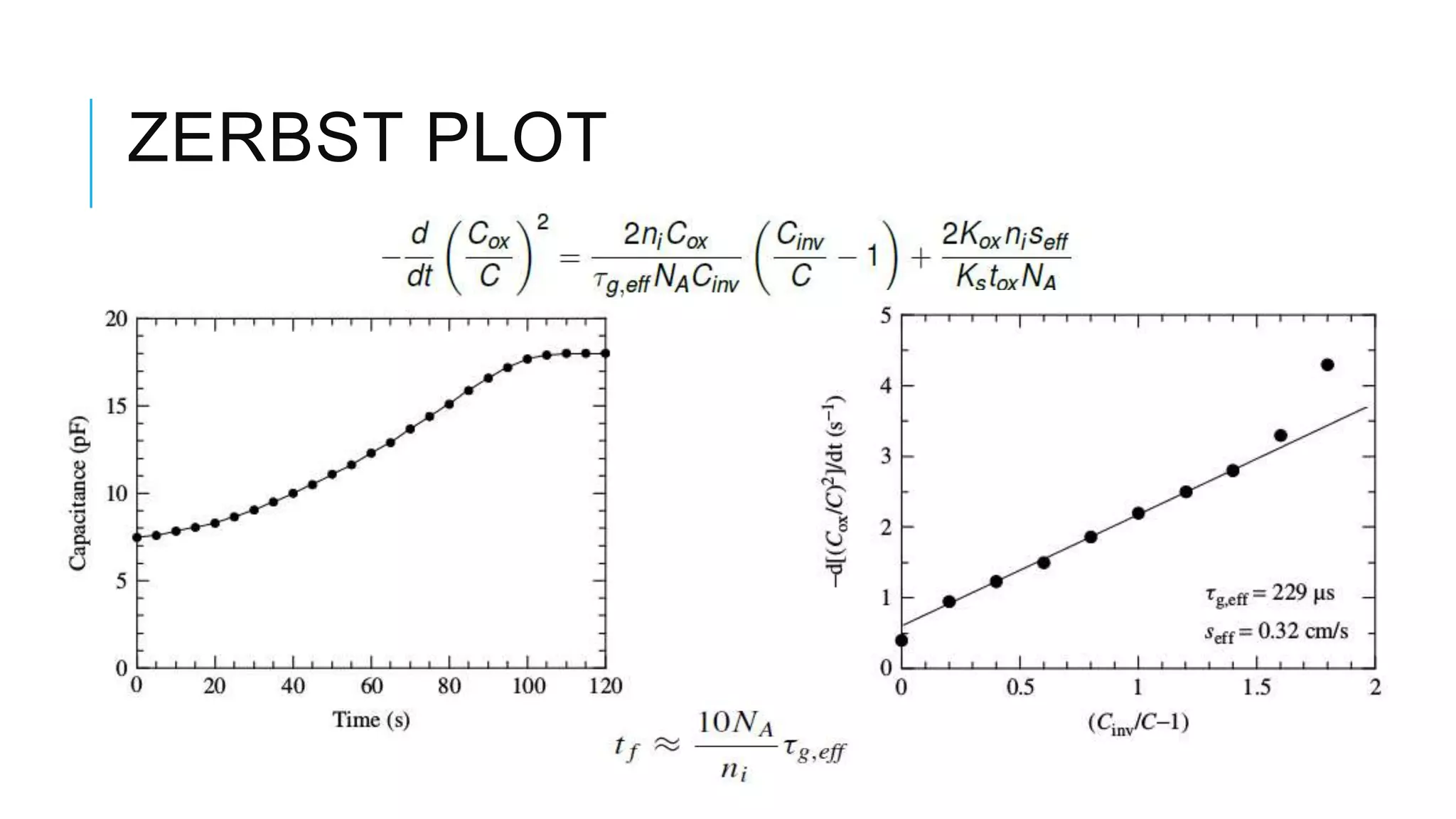
•Deep depletion method and Zerbst plot
•Current-capacitance
8/18/2018
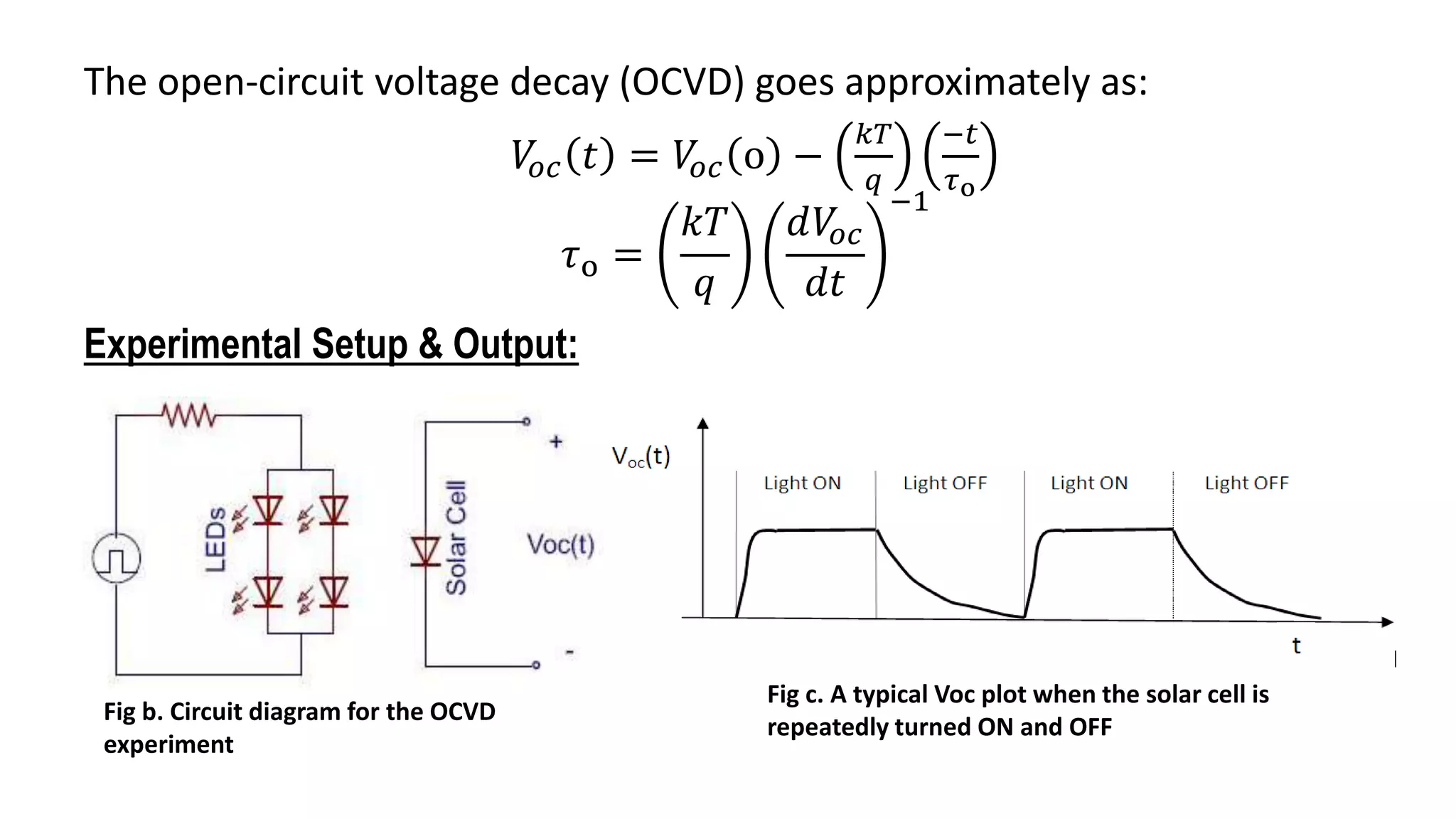
OPEN-CIRCUIT VOLTAGE
DECAY (OCVD)
Fig a. Plot of the decay of Voc with time
The carriers decay
exponentially, due to
recombination given by
𝑛 = 𝐴𝑒𝑥𝑝(
−𝑡
𝜏o
)
The open‐circuit voltage
decay (OCVD) goes
approximately as:
𝑉𝑜𝑐 𝑡 = 𝑉𝑜𝑐 o −
𝑘𝑇
𝑞
−𝑡
𝜏o
𝑉𝑜𝑐(𝑡)
𝑉𝑜𝑐(o)
The open‐circuit voltage decay (OCVD) goes approximately as:
𝑉𝑜𝑐 𝑡 = 𝑉𝑜𝑐 o −
𝑘𝑇
𝑞
−𝑡
𝜏o
𝜏o =
𝑘𝑇
𝑞
𝑑𝑉𝑜𝑐
𝑑𝑡
−1
Experimental Setup & Output:
Fig b. Circuit diagram for the OCVD
experiment
Fig c. A typical Voc plot when the solar cell is
repeatedly turned ON and OFF
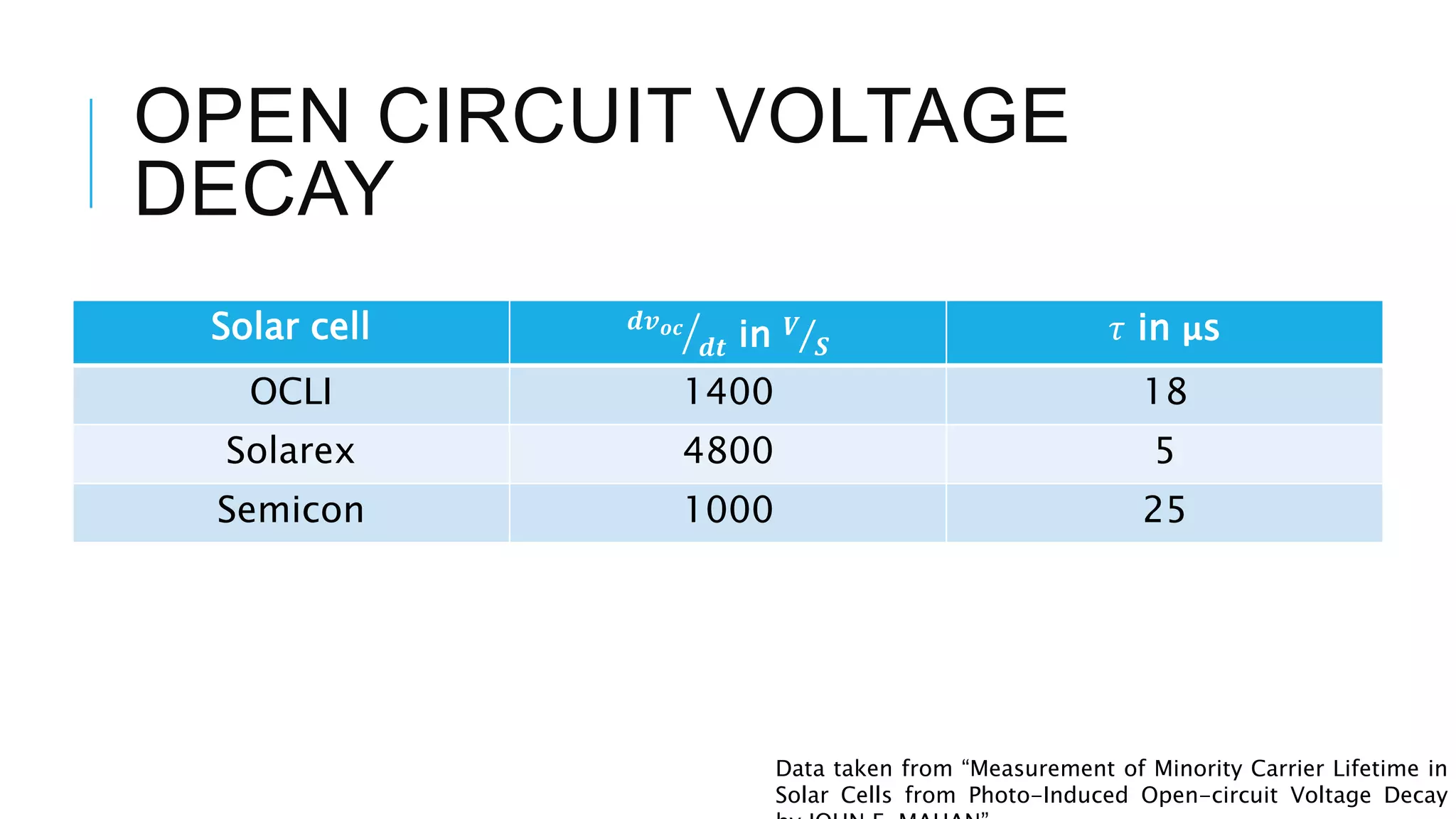
OPEN CIRCUIT VOLTAGE
DECAY
Solar cell 𝒅𝒗 𝒐𝒄
𝒅𝒕 in 𝑽
𝑺
𝜏 in μs
OCLI 1400 18
Solarex 4800 5
Semicon 1000 25
Data taken from “Measurement of Minority Carrier Lifetime in
Solar Cells from Photo-Induced Open-circuit Voltage Decay
REVERSE RECOVERY (RR)
Fig a. Circuit
Schematic
Fig b. Plot of reverse recovery of a solar cell under
transient condition
V(t)
V(f)
V t
t
i(t) I(f)
-Ir ts𝑡 𝑠 = 𝜏 𝑜ln 1 +
𝐼𝑓
𝐼𝑟
CONCEPT OF MOS
CAPACITOR
Fig a: Structure of MOS Capacitor
𝐶 =
𝐶 𝑜𝑥 × 𝐶 𝑑
𝐶 𝑜𝑥 + 𝐶 𝑑
Total Capacitance C is given by,
CARRIER DISTRIBUTION IN
MOS STRUCTURE
Accumulation Depletion
Inversion
C-V CHARACTERISTICS OF A
MOS STRUCTURE
Characteristic of structure at
a- Low Frequency
b- High Frequency
c- High Frequency with pulsed bias
Methods are based on return of pulsed
MOS to equilibrium from
Accumulation towards depletion
Inversion towards depletion
DEEP DEPLETION METHOD
The MOS receives voltage pulses, going from equilibrium to deep
depletion: the capacitance is observed as the MOS comes back to
equilibrium via thermal generation of carriers.
Fig a. The C–VG and C − t behavior of an MOS-C pulsed into
deep depletion.
ZERBST PLOT
CURRENT-CAPACITANCE
Advantages:
Does not require differentiation of
experimental data
Doping concentration need not be
known
Measurement time required is less
Fig a. Current Vs Inverse
Capacitance Plot
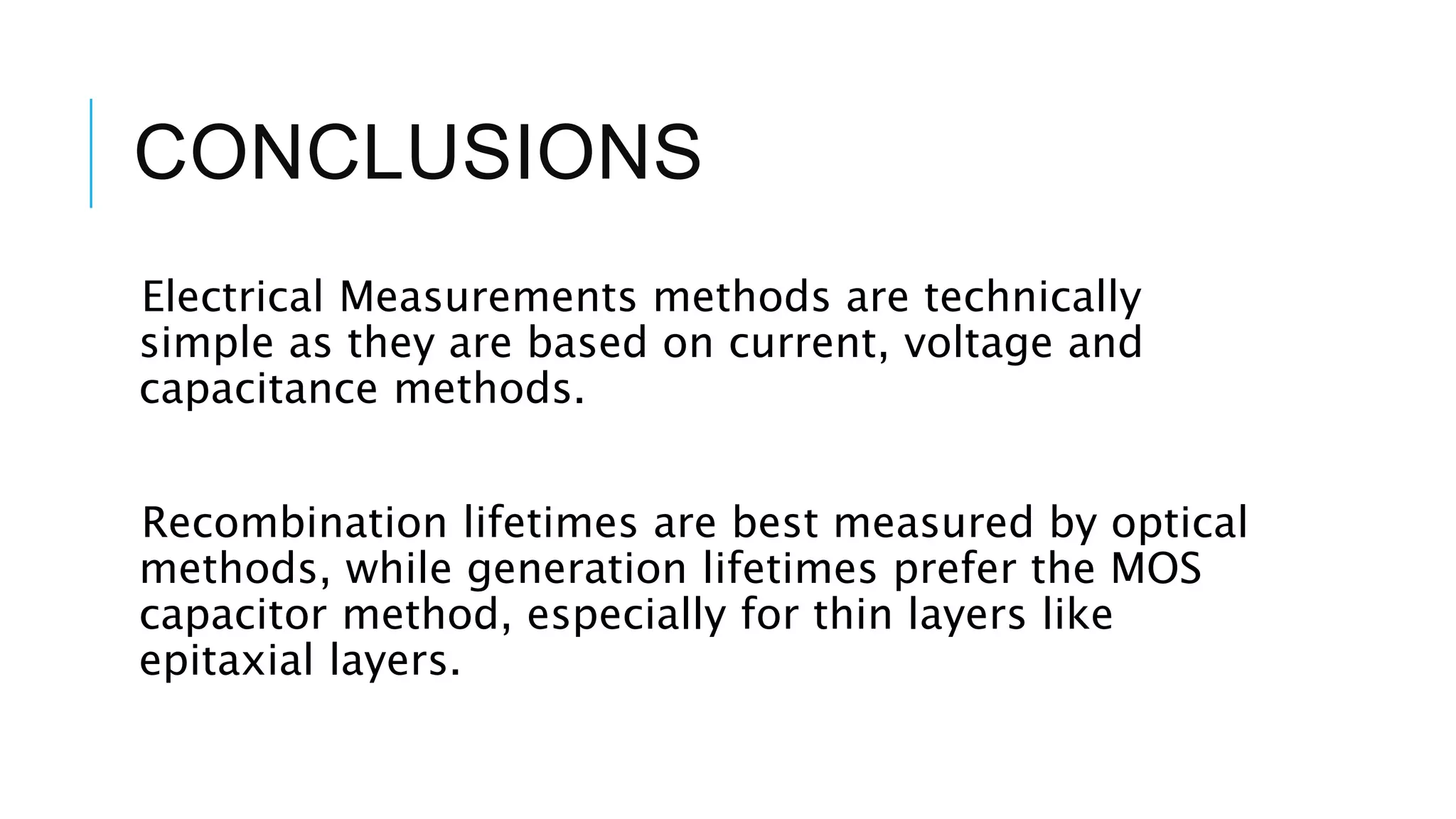
CONCLUSIONS
Electrical Measurements methods are technically
simple as they are based on current, voltage and
capacitance methods.
Recombination lifetimes are best measured by optical
methods, while generation lifetimes prefer the MOS
capacitor method, especially for thin layers like
epitaxial layers.
The recombination lifetime τr is
shown in Fig. and given by,
1
𝜏 𝑟
=
1
𝜏 𝑅𝑎𝑑
+
1
𝜏 𝑆𝑅𝐻
+
1
𝜏 𝐴𝑢𝑔𝑒𝑟
Determine σpNT and C for device
(i) and σpNT and B for device (ii).
vth = 107 cm/s.
Problem
Problem 1
For device (i),
𝜏 𝑆𝑅𝐻 =
1
𝜎 𝑝 𝑣 𝑡ℎ 𝑁𝑡
= 5 × 10⁻⁶
𝑠𝑒𝑐
𝜎 𝑝 𝑣 𝑡ℎ 𝑁𝑡 =
1
5 × 10⁻⁶
𝜎 𝑝 𝑁𝑡 =
1
5 × 10−6 × 107
𝜎 𝑝 𝑁𝑡 = 0.02
Also from 2 points we get the equations,
𝐵 × 1019
+ 𝐶 × 1038
= 998 × 105
𝑎𝑛𝑑 𝐵 × 1019 + 40𝐶 × 1036 = 245 × 105
Solving these we get 𝐶 = 125.5 ×
10−32
𝑐𝑚6
/𝑠
Problem 2
For device (ii),
𝜏 𝑆𝑅𝐻 =
1
𝜎 𝑝 𝑣 𝑡ℎ 𝑁𝑡
= 5 × 10⁻⁷
𝑠𝑒𝑐
𝜎 𝑝 𝑣 𝑡ℎ 𝑁𝑡 =
1
5 × 10⁻⁷
𝜎 𝑝 𝑁𝑡 =
1
5 × 10−7 × 107
𝜎 𝑝 𝑁𝑡 = 0.2
Also from 2 points we get the equations,
5𝐵 × 1018
+ 25𝐶 × 1036
= 488 × 106
𝑎𝑛𝑑 25𝐵 × 1019
+ 25𝐶 × 1036
= 244 × 108
Solving these we get 𝐵 = 97.6 × 10⁻¹² 𝑐𝑚6/
𝑠
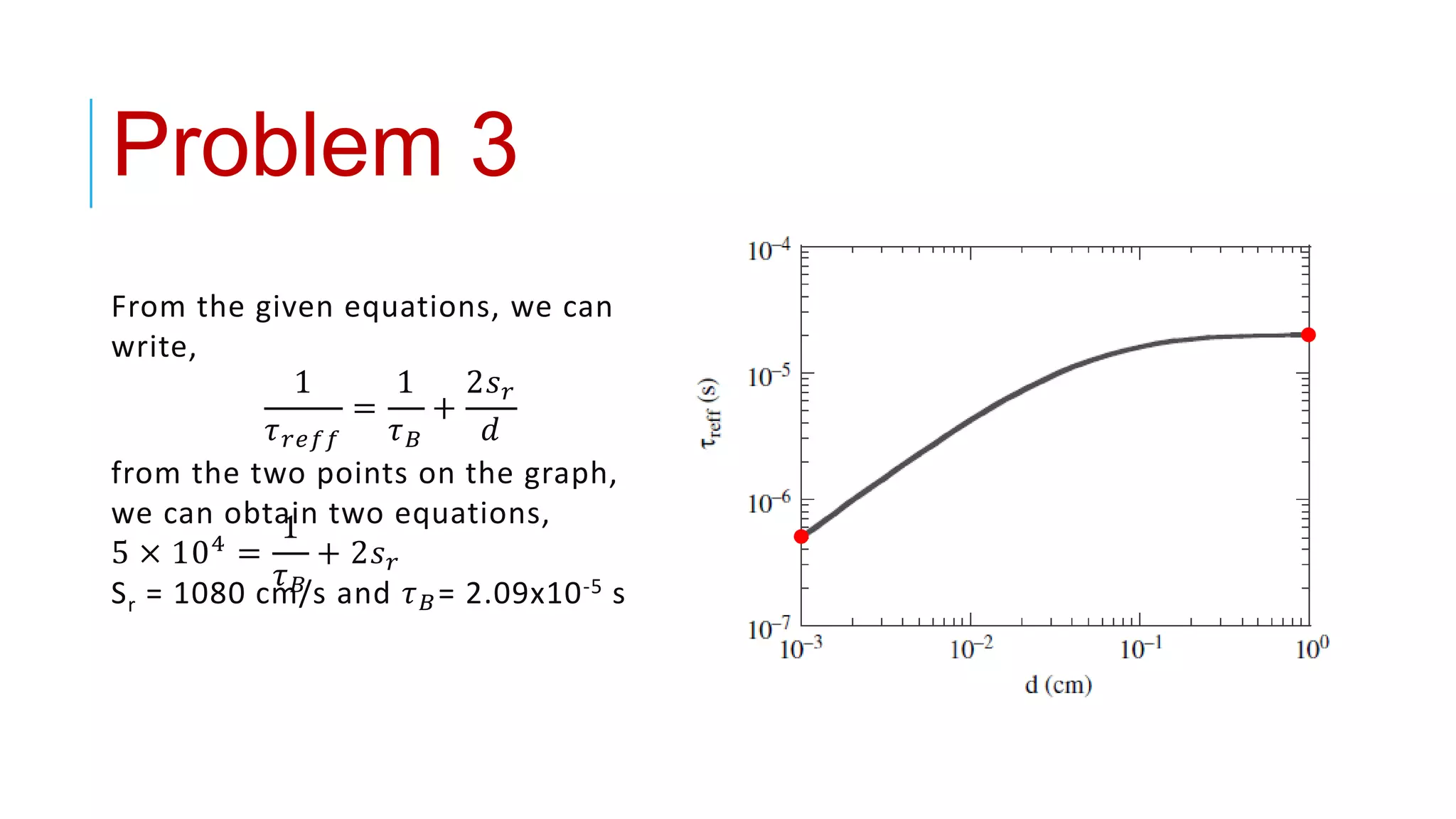
The effective recombination
lifetime is shown in fig. As a
function of wafer thickness; all
samples have identical τB and sr.
1
𝜏 𝑟𝑒𝑓𝑓
=
1
𝜏 𝐵
+
1
𝜏 𝑆
; 𝜏 𝑆 =
𝑑
2𝑠 𝑟
Determine τB and sr .
Problem 3
From the given equations, we can
write,
1
𝜏 𝑟𝑒𝑓𝑓
=
1
𝜏 𝐵
+
2𝑠 𝑟
𝑑
from the two points on the graph,
we can obtain two equations,
5 × 104 =
1
𝜏 𝐵
+ 2𝑠 𝑟
Sr = 1080 cm/s and 𝜏 𝐵= 2.09x10⁻⁵ s
Problem 3
Problem 4
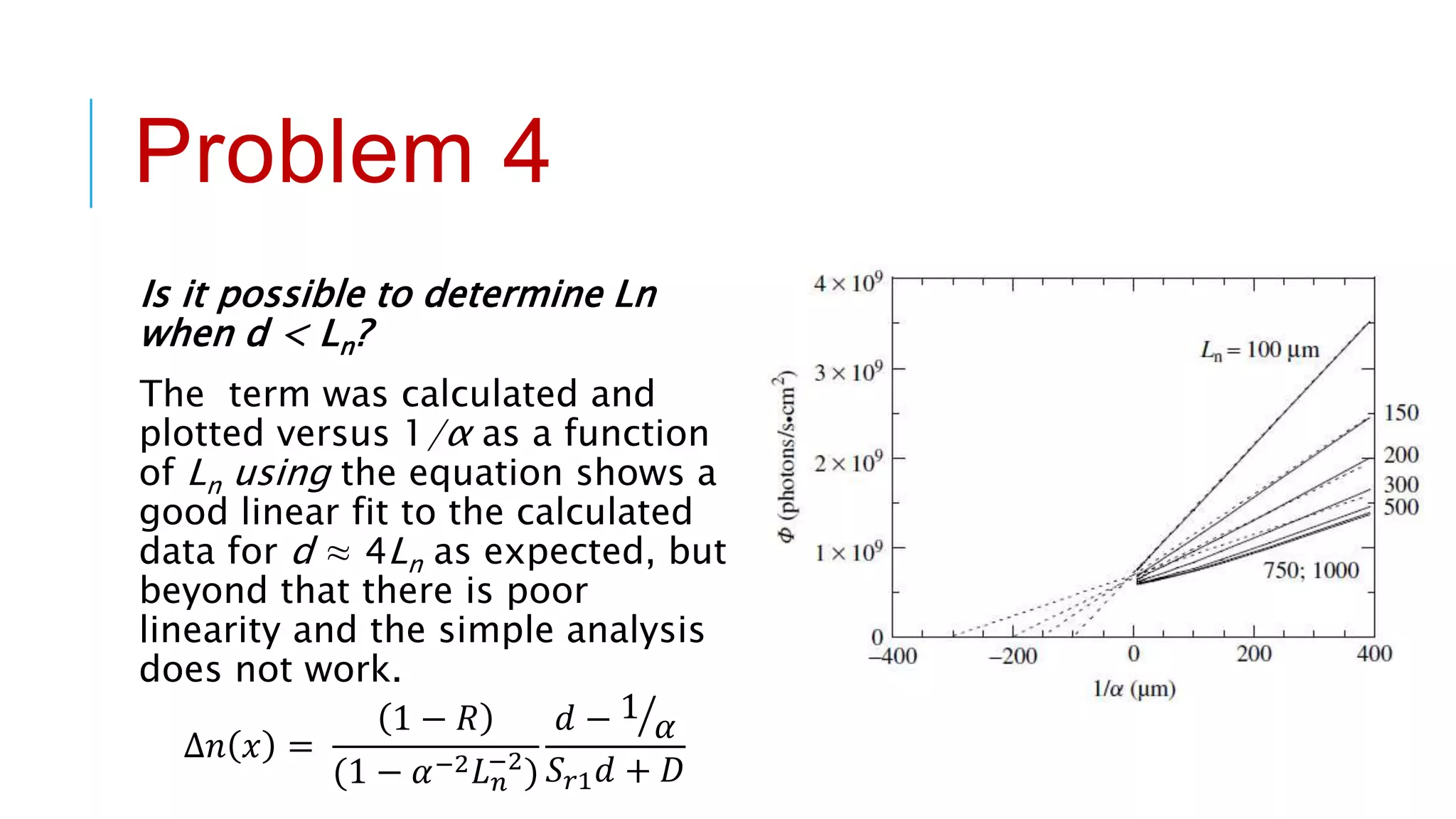
Is it possible to determine Ln
when d < Ln?
The term was calculated and
plotted versus 1/α as a function
of Ln using the equation shows a
good linear fit to the calculated
data for d ≈ 4Ln as expected, but
beyond that there is poor
linearity and the simple analysis
does not work.
∆𝑛 𝑥 =
1 − 𝑅
(1 − 𝛼−2 𝐿 𝑛
−2
)
𝑑 − 1
𝛼
𝑆𝑟1 𝑑 + 𝐷
Problem 4
Constant voltage SPV plots exact
equation, approximate equation.
sr1 = 104 cm/s, sr2 = 104 cm/s,
Dn = 30 cm2/s, VSPV = 10 mV, R =0.3,
npo = 105 cm−3, d = 500 μm.
where the approximation holds for
high sr2.
The equation has a 1/α intercept
that is neither the sample thickness
d nor Ln. It is obvious from these
figures that the diffusion length
cannot be reliably determined when
Ln exceeds the sample thickness.
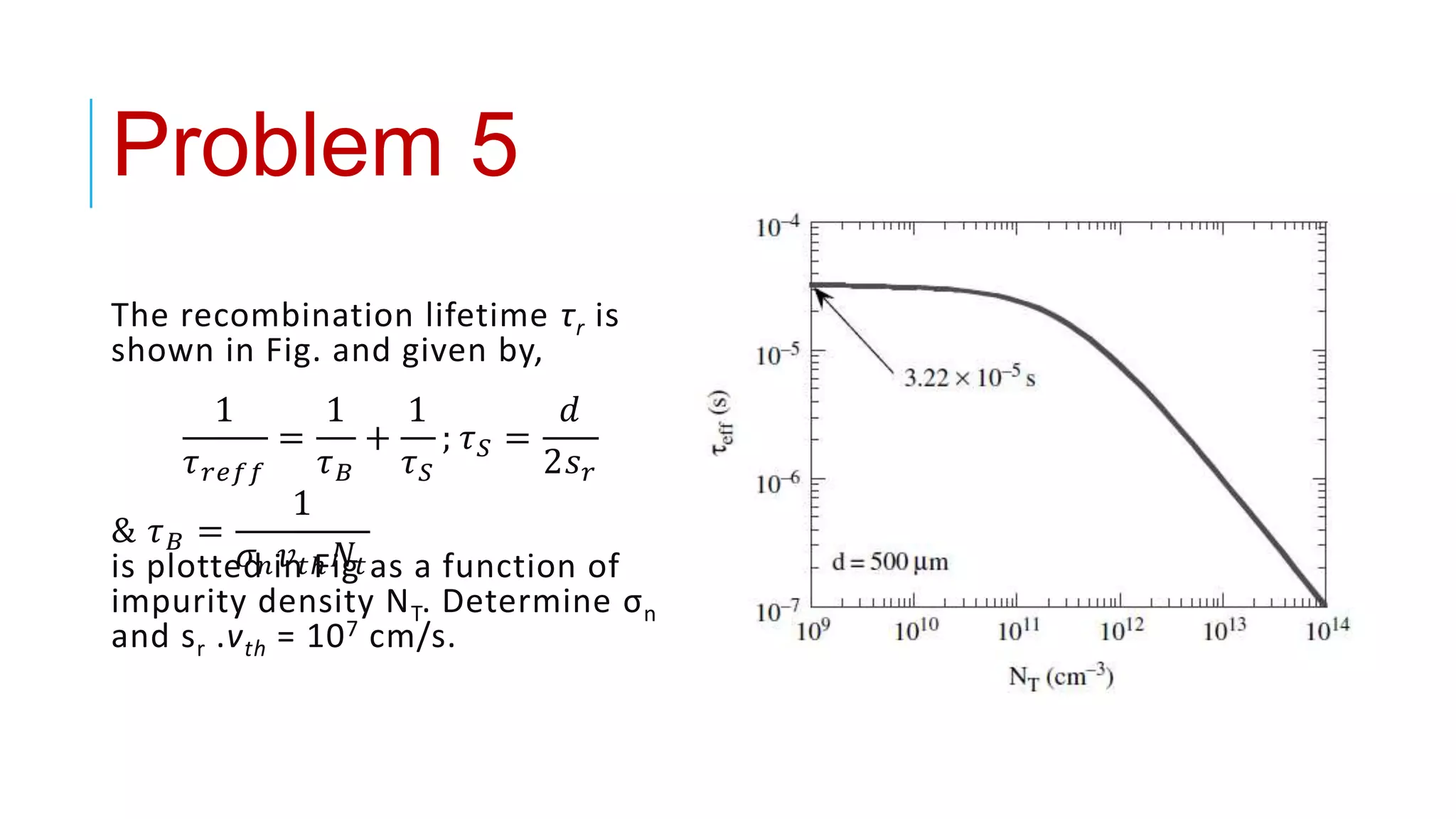
The recombination lifetime τr is
shown in Fig. and given by,
1
𝜏 𝑟𝑒𝑓𝑓
=
1
𝜏 𝐵
+
1
𝜏 𝑆
; 𝜏 𝑆 =
𝑑
2𝑠 𝑟
& 𝜏 𝐵 =
1
𝜎 𝑛 𝑣 𝑡ℎ 𝑁𝑡is plotted in Fig as a function of
impurity density NT. Determine σn
and sr .vth = 107 cm/s.
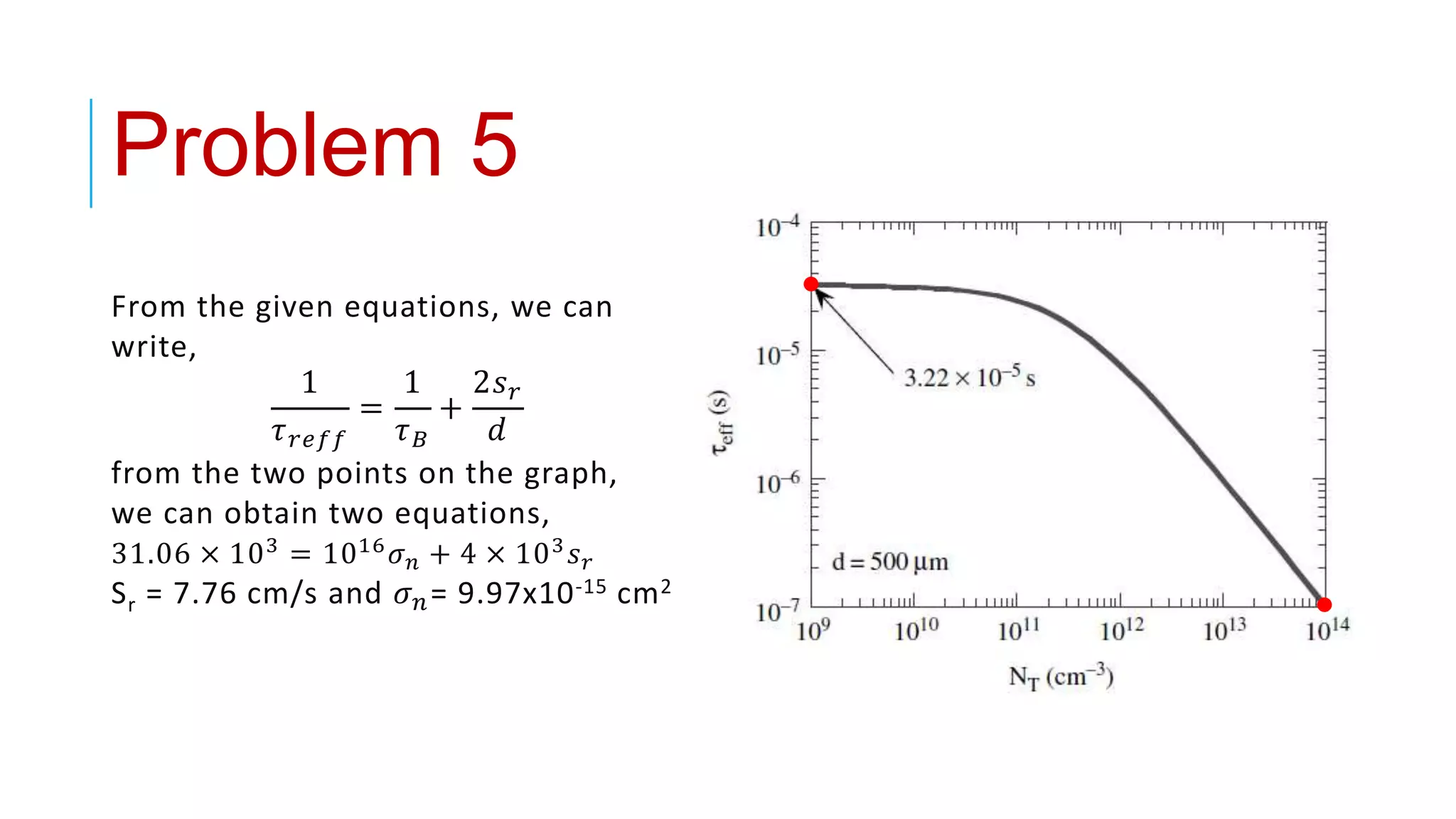
Problem 5
From the given equations, we can
write,
1
𝜏 𝑟𝑒𝑓𝑓
=
1
𝜏 𝐵
+
2𝑠 𝑟
𝑑
from the two points on the graph,
we can obtain two equations,
31.06 × 103 = 1016 𝜎 𝑛 + 4 × 10³ 𝑠 𝑟
Sr = 7.76 cm/s and 𝜎 𝑛= 9.97x10⁻¹⁵ cm2
Problem 5
8/18/2018
THANK YOU!
Measurement Of Minority-carrier Lifetime By Time-resolve Photoluminescence By R. K. Ahrenkiel
Measurement Of Minority Carrier Lifetime In Solar Cells From Photo-induced Open-circuit Voltage Decay
By JOHN E. Mahan, Thomas W.E Kstedt,, Robert I. Frank, Member, Ieeaen,d Roy Kapiow
Minority-carrier Lifetime Measurements On Silicon Solar Cells Using Isc And Voc Transient Decay B. H.
Rose
Carrier Lifetime Analysis By Photoconductance Decay And Free Carrier Absorption Measurement H.-J.
Schulze, A. Frohnmeyer, Niedernostheide, F. Hille, P. Tutto, T. Pavelka And G. Wachutkab
Measurement Of Carrier Lifetimes In Germanium And Silicon DONALD T. Stevenson And Robert J. Keyes
Electrical And Electronic Measurements By Kaufmann
Semiconductor Material And Device Characterization By Dieter K. Schroder

Characterization of Carrier Lifetime

  • 1.
    Characterization of Carrier Lifetime Presentationas part of internal assessment in course Semiconductor Processing & Characterization M.Tech Solar, PDPU. Presented to Prof. Manoj Kumar Presented by Aditya Soni (17MSE001) Jay Joshi (17MSE005) Mrunmayee Unawane (17MSE016)
  • 2.
    CARRIER LIFETIMES –WHY MEASURE THEM In IC Industries, • Carrier lifetime determines performance of devices. • It is a sensitive measure of material quality and cleanliness. • It gives information about defect densities as low as to 1o11 cm-3 8/18/2018 In Solar Cells, •Carrier lifetime of minority carriers determines performance of the solar cell. •Longer the minority carries retain the energy corresponding to the conduction band, higher their probability to cross the SCR and contribute in conduction. Band diagram of Solar Cell under illumination.
  • 3.
    ℎ𝜈 CARRIER LIFETIMES –WHAT ARE THEY Recombination lifetime 𝜏 𝑟: Excess carriers decay by recombining  𝜏 𝑟 is the average time after which the electron goes back in the valence band and recombines with it’s hole. 8/18/2018 E v Ec 𝑛𝑜𝑛 𝑟𝑎𝑑𝑖𝑎𝑡𝑖𝑣𝑒 𝑒𝑚𝑚𝑖𝑠𝑖𝑜𝑛 𝑛𝑜𝑛 𝑟𝑎𝑑𝑖𝑎𝑡𝑖𝑣𝑒 𝑒𝑚𝑚𝑖𝑠𝑖𝑜𝑛 𝑅−𝐺 𝐶𝑒𝑛𝑡𝑒𝑟𝑠 E v Ec • Band to Band recombination • SRH Recombination • Auger recombination E v Ec
  • 4.
    CARRIER LIFETIMES –WHAT ARE THEY Generation lifetime 𝜏 𝑔: In case of lack of carriers, electron-hole pairs are generated.  𝜏 𝑔 is the average time which the electron hole is generated.  Misnomer - Generation Time. 8/18/2018 • Thermal Generation • Optical Generation • Impact Ionization generation E v Ec Ef T = o K T > o K E v Ec ℎ𝜈 > 𝐸 𝑔 An carrier with enough kinetic energy can knock a bound electron out of its bound state and promote it to a state in the conduction band, creating an electron-hole pair.
  • 5.
    RECOMBINATION LIFETIME 8/18/2018 𝜏 𝑆𝑅𝐻= 𝜏 𝑝 𝑛 𝑜 + 𝑛 + ∆𝑛 + 𝜏 𝑛(𝑝o+𝑝 + ∆𝑝) 𝑝o +𝑛o +∆𝑛 𝜏 𝑅𝑎𝑑 = 1 𝐵(𝑝o +𝑛o +∆𝑛) 𝜏 𝐴𝑢𝑔𝑒𝑟 = 1 𝐶 𝑝(𝑝o 2 +2𝑝o∆𝑛 + ∆𝑛2) + 𝐶 𝑛(𝑛o 2 + 2𝑛o∆𝑛 + ∆𝑛2) 𝑁 𝑇= 𝐷𝑒𝑛𝑠𝑖𝑡𝑦 𝑣𝑡ℎ= 𝑇ℎ𝑒𝑟𝑚𝑎𝑙 𝑉𝑒𝑙𝑜𝑐𝑖𝑡𝑦 𝜎 𝑝 = 𝑐𝑎𝑝𝑡𝑢𝑟𝑒 𝑐𝑟𝑜𝑠𝑠-𝑠𝑒𝑐𝑡𝑖𝑜𝑛𝑠 𝑜𝑓 ℎ𝑜𝑙𝑒𝑠 𝜎n = 𝑐𝑎𝑝𝑡𝑢𝑟𝑒 𝑐𝑟𝑜𝑠𝑠-𝑠𝑒𝑐𝑡𝑖𝑜𝑛𝑠 𝑜𝑓 electrons 𝑛 = 𝑒𝑙𝑒𝑐𝑡𝑟𝑜𝑛 𝑐𝑜𝑛𝑐𝑒𝑛𝑡𝑟𝑎𝑡𝑖𝑜𝑛 𝑝 = ℎ𝑜𝑙𝑒 𝑐𝑜𝑛𝑐𝑒𝑛𝑡𝑟𝑎𝑡𝑖𝑜𝑛 𝑛o = 𝑒𝑞𝑢𝑖𝑙𝑙𝑖𝑏𝑟𝑖𝑢𝑚 𝑒− 𝑐𝑜𝑛𝑐𝑒𝑛𝑡𝑟𝑎𝑡𝑖𝑜𝑛 𝑝o = 𝑒𝑞𝑢𝑖𝑙𝑙𝑖𝑏𝑟𝑖𝑢𝑚 ℎ+ 𝑐𝑜𝑛𝑐𝑒𝑛𝑡𝑟𝑎𝑡𝑖𝑜𝑛 Δ𝑛= 𝑒𝑥𝑐𝑒𝑠𝑠 𝑒− 𝑐𝑜𝑛𝑐𝑒𝑛𝑡𝑟𝑎𝑡𝑖𝑜𝑛 𝛥𝑝= 𝑒𝑥𝑐𝑒𝑠𝑠 ℎ+ 𝑐𝑜𝑛𝑐𝑒𝑛𝑡𝑟𝑎𝑡𝑖𝑜𝑛 𝜏 𝑝 = 1 𝜎 𝑝 𝑣 𝑡ℎ 𝑁𝑡 𝜏 𝑛 = 1 𝜎 𝑛 𝑣 𝑡ℎ 𝑁𝑡 𝟏 𝝉 𝒓 = 𝟏 𝝉 𝑹𝒂𝒅 + 𝟏 𝝉 𝑺𝑹𝑯 + 𝟏 𝝉 𝑨𝒖𝒈𝒆𝒓
  • 6.
    RECOMBINATION LIFETIME 8/18/2018 𝜏 𝐴𝑢𝑔𝑒𝑟= 1 𝐶 𝑝(𝑝o 2 +2𝑝o∆𝑛 + ∆𝑛2) + 𝐶 𝑛(𝑛o 2 + 2𝑛o∆𝑛 + ∆𝑛2) 𝜏 𝑅𝑎𝑑 = 1 𝐵(𝑝o +𝑛o +∆𝑛)
  • 7.
    RECOMBINATION LIFETIME 𝑛 (𝑐𝑚−3) Recombinationlifetime versus majority carrier density for n-Si with 𝑪 𝒏 = 𝟐 × 𝟏𝟎−𝟑𝟏 𝒄𝒎 𝟔/𝒔 & 𝑩 = 𝟒. 𝟕𝟑 × 𝟏𝟎−𝟏𝟓 𝒄𝒎 𝟑/𝒔
  • 8.
    GENERATION LIFETIME 8/18/2018 𝜏 𝑔= 𝜏 𝑝 𝑒𝑥𝑝 𝐸 𝑇 − 𝐸𝑖 𝑘𝑇 + 𝜏 𝑛 𝑒𝑥𝑝 − 𝐸 𝑇 − 𝐸𝑖 𝑘𝑇 E 𝑇 = Energy Level Ei = Intrinsic Energy Level 𝜏 𝑝 = 1 𝜎 𝑝 𝑣 𝑡ℎ 𝑁𝑡 𝜏 𝑛 = 1 𝜎 𝑛 𝑣 𝑡ℎ 𝑁𝑡
  • 9.
    OPTICAL METHODS Different methodsavailable  Photoluminescence method (PL)  Free carrier absorption (FCA)  Photoconductance Decay (PCD)  Short circuit current / open circuit voltage decay (SCCD /  Surface Voltage  Steady state short circuit current method (SSSCC)  Electron beam induced current (EBIC)  Quasi steady state photoconductance (QSSP)
  • 10.
    PHOTOLUMINESCENCE METHOD  Near bandgap emission is used.  The pulse height discriminator is necessary to block electrical pulses produced by thermal and other nonphotonic sources.  Different types of Photodetectors  Photomultiplier tubes detector (impulse response of about 300ps)  Microchannel plates detector (impulse response of about 30ps) Fig – Experimental Setup Time Amplitude Converter Pulse Height analyzer
  • 11.
    PHOTOLUMINESCENCE METHOD • Advantages • Noncontact method • Also can be used for determining the composition of compound Semiconductors, such as 𝐴𝑙 𝑥 𝐺𝑎1−𝑥 𝐴𝑠 by using shallow emission or deep level emissions Fig – Experimental Setup Time Amplitude Converter Pulse Height analyzer
  • 12.
    PHOTOLUMINESCENCE METHOD • Disadvantages • Costlyequipment required • Not so accurate for the characterization of indirect band gap semiconductors • Not a bulk characterization technique • Only a thin, near surface region can be investigated. • Error can occur if the photon recycling happens Fig – Experimental Setup Time Amplitude Converter Pulse Height analyzer
  • 13.
    PHOTON RECYCLING  Basically,it is the recapturing of photon  It may give you the carrier lifetime well above the theoretical value  It could be corrected by adding the photon recycling factor in the final equation ℎ𝜈 E v Ec
  • 14.
    FREE CARRIER ABSORPTION Excesscarrier density ∆𝑛 𝑡 = 1 𝜎 𝐹𝐶𝐴 . 1 𝑑 ln 𝐼0 𝐼𝑡 Here, 𝜎 𝐹𝐶𝐴 = cross sectional area d = sample thickness 𝐼0 = incident beam intensity 𝐼𝑡 = 𝐼0 𝑒𝑥𝑝 −𝛼 𝑝𝑟𝑜𝑏𝑒 𝑡 . 𝑑 𝛼 𝑝𝑟𝑜𝑏𝑒 𝑡 = 𝛼0 + ∆𝛼 𝑡 𝛼0 = absorption coefficient 𝜏 = 𝑑 ∆𝑛 𝐺′ Where, Laser generation rate 𝐺′ = 1 − 𝑅 𝐼0 Detector Amplifier Oscilloscope
  • 15.
    FREE CARRIER ABSORPTION Detector Pump Laser Selection  From experiments, it is observed that a yttrium-aluminum-garnet (YAG) laser operating at λ = 1.06 μm is ideally suited for Si wafers (around 350 μm thick) because of its low absorption coefficient.  Pulse duration must be kept below the shortest expected lifetime in the sample, minimum beam size should be at least a few carrier diffusion lengths in diameter. Amplifier Oscilloscope
  • 16.
    FREE CARRIER ABSORPTION Probe Laser Selection  long wavelengths toward the IR range are preferable and the choice is often set by laser availability.  As probe lasers, HeNe lasers are traditionally used at operating wavelengths of 3.39, 1.3, or 0.632 μm, depending on band gap.  Also, relatively intense lasers (high temperature) have become available offering increased measurement speed, although care must be taken not to affect the carrier dynamics by heating. Detector Amplifier Oscilloscope
  • 17.
    FREE CARRIER ABSORPTION Detection Electronics  Reduction of noise is the priority here.  To reduce noise, oscilloscopes with minimum bandwidth is selected.  Digital oscilloscope is preferred over the analog because of the provision of digital averaging. Detector Amplifier Oscilloscope
  • 18.
    FREE CARRIER ABSORPTION Advantages  Non contact method  Suitable for bulk lifetime measurements  Able to measure through very different sample structures and semiconductor materials  Disadvantages  Surface recombination decreases the accuracy  Thus, it is accurate in short carrier lifetimes (for example, indirect-band-gap semiconductors.  At low carrier concentration, the optical Detector Amplifier Oscilloscope
  • 19.
    PHOTOCONDUCTANCE DECAY  Methodology 𝜕∆𝑛(𝑡) 𝜕𝑡 = G– R = G - ∆𝑛(𝑡) 𝜏 𝑒𝑓𝑓 (Continuity equation) For PCD, G(t) << 𝜕∆𝑛(𝑡) 𝜕𝑡 Therefore, 𝜏 𝑒𝑓𝑓(∆𝑛) = - ∆𝑛(𝑡) 𝜕∆𝑛(𝑡) 𝜕𝑡 (We need to find ∆𝑛)
  • 20.
    PHOTOCONDUCTANCE DECAY  Methodology Conductivity canbe given by, 𝜎 = 𝑞 𝜇 𝑛 𝑛 + 𝜇 𝑝 𝑝 Where, 𝜇 𝑛 and 𝜇 𝑝 are the mobility of electrons and holes q is the charge of electron n = 𝑛0 + ∆𝑛 & p = 𝑝0 + ∆𝑝 For equilibrium, ∆𝑛 = ∆𝑝 Therefore, ∆𝑛 = ∆𝜎 𝑞 𝜇 𝑛+𝜇 𝑝 (We need to find ∆𝜎)
  • 21.
    PHOTOCONDUCTANCE DECAY ∆𝑉 = 𝑖𝑝ℎ − 𝑖 𝑑𝑘 𝑅 Here, ∆𝑉 is the voltage change between the dark and the illuminated sample. 𝑖 𝑝ℎ & 𝑖 𝑑𝑘 are photocurrent and dark current. Conductivity ∆𝑔 = 𝑔 𝑝ℎ − 𝑔 𝑑𝑘 = 1 𝑟 𝑝ℎ − 1 𝑟 𝑑𝑘 ∆𝑔 = ∆𝜎𝐴 𝐿 (We need to find ∆𝑔 )
  • 22.
    PHOTOCONDUCTANCE DECAY ∆𝑉 = 𝑅 ∆𝑔𝑣0 𝑟𝑑𝑘 2 𝑅 + 𝑟𝑑𝑘 (𝑅 + 𝑟𝑑𝑘 + 𝑅𝑟𝑑𝑘∆𝑔) For constant voltage, the above equation can be written as ∆𝑉 = 𝑅 ∆𝑔 𝑣0 1 − ∆𝑉 𝑉0 Form this equation, we get ∆𝑔.
  • 23.
    VERDICT Versatile techniques. Canbe used for several different conductors. Non contact method, which means simple or no sample preparation. You may get an error in the calculation if carrier trapping is dominant. They require comparatively complex experimental setup.
  • 24.
    ELECTRICAL MEASUREMENT TECHNIQUES Diode-based: • Open-circuitvoltage decay (𝜏 𝑟) • Reverse-recovery (𝜏 𝑟) Pulsed MOS capacitor method (𝜏 𝑟): • Inversion method 8/18/2018
  • 25.
    ELECTRICAL MEASUREMENT TECHNIQUES Pulsed MOScapacitor method (τg): •Deep depletion method and Zerbst plot •Current-capacitance 8/18/2018
  • 26.
    OPEN-CIRCUIT VOLTAGE DECAY (OCVD) Figa. Plot of the decay of Voc with time The carriers decay exponentially, due to recombination given by 𝑛 = 𝐴𝑒𝑥𝑝( −𝑡 𝜏o ) The open‐circuit voltage decay (OCVD) goes approximately as: 𝑉𝑜𝑐 𝑡 = 𝑉𝑜𝑐 o − 𝑘𝑇 𝑞 −𝑡 𝜏o 𝑉𝑜𝑐(𝑡) 𝑉𝑜𝑐(o)
  • 27.
    The open‐circuit voltagedecay (OCVD) goes approximately as: 𝑉𝑜𝑐 𝑡 = 𝑉𝑜𝑐 o − 𝑘𝑇 𝑞 −𝑡 𝜏o 𝜏o = 𝑘𝑇 𝑞 𝑑𝑉𝑜𝑐 𝑑𝑡 −1 Experimental Setup & Output: Fig b. Circuit diagram for the OCVD experiment Fig c. A typical Voc plot when the solar cell is repeatedly turned ON and OFF
  • 28.
    OPEN CIRCUIT VOLTAGE DECAY Solarcell 𝒅𝒗 𝒐𝒄 𝒅𝒕 in 𝑽 𝑺 𝜏 in μs OCLI 1400 18 Solarex 4800 5 Semicon 1000 25 Data taken from “Measurement of Minority Carrier Lifetime in Solar Cells from Photo-Induced Open-circuit Voltage Decay
  • 29.
    REVERSE RECOVERY (RR) Figa. Circuit Schematic Fig b. Plot of reverse recovery of a solar cell under transient condition V(t) V(f) V t t i(t) I(f) -Ir ts𝑡 𝑠 = 𝜏 𝑜ln 1 + 𝐼𝑓 𝐼𝑟
  • 30.
    CONCEPT OF MOS CAPACITOR Figa: Structure of MOS Capacitor 𝐶 = 𝐶 𝑜𝑥 × 𝐶 𝑑 𝐶 𝑜𝑥 + 𝐶 𝑑 Total Capacitance C is given by,
  • 31.
    CARRIER DISTRIBUTION IN MOSSTRUCTURE Accumulation Depletion Inversion
  • 32.
    C-V CHARACTERISTICS OFA MOS STRUCTURE Characteristic of structure at a- Low Frequency b- High Frequency c- High Frequency with pulsed bias Methods are based on return of pulsed MOS to equilibrium from Accumulation towards depletion Inversion towards depletion
  • 33.
    DEEP DEPLETION METHOD TheMOS receives voltage pulses, going from equilibrium to deep depletion: the capacitance is observed as the MOS comes back to equilibrium via thermal generation of carriers. Fig a. The C–VG and C − t behavior of an MOS-C pulsed into deep depletion.
  • 34.
  • 35.
    CURRENT-CAPACITANCE Advantages: Does not requiredifferentiation of experimental data Doping concentration need not be known Measurement time required is less Fig a. Current Vs Inverse Capacitance Plot
  • 36.
    CONCLUSIONS Electrical Measurements methodsare technically simple as they are based on current, voltage and capacitance methods. Recombination lifetimes are best measured by optical methods, while generation lifetimes prefer the MOS capacitor method, especially for thin layers like epitaxial layers.
  • 37.
    The recombination lifetimeτr is shown in Fig. and given by, 1 𝜏 𝑟 = 1 𝜏 𝑅𝑎𝑑 + 1 𝜏 𝑆𝑅𝐻 + 1 𝜏 𝐴𝑢𝑔𝑒𝑟 Determine σpNT and C for device (i) and σpNT and B for device (ii). vth = 107 cm/s. Problem
  • 38.
    Problem 1 For device(i), 𝜏 𝑆𝑅𝐻 = 1 𝜎 𝑝 𝑣 𝑡ℎ 𝑁𝑡 = 5 × 10⁻⁶ 𝑠𝑒𝑐 𝜎 𝑝 𝑣 𝑡ℎ 𝑁𝑡 = 1 5 × 10⁻⁶ 𝜎 𝑝 𝑁𝑡 = 1 5 × 10−6 × 107 𝜎 𝑝 𝑁𝑡 = 0.02 Also from 2 points we get the equations, 𝐵 × 1019 + 𝐶 × 1038 = 998 × 105 𝑎𝑛𝑑 𝐵 × 1019 + 40𝐶 × 1036 = 245 × 105 Solving these we get 𝐶 = 125.5 × 10⁻³² 𝑐𝑚6 /𝑠
  • 39.
    Problem 2 For device(ii), 𝜏 𝑆𝑅𝐻 = 1 𝜎 𝑝 𝑣 𝑡ℎ 𝑁𝑡 = 5 × 10⁻⁷ 𝑠𝑒𝑐 𝜎 𝑝 𝑣 𝑡ℎ 𝑁𝑡 = 1 5 × 10⁻⁷ 𝜎 𝑝 𝑁𝑡 = 1 5 × 10−7 × 107 𝜎 𝑝 𝑁𝑡 = 0.2 Also from 2 points we get the equations, 5𝐵 × 1018 + 25𝐶 × 1036 = 488 × 106 𝑎𝑛𝑑 25𝐵 × 1019 + 25𝐶 × 1036 = 244 × 108 Solving these we get 𝐵 = 97.6 × 10⁻¹² 𝑐𝑚6/ 𝑠
  • 40.
    The effective recombination lifetimeis shown in fig. As a function of wafer thickness; all samples have identical τB and sr. 1 𝜏 𝑟𝑒𝑓𝑓 = 1 𝜏 𝐵 + 1 𝜏 𝑆 ; 𝜏 𝑆 = 𝑑 2𝑠 𝑟 Determine τB and sr . Problem 3
  • 41.
    From the givenequations, we can write, 1 𝜏 𝑟𝑒𝑓𝑓 = 1 𝜏 𝐵 + 2𝑠 𝑟 𝑑 from the two points on the graph, we can obtain two equations, 5 × 104 = 1 𝜏 𝐵 + 2𝑠 𝑟 Sr = 1080 cm/s and 𝜏 𝐵= 2.09x10⁻⁵ s Problem 3
  • 42.
    Problem 4 Is itpossible to determine Ln when d < Ln? The term was calculated and plotted versus 1/α as a function of Ln using the equation shows a good linear fit to the calculated data for d ≈ 4Ln as expected, but beyond that there is poor linearity and the simple analysis does not work. ∆𝑛 𝑥 = 1 − 𝑅 (1 − 𝛼−2 𝐿 𝑛 −2 ) 𝑑 − 1 𝛼 𝑆𝑟1 𝑑 + 𝐷
  • 43.
    Problem 4 Constant voltageSPV plots exact equation, approximate equation. sr1 = 104 cm/s, sr2 = 104 cm/s, Dn = 30 cm2/s, VSPV = 10 mV, R =0.3, npo = 105 cm−3, d = 500 μm. where the approximation holds for high sr2. The equation has a 1/α intercept that is neither the sample thickness d nor Ln. It is obvious from these figures that the diffusion length cannot be reliably determined when Ln exceeds the sample thickness.
  • 44.
    The recombination lifetimeτr is shown in Fig. and given by, 1 𝜏 𝑟𝑒𝑓𝑓 = 1 𝜏 𝐵 + 1 𝜏 𝑆 ; 𝜏 𝑆 = 𝑑 2𝑠 𝑟 & 𝜏 𝐵 = 1 𝜎 𝑛 𝑣 𝑡ℎ 𝑁𝑡is plotted in Fig as a function of impurity density NT. Determine σn and sr .vth = 107 cm/s. Problem 5
  • 45.
    From the givenequations, we can write, 1 𝜏 𝑟𝑒𝑓𝑓 = 1 𝜏 𝐵 + 2𝑠 𝑟 𝑑 from the two points on the graph, we can obtain two equations, 31.06 × 103 = 1016 𝜎 𝑛 + 4 × 10³ 𝑠 𝑟 Sr = 7.76 cm/s and 𝜎 𝑛= 9.97x10⁻¹⁵ cm2 Problem 5
  • 46.
    8/18/2018 THANK YOU! Measurement OfMinority-carrier Lifetime By Time-resolve Photoluminescence By R. K. Ahrenkiel Measurement Of Minority Carrier Lifetime In Solar Cells From Photo-induced Open-circuit Voltage Decay By JOHN E. Mahan, Thomas W.E Kstedt,, Robert I. Frank, Member, Ieeaen,d Roy Kapiow Minority-carrier Lifetime Measurements On Silicon Solar Cells Using Isc And Voc Transient Decay B. H. Rose Carrier Lifetime Analysis By Photoconductance Decay And Free Carrier Absorption Measurement H.-J. Schulze, A. Frohnmeyer, Niedernostheide, F. Hille, P. Tutto, T. Pavelka And G. Wachutkab Measurement Of Carrier Lifetimes In Germanium And Silicon DONALD T. Stevenson And Robert J. Keyes Electrical And Electronic Measurements By Kaufmann Semiconductor Material And Device Characterization By Dieter K. Schroder