TECHNICAL SEMINAR
Topic : Microgrid
Made by
PEDIREDLA SANJAY KUMAR
18981A0241
UNDER THE GUIDANCE
OF
Dr. T.SATYANARAYANA
(Assistant Professor)
Outline
 Introduction to Microgrid.
 Microgrid Operating Modes.
 The Need of Microgrid.
 Interconnected Microgrids – Power Parks.
 Environmental Aspects.
 Conventional Grid versus Microgrid.
 Advantages & Disadvantagesof Microgrid.
 Future Directions on Microgrid Research.
 References.
Introduction To Microgrid
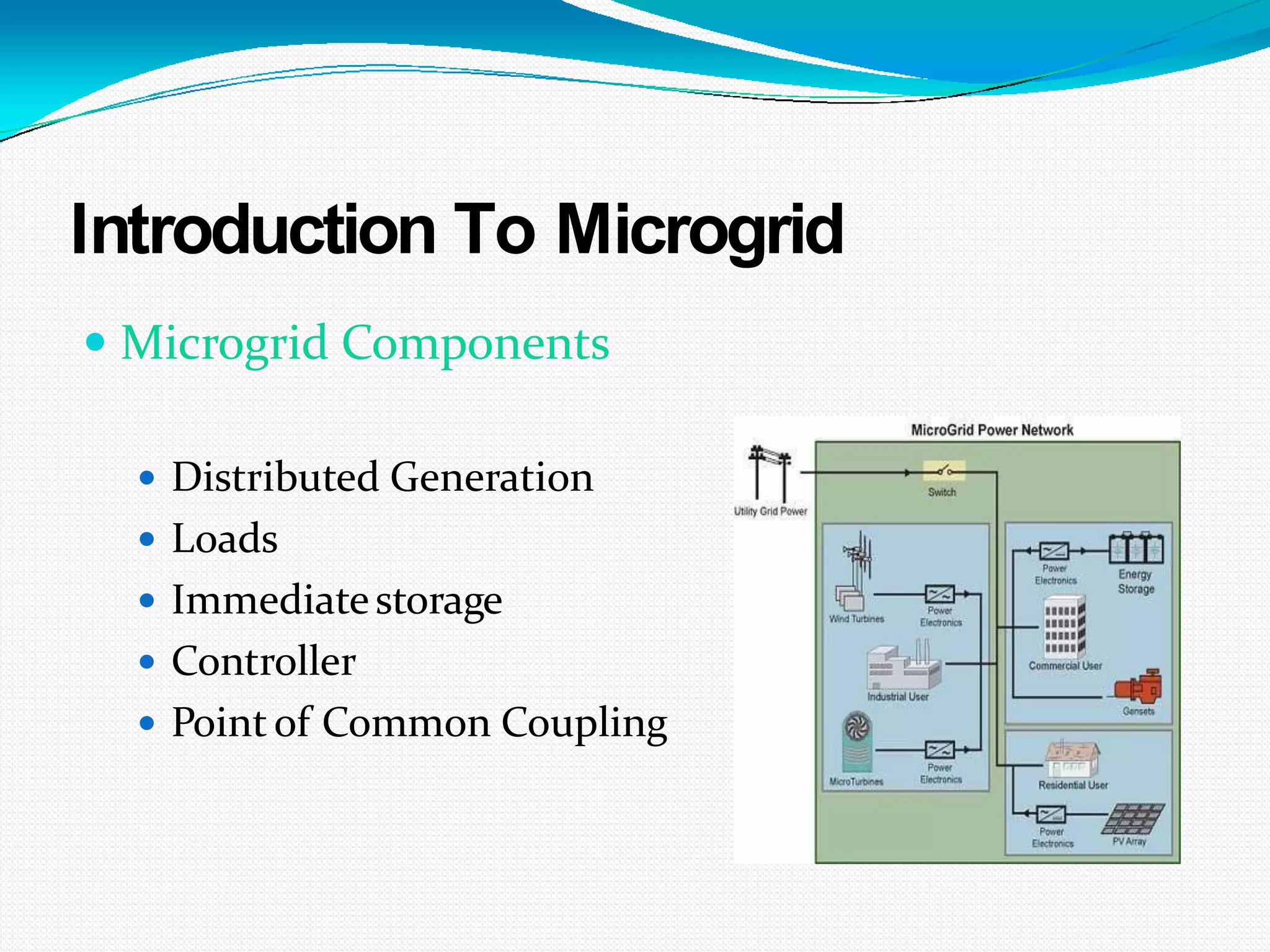
 Microgrid Components
 Distributed Generation
 Loads
 Immediatestorage
 Controller
 Point of Common Coupling
Introduction To Microgrid
 What is Microgrid?
 It isasmall-scale power supply network that is designed
to provide power fora small community.
 Itenables local powergeneration for local loads.
 Itcomprises of varioussmall powergenerating sources
that makes it highly f lexibleand efficient.
Introduction To Microgrid
 What is Microgrid?
 It isconnected to both the local generating unitsand the
utilitygrid thus preventing poweroutages.
 Excess powercan be sold to the utilitygrid.
 Sizeof the Microgrid may range from housing estate to
municipal regions.
8/25/2009
Typical Microgrid is shown below:
8/25/2009
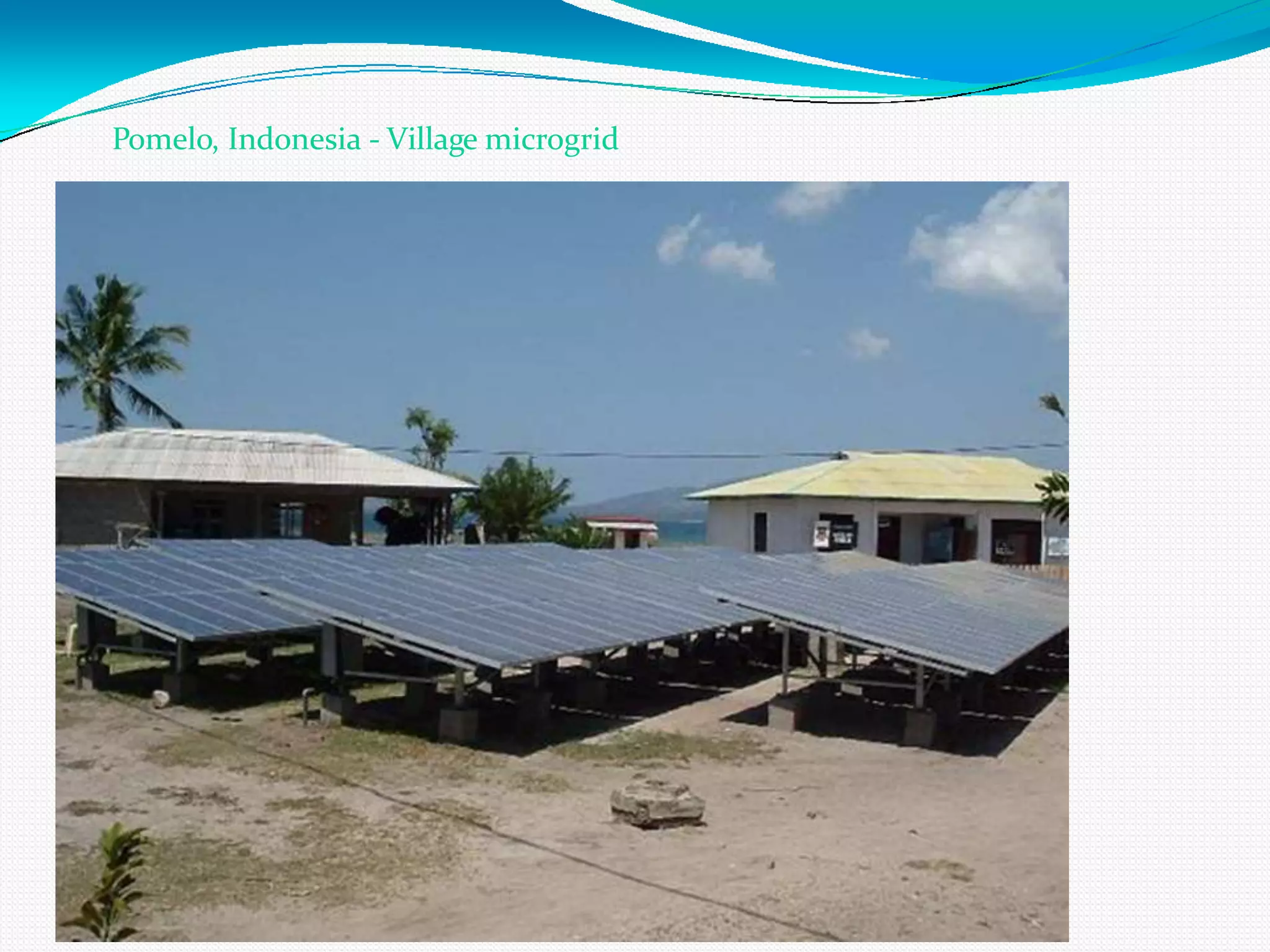
Pomelo, Indonesia - Village microgrid
Microgrid Operating Modes
 Grid Connected Mode:
 Utilitygrid is active.
 Static switch is closed
 All the feeders are being
supplied by utility grid.
Microgrid Operating Modes
 Island Mode:
 Utilitygrid is not supplying power
 Static switch is open.
 Feeder A, B, C are being supplied
by Microsources.
 Feeder D (not sensitive )
isdead.
Interconnected Microgrids
Interconnected Microgrids – Power Parks
 Practical sizeof Microgrids is limited toa few MVA.
 For larger loads, it is desirable to interconnect many
Microgrids to form a larger Microgrid network called
Power Parks.
 Theadvantages of this Microgrid structure insures
greaterstabilityand controllability forthe Power Parks.
Environmental Aspects
 Microgrid encourages the useof the renewable energy
sources.
 Large land use impactsare avoided.
 CO2 Emissionsare reduced.
Future Directions on Microgrid
Research
 To investigate full-scale development, field demonstration,
experimental performance evaluation of frequency and voltage control
methods under various operation modes.
 Transition between grid connected and islanded modes on interaction
phenomena between distribution generation and high penetration of
distributed generation.
 Transformation of Microgrid system today into the intelligent,
robust energy delivery system in the future by providing
significant reliability and security benefits.
The Need Of Microgrid
10
 Microgrid could be theanswer to ourenergycrisis.
 Transmission losses gets highly reduced.
 Microgrid results in substantial savings and cuts
emissions without majorchanges to lifestyles.
 Provide highqualityand reliableenergy supply to
critical loads
Conventional Grid vs. Microgrid
 Efficiencyof conventional grid isvery low as compared
to Microgrid.
 Large amount of energy in the form of heat is wasted in
conventional grid.
 Power sources in case of Microgrid (often referred toas
Microsources) are small and are located in close
proximityto load.
Advantages & Disadvantages
 Microgrid Advantages
 A majoradvantageof a Microgrid, is itsability, during a utility
grid disturbance, to separateand isolate itself from the utility
seamlesslywith littleor nodisruption to the loads within the
Microgrid.
 In peak load periods it prevents utilitygrid failure by
reducing the load on thegrid.
 Significantenvironmental benefits made possible by the use
of low orzeroemissiongenerators.
Advantages & Disadvantages
 Microgrid Advantages
 The useof both electricityand heat permitted by the
close proximityof thegenerator to the user, thereby
increasing theoverall energyefficiency.
 Microgrid can act to mitigate theelectricitycosts to its
users by generating some orall of its electricity needs.
Advantages & Disadvantages
 Microgrid Disadvantages
 Voltage, frequencyand powerqualityare three main
parametersthat must beconsidered and controlled to
acceptable standardswhilst the powerand energy balance is
maintained.
 Electrical energy needs to be stored in battery banks thus
requiring morespaceand maintenance.
 Resynchronizationwith the utilitygrid is difficult.
References
 A. A. Salam, A. Mohamed and M. A. Hannan. "TECHNICAL CHALLENGES
ON MICROGRIDS" (DECEMBER 2008)
http://www.arpnjournals.com/jeas/research_papers/rp_2008/jeas_1208_146.pdf
 S. Abu-Sharkha, R.J. Arnolde, J. Kohlerd, R. Lia, T. Markvarta, J.N. Rossb, K.
Steemersc, P. Wilsonb, R. Yaoc. "Can microgrids make a majorcontribution to
UK energysupply?" (September 2004)
http://eprints.ecs.soton.ac.uk/11276/1/Microgrids.pdf
 John Stevens. "Characterization of Microgrids in the United States", Sandia
National Laboratories (January 2005)
http://www.electricdistribution.ctc.com/pdfs/RDC_Microgrid_Whitepaper_1-7-05.pdf
 Robert H. Lasseter, Paolo Piagi. "Microgrid: A Conceptual Solution", University
of Wisconsin-Madison (June 2004)
http://www.pserc.wisc.edu/ecow/get/publicatio/2004public/lasseterpesc04us.pdf
Thank You

PPT IS ON MICROGRID

  • 1.
    TECHNICAL SEMINAR Topic :Microgrid Made by PEDIREDLA SANJAY KUMAR 18981A0241 UNDER THE GUIDANCE OF Dr. T.SATYANARAYANA (Assistant Professor)
  • 2.
    Outline  Introduction toMicrogrid.  Microgrid Operating Modes.  The Need of Microgrid.  Interconnected Microgrids – Power Parks.  Environmental Aspects.  Conventional Grid versus Microgrid.  Advantages & Disadvantagesof Microgrid.  Future Directions on Microgrid Research.  References.
  • 3.
    Introduction To Microgrid Microgrid Components  Distributed Generation  Loads  Immediatestorage  Controller  Point of Common Coupling
  • 4.
    Introduction To Microgrid What is Microgrid?  It isasmall-scale power supply network that is designed to provide power fora small community.  Itenables local powergeneration for local loads.  Itcomprises of varioussmall powergenerating sources that makes it highly f lexibleand efficient.
  • 5.
    Introduction To Microgrid What is Microgrid?  It isconnected to both the local generating unitsand the utilitygrid thus preventing poweroutages.  Excess powercan be sold to the utilitygrid.  Sizeof the Microgrid may range from housing estate to municipal regions.
  • 6.
  • 7.
  • 8.
    Microgrid Operating Modes Grid Connected Mode:  Utilitygrid is active.  Static switch is closed  All the feeders are being supplied by utility grid.
  • 9.
    Microgrid Operating Modes Island Mode:  Utilitygrid is not supplying power  Static switch is open.  Feeder A, B, C are being supplied by Microsources.  Feeder D (not sensitive ) isdead.
  • 10.
    Interconnected Microgrids Interconnected Microgrids– Power Parks  Practical sizeof Microgrids is limited toa few MVA.  For larger loads, it is desirable to interconnect many Microgrids to form a larger Microgrid network called Power Parks.  Theadvantages of this Microgrid structure insures greaterstabilityand controllability forthe Power Parks.
  • 11.
    Environmental Aspects  Microgridencourages the useof the renewable energy sources.  Large land use impactsare avoided.  CO2 Emissionsare reduced.
  • 12.
    Future Directions onMicrogrid Research  To investigate full-scale development, field demonstration, experimental performance evaluation of frequency and voltage control methods under various operation modes.  Transition between grid connected and islanded modes on interaction phenomena between distribution generation and high penetration of distributed generation.  Transformation of Microgrid system today into the intelligent, robust energy delivery system in the future by providing significant reliability and security benefits.
  • 13.
    The Need OfMicrogrid 10  Microgrid could be theanswer to ourenergycrisis.  Transmission losses gets highly reduced.  Microgrid results in substantial savings and cuts emissions without majorchanges to lifestyles.  Provide highqualityand reliableenergy supply to critical loads
  • 14.
    Conventional Grid vs.Microgrid  Efficiencyof conventional grid isvery low as compared to Microgrid.  Large amount of energy in the form of heat is wasted in conventional grid.  Power sources in case of Microgrid (often referred toas Microsources) are small and are located in close proximityto load.
  • 15.
    Advantages & Disadvantages Microgrid Advantages  A majoradvantageof a Microgrid, is itsability, during a utility grid disturbance, to separateand isolate itself from the utility seamlesslywith littleor nodisruption to the loads within the Microgrid.  In peak load periods it prevents utilitygrid failure by reducing the load on thegrid.  Significantenvironmental benefits made possible by the use of low orzeroemissiongenerators.
  • 16.
    Advantages & Disadvantages Microgrid Advantages  The useof both electricityand heat permitted by the close proximityof thegenerator to the user, thereby increasing theoverall energyefficiency.  Microgrid can act to mitigate theelectricitycosts to its users by generating some orall of its electricity needs.
  • 17.
    Advantages & Disadvantages Microgrid Disadvantages  Voltage, frequencyand powerqualityare three main parametersthat must beconsidered and controlled to acceptable standardswhilst the powerand energy balance is maintained.  Electrical energy needs to be stored in battery banks thus requiring morespaceand maintenance.  Resynchronizationwith the utilitygrid is difficult.
  • 18.
    References  A. A.Salam, A. Mohamed and M. A. Hannan. "TECHNICAL CHALLENGES ON MICROGRIDS" (DECEMBER 2008) http://www.arpnjournals.com/jeas/research_papers/rp_2008/jeas_1208_146.pdf  S. Abu-Sharkha, R.J. Arnolde, J. Kohlerd, R. Lia, T. Markvarta, J.N. Rossb, K. Steemersc, P. Wilsonb, R. Yaoc. "Can microgrids make a majorcontribution to UK energysupply?" (September 2004) http://eprints.ecs.soton.ac.uk/11276/1/Microgrids.pdf  John Stevens. "Characterization of Microgrids in the United States", Sandia National Laboratories (January 2005) http://www.electricdistribution.ctc.com/pdfs/RDC_Microgrid_Whitepaper_1-7-05.pdf  Robert H. Lasseter, Paolo Piagi. "Microgrid: A Conceptual Solution", University of Wisconsin-Madison (June 2004) http://www.pserc.wisc.edu/ecow/get/publicatio/2004public/lasseterpesc04us.pdf
  • 19.