Muhammad Sarmad 0026-BSEE-2015
Muhammad Nadeem 0011-BSEE-2015
Muhammad Salman 0014-BSEE-2015
Touseef Ahmed 0009-BSEE-2015
8/25/2009 1
 Outline
04/26/2018 2
Introduction to Microgrid.
Microgrid Operating Modes.
The Need ofMicrogrid.
Interconnected Microgrid
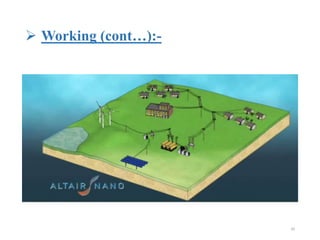
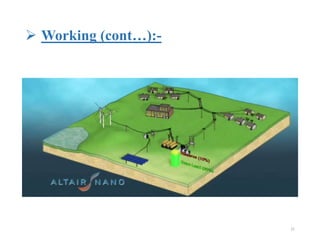
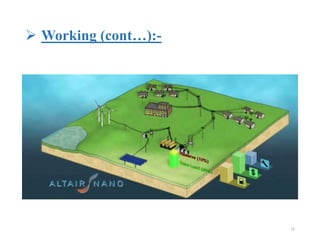
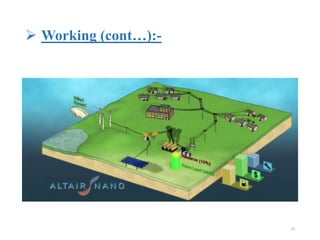
Working of Microgrid.
Environmental Aspects.
Conventional Grid versus Microgrid.
Advantages &Disadvantages of Micro grid.
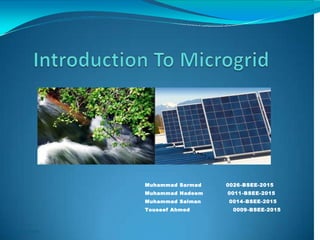
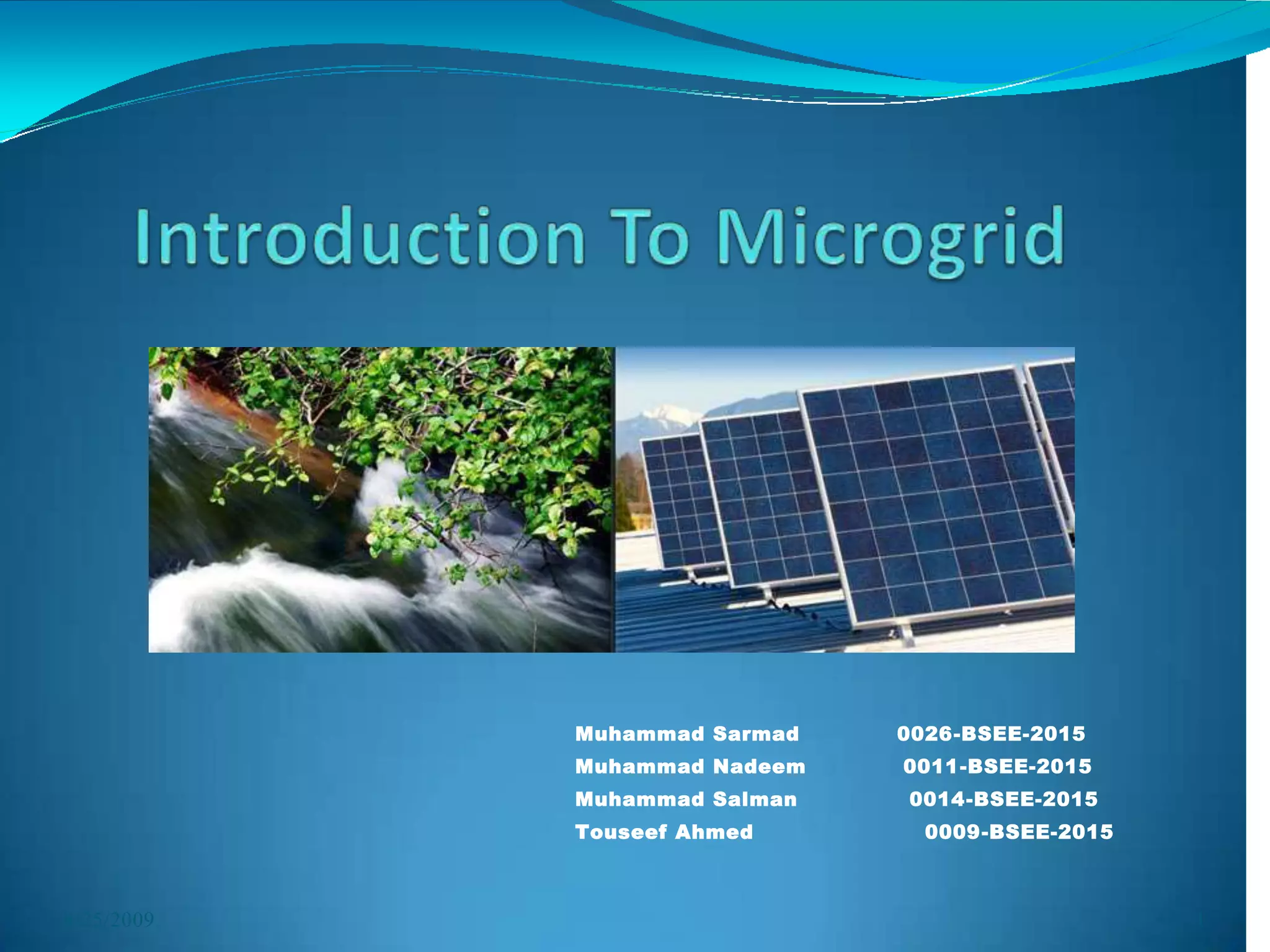
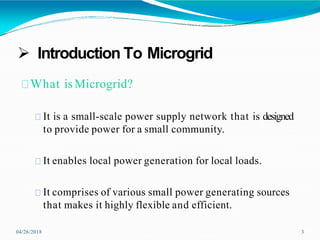
 Introduction To Microgrid
04/26/2018 3
What isMicrogrid?
It is a small-scale power supply network that is designed
to provide power for a small community.
It enables local power generation for local loads.
It comprises of various small power generating sources
that makes it highly flexible and efficient.
 Introduction To Microgrid
04/26/2018 4
What isMicrogrid?
It is connected to both the local generating units and the
utility grid thus preventing power outages.
Excess power can be sold to the utility grid.
Size of the Microgrid may range from housing estate to
municipal regions.
 Introduction To Microgrid
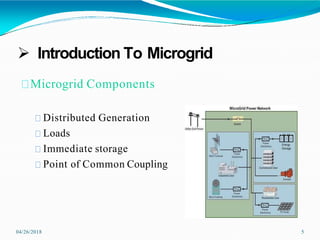
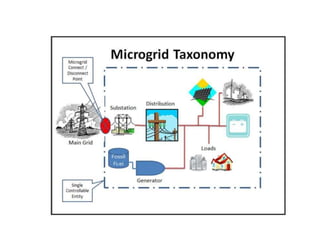
Microgrid Components
Distributed Generation
Loads
Immediate storage
Point of Common Coupling
04/26/2018 5
6
 Microgrid Operating Modes
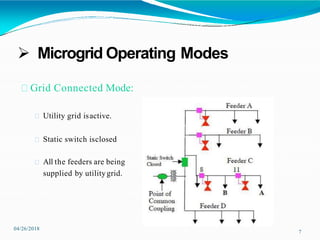
Grid Connected Mode:
Utility grid isactive.
Static switch isclosed
All the feeders are being
supplied by utilitygrid.
04/26/2018
7
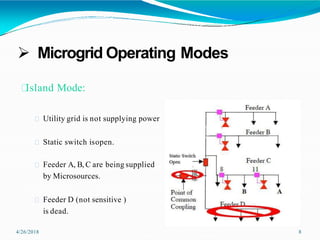
 Microgrid Operating Modes
Island Mode:
Utility grid is not supplying power
Static switch isopen.
Feeder A, B, C are being supplied
by Microsources.
Feeder D (not sensitive )
is dead.
4/26/2018 8
 The Need Of Microgrid
04/26/2018 9
Microgrid could be the answer to our energy crisis.
Transmission losses gets highly reduced.
Microgrid results in substantial savings and cuts
emissions without major changes to lifestyles.
Provide high quality and reliable energy supply to
critical loads
 Basic Components in Micro grids
• There are four main components of microgrids
 Local Generation
Consumption or Loads
Energy Storage
Point of common coupling (PCC)
10
 Basic Components in Micro grids
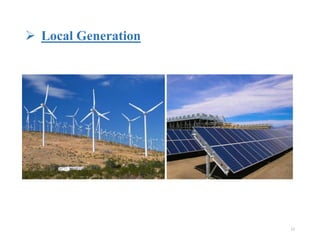
1):- Local generation
It presents various types of generation source that feed
electricity to user. These sources are divided into two major
groups – thermal energy sources (ex. Diesel generators) and
renewable generation sources (e.g. wind turbines, solar).
11
 Local Generation
12
 Basic components in microgrids
(cont…)
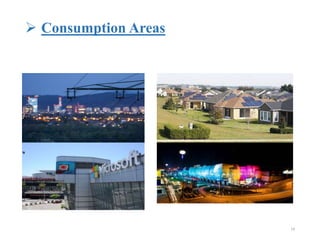
2):- Consumption or Loads
It simply refers to elements that consume electricity which
range from single devices to lighting, heating system of
buildings, commercial centers, etc. In the case of controllable
loads, the electricity consumption can be modified in demand
of the network.
13
 Consumption Areas
14
 Basic components in microgrids (cont…)
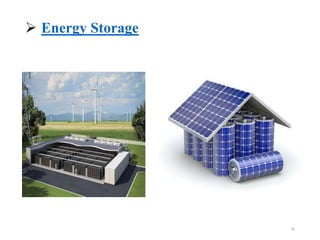
3):- Energy Storage
In microgrid, energy storage is able to perform multiple
functions, such as ensuring power quality, including frequency
and voltage regulation, smoothing the output of renewable
energy sources, providing backup power for the system and
playing crucial role in cost optimization. It includes all of
electrical, pressure, gravitational, flywheel, and heat storage
technologies
15
 Energy Storage
16
 Basic components in microgrids
(cont…)
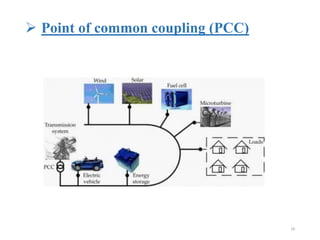
4):- Point of common coupling (PCC)
It is the point in the electric circuit where a microgrid is
connected to a main grid. Microgrids that do not have a PCC
are called isolated microgrids which are usually presented in
the case of remote sites (e.g., remote communities or remote
industrial sites) where an interconnection with the main grid
is not feasible due to either technical and/or economic
constraints.
17
 Point of common coupling (PCC)
18
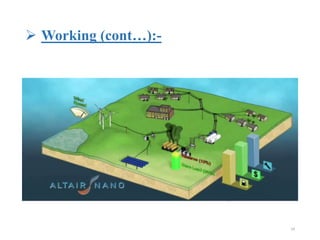
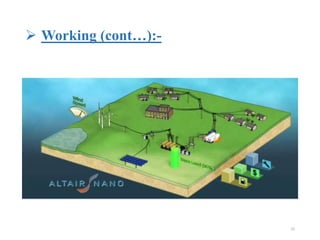
 Working:-
19
 Working (cont…):-
20
 Working (cont…):-
21
 Working (cont…):-
22
 Working (cont…):-
23
 Working (cont…):-
24
 Working (cont…):-
25
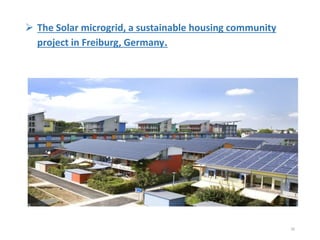
 The Solar microgrid, a sustainable housing community
project in Freiburg, Germany.
26
 Environmental Aspects
04/26/2018 27
Microgrid encourages the use of the renewable energy
sources.
Large land use impacts are avoided.
CO2 Emissions are reduced.
 Interconnected Microgrids
04/26/2018 28
Interconnected Microgrids – Power Parks
Practical size of Microgrids is limited to a few MVA.
For larger loads, it is desirable to interconnect many
Microgrids to form a larger Microgrid network called
PowerParks.
The advantages of this Microgrid structure insures
greater stability and controllability for the PowerParks.
 Conventional Grid vs. Microgrid
04/26/2018 29
Efficiency of conventional grid is very low as compared
to Microgrid.
Large amount of energy in the form of heat is wasted in
conventional grid.
Power sources in case of Microgrid (often referred to as
Microsources) are small and are located in close
proximity to load.
 Advantages & Disadvantages
04/26/2018 30
Microgrid Advantages
Amajor advantage of a Microgrid, is its ability, during a utility
grid disturbance, to separate and isolate itself from the utility
seamlessly with little or no disruption to the loads within the
Microgrid.
In peak load periods it prevents utility grid failure by
reducing the load on the grid.
Significant environmental benefits made possible by the use
of low or zero emission generators.
 Advantages & Disadvantages
04/26/2018 31
Microgrid Advantages
The use of both electricity and heat permitted by the
close proximity of the generator to the user, thereby
increasing the overall energy efficiency.
Microgrid can act to mitigate the electricity costs to its
users by generating some or all of its electricity needs.
 Advantages & Disadvantages
04/26/2018 32
Microgrid Disadvantages
Voltage, frequency and power quality are three main
parameters that must be considered and controlled to
acceptable standards whilst the power and energy balance is
maintained.
Electrical energy needs to be stored in battery banks thus
requiring more space and maintenance.
Resynchronization with the utility grid is difficult.
 Advantages & Disadvantages
04/26/2018 33
Microgrid Disadvantages
Microgrid protection is one of the most important challenges
facing the implementationof Microgrids.
Issues such as standby charges and net metering may pose
obstacles for Microgrid.
Interconnection standards needs to be developed to ensure
consistency. IEEEP1547,a standard proposed by Institute
of Electrical and ElectronicsEngineersmay end up filling
the void.
 Future Directions on Microgrid
Research
04/26/2018 34
To investigate full-scale development, field demonstration,
experimental performance evaluation of frequency and voltage control
methods under various operation modes.
Transition between grid connected and islanded modes on interaction
phenomena between distribution generation and high penetration of
distributed generation.
Transformation of Microgrid system today into the intelligent,
robust energy delivery system in the future by providing
significant reliability and security benefits.
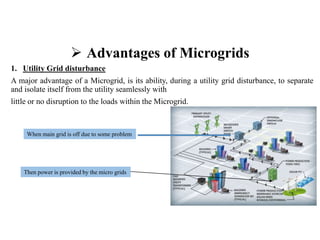
 Advantages of Microgrids
1. Utility Grid disturbance
A major advantage of a Microgrid, is its ability, during a utility grid disturbance, to separate
and isolate itself from the utility seamlessly with
little or no disruption to the loads within the Microgrid.
When main grid is off due to some problem
Then power is provided by the micro grids
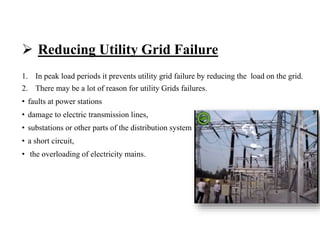
 Reducing Utility Grid Failure
1. In peak load periods it prevents utility grid failure by reducing the load on the grid.
2. There may be a lot of reason for utility Grids failures.
• faults at power stations
• damage to electric transmission lines,
• substations or other parts of the distribution system
• a short circuit,
• the overloading of electricity mains.
 Environmental Factors
• Significant environmental benefits made possible by the use of low or
zero emission generators.
• In microgrids we use renewable source of energy for example wind,
water, and solar energy sources which produce less pollution as compared
to other sources and also these sources are more efficient.
 Energy efficiency
• The use of both electricity and heat permitted by the close proximity
of the generator to the user, thereby increasing the overall energy
efficiency.
• As the load is located not too far away from the generation station so
Due to which energy losses are reduced and
overall energy efficiency is increased.
Microgrid
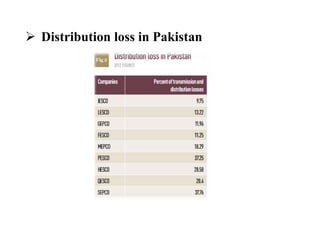
 Distribution loss in Pakistan
 Reduce Electricity Cost
• Microgrid can act to mitigate(reduce) the electricity costs to its users
by generating some or all of its electricity needs.
• According to the US Energy Information Administration reported in
October that microgrid can reduce cost up to 20 to 40%.
 Types Of Microgrid ( Basis on Interface )
Microgrids are categorized most broadly by their grid interface, of
which there are two choices. A microgrid is either grid connected or
remote (not linked to the grid).
1. Remote Micro Grid
2. Grid connected Micro Grid
 Remote Microgrid
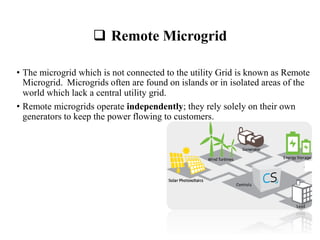
• The microgrid which is not connected to the utility Grid is known as Remote
Microgrid. Microgrids often are found on islands or in isolated areas of the
world which lack a central utility grid.
• Remote microgrids operate independently; they rely solely on their own
generators to keep the power flowing to customers.
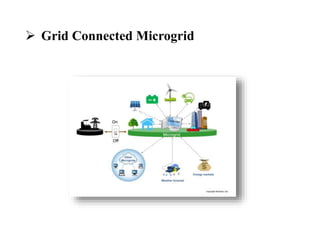
 Grid-connected Microgrids
Grid-connected Microgrids can work with a central grid. They have the
choice of taking service from the grid or using their own internal
generators to serve their customers. Advance microgrids have its own
control system, which control it function.
Control system “decides” at any given moment which energy source is
most advantageous, given moment-to-moment change in electricity
pricing, resource availability (e.g. Is the sun shining on solar panels?)
and other factors. These decisions are based on programming priorities
set by the microgrid owner.
 Grid Connected Microgrid
 Campus /Institutional Microgrids
• The focus of campus microgrids is aggregating existing on-site
generation with multiple loads that located in tight geography in
which owner easily manage them.
• The institute can be a hospital , school, or a university. The main
purpose of the campus microgrid to provide the power to its area.
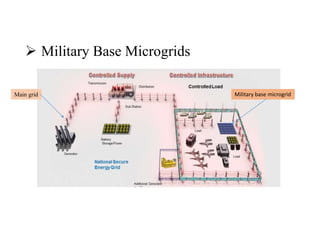
 Military Base Microgrids
• Military bases require reliable and resilient power to accommodate a
variety of missions. From training to research and
development, energy security is vital for DOD facilities worldwide.
• Military base microgrids are design to provide power to the military
bases for security purposes, without relying on the main grid.
• Furthermore, the military can enhance security against the threat of
grid outages from extreme weather or cyberattacks
 Military Base Microgrids
Main grid Military base microgrid
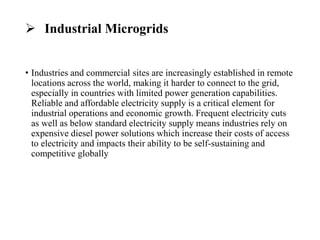
 Industrial Microgrids
• Industries and commercial sites are increasingly established in remote
locations across the world, making it harder to connect to the grid,
especially in countries with limited power generation capabilities.
Reliable and affordable electricity supply is a critical element for
industrial operations and economic growth. Frequent electricity cuts
as well as below standard electricity supply means industries rely on
expensive diesel power solutions which increase their costs of access
to electricity and impacts their ability to be self-sustaining and
competitive globally
Overview of Microgrid
References
04/26/2018 50
A. A. Salam, A. Mohamed and M. A. Hannan. "TECHNICALCHALLENGES
ON MICROGRIDS" (DECEMBER 2008)
http://www.arpnjournals.com/jeas/research_papers/rp_2008/jeas_1208_146.pdf
S. Abu-Sharkha, R.J. Arnolde, J. Kohlerd, R. Lia, T. Markvarta, J.N. Rossb, K.
Steemersc, P. Wilsonb, R. Yaoc. "Can microgrids make a major contribution to
UK energy supply?" (September2004)
http://eprints.ecs.soton.ac.uk/11276/1/Microgrids.pdf
John Stevens. "Characterization of Microgrids in the United States", Sandia
National Laboratories (January 2005)
http://www.electricdistribution.ctc.com/pdfs/RDC_Microgrid_Whitepaper_1-7-05.pdf
Robert H. Lasseter, Paolo Piagi. "Microgrid: AConceptual Solution",University
of Wisconsin-Madison (June 2004)
http://www.pserc.wisc.edu/ecow/get/publicatio/2004public/lasseterpesc04us.pdf
References
04/26/2018 51
"Integration of Distributed Energy Resources - The CERTS MicroGrid
Concept", Consultant Report (October 2003)
http://www.pserc.org/cgi-
pserc/getbig/researchdo/certsdocum0/certspubli/certsmicrogridwhitepaper.pdf
"Why the Microgrid Could Be the Answer to Our Energy Crisis"
http://www.fastcompany.com/magazine/137/beyond-the-grid.html
"How a MicrogridWorks"
http://science.howstuffworks.com/microgrid.htm
“The Rise of MicroGrid PowerNetworks"
http://www.sustainablefacility.com/Articles/Feature_Article/58905d08bd629010VgnVC
M100000f932a8c0
Micro grid

Micro grid

  • 1.
    Muhammad Sarmad 0026-BSEE-2015 MuhammadNadeem 0011-BSEE-2015 Muhammad Salman 0014-BSEE-2015 Touseef Ahmed 0009-BSEE-2015 8/25/2009 1
  • 2.
     Outline 04/26/2018 2 Introductionto Microgrid. Microgrid Operating Modes. The Need ofMicrogrid. Interconnected Microgrid Working of Microgrid. Environmental Aspects. Conventional Grid versus Microgrid. Advantages &Disadvantages of Micro grid.
  • 3.
     Introduction ToMicrogrid 04/26/2018 3 What isMicrogrid? It is a small-scale power supply network that is designed to provide power for a small community. It enables local power generation for local loads. It comprises of various small power generating sources that makes it highly flexible and efficient.
  • 4.
     Introduction ToMicrogrid 04/26/2018 4 What isMicrogrid? It is connected to both the local generating units and the utility grid thus preventing power outages. Excess power can be sold to the utility grid. Size of the Microgrid may range from housing estate to municipal regions.
  • 5.
     Introduction ToMicrogrid Microgrid Components Distributed Generation Loads Immediate storage Point of Common Coupling 04/26/2018 5
  • 6.
  • 7.
     Microgrid OperatingModes Grid Connected Mode: Utility grid isactive. Static switch isclosed All the feeders are being supplied by utilitygrid. 04/26/2018 7
  • 8.
     Microgrid OperatingModes Island Mode: Utility grid is not supplying power Static switch isopen. Feeder A, B, C are being supplied by Microsources. Feeder D (not sensitive ) is dead. 4/26/2018 8
  • 9.
     The NeedOf Microgrid 04/26/2018 9 Microgrid could be the answer to our energy crisis. Transmission losses gets highly reduced. Microgrid results in substantial savings and cuts emissions without major changes to lifestyles. Provide high quality and reliable energy supply to critical loads
  • 10.
     Basic Componentsin Micro grids • There are four main components of microgrids  Local Generation Consumption or Loads Energy Storage Point of common coupling (PCC) 10
  • 11.
     Basic Componentsin Micro grids 1):- Local generation It presents various types of generation source that feed electricity to user. These sources are divided into two major groups – thermal energy sources (ex. Diesel generators) and renewable generation sources (e.g. wind turbines, solar). 11
  • 12.
  • 13.
     Basic componentsin microgrids (cont…) 2):- Consumption or Loads It simply refers to elements that consume electricity which range from single devices to lighting, heating system of buildings, commercial centers, etc. In the case of controllable loads, the electricity consumption can be modified in demand of the network. 13
  • 14.
  • 15.
     Basic componentsin microgrids (cont…) 3):- Energy Storage In microgrid, energy storage is able to perform multiple functions, such as ensuring power quality, including frequency and voltage regulation, smoothing the output of renewable energy sources, providing backup power for the system and playing crucial role in cost optimization. It includes all of electrical, pressure, gravitational, flywheel, and heat storage technologies 15
  • 16.
  • 17.
     Basic componentsin microgrids (cont…) 4):- Point of common coupling (PCC) It is the point in the electric circuit where a microgrid is connected to a main grid. Microgrids that do not have a PCC are called isolated microgrids which are usually presented in the case of remote sites (e.g., remote communities or remote industrial sites) where an interconnection with the main grid is not feasible due to either technical and/or economic constraints. 17
  • 18.
     Point ofcommon coupling (PCC) 18
  • 19.
  • 20.
  • 21.
  • 22.
  • 23.
  • 24.
  • 25.
  • 26.
     The Solarmicrogrid, a sustainable housing community project in Freiburg, Germany. 26
  • 27.
     Environmental Aspects 04/26/201827 Microgrid encourages the use of the renewable energy sources. Large land use impacts are avoided. CO2 Emissions are reduced.
  • 28.
     Interconnected Microgrids 04/26/201828 Interconnected Microgrids – Power Parks Practical size of Microgrids is limited to a few MVA. For larger loads, it is desirable to interconnect many Microgrids to form a larger Microgrid network called PowerParks. The advantages of this Microgrid structure insures greater stability and controllability for the PowerParks.
  • 29.
     Conventional Gridvs. Microgrid 04/26/2018 29 Efficiency of conventional grid is very low as compared to Microgrid. Large amount of energy in the form of heat is wasted in conventional grid. Power sources in case of Microgrid (often referred to as Microsources) are small and are located in close proximity to load.
  • 30.
     Advantages &Disadvantages 04/26/2018 30 Microgrid Advantages Amajor advantage of a Microgrid, is its ability, during a utility grid disturbance, to separate and isolate itself from the utility seamlessly with little or no disruption to the loads within the Microgrid. In peak load periods it prevents utility grid failure by reducing the load on the grid. Significant environmental benefits made possible by the use of low or zero emission generators.
  • 31.
     Advantages &Disadvantages 04/26/2018 31 Microgrid Advantages The use of both electricity and heat permitted by the close proximity of the generator to the user, thereby increasing the overall energy efficiency. Microgrid can act to mitigate the electricity costs to its users by generating some or all of its electricity needs.
  • 32.
     Advantages &Disadvantages 04/26/2018 32 Microgrid Disadvantages Voltage, frequency and power quality are three main parameters that must be considered and controlled to acceptable standards whilst the power and energy balance is maintained. Electrical energy needs to be stored in battery banks thus requiring more space and maintenance. Resynchronization with the utility grid is difficult.
  • 33.
     Advantages &Disadvantages 04/26/2018 33 Microgrid Disadvantages Microgrid protection is one of the most important challenges facing the implementationof Microgrids. Issues such as standby charges and net metering may pose obstacles for Microgrid. Interconnection standards needs to be developed to ensure consistency. IEEEP1547,a standard proposed by Institute of Electrical and ElectronicsEngineersmay end up filling the void.
  • 34.
     Future Directionson Microgrid Research 04/26/2018 34 To investigate full-scale development, field demonstration, experimental performance evaluation of frequency and voltage control methods under various operation modes. Transition between grid connected and islanded modes on interaction phenomena between distribution generation and high penetration of distributed generation. Transformation of Microgrid system today into the intelligent, robust energy delivery system in the future by providing significant reliability and security benefits.
  • 35.
     Advantages ofMicrogrids 1. Utility Grid disturbance A major advantage of a Microgrid, is its ability, during a utility grid disturbance, to separate and isolate itself from the utility seamlessly with little or no disruption to the loads within the Microgrid. When main grid is off due to some problem Then power is provided by the micro grids
  • 36.
     Reducing UtilityGrid Failure 1. In peak load periods it prevents utility grid failure by reducing the load on the grid. 2. There may be a lot of reason for utility Grids failures. • faults at power stations • damage to electric transmission lines, • substations or other parts of the distribution system • a short circuit, • the overloading of electricity mains.
  • 37.
     Environmental Factors •Significant environmental benefits made possible by the use of low or zero emission generators. • In microgrids we use renewable source of energy for example wind, water, and solar energy sources which produce less pollution as compared to other sources and also these sources are more efficient.
  • 38.
     Energy efficiency •The use of both electricity and heat permitted by the close proximity of the generator to the user, thereby increasing the overall energy efficiency. • As the load is located not too far away from the generation station so Due to which energy losses are reduced and overall energy efficiency is increased. Microgrid
  • 39.
  • 40.
     Reduce ElectricityCost • Microgrid can act to mitigate(reduce) the electricity costs to its users by generating some or all of its electricity needs. • According to the US Energy Information Administration reported in October that microgrid can reduce cost up to 20 to 40%.
  • 41.
     Types OfMicrogrid ( Basis on Interface ) Microgrids are categorized most broadly by their grid interface, of which there are two choices. A microgrid is either grid connected or remote (not linked to the grid). 1. Remote Micro Grid 2. Grid connected Micro Grid
  • 42.
     Remote Microgrid •The microgrid which is not connected to the utility Grid is known as Remote Microgrid. Microgrids often are found on islands or in isolated areas of the world which lack a central utility grid. • Remote microgrids operate independently; they rely solely on their own generators to keep the power flowing to customers.
  • 43.
     Grid-connected Microgrids Grid-connectedMicrogrids can work with a central grid. They have the choice of taking service from the grid or using their own internal generators to serve their customers. Advance microgrids have its own control system, which control it function. Control system “decides” at any given moment which energy source is most advantageous, given moment-to-moment change in electricity pricing, resource availability (e.g. Is the sun shining on solar panels?) and other factors. These decisions are based on programming priorities set by the microgrid owner.
  • 44.
  • 45.
     Campus /InstitutionalMicrogrids • The focus of campus microgrids is aggregating existing on-site generation with multiple loads that located in tight geography in which owner easily manage them. • The institute can be a hospital , school, or a university. The main purpose of the campus microgrid to provide the power to its area.
  • 46.
     Military BaseMicrogrids • Military bases require reliable and resilient power to accommodate a variety of missions. From training to research and development, energy security is vital for DOD facilities worldwide. • Military base microgrids are design to provide power to the military bases for security purposes, without relying on the main grid. • Furthermore, the military can enhance security against the threat of grid outages from extreme weather or cyberattacks
  • 47.
     Military BaseMicrogrids Main grid Military base microgrid
  • 48.
     Industrial Microgrids •Industries and commercial sites are increasingly established in remote locations across the world, making it harder to connect to the grid, especially in countries with limited power generation capabilities. Reliable and affordable electricity supply is a critical element for industrial operations and economic growth. Frequent electricity cuts as well as below standard electricity supply means industries rely on expensive diesel power solutions which increase their costs of access to electricity and impacts their ability to be self-sustaining and competitive globally
  • 49.
  • 50.
    References 04/26/2018 50 A. A.Salam, A. Mohamed and M. A. Hannan. "TECHNICALCHALLENGES ON MICROGRIDS" (DECEMBER 2008) http://www.arpnjournals.com/jeas/research_papers/rp_2008/jeas_1208_146.pdf S. Abu-Sharkha, R.J. Arnolde, J. Kohlerd, R. Lia, T. Markvarta, J.N. Rossb, K. Steemersc, P. Wilsonb, R. Yaoc. "Can microgrids make a major contribution to UK energy supply?" (September2004) http://eprints.ecs.soton.ac.uk/11276/1/Microgrids.pdf John Stevens. "Characterization of Microgrids in the United States", Sandia National Laboratories (January 2005) http://www.electricdistribution.ctc.com/pdfs/RDC_Microgrid_Whitepaper_1-7-05.pdf Robert H. Lasseter, Paolo Piagi. "Microgrid: AConceptual Solution",University of Wisconsin-Madison (June 2004) http://www.pserc.wisc.edu/ecow/get/publicatio/2004public/lasseterpesc04us.pdf
  • 51.
    References 04/26/2018 51 "Integration ofDistributed Energy Resources - The CERTS MicroGrid Concept", Consultant Report (October 2003) http://www.pserc.org/cgi- pserc/getbig/researchdo/certsdocum0/certspubli/certsmicrogridwhitepaper.pdf "Why the Microgrid Could Be the Answer to Our Energy Crisis" http://www.fastcompany.com/magazine/137/beyond-the-grid.html "How a MicrogridWorks" http://science.howstuffworks.com/microgrid.htm “The Rise of MicroGrid PowerNetworks" http://www.sustainablefacility.com/Articles/Feature_Article/58905d08bd629010VgnVC M100000f932a8c0