POWER GENERATION MADE SMART
PRESENTED BY:
MUNEEB AMIN KHAN
ROLL NO. 253/15
UNDER THE GUIDANCE OF:
MR. VIKAS SHARMA
Mahant Bachitttar Singh College of Engineering and Technology, Jammu
• Introduction to Microgrid.
• The Need of Microgrid.
• Microgrid Operating Modes.
• Conventional Grid versus Microgrid.
• Interconnected Microgrids – Power Parks.
• Environmental Aspects.
• DC Microgrid.
• Advantages & Disadvantages of Microgrid.
• Future Directions on Microgrid Research.
Outline
Mahant Bachitttar Singh College of Engineering and Technology, Jammu
INTRODUCTION TO MICROGRID
 What is Microgrid?
 It is a small-scale power supply network that is designed
to provide power for a small community.
 It enables local power generation for local loads.
 It comprises of various small power generating sources
that makes it highly flexible and efficient.
Mahant Bachitttar Singh College of Engineering and Technology, Jammu
INTRODUCTION TO MICROGRID
 What is Microgrid?
 It is connected to both the local generating units and the
utility grid thus preventing power outages.
 Excess power can be sold to the utility grid.
 Size of the Microgrid may range from housing estate to
municipal regions.
Mahant Bachitttar Singh College of Engineering and Technology, Jammu
INTRODUCTION TO MICROGRID
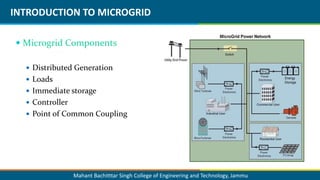
 Microgrid Components
 Distributed Generation
 Loads
 Immediate storage
 Controller
 Point of Common Coupling
Mahant Bachitttar Singh College of Engineering and Technology, Jammu
The Need Of Microgrid
 Microgrid could be the answer to our energy crisis.
 Transmission losses gets highly reduced.
 Microgrid results in substantial savings and cuts
emissions without major changes to lifestyle.
 Provide high quality and reliable energy supply to
critical loads.
Mahant Bachitttar Singh College of Engineering and Technology, Jammu
OPERATING MODES
 Grid Connected Mode:
 In this mode the microgrid works in integration
with utility grid.
 The two grids are connected at the point of
common coupling with the help of either a
circuit breaker or a static switch or a power
electronic interface.
 All the feeders are being supplied by utility grid.
Mahant Bachitttar Singh College of Engineering and Technology, Jammu
OPERATING MODES
 Island Mode:
 In this the microgrid works alone on its own
resources either intentionally or due to failure of
main grid. However special attention is required
when transition takes place from one to other
mode due to transients.
 Utility grid is not supplying power
Mahant Bachitttar Singh College of Engineering and Technology, Jammu
CONVENTIONAL GRID VS. MICROGRID
 Efficiency of conventional grid is very low as compared
to Microgrid.
 Large amount of energy in the form of heat is wasted in
conventional grid.
 Power sources in case of Microgrid (often referred to as
Microsources) are small and are located in close
proximity to load.
Mahant Bachitttar Singh College of Engineering and Technology, Jammu
INTERCONNECTED MICROGRIDS
Interconnected Microgrids – Power Parks
 Practical size of Microgrids is limited to a few MVA.
 For larger loads, it is desirable to interconnect many
Microgrids to form a larger Microgrid network called
Power Parks.
 The advantages of this Microgrid structure insures
greater stability and controllability for the Power Parks.
Mahant Bachitttar Singh College of Engineering and Technology, Jammu
ENVIRONMENTAL ASPECTS
 Microgrid encourages the use of the renewable energy
sources.
 Large land use impacts are avoided.
 CO2 Emissions are reduced.
Mahant Bachitttar Singh College of Engineering and Technology, Jammu
• Microgrids have a long history. In fact, Thomas Edison’s first power plant constructed
in 1882 – the Manhattan Pearl Street Station – was essentially a microgrid since our
centralized grid was not yet established. By 1886, Edison’s firm had installed 58
Direct Current (DC) microgrids.
• Direct Current (DC) electricity locally generated by renewable energy sources such
as solar panels, windmills used with a minimum conversion (DC to AC or AC to DC)
and minimum transmission can reduce energy losses by as much as 30% or more
energy.
• Microgrids enable significant energy savings and the simple integration of advanced
power generation technologies.
DC MICROGRID
Mahant Bachitttar Singh College of Engineering and Technology, Jammu
DC MICROGRID
Mahant Bachitttar Singh College of Engineering and Technology, Jammu
DC MICROGRID
Mahant Bachitttar Singh College of Engineering and Technology, Jammu
ADVANTAGES AND DISADVANTAGES
 Microgrid Advantages
 Energy efficiency
 Minimization of the overall energy consumption.
 Improved environmental impact.
 Improvement of energy system reliability and resilience.
 Network benefits.
 Cost efficient electricity infrastructure replacement
strategies
Mahant Bachitttar Singh College of Engineering and Technology, Jammu
ADVANTAGES AND DISADVANTAGES
 Microgrid Disadvantages
 Microgrid protection is one of the most important challenges
facing the implementation of Microgrids.
 Issues such as standby charges and net metering may pose
obstacles for Microgrid.
 Interconnection standards needs to be developed to ensure
consistency. IEEE P1547, a standard proposed by Institute
of Electrical and Electronics Engineers may end up filling
the void.
Mahant Bachitttar Singh College of Engineering and Technology, Jammu
• In the near future when cost of Microgrid system will be
affordable then Microgrids will become more popular and
conventional grid will be replaced by Micro grid.
• Research are going such as to increase stability and reliability
of the Microgrid for effective working.
FUTURE SCOPE
Mahant Bachitttar Singh College of Engineering and Technology, Jammu
• Microgrid systems facilitate remote applications and allow
access to pollution-free energy.
• They give impetus to the use of renewable sources of
energy.
• Moreover, in the event of a power grid failure, a microgrid is
one of the best alternatives.
• Microgrid research fits very well with ongoing smart grid
activities throughout the world, and several challenges need
to be overcome before it becomes a reality.
CONCLUSION
Mahant Bachitttar Singh College of Engineering and Technology, Jammu
THANK YOU

Microgrids

  • 1.
    POWER GENERATION MADESMART PRESENTED BY: MUNEEB AMIN KHAN ROLL NO. 253/15 UNDER THE GUIDANCE OF: MR. VIKAS SHARMA
  • 2.
    Mahant Bachitttar SinghCollege of Engineering and Technology, Jammu • Introduction to Microgrid. • The Need of Microgrid. • Microgrid Operating Modes. • Conventional Grid versus Microgrid. • Interconnected Microgrids – Power Parks. • Environmental Aspects. • DC Microgrid. • Advantages & Disadvantages of Microgrid. • Future Directions on Microgrid Research. Outline
  • 3.
    Mahant Bachitttar SinghCollege of Engineering and Technology, Jammu INTRODUCTION TO MICROGRID  What is Microgrid?  It is a small-scale power supply network that is designed to provide power for a small community.  It enables local power generation for local loads.  It comprises of various small power generating sources that makes it highly flexible and efficient.
  • 4.
    Mahant Bachitttar SinghCollege of Engineering and Technology, Jammu INTRODUCTION TO MICROGRID  What is Microgrid?  It is connected to both the local generating units and the utility grid thus preventing power outages.  Excess power can be sold to the utility grid.  Size of the Microgrid may range from housing estate to municipal regions.
  • 5.
    Mahant Bachitttar SinghCollege of Engineering and Technology, Jammu INTRODUCTION TO MICROGRID  Microgrid Components  Distributed Generation  Loads  Immediate storage  Controller  Point of Common Coupling
  • 6.
    Mahant Bachitttar SinghCollege of Engineering and Technology, Jammu The Need Of Microgrid  Microgrid could be the answer to our energy crisis.  Transmission losses gets highly reduced.  Microgrid results in substantial savings and cuts emissions without major changes to lifestyle.  Provide high quality and reliable energy supply to critical loads.
  • 7.
    Mahant Bachitttar SinghCollege of Engineering and Technology, Jammu OPERATING MODES  Grid Connected Mode:  In this mode the microgrid works in integration with utility grid.  The two grids are connected at the point of common coupling with the help of either a circuit breaker or a static switch or a power electronic interface.  All the feeders are being supplied by utility grid.
  • 8.
    Mahant Bachitttar SinghCollege of Engineering and Technology, Jammu OPERATING MODES  Island Mode:  In this the microgrid works alone on its own resources either intentionally or due to failure of main grid. However special attention is required when transition takes place from one to other mode due to transients.  Utility grid is not supplying power
  • 9.
    Mahant Bachitttar SinghCollege of Engineering and Technology, Jammu CONVENTIONAL GRID VS. MICROGRID  Efficiency of conventional grid is very low as compared to Microgrid.  Large amount of energy in the form of heat is wasted in conventional grid.  Power sources in case of Microgrid (often referred to as Microsources) are small and are located in close proximity to load.
  • 10.
    Mahant Bachitttar SinghCollege of Engineering and Technology, Jammu INTERCONNECTED MICROGRIDS Interconnected Microgrids – Power Parks  Practical size of Microgrids is limited to a few MVA.  For larger loads, it is desirable to interconnect many Microgrids to form a larger Microgrid network called Power Parks.  The advantages of this Microgrid structure insures greater stability and controllability for the Power Parks.
  • 11.
    Mahant Bachitttar SinghCollege of Engineering and Technology, Jammu ENVIRONMENTAL ASPECTS  Microgrid encourages the use of the renewable energy sources.  Large land use impacts are avoided.  CO2 Emissions are reduced.
  • 12.
    Mahant Bachitttar SinghCollege of Engineering and Technology, Jammu • Microgrids have a long history. In fact, Thomas Edison’s first power plant constructed in 1882 – the Manhattan Pearl Street Station – was essentially a microgrid since our centralized grid was not yet established. By 1886, Edison’s firm had installed 58 Direct Current (DC) microgrids. • Direct Current (DC) electricity locally generated by renewable energy sources such as solar panels, windmills used with a minimum conversion (DC to AC or AC to DC) and minimum transmission can reduce energy losses by as much as 30% or more energy. • Microgrids enable significant energy savings and the simple integration of advanced power generation technologies. DC MICROGRID
  • 13.
    Mahant Bachitttar SinghCollege of Engineering and Technology, Jammu DC MICROGRID
  • 14.
    Mahant Bachitttar SinghCollege of Engineering and Technology, Jammu DC MICROGRID
  • 15.
    Mahant Bachitttar SinghCollege of Engineering and Technology, Jammu ADVANTAGES AND DISADVANTAGES  Microgrid Advantages  Energy efficiency  Minimization of the overall energy consumption.  Improved environmental impact.  Improvement of energy system reliability and resilience.  Network benefits.  Cost efficient electricity infrastructure replacement strategies
  • 16.
    Mahant Bachitttar SinghCollege of Engineering and Technology, Jammu ADVANTAGES AND DISADVANTAGES  Microgrid Disadvantages  Microgrid protection is one of the most important challenges facing the implementation of Microgrids.  Issues such as standby charges and net metering may pose obstacles for Microgrid.  Interconnection standards needs to be developed to ensure consistency. IEEE P1547, a standard proposed by Institute of Electrical and Electronics Engineers may end up filling the void.
  • 17.
    Mahant Bachitttar SinghCollege of Engineering and Technology, Jammu • In the near future when cost of Microgrid system will be affordable then Microgrids will become more popular and conventional grid will be replaced by Micro grid. • Research are going such as to increase stability and reliability of the Microgrid for effective working. FUTURE SCOPE
  • 18.
    Mahant Bachitttar SinghCollege of Engineering and Technology, Jammu • Microgrid systems facilitate remote applications and allow access to pollution-free energy. • They give impetus to the use of renewable sources of energy. • Moreover, in the event of a power grid failure, a microgrid is one of the best alternatives. • Microgrid research fits very well with ongoing smart grid activities throughout the world, and several challenges need to be overcome before it becomes a reality. CONCLUSION
  • 19.
    Mahant Bachitttar SinghCollege of Engineering and Technology, Jammu THANK YOU