3/11/2014SMART GRID TECHNOLOGY DEPT.ECE SDMIT 1
REVIEW ON THE PERFORMANCE OF
HYBRID GRID UNDER DIFFERENT FAULT
CONDITIONS
Under the esteemed guidance of
Presented by:
14331D5603
CONTENTS
 Objective of the thesis
 Literature review
 Introduction
 Solar and wind energy
 Power quality issues
 Simulation and results
 Work done to be done
 conclusion
OBJECTIVE OF THE THESIS
 Grid integrated system
 study on Integration of DG’s
 Key challenges observed
 Modelling and study of hybrid systems under
different fault conditions
 Propose suitable methods to over come some
of these challenges
LITERATURE REVIEW
So far I have reviewed approx. 25 papers on micro grids
 [1] F Kanellos et aI., "Micro-grid Simulation during Grid-
connected and Islanded modes of Operation," The
International Conference on Power Systems Transients,
(IPST'05), Montereal, 19-23 June 2005, Paper No. IPST05-113..
 [2] Z. Chen and W. Kong, "Protection Coordination Based on
Multi Agent for Distribution Power System with
Distribution Generation Units," 2007, pp. 1-5.
 [3] T. Quoce et aI., "Dynamics Analysis of an Insulated
Distribution Network," IEEE Proceedings of Power System
Conference and Exposition, Vol. 2, 2004, pp.815-821.
 [4] C.L.T Borges, and D.M. Falcao, "Impact of
Distributed Generation Allocation and Sizing on Reliability,
Losses, and Voltage Profile", 2003 IEEE Bologna Power
Tech Conference Proceedings, Bologna, Volume 2, 23-26 June
2003
INTRODUCTION
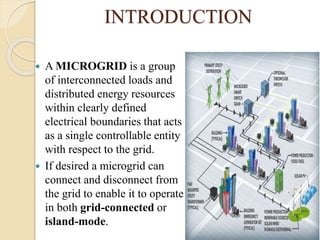
 A MICROGRID is a group
of interconnected loads and
distributed energy resources
within clearly defined
electrical boundaries that acts
as a single controllable entity
with respect to the grid.
 If desired a microgrid can
connect and disconnect from
the grid to enable it to operate
in both grid-connected or
island-mode.
This analysis mainly
includes micro grid
operation under:
 Grid connected mode
 Islanded mode
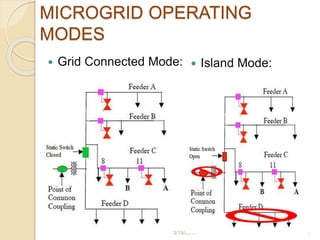
MICROGRID OPERATING
MODES
 Island Mode:
3/19/2017 7
 Grid Connected Mode:
IMPORTANCE & BENEFITS
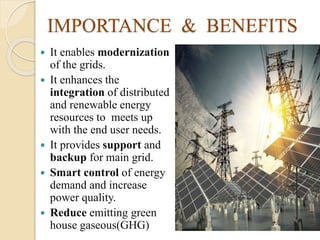
 It enables modernization
of the grids.
 It enhances the
integration of distributed
and renewable energy
resources to meets up
with the end user needs.
 It provides support and
backup for main grid.
 Smart control of energy
demand and increase
power quality.
 Reduce emitting green
house gaseous(GHG)
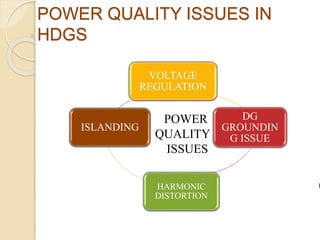
POWER QUALITY ISSUES IN
HDGS
SLIDE 15
9
VOLTAGE
REGULATION
DG
GROUNDIN
G ISSUE
HARMONIC
DISTORTION
ISLANDING
POWER
QUALITY
ISSUES
F
CHALLENGES IN HDGS
A risk of out-of-phase reconnection for synchronized
connection.
Coordination with load-shedding schemes
Voltage and frequency regulation
Load (phase) imbalance
Load and generation matching
Possible damage to equipment due to voltage and frequency
fluctuations.
lower capacity utilization factors.
high capital costs when compared to conventional power
systems.
Lack of operation and maintenance services providers is an
issue that needs attention.
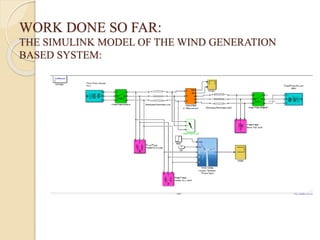
WORK DONE SO FAR:
THE SIMULINK MODEL OF THE WIND GENERATION
BASED SYSTEM:
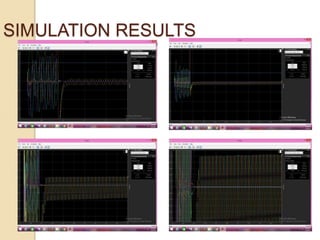
SIMULATION RESULTS
WORK TO BE
COMPLETED…
Transient behaviour of the
integrated hybrid grid system
powered by both wind and
photo voltaic generation under
normal grid connected mode
and islanding condition are to
be studied by using
PSCAD/EMTDC.
The obtained results will be analyzed
under different fault conditions to obtain a
solution for challenging issues like
harmonic distortions and frequency
variations.
CONCLUSION
Modified ppt for mtech project

Modified ppt for mtech project

  • 1.
    3/11/2014SMART GRID TECHNOLOGYDEPT.ECE SDMIT 1 REVIEW ON THE PERFORMANCE OF HYBRID GRID UNDER DIFFERENT FAULT CONDITIONS Under the esteemed guidance of Presented by: 14331D5603
  • 2.
    CONTENTS  Objective ofthe thesis  Literature review  Introduction  Solar and wind energy  Power quality issues  Simulation and results  Work done to be done  conclusion
  • 3.
    OBJECTIVE OF THETHESIS  Grid integrated system  study on Integration of DG’s  Key challenges observed  Modelling and study of hybrid systems under different fault conditions  Propose suitable methods to over come some of these challenges
  • 4.
    LITERATURE REVIEW So farI have reviewed approx. 25 papers on micro grids  [1] F Kanellos et aI., "Micro-grid Simulation during Grid- connected and Islanded modes of Operation," The International Conference on Power Systems Transients, (IPST'05), Montereal, 19-23 June 2005, Paper No. IPST05-113..  [2] Z. Chen and W. Kong, "Protection Coordination Based on Multi Agent for Distribution Power System with Distribution Generation Units," 2007, pp. 1-5.  [3] T. Quoce et aI., "Dynamics Analysis of an Insulated Distribution Network," IEEE Proceedings of Power System Conference and Exposition, Vol. 2, 2004, pp.815-821.  [4] C.L.T Borges, and D.M. Falcao, "Impact of Distributed Generation Allocation and Sizing on Reliability, Losses, and Voltage Profile", 2003 IEEE Bologna Power Tech Conference Proceedings, Bologna, Volume 2, 23-26 June 2003
  • 5.
    INTRODUCTION  A MICROGRIDis a group of interconnected loads and distributed energy resources within clearly defined electrical boundaries that acts as a single controllable entity with respect to the grid.  If desired a microgrid can connect and disconnect from the grid to enable it to operate in both grid-connected or island-mode.
  • 6.
    This analysis mainly includesmicro grid operation under:  Grid connected mode  Islanded mode
  • 7.
    MICROGRID OPERATING MODES  IslandMode: 3/19/2017 7  Grid Connected Mode:
  • 8.
    IMPORTANCE & BENEFITS It enables modernization of the grids.  It enhances the integration of distributed and renewable energy resources to meets up with the end user needs.  It provides support and backup for main grid.  Smart control of energy demand and increase power quality.  Reduce emitting green house gaseous(GHG)
  • 9.
    POWER QUALITY ISSUESIN HDGS SLIDE 15 9 VOLTAGE REGULATION DG GROUNDIN G ISSUE HARMONIC DISTORTION ISLANDING POWER QUALITY ISSUES F
  • 10.
    CHALLENGES IN HDGS Arisk of out-of-phase reconnection for synchronized connection. Coordination with load-shedding schemes Voltage and frequency regulation Load (phase) imbalance Load and generation matching Possible damage to equipment due to voltage and frequency fluctuations. lower capacity utilization factors. high capital costs when compared to conventional power systems. Lack of operation and maintenance services providers is an issue that needs attention.
  • 11.
    WORK DONE SOFAR: THE SIMULINK MODEL OF THE WIND GENERATION BASED SYSTEM:
  • 12.
  • 13.
    WORK TO BE COMPLETED… Transientbehaviour of the integrated hybrid grid system powered by both wind and photo voltaic generation under normal grid connected mode and islanding condition are to be studied by using PSCAD/EMTDC.
  • 14.
    The obtained resultswill be analyzed under different fault conditions to obtain a solution for challenging issues like harmonic distortions and frequency variations. CONCLUSION