Energy Efficiency
(Cooling)
Presented By:
17MSE07 to 17MSE012
Solar air conditioning refers to any air
conditioning (cooling) system that uses solar power by
different means.
This can be done through:
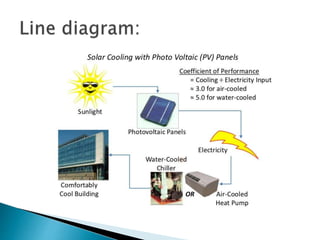
1.Photovoltaic conversion (sunlight to electricity)
2.Geothermal cooling
3.Passive cooling
Photovoltaic can provide the power for any type of electrically
powered cooling be it conventional compressor-based or
adsorption/absorption-based system.
 For small residential and small commercial cooling (less than
5 MWh/a) PV-powered cooling has been the most frequently
implemented solar cooling technology.
Since PV cooling's cost effectiveness depends largely on the
cooling equipment and given the poor efficiencies in electrical
cooling methods until recently it has not been cost
effective without subsidies.
 But,Using more efficient electrical cooling methods and
allowing longer payback schedules, We can change that
scenario.
Earth sheltering or Earth cooling tubes can take advantage of the
ambient temperature of the Earth to reduce or eliminate conventional
air conditioning requirements.
 In many climates where the majority of humans live, they can greatly
reduce the build-up of undesirable summer heat, and also help
remove heat from the interior of the building.
They increase construction cost, but reduce or eliminate the cost of
conventional air conditioning equipment.
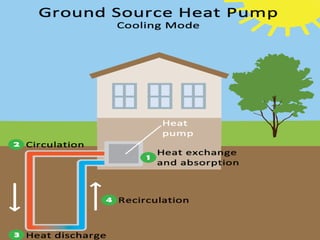
A geothermal heat pump uses ambient Earth temperature to
improve operation of cooling. A deep well recirculates water to
extract ambient Earth temperature (typically at 2 gallons of water per
ton per minute).
 These "open loop" systems were the most common in early
systems, however water quality could cause damage to the coils in
the heat pump and shorten the life of the equipment.
Another method is a closed loop system, in which a loop of tubing
is run down a well to cool an intermediate fluid.
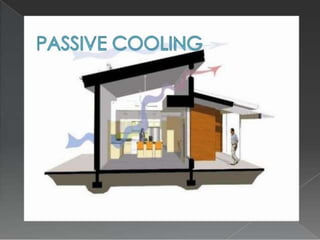
This type of cooling solar thermal energy is not used directly
to create a cold environment or drive any direct cooling
processes.
 Instead, solar building design aims at slowing the rate
of heat transfer into a building in the summer, and improving
the removal of unwanted heat.
 It involves a good understanding of the mechanisms of heat
transfer: heat conduction, convective heat transfer, and thermal
radiation, the latter primarily from the sun.
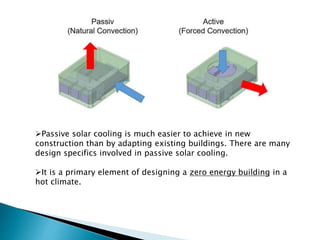
Passive solar cooling is much easier to achieve in new
construction than by adapting existing buildings. There are many
design specifics involved in passive solar cooling.
It is a primary element of designing a zero energy building in a
hot climate.
Goals of zero-energy buildings include sustainable, green
building technologies that can significantly reduce, or eliminate, net
annual energy bills.
 The supreme achievement is the totally off-the-grid autonomous
building that does not have to be connected to utility companies.
 In hot climates with significant degree days of cooling
requirement, leading-edge solar air conditioning will be an
increasingly important critical success factor.
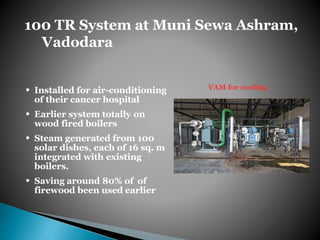
100 TR System at Muni Sewa Ashram,
Vadodara
• Installed for air-conditioning
of their cancer hospital
• Earlier system totally on
wood fired boilers
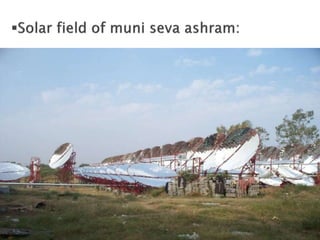
• Steam generated from 100
solar dishes, each of 16 sq. m
integrated with existing
boilers.
• Saving around 80% of of
firewood been used earlier
VAM for cooling
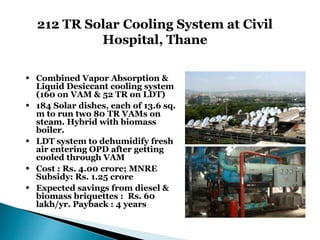
212 TR Solar Cooling System at Civil
Hospital, Thane
• Combined Vapor Absorption &
Liquid Desiccant cooling system
(160 on VAM & 52 TR on LDT)
• 184 Solar dishes, each of 13.6 sq.
m to run two 80 TR VAMs on
steam. Hybrid with biomass
boiler.
• LDT system to dehumidify fresh
air entering OPD after getting
cooled through VAM
• Cost : Rs. 4.00 crore; MNRE
Subsidy: Rs. 1.25 crore
• Expected savings from diesel &
biomass briquettes : Rs. 60
lakh/yr. Payback : 4 years
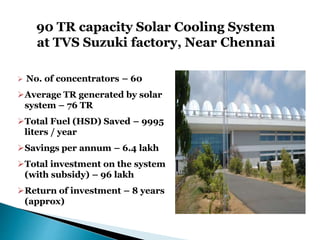
90 TR capacity Solar Cooling System
at TVS Suzuki factory, Near Chennai
 No. of concentrators – 60
Average TR generated by solar
system – 76 TR
Total Fuel (HSD) Saved – 9995
liters / year
Savings per annum – 6.4 lakh
Total investment on the system
(with subsidy) – 96 lakh
Return of investment – 8 years
(approx)
Energy efficint colling

Energy efficint colling

  • 1.
  • 2.
    Solar air conditioningrefers to any air conditioning (cooling) system that uses solar power by different means. This can be done through: 1.Photovoltaic conversion (sunlight to electricity) 2.Geothermal cooling 3.Passive cooling
  • 5.
    Photovoltaic can providethe power for any type of electrically powered cooling be it conventional compressor-based or adsorption/absorption-based system.  For small residential and small commercial cooling (less than 5 MWh/a) PV-powered cooling has been the most frequently implemented solar cooling technology.
  • 6.
    Since PV cooling'scost effectiveness depends largely on the cooling equipment and given the poor efficiencies in electrical cooling methods until recently it has not been cost effective without subsidies.  But,Using more efficient electrical cooling methods and allowing longer payback schedules, We can change that scenario.
  • 9.
    Earth sheltering orEarth cooling tubes can take advantage of the ambient temperature of the Earth to reduce or eliminate conventional air conditioning requirements.  In many climates where the majority of humans live, they can greatly reduce the build-up of undesirable summer heat, and also help remove heat from the interior of the building. They increase construction cost, but reduce or eliminate the cost of conventional air conditioning equipment.
  • 10.
    A geothermal heatpump uses ambient Earth temperature to improve operation of cooling. A deep well recirculates water to extract ambient Earth temperature (typically at 2 gallons of water per ton per minute).  These "open loop" systems were the most common in early systems, however water quality could cause damage to the coils in the heat pump and shorten the life of the equipment. Another method is a closed loop system, in which a loop of tubing is run down a well to cool an intermediate fluid.
  • 13.
    This type ofcooling solar thermal energy is not used directly to create a cold environment or drive any direct cooling processes.  Instead, solar building design aims at slowing the rate of heat transfer into a building in the summer, and improving the removal of unwanted heat.  It involves a good understanding of the mechanisms of heat transfer: heat conduction, convective heat transfer, and thermal radiation, the latter primarily from the sun.
  • 14.
    Passive solar coolingis much easier to achieve in new construction than by adapting existing buildings. There are many design specifics involved in passive solar cooling. It is a primary element of designing a zero energy building in a hot climate.
  • 15.
    Goals of zero-energybuildings include sustainable, green building technologies that can significantly reduce, or eliminate, net annual energy bills.  The supreme achievement is the totally off-the-grid autonomous building that does not have to be connected to utility companies.  In hot climates with significant degree days of cooling requirement, leading-edge solar air conditioning will be an increasingly important critical success factor.
  • 17.
    100 TR Systemat Muni Sewa Ashram, Vadodara • Installed for air-conditioning of their cancer hospital • Earlier system totally on wood fired boilers • Steam generated from 100 solar dishes, each of 16 sq. m integrated with existing boilers. • Saving around 80% of of firewood been used earlier VAM for cooling
  • 19.
    212 TR SolarCooling System at Civil Hospital, Thane • Combined Vapor Absorption & Liquid Desiccant cooling system (160 on VAM & 52 TR on LDT) • 184 Solar dishes, each of 13.6 sq. m to run two 80 TR VAMs on steam. Hybrid with biomass boiler. • LDT system to dehumidify fresh air entering OPD after getting cooled through VAM • Cost : Rs. 4.00 crore; MNRE Subsidy: Rs. 1.25 crore • Expected savings from diesel & biomass briquettes : Rs. 60 lakh/yr. Payback : 4 years
  • 20.
    90 TR capacitySolar Cooling System at TVS Suzuki factory, Near Chennai  No. of concentrators – 60 Average TR generated by solar system – 76 TR Total Fuel (HSD) Saved – 9995 liters / year Savings per annum – 6.4 lakh Total investment on the system (with subsidy) – 96 lakh Return of investment – 8 years (approx)