8/25/2009 1
Shahab Ahmad Khan 06 EEB 127
Reshadat Ali 06 EEB 158
Sharib Hussain 06 EEB 168
Outline
 Introduction to Microgrid.
 Microgrid Operating Modes.
 The Need of Microgrid.
 Interconnected Microgrids – Power Parks.
 Environmental Aspects.
 Conventional Grid versus Microgrid.
 Advantages & Disadvantages of Microgrid.
 Future Directions on Microgrid Research.
 References.
8/25/2009 2
Introduction To Microgrid
 What is Microgrid?
 It is a small-scale power supply network that is designed
to provide power for a small community.
 It enables local power generation for local loads.
 It comprises of various small power generating sources
that makes it highly flexible and efficient.
8/25/2009 3
Introduction To Microgrid
 What is Microgrid?
 It is connected to both the local generating units and the
utility grid thus preventing power outages.
 Excess power can be sold to the utility grid.
 Size of the Microgrid may range from housing estate to
municipal regions.
8/25/2009 4
Introduction To Microgrid
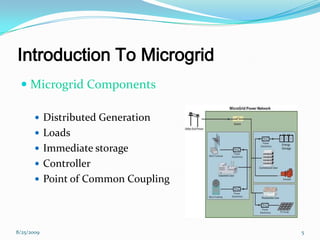
 Microgrid Components
 Distributed Generation
 Loads
 Immediate storage
 Controller
 Point of Common Coupling
8/25/2009 5
8/25/2009 6
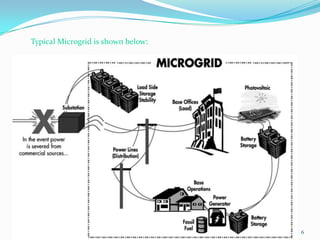
Typical Microgrid is shown below:
8/25/2009 7
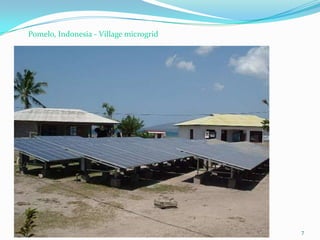
Pomelo, Indonesia - Village microgrid
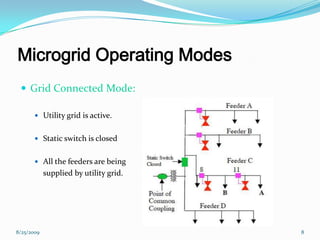
Microgrid Operating Modes
 Grid Connected Mode:
 Utility grid is active.
 Static switch is closed
 All the feeders are being
supplied by utility grid.
8/25/2009 8
Microgrid Operating Modes
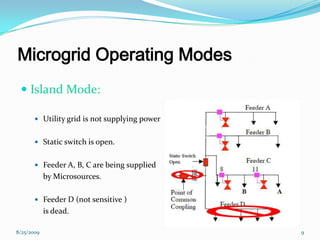
 Island Mode:
 Utility grid is not supplying power
 Static switch is open.
 Feeder A, B, C are being supplied
by Microsources.
 Feeder D (not sensitive )
is dead.
8/25/2009 9
The Need Of Microgrid
 Microgrid could be the answer to our energy crisis.
 Transmission losses gets highly reduced.
 Microgrid results in substantial savings and cuts
emissions without major changes to lifestyles.
 Provide high quality and reliable energy supply to
critical loads
8/25/2009 10
Interconnected Microgrids
Interconnected Microgrids – Power Parks
 Practical size of Microgrids is limited to a few MVA.
 For larger loads, it is desirable to interconnect many
Microgrids to form a larger Microgrid network called
Power Parks.
 The advantages of this Microgrid structure insures
greater stability and controllability for the Power Parks.
8/25/2009 11
Environmental Aspects
 Microgrid encourages the use of the renewable energy
sources.
 Large land use impacts are avoided.
 CO2 Emissions are reduced.
8/25/2009 12
Conventional Grid vs. Microgrid
 Efficiency of conventional grid is very low as compared
to Microgrid.
 Large amount of energy in the form of heat is wasted in
conventional grid.
 Power sources in case of Microgrid (often referred to as
Microsources) are small and are located in close
proximity to load.
8/25/2009 13
Advantages & Disadvantages
 Microgrid Advantages
 A major advantage of a Microgrid, is its ability, during a utility
grid disturbance, to separate and isolate itself from the utility
seamlessly with little or no disruption to the loads within the
Microgrid.
 In peak load periods it prevents utility grid failure by
reducing the load on the grid.
 Significant environmental benefits made possible by the use
of low or zero emission generators.
8/25/2009 14
Advantages & Disadvantages
 Microgrid Advantages
 The use of both electricity and heat permitted by the
close proximity of the generator to the user, thereby
increasing the overall energy efficiency.
 Microgrid can act to mitigate the electricity costs to its
users by generating some or all of its electricity needs.
8/25/2009 15
Advantages & Disadvantages
 Microgrid Disadvantages
 Voltage, frequency and power quality are three main
parameters that must be considered and controlled to
acceptable standards whilst the power and energy balance is
maintained.
 Electrical energy needs to be stored in battery banks thus
requiring more space and maintenance.
 Resynchronization with the utility grid is difficult.
8/25/2009 16
Advantages & Disadvantages
 Microgrid Disadvantages
 Microgrid protection is one of the most important challenges
facing the implementation of Microgrids.
 Issues such as standby charges and net metering may pose
obstacles for Microgrid.
 Interconnection standards needs to be developed to ensure
consistency. IEEE P1547, a standard proposed by Institute
of Electrical and Electronics Engineers may end up filling
the void.
8/25/2009 17
Future Directions on Microgrid
Research
 To investigate full-scale development, field demonstration,
experimental performance evaluation of frequency and voltage control
methods under various operation modes.
 Transition between grid connected and islanded modes on interaction
phenomena between distribution generation and high penetration of
distributed generation.
 Transformation of Microgrid system today into the intelligent,
robust energy delivery system in the future by providing
significant reliability and security benefits.
8/25/2009 18
References
 A. A. Salam, A. Mohamed and M. A. Hannan. "TECHNICAL CHALLENGES
ON MICROGRIDS" (DECEMBER 2008)
http://www.arpnjournals.com/jeas/research_papers/rp_2008/jeas_1208_146.pdf
 S. Abu-Sharkha, R.J. Arnolde, J. Kohlerd, R. Lia, T. Markvarta, J.N. Rossb, K.
Steemersc, P. Wilsonb, R. Yaoc. "Can microgrids make a major contribution to
UK energy supply?" (September 2004)
http://eprints.ecs.soton.ac.uk/11276/1/Microgrids.pdf
 John Stevens. "Characterization of Microgrids in the United States", Sandia
National Laboratories (January 2005)
http://www.electricdistribution.ctc.com/pdfs/RDC_Microgrid_Whitepaper_1-7-05.pdf
 Robert H. Lasseter, Paolo Piagi. "Microgrid: A Conceptual Solution", University
of Wisconsin-Madison (June 2004)
http://www.pserc.wisc.edu/ecow/get/publicatio/2004public/lasseterpesc04us.pdf
8/25/2009 19
References
 "Integration of Distributed Energy Resources - The CERTS MicroGrid
Concept", Consultant Report (October 2003)
http://www.pserc.org/cgi-
pserc/getbig/researchdo/certsdocum0/certspubli/certsmicrogridwhitepaper.pdf
 "Why the Microgrid Could Be the Answer to Our Energy Crisis"
http://www.fastcompany.com/magazine/137/beyond-the-grid.html
 "How a Microgrid Works"
http://science.howstuffworks.com/microgrid.htm
 “The Rise of MicroGrid Power Networks"
http://www.sustainablefacility.com/Articles/Feature_Article/58905d08bd629010VgnVC
M100000f932a8c0____
8/25/2009 20
Thank You
8/25/2009 21
Queries?
8/25/2009 22

microgrid-presentation-090825235628-phpapp02.pdf

  • 1.
    8/25/2009 1 Shahab AhmadKhan 06 EEB 127 Reshadat Ali 06 EEB 158 Sharib Hussain 06 EEB 168
  • 2.
    Outline  Introduction toMicrogrid.  Microgrid Operating Modes.  The Need of Microgrid.  Interconnected Microgrids – Power Parks.  Environmental Aspects.  Conventional Grid versus Microgrid.  Advantages & Disadvantages of Microgrid.  Future Directions on Microgrid Research.  References. 8/25/2009 2
  • 3.
    Introduction To Microgrid What is Microgrid?  It is a small-scale power supply network that is designed to provide power for a small community.  It enables local power generation for local loads.  It comprises of various small power generating sources that makes it highly flexible and efficient. 8/25/2009 3
  • 4.
    Introduction To Microgrid What is Microgrid?  It is connected to both the local generating units and the utility grid thus preventing power outages.  Excess power can be sold to the utility grid.  Size of the Microgrid may range from housing estate to municipal regions. 8/25/2009 4
  • 5.
    Introduction To Microgrid Microgrid Components  Distributed Generation  Loads  Immediate storage  Controller  Point of Common Coupling 8/25/2009 5
  • 6.
  • 7.
    8/25/2009 7 Pomelo, Indonesia- Village microgrid
  • 8.
    Microgrid Operating Modes Grid Connected Mode:  Utility grid is active.  Static switch is closed  All the feeders are being supplied by utility grid. 8/25/2009 8
  • 9.
    Microgrid Operating Modes Island Mode:  Utility grid is not supplying power  Static switch is open.  Feeder A, B, C are being supplied by Microsources.  Feeder D (not sensitive ) is dead. 8/25/2009 9
  • 10.
    The Need OfMicrogrid  Microgrid could be the answer to our energy crisis.  Transmission losses gets highly reduced.  Microgrid results in substantial savings and cuts emissions without major changes to lifestyles.  Provide high quality and reliable energy supply to critical loads 8/25/2009 10
  • 11.
    Interconnected Microgrids Interconnected Microgrids– Power Parks  Practical size of Microgrids is limited to a few MVA.  For larger loads, it is desirable to interconnect many Microgrids to form a larger Microgrid network called Power Parks.  The advantages of this Microgrid structure insures greater stability and controllability for the Power Parks. 8/25/2009 11
  • 12.
    Environmental Aspects  Microgridencourages the use of the renewable energy sources.  Large land use impacts are avoided.  CO2 Emissions are reduced. 8/25/2009 12
  • 13.
    Conventional Grid vs.Microgrid  Efficiency of conventional grid is very low as compared to Microgrid.  Large amount of energy in the form of heat is wasted in conventional grid.  Power sources in case of Microgrid (often referred to as Microsources) are small and are located in close proximity to load. 8/25/2009 13
  • 14.
    Advantages & Disadvantages Microgrid Advantages  A major advantage of a Microgrid, is its ability, during a utility grid disturbance, to separate and isolate itself from the utility seamlessly with little or no disruption to the loads within the Microgrid.  In peak load periods it prevents utility grid failure by reducing the load on the grid.  Significant environmental benefits made possible by the use of low or zero emission generators. 8/25/2009 14
  • 15.
    Advantages & Disadvantages Microgrid Advantages  The use of both electricity and heat permitted by the close proximity of the generator to the user, thereby increasing the overall energy efficiency.  Microgrid can act to mitigate the electricity costs to its users by generating some or all of its electricity needs. 8/25/2009 15
  • 16.
    Advantages & Disadvantages Microgrid Disadvantages  Voltage, frequency and power quality are three main parameters that must be considered and controlled to acceptable standards whilst the power and energy balance is maintained.  Electrical energy needs to be stored in battery banks thus requiring more space and maintenance.  Resynchronization with the utility grid is difficult. 8/25/2009 16
  • 17.
    Advantages & Disadvantages Microgrid Disadvantages  Microgrid protection is one of the most important challenges facing the implementation of Microgrids.  Issues such as standby charges and net metering may pose obstacles for Microgrid.  Interconnection standards needs to be developed to ensure consistency. IEEE P1547, a standard proposed by Institute of Electrical and Electronics Engineers may end up filling the void. 8/25/2009 17
  • 18.
    Future Directions onMicrogrid Research  To investigate full-scale development, field demonstration, experimental performance evaluation of frequency and voltage control methods under various operation modes.  Transition between grid connected and islanded modes on interaction phenomena between distribution generation and high penetration of distributed generation.  Transformation of Microgrid system today into the intelligent, robust energy delivery system in the future by providing significant reliability and security benefits. 8/25/2009 18
  • 19.
    References  A. A.Salam, A. Mohamed and M. A. Hannan. "TECHNICAL CHALLENGES ON MICROGRIDS" (DECEMBER 2008) http://www.arpnjournals.com/jeas/research_papers/rp_2008/jeas_1208_146.pdf  S. Abu-Sharkha, R.J. Arnolde, J. Kohlerd, R. Lia, T. Markvarta, J.N. Rossb, K. Steemersc, P. Wilsonb, R. Yaoc. "Can microgrids make a major contribution to UK energy supply?" (September 2004) http://eprints.ecs.soton.ac.uk/11276/1/Microgrids.pdf  John Stevens. "Characterization of Microgrids in the United States", Sandia National Laboratories (January 2005) http://www.electricdistribution.ctc.com/pdfs/RDC_Microgrid_Whitepaper_1-7-05.pdf  Robert H. Lasseter, Paolo Piagi. "Microgrid: A Conceptual Solution", University of Wisconsin-Madison (June 2004) http://www.pserc.wisc.edu/ecow/get/publicatio/2004public/lasseterpesc04us.pdf 8/25/2009 19
  • 20.
    References  "Integration ofDistributed Energy Resources - The CERTS MicroGrid Concept", Consultant Report (October 2003) http://www.pserc.org/cgi- pserc/getbig/researchdo/certsdocum0/certspubli/certsmicrogridwhitepaper.pdf  "Why the Microgrid Could Be the Answer to Our Energy Crisis" http://www.fastcompany.com/magazine/137/beyond-the-grid.html  "How a Microgrid Works" http://science.howstuffworks.com/microgrid.htm  “The Rise of MicroGrid Power Networks" http://www.sustainablefacility.com/Articles/Feature_Article/58905d08bd629010VgnVC M100000f932a8c0____ 8/25/2009 20
  • 21.
  • 22.