Available Energy ,Exergy and
Irreversibility
Prepared by :- sagar paneliya (17MSE011)
Thermodynamics & Heat
Transfer
•The second law of thermodynamics tells us that it is not
possible to convert all the heat absorbed by a system into
work.
•Suppose a certain quantity of energy Q as heat can be
received from a body at temperature T.
•The maximum work can be obtained by operating a
Carnot engine (reversible engine) using the body at T as
the source and the ambient atmosphere at T0 as the sink.
Where s is the entropy of the body supplying the energy as
heat.
The Carnot cycle and the available energy is shown in figure.
The area 1-2-3-4 represents the available energy.
Unavailable energy
available energy
s0 s1
T1
T0
Maximum work = {Qs – T0(s1-s0)}
Actual work = {Qs - Qr}
{dS=dQ/T0
Q=T0( S )}
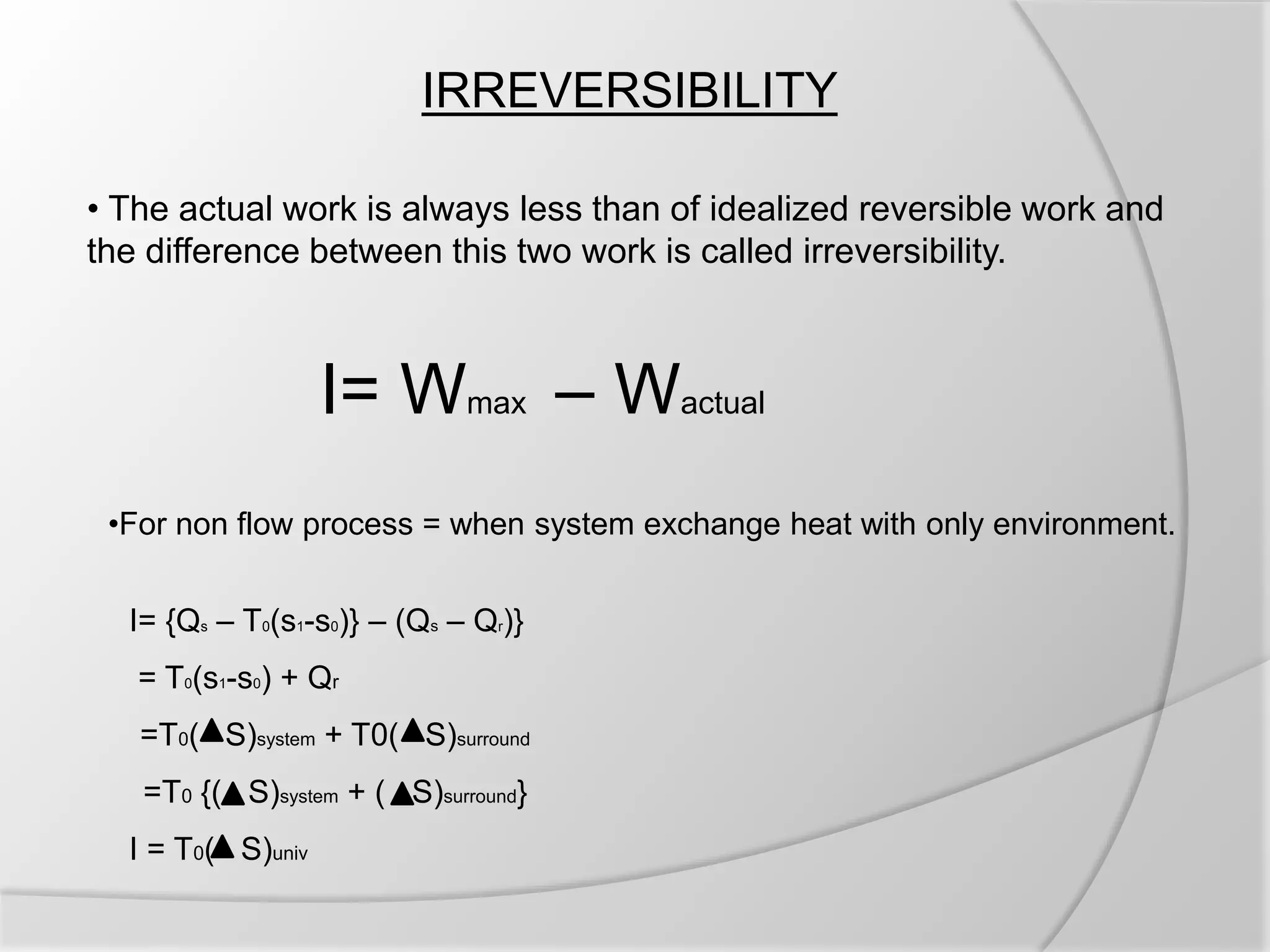
IRREVERSIBILITY
• The actual work is always less than of idealized reversible work and
the difference between this two work is called irreversibility.
I= Wmax – Wactual
•For non flow process = when system exchange heat with only environment.
I= {Qs – T0(s1-s0)} – (Qs – Qr)}
= T0(s1-s0) + Qr
=T0( S)system + T0( S)surround
=T0 {( S)system + ( S)surround}
I = T0( S)univ
•For steady flow process:-
I= Wmax – Wactual
H=Q-W
B=Q-H (Q=T(S1-S2))
Exergy
•Useful work
•Upper limit on the amount of work a device can deliver
without violating any thermodynamic law.
• A system at a given state can attain a new state through work
and heat interactions with its surroundings. Since the exergy
value associated with the new state would generally differ from
the value at the initial state.
• The change in exergy of a system during a process would not
necessarily equal the net exergy transferred, for exergy would be
destroyed if irreversibility were present within the system
during the process.
•Note that exergy is a property, and the value of a property does not
change unless the state changes.
•If the state of system or the state of the environment do not change,
the exergy does not change.
•Therefore, the exergy change of a system is zero if the state of the
system or the environment does not change during the process. For
example, the exergy change of steady flow devices such as nozzles,
compressors, turbines, pumps, and heat exchangers in a given
environment is zero during steady operation.
•The exergy of a closed system is either positive or zero. It is never
negative.
Thank You

available energy ,irreversibility,exchargy

  • 1.
    Available Energy ,Exergyand Irreversibility Prepared by :- sagar paneliya (17MSE011) Thermodynamics & Heat Transfer
  • 2.
    •The second lawof thermodynamics tells us that it is not possible to convert all the heat absorbed by a system into work. •Suppose a certain quantity of energy Q as heat can be received from a body at temperature T. •The maximum work can be obtained by operating a Carnot engine (reversible engine) using the body at T as the source and the ambient atmosphere at T0 as the sink.
  • 3.
    Where s isthe entropy of the body supplying the energy as heat. The Carnot cycle and the available energy is shown in figure. The area 1-2-3-4 represents the available energy.
  • 4.
    Unavailable energy available energy s0s1 T1 T0 Maximum work = {Qs – T0(s1-s0)} Actual work = {Qs - Qr} {dS=dQ/T0 Q=T0( S )}
  • 5.
    IRREVERSIBILITY • The actualwork is always less than of idealized reversible work and the difference between this two work is called irreversibility. I= Wmax – Wactual •For non flow process = when system exchange heat with only environment. I= {Qs – T0(s1-s0)} – (Qs – Qr)} = T0(s1-s0) + Qr =T0( S)system + T0( S)surround =T0 {( S)system + ( S)surround} I = T0( S)univ
  • 6.
    •For steady flowprocess:- I= Wmax – Wactual H=Q-W B=Q-H (Q=T(S1-S2))
  • 7.
    Exergy •Useful work •Upper limiton the amount of work a device can deliver without violating any thermodynamic law.
  • 8.
    • A systemat a given state can attain a new state through work and heat interactions with its surroundings. Since the exergy value associated with the new state would generally differ from the value at the initial state. • The change in exergy of a system during a process would not necessarily equal the net exergy transferred, for exergy would be destroyed if irreversibility were present within the system during the process.
  • 9.
    •Note that exergyis a property, and the value of a property does not change unless the state changes. •If the state of system or the state of the environment do not change, the exergy does not change. •Therefore, the exergy change of a system is zero if the state of the system or the environment does not change during the process. For example, the exergy change of steady flow devices such as nozzles, compressors, turbines, pumps, and heat exchangers in a given environment is zero during steady operation. •The exergy of a closed system is either positive or zero. It is never negative.
  • 10.