CARNOT’S THEOREM, COROLLARY OF CARNOT’S THEOREM
AND
THERMODYNAMIC TEMPERATURE SCALE
-MIHIR LAD (17MSE007)
1
“All the heat engines operating between
a given constant temperature source
and given constant temperature sink,
NONE has higher efficiency than a
reversible engine”
2
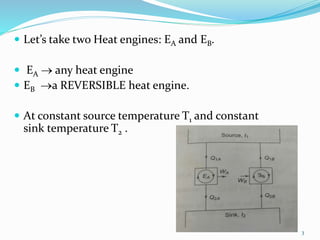
 Let’s take two Heat engines: EA and EB.
 EA  any heat engine
 EB a REVERSIBLE heat engine.
 At constant source temperature T1 and constant
sink temperature T2 .
3
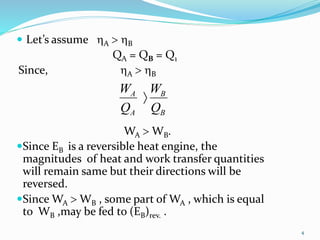
 Let’s assume A  B
QA = QB = Q1
Since, A  B
WA  WB.
Since EB is a reversible heat engine, the
magnitudes of heat and work transfer quantities
will remain same but their directions will be
reversed.
Since WA  WB , some part of WA , which is equal
to WB ,may be fed to (EB)rev. .
4
B
B
A
A
Q
W
Q
W

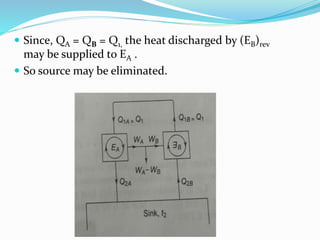
 Since, QA = QB = Q1, the heat discharged by (EB)rev
may be supplied to EA .
 So source may be eliminated.
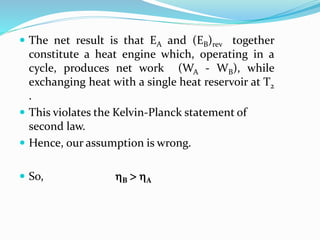
 The net result is that EA and (EB)rev together
constitute a heat engine which, operating in a
cycle, produces net work (WA - WB), while
exchanging heat with a single heat reservoir at T2
.
 This violates the Kelvin-Planck statement of
second law.
 Hence, our assumption is wrong.
 So, B  A
COROLLARY OF CARNOT’S THEOREM
7
“The efficiency of all the reversible heat
engines operating between the same
temperature levels is the same.”
So, it is independent of the nature or
amount of the working substance
undergoing the cycle.
ABSOLUTE THERMODYNAMIC TEMPERATURE
SCALE
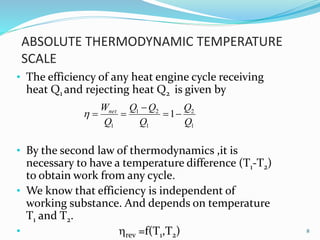
• The efficiency of any heat engine cycle receiving
heat Q1 and rejecting heat Q2 is given by
• By the second law of thermodynamics ,it is
necessary to have a temperature difference (T1-T2)
to obtain work from any cycle.
• We know that efficiency is independent of
working substance. And depends on temperature
T1 and T2.
• rev =f(T1,T2) 8
1
2
1
21
1
1
Q
Q
Q
QQ
Q
Wnet




 If some functional relationship is assigned between
T1 , T2 and (Q2 / Q1 ),the equation becomes the
definition of a temperature scale.
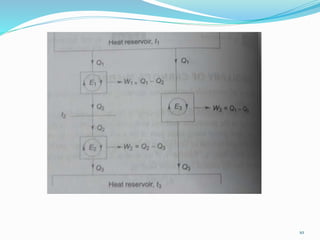
 Let’s consider two reversible engines,E1 receiving heat
from the source at T1 ,and rejecting heat at T2 to E2
,which rejects heat to the sink at T3 .
9
),(1 21
1
2
TTf
Q
Q

),( 21
1
2
TTF
Q
Q

),();,( 32
3
2
21
2
1
TTF
Q
Q
TTF
Q
Q

10
 E1 and E2 together constitute another heat engine
E3 operating between T1 and T3 .
11
),(
),(
),(
/
/
),(
32
31
21
2
1
32
31
2
1
31
3
1
TTf
TTf
TTf
Q
Q
QQ
QQ
Q
Q
TTf
Q
Q



Ratio Q1 / Q2 depends only on T1 and T2 ,
Independent of T3 .
)(
)(
),(
2
1
21
2
1
T
T
TTf
Q
Q



12
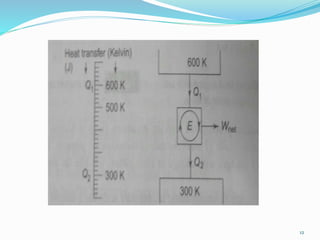
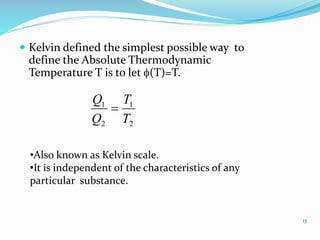
 Kelvin defined the simplest possible way to
define the Absolute Thermodynamic
Temperature T is to let (T)=T.
13
•Also known as Kelvin scale.
•It is independent of the characteristics of any
particular substance.
2
1
2
1
T
T
Q
Q

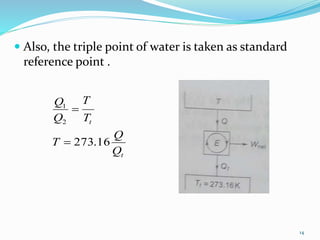
 Also, the triple point of water is taken as standard
reference point .
14
t
t
Q
Q
T
T
T
Q
Q
16.273
2
1


15

Carnot theorem

  • 1.
    CARNOT’S THEOREM, COROLLARYOF CARNOT’S THEOREM AND THERMODYNAMIC TEMPERATURE SCALE -MIHIR LAD (17MSE007) 1
  • 2.
    “All the heatengines operating between a given constant temperature source and given constant temperature sink, NONE has higher efficiency than a reversible engine” 2
  • 3.
     Let’s taketwo Heat engines: EA and EB.  EA  any heat engine  EB a REVERSIBLE heat engine.  At constant source temperature T1 and constant sink temperature T2 . 3
  • 4.
     Let’s assumeA  B QA = QB = Q1 Since, A  B WA  WB. Since EB is a reversible heat engine, the magnitudes of heat and work transfer quantities will remain same but their directions will be reversed. Since WA  WB , some part of WA , which is equal to WB ,may be fed to (EB)rev. . 4 B B A A Q W Q W 
  • 5.
     Since, QA= QB = Q1, the heat discharged by (EB)rev may be supplied to EA .  So source may be eliminated.
  • 6.
     The netresult is that EA and (EB)rev together constitute a heat engine which, operating in a cycle, produces net work (WA - WB), while exchanging heat with a single heat reservoir at T2 .  This violates the Kelvin-Planck statement of second law.  Hence, our assumption is wrong.  So, B  A
  • 7.
    COROLLARY OF CARNOT’STHEOREM 7 “The efficiency of all the reversible heat engines operating between the same temperature levels is the same.” So, it is independent of the nature or amount of the working substance undergoing the cycle.
  • 8.
    ABSOLUTE THERMODYNAMIC TEMPERATURE SCALE •The efficiency of any heat engine cycle receiving heat Q1 and rejecting heat Q2 is given by • By the second law of thermodynamics ,it is necessary to have a temperature difference (T1-T2) to obtain work from any cycle. • We know that efficiency is independent of working substance. And depends on temperature T1 and T2. • rev =f(T1,T2) 8 1 2 1 21 1 1 Q Q Q QQ Q Wnet   
  • 9.
      If somefunctional relationship is assigned between T1 , T2 and (Q2 / Q1 ),the equation becomes the definition of a temperature scale.  Let’s consider two reversible engines,E1 receiving heat from the source at T1 ,and rejecting heat at T2 to E2 ,which rejects heat to the sink at T3 . 9 ),(1 21 1 2 TTf Q Q  ),( 21 1 2 TTF Q Q  ),();,( 32 3 2 21 2 1 TTF Q Q TTF Q Q 
  • 10.
  • 11.
     E1 andE2 together constitute another heat engine E3 operating between T1 and T3 . 11 ),( ),( ),( / / ),( 32 31 21 2 1 32 31 2 1 31 3 1 TTf TTf TTf Q Q QQ QQ Q Q TTf Q Q    Ratio Q1 / Q2 depends only on T1 and T2 , Independent of T3 . )( )( ),( 2 1 21 2 1 T T TTf Q Q   
  • 12.
  • 13.
     Kelvin definedthe simplest possible way to define the Absolute Thermodynamic Temperature T is to let (T)=T. 13 •Also known as Kelvin scale. •It is independent of the characteristics of any particular substance. 2 1 2 1 T T Q Q 
  • 14.
     Also, thetriple point of water is taken as standard reference point . 14 t t Q Q T T T Q Q 16.273 2 1  
  • 15.