WHAT IS MICRO GRID SYSTEM?
 A microgrid is a small-scale power grid that can operate
independently or collaboratively with other small power
grids. The practice of using microgrids is known as
distributed, dispersed, decentralized, district or embedded
energy production.Any small-scale, localized power station
that has its own generation and storage resources and
definable boundaries can be considered a microgrid. If the
microgrid can be integrated with the area’s main power grid,
it is often referred to as a hybrid microgrid.
WHAT ARE MICRO GRID ?
 A microgrid is a group of interconnected loads and
distributed energy resources that acts as a single
controllable entity with respect to the grid. It can connect
and disconnect from the grid to operate in grid-
connected or island mode. Microgrids can improve
customer reliability and resilience to grid
disturbances.Advanced microgrids enable local power
generation assets—including traditional generators,
renewables, and storage—to keep the local grid running
even when the larger grid experiences interruptions or,
for remote areas, where there is no connection to the
larger grid. In addition, advanced microgrids allow local
assets to work together to save costs, extend duration of
energy supplies, and produce revenue via market
participation
HOW DOES MICROMICROGRID
WORK ?
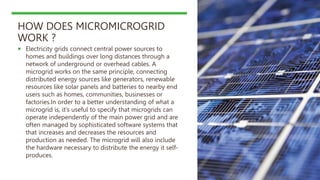
 Electricity grids connect central power sources to
homes and buildings over long distances through a
network of underground or overhead cables. A
microgrid works on the same principle, connecting
distributed energy sources like generators, renewable
resources like solar panels and batteries to nearby end
users such as homes, communities, businesses or
factories.In order to a better understanding of what a
microgrid is, it’s useful to specify that microgrids can
operate independently of the main power grid and are
often managed by sophisticated software systems that
that increases and decreases the resources and
production as needed. The microgrid will also include
the hardware necessary to distribute the energy it self-
produces.
BENEFITS OF MICROGRIDS
 Provide efficient, low-cost, clean energyImprove the operation and
stability of the regional electric gridCritical infrastructure that increases
reliability and resilienceReduce grid “congestion” and peak loadsEnable
highly-efficient CHP, reducing fuel use, line losses, and carbon
footprintIntegrate CHP, renewables, thermal and electric storage, and
advanced system and building controlsMake RTO markets more
competitiveOffer grid services including: energy, capacity, and ancillary
servicesSupport places of refuge in regional crises and first
respondersUse local energy resources and jobsDiversified risk rather
than concentrated riskUsing electric and thermal storage capabilities, a
microgrid can provide local management of variable renewable
generation, particularly on-site solarWhen properly designed, a regional
power grid that combines both large central plants and distributed
microgrids can be built with: less total capital cost, less installed
generation, higher capacity factor on all assets, and higher reliability
TYPES OF MICROMICROGRID
 Advanced microgrid-:A microgrid that uses sophisticated software,
controls and sometimes artificial intelligence to manage multiple
energy resources. Most of the microgrid types listed here can be
configured as advanced microgrids.
 Community microgrid-:A microgrid that serves critical facilities within
a community, such as emergency response centers, water and
wastewater treatment plants, grocery stores, fueling stations,
government buildings and shelters. In some cases, community
microgrids extend to noncritical buildings or homes.
 Campus microgrid-: A microgrid that serves multiple buildings on a
single large parcel of land, often for a single offtaker. Examples
include business parks, medical centers and educational facilities.
 Grid-connected microgrid-: As the name implies, it’s a microgrid that
is connected to the central power grid, but that can be separated
from the central grid when conditions warrant.
 Hybrid microgrid-: Hybrid microgrids generate power with two or more distributed
energy sources, such as wind and solar. They also use a battery to store energy. These
microgrids can operate in both grid-connected mode and islanded mode
(disconnected from the grid).
 Mobile microgrid-:Mobile microgrids can be relocated to support emergency response
teams or provide power for personal electronic or medical device charging during
times of crisis. Because they often use renewable energy or batteries, mobile
microgrids reduce the need to ship fuel to remote areas or disaster zones. One
example of a mobile microgrid entails using electric vehicles to support the grid
during times of high demand
 Nanogrid-:Nano grids are basically small microgrids that serve a single customer or
facility. These microgrids can typically operate in both grid-connected mode and
islanded mode (disconnected from the grid). Remote microgrid-:Remote microgrids
are found on islands, in isolated areas or in parts of the world without a central or
reliable power grid. They are not connected to the grid. Renewable energy microgrid-
:A microgrid that uses one or more renewable energy sources, such as wind or solar.
 Utility microgrid-:A microgrid that is owned and operated by an investor-owned or
public utility
HIERARCHICAL CONTROL OF
MICROGRID
 Primary control -: In hierarchical control of a micromicrogrid, the
primary level focuses on immediate and local control actions to
maintain voltage and frequency within acceptable limits. This
includes managing individual distributed energy resources
(DERs) such as solar panels, wind turbines, and batteries, to
respond to local fluctuations in demand and supply. Primary
control ensures stability and reliability at the micro-level of the
grid.
 Secondary-:: the secondary level operates at a slightly higher
hierarchy than the primary level. Here, the focus shifts to
coordinating the operation of multiple DERs within the
micromicrogrid to optimize energy flow, minimize losses, and
enhance overall system efficiency. Secondary control algorithms
typically involve economic dispatch, load balancing, and voltage
regulation to ensure optimal performance across the
micromicrogrid.
 Teritary -:In the tertiary control of a micromicrogrid,
the focus is on optimizing long-term performance and
planning. This level involves strategic decision-making
regarding energy trading, demand-side management,
and grid integration with larger systems. Tertiary
control aims to maximize economic benefits, enhance
system resilience, and facilitate the integration of
renewable energy sources into the broader energy
landscape.
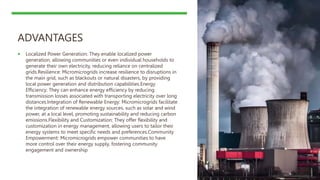
ADVANTAGES
 Localized Power Generation: They enable localized power
generation, allowing communities or even individual households to
generate their own electricity, reducing reliance on centralized
grids.Resilience: Micromicrogrids increase resilience to disruptions in
the main grid, such as blackouts or natural disasters, by providing
local power generation and distribution capabilities.Energy
Efficiency: They can enhance energy efficiency by reducing
transmission losses associated with transporting electricity over long
distances.Integration of Renewable Energy: Micromicrogrids facilitate
the integration of renewable energy sources, such as solar and wind
power, at a local level, promoting sustainability and reducing carbon
emissions.Flexibility and Customization: They offer flexibility and
customization in energy management, allowing users to tailor their
energy systems to meet specific needs and preferences.Community
Empowerment: Micromicrogrids empower communities to have
more control over their energy supply, fostering community
engagement and ownership
DISADVANTAGES
 Initial Cost: Setting up micromicrogrids can require significant
upfront investment in infrastructure, including generation,
storage, and control systems.Complexity: Managing
micromicrogrids involves complex control and coordination
tasks, especially as the number of distributed energy resources
increases.Regulatory Challenges: Regulatory frameworks may
not always be well-suited to micromicrogrid deployment,
potentially creating barriers to implementation.Interconnection
Issues: Integrating micromicrogrids with the main grid can pose
technical challenges, such as synchronization and
interoperability issues.Maintenance and Management:
Micromicrogrids require ongoing maintenance and
management, which can be resource-intensive and may require
specialized expertise.Limited Scalability: While suitable for
localized applications, micromicrogrids may have limited
scalability compared to larger grid systems, especially in densely
populated urban areas.
Presentation on Ac and Dc micro grid (21).pptx

Presentation on Ac and Dc micro grid (21).pptx

  • 2.
    WHAT IS MICROGRID SYSTEM?  A microgrid is a small-scale power grid that can operate independently or collaboratively with other small power grids. The practice of using microgrids is known as distributed, dispersed, decentralized, district or embedded energy production.Any small-scale, localized power station that has its own generation and storage resources and definable boundaries can be considered a microgrid. If the microgrid can be integrated with the area’s main power grid, it is often referred to as a hybrid microgrid.
  • 3.
    WHAT ARE MICROGRID ?  A microgrid is a group of interconnected loads and distributed energy resources that acts as a single controllable entity with respect to the grid. It can connect and disconnect from the grid to operate in grid- connected or island mode. Microgrids can improve customer reliability and resilience to grid disturbances.Advanced microgrids enable local power generation assets—including traditional generators, renewables, and storage—to keep the local grid running even when the larger grid experiences interruptions or, for remote areas, where there is no connection to the larger grid. In addition, advanced microgrids allow local assets to work together to save costs, extend duration of energy supplies, and produce revenue via market participation
  • 4.
    HOW DOES MICROMICROGRID WORK?  Electricity grids connect central power sources to homes and buildings over long distances through a network of underground or overhead cables. A microgrid works on the same principle, connecting distributed energy sources like generators, renewable resources like solar panels and batteries to nearby end users such as homes, communities, businesses or factories.In order to a better understanding of what a microgrid is, it’s useful to specify that microgrids can operate independently of the main power grid and are often managed by sophisticated software systems that that increases and decreases the resources and production as needed. The microgrid will also include the hardware necessary to distribute the energy it self- produces.
  • 5.
    BENEFITS OF MICROGRIDS Provide efficient, low-cost, clean energyImprove the operation and stability of the regional electric gridCritical infrastructure that increases reliability and resilienceReduce grid “congestion” and peak loadsEnable highly-efficient CHP, reducing fuel use, line losses, and carbon footprintIntegrate CHP, renewables, thermal and electric storage, and advanced system and building controlsMake RTO markets more competitiveOffer grid services including: energy, capacity, and ancillary servicesSupport places of refuge in regional crises and first respondersUse local energy resources and jobsDiversified risk rather than concentrated riskUsing electric and thermal storage capabilities, a microgrid can provide local management of variable renewable generation, particularly on-site solarWhen properly designed, a regional power grid that combines both large central plants and distributed microgrids can be built with: less total capital cost, less installed generation, higher capacity factor on all assets, and higher reliability
  • 6.
    TYPES OF MICROMICROGRID Advanced microgrid-:A microgrid that uses sophisticated software, controls and sometimes artificial intelligence to manage multiple energy resources. Most of the microgrid types listed here can be configured as advanced microgrids.  Community microgrid-:A microgrid that serves critical facilities within a community, such as emergency response centers, water and wastewater treatment plants, grocery stores, fueling stations, government buildings and shelters. In some cases, community microgrids extend to noncritical buildings or homes.  Campus microgrid-: A microgrid that serves multiple buildings on a single large parcel of land, often for a single offtaker. Examples include business parks, medical centers and educational facilities.  Grid-connected microgrid-: As the name implies, it’s a microgrid that is connected to the central power grid, but that can be separated from the central grid when conditions warrant.
  • 7.
     Hybrid microgrid-:Hybrid microgrids generate power with two or more distributed energy sources, such as wind and solar. They also use a battery to store energy. These microgrids can operate in both grid-connected mode and islanded mode (disconnected from the grid).  Mobile microgrid-:Mobile microgrids can be relocated to support emergency response teams or provide power for personal electronic or medical device charging during times of crisis. Because they often use renewable energy or batteries, mobile microgrids reduce the need to ship fuel to remote areas or disaster zones. One example of a mobile microgrid entails using electric vehicles to support the grid during times of high demand  Nanogrid-:Nano grids are basically small microgrids that serve a single customer or facility. These microgrids can typically operate in both grid-connected mode and islanded mode (disconnected from the grid). Remote microgrid-:Remote microgrids are found on islands, in isolated areas or in parts of the world without a central or reliable power grid. They are not connected to the grid. Renewable energy microgrid- :A microgrid that uses one or more renewable energy sources, such as wind or solar.  Utility microgrid-:A microgrid that is owned and operated by an investor-owned or public utility
  • 8.
    HIERARCHICAL CONTROL OF MICROGRID Primary control -: In hierarchical control of a micromicrogrid, the primary level focuses on immediate and local control actions to maintain voltage and frequency within acceptable limits. This includes managing individual distributed energy resources (DERs) such as solar panels, wind turbines, and batteries, to respond to local fluctuations in demand and supply. Primary control ensures stability and reliability at the micro-level of the grid.  Secondary-:: the secondary level operates at a slightly higher hierarchy than the primary level. Here, the focus shifts to coordinating the operation of multiple DERs within the micromicrogrid to optimize energy flow, minimize losses, and enhance overall system efficiency. Secondary control algorithms typically involve economic dispatch, load balancing, and voltage regulation to ensure optimal performance across the micromicrogrid.
  • 9.
     Teritary -:Inthe tertiary control of a micromicrogrid, the focus is on optimizing long-term performance and planning. This level involves strategic decision-making regarding energy trading, demand-side management, and grid integration with larger systems. Tertiary control aims to maximize economic benefits, enhance system resilience, and facilitate the integration of renewable energy sources into the broader energy landscape.
  • 10.
    ADVANTAGES  Localized PowerGeneration: They enable localized power generation, allowing communities or even individual households to generate their own electricity, reducing reliance on centralized grids.Resilience: Micromicrogrids increase resilience to disruptions in the main grid, such as blackouts or natural disasters, by providing local power generation and distribution capabilities.Energy Efficiency: They can enhance energy efficiency by reducing transmission losses associated with transporting electricity over long distances.Integration of Renewable Energy: Micromicrogrids facilitate the integration of renewable energy sources, such as solar and wind power, at a local level, promoting sustainability and reducing carbon emissions.Flexibility and Customization: They offer flexibility and customization in energy management, allowing users to tailor their energy systems to meet specific needs and preferences.Community Empowerment: Micromicrogrids empower communities to have more control over their energy supply, fostering community engagement and ownership
  • 11.
    DISADVANTAGES  Initial Cost:Setting up micromicrogrids can require significant upfront investment in infrastructure, including generation, storage, and control systems.Complexity: Managing micromicrogrids involves complex control and coordination tasks, especially as the number of distributed energy resources increases.Regulatory Challenges: Regulatory frameworks may not always be well-suited to micromicrogrid deployment, potentially creating barriers to implementation.Interconnection Issues: Integrating micromicrogrids with the main grid can pose technical challenges, such as synchronization and interoperability issues.Maintenance and Management: Micromicrogrids require ongoing maintenance and management, which can be resource-intensive and may require specialized expertise.Limited Scalability: While suitable for localized applications, micromicrogrids may have limited scalability compared to larger grid systems, especially in densely populated urban areas.