Eco EnergyMicro Grid
Modular, Scalable Micro Grid 
Incorporating Traditional and 
Renewable Energy Systems
P D Madden, PE
T D Lowe, PhD
Energy Technologies, Inc.
March 23, 2016
Eco EnergyMicro Grid
DOE Definition:
Microgrid: “a group of interconnected loads
and distributed energy resources within clearly
defined electrical boundaries that act as a
single controllable entity with respect to the
grid. A microgrid can connect and disconnect
from the grid to enable it to operate in both
grid-connected or island-mode.”
Eco EnergyMicro Grid
Military Microgrids: Why the DOD is
Leading the Pack
“Microgrids can shrink the amount of fossil fuels
consumed to create electricity by networking
generators as a system to maximize efficiency.
Yet, they can also be used to help integrate
renewable energy resources (such as wind and
solar) at the local distribution grid level.”
-Navigant Research
Eco EnergyMicro Grid
EPA Definition:
“Renewable energy is electricity generated by
fuel sources that restore themselves over a
short period of time and do not diminish.
Although some renewable energy technologies
have an impact on the environment, renewables
are considered environmentally preferable to
conventional sources and, when replacing fossil
fuels, have significant potential to reduce
greenhouse gas emissions.”
Eco EnergyMicro Grid
Assumptions:
• Electricity is the common energy transfer
medium of a Micro Grid.
• System of Systems approach allows modular
implementation on both legacy and new grids.
• Lessons learned from systems developed for
Military applications can apply commercially.
• Micro Grids typically apply to a defined region,
but the control strategies can also apply to a
Eco EnergyMicro Grid
Micro Grid Benefits (Economic):
• Reduced fossil fuel use by operating more efficiently
• Ability to offset fossil fuels with renewables
• Ability to choose lowest cost energy source
• Reduced peak demand charges from utility by bringing on
additional generation, using stored energy or shaving load
• Reduced capacity charges with managed generation
• Sell excess energy back to utility
• Reduced generator wet-stacking and maintenance
• Optimize overall maintenance scheduling with better logs
• Reduced troubleshooting time with better real-time data
• Reduced manpower with computer monitoring and control
Eco EnergyMicro Grid
Micro Grid Benefits (Other):
• Increased overall reliability and stability
• Less risk of cascading events
• Protection of critical loads
• Controlled power quality
• Reduced blackout or brownout risk
• Reduced greenhouse gas emissions
• Reduced single point failures
• Ability to modularly integrate new technologies as available
Eco EnergyMicro Grid
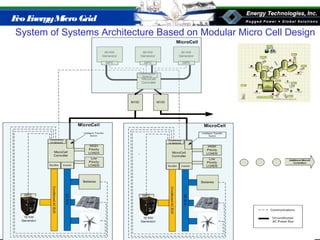
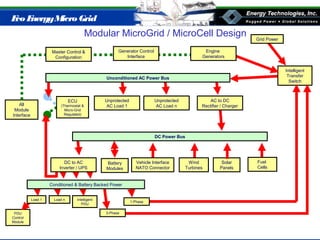
System of Systems Architecture Based on Modular Micro Cell Design
Eco EnergyMicro Grid
Grid Power
Intelligent
Transfer
Switch
Unprotected
AC Load nAll
Module
Interface
PDU
Control
Module
Unprotected
AC Load 1
ECU
(Thermostat &
Micro-Grid
Regulated)
Load 1
Vehicle Interface
NATO Connector
Wind
Turbines
Solar
Panels
Battery
Modules
Load n Intelligent
PDU
DC to AC
Inverter / UPS
1-Phase
3-Phase
Conditioned & Battery Backed Power
AC to DC
Rectifier / Charger
Unconditioned AC Power Bus
DC Power Bus
Generator Control
Interface
Engine
Generators
Master Control &
Configuration
Fuel
Cells
Modular MicroGrid / MicroCell Design
Eco EnergyMicro Grid
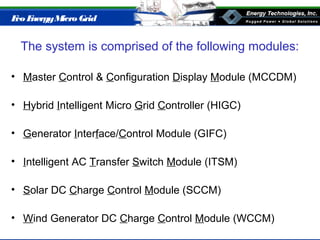
The system is comprised of the following modules:
• Master Control & Configuration Display Module (MCCDM)
• Hybrid Intelligent Micro Grid Controller (HIGC)
• Generator Interface/Control Module (GIFC)
• Intelligent AC Transfer Switch Module (ITSM)
• Solar DC Charge Control Module (SCCM)
• Wind Generator DC Charge Control Module (WCCM)
Eco EnergyMicro Grid
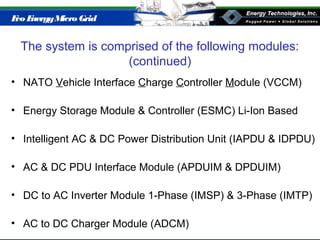
The system is comprised of the following modules:
(continued)
• NATO Vehicle Interface Charge Controller Module (VCCM)
• Energy Storage Module & Controller (ESMC) Li-Ion Based
• Intelligent AC & DC Power Distribution Unit (IAPDU & IDPDU)
• AC & DC PDU Interface Module (APDUIM & DPDUIM)
• DC to AC Inverter Module 1-Phase (IMSP) & 3-Phase (IMTP)
• AC to DC Charger Module (ADCM)
Eco EnergyMicro Grid
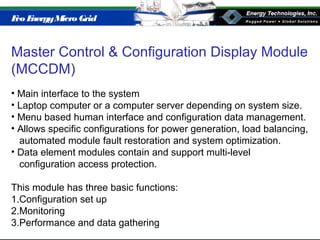
Master Control & Configuration Display Module
(MCCDM)
• Main interface to the system
• Laptop computer or a computer server depending on system size.
• Menu based human interface and configuration data management.
• Allows specific configurations for power generation, load balancing,
automated module fault restoration and system optimization.
• Data element modules contain and support multi-level
configuration access protection.
This module has three basic functions:
1.Configuration set up
2.Monitoring
3.Performance and data gathering
Eco EnergyMicro Grid
Micro Grid Computer System Software Architecture
Eco EnergyMicro Grid
N2 Chart with Micro Grid States and Modes
Eco EnergyMicro Grid
Hybrid Intelligent Grid Controller (HIGC)
• Master controller of the configured system or sub-system,
depending on system size and complexity
• Modular and can be configured for various power ratings based
on application
• Module takes the input power resource and distributes and
controls as configured without any dependence on additional
controller modules
• Interface to support setting up a configuration via a portable
device when the master control and configuration display
module is not configured in small applications
• Default configuration/operations reside in this module for all
battle short algorithmic functions and actions
Eco EnergyMicro Grid
Generator Interface/Control Module (GIFC)
• Configured to allow interface to a wide range of generators
• Interprets the system commands to the control functions of the
generator for starting, paralleling and status functions
• Capability to monitor consumables such as fuel and oil levels
• Module will take and execute all commands from the HIGC based
on the configuration settings and shut down requirements as
defined by the algorithmic functions of the system
• Interface module will also contain a fall back or battle short
capability as these modules will be located on the generator and
may not necessarily be located close to the HIGC
Eco EnergyMicro Grid
Intelligent AC Transfer Switch Module (ITSM)
• The Intelligent Transfer Switch Module interfaces to power
generating sources and is configured in a fall back configuration
that will allow the power to be distributed to the AC support bus
• ITSM has an intelligent interface that will operate based on the
command requirements of the Hybrid Intelligent Grid Controller
• Upon loss of generating power, the HIGC can command the
ITSM to disconnect from the generator and connect battery
supplied inverters to the AC bus allowing continued operation of
critical loads
• ITSM can support a local grid power sources and switch to the
grid power to the AC support bus
Eco EnergyMicro Grid
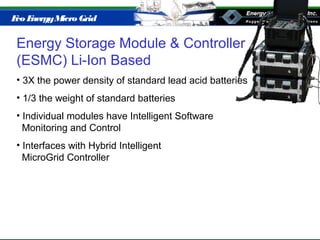
Energy Storage Module & Controller
(ESMC) Li-Ion Based
• 3X the power density of standard lead acid batteries
• 1/3 the weight of standard batteries
• Individual modules have Intelligent Software
Monitoring and Control
• Interfaces with Hybrid Intelligent
MicroGrid Controller
Eco EnergyMicro Grid
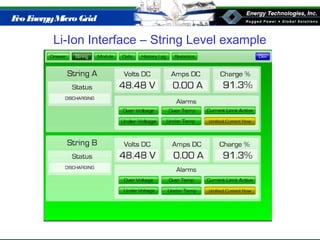
Li-Ion Interface – String Level example
Eco EnergyMicro Grid
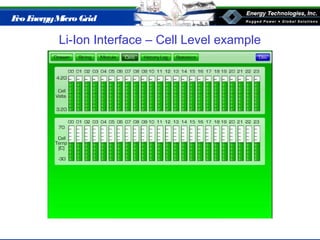
Li-Ion Interface – Cell Level example
Eco EnergyMicro Grid
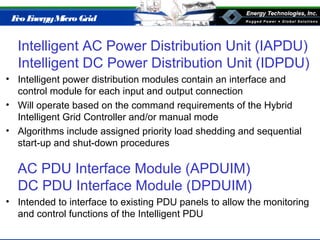
Intelligent AC Power Distribution Unit (IAPDU)
Intelligent DC Power Distribution Unit (IDPDU)
• Intelligent power distribution modules contain an interface and
control module for each input and output connection
• Will operate based on the command requirements of the Hybrid
Intelligent Grid Controller and/or manual mode
• Algorithms include assigned priority load shedding and sequential
start-up and shut-down procedures
AC PDU Interface Module (APDUIM)
DC PDU Interface Module (DPDUIM)
• Intended to interface to existing PDU panels to allow the monitoring
and control functions of the Intelligent PDU
Eco EnergyMicro Grid
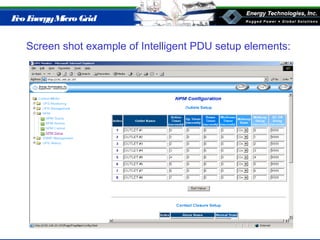
Screen shot example of Intelligent PDU setup elements:
Eco EnergyMicro Grid
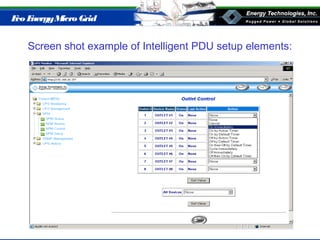
Screen shot example of Intelligent PDU setup elements:
Eco EnergyMicro Grid
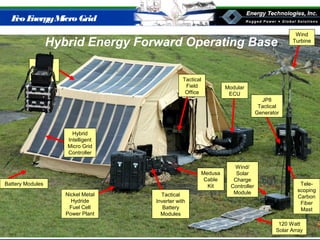
Hybrid Energy Forward Operating Base
Wind/
Solar
Charge
Controller
Module
Wind
Turbine
Shelter
Solar
Array
120 Watt
Solar Array
Tactical
Inverter with
Battery
Modules
Nickel Metal
Hydride
Fuel Cell
Power Plant
Tactical
Field
Office
JP8
Tactical
Generator
Modular
ECU
Medusa
Cable
Kit Tele-
scoping
Carbon
Fiber
Mast
Hybrid
Intelligent
Micro Grid
Controller
Battery Modules
Eco EnergyMicro Grid
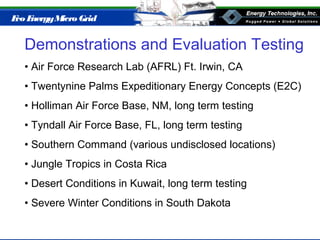
Demonstrations and Evaluation Testing
• Air Force Research Lab (AFRL) Ft. Irwin, CA
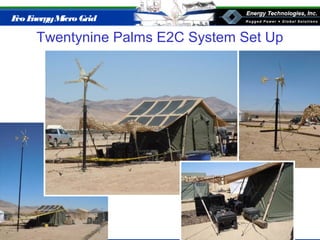
• Twentynine Palms Expeditionary Energy Concepts (E2C)
• Holliman Air Force Base, NM, long term testing
• Tyndall Air Force Base, FL, long term testing
• Southern Command (various undisclosed locations)
• Jungle Tropics in Costa Rica
• Desert Conditions in Kuwait, long term testing
• Severe Winter Conditions in South Dakota
Eco EnergyMicro Grid
Twentynine Palms E2C System Set Up
Eco EnergyMicro Grid
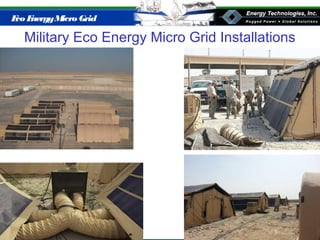
Military Eco Energy Micro Grid Installations
Eco EnergyMicro Grid
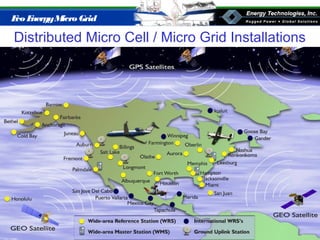
Distributed Micro Cell / Micro Grid Installations
Eco EnergyMicro Grid
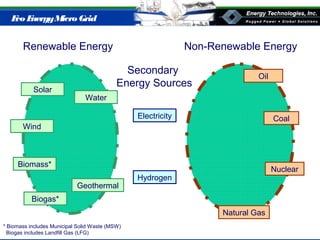
Renewable Energy Non-Renewable Energy
Secondary
Energy Sources
Wind
Geothermal
Water
Biomass*
Solar
Electricity Coal
Hydrogen
Natural Gas
Nuclear
Oil
Biogas*
* Biomass includes Municipal Solid Waste (MSW)
Biogas includes Landfill Gas (LFG)
Eco EnergyMicro Grid
Adding Bio Renewables to a Micro Grid
• Regions covered by Micro Grids generally include organic
waste materials: i.e. municipal and agricultural waste
• The bio waste materials can be converted directly into
hydrogen while reducing landfill requirements
• The EPA now considers landfill gas and digester biogas
as renewable energy sources
• The biogases can be converted directly into hydrogen
while reducing flaring or other methods of eliminating them
• The hydrogen can be sold into the merchant market at a
profit or it can be used in fuel cells to produce electricity
Eco EnergyMicro Grid
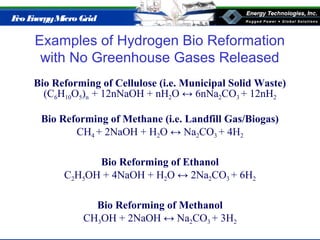
Examples of Hydrogen Bio Reformation
with No Greenhouse Gases Released
Bio Reforming of Cellulose (i.e. Municipal Solid Waste)
(C6H10O5)n + 12nNaOH + nH2O ↔ 6nNa2CO3 + 12nH2
Bio Reforming of Methane (i.e. Landfill Gas/Biogas)
CH4 + 2NaOH + H2O ↔ Na2CO3 + 4H2
Bio Reforming of Ethanol
C2H5OH + 4NaOH + H2O ↔ 2Na2CO3 + 6H2
Bio Reforming of Methanol
CH3OH + 2NaOH ↔ Na2CO3 + 3H2
Eco EnergyMicro Grid
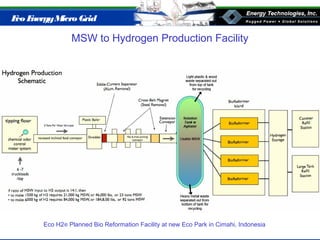
MSW to Hydrogen Production Facility
MSW from
landfill
Eco H2® Planned Bio Reformation Facility at new Eco Park in Cimahi, Indonesia
Eco EnergyMicro Grid
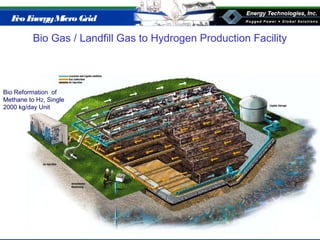
Bio Gas / Landfill Gas to Hydrogen Production Facility
Bio Reformation of
Methane to H2, Single
2000 kg/day Unit
Eco EnergyMicro Grid
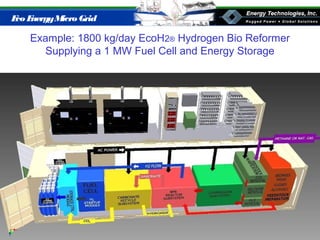
Example: 1800 kg/day EcoH2® Hydrogen Bio Reformer
Supplying a 1 MW Fuel Cell and Energy Storage
Eco EnergyMicro Grid
Conclusions
• Experiences from the military testing can be applied to
other commercial or industrial Micro Grid applications
• Applying the Micro Cell approach to the Micro Grid offers
the ability to expand as needed both regionally or globally
• Introduction of renewable energy sources into a Micro Grid
may add complexity, but can improve overall economics
and reduce the overall carbon footprint
• Utilizing Municipal Solid Waste (MSW) and/or Biogas to
make H2 reduces waste disposal issues while producing
H2 at a lower cost compared to traditional methods
• The H2 produced can be sold at a profit or used to
generate additional power via fuel cells
Eco EnergyMicro Grid
Contact Information
P D Madden, PE, CEO
pdmadden@ruggedsystems.com
T D Lowe, PhD, VP of Sales
tdlowe@ruggedsystems.com
Energy Technologies, Inc.
219 Park Avenue East
Mansfield, OH 44902-1845
1.419.522.4444 Voice
1.419.522.4466 Fax
www.EcoEnergyMicroGrid.com
www.HybridEnergyTechnologies.com

Modular Scalable Micro Grid: ICEPAG 2016 Presentation

  • 1.
  • 2.
    Eco EnergyMicro Grid DOEDefinition: Microgrid: “a group of interconnected loads and distributed energy resources within clearly defined electrical boundaries that act as a single controllable entity with respect to the grid. A microgrid can connect and disconnect from the grid to enable it to operate in both grid-connected or island-mode.”
  • 3.
    Eco EnergyMicro Grid MilitaryMicrogrids: Why the DOD is Leading the Pack “Microgrids can shrink the amount of fossil fuels consumed to create electricity by networking generators as a system to maximize efficiency. Yet, they can also be used to help integrate renewable energy resources (such as wind and solar) at the local distribution grid level.” -Navigant Research
  • 4.
    Eco EnergyMicro Grid EPADefinition: “Renewable energy is electricity generated by fuel sources that restore themselves over a short period of time and do not diminish. Although some renewable energy technologies have an impact on the environment, renewables are considered environmentally preferable to conventional sources and, when replacing fossil fuels, have significant potential to reduce greenhouse gas emissions.”
  • 5.
    Eco EnergyMicro Grid Assumptions: •Electricity is the common energy transfer medium of a Micro Grid. • System of Systems approach allows modular implementation on both legacy and new grids. • Lessons learned from systems developed for Military applications can apply commercially. • Micro Grids typically apply to a defined region, but the control strategies can also apply to a
  • 6.
    Eco EnergyMicro Grid MicroGrid Benefits (Economic): • Reduced fossil fuel use by operating more efficiently • Ability to offset fossil fuels with renewables • Ability to choose lowest cost energy source • Reduced peak demand charges from utility by bringing on additional generation, using stored energy or shaving load • Reduced capacity charges with managed generation • Sell excess energy back to utility • Reduced generator wet-stacking and maintenance • Optimize overall maintenance scheduling with better logs • Reduced troubleshooting time with better real-time data • Reduced manpower with computer monitoring and control
  • 7.
    Eco EnergyMicro Grid MicroGrid Benefits (Other): • Increased overall reliability and stability • Less risk of cascading events • Protection of critical loads • Controlled power quality • Reduced blackout or brownout risk • Reduced greenhouse gas emissions • Reduced single point failures • Ability to modularly integrate new technologies as available
  • 8.
    Eco EnergyMicro Grid Systemof Systems Architecture Based on Modular Micro Cell Design
  • 9.
    Eco EnergyMicro Grid GridPower Intelligent Transfer Switch Unprotected AC Load nAll Module Interface PDU Control Module Unprotected AC Load 1 ECU (Thermostat & Micro-Grid Regulated) Load 1 Vehicle Interface NATO Connector Wind Turbines Solar Panels Battery Modules Load n Intelligent PDU DC to AC Inverter / UPS 1-Phase 3-Phase Conditioned & Battery Backed Power AC to DC Rectifier / Charger Unconditioned AC Power Bus DC Power Bus Generator Control Interface Engine Generators Master Control & Configuration Fuel Cells Modular MicroGrid / MicroCell Design
  • 10.
    Eco EnergyMicro Grid Thesystem is comprised of the following modules: • Master Control & Configuration Display Module (MCCDM) • Hybrid Intelligent Micro Grid Controller (HIGC) • Generator Interface/Control Module (GIFC) • Intelligent AC Transfer Switch Module (ITSM) • Solar DC Charge Control Module (SCCM) • Wind Generator DC Charge Control Module (WCCM)
  • 11.
    Eco EnergyMicro Grid Thesystem is comprised of the following modules: (continued) • NATO Vehicle Interface Charge Controller Module (VCCM) • Energy Storage Module & Controller (ESMC) Li-Ion Based • Intelligent AC & DC Power Distribution Unit (IAPDU & IDPDU) • AC & DC PDU Interface Module (APDUIM & DPDUIM) • DC to AC Inverter Module 1-Phase (IMSP) & 3-Phase (IMTP) • AC to DC Charger Module (ADCM)
  • 12.
    Eco EnergyMicro Grid MasterControl & Configuration Display Module (MCCDM) • Main interface to the system • Laptop computer or a computer server depending on system size. • Menu based human interface and configuration data management. • Allows specific configurations for power generation, load balancing, automated module fault restoration and system optimization. • Data element modules contain and support multi-level configuration access protection. This module has three basic functions: 1.Configuration set up 2.Monitoring 3.Performance and data gathering
  • 13.
    Eco EnergyMicro Grid MicroGrid Computer System Software Architecture
  • 14.
    Eco EnergyMicro Grid N2Chart with Micro Grid States and Modes
  • 15.
    Eco EnergyMicro Grid HybridIntelligent Grid Controller (HIGC) • Master controller of the configured system or sub-system, depending on system size and complexity • Modular and can be configured for various power ratings based on application • Module takes the input power resource and distributes and controls as configured without any dependence on additional controller modules • Interface to support setting up a configuration via a portable device when the master control and configuration display module is not configured in small applications • Default configuration/operations reside in this module for all battle short algorithmic functions and actions
  • 16.
    Eco EnergyMicro Grid GeneratorInterface/Control Module (GIFC) • Configured to allow interface to a wide range of generators • Interprets the system commands to the control functions of the generator for starting, paralleling and status functions • Capability to monitor consumables such as fuel and oil levels • Module will take and execute all commands from the HIGC based on the configuration settings and shut down requirements as defined by the algorithmic functions of the system • Interface module will also contain a fall back or battle short capability as these modules will be located on the generator and may not necessarily be located close to the HIGC
  • 17.
    Eco EnergyMicro Grid IntelligentAC Transfer Switch Module (ITSM) • The Intelligent Transfer Switch Module interfaces to power generating sources and is configured in a fall back configuration that will allow the power to be distributed to the AC support bus • ITSM has an intelligent interface that will operate based on the command requirements of the Hybrid Intelligent Grid Controller • Upon loss of generating power, the HIGC can command the ITSM to disconnect from the generator and connect battery supplied inverters to the AC bus allowing continued operation of critical loads • ITSM can support a local grid power sources and switch to the grid power to the AC support bus
  • 18.
    Eco EnergyMicro Grid EnergyStorage Module & Controller (ESMC) Li-Ion Based • 3X the power density of standard lead acid batteries • 1/3 the weight of standard batteries • Individual modules have Intelligent Software Monitoring and Control • Interfaces with Hybrid Intelligent MicroGrid Controller
  • 19.
    Eco EnergyMicro Grid Li-IonInterface – String Level example
  • 20.
    Eco EnergyMicro Grid Li-IonInterface – Cell Level example
  • 21.
    Eco EnergyMicro Grid IntelligentAC Power Distribution Unit (IAPDU) Intelligent DC Power Distribution Unit (IDPDU) • Intelligent power distribution modules contain an interface and control module for each input and output connection • Will operate based on the command requirements of the Hybrid Intelligent Grid Controller and/or manual mode • Algorithms include assigned priority load shedding and sequential start-up and shut-down procedures AC PDU Interface Module (APDUIM) DC PDU Interface Module (DPDUIM) • Intended to interface to existing PDU panels to allow the monitoring and control functions of the Intelligent PDU
  • 22.
    Eco EnergyMicro Grid Screenshot example of Intelligent PDU setup elements:
  • 23.
    Eco EnergyMicro Grid Screenshot example of Intelligent PDU setup elements:
  • 24.
    Eco EnergyMicro Grid HybridEnergy Forward Operating Base Wind/ Solar Charge Controller Module Wind Turbine Shelter Solar Array 120 Watt Solar Array Tactical Inverter with Battery Modules Nickel Metal Hydride Fuel Cell Power Plant Tactical Field Office JP8 Tactical Generator Modular ECU Medusa Cable Kit Tele- scoping Carbon Fiber Mast Hybrid Intelligent Micro Grid Controller Battery Modules
  • 25.
    Eco EnergyMicro Grid Demonstrationsand Evaluation Testing • Air Force Research Lab (AFRL) Ft. Irwin, CA • Twentynine Palms Expeditionary Energy Concepts (E2C) • Holliman Air Force Base, NM, long term testing • Tyndall Air Force Base, FL, long term testing • Southern Command (various undisclosed locations) • Jungle Tropics in Costa Rica • Desert Conditions in Kuwait, long term testing • Severe Winter Conditions in South Dakota
  • 26.
    Eco EnergyMicro Grid TwentyninePalms E2C System Set Up
  • 27.
    Eco EnergyMicro Grid MilitaryEco Energy Micro Grid Installations
  • 28.
    Eco EnergyMicro Grid DistributedMicro Cell / Micro Grid Installations
  • 29.
    Eco EnergyMicro Grid RenewableEnergy Non-Renewable Energy Secondary Energy Sources Wind Geothermal Water Biomass* Solar Electricity Coal Hydrogen Natural Gas Nuclear Oil Biogas* * Biomass includes Municipal Solid Waste (MSW) Biogas includes Landfill Gas (LFG)
  • 30.
    Eco EnergyMicro Grid AddingBio Renewables to a Micro Grid • Regions covered by Micro Grids generally include organic waste materials: i.e. municipal and agricultural waste • The bio waste materials can be converted directly into hydrogen while reducing landfill requirements • The EPA now considers landfill gas and digester biogas as renewable energy sources • The biogases can be converted directly into hydrogen while reducing flaring or other methods of eliminating them • The hydrogen can be sold into the merchant market at a profit or it can be used in fuel cells to produce electricity
  • 31.
    Eco EnergyMicro Grid Examplesof Hydrogen Bio Reformation with No Greenhouse Gases Released Bio Reforming of Cellulose (i.e. Municipal Solid Waste) (C6H10O5)n + 12nNaOH + nH2O ↔ 6nNa2CO3 + 12nH2 Bio Reforming of Methane (i.e. Landfill Gas/Biogas) CH4 + 2NaOH + H2O ↔ Na2CO3 + 4H2 Bio Reforming of Ethanol C2H5OH + 4NaOH + H2O ↔ 2Na2CO3 + 6H2 Bio Reforming of Methanol CH3OH + 2NaOH ↔ Na2CO3 + 3H2
  • 32.
    Eco EnergyMicro Grid MSWto Hydrogen Production Facility MSW from landfill Eco H2® Planned Bio Reformation Facility at new Eco Park in Cimahi, Indonesia
  • 33.
    Eco EnergyMicro Grid BioGas / Landfill Gas to Hydrogen Production Facility Bio Reformation of Methane to H2, Single 2000 kg/day Unit
  • 34.
    Eco EnergyMicro Grid Example:1800 kg/day EcoH2® Hydrogen Bio Reformer Supplying a 1 MW Fuel Cell and Energy Storage
  • 35.
    Eco EnergyMicro Grid Conclusions •Experiences from the military testing can be applied to other commercial or industrial Micro Grid applications • Applying the Micro Cell approach to the Micro Grid offers the ability to expand as needed both regionally or globally • Introduction of renewable energy sources into a Micro Grid may add complexity, but can improve overall economics and reduce the overall carbon footprint • Utilizing Municipal Solid Waste (MSW) and/or Biogas to make H2 reduces waste disposal issues while producing H2 at a lower cost compared to traditional methods • The H2 produced can be sold at a profit or used to generate additional power via fuel cells
  • 36.
    Eco EnergyMicro Grid ContactInformation P D Madden, PE, CEO pdmadden@ruggedsystems.com T D Lowe, PhD, VP of Sales tdlowe@ruggedsystems.com Energy Technologies, Inc. 219 Park Avenue East Mansfield, OH 44902-1845 1.419.522.4444 Voice 1.419.522.4466 Fax www.EcoEnergyMicroGrid.com www.HybridEnergyTechnologies.com