

Presentation on
DC Microgrid
of
Master of Technology
in
Power System Engineering
By:
PRABHAT KUMAR
Reg. No.-2021PGEEPS13
Under the Guidance of:
Prof. NIRANJAN KUMAR
(Assistant Professor)
NIT JAMSHEDPUR
DEPARTMENT OF ELECTRICAL ENGINEERING
Outline:
 Introduction to DC Microgrid
 Components of Microgrid
 Operating Modes of Microgrid
 Need of Microgrid
 Environmental Aspects
 Conventional grid vs. Microgrid
 Advantages of Microgrid
 Disadvantages of Microgrid
Introduction to DC Microgrid:
 What is Microgrid ?
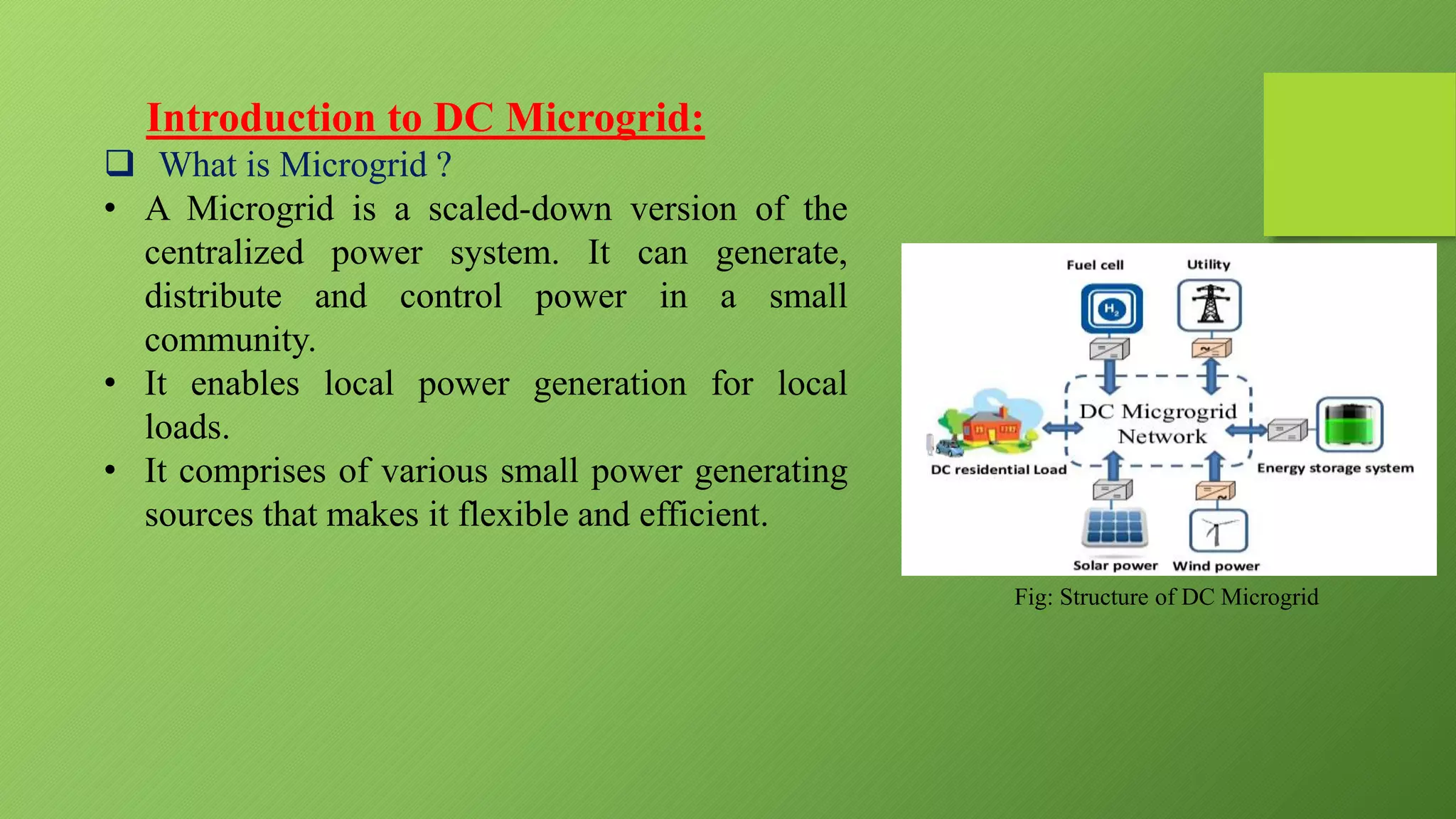
• A Microgrid is a scaled-down version of the
centralized power system. It can generate,
distribute and control power in a small
community.
• It enables local power generation for local
loads.
• It comprises of various small power generating
sources that makes it flexible and efficient.
Fig: Structure of DC Microgrid
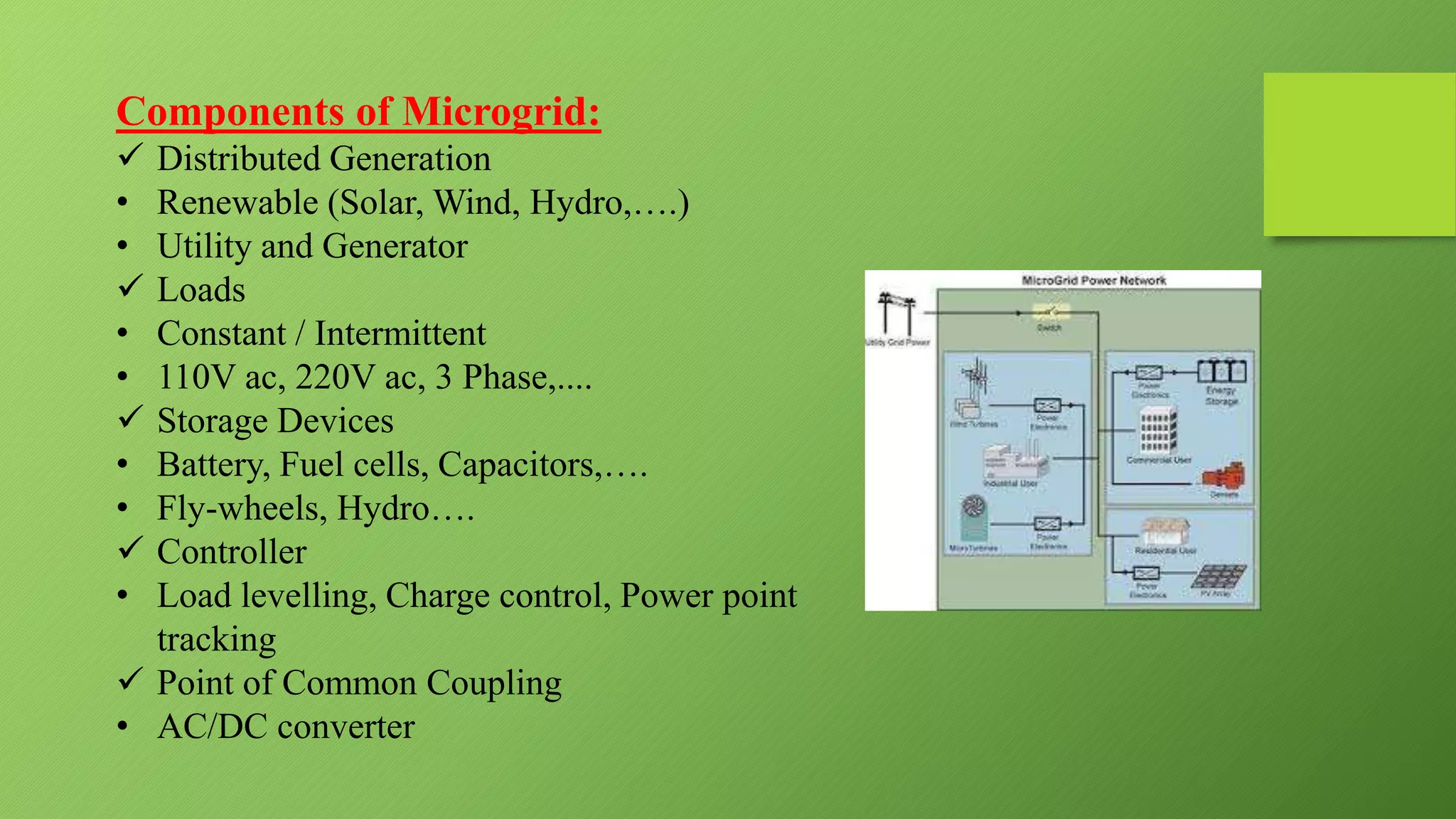
Components of Microgrid:
 Distributed Generation
• Renewable (Solar, Wind, Hydro,….)
• Utility and Generator
 Loads
• Constant / Intermittent
• 110V ac, 220V ac, 3 Phase,....
 Storage Devices
• Battery, Fuel cells, Capacitors,….
• Fly-wheels, Hydro….
 Controller
• Load levelling, Charge control, Power point
tracking
 Point of Common Coupling
• AC/DC converter
Operating Modes Microgrid:
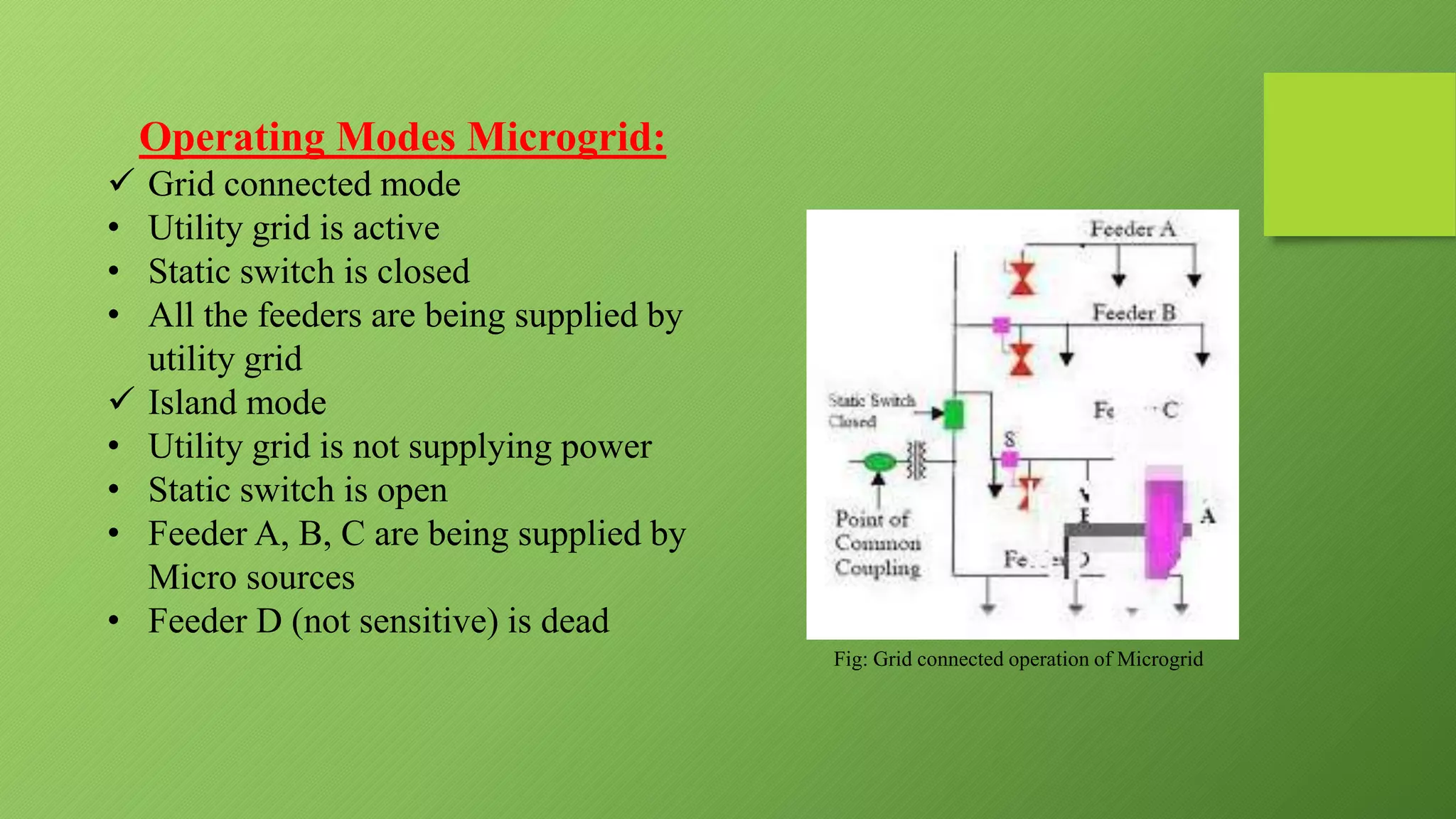
 Grid connected mode
• Utility grid is active
• Static switch is closed
• All the feeders are being supplied by
utility grid
 Island mode
• Utility grid is not supplying power
• Static switch is open
• Feeder A, B, C are being supplied by
Micro sources
• Feeder D (not sensitive) is dead
Fig: Grid connected operation of Microgrid
Need Of Microgrid:
• Microgrid could be the assistance during energy crisis.
• It is flexible.
• The composition of Microgrid is diverse.
• It has the property of Controllability, Interactivity and
Independence.
• Microgrid enhance local resiliency and improve the
operation and stability of the regional electric grid.
• Microgrid does not only provide backup support but
also minimize the power cost.
• It is eco-friendly to our environment.
Interconnected Microgrids:
 Interconnected Microgrids - Power parks
• Practical size of Microgrids is limited to a few MVA.
• For larger loads, it is desirable to interconnect many
Microgrids to form a larger Microgrid network called
power parks.
• The advantage of this Microgrid structure insures
greater stability and controllability for the power
parks.
Environmental Aspects:
• Microgrid encourages the use of Renewable sources.
• Large land use impacts are avoided.
• CO2 Emissions are reduced.
• Microgrids offer the opportunity to deploy more
zero-emission electricity sources, thereby reducing
greenhouse gas emission.
Conventional Grid Vs. Microgrid
• Efficiency of Conventional Microgrid is very
less as compared to Microgrid.
• Large amount of energy in the form of heat is
wasted in conventional grid which is absent in
Microgrid.
• Power sources in case of Microgrid (often
referred to as Micro sources) are small and are
located in close proximity to load.
Advantages of Microgrid:
 Microgrid provides backup for the grids in case of
emergencies.
 Provides efficient, low-cost, clean energy.
 Reduce grid “congestion” and peak loads.
 Improve the operation and stability of the regional
electric grid.
 A Microgrid improves Electric Reliability.
 A Microgrid enhances resilience.
Drawbacks of Microgrid:
 Electrical needs to be stored in Batteries which
require space and maintenance.
 Re-synchronization with the main grid can be a
problem.
 Issues such as standby charges as well as net
metering are obstacles for microgrids.
Future References on Microgrid Research:
 Transition between grid connected and islanded
modes on interaction phenomenon between
distribution generation and high penetration of
distributed generation.
 Transformation of Microgrid system today into the
intelligent, robust energy delivery system in the
future by providing significant reliability and
security benefits.
 To investigate full scale development, field
demonstration experimental performance evaluation
of frequency and voltage control methods under
various operation modes.
THANKS

Presentation on DC Microgrid protection.pptx

  • 1.
    Presentation on DC Microgrid of Masterof Technology in Power System Engineering By: PRABHAT KUMAR Reg. No.-2021PGEEPS13 Under the Guidance of: Prof. NIRANJAN KUMAR (Assistant Professor) NIT JAMSHEDPUR DEPARTMENT OF ELECTRICAL ENGINEERING
  • 2.
    Outline:  Introduction toDC Microgrid  Components of Microgrid  Operating Modes of Microgrid  Need of Microgrid  Environmental Aspects  Conventional grid vs. Microgrid  Advantages of Microgrid  Disadvantages of Microgrid
  • 3.
    Introduction to DCMicrogrid:  What is Microgrid ? • A Microgrid is a scaled-down version of the centralized power system. It can generate, distribute and control power in a small community. • It enables local power generation for local loads. • It comprises of various small power generating sources that makes it flexible and efficient. Fig: Structure of DC Microgrid
  • 4.
    Components of Microgrid: Distributed Generation • Renewable (Solar, Wind, Hydro,….) • Utility and Generator  Loads • Constant / Intermittent • 110V ac, 220V ac, 3 Phase,....  Storage Devices • Battery, Fuel cells, Capacitors,…. • Fly-wheels, Hydro….  Controller • Load levelling, Charge control, Power point tracking  Point of Common Coupling • AC/DC converter
  • 5.
    Operating Modes Microgrid: Grid connected mode • Utility grid is active • Static switch is closed • All the feeders are being supplied by utility grid  Island mode • Utility grid is not supplying power • Static switch is open • Feeder A, B, C are being supplied by Micro sources • Feeder D (not sensitive) is dead Fig: Grid connected operation of Microgrid
  • 6.
    Need Of Microgrid: •Microgrid could be the assistance during energy crisis. • It is flexible. • The composition of Microgrid is diverse. • It has the property of Controllability, Interactivity and Independence. • Microgrid enhance local resiliency and improve the operation and stability of the regional electric grid. • Microgrid does not only provide backup support but also minimize the power cost. • It is eco-friendly to our environment.
  • 7.
    Interconnected Microgrids:  InterconnectedMicrogrids - Power parks • Practical size of Microgrids is limited to a few MVA. • For larger loads, it is desirable to interconnect many Microgrids to form a larger Microgrid network called power parks. • The advantage of this Microgrid structure insures greater stability and controllability for the power parks.
  • 8.
    Environmental Aspects: • Microgridencourages the use of Renewable sources. • Large land use impacts are avoided. • CO2 Emissions are reduced. • Microgrids offer the opportunity to deploy more zero-emission electricity sources, thereby reducing greenhouse gas emission.
  • 9.
    Conventional Grid Vs.Microgrid • Efficiency of Conventional Microgrid is very less as compared to Microgrid. • Large amount of energy in the form of heat is wasted in conventional grid which is absent in Microgrid. • Power sources in case of Microgrid (often referred to as Micro sources) are small and are located in close proximity to load.
  • 10.
    Advantages of Microgrid: Microgrid provides backup for the grids in case of emergencies.  Provides efficient, low-cost, clean energy.  Reduce grid “congestion” and peak loads.  Improve the operation and stability of the regional electric grid.  A Microgrid improves Electric Reliability.  A Microgrid enhances resilience.
  • 11.
    Drawbacks of Microgrid: Electrical needs to be stored in Batteries which require space and maintenance.  Re-synchronization with the main grid can be a problem.  Issues such as standby charges as well as net metering are obstacles for microgrids.
  • 12.
    Future References onMicrogrid Research:  Transition between grid connected and islanded modes on interaction phenomenon between distribution generation and high penetration of distributed generation.  Transformation of Microgrid system today into the intelligent, robust energy delivery system in the future by providing significant reliability and security benefits.  To investigate full scale development, field demonstration experimental performance evaluation of frequency and voltage control methods under various operation modes.
  • 13.